Tag: Vocabulary Builder

  • 🌳 The Daily Shield: The Law of Rooted Character

    🌳 The Daily Shield: The Law of Rooted Character

    “The apple doesn’t fall far from the tree.”


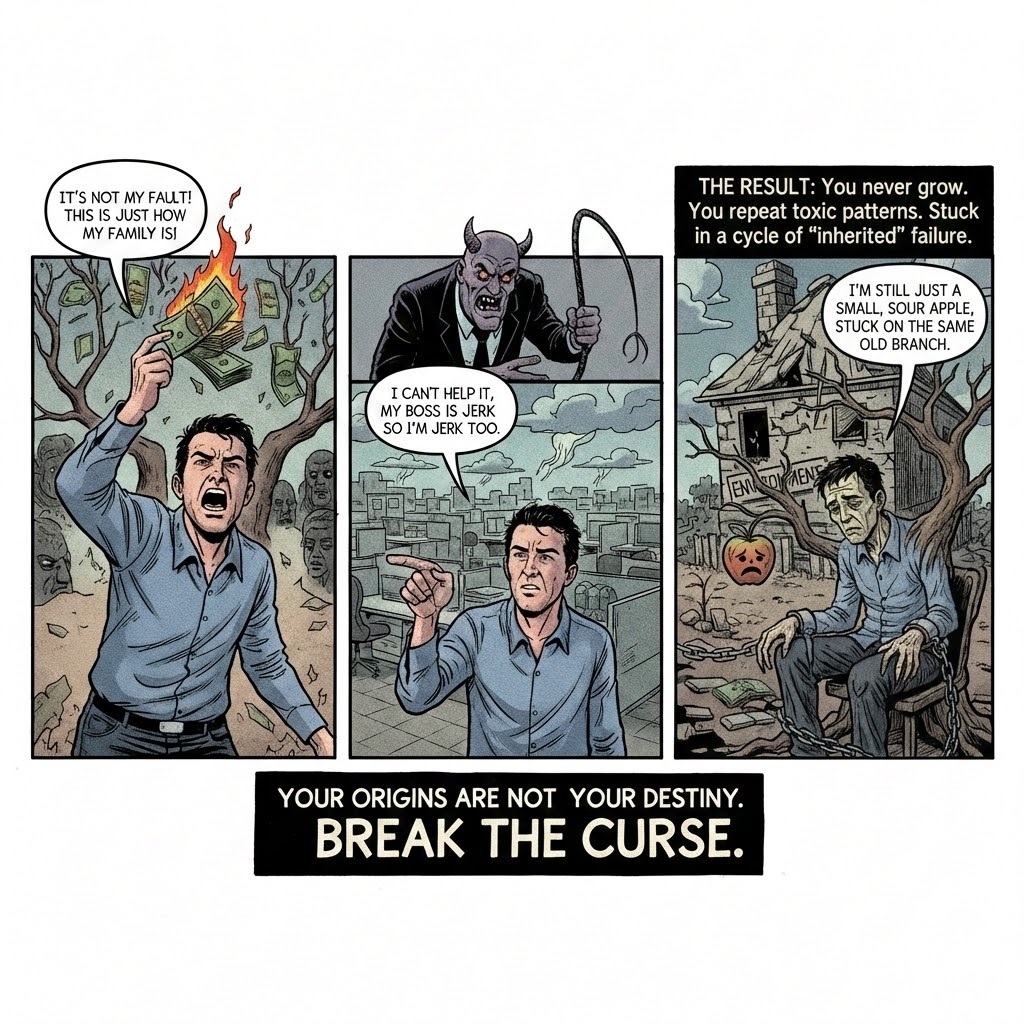
    😈 The Villain (The Blame Shifter)


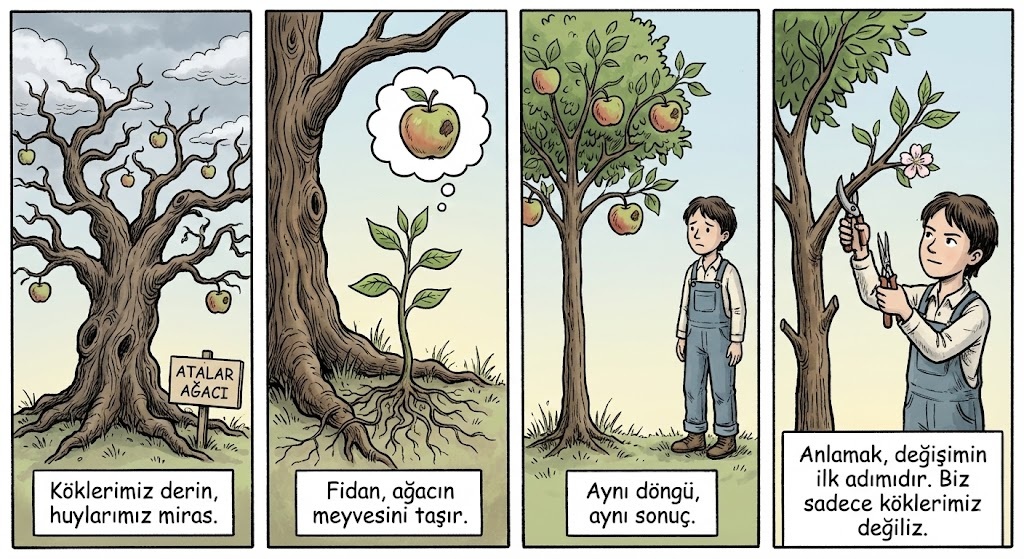
    You make a mistake. You lose your temper. You act dishonestly. 💸 “It’s not my fault! This is just how my family is!””I can’t help it, my boss is a jerk so I’m a jerk too.””I was raised this way, I’m just a product of my environment.” You treat your character like a fixed curse. You use your origins as an excuse for your poor choices today.
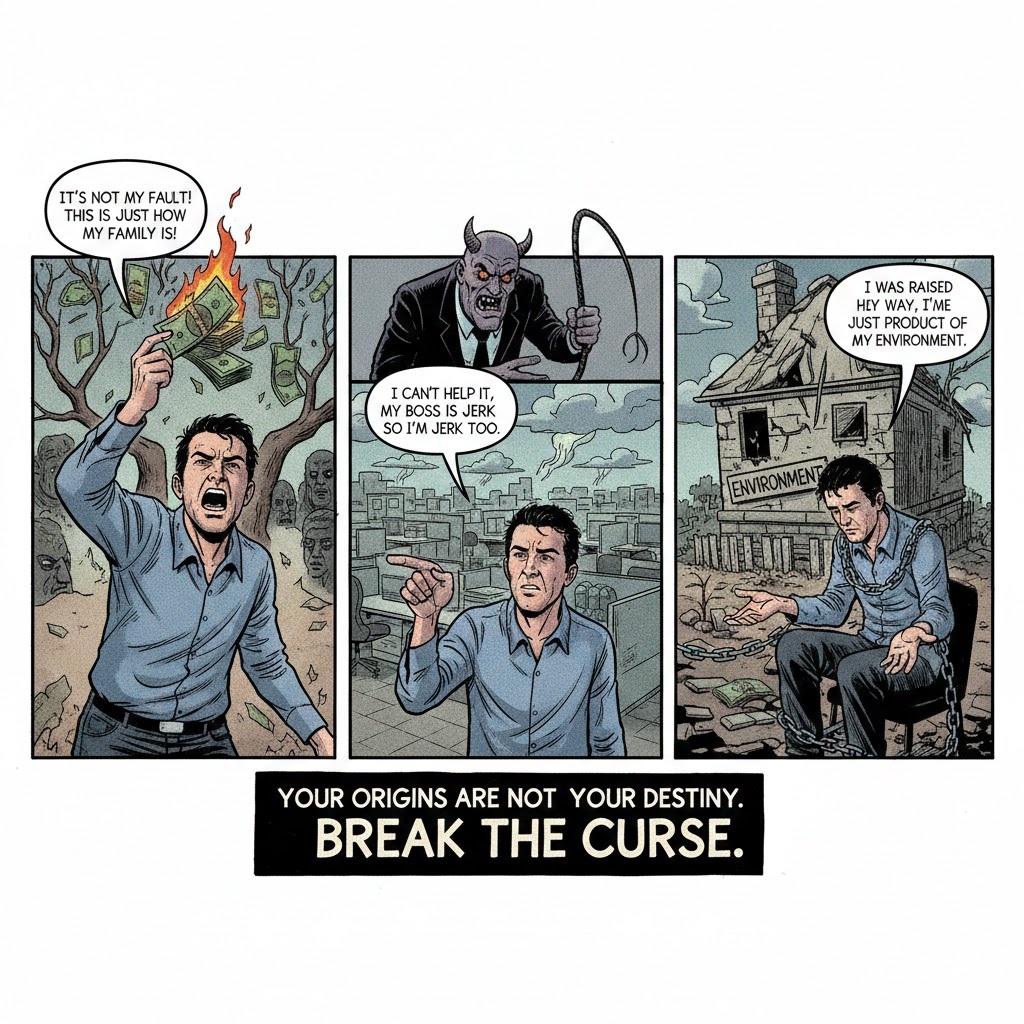
    The Result? You never grow. You repeat the same toxic patterns. You feel stuck in a cycle of “inherited” failure. You stay a small, sour apple because you refuse to see that you are still attached to the same old branch. 🍎

    😇 The Hero (The Cycle Breaker)


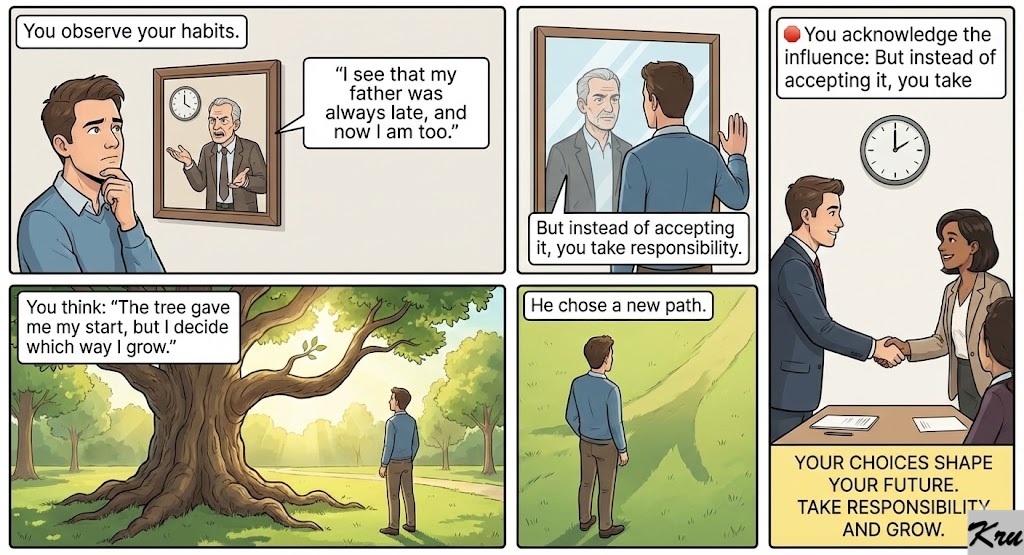
    You observe your habits. You look at your parents, your mentors, or your peers. 🛑 You acknowledge the influence: “I see that my father was always late, and now I am too.” But instead of accepting it, you take responsibility. You think: “The tree gave me my start, but I decide which way I grow.”
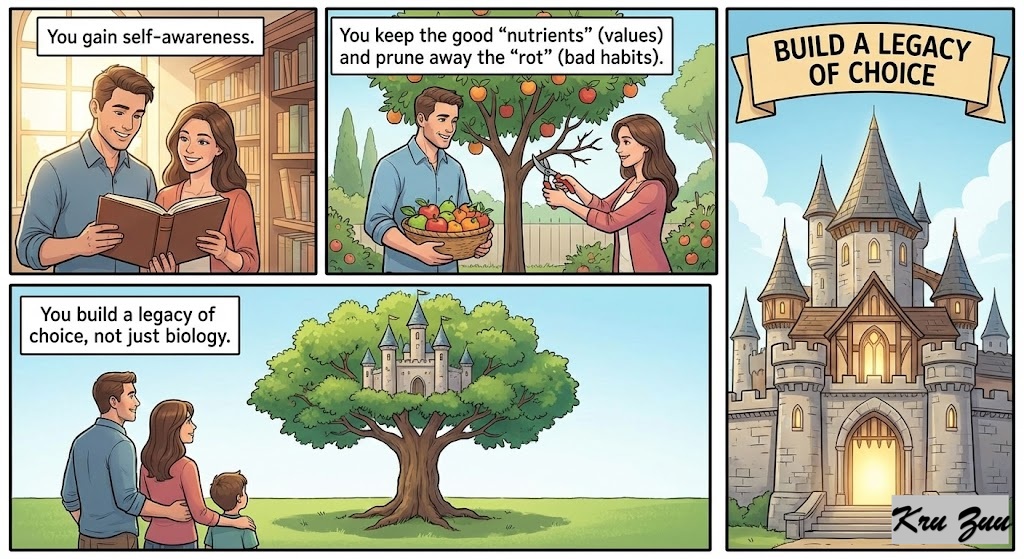
    The Result? You gain self-awareness. You keep the good “nutrients” (values) and prune away the “rot” (bad habits). You build a legacy of choice, not just biology. 🏰

    ⚖️ The Reality


    Nature vs. Nurture. We are heavily influenced by our roots. Whether it’s our parents’ work ethic or our best friends’ vocabulary, we tend to mimic what we are near. Characteristics, like apples, stay close to the source. But while the proverb highlights similarity, it also serves as a warning: if you want to be a different kind of fruit, you have to be conscious of the tree you are hanging from.
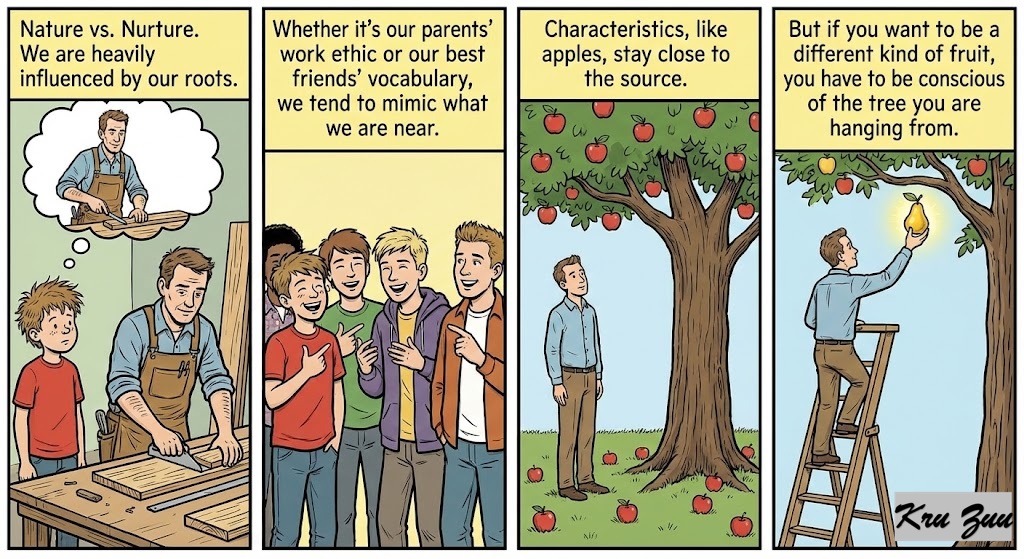

    The Secret: You are the average of the people you spend the most time with. If you don’t like the apple you’ve become, look at your tree.
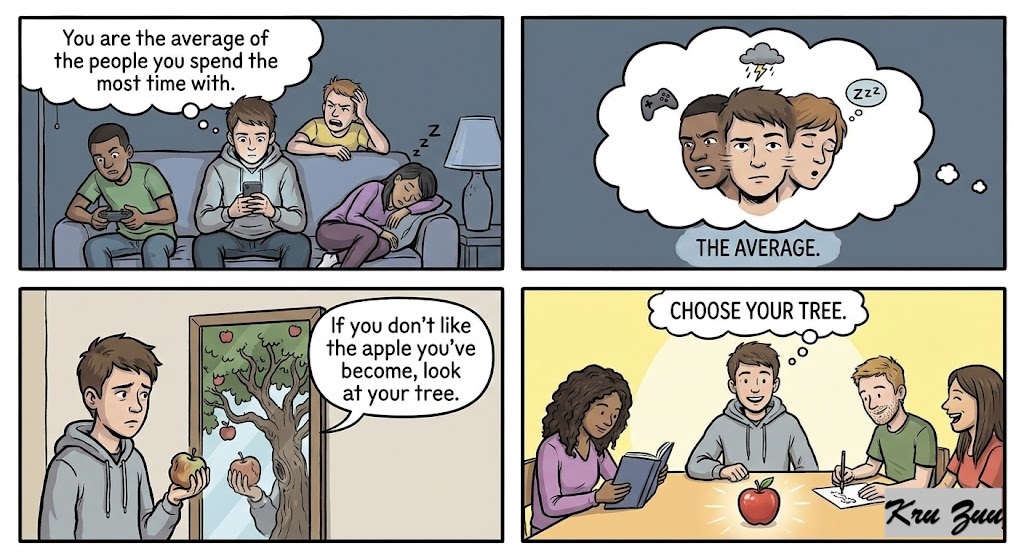
    🧐 The Anatomy of the Proverb


    This is a biological metaphor for behavioral inheritance.

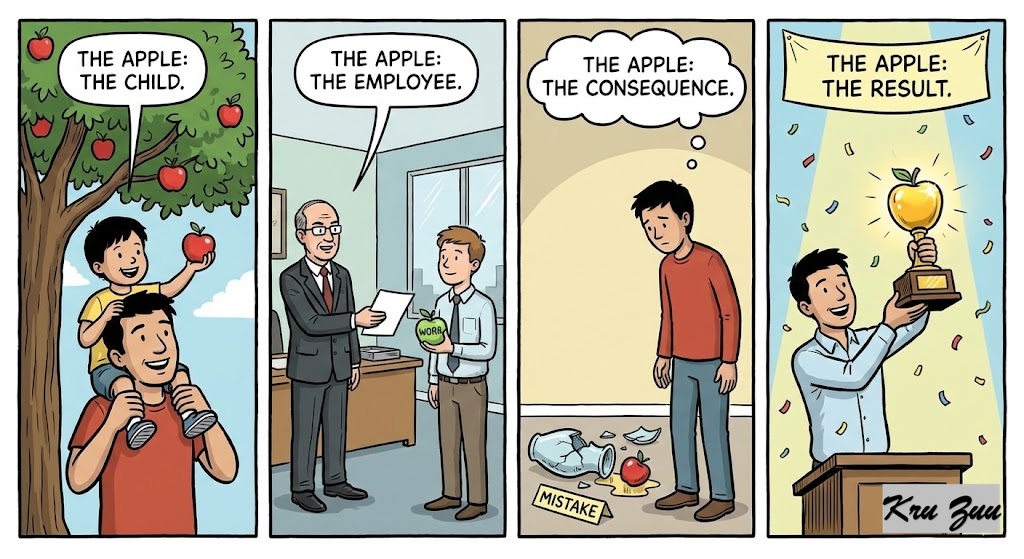
    The Apple (Noun): The child, the employee, the consequence, or the result.

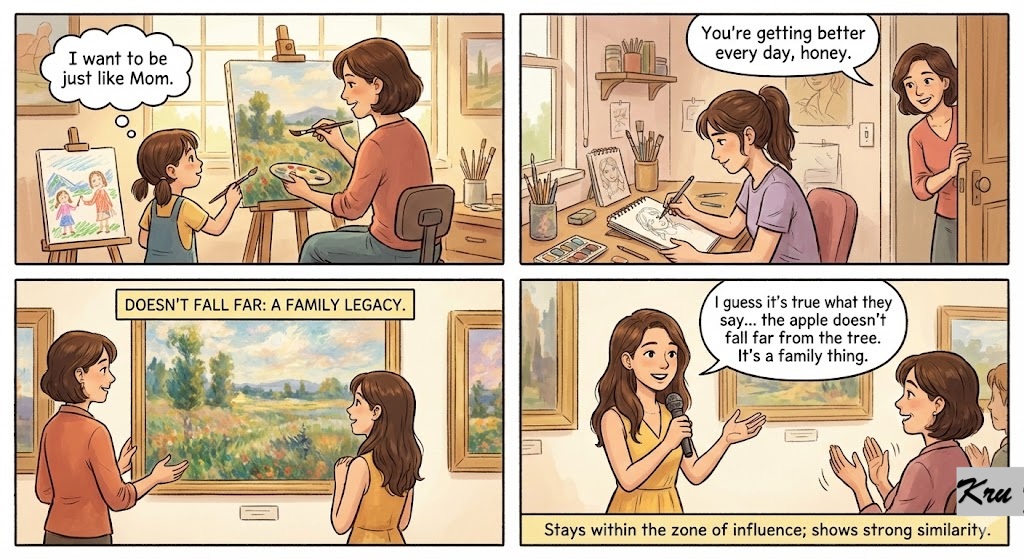
    Doesn’t Fall Far (Adverbial Phrase): Stays within the zone of influence; shows strong similarity.

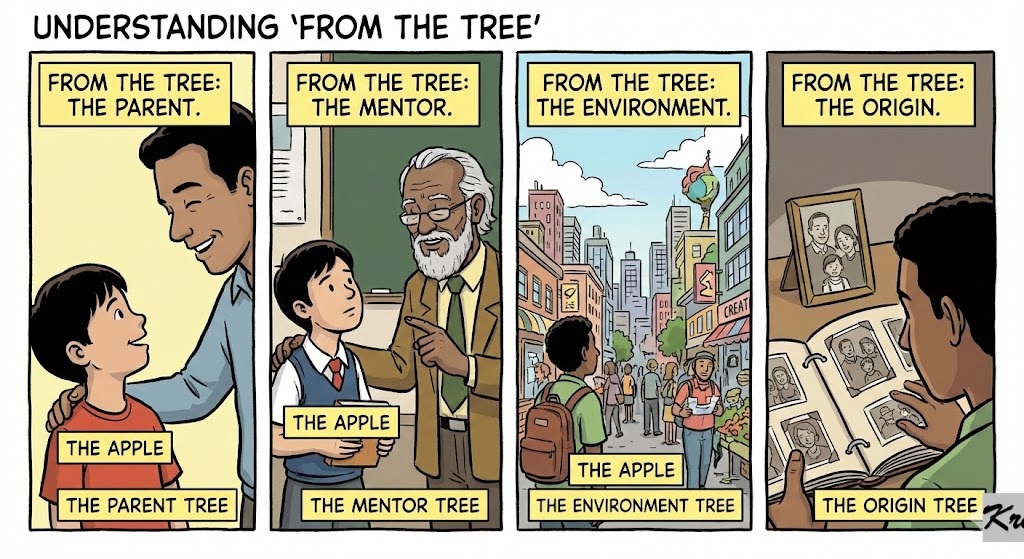
    From The Tree (Prepositional Phrase): The parent, the mentor, the environment, or the origin.

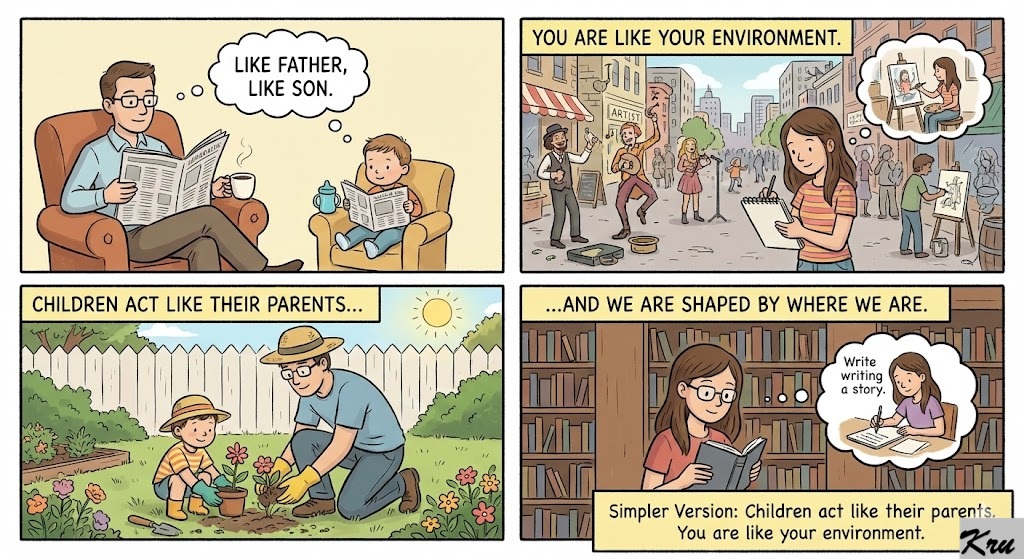
    Simpler Version: Children act like their parents. / You are like your environment.

    📚 Vocabulary Vault


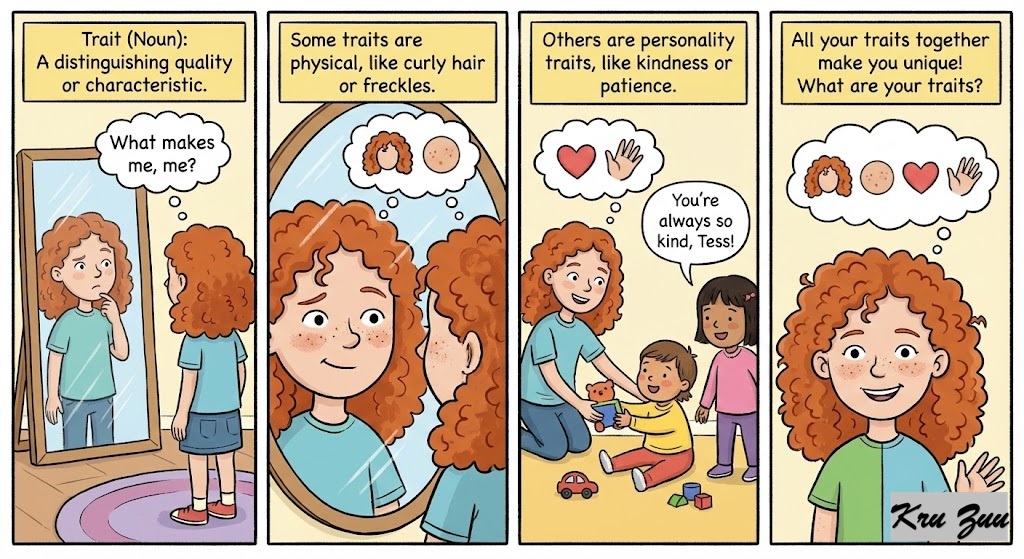
    Trait (Noun): A distinguishing quality or characteristic.

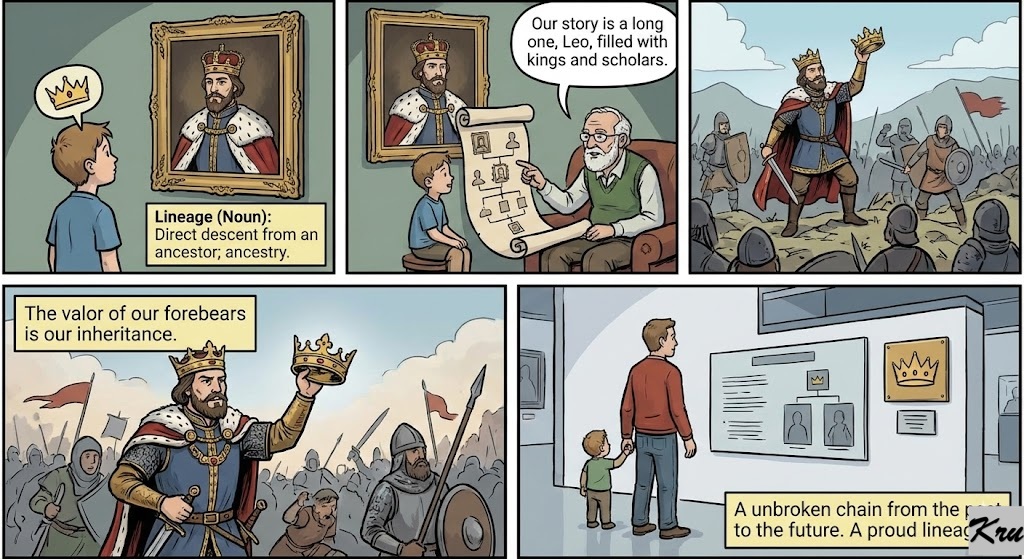
    Lineage (Noun): Direct descent from an ancestor; ancestry. 👑

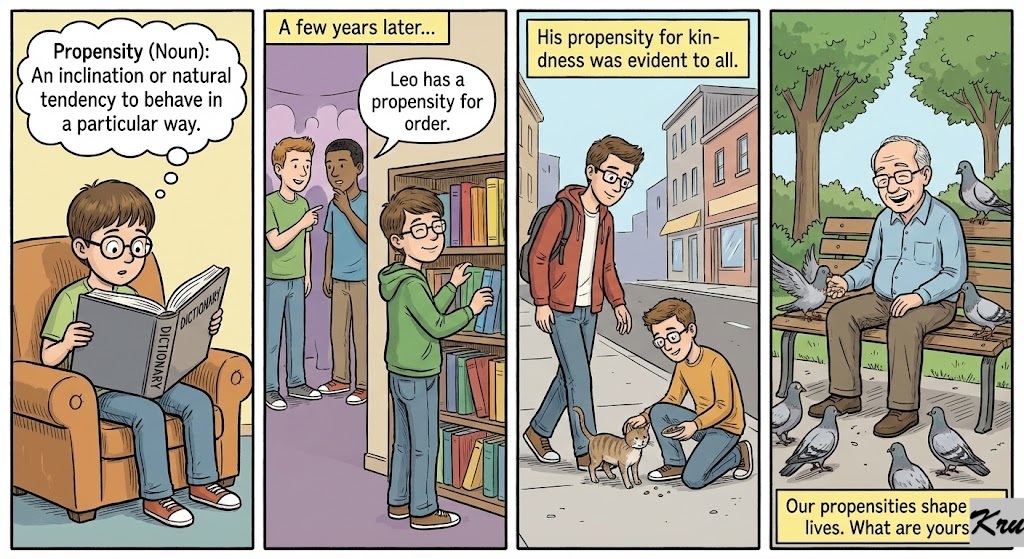
    Propensity (Noun): An inclination or natural tendency to behave in a particular way.

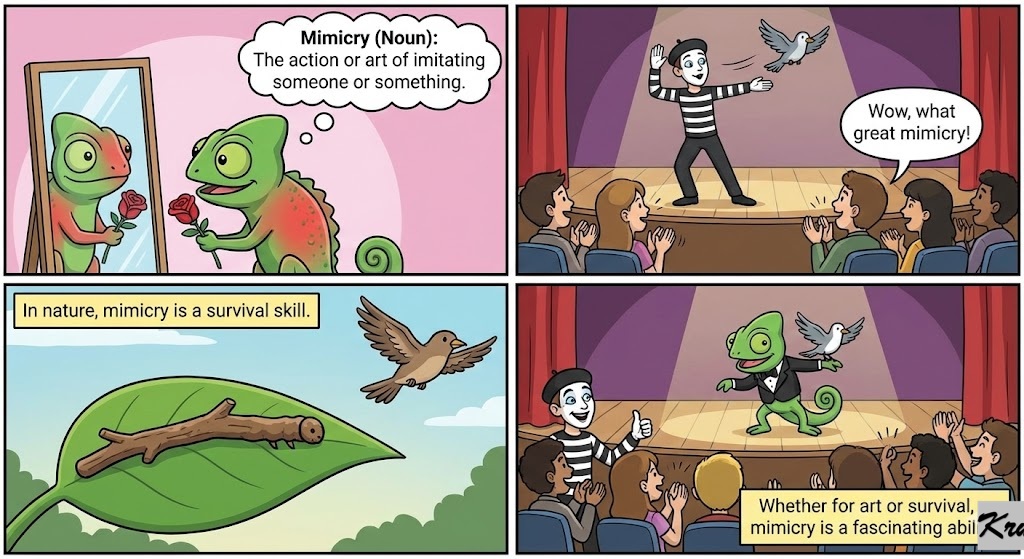
    Mimicry (Noun): The action or art of imitating someone or something.

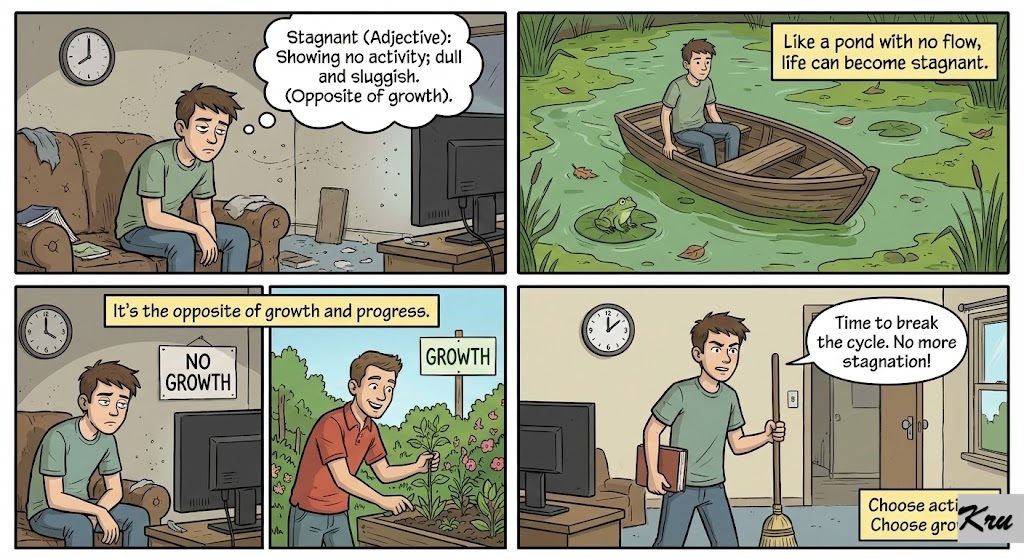
    Stagnant (Adjective): Showing no activity; dull and sluggish. (Opposite of growth).

    🧠 Grammar Focus: Idioms for Observation


    We use this idiom to explain why someone behaves a certain way based on their background.
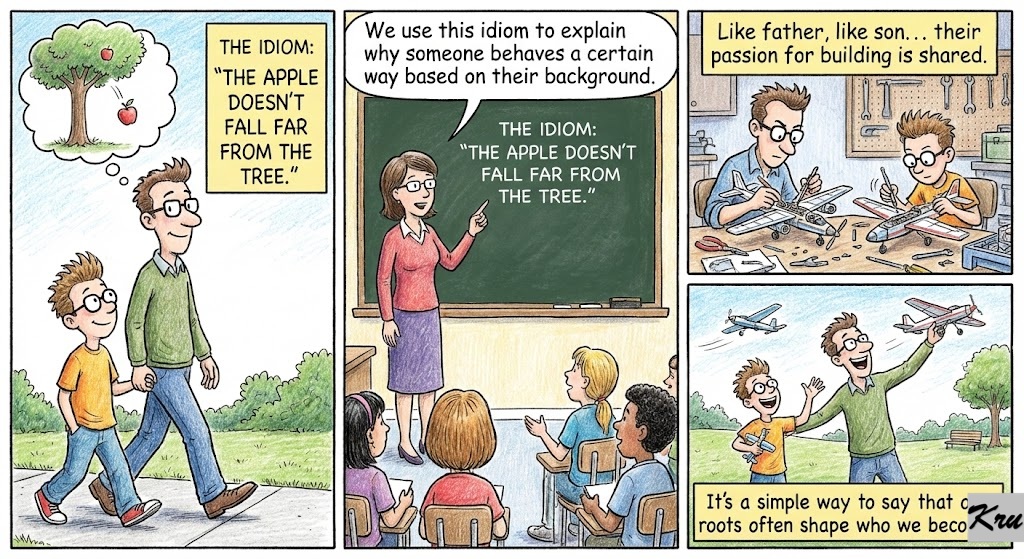

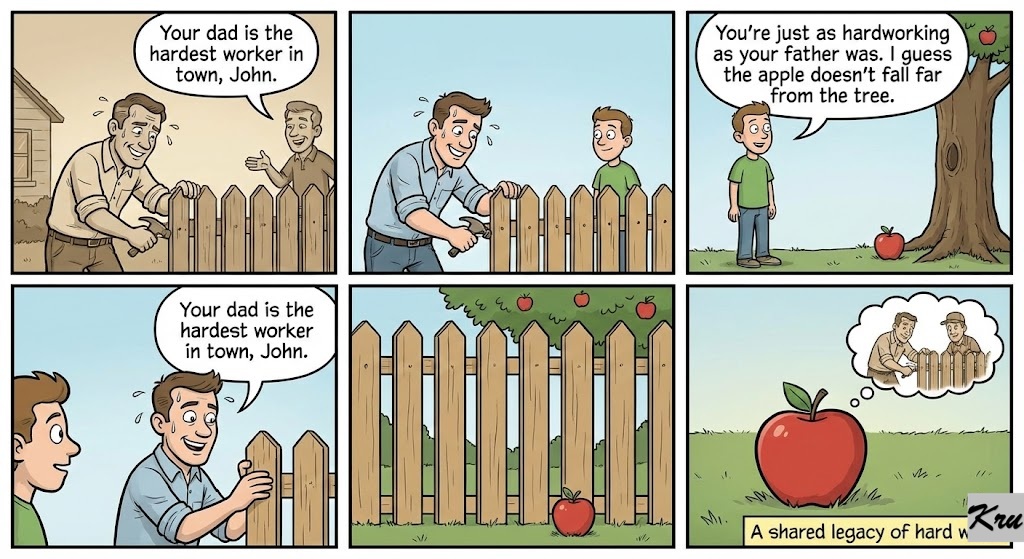
    Example: “John is just as hardworking as his father was. I guess the apple doesn’t fall far from the tree.”

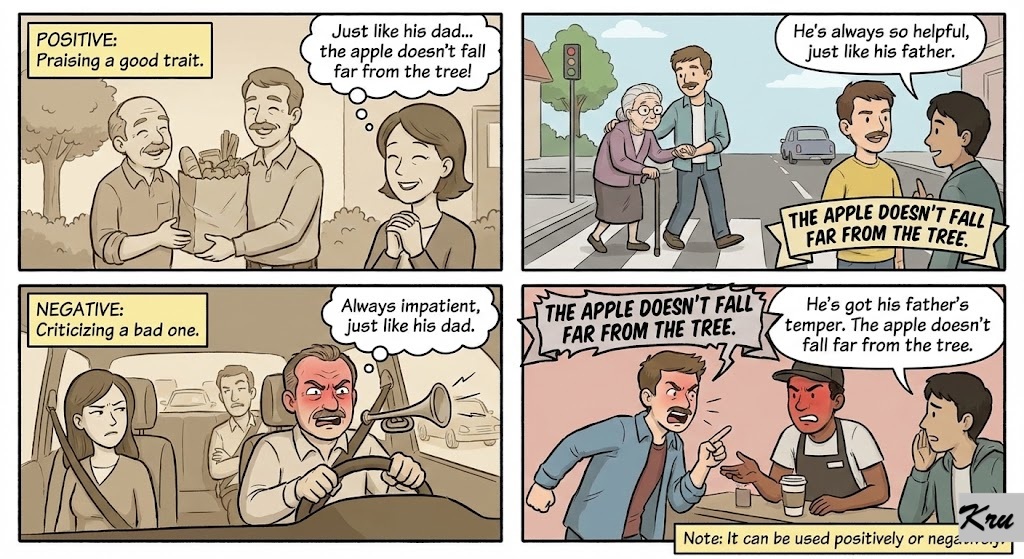
    Note: It can be used positively (praising a good trait) or negatively (criticizing a bad one).
    📜 History: Origin and Spread


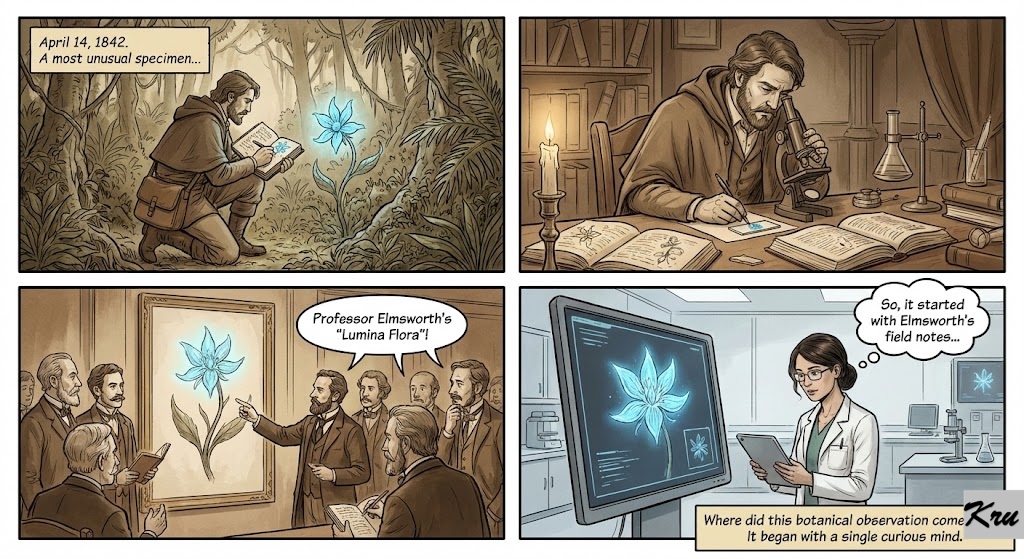
    Where did this botanical observation come from?

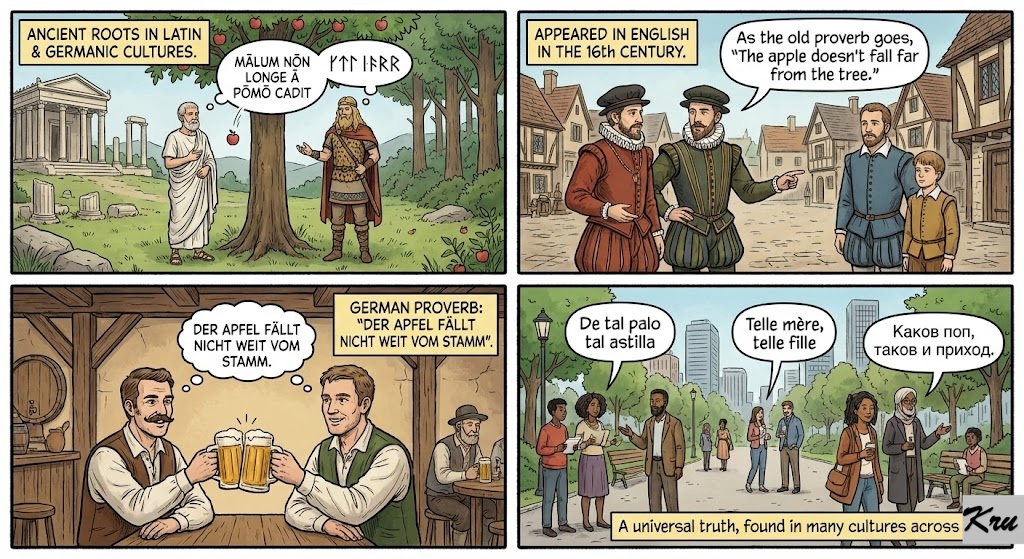
    The Origin: This is an ancient proverb found in many cultures. It appeared in English in the 16th century but has roots in German (Der Apfel fällt nicht weit vom Stamm) and Latin.

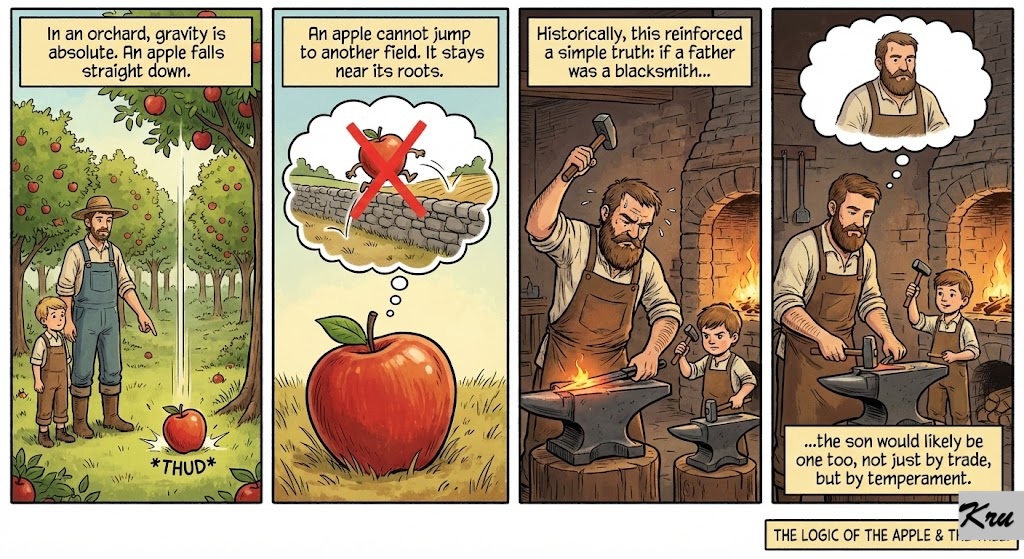
    The Logic: In an orchard, gravity is absolute. An apple cannot jump to another field. Historically, it reinforced the idea that if a father was a blacksmith, the son would likely be one too, not just by trade, but by temperament.

    Global Cousins


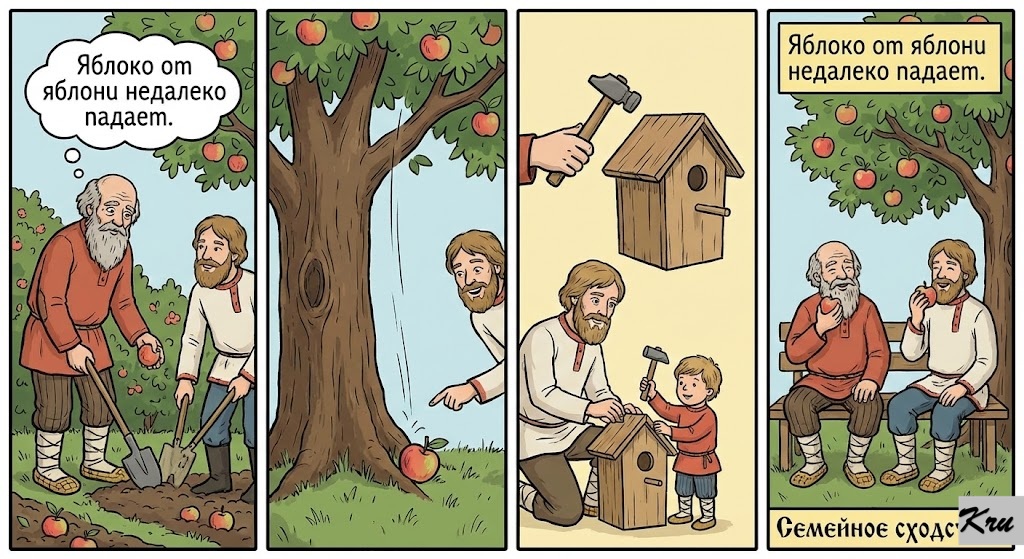
    🇷🇺 Russian: “The apple stays close to the apple tree.”

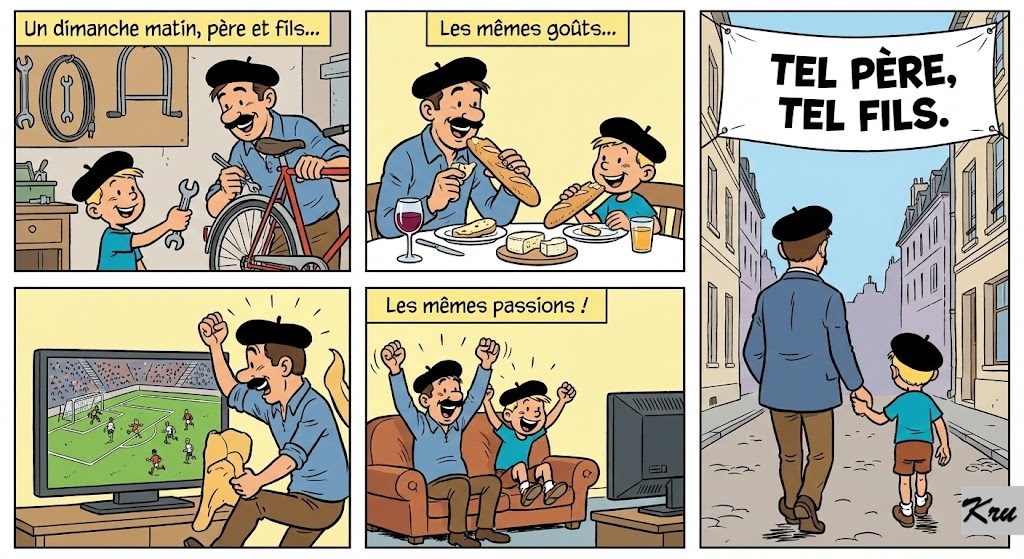
    🇫🇷 French: “Tel père, tel fils.” (Like father, like son).

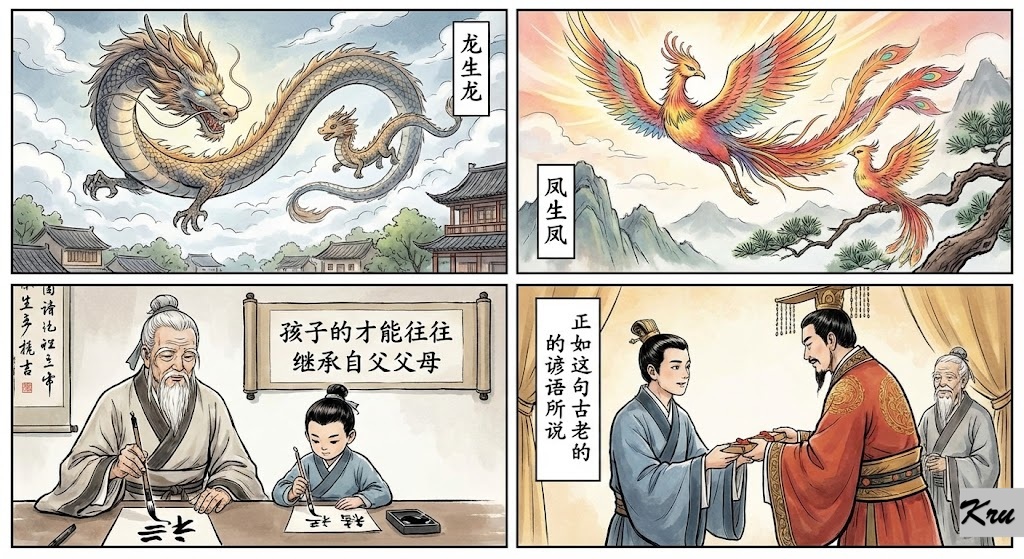
    🇨🇳 Chinese: “Dragons give birth to dragons, phoenixes give birth to phoenixes.” (Meaning children inherit their parents’ status/talents).
    🎭 Short Story: The Sour Seed 🍎🐱🐔🐸


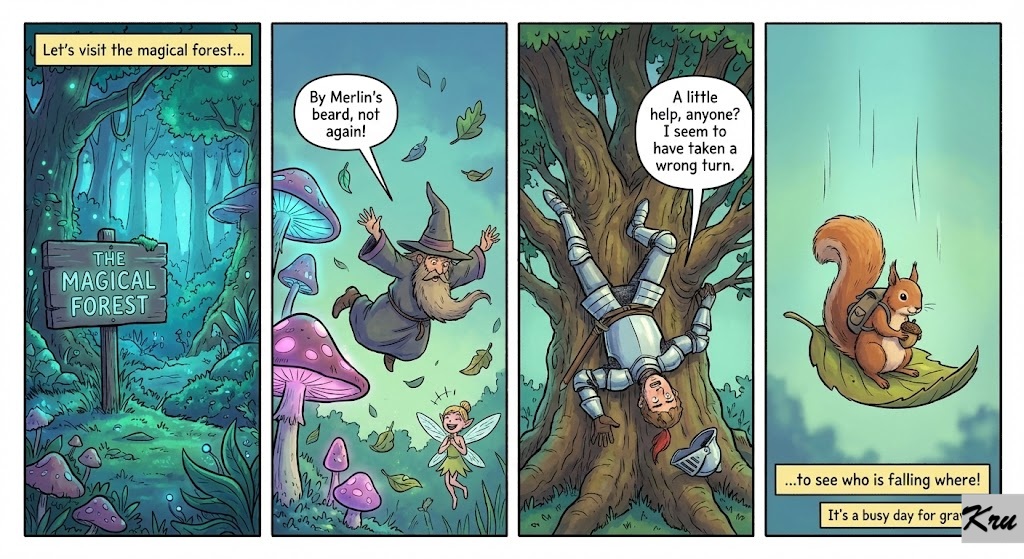
    Let’s visit the magical forest to see who is falling where.

    🌟 The Cast


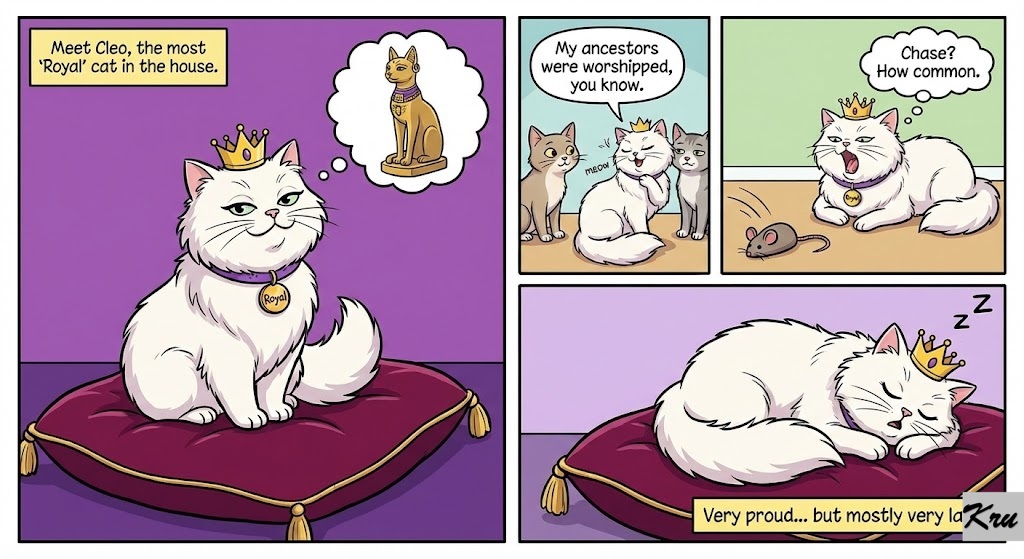
    Cleo the Cat: Very proud of her “Royal” lineage, but lazy. 😼

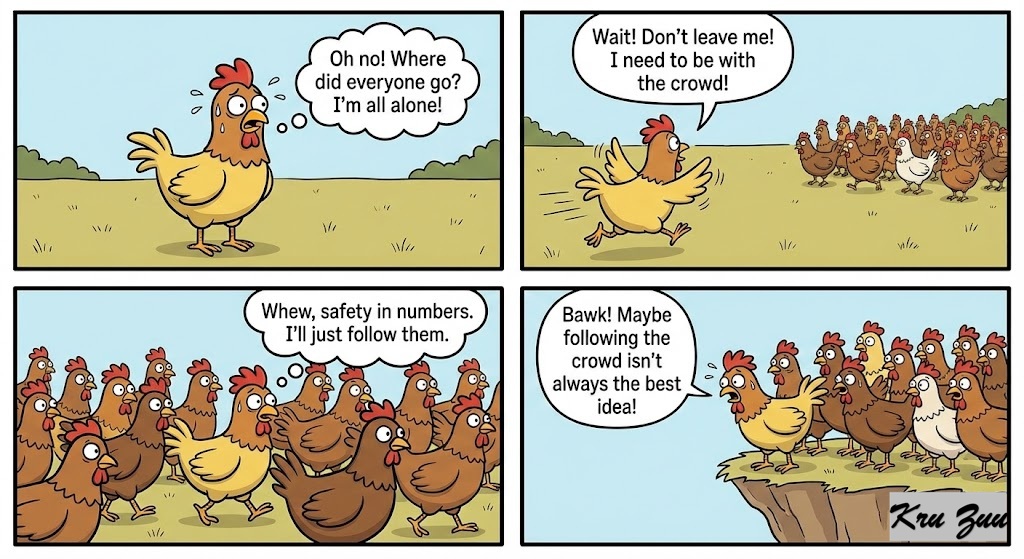
    Cluck the Chicken: Nervous, always follows the crowd. 🐔

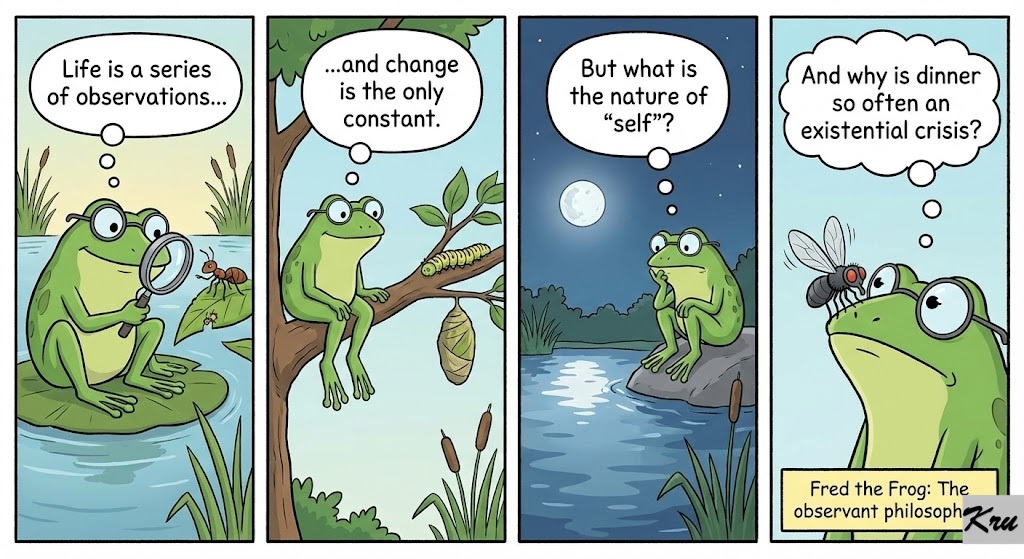
    Fred the Frog: The observant philosopher. 🐸

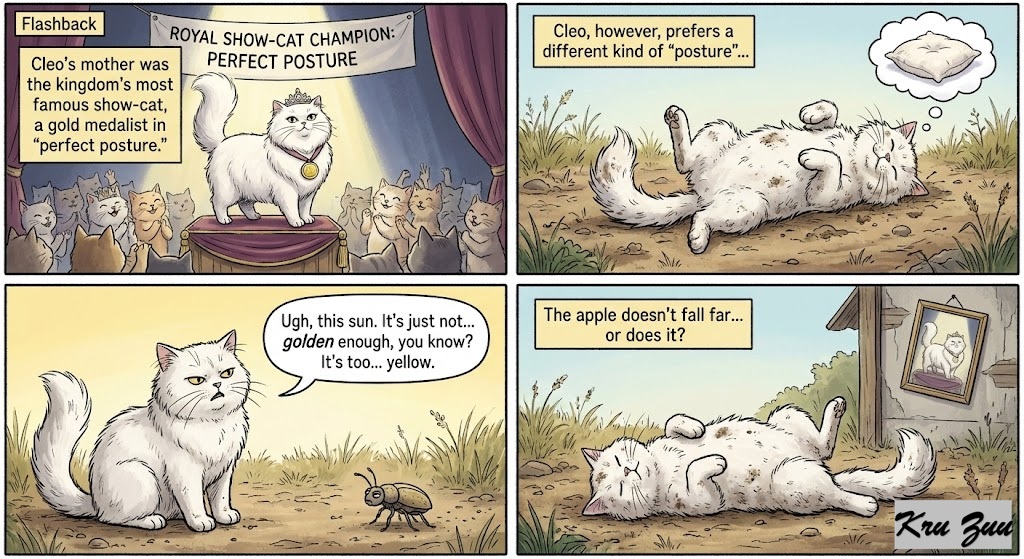
    The Situation: Cleo’s mother was the most famous show-cat in the kingdom. She won gold medals for her “perfect posture.” Cleo, however, spends all day napping in the dirt and complaining that the sun isn’t “golden enough.”

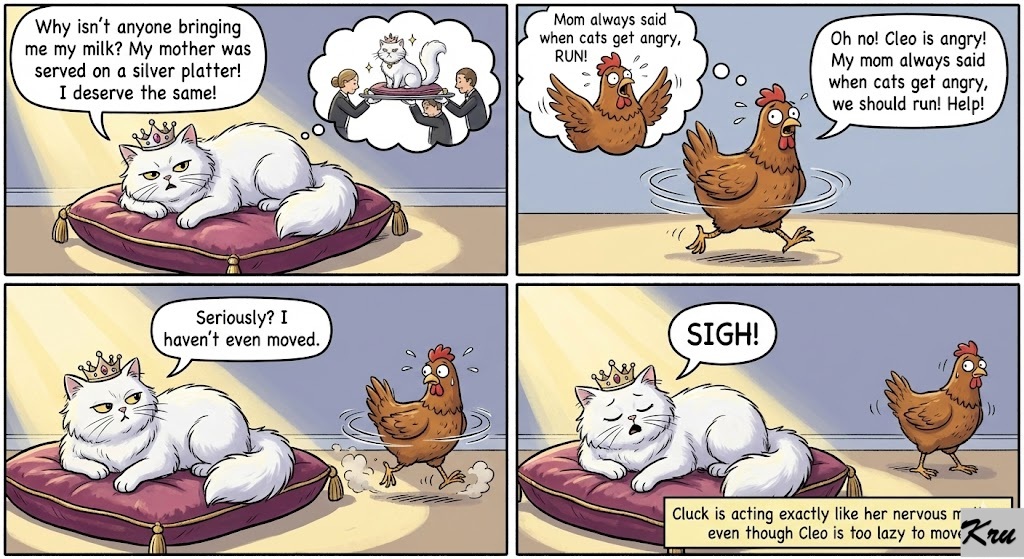
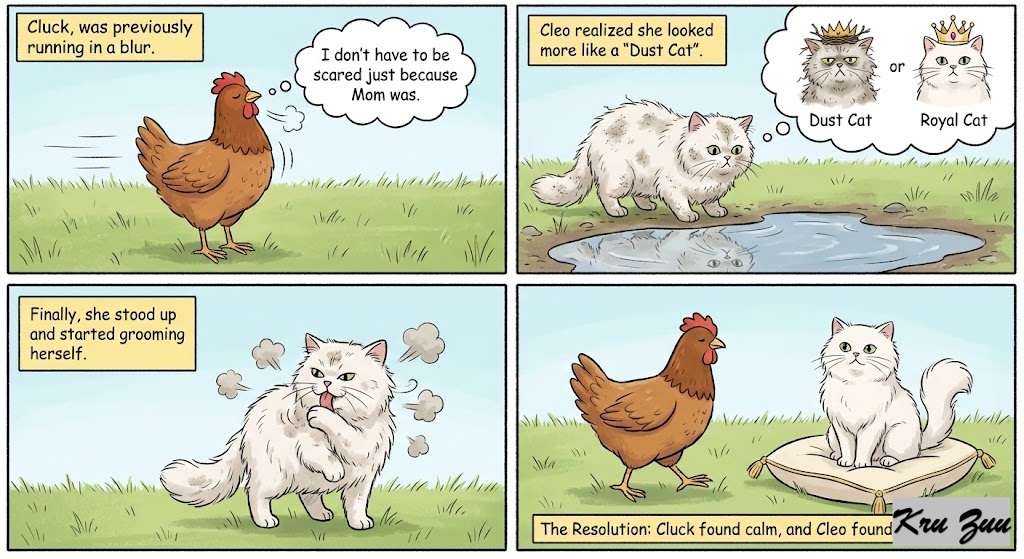
    The Conflict: “Why isn’t anyone bringing me my milk?” Cleo demands. “My mother was served on a silver platter! I deserve the same!” Cluck, who comes from a family of frantic, panicky chickens, starts running in circles. “Oh no! Cleo is angry! My mom always said when cats get angry, we should run! Help!” Cluck is acting exactly like her nervous mother, even though Cleo is too lazy to move.

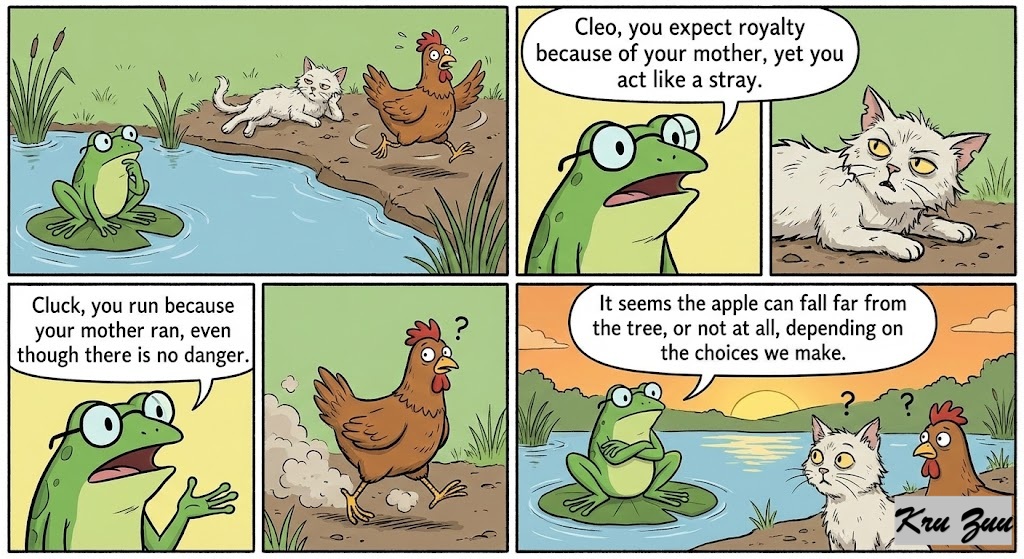
    The Reaction: Fred the Frog watches from his pond. “Cleo, you expect royalty because of your mother, yet you act like a stray. Cluck, you run because your mother ran, even though there is no danger.”

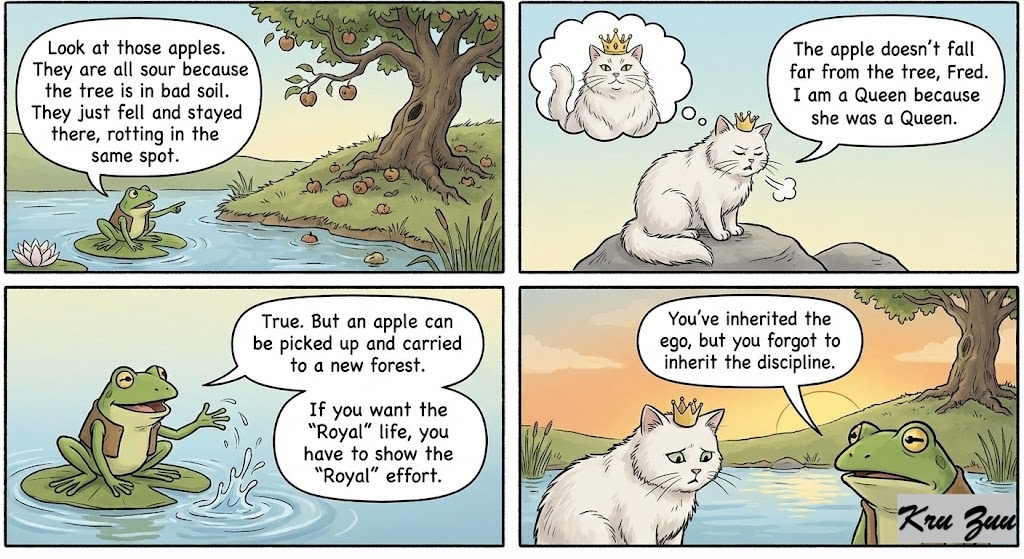
    The Lesson: Fred points to a wild apple tree. “Look at those apples. They are all sour because the tree is in bad soil. They just fell and stayed there, rotting in the same spot.” Cleo huffs, “The apple doesn’t fall far from the tree, Fred. I am a Queen because she was a Queen.” Fred splashes some water. “True. But an apple can be picked up and carried to a new forest. If you want the ‘Royal’ life, you have to show the ‘Royal’ effort. You’ve inherited the ego, but you forgot to inherit the discipline.”

    The Resolution: Cluck stopped running and took a deep breath. She realized she didn’t have to be scared just because her mom was. Cleo, realizing she looked more like a “Dust Cat” than a “Royal Cat,” finally stood up and started grooming herself.

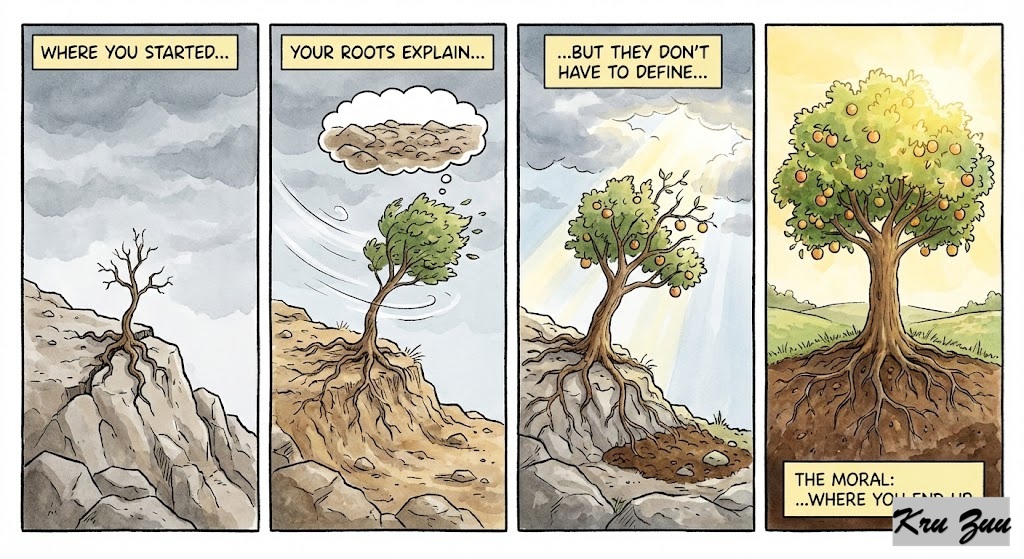
    The Moral: Your roots explain where you started, but they don’t have to define where you end up. 🌳
    🎓 Lesson for English Learners


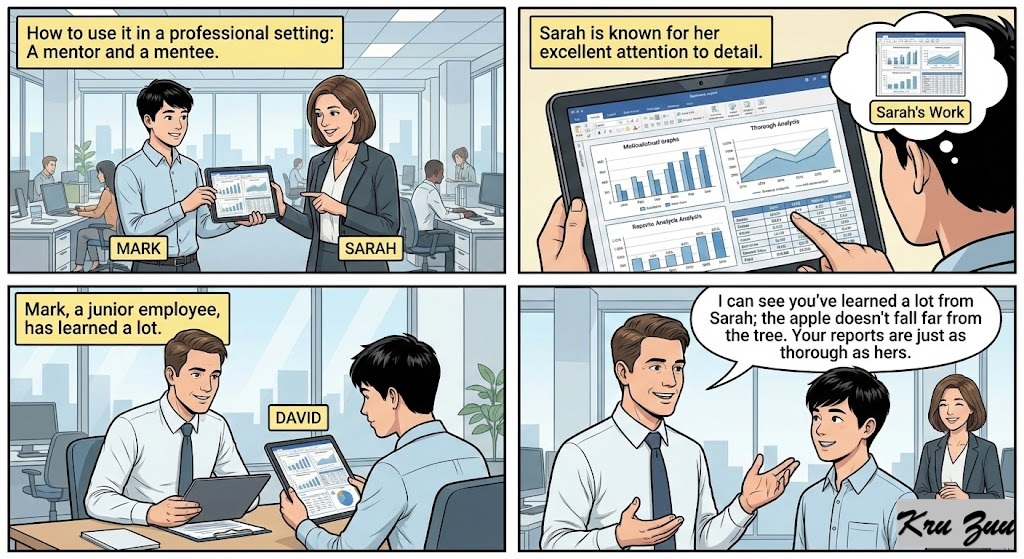
    How to use it in a professional setting: If you see a junior employee who has the same excellent attention to detail as their mentor, you can say: “I can see you’ve learned a lot from Sarah; the apple doesn’t fall far from the tree. Your reports are just as thorough as hers.”

    💬 Your Turn: The “Mirror” Challenge 🚀


    Ready to see your own “tree”?

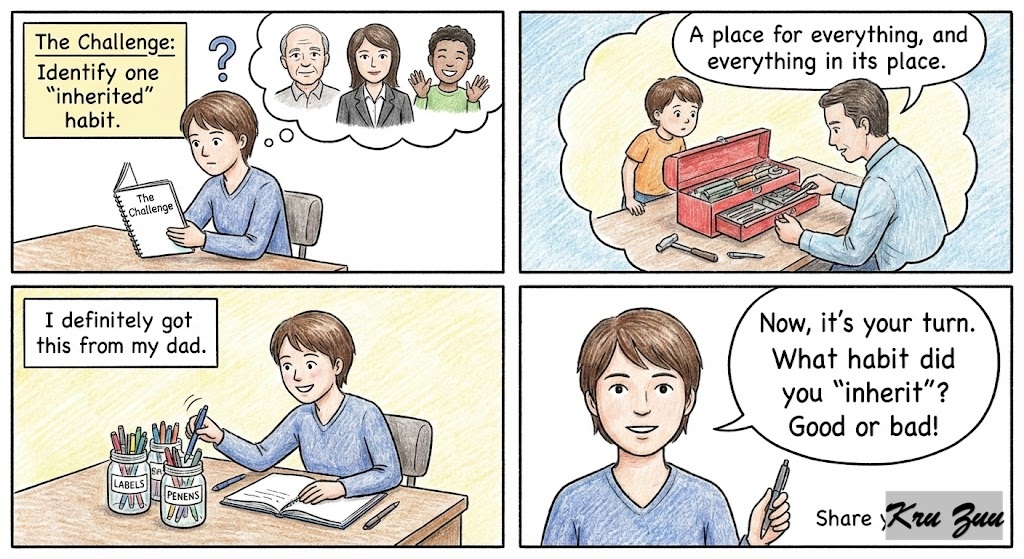
    The Challenge:
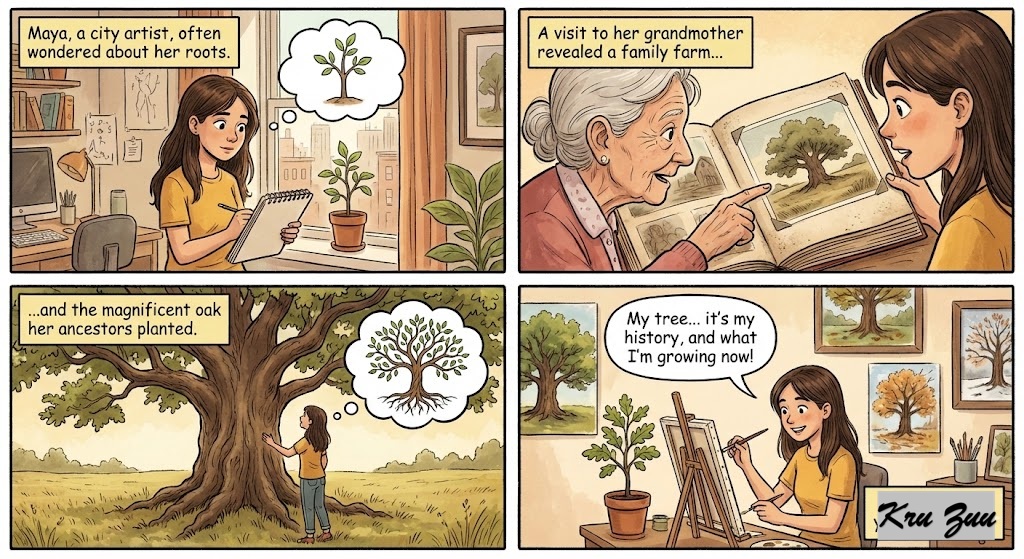
    Identify one habit you have (good or bad) that you definitely “inherited” from a parent, a former boss, or a close friend.
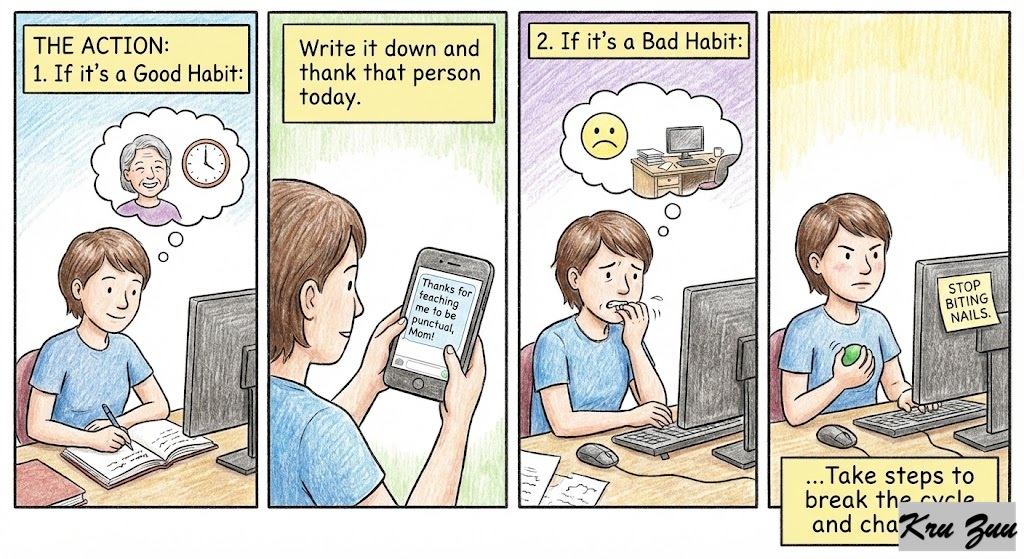
    The Action: 1. If it’s a Good Habit: Write it down and thank that person today. 2. If it’s a Bad
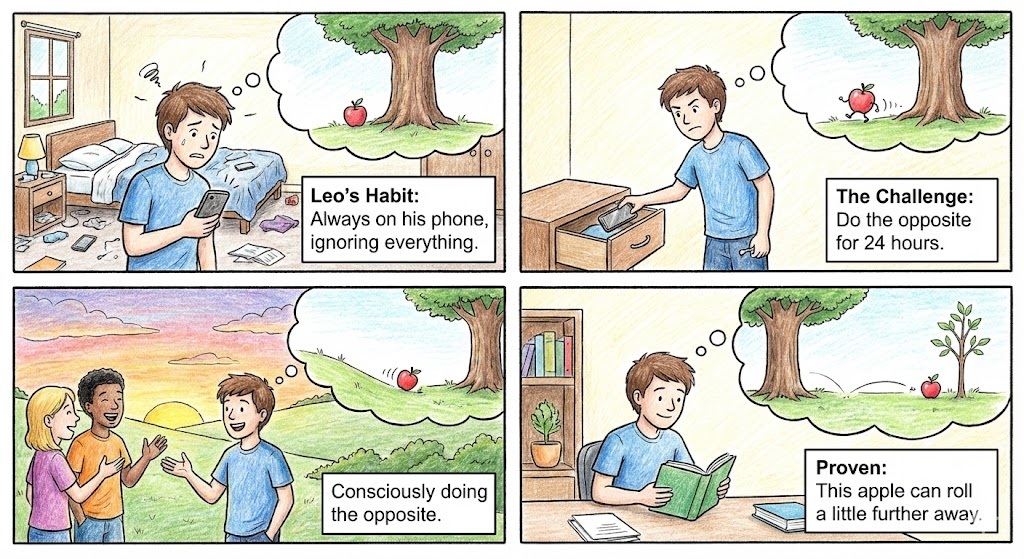
    Habit: Consciously do the opposite for 24 hours. Prove that this apple can roll a little further away.

    👇 Question for the comments: Which trait did you get from your “tree”? Are you happy about it, or are you trying to roll away? Tell us below!

    By Zubeyir YURTKURAN

    https://www.facebook.com/BrainBattleground/

    https://www.facebook.com/zubeyr.yurtkuran/

    https://www.instagram.com/zubeyryurtkuran/

    https://www.youtube.com/@BrainBattleground-b3p

    https://www.instagram.com/brainbattleground/

  • 🧺 Don’t Put All Your Eggs in One Basket: The Secret to Risk Management

    🧺 Don’t Put All Your Eggs in One Basket: The Secret to Risk Management

    Don’t put all your eggs in one basket.


    👿 The Risk Taker:
    You invested all your savings in a single stock.

    You applied to only one university. You are waiting solely for the job offer from one company.

    The Result? If that stock tanks, everything is gone. If that university rejects you, you have no backup.

    Stress levels skyrocket, and your entire life is tied to one fragile point. 🌋


    😇 The Planner (The Diversifier): You spread your money across different bank accounts and investment tools.

    You applied to three different colleges.

    You are learning a new skill while also taking on some freelance work.

    The Result? If one investment dips, the others protect you. There is always a ‘Plan B.’ Your life rests on solid ground. 🛡️


    📉 The Reality: This saying is not just about finance. It applies to career, relationships, hobbies, and education too.

    Life is not a lottery where one thing saves you; it’s a strategic game where you manage probabilities. 🎯


    💎 The Secret: Flexibility is your power in life. If one area fails, the others can support you. Successful people always have a contingency plan.

    🧐 The Anatomy of the Proverb


    This common English phrase is a direct warning against making your life dependent on a single thing.


    📚 Vocabulary Vault


    Basket (Noun):
    A container. (Here: An area of investment, an opportunity, or an effort.) 🍎


    Example: “She keeps all her laundry in a plastic basket.”


    To Put (Verb): To place. (Here: To invest, to focus, to trust.)


    All Your Eggs: All your eggs. (Here: All your resources, money, energy, or hopes.) 🥚


    Diversification (Bonus Word):
    The strategy of investing in a variety of assets to reduce risk.


    🧠 Grammar Focus


    The Negative Imperative Mood (The Bossy Verb, Negative):


    The sentence starts with “Don’t” (Do not). Like the positive imperative “Treat others…”, this is a direct instruction or strong piece of advice.


    Normal: You should not put…


    Imperative:Don’t put all your eggs… (You are strongly advised not to do this!)

    📜 History: Origin and Spread


    The saying is based on a centuries old agricultural metaphor.


    The Origin: The phrase can be traced back to the 1600s in Spanish literature and the works of English writer Miguel de Cervantes (author of Don Quixote). The basic idea is simple: if you drop the basket, all your eggs break. 🍳


    Global Cousins:


    🇹🇷 Turkish:
    “Bütün yumurtalarını tek bir sepete koyma.” (Direct translation and most common usage.)


    🇨🇳 Chinese: “A man who wants his own end hangs himself from a single tree.” (The idea of finding alternative solutions.)


    🇮🇳 Hindi: “Taking risks is fine, but don’t risk your entire existence.” (Emphasizing the same theme.)

    🎯 Impact on Life: The Pros & Cons


    What are the benefits of living by this philosophy?


    ✅ The Pros (The Safety Net):


    Resilience:
    One failure doesn’t derail your whole life. You can recover quickly.


    Mental Peace: It reduces the pressure that comes from being over-reliant on a single outcome.


    Broader Experience: Trying different areas diversifies your skills and capabilities.


    ❌ The Cons (The Pitfalls):


    Dilution of Focus:
    If you spend too little energy on too many things, you might not achieve true excellence in any of them. (Too many baskets, too few eggs!)


    Missed Opportunity: Sometimes, taking a big risk can yield a big reward. This rule can sometimes lead to excessive caution.

    🎭 Short Story: The Village Market


    Let’s check in with our farm friends again!


    🌟 Character Introduction


    Penny the Pig:
    Ambitious, highly focused. 🐷


    Fiona the Fox: Cunning, risk-management expert. 🦊


    Max the Mouse:
    The market accountant. 🐭


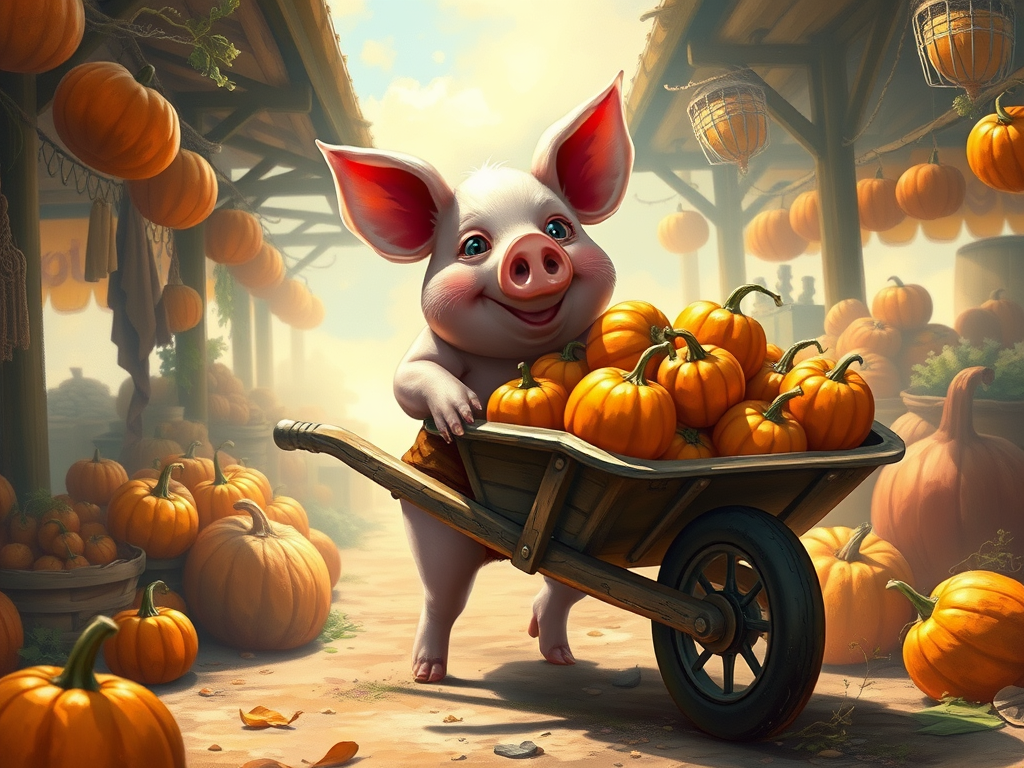
    The Setup: It was market day. Penny loaded all her delicious pumpkins onto one massive wheelbarrow. “This is the fastest way!” she thought.

    Fiona, however, divided her pumpkins into three separate smaller baskets, ready to sell at three different stalls.


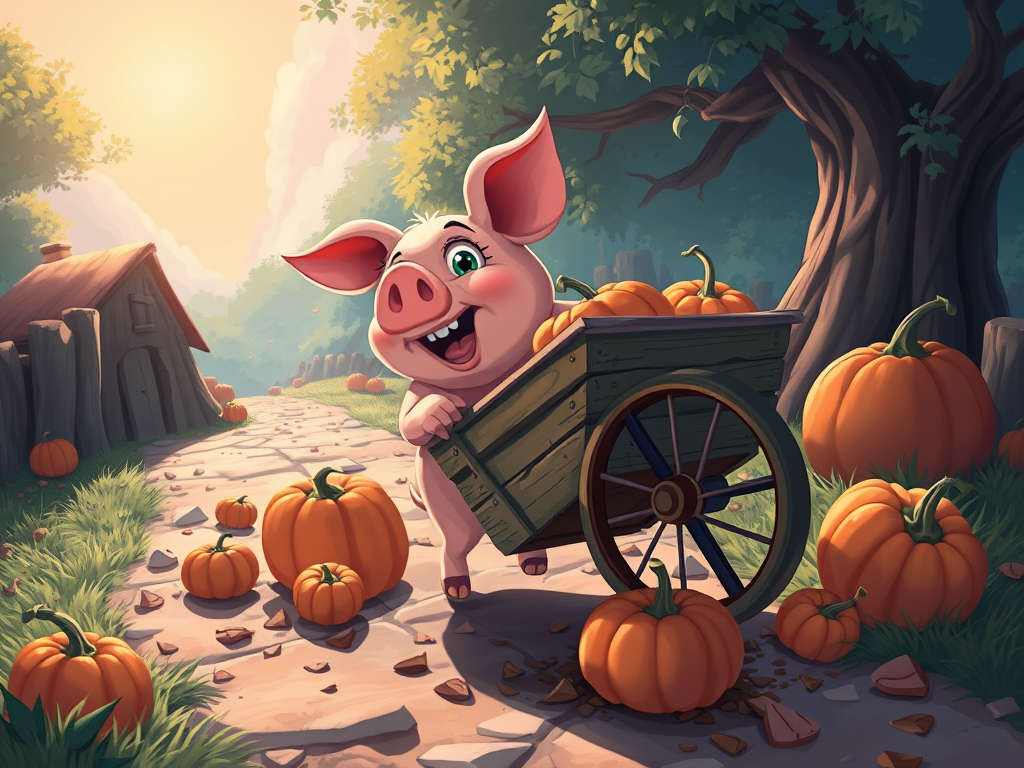
    The Conflict: The path was bumpy, and just as Penny was descending a hill, her large wheelbarrow’s wheel came loose, and the WHOLE THING CRASHED! All her pumpkins were smashed. 🎃


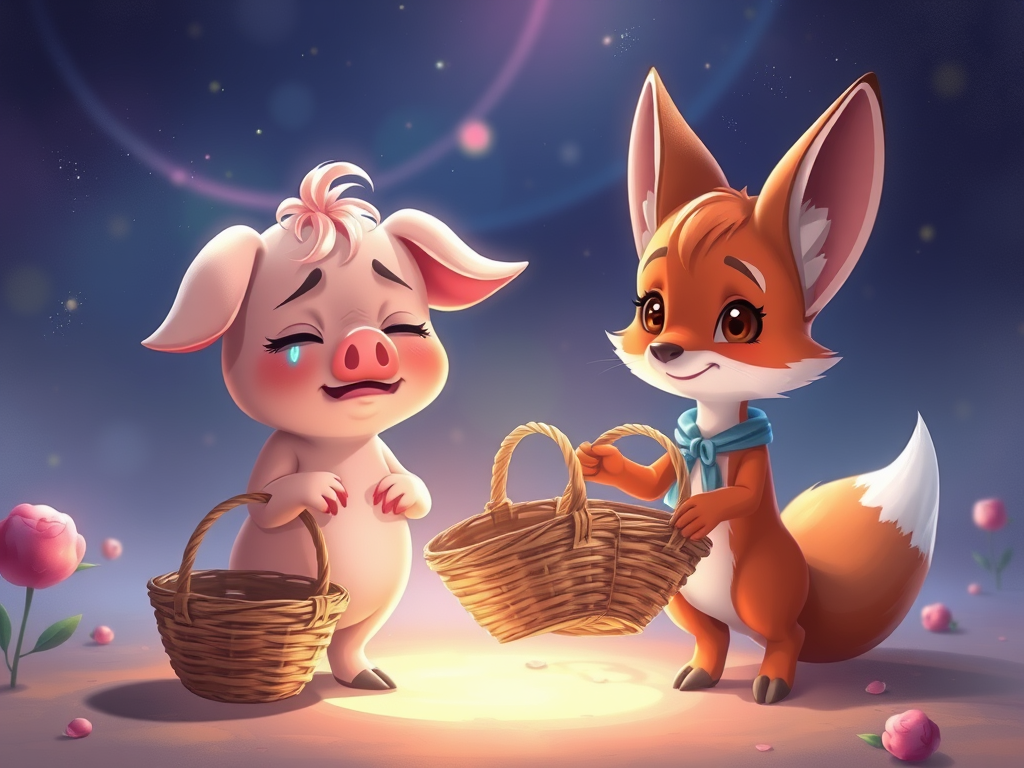
    The Solution: As Penny cried, Fiona realized that two of her three baskets were still perfectly fine. Even though the third basket had tipped, the bulk of her loss was contained.

    Max the Mouse summed it up: “Penny’s loss is 100%. Fiona’s loss is only 33%. Fiona earned less, but she didn’t crash.”


    The Moral: Success is measured not only by what you gain but by what you avoid losing. Separating the baskets minimizes the cost of risk.

    🎓 Lesson for English Learners


    How can you use “The Basket Proverb” in your English conversations?


    Advice Language 🗣️


    If your friend applies to only one company:
    “Hey, don’t put all your eggs in one basket. Maybe apply to two or three more places as a backup.”


    To someone stressing over an exam: “Remember to study a variety of topics. Don’t put all your eggs in one basket for the final exam!”


    Vocabulary Expansion 📚


    Contingency Plan (Noun):
    A plan for a possible future event. “We need a contingency plan in case the main project fails.”


    Mitigate (Verb): To make less severe or serious. “The strategy is designed to mitigate risk.”


    Prudent (Adjective): Acting with or showing care for the future. “It is prudent to have multiple sources of income.”


    💬 Your Turn


    The Life Portfolio Challenge 📝


    Right now, think about the 3 most important “baskets” in your life and the “eggs” (energy/resources) you put into them.


    Basket 1 (e.g., Career/Job)


    Basket 2 (e.g., Health/Fitness)


    Basket 3 (e.g., Relationships/Family)


    Question: If one basket completely crashed (like losing your job), would the other two baskets be strong enough to save you? Or have you put all your eggs into one place?


    Tell me in the comments below which basket you’ve decided to strengthen! 👇

    By Zubeyir YURTKURAN

    https://www.facebook.com/BrainBattleground/

    https://www.facebook.com/zubeyr.yurtkuran/

    https://www.instagram.com/zubeyryurtkuran/

    https://www.youtube.com/@BrainBattleground-b3p