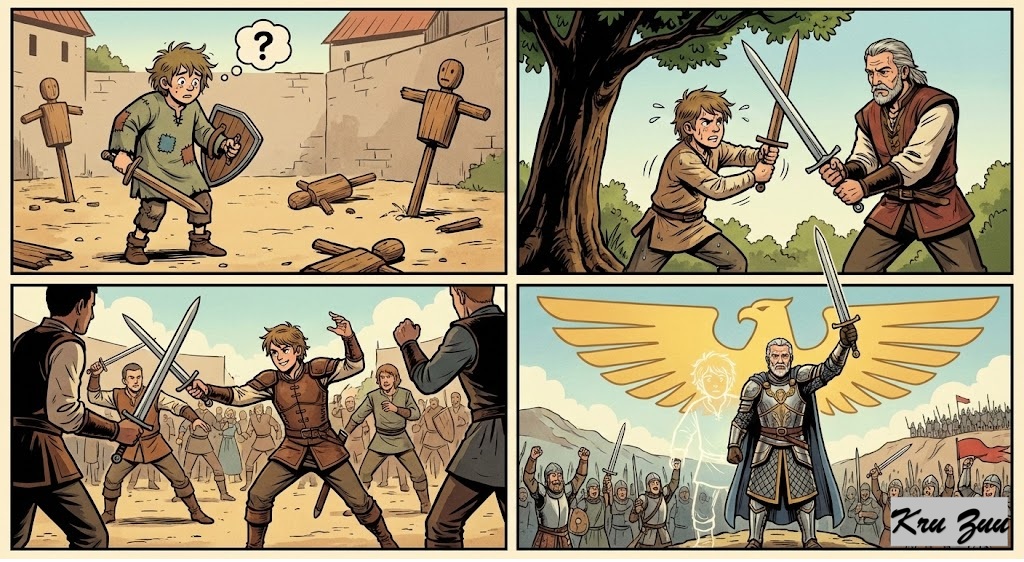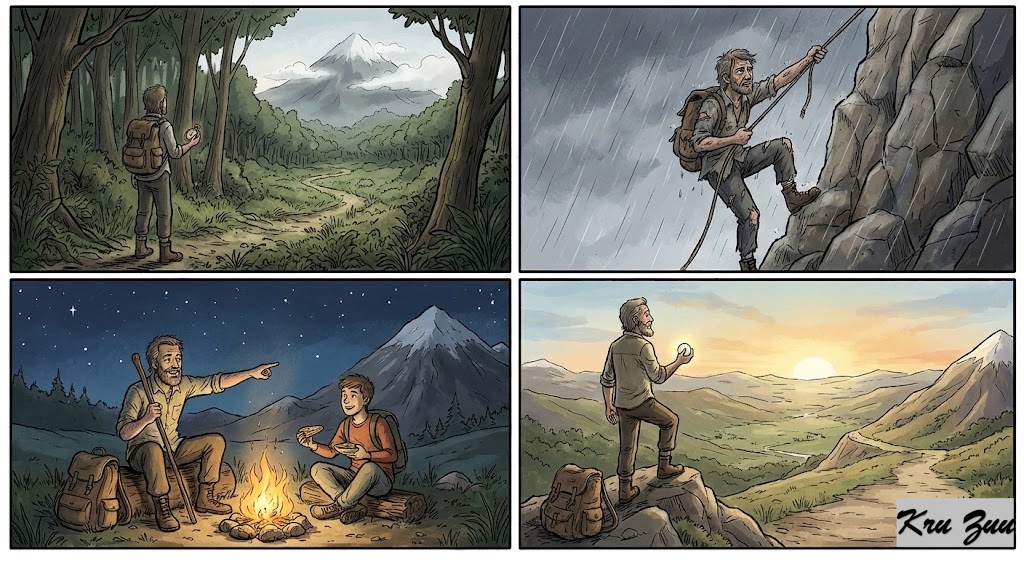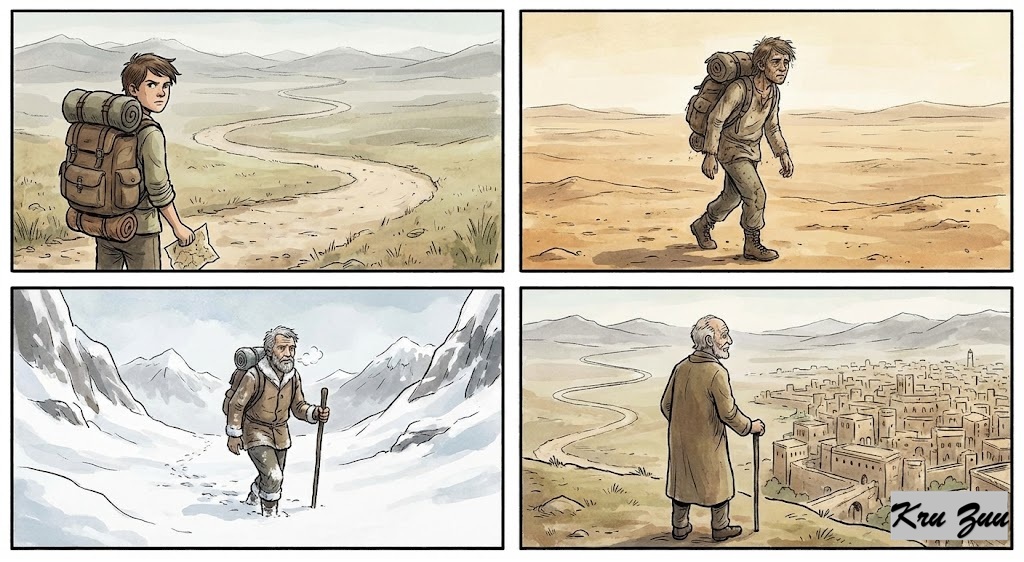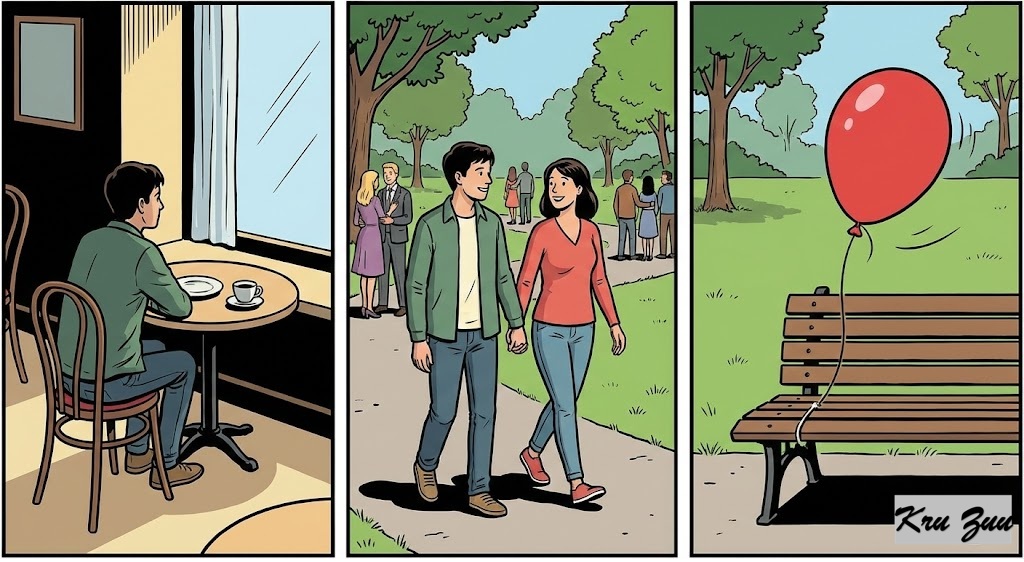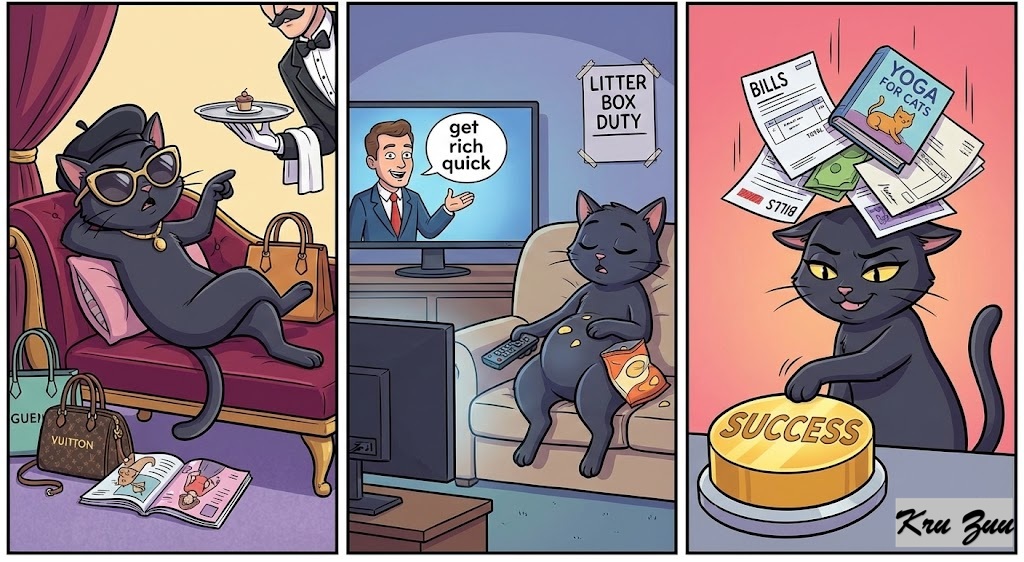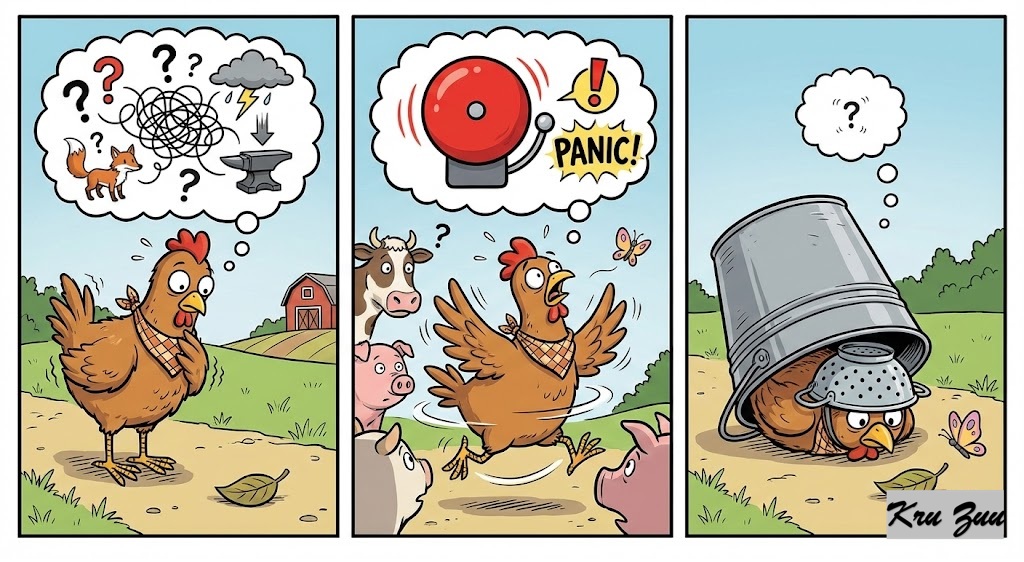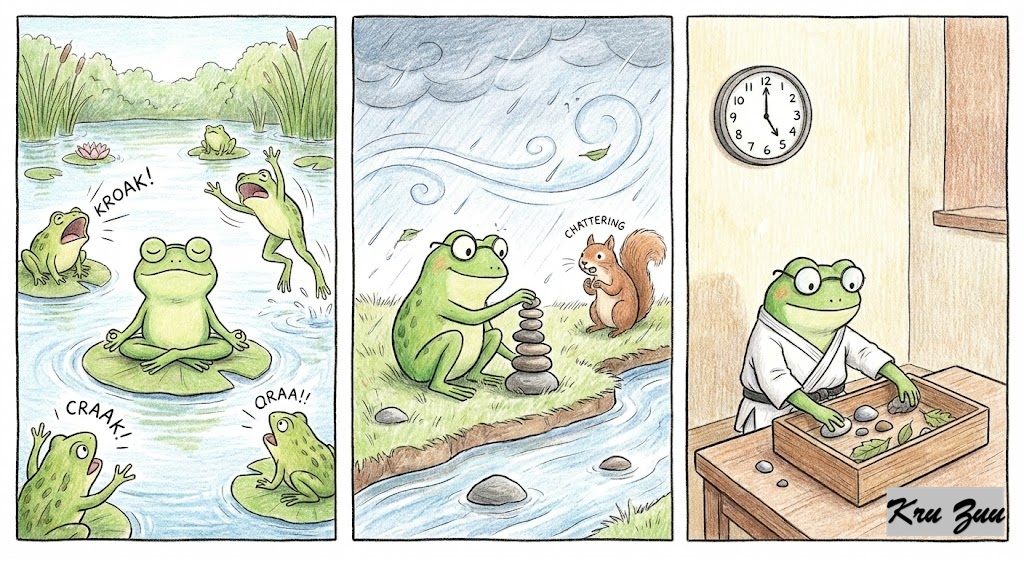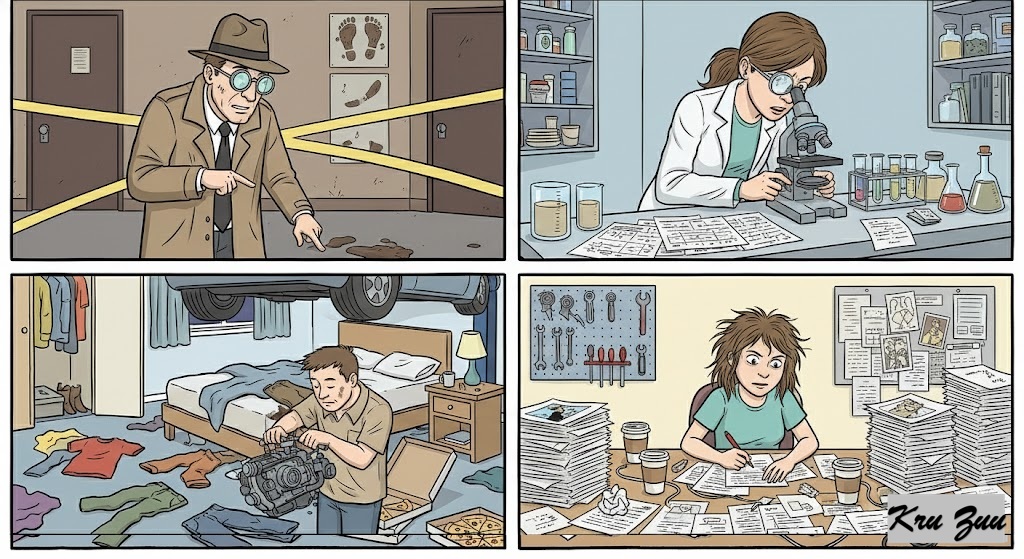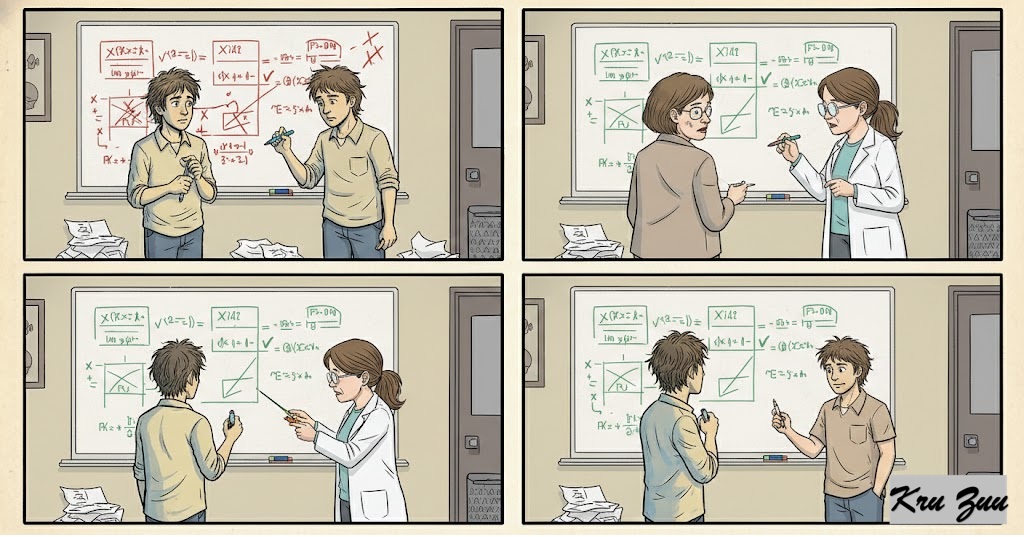
Tag: The Daily Shield

  • ⏳ The Daily Shield: The Law of Relative Time

    ⏳ The Daily Shield: The Law of Relative Time

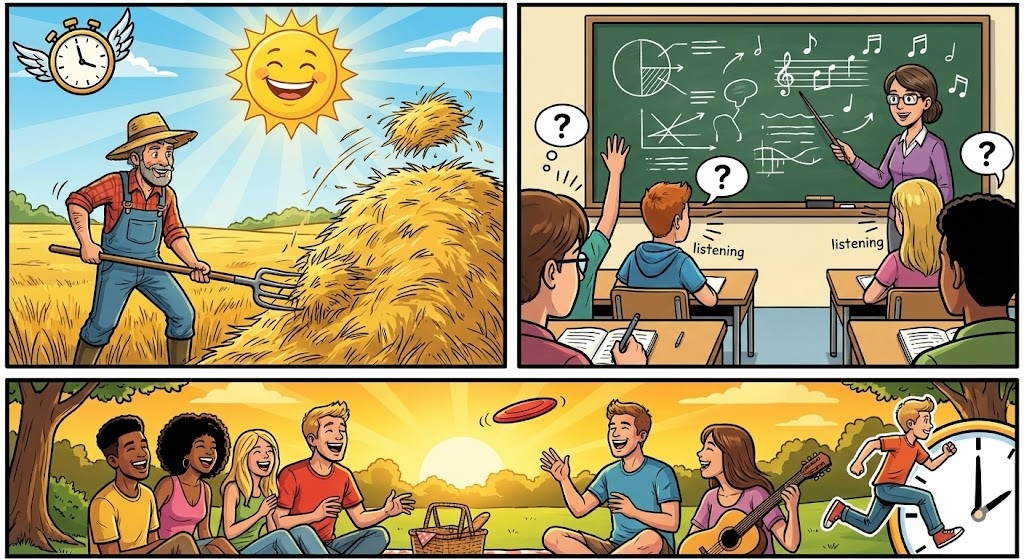
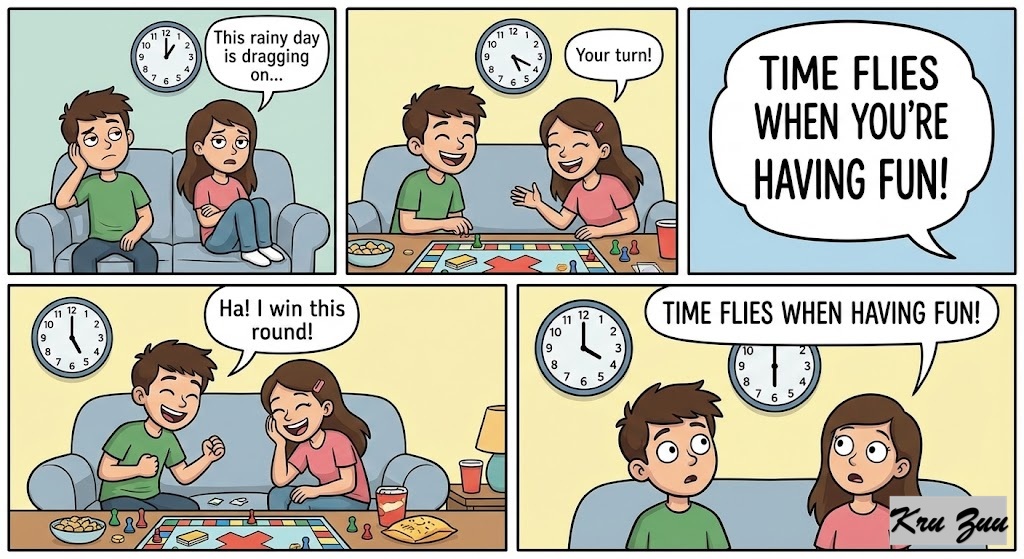
    “Time flies when you’re having fun.”


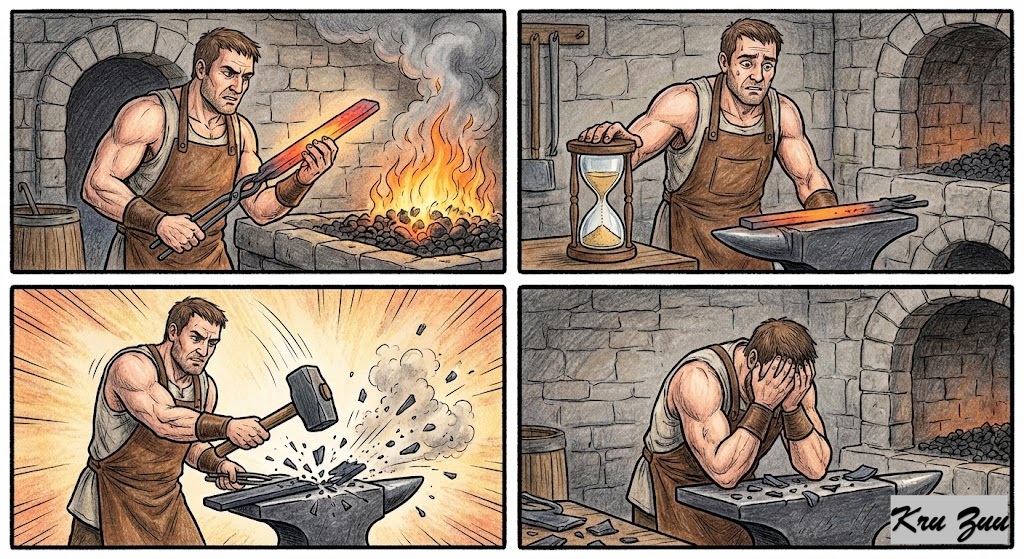
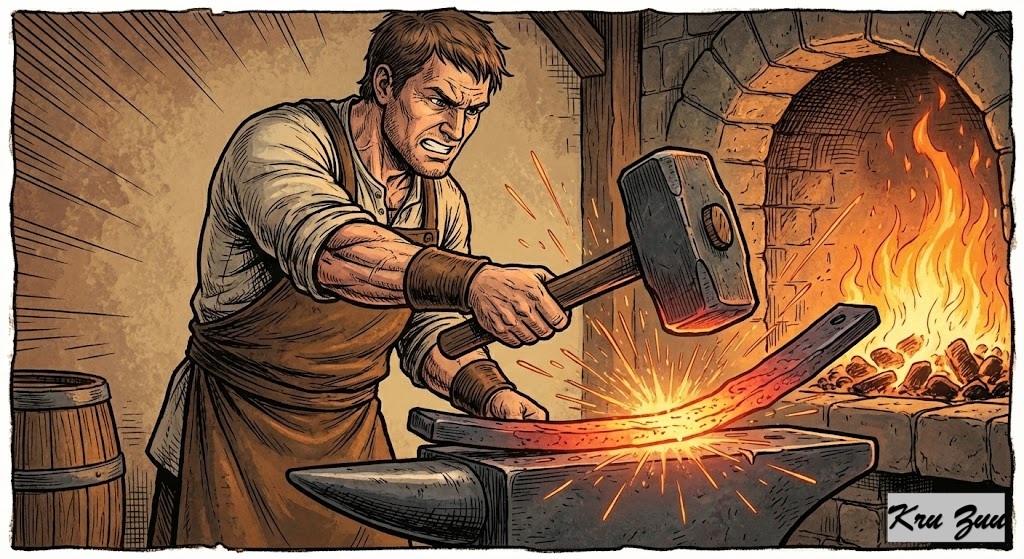
    😈 The Villain (The Clock Watcher)


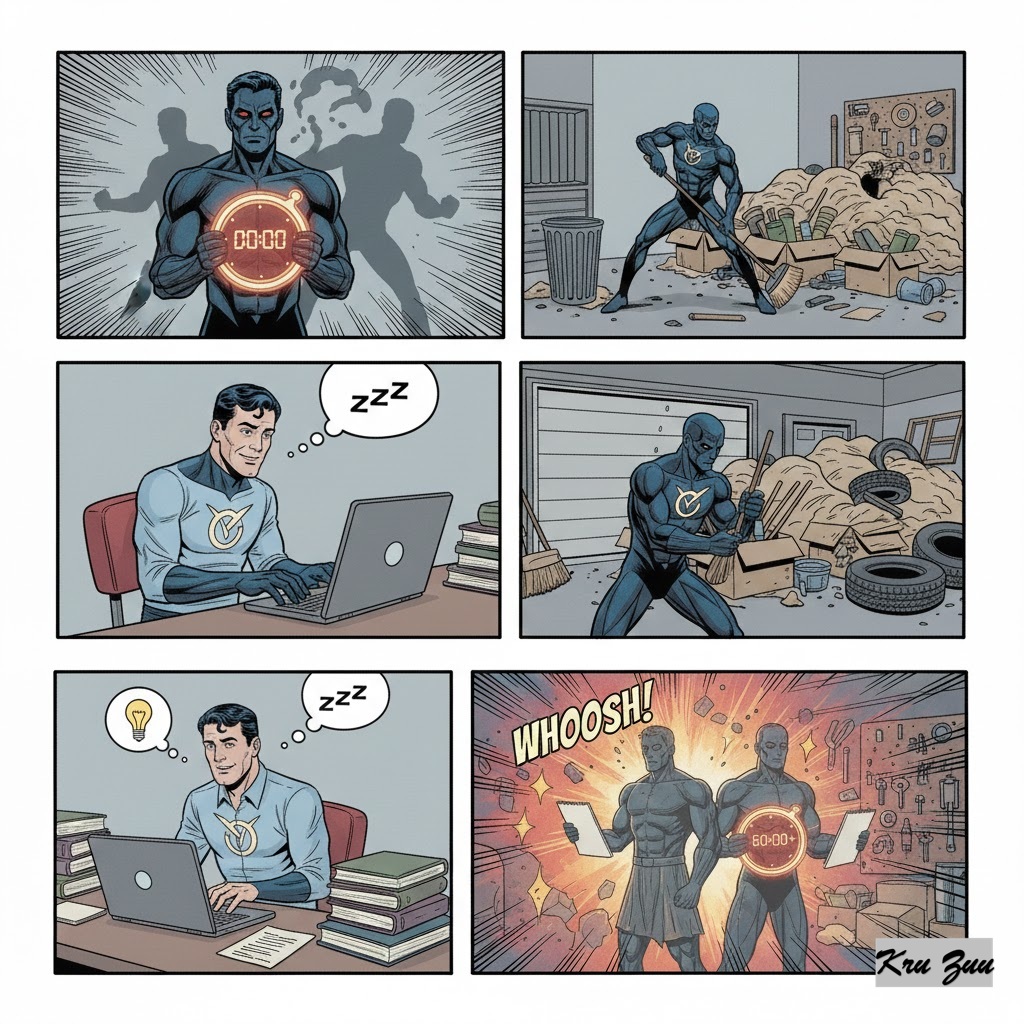
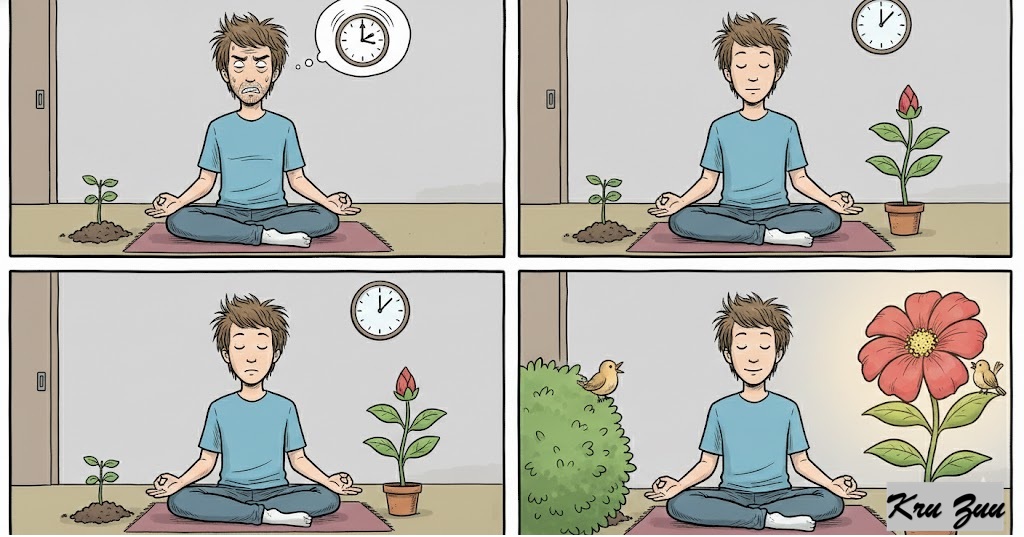
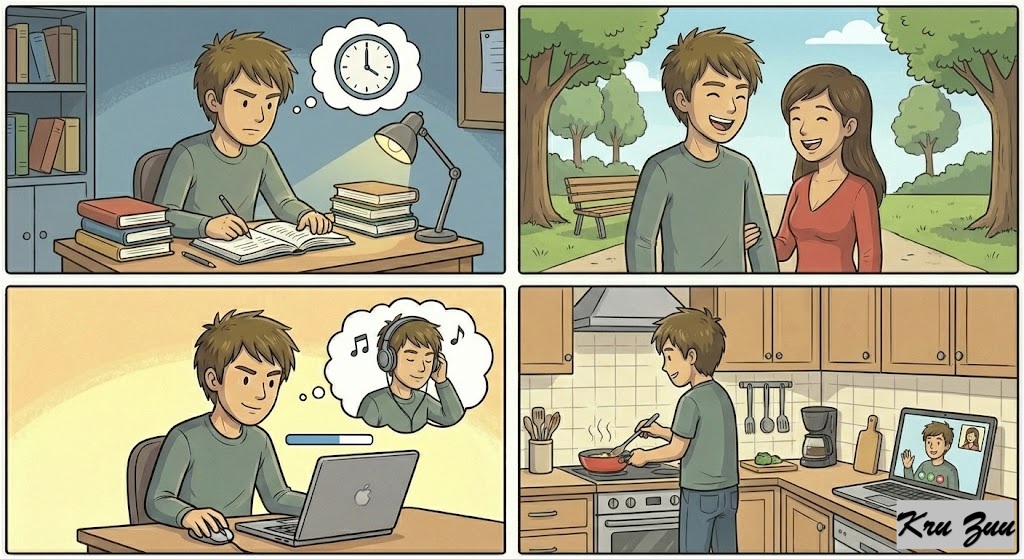
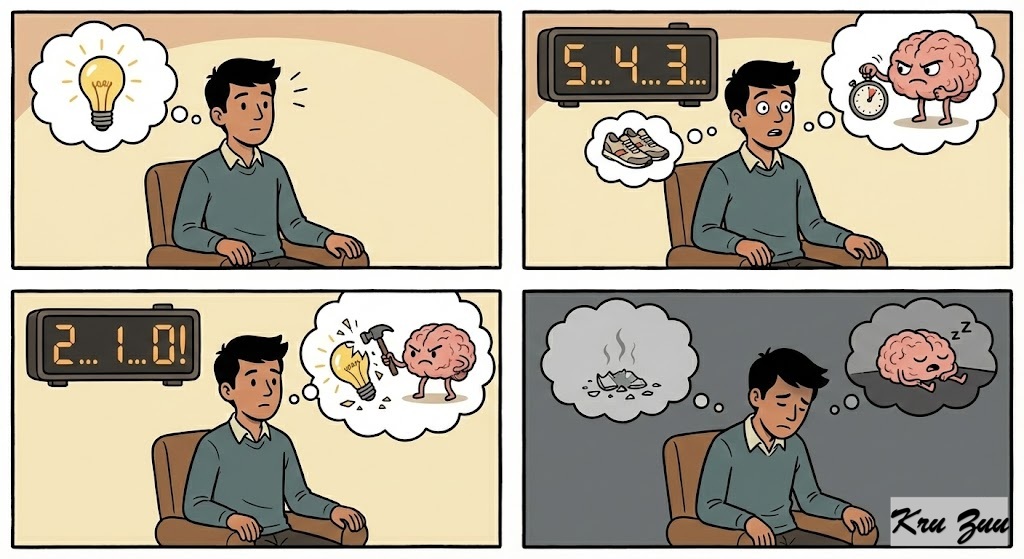
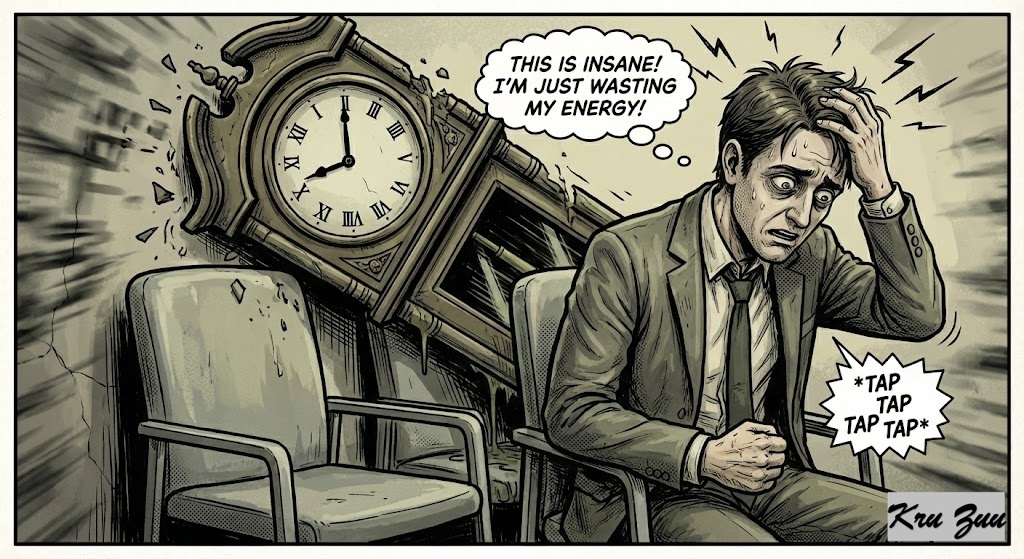
    You are sitting in a meeting, a classroom, or a waiting room. You check your watch: 2:00 PM. You sigh, tap your foot, and stare at the wall. You check your watch again. 2:01 PM. 😱 “Why is this taking forever?” When you are bored, anxious, or doing something you hate, you become the Clock Watcher. You feel every single second tick by. You are trapped in “Slow Motion Misery.”
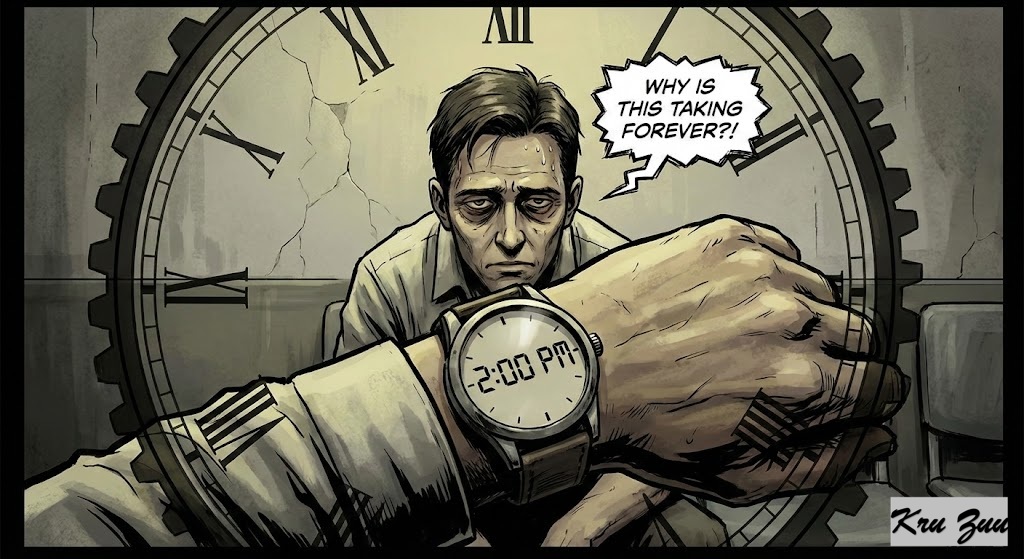
    The result? You become impatient, irritable, and you waste mental energy fighting against reality.

    😇 The Hero (The Flow Master)


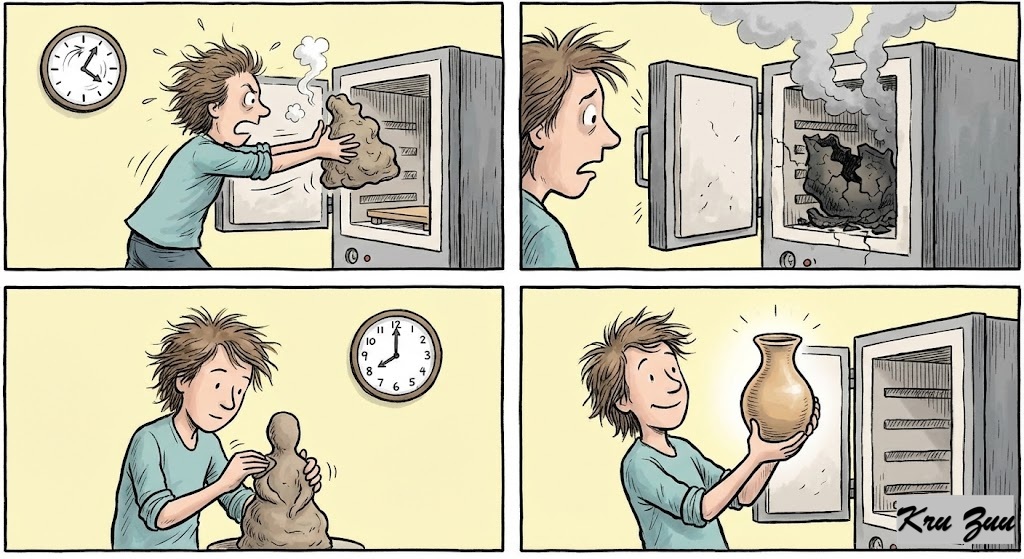
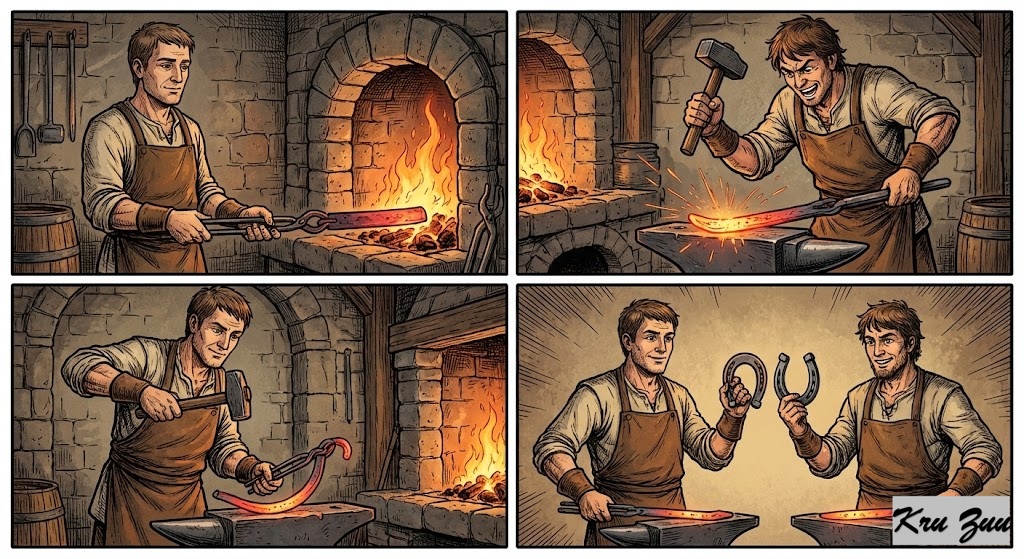
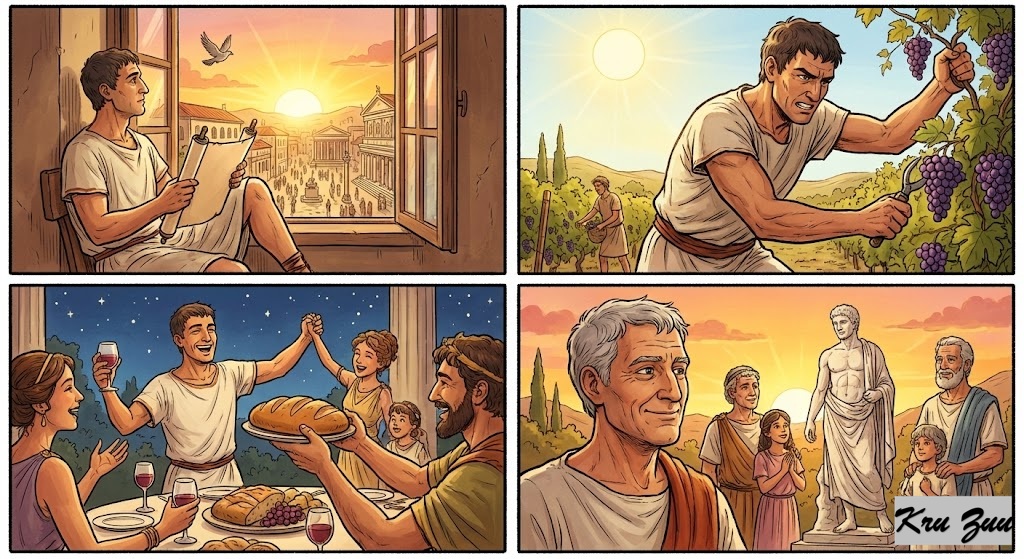
    You sit down to play your favorite video game, paint a picture, or talk to your best friend. You feel excited. You are 100% focused. You don’t look at your phone. You don’t look at the clock. Suddenly, your stomach growls. You look up. It was 8:00 PM when you started… now it is midnight! 🌑 “Where did the time go?” You are the Flow Master. Because your brain was happy and engaged, you skipped the boring parts of time.

    The result? You feel energized, accomplished, and surprised. You didn’t just spend time; you invested it in joy.


    ⚖️ The Reality


    Chronological Time vs. Psychological Time. The clock on the wall never changes its speed. One minute is always 60 seconds. However, your brain processes time differently based on emotion.
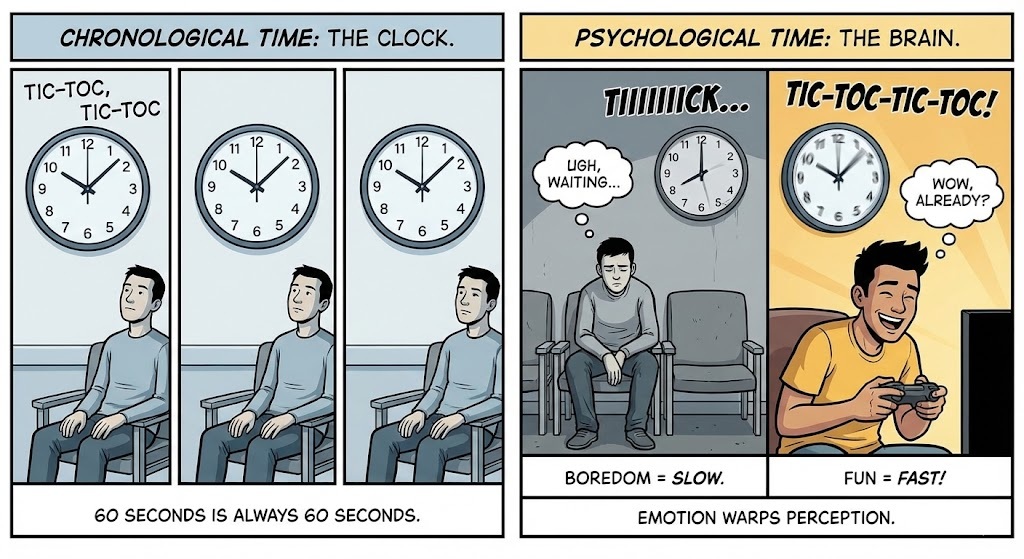

    Pain/Boredom: Your brain pays attention to everything. Time slows down.
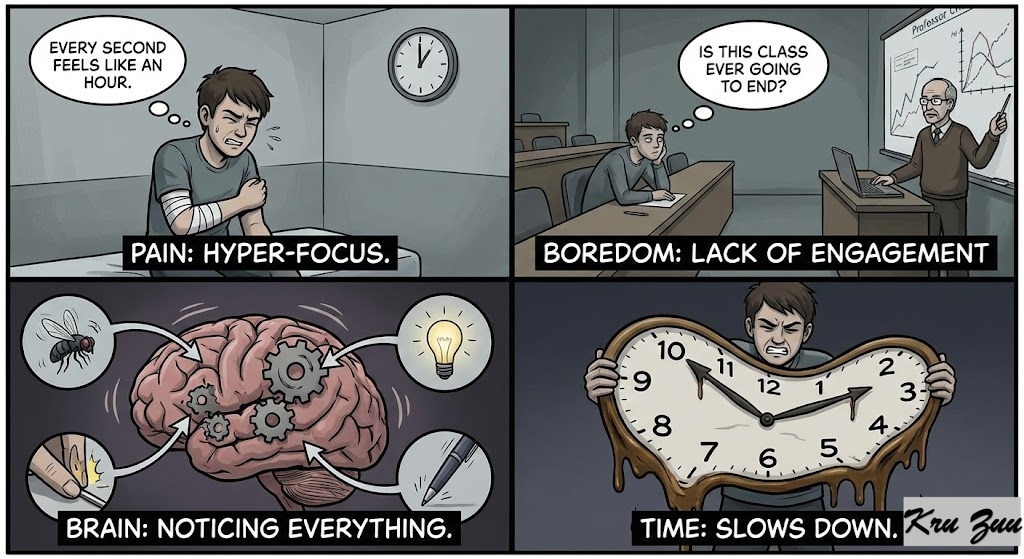

    Joy/Focus: Your brain filters out the background. You forget to count the seconds. Time accelerates.
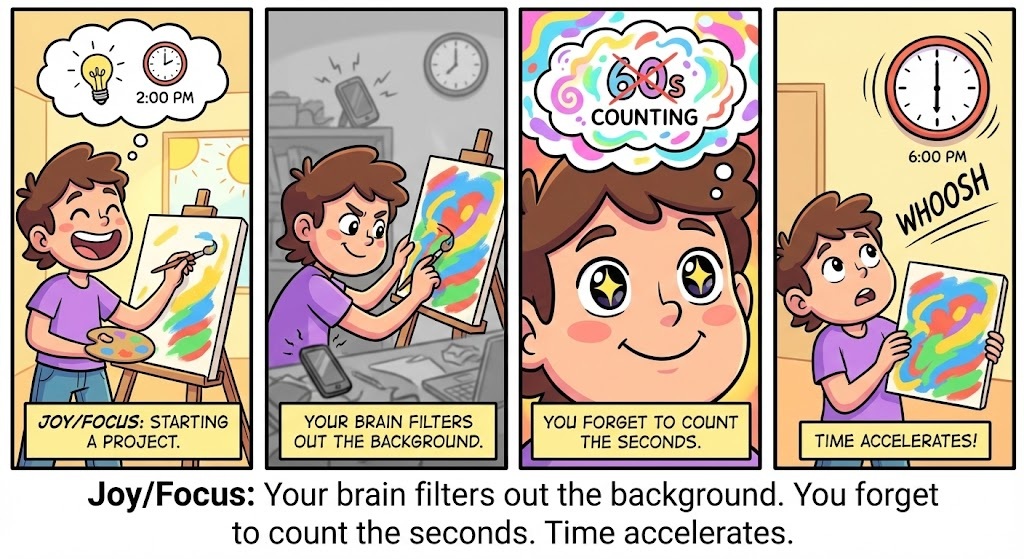

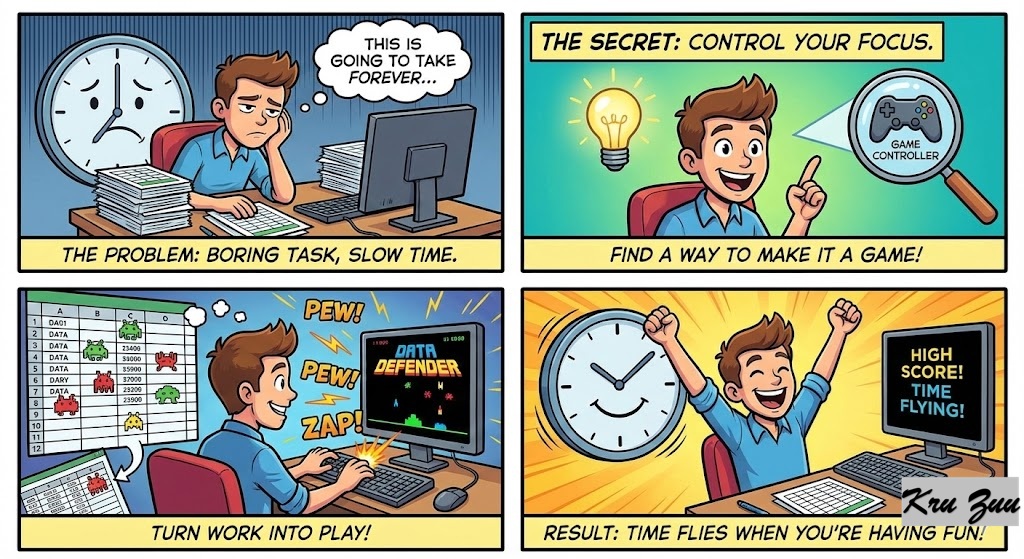
    💎 The Secret: You cannot control the clock, but you can control your focus. If you want a boring task to go faster, find a way to make it a game.
    🧐 The Anatomy of the Proverb


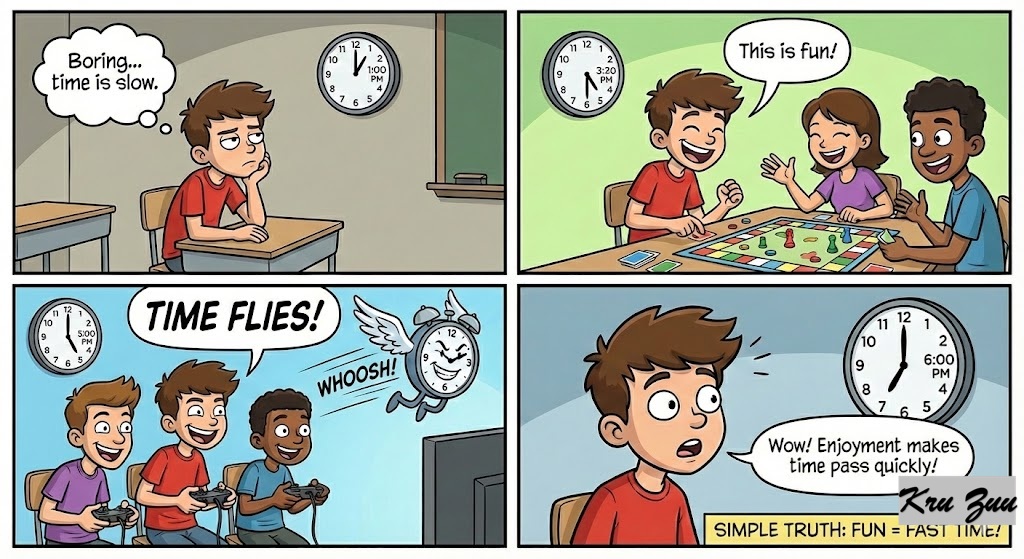
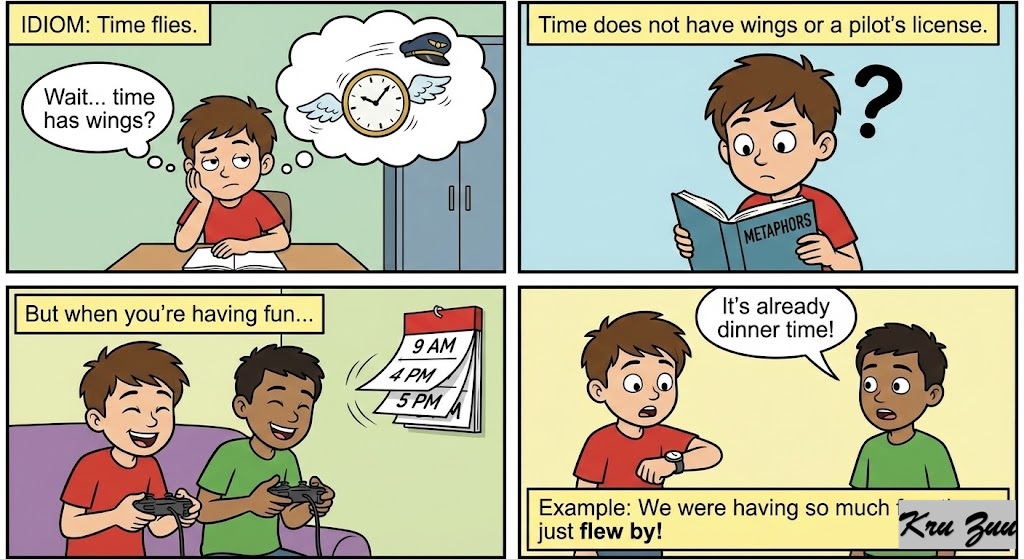
    This idiom is used to express surprise that a period of time has passed quickly because you were enjoying yourself.

    Time (Noun): The indefinite continued progress of existence.
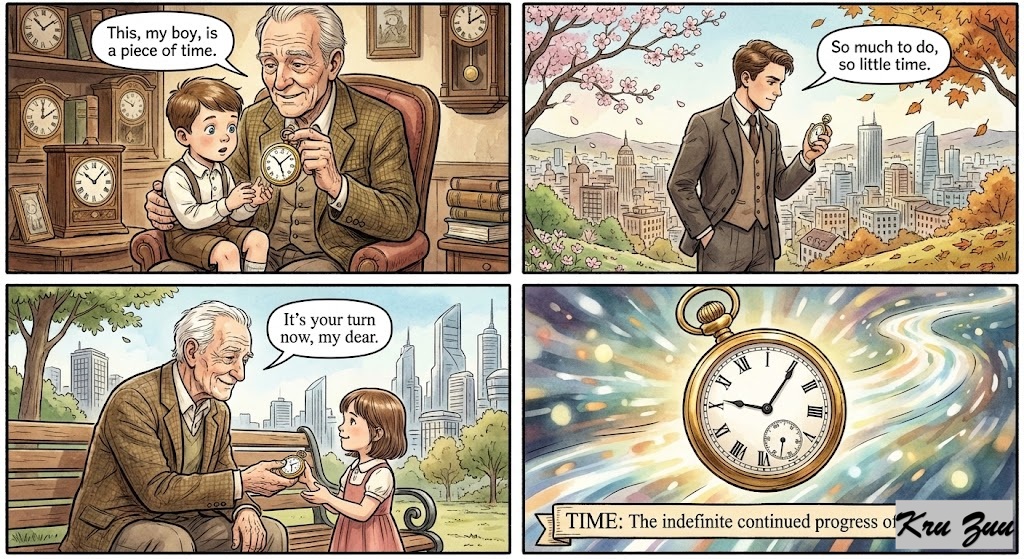

    Flies (Metaphorical Verb): Moves through the air with wings (meaning: moves extremely fast).
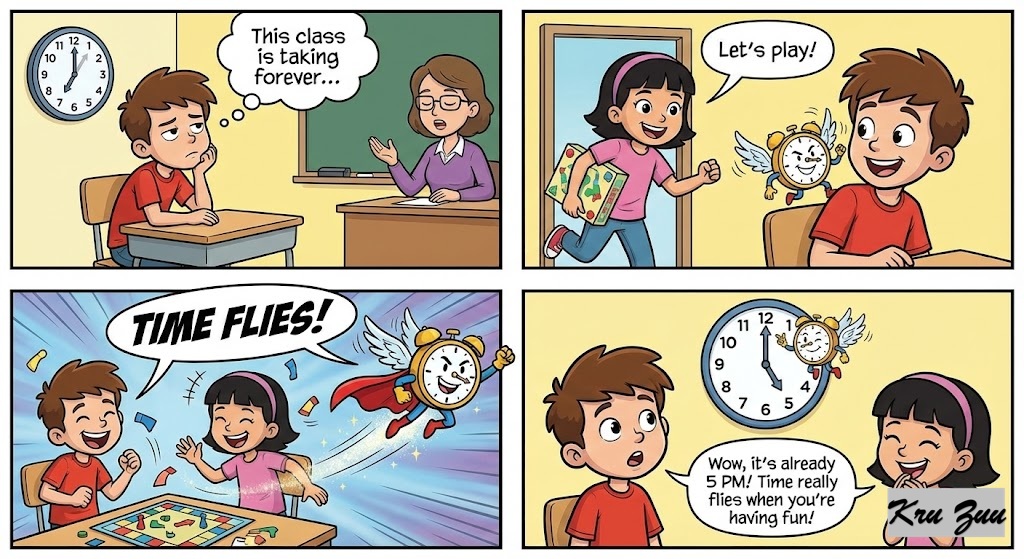

    When you’re having fun (Condition): The trigger for the speed.
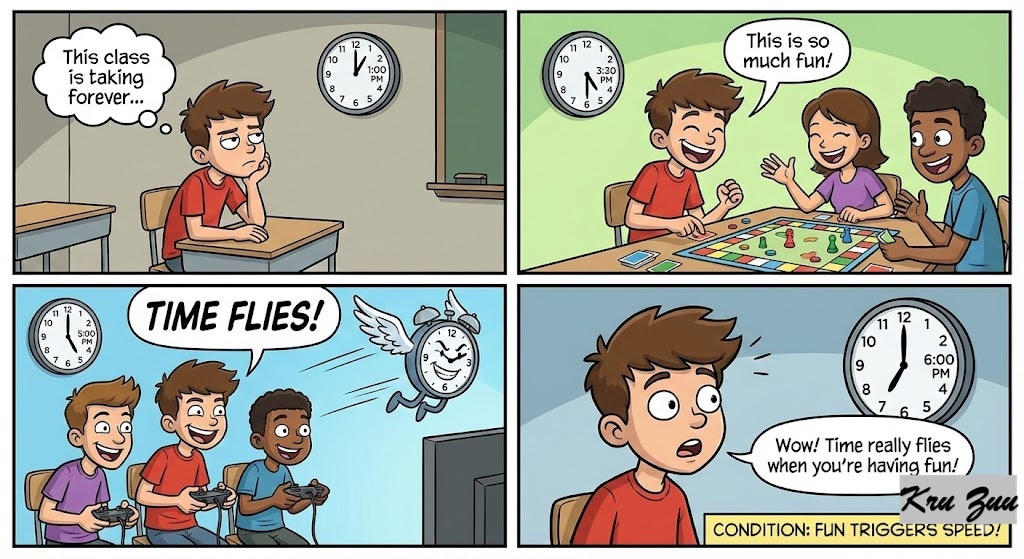

    Simpler Version: Enjoyment makes time pass quickly.

    📚 Vocabulary Vault


    Perception (Noun):
    The way you interpret or understand something. (How you see the world).
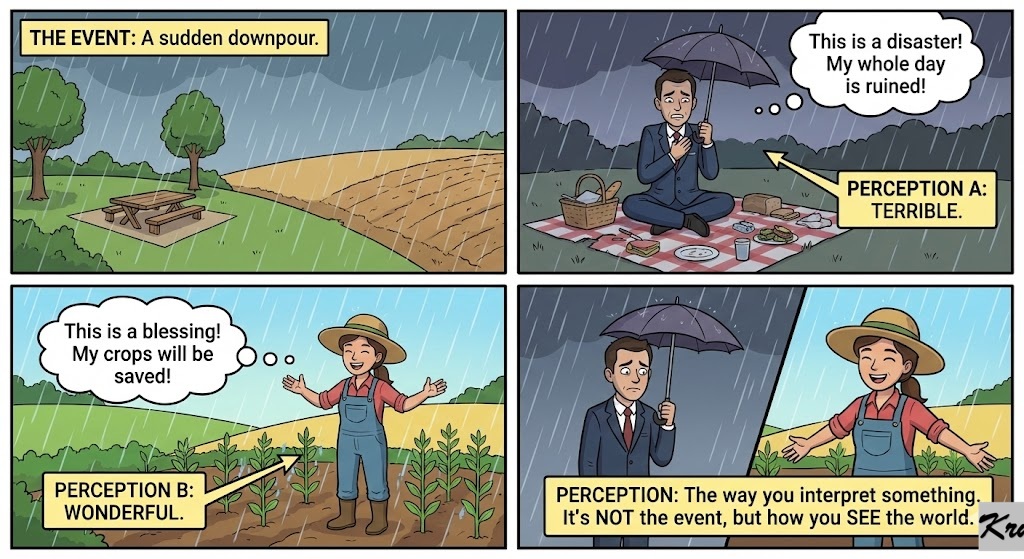

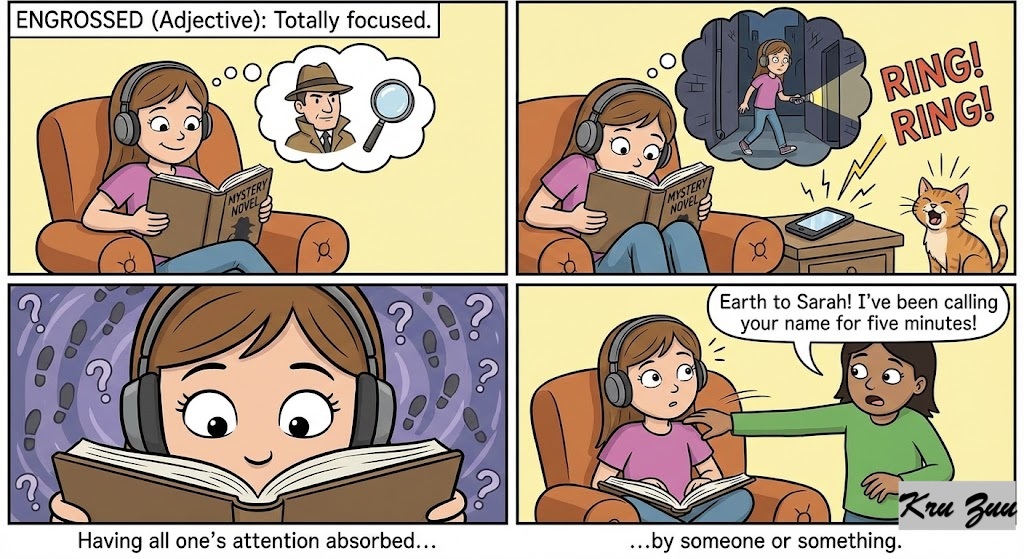
    Engrossed (Adjective): Having all one’s attention or interest absorbed by someone or something. (Totally focused). 🧠

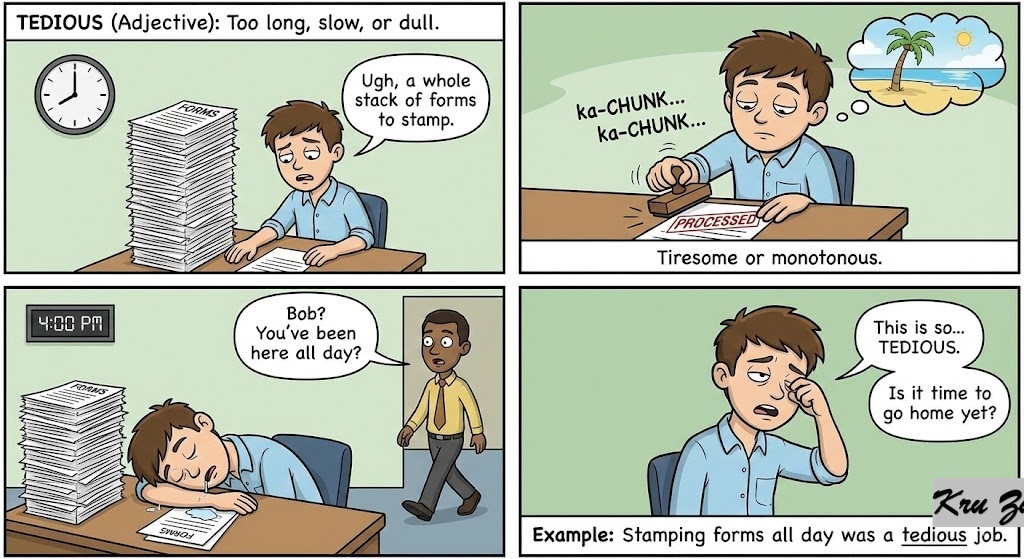
    Tedious (Adjective): Too long, slow, or dull; tiresome or monotonous.

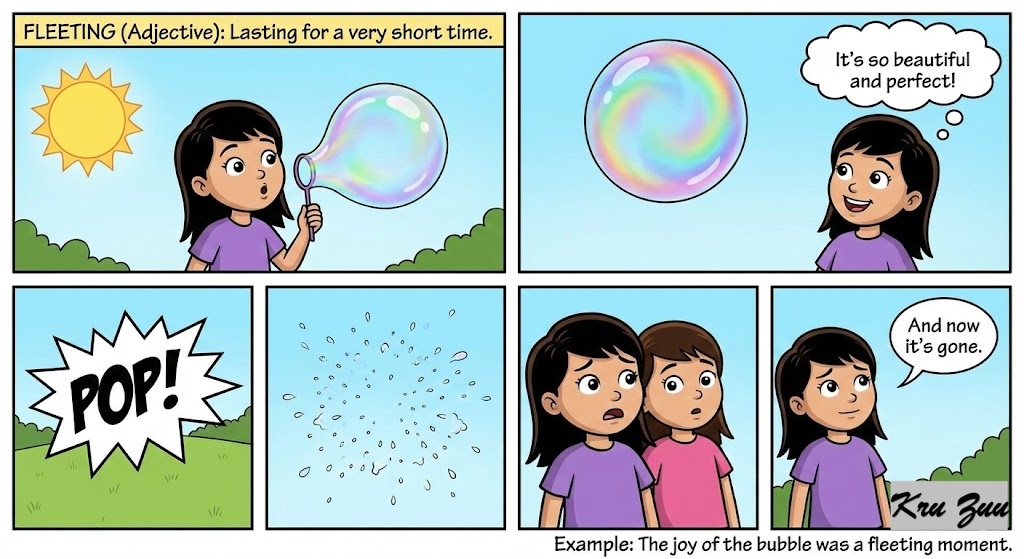
    Fleeting (Adjective): Lasting for a very short time.

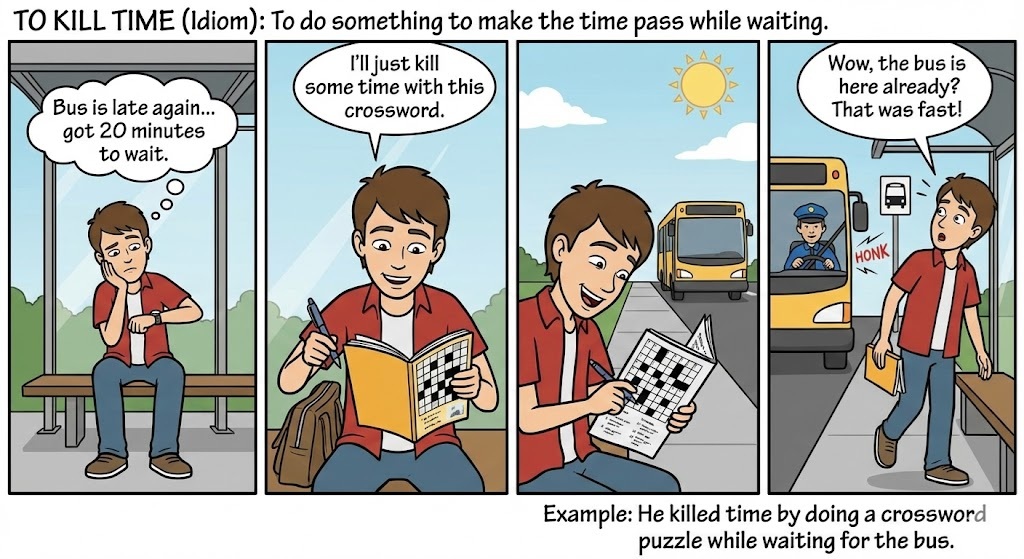
    To kill time (Idiom): To do something to make the time pass while waiting.

    🧠 Grammar Focus: Personification


    Personification is when we give human or animal qualities to non-living things.
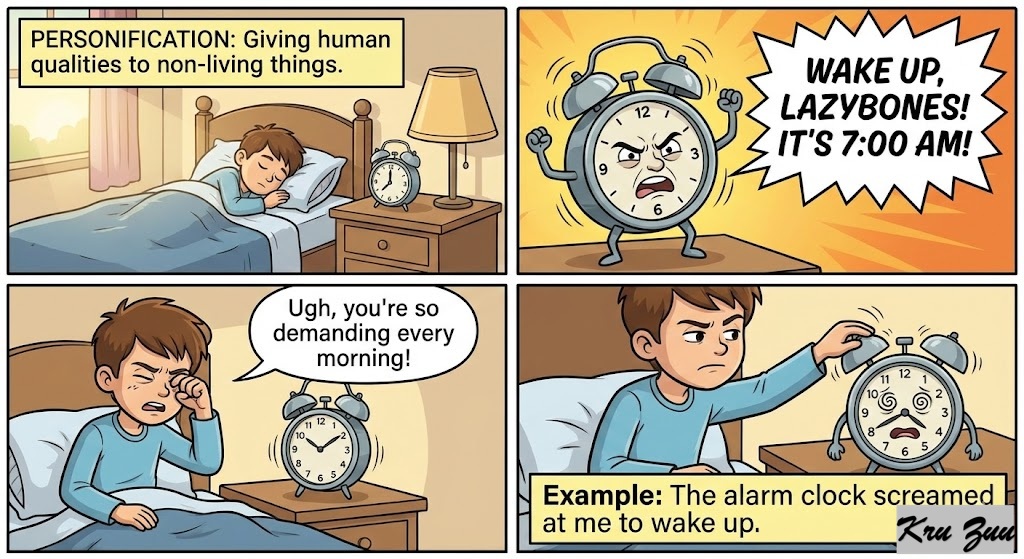

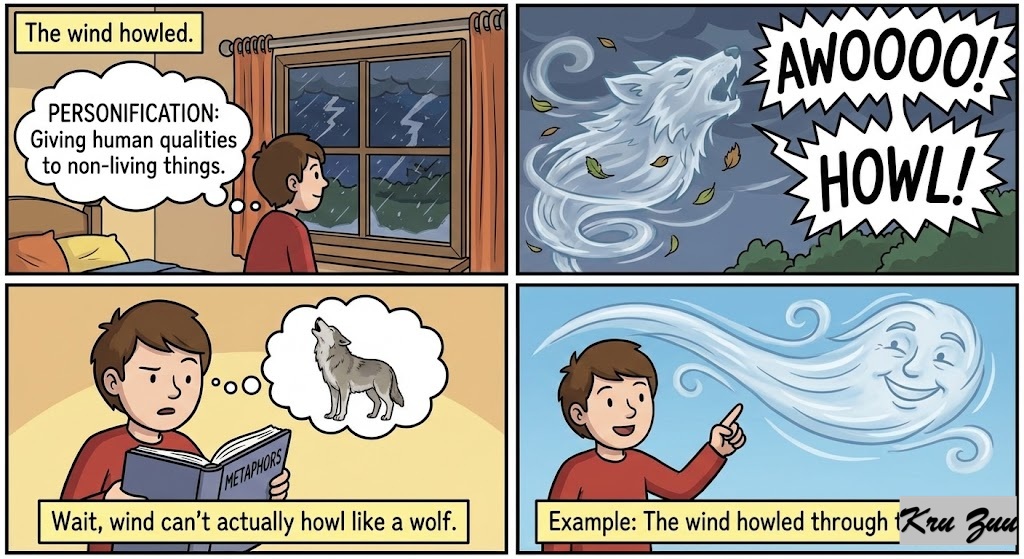
    The wind howled. (Wind can’t actually howl like a wolf).

    Time flies. (Time does not have wings or a pilot’s license).

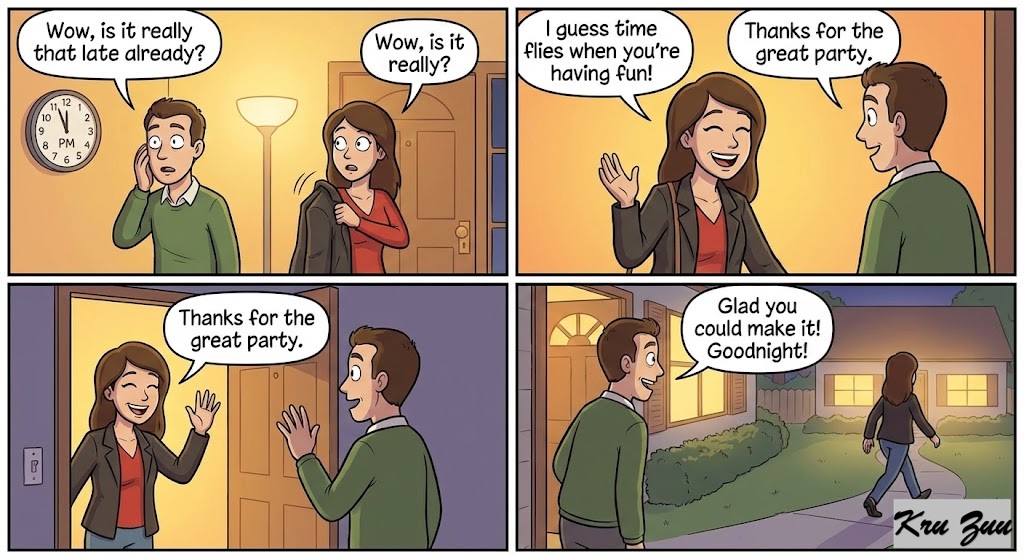
    Common Usage: You use this when you are about to leave a social gathering.
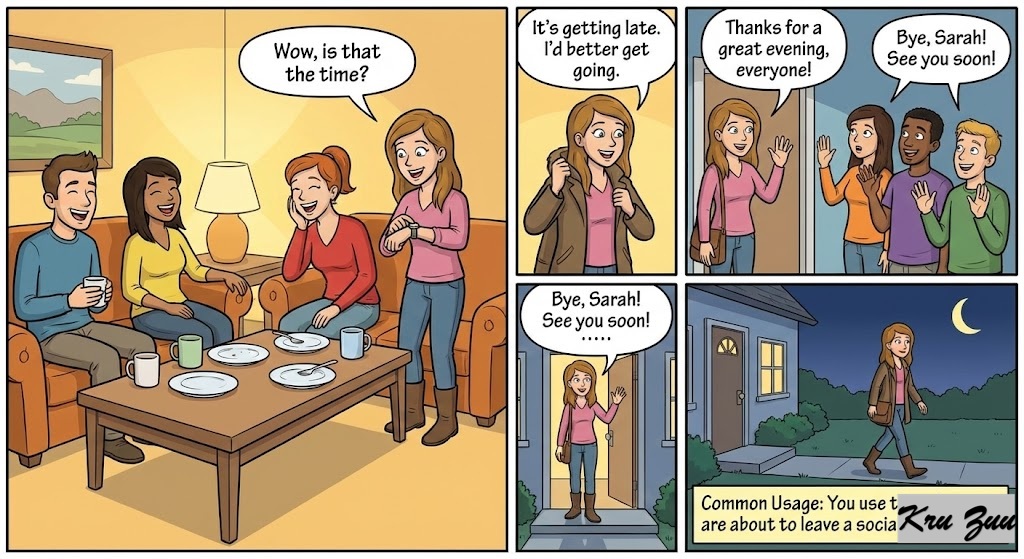

    Host: “Leaving so soon? It’s only 11 PM!”


    Guest: “Wow, is it really? I guess time flies when you’re having fun! Thanks for the great party.”
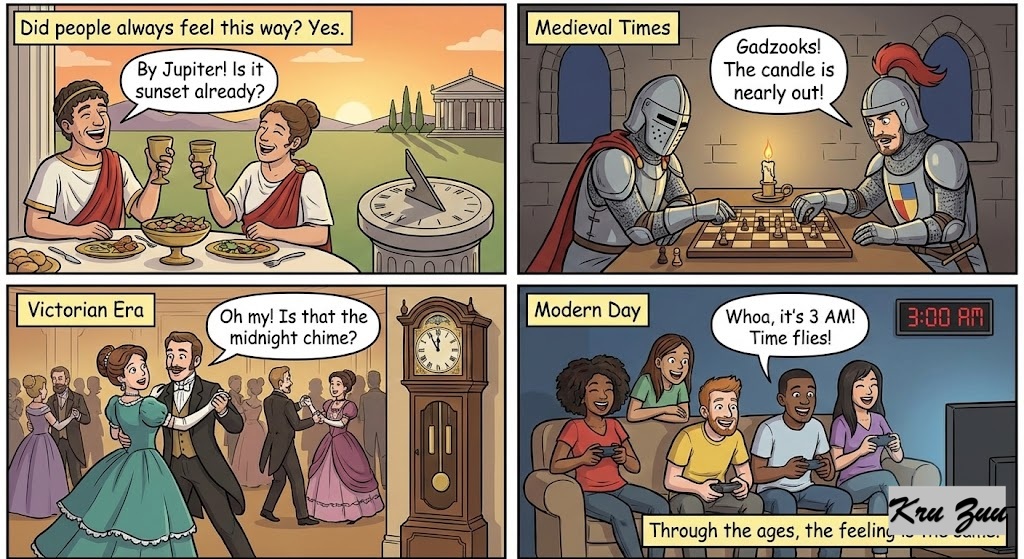
    📜 History: Origin and Spread


    Did people always feel this way? Yes.

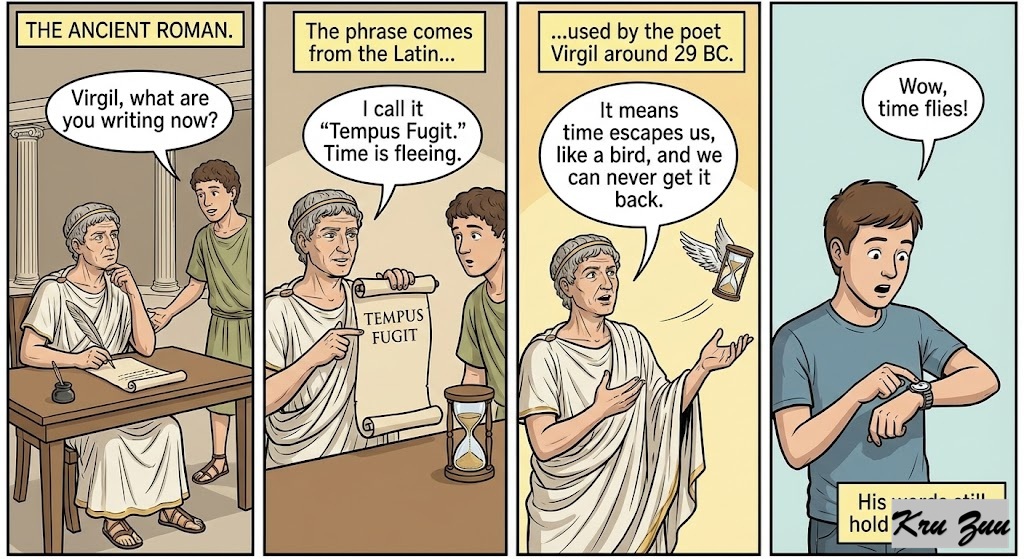
    The Ancient Roman: The phrase comes from the Latin “Tempus Fugit” (Time Fleeing), used by the poet Virgil around 29 BC. He meant that time escapes us and we can never get it back.

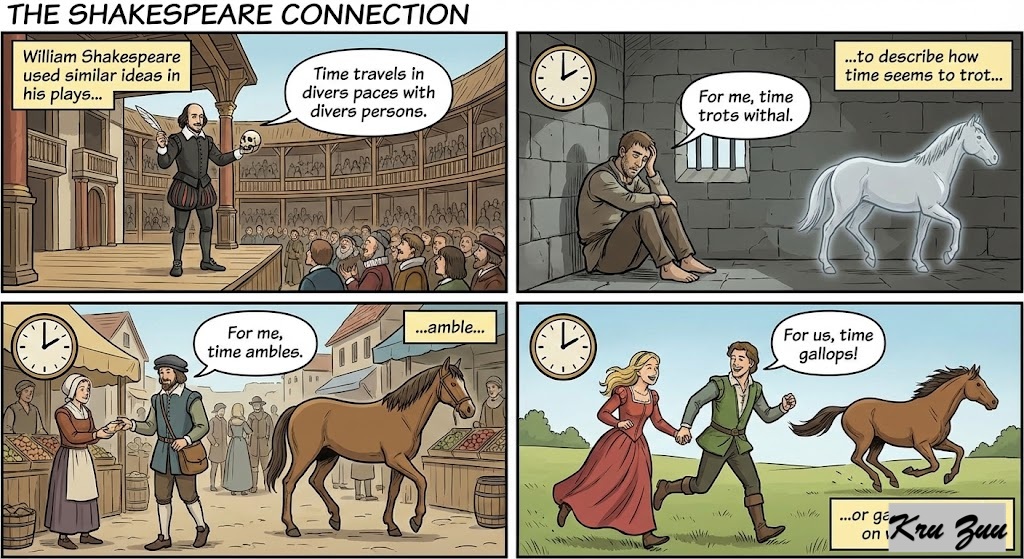
    The Shakespeare Connection: William Shakespeare used similar ideas in his plays to describe how time seems to trot, amble, or gallop depending on who you are.

    The Einstein Explanation: Even Albert Einstein, the genius of physics, used a joke to explain this:
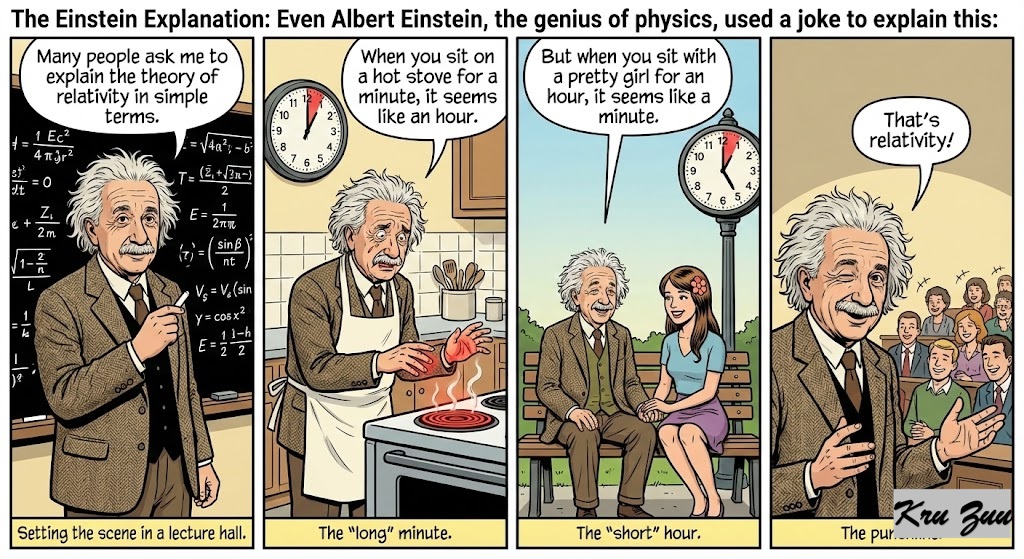

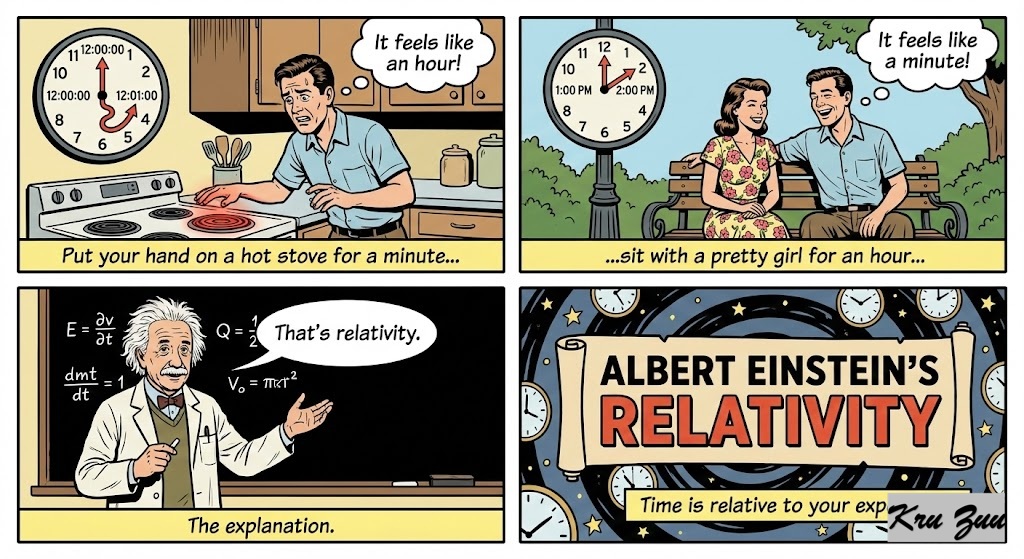
    “Put your hand on a hot stove for a minute, and it seems like an hour. Sit with a pretty girl for an hour, and it seems like a minute. That’s relativity.”
    🎭 Short Story: The Waiting Room & The Arcade 🎮🙀🐸


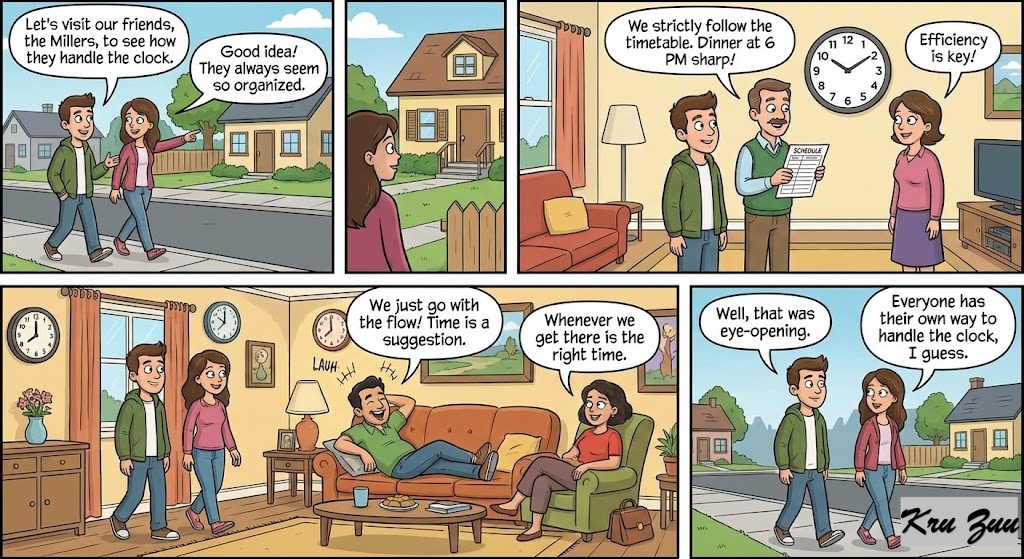
    Let’s visit our friends to see how they handle the clock.

    🌟 The Cast


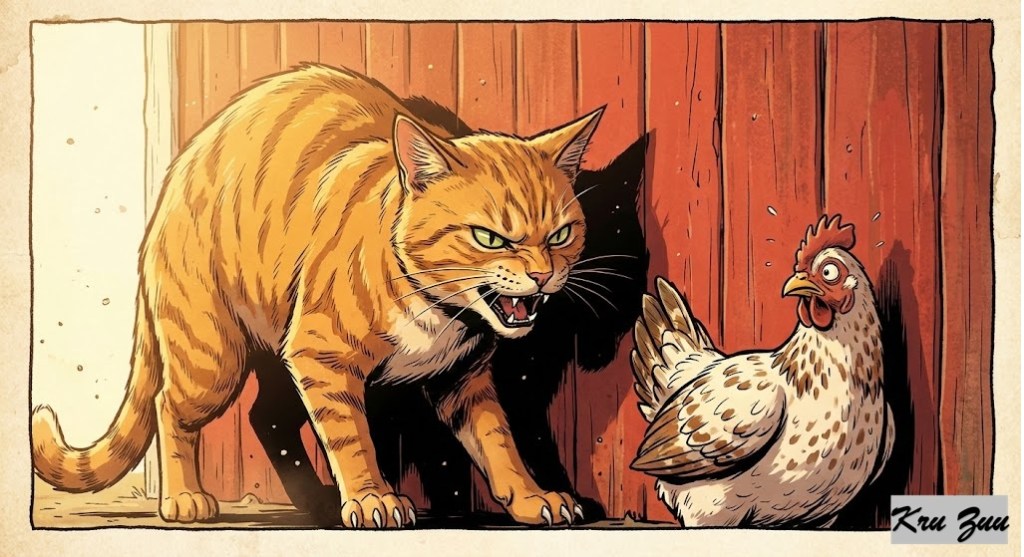
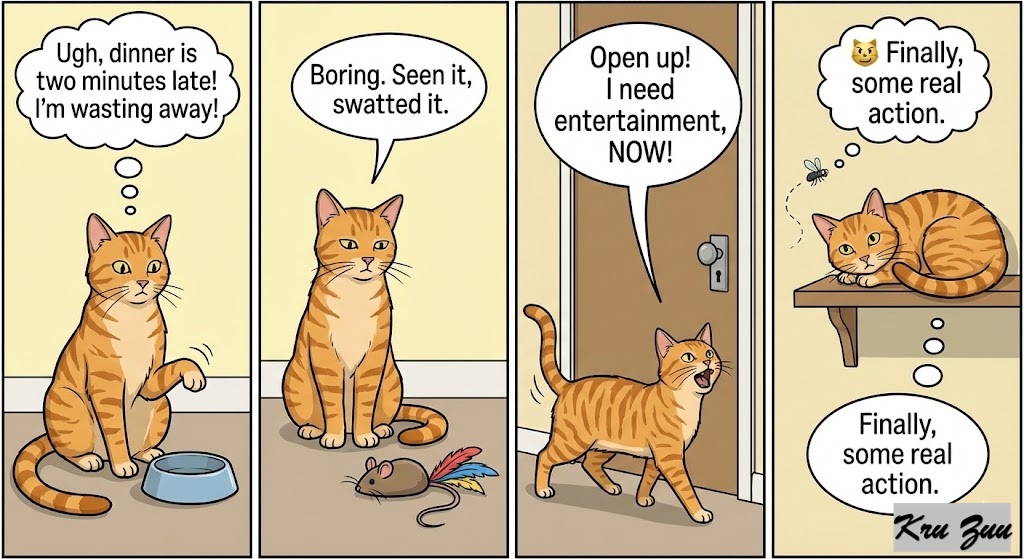
    Cleo the Cat: Impatient, hates waiting, easily bored. 😼

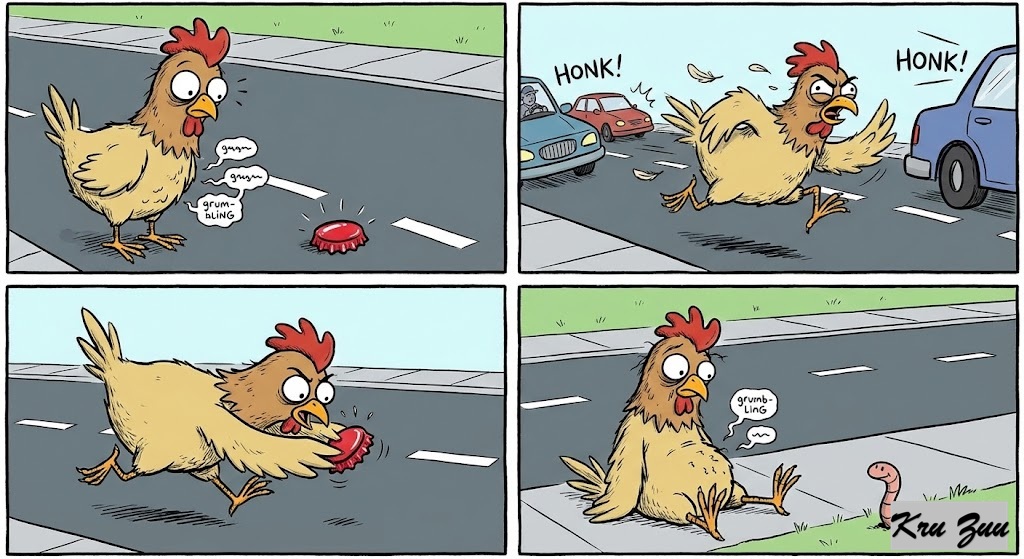
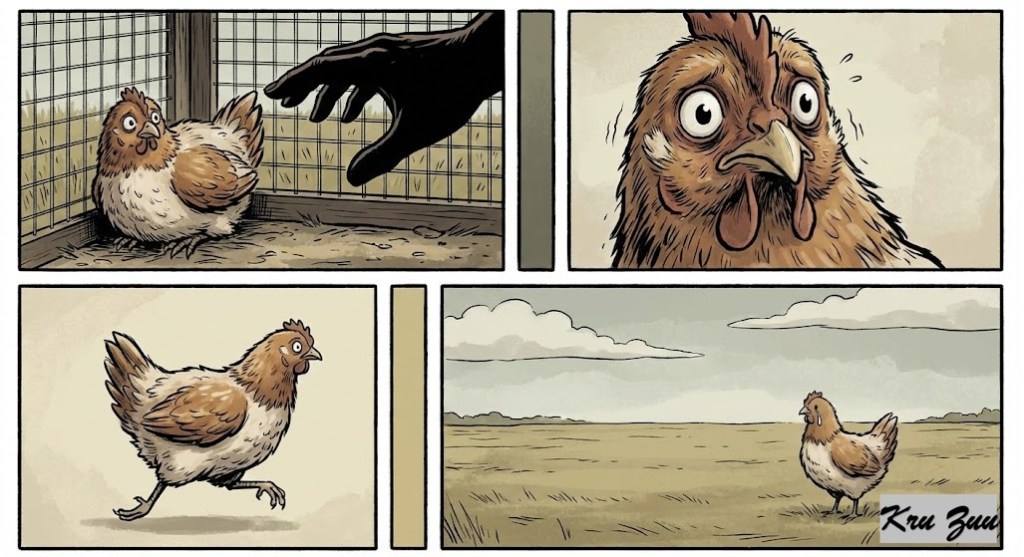
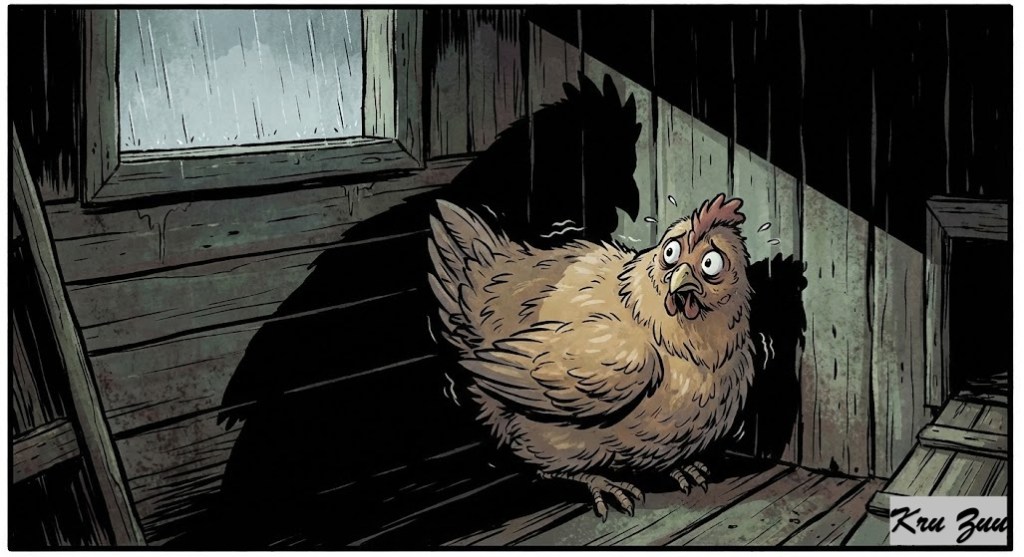
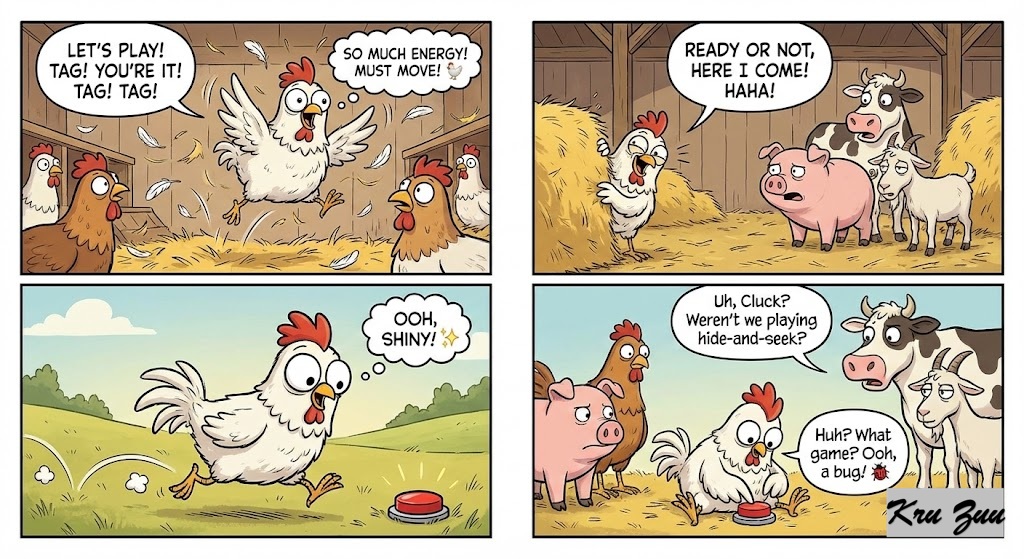
    Cluck the Chicken: Hyperactive, loves games, loses focus easily. 🐔

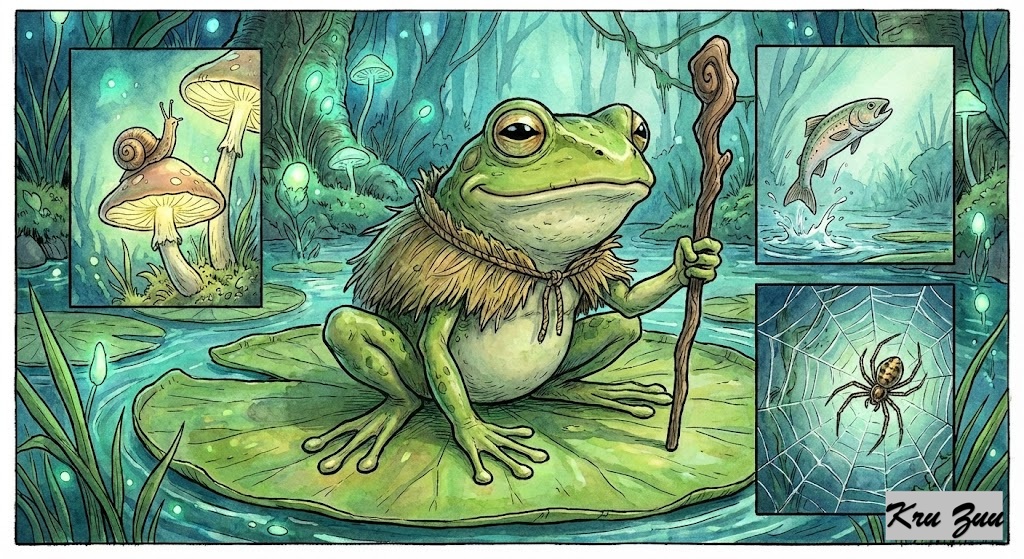
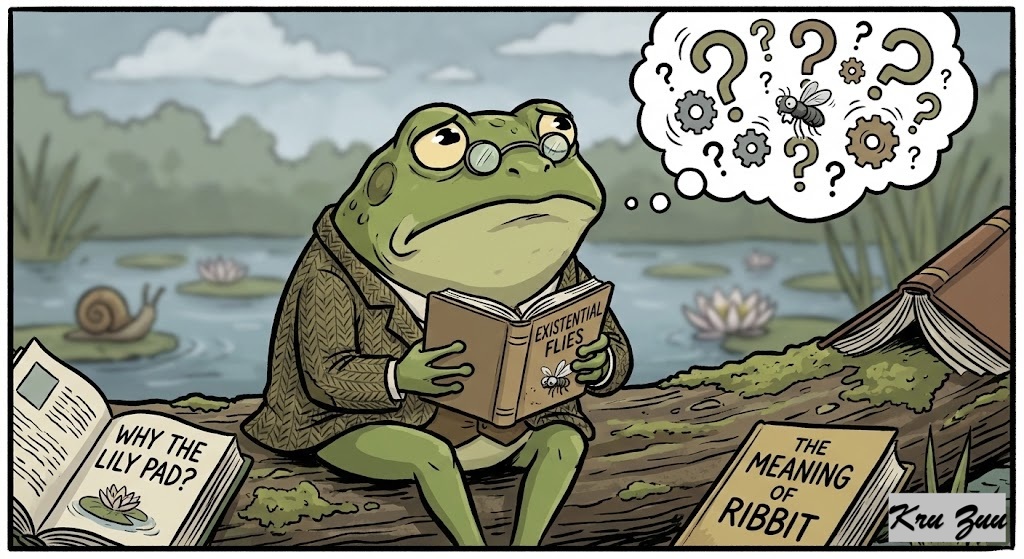
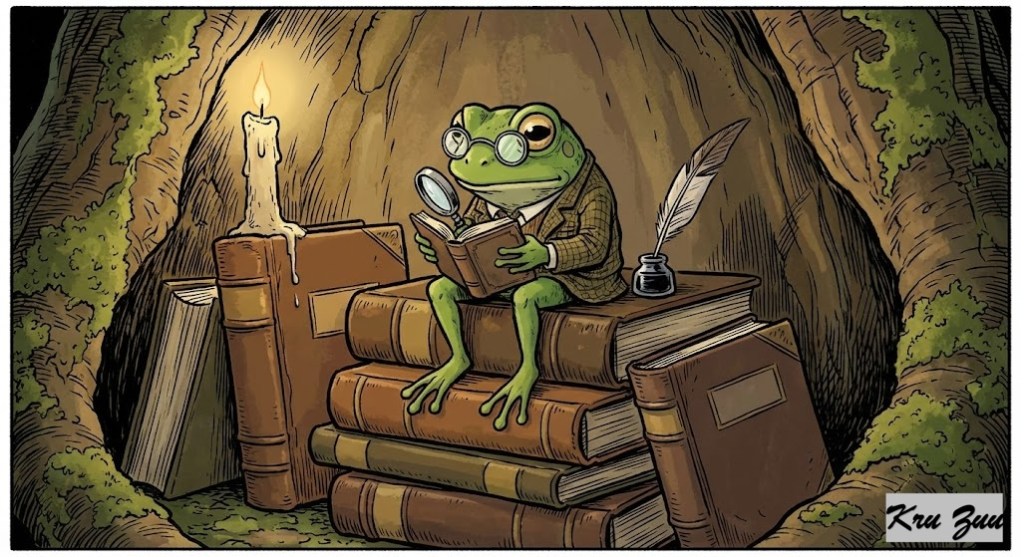
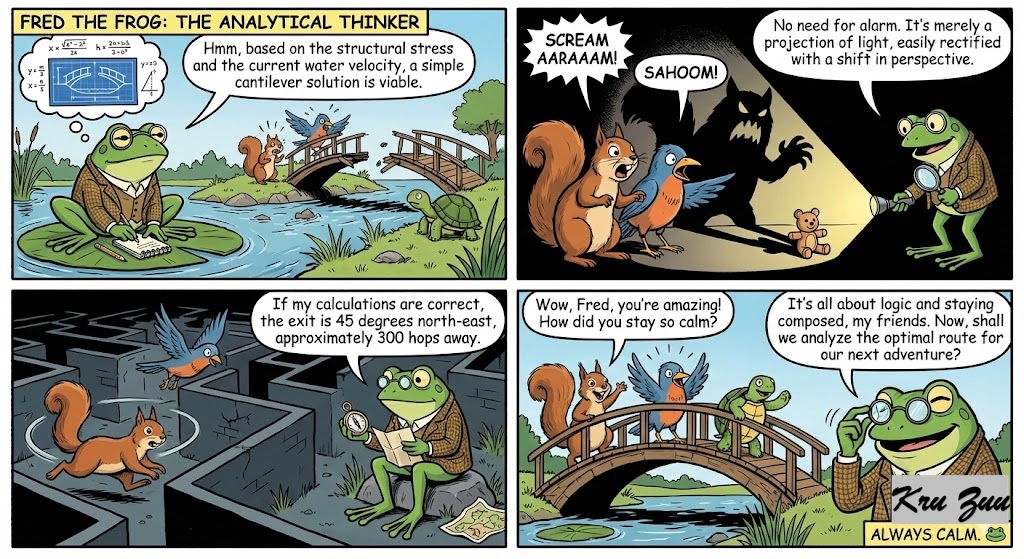
    Fred the Frog: The analytical thinker, always calm. 🐸

    The Situation: It was pouring rain. The three friends were stuck inside the “Lily Pad Station” waiting for the bus to take them to the “Super Fun Arcade.” The bus was delayed by 1 hour.


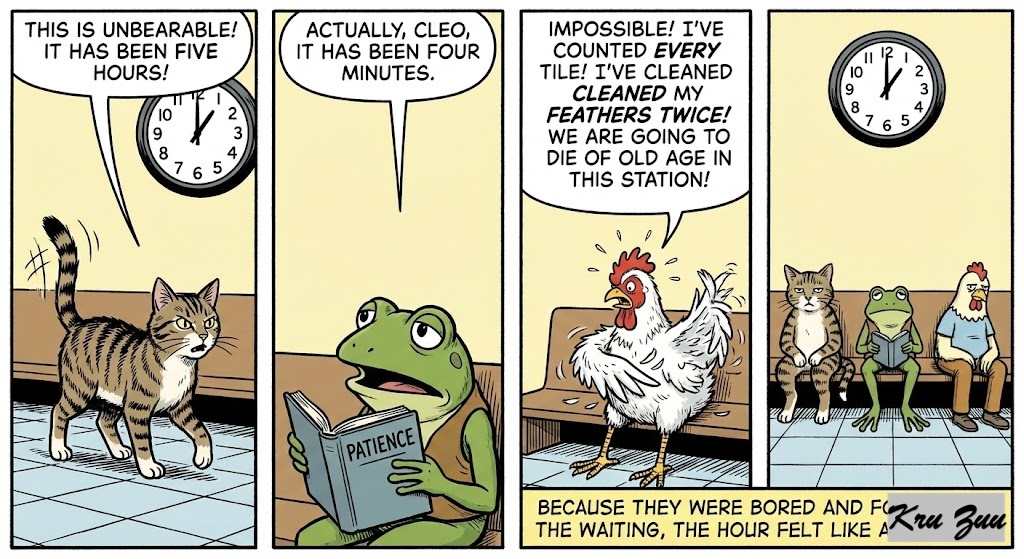
    Part 1: The Torture (The Waiting Room) Cleo paced back and forth, swishing her tail angrily. She stared at the clock on the wall. Tick… tock… tick… tock. “This is unbearable!” Cleo hissed. “It has been five hours!” Fred looked up from his book. “Actually, Cleo, it has been four minutes.” “Impossible!” Cluck squawked. “I have counted every tile on the floor. I have cleaned my feathers twice. We are going to die of old age in this station!” Because they were bored and focused on the waiting, the hour felt like a century. 🐢

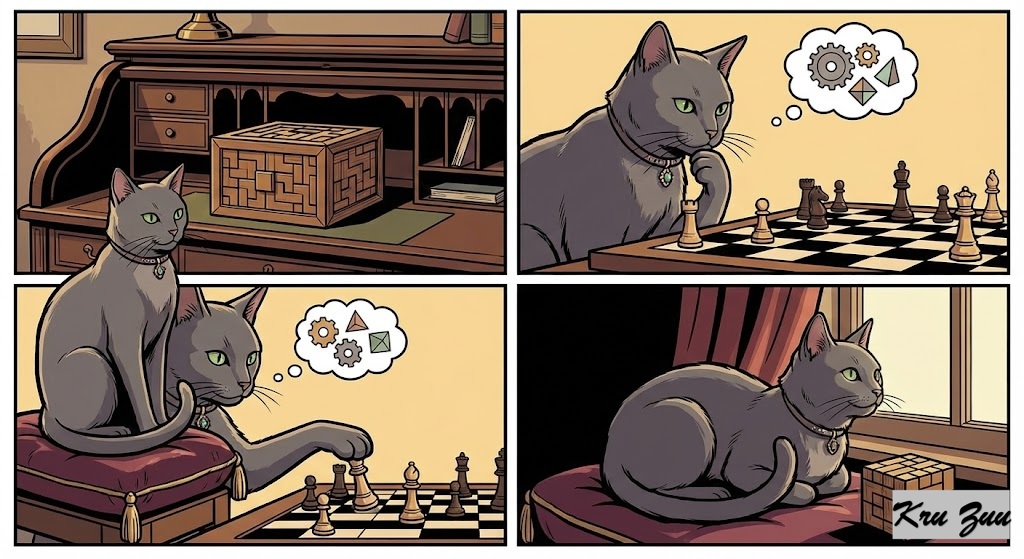
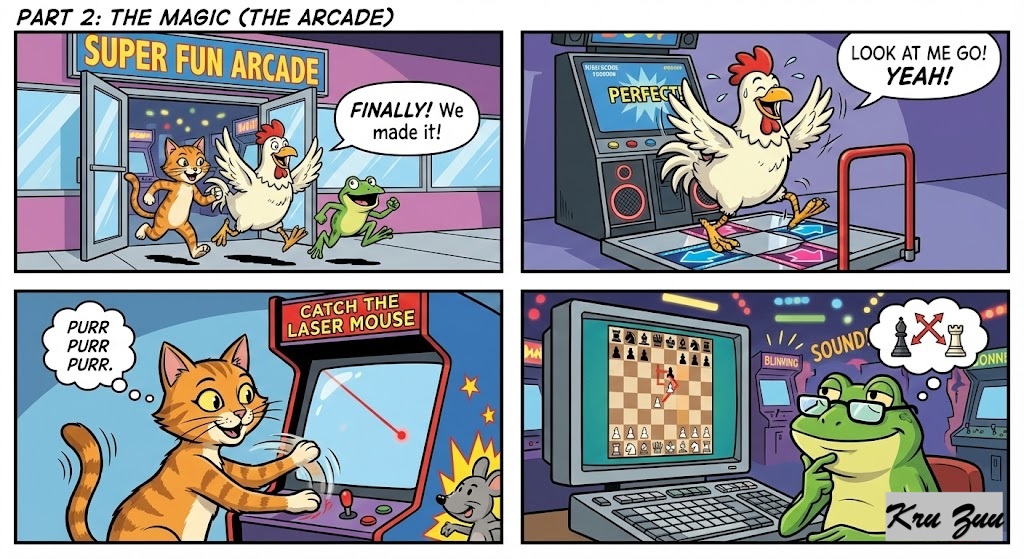
    Part 2: The Magic (The Arcade) Finally, the bus arrived. They rushed into the Super Fun Arcade. Cluck ran to the Dance-Dance-Revolution machine. “Look at me go!” he yelled, flapping his wings to the beat. Cleo found a game called Catch the Laser Mouse. She was obsessed. She jumped, swiped, and purred, completely engrossed in the game. Fred found a difficult chess computer. He calculated moves, tapped his chin, and smiled.

    The Shock: Suddenly, a loud buzzer sounded. BZZZZT! The lights flickered. A security guard walked in. “Closing time, folks!” Cluck froze mid-dance. “What? We just got here!” Cleo looked around, confused. “Don’t be rude. We’ve only played for 10 minutes.” Fred checked his pocket watch. “Ribbit,” he croaked. ” actually, we have been here for six hours.”
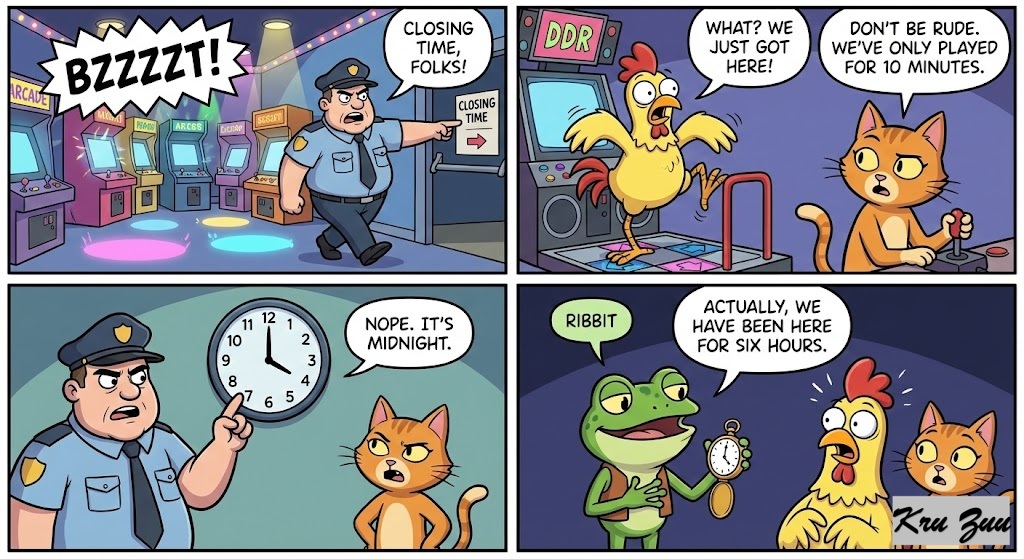

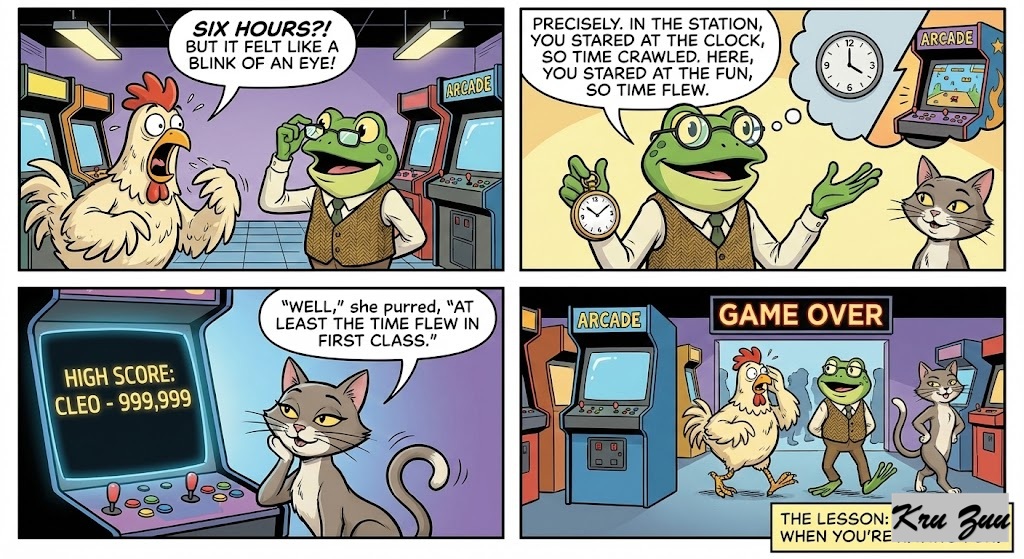
    The Lesson: “Six hours?!” Cluck screamed. “But it felt like a blink of an eye!” Fred adjusted his glasses. “Precisely. In the station, you stared at the clock, so time crawled. Here, you stared at the fun, so time flew.” Cleo sighed, looking at her high score. “Well,” she purred, “At least the time flew in first class.”

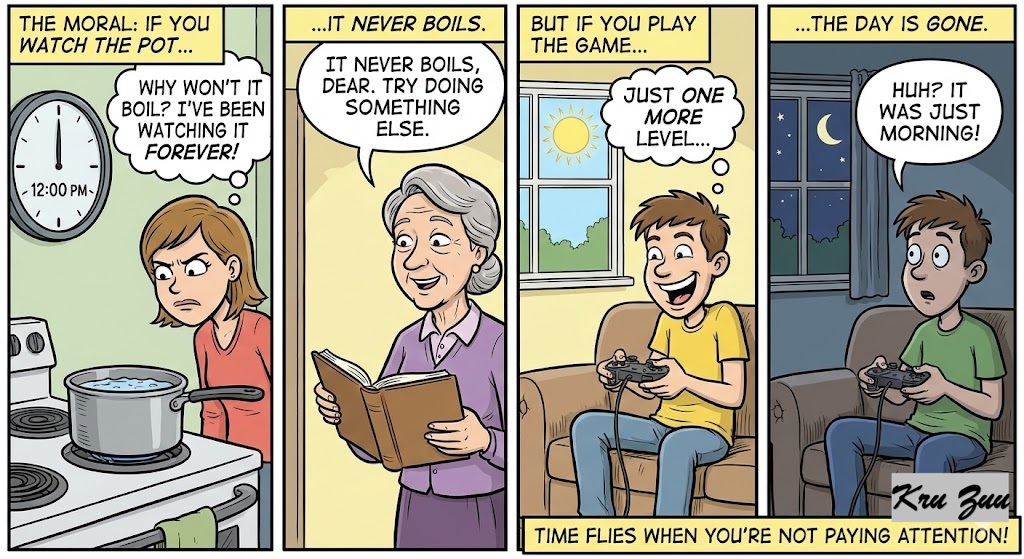
    The Moral: If you watch the pot, it never boils. If you play the game, the day is gone.
    🎓 Lesson for English Learners


    How to apologize for being late (using the idiom).
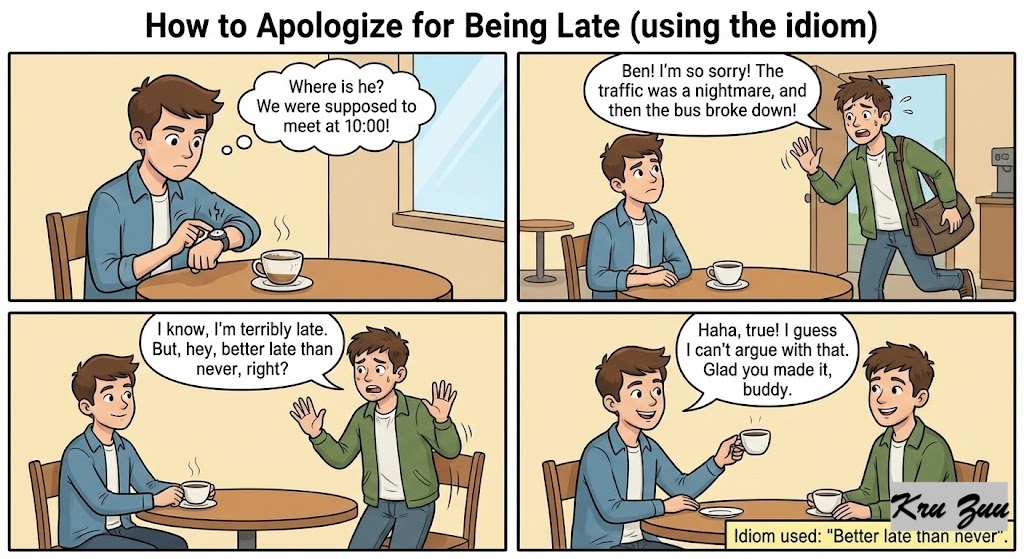

    Situation: You are having coffee with a friend. You are talking and laughing. You realize you are late for your next meeting.
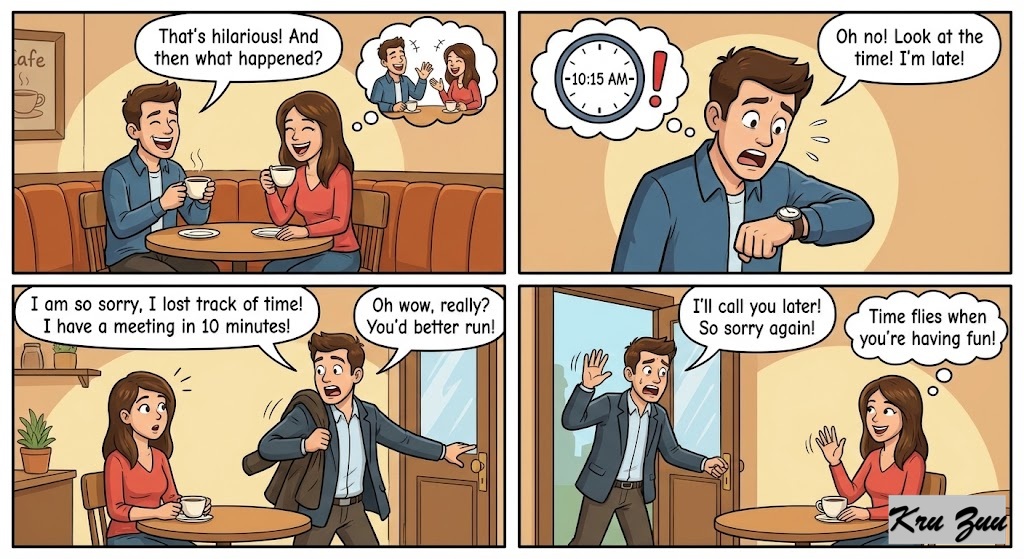
    The Shift: Instead of just saying “I have to go,” acknowledge the quality of the time spent.
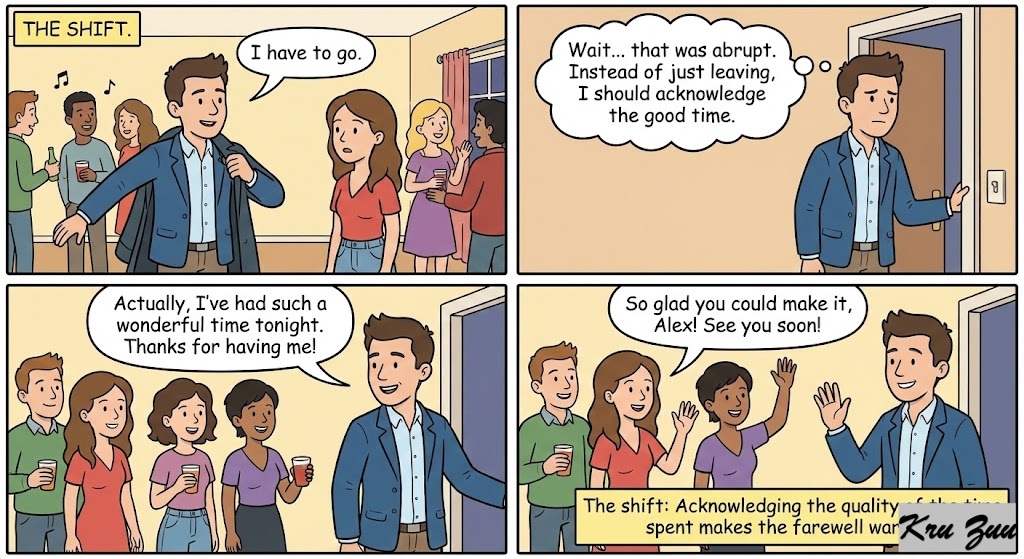
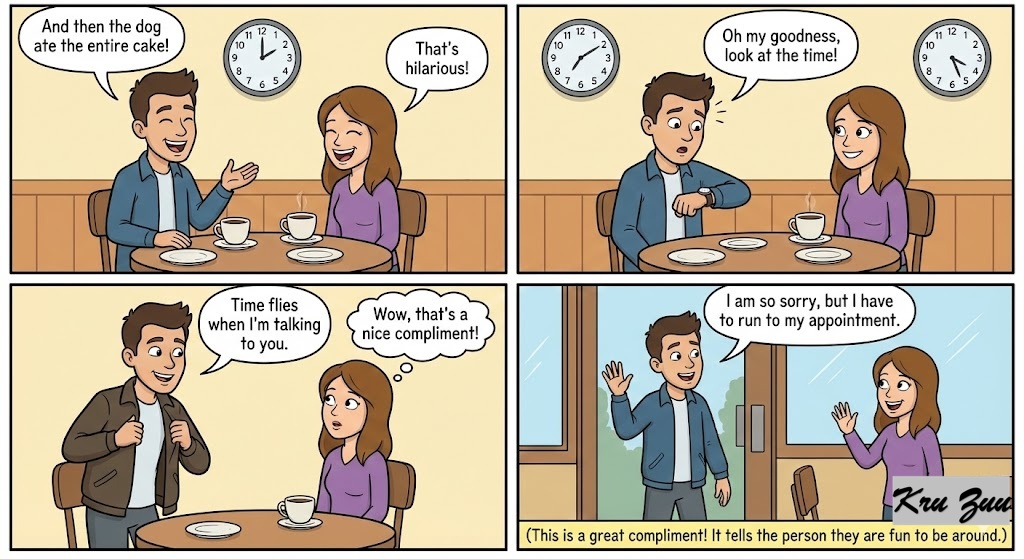
    You Say: “Oh my goodness, look at the time! Time flies when I’m talking to you. I am so sorry, but I have to run to my appointment.” (This is a great compliment! It tells the person they are fun to be around.)

    💬 Your Turn: The “Flow” Challenge 🚀


    Do you want to master your time?
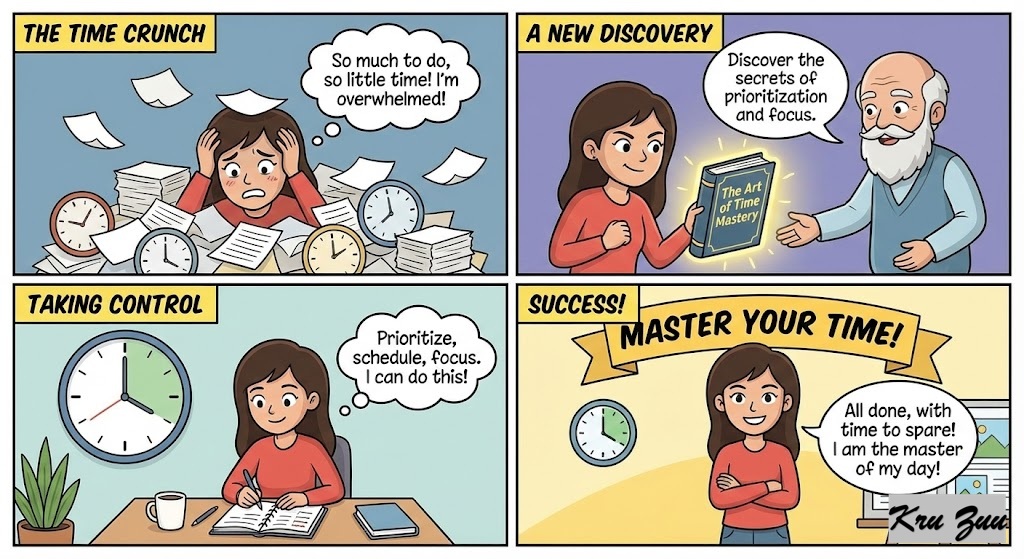

    The Challenge: Identify your “Time Machine” activity.
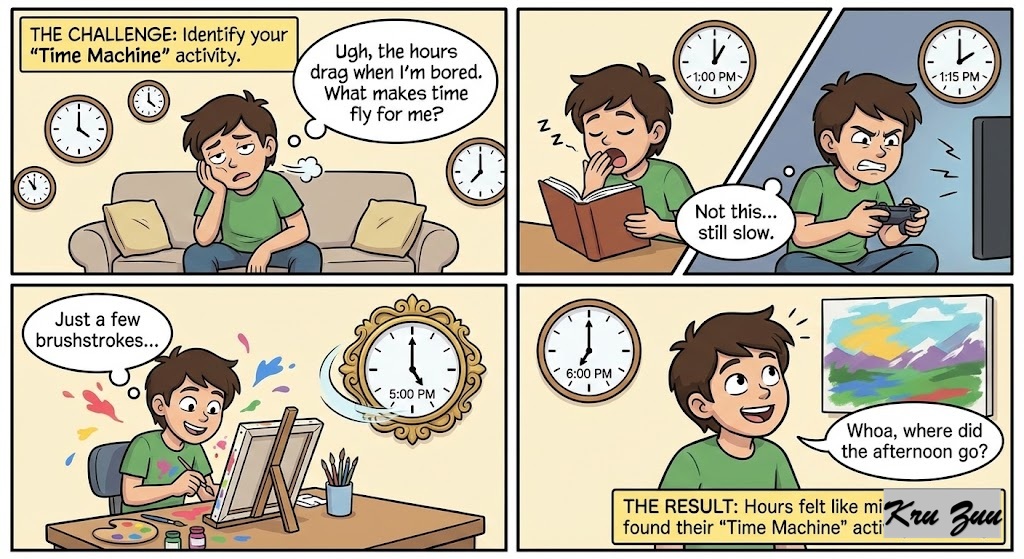

    Think of the last time you looked at the clock and were shocked that hours had passed.


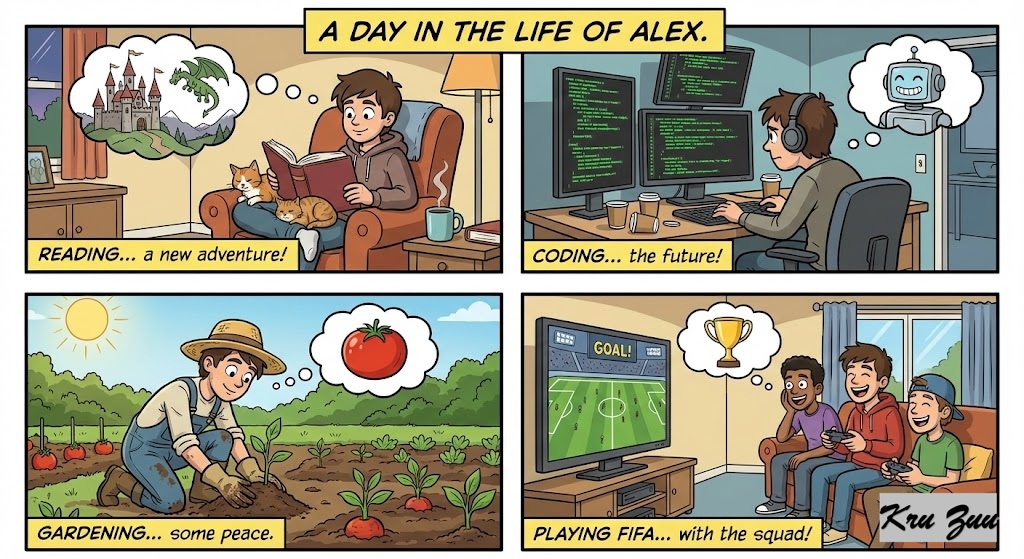
    What were you doing? (Reading? Coding? Gardening? Playing FIFA?)

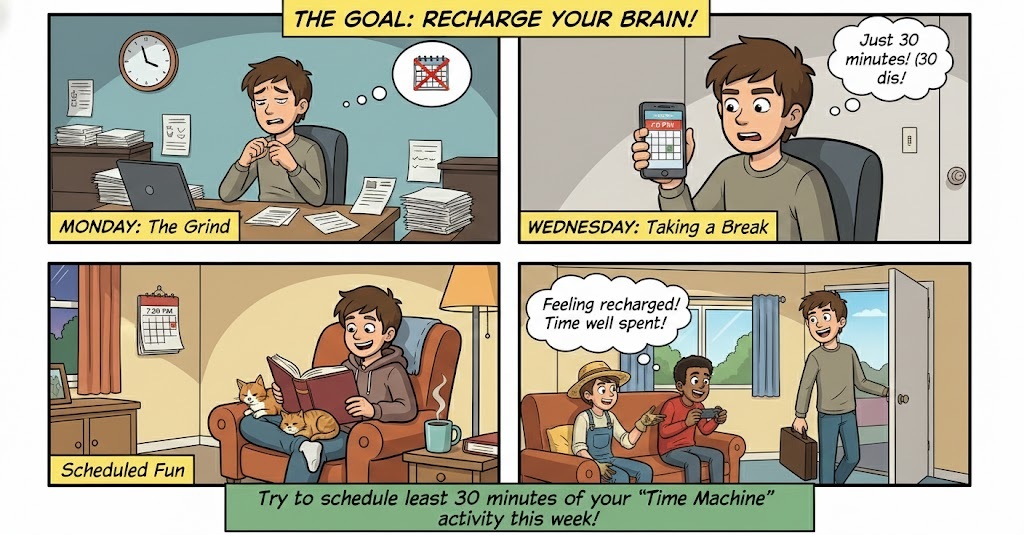
    The Goal:
    Try to schedule at least 30 minutes of that activity this week to recharge your brain.

    👇 Question for the comments: What is the ONE activity that makes time fly for you? For me, it’s writing these blog posts! Let me know below! 👇

    By Zubeyir YURTKURAN

    https://www.facebook.com/BrainBattleground/

    https://www.facebook.com/zubeyr.yurtkuran/

    https://www.instagram.com/zubeyryurtkuran/

    https://www.youtube.com/@BrainBattleground-b3p

    https://www.instagram.com/brainbattleground/

  • 🌳 The Daily Shield: The Law of Rooted Character

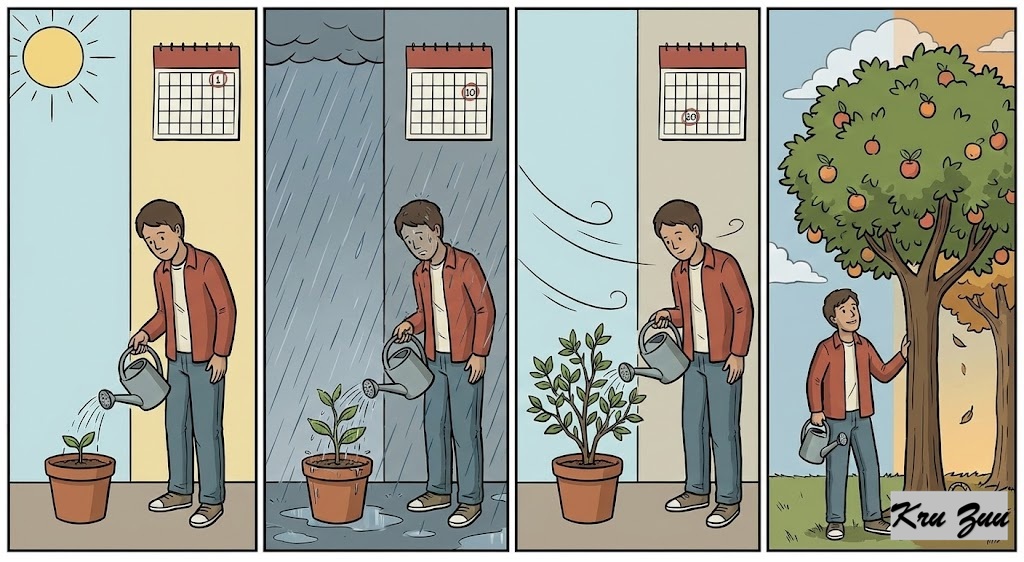
    🌳 The Daily Shield: The Law of Rooted Character

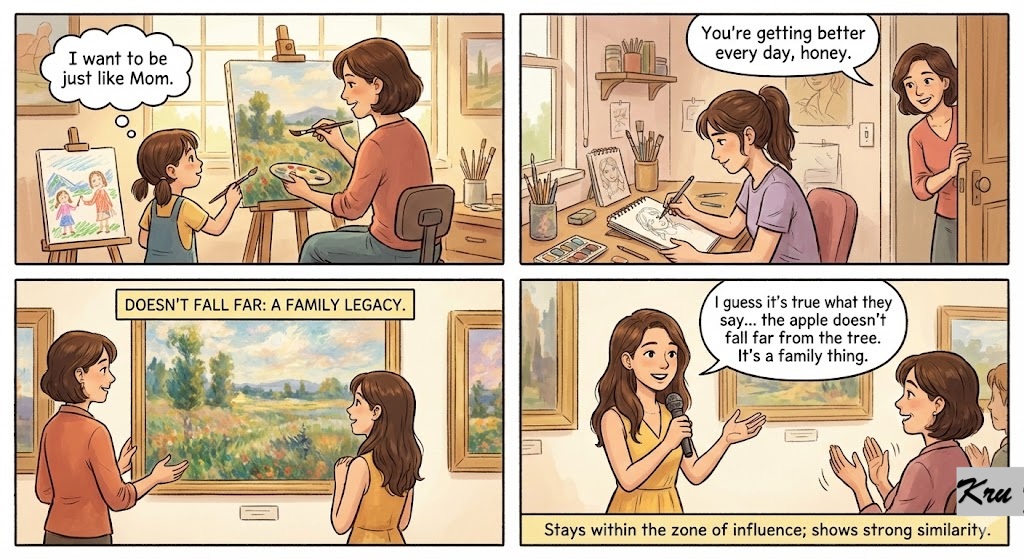
    “The apple doesn’t fall far from the tree.”


    😈 The Villain (The Blame Shifter)


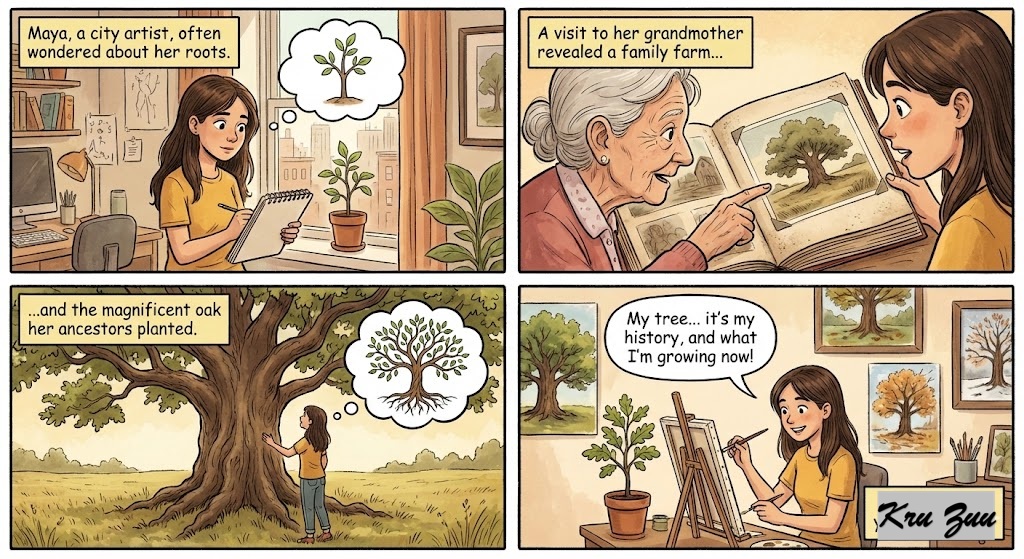
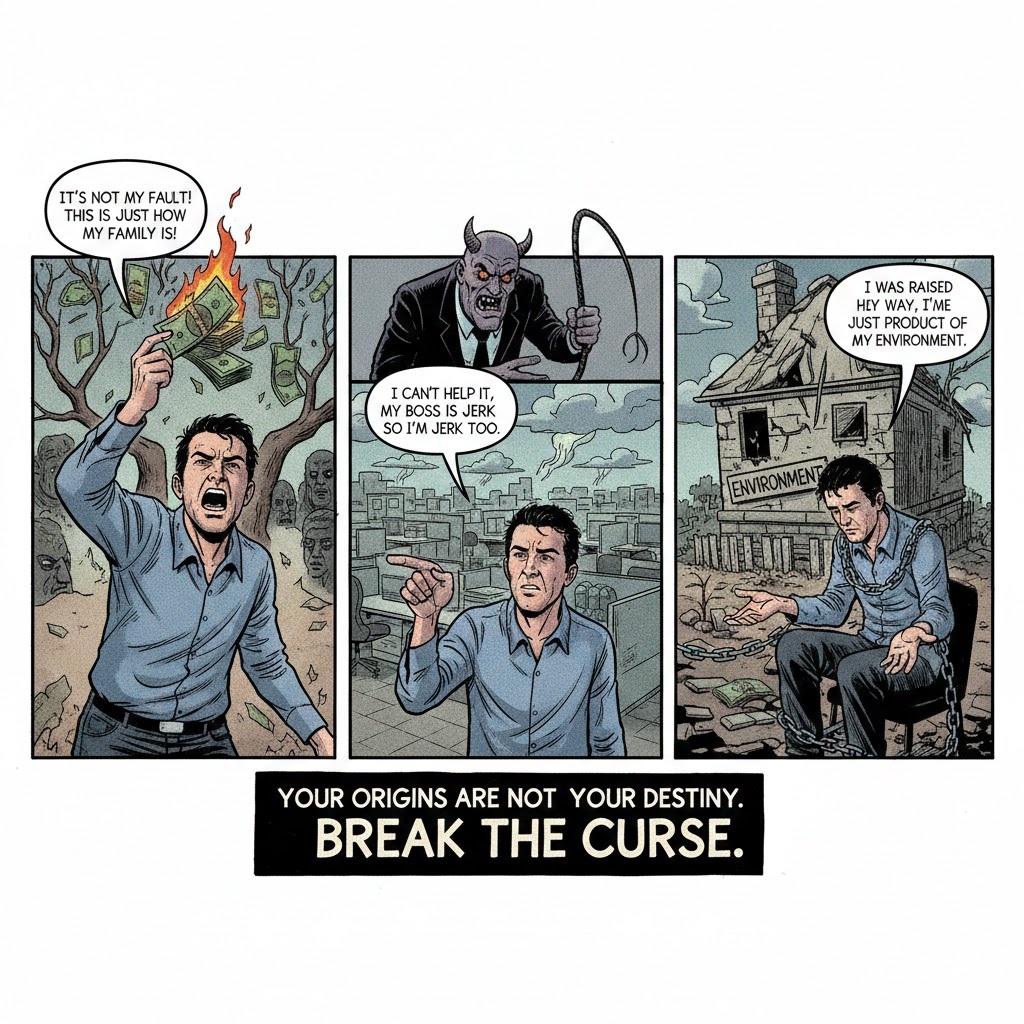
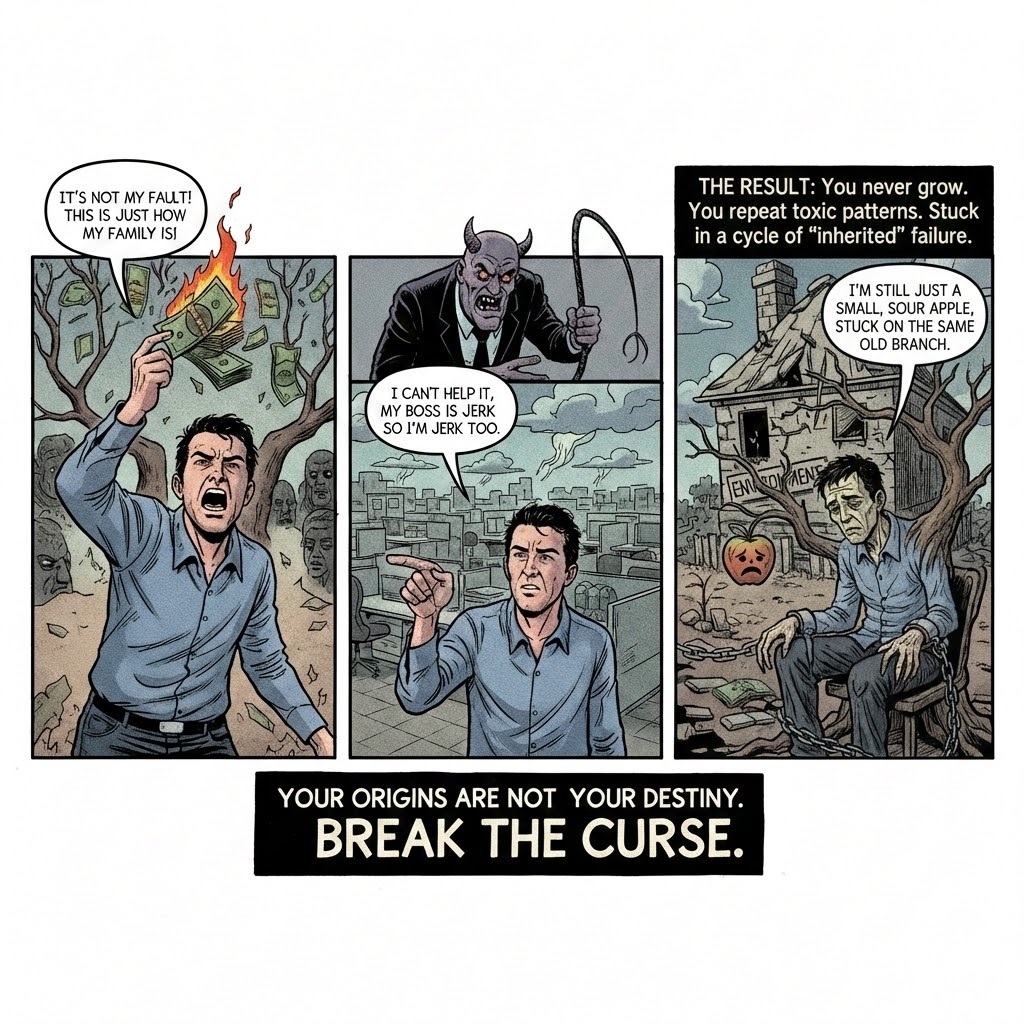
    You make a mistake. You lose your temper. You act dishonestly. 💸 “It’s not my fault! This is just how my family is!””I can’t help it, my boss is a jerk so I’m a jerk too.””I was raised this way, I’m just a product of my environment.” You treat your character like a fixed curse. You use your origins as an excuse for your poor choices today.

    The Result? You never grow. You repeat the same toxic patterns. You feel stuck in a cycle of “inherited” failure. You stay a small, sour apple because you refuse to see that you are still attached to the same old branch. 🍎


    😇 The Hero (The Cycle Breaker)


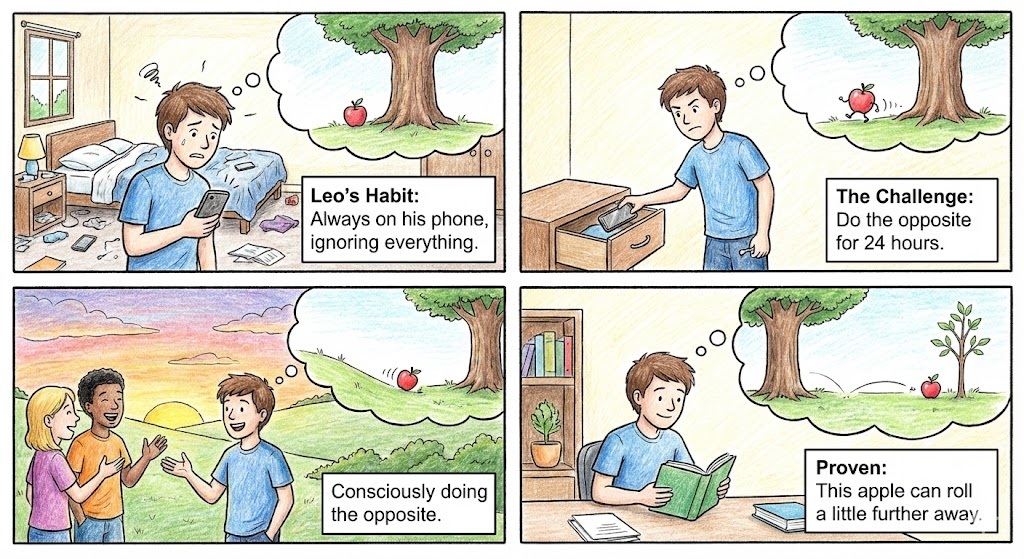
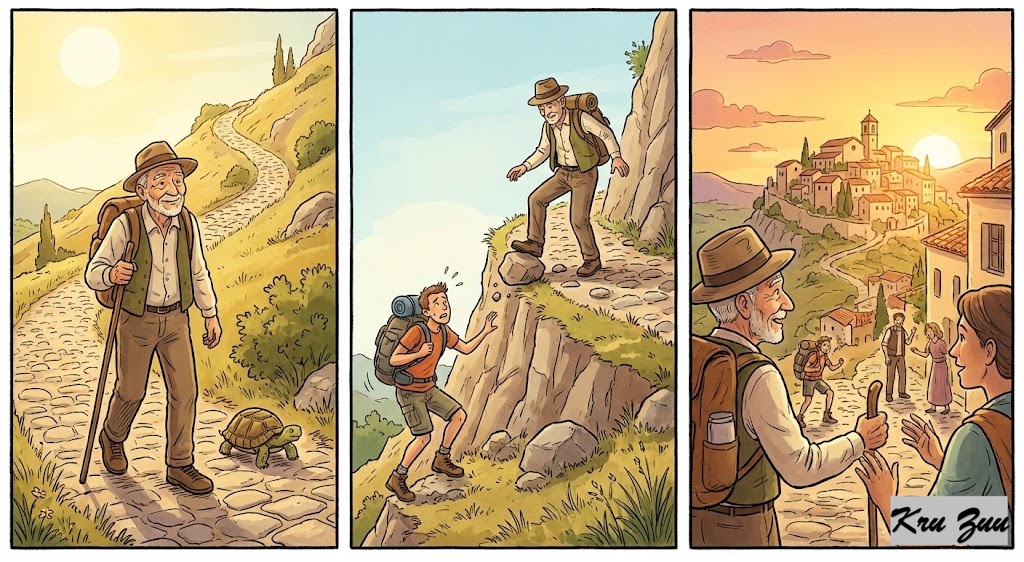
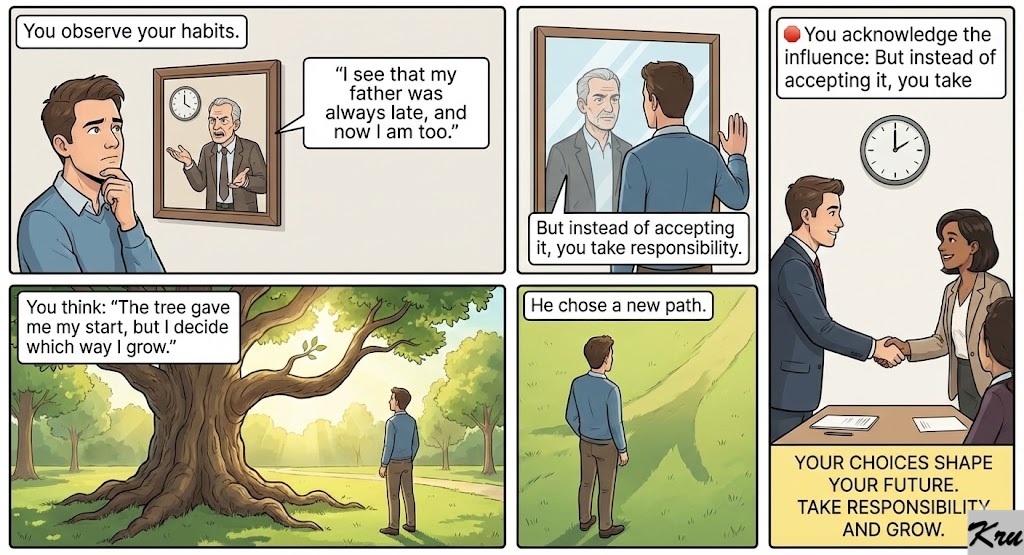
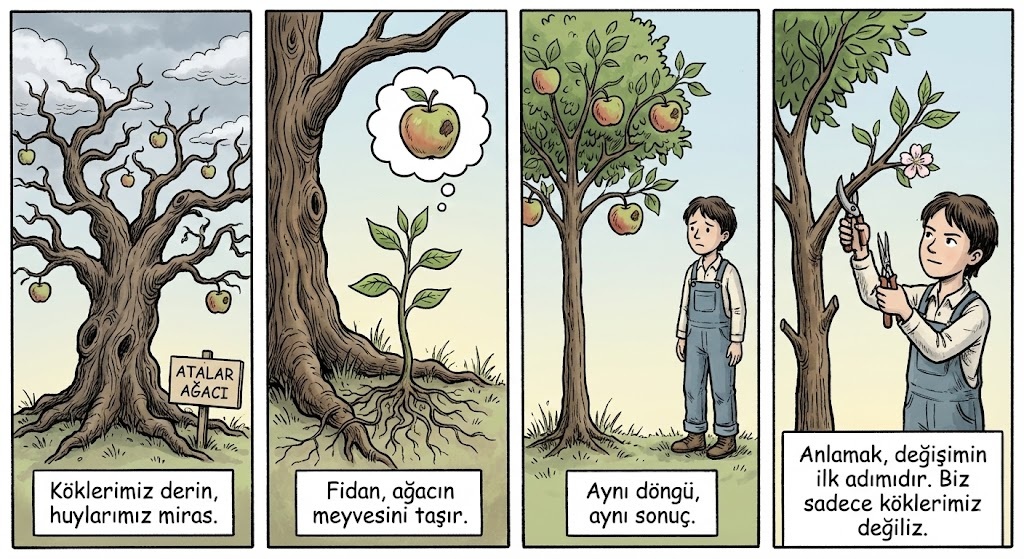
    You observe your habits. You look at your parents, your mentors, or your peers. 🛑 You acknowledge the influence: “I see that my father was always late, and now I am too.” But instead of accepting it, you take responsibility. You think: “The tree gave me my start, but I decide which way I grow.”

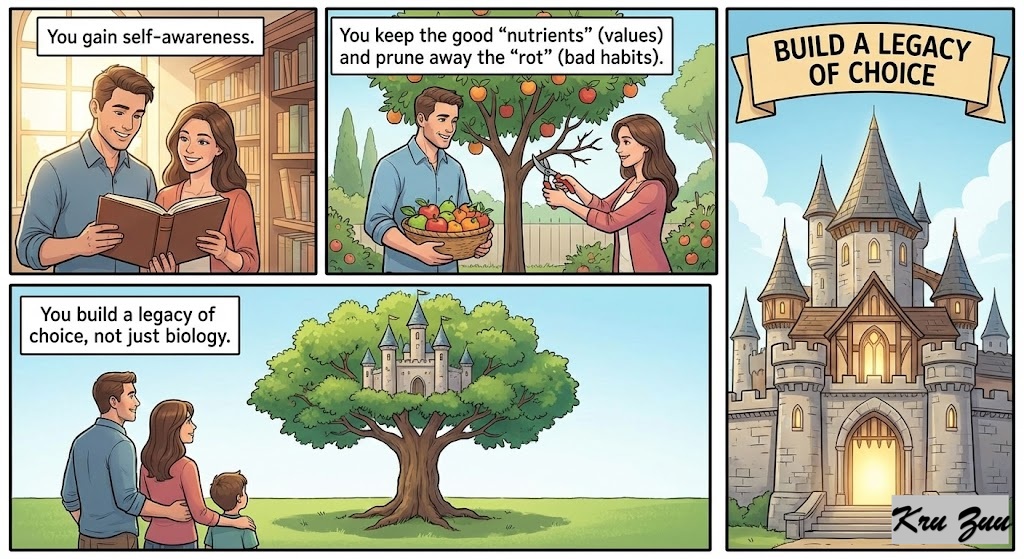
    The Result? You gain self-awareness. You keep the good “nutrients” (values) and prune away the “rot” (bad habits). You build a legacy of choice, not just biology. 🏰


    ⚖️ The Reality


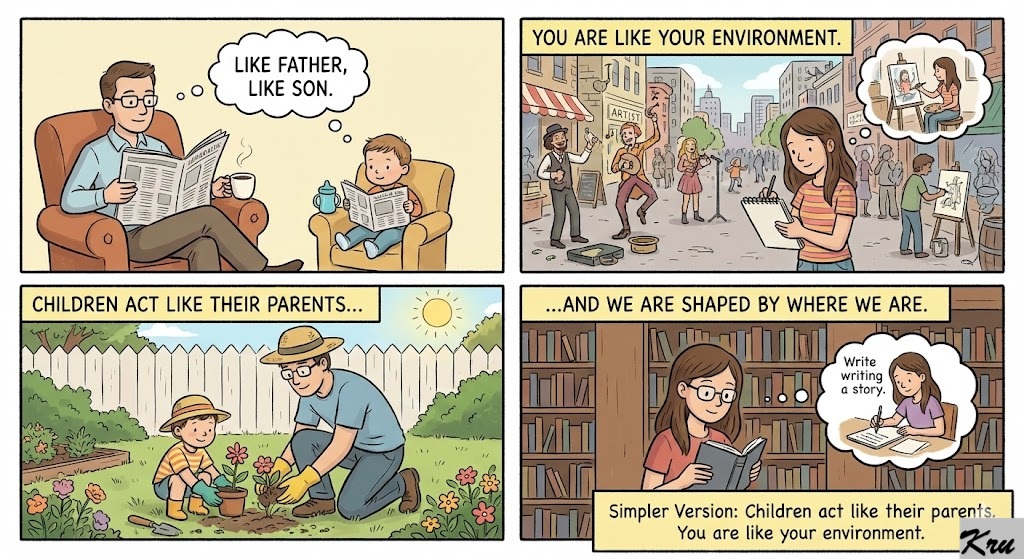
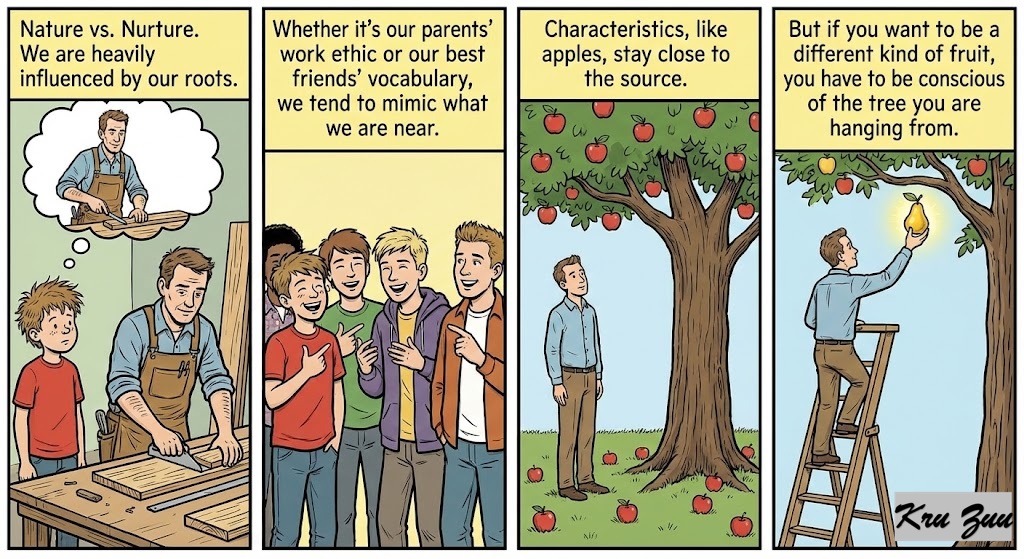
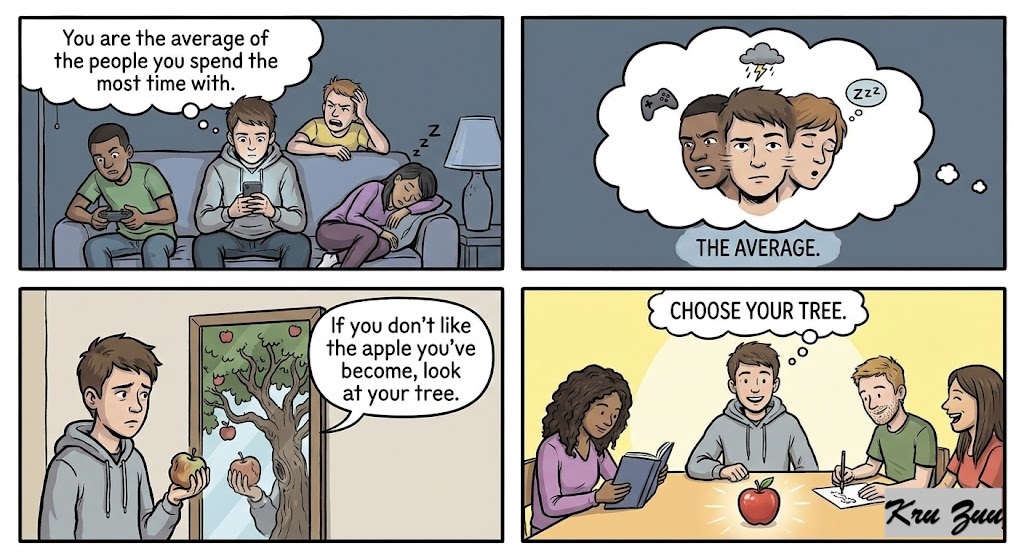
    Nature vs. Nurture. We are heavily influenced by our roots. Whether it’s our parents’ work ethic or our best friends’ vocabulary, we tend to mimic what we are near. Characteristics, like apples, stay close to the source. But while the proverb highlights similarity, it also serves as a warning: if you want to be a different kind of fruit, you have to be conscious of the tree you are hanging from.


    The Secret: You are the average of the people you spend the most time with. If you don’t like the apple you’ve become, look at your tree.

    🧐 The Anatomy of the Proverb


    This is a biological metaphor for behavioral inheritance.


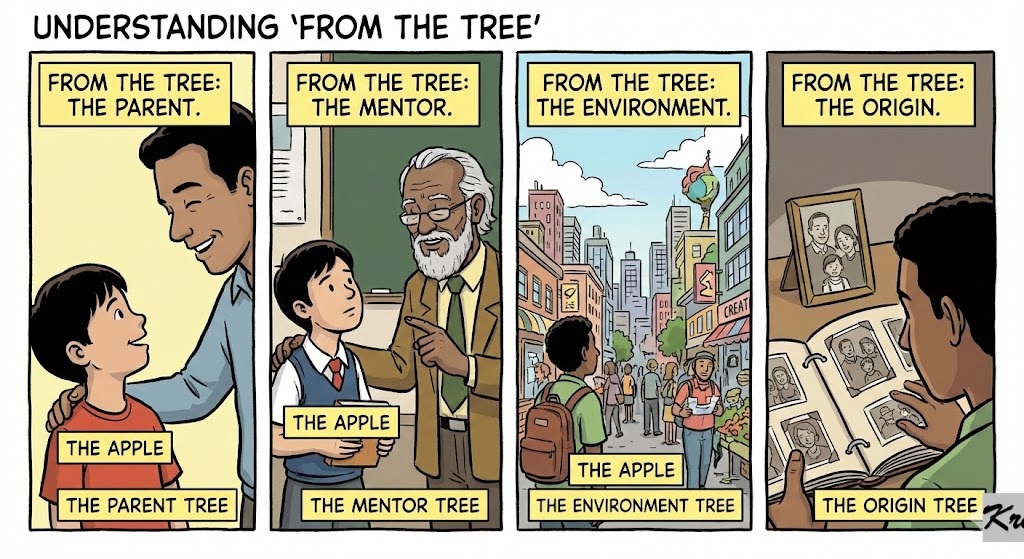
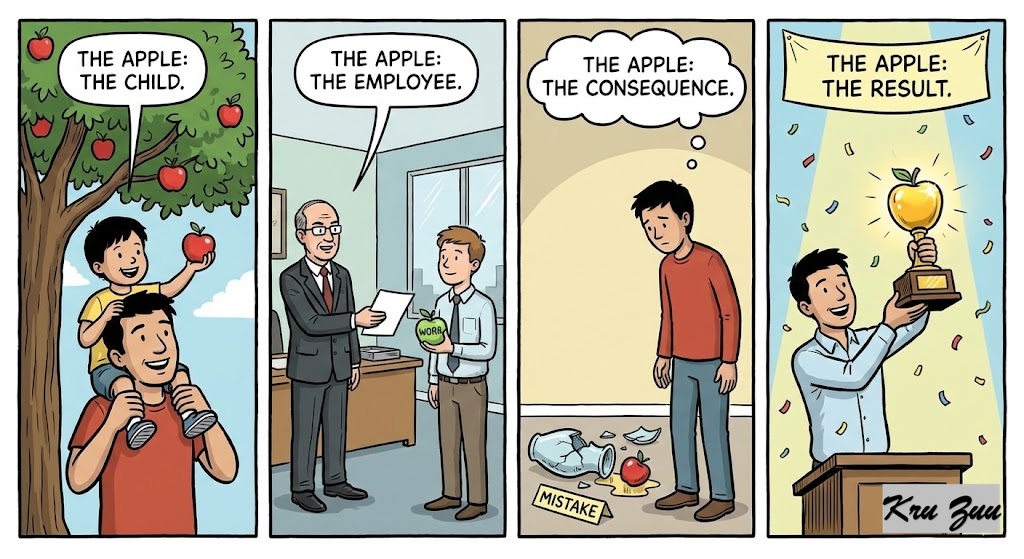
    The Apple (Noun): The child, the employee, the consequence, or the result.


    Doesn’t Fall Far (Adverbial Phrase): Stays within the zone of influence; shows strong similarity.


    From The Tree (Prepositional Phrase): The parent, the mentor, the environment, or the origin.


    Simpler Version: Children act like their parents. / You are like your environment.


    📚 Vocabulary Vault


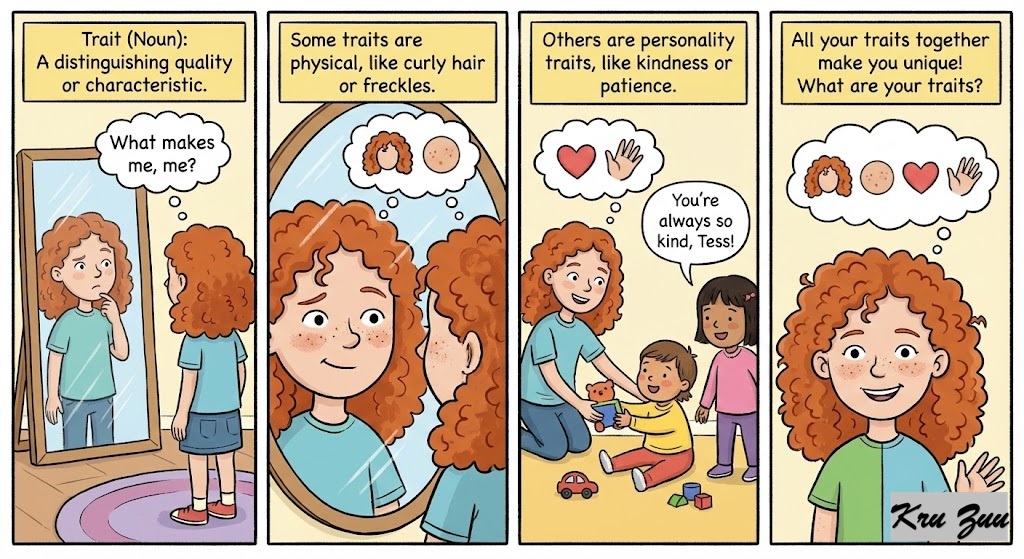
    Trait (Noun): A distinguishing quality or characteristic.


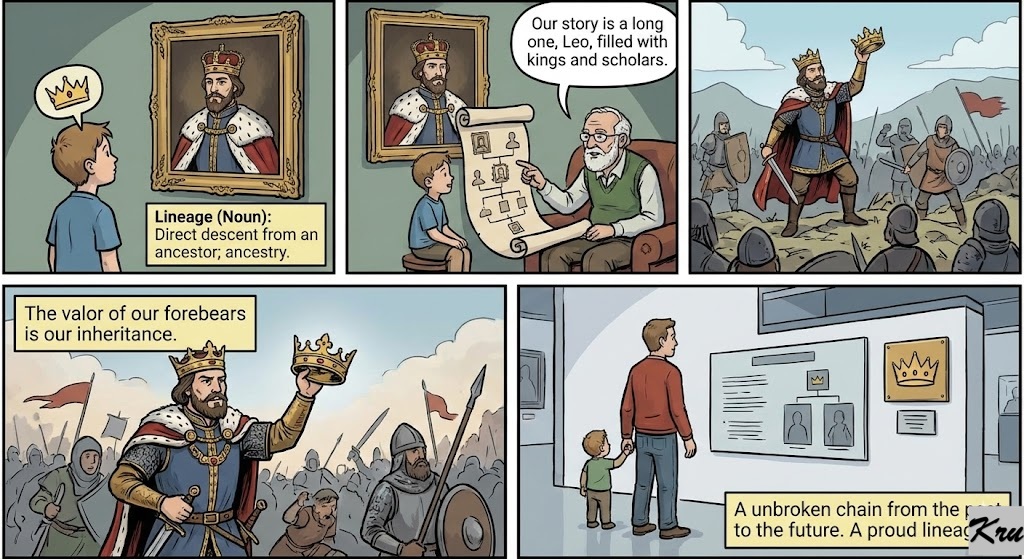
    Lineage (Noun): Direct descent from an ancestor; ancestry. 👑


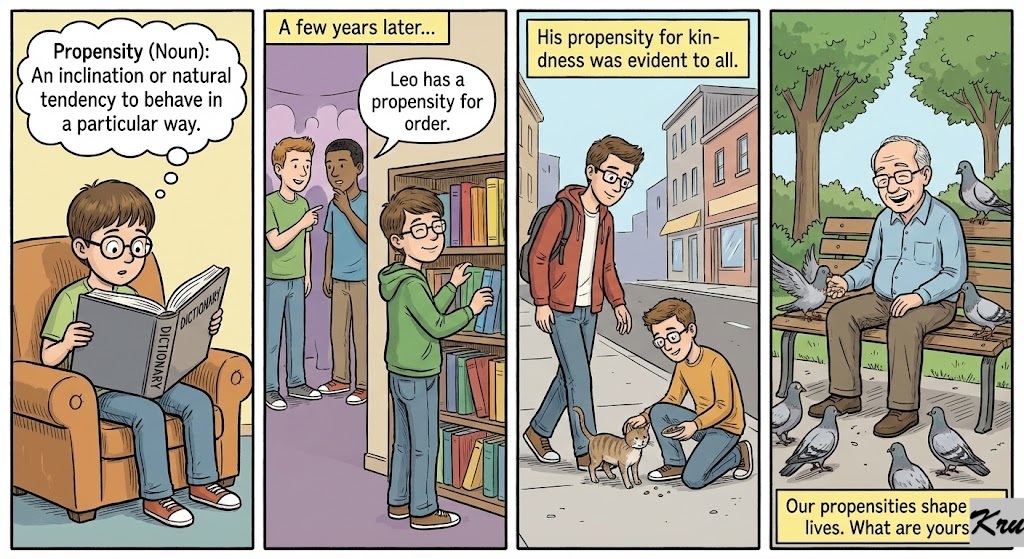
    Propensity (Noun): An inclination or natural tendency to behave in a particular way.


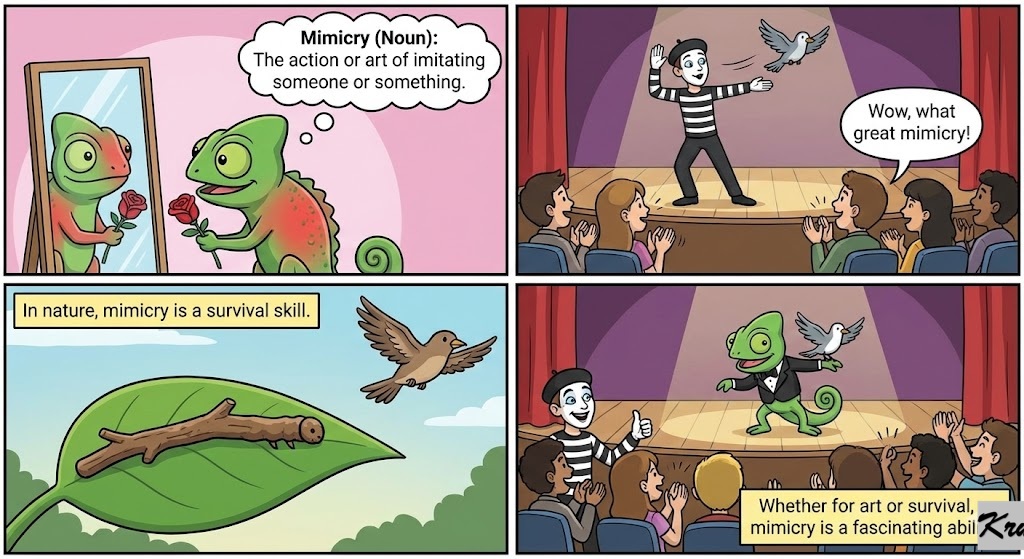
    Mimicry (Noun): The action or art of imitating someone or something.


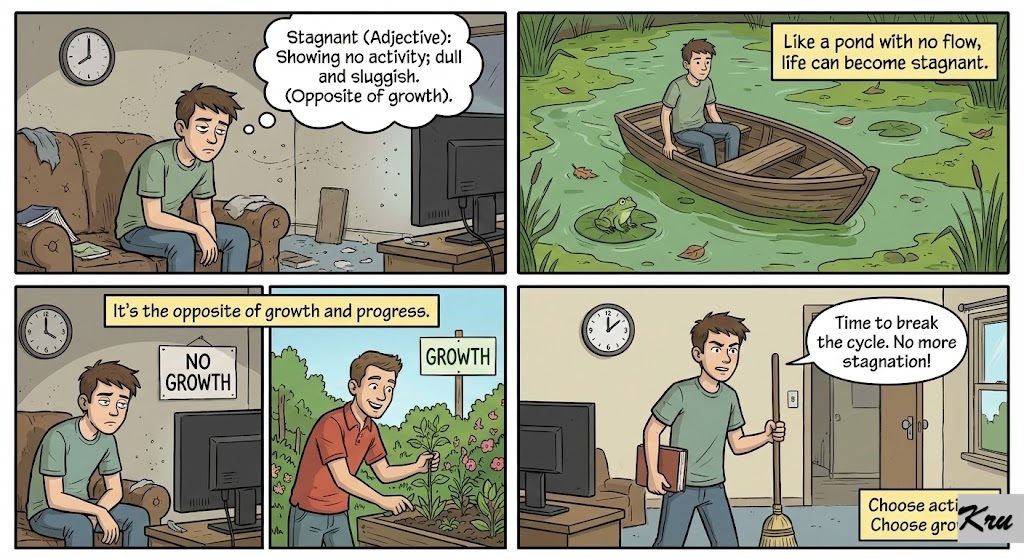
    Stagnant (Adjective): Showing no activity; dull and sluggish. (Opposite of growth).


    🧠 Grammar Focus: Idioms for Observation


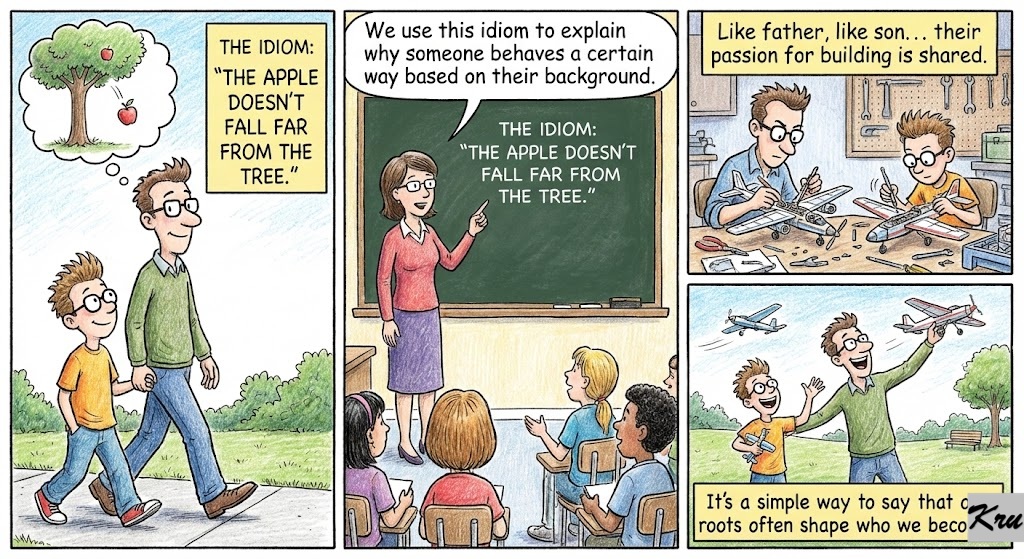
    We use this idiom to explain why someone behaves a certain way based on their background.


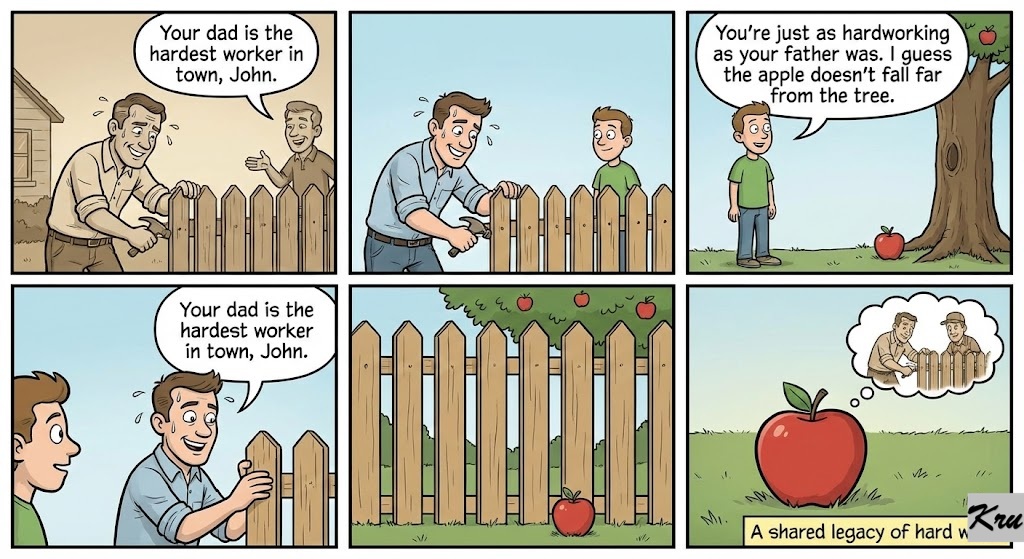
    Example: “John is just as hardworking as his father was. I guess the apple doesn’t fall far from the tree.”


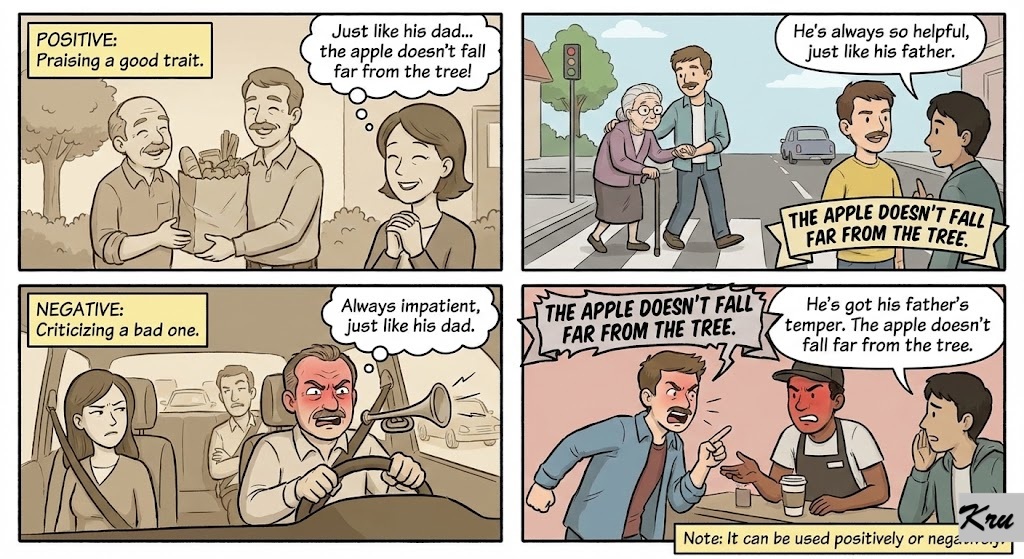
    Note: It can be used positively (praising a good trait) or negatively (criticizing a bad one).

    📜 History: Origin and Spread


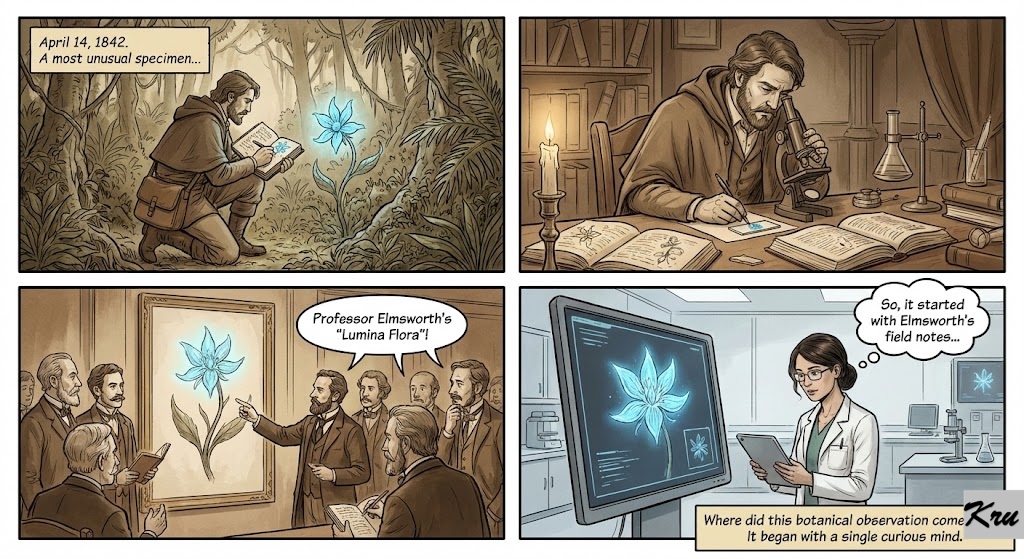
    Where did this botanical observation come from?


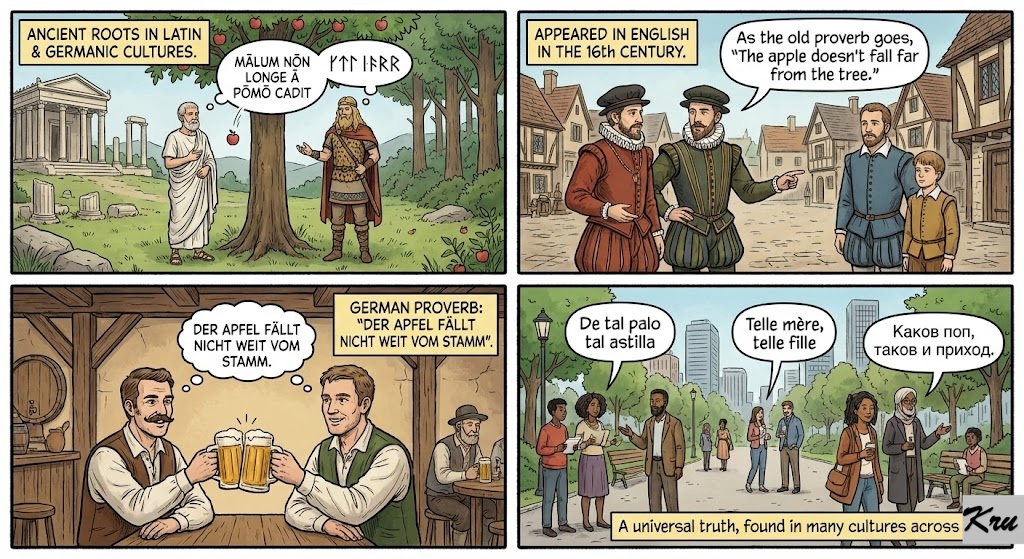
    The Origin: This is an ancient proverb found in many cultures. It appeared in English in the 16th century but has roots in German (Der Apfel fällt nicht weit vom Stamm) and Latin.


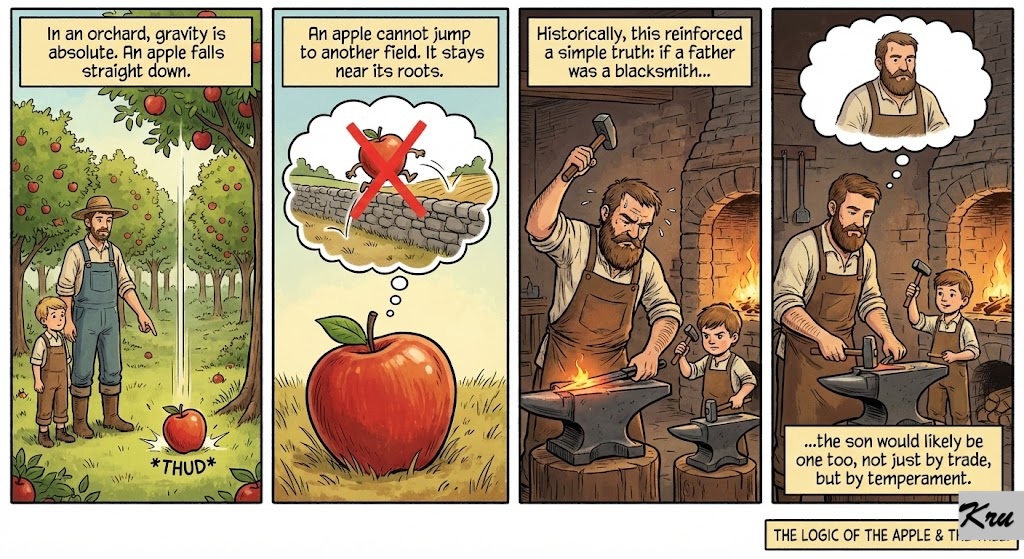
    The Logic: In an orchard, gravity is absolute. An apple cannot jump to another field. Historically, it reinforced the idea that if a father was a blacksmith, the son would likely be one too, not just by trade, but by temperament.


    Global Cousins


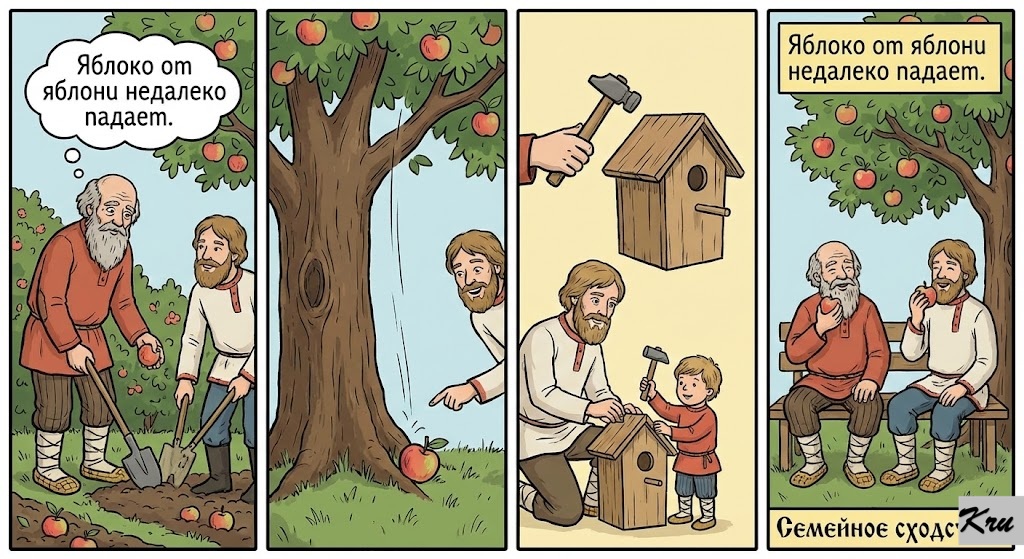
    🇷🇺 Russian: “The apple stays close to the apple tree.”


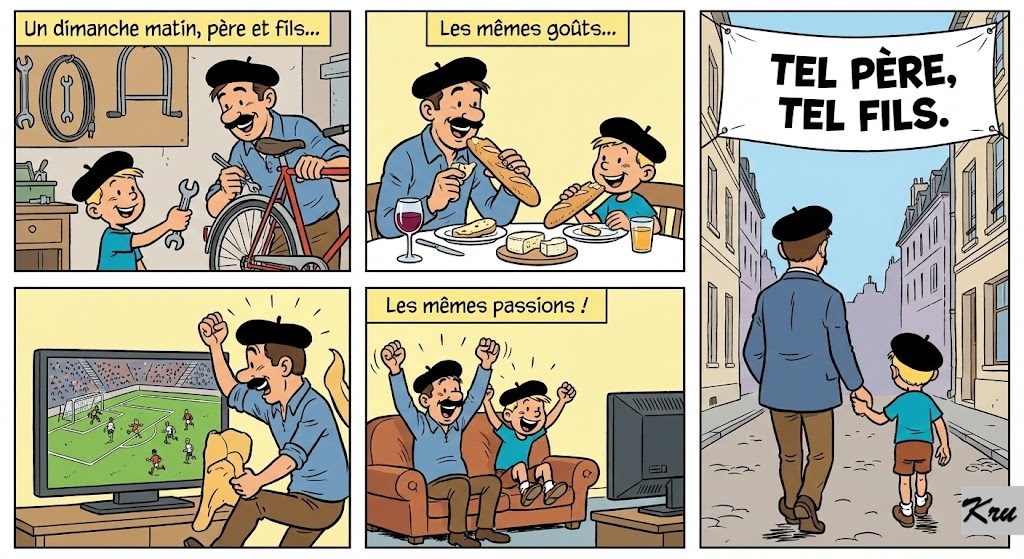
    🇫🇷 French: “Tel père, tel fils.” (Like father, like son).


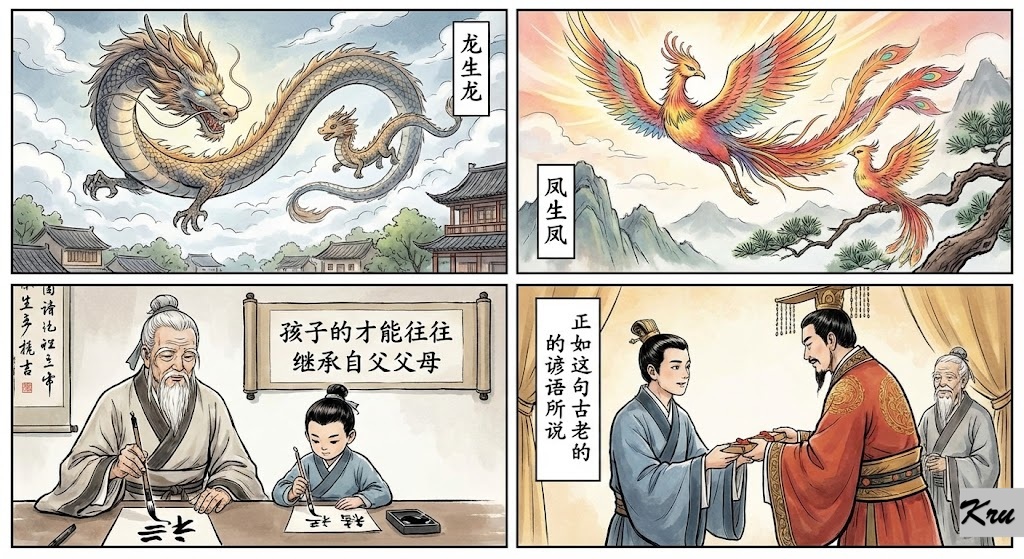
    🇨🇳 Chinese: “Dragons give birth to dragons, phoenixes give birth to phoenixes.” (Meaning children inherit their parents’ status/talents).

    🎭 Short Story: The Sour Seed 🍎🐱🐔🐸


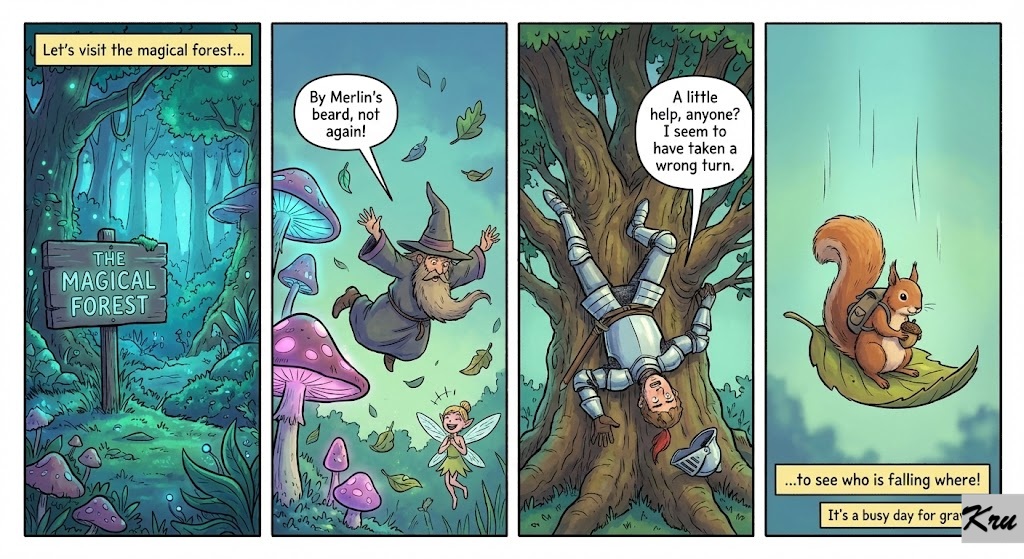
    Let’s visit the magical forest to see who is falling where.


    🌟 The Cast


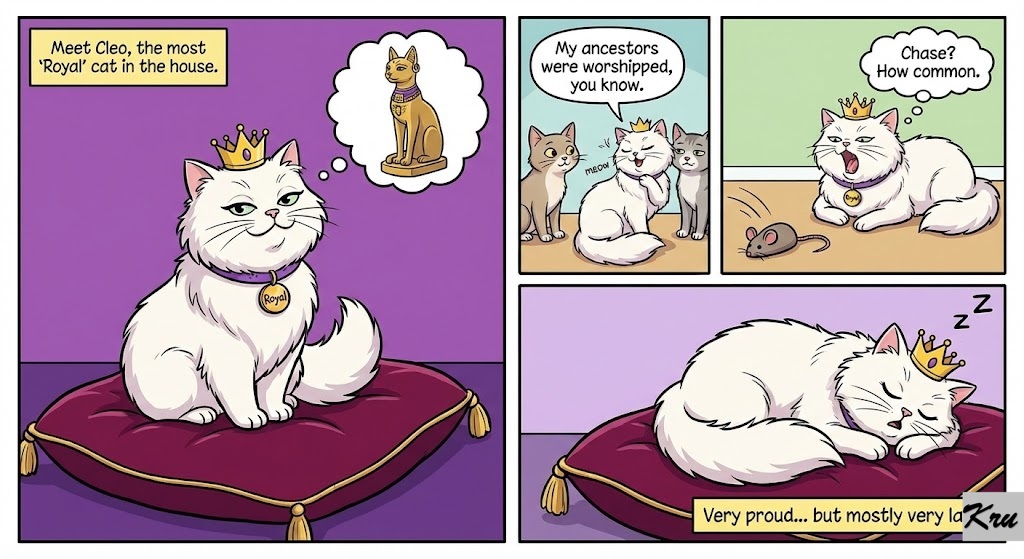
    Cleo the Cat: Very proud of her “Royal” lineage, but lazy. 😼


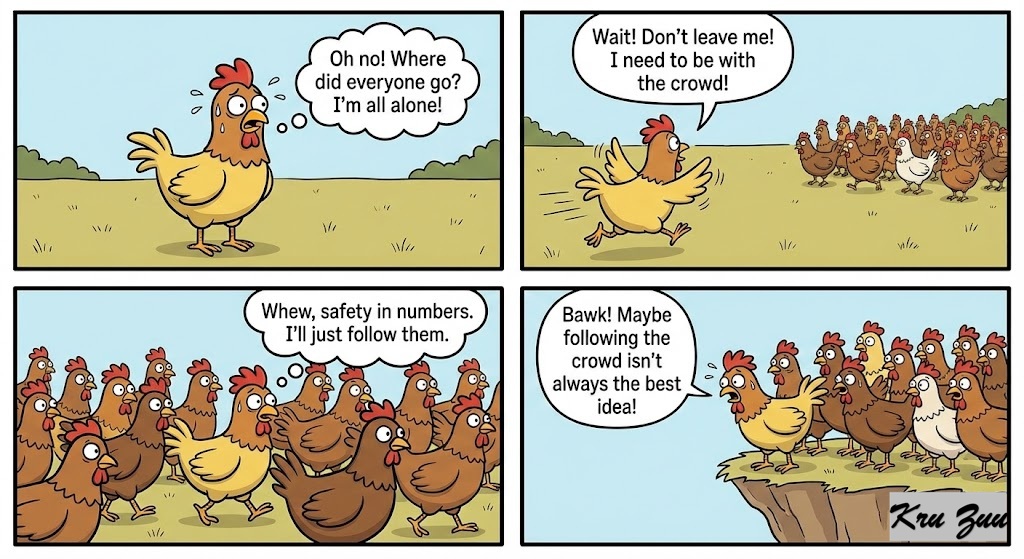
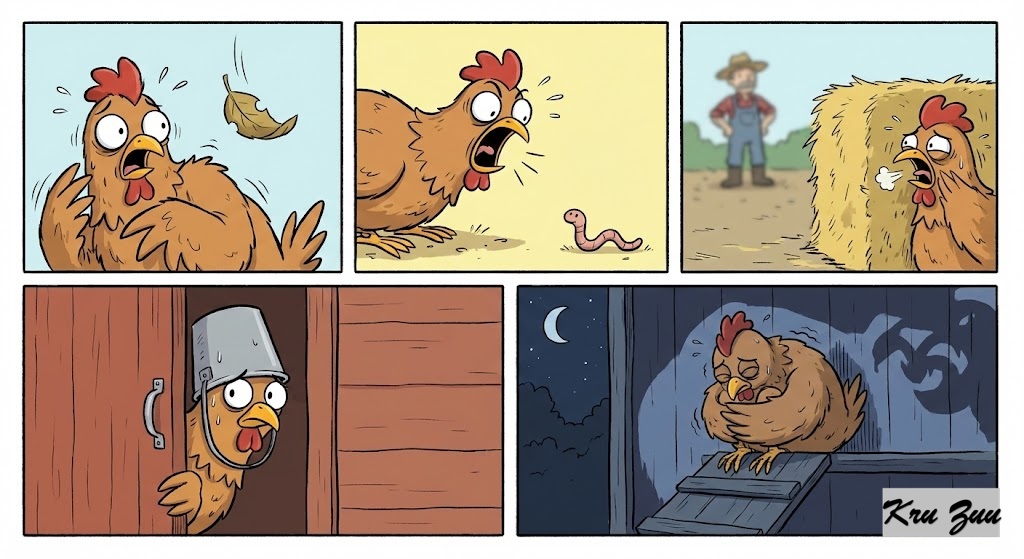
    Cluck the Chicken: Nervous, always follows the crowd. 🐔


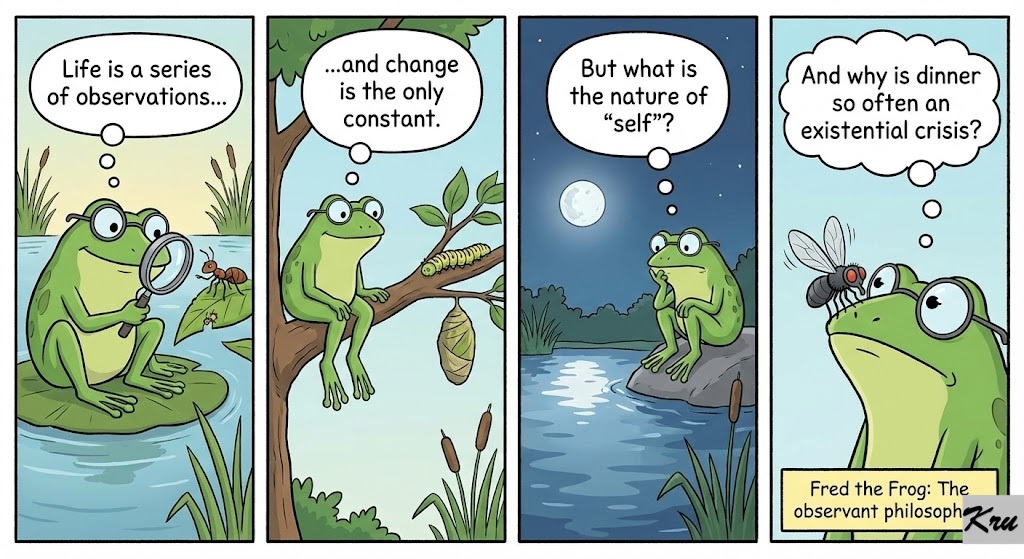
    Fred the Frog: The observant philosopher. 🐸


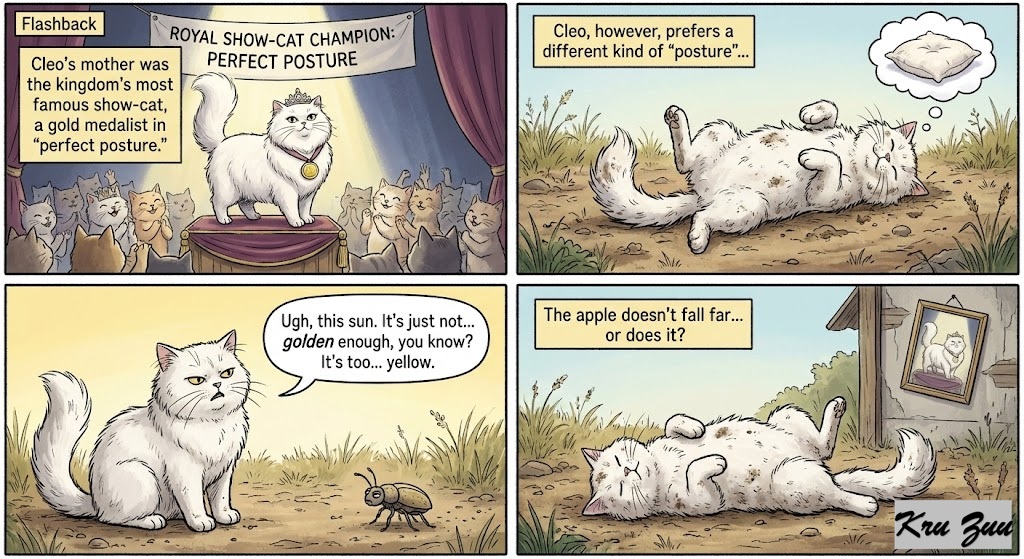
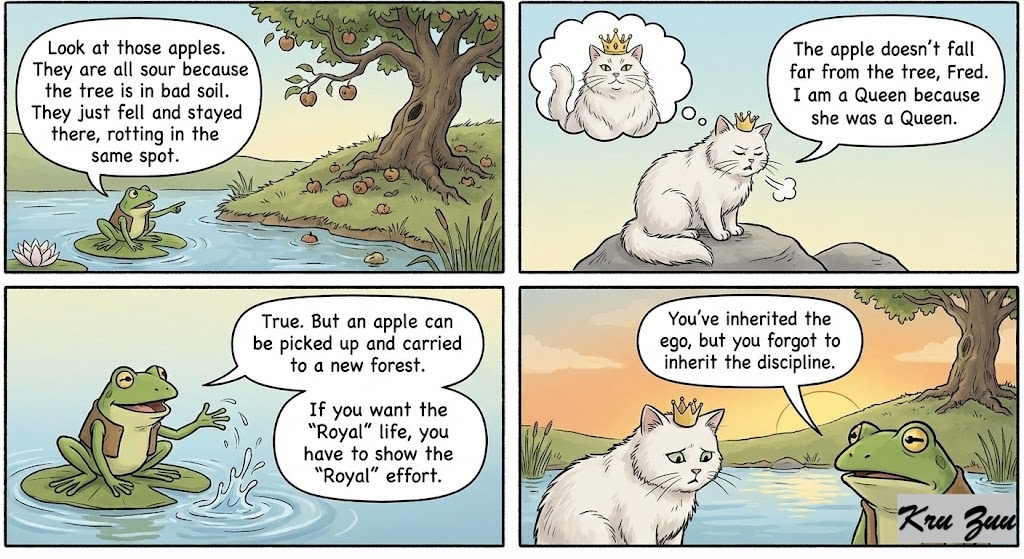
    The Situation: Cleo’s mother was the most famous show-cat in the kingdom. She won gold medals for her “perfect posture.” Cleo, however, spends all day napping in the dirt and complaining that the sun isn’t “golden enough.”


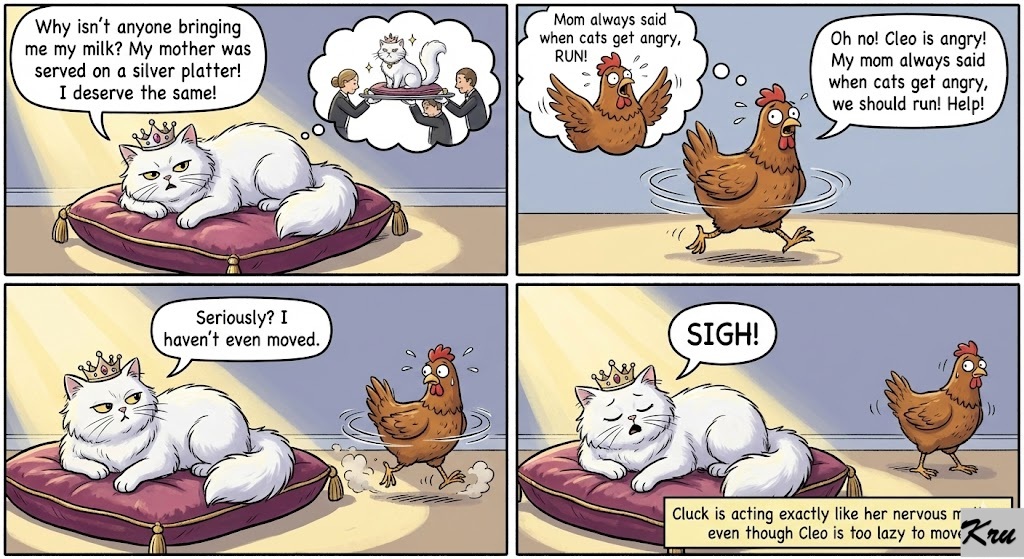
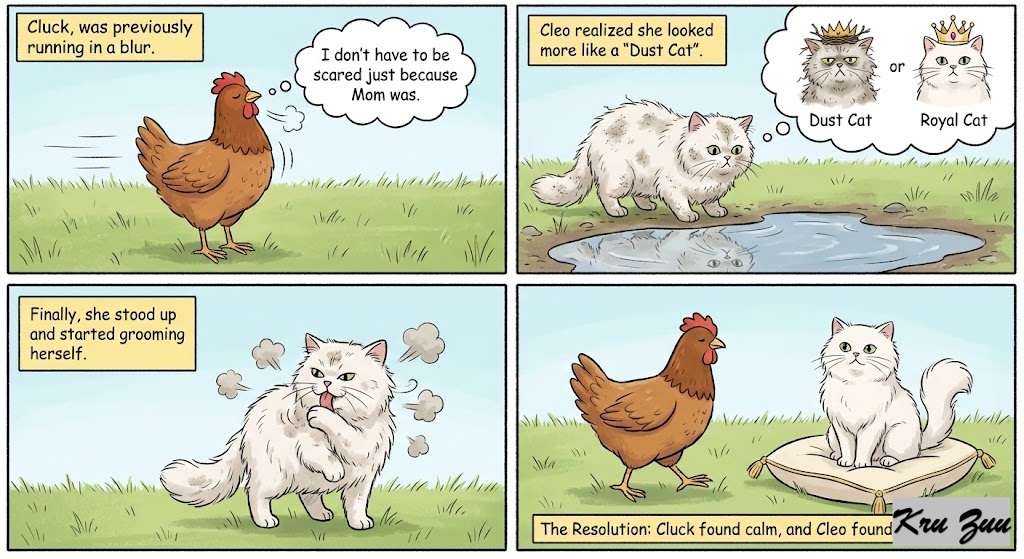
    The Conflict: “Why isn’t anyone bringing me my milk?” Cleo demands. “My mother was served on a silver platter! I deserve the same!” Cluck, who comes from a family of frantic, panicky chickens, starts running in circles. “Oh no! Cleo is angry! My mom always said when cats get angry, we should run! Help!” Cluck is acting exactly like her nervous mother, even though Cleo is too lazy to move.


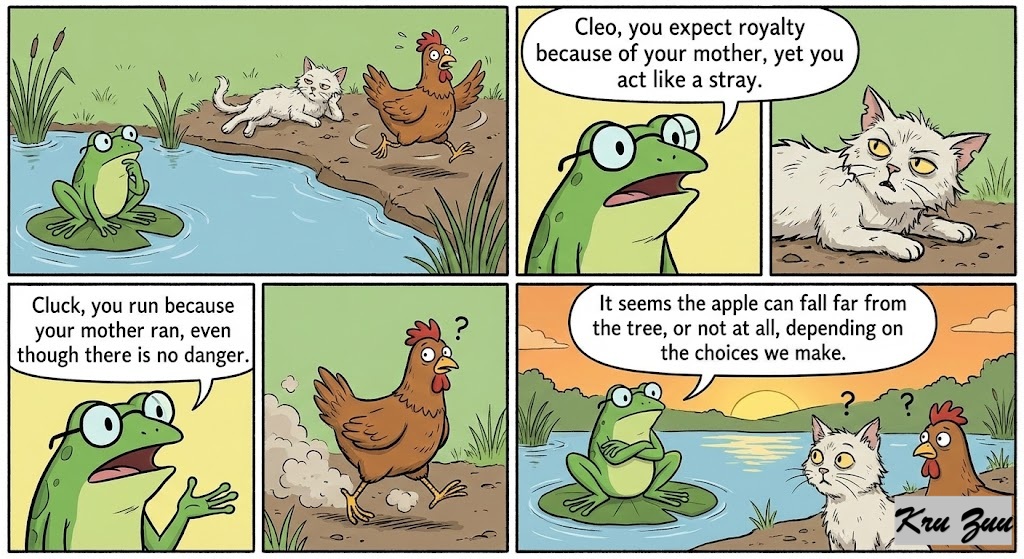
    The Reaction: Fred the Frog watches from his pond. “Cleo, you expect royalty because of your mother, yet you act like a stray. Cluck, you run because your mother ran, even though there is no danger.”


    The Lesson: Fred points to a wild apple tree. “Look at those apples. They are all sour because the tree is in bad soil. They just fell and stayed there, rotting in the same spot.” Cleo huffs, “The apple doesn’t fall far from the tree, Fred. I am a Queen because she was a Queen.” Fred splashes some water. “True. But an apple can be picked up and carried to a new forest. If you want the ‘Royal’ life, you have to show the ‘Royal’ effort. You’ve inherited the ego, but you forgot to inherit the discipline.”


    The Resolution: Cluck stopped running and took a deep breath. She realized she didn’t have to be scared just because her mom was. Cleo, realizing she looked more like a “Dust Cat” than a “Royal Cat,” finally stood up and started grooming herself.


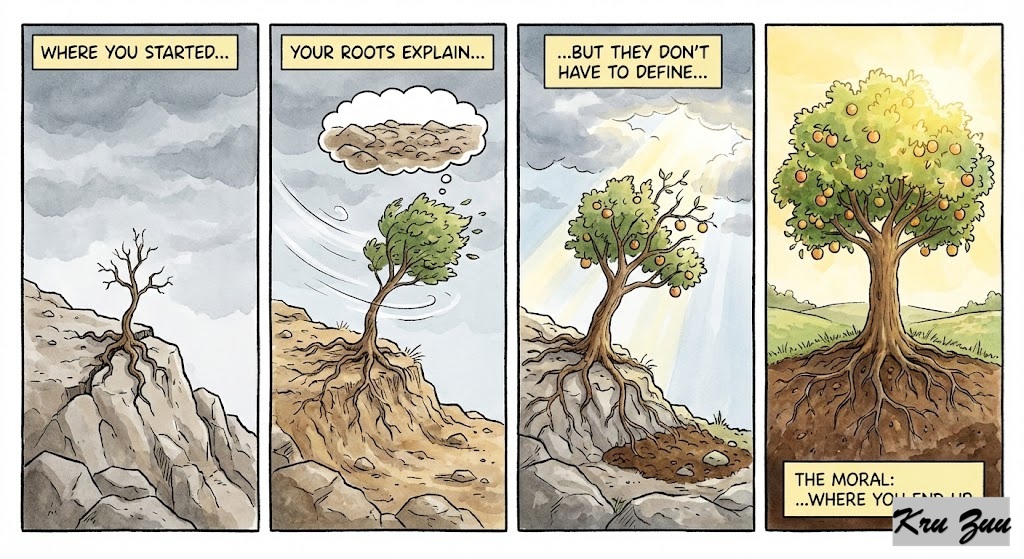
    The Moral: Your roots explain where you started, but they don’t have to define where you end up. 🌳

    🎓 Lesson for English Learners


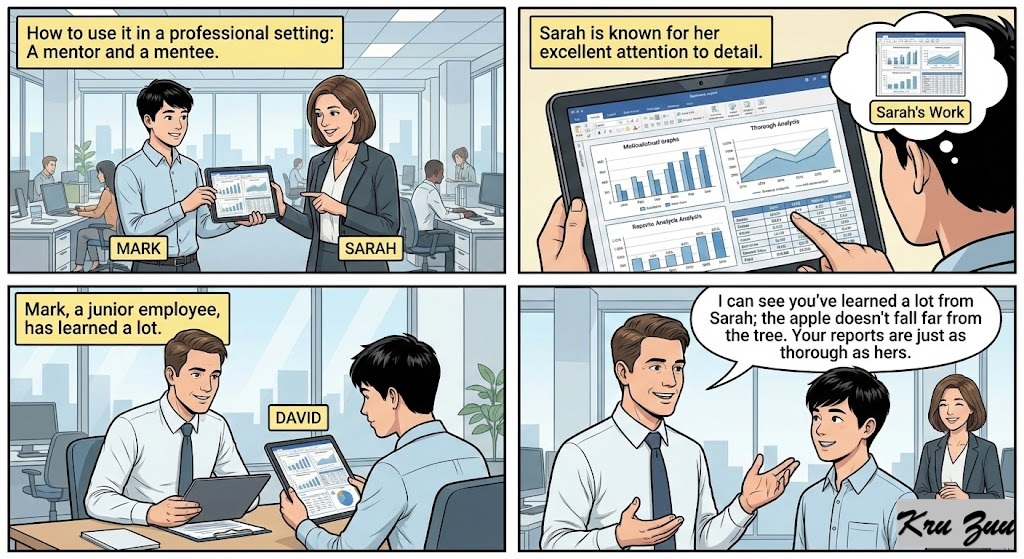
    How to use it in a professional setting: If you see a junior employee who has the same excellent attention to detail as their mentor, you can say: “I can see you’ve learned a lot from Sarah; the apple doesn’t fall far from the tree. Your reports are just as thorough as hers.”


    💬 Your Turn: The “Mirror” Challenge 🚀


    Ready to see your own “tree”?


    The Challenge:
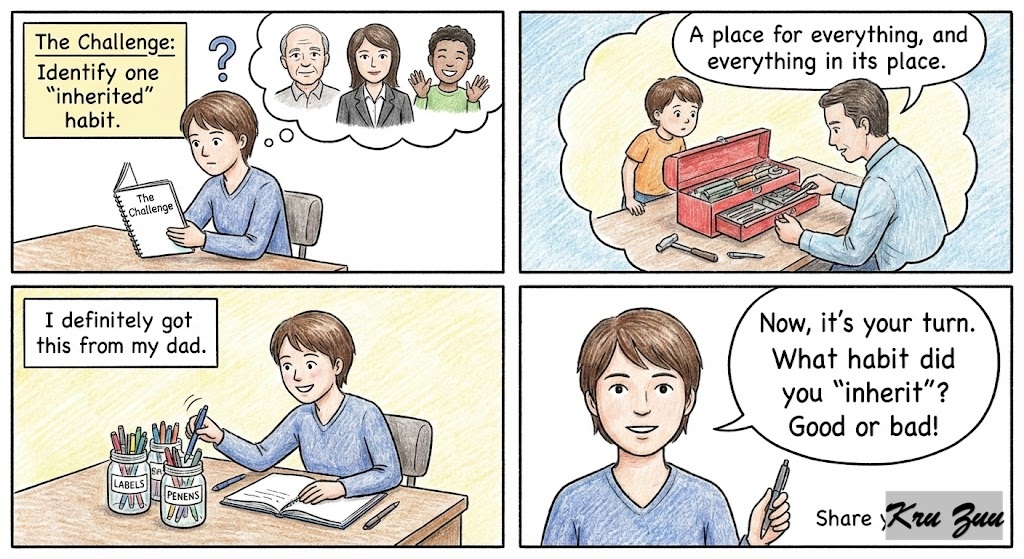
    Identify one habit you have (good or bad) that you definitely “inherited” from a parent, a former boss, or a close friend.

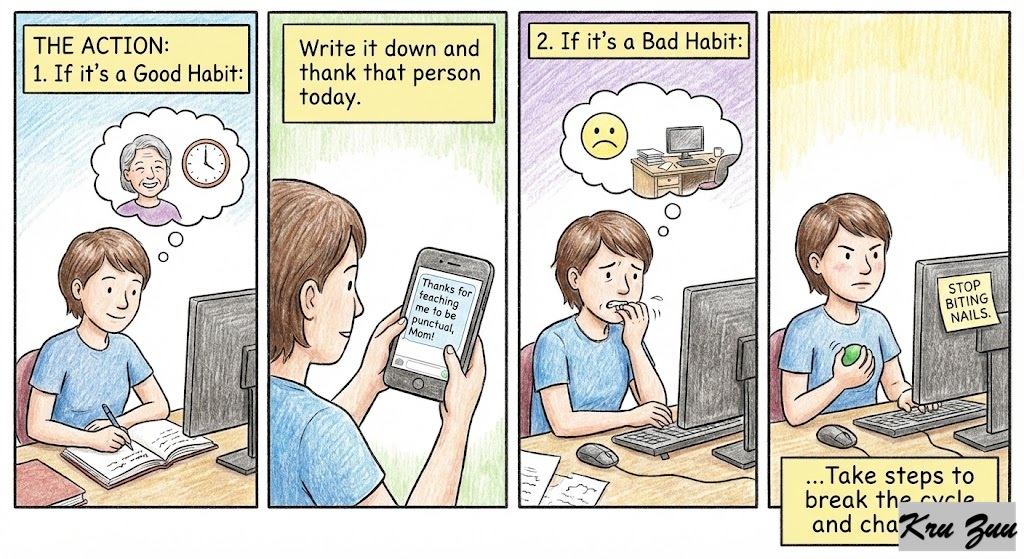
    The Action: 1. If it’s a Good Habit: Write it down and thank that person today. 2. If it’s a Bad

    Habit: Consciously do the opposite for 24 hours. Prove that this apple can roll a little further away.


    👇 Question for the comments: Which trait did you get from your “tree”? Are you happy about it, or are you trying to roll away? Tell us below!

    By Zubeyir YURTKURAN

    https://www.facebook.com/BrainBattleground/

    https://www.facebook.com/zubeyr.yurtkuran/

    https://www.instagram.com/zubeyryurtkuran/
    https://www.youtube.com/@BrainBattleground-b3p

    https://www.instagram.com/brainbattleground/

  • 🤫 The Daily Shield: The Law of Quiet Power

    🤫 The Daily Shield: The Law of Quiet Power

    “Silence is golden.”


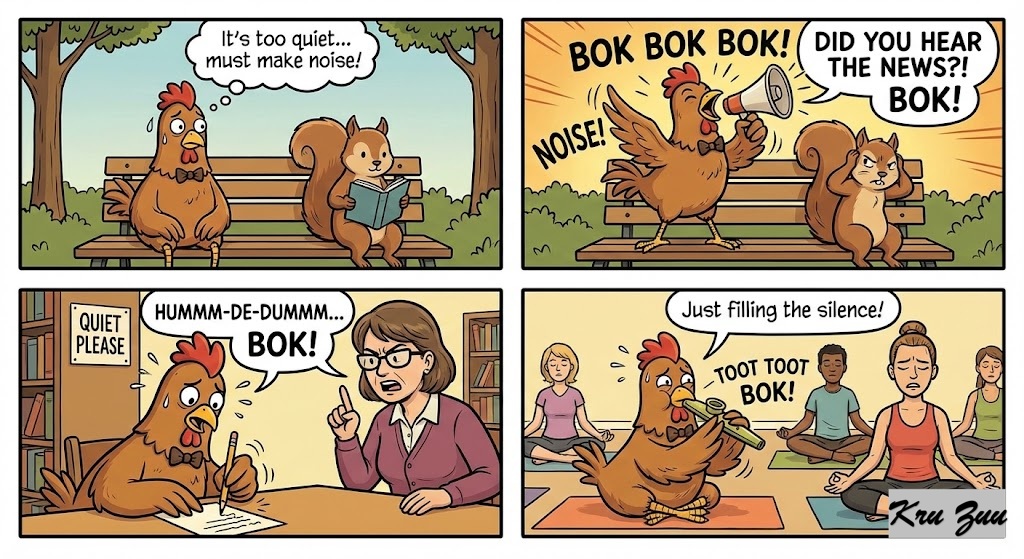
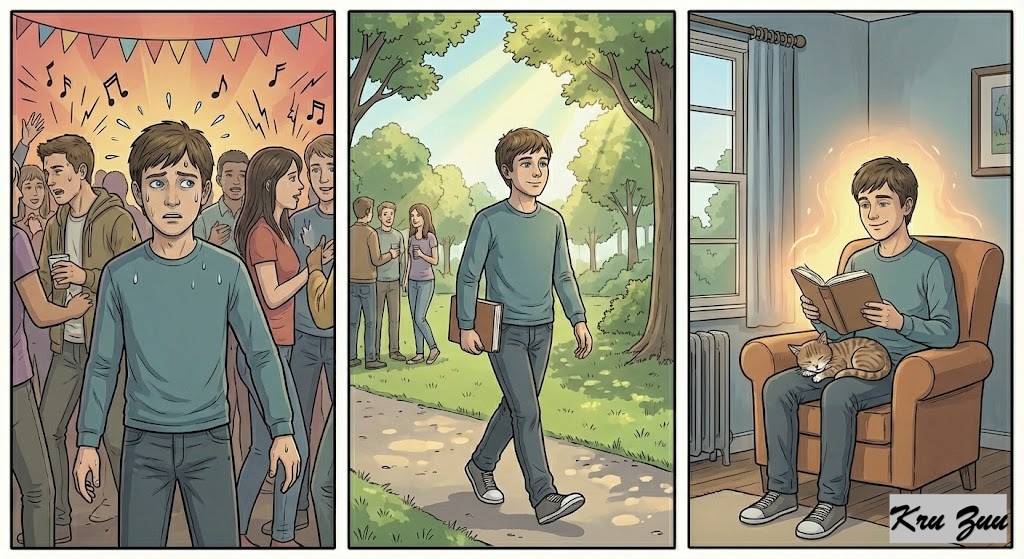
    😈 The Villain (The Noise Maker)

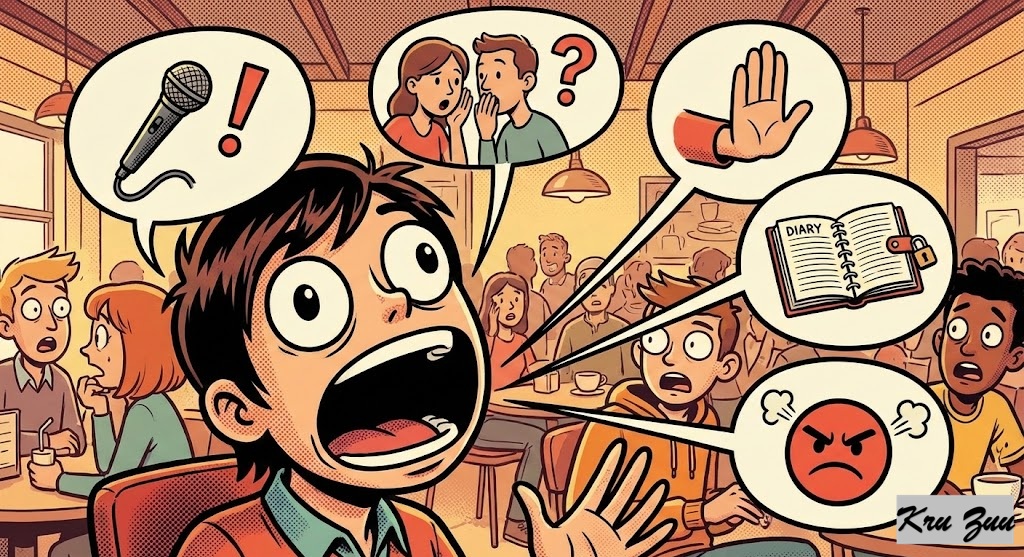
    You have a thought, and it instantly leaves your mouth. 🗣️ “I have to say my opinion!” “Did you hear the gossip about…?” “Let me interrupt you right there!” You act as if every silence is awkward and needs to be filled. You reveal your secrets to strangers. You speak when you are angry.

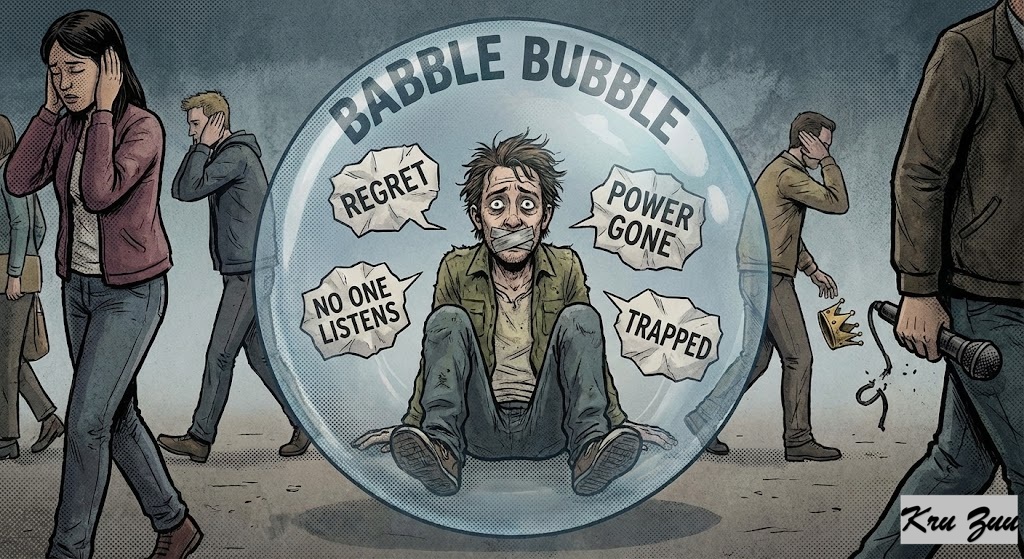
    The Result? You say things you regret. You give away your power. People stop listening because you never stop talking. You are trapped in the “Babble Bubble.” 🫧


    😇 The Hero (The Wise Observer)

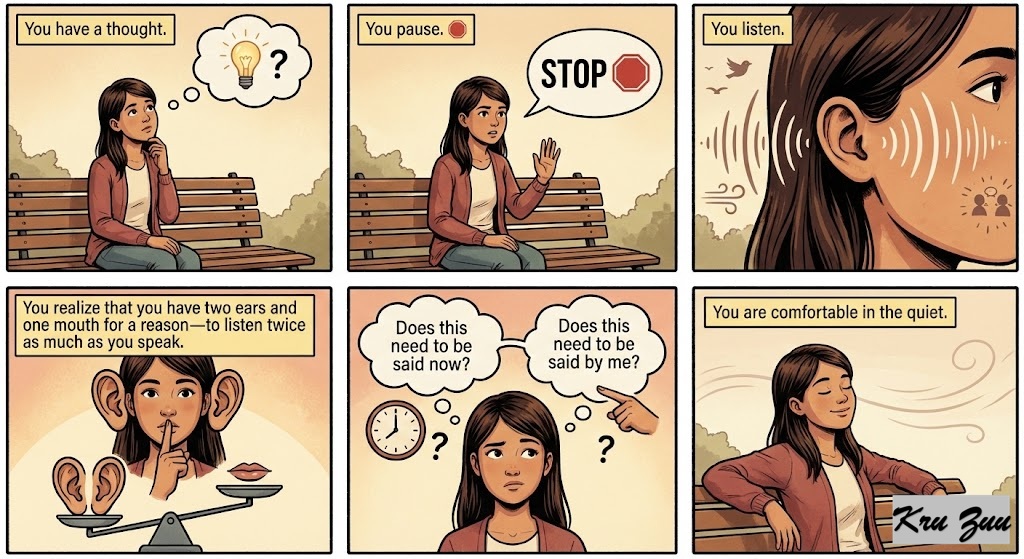
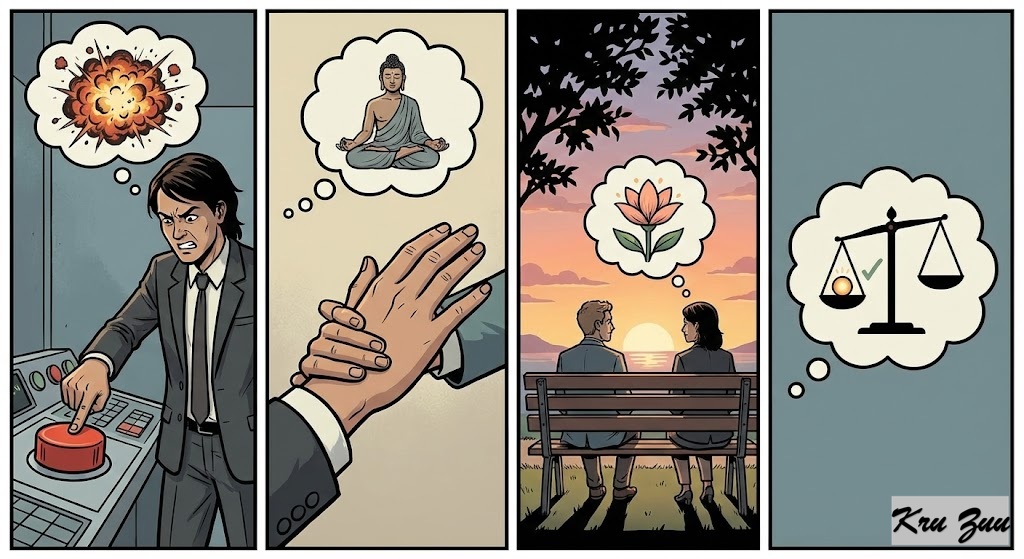
    You have a thought. You pause. 🛑 You listen. You realize that you have two ears and one mouth for a reason, to listen twice as much as you speak. You think: “Does this need to be said now? Does it need to be said by me?” You are comfortable in the quiet.

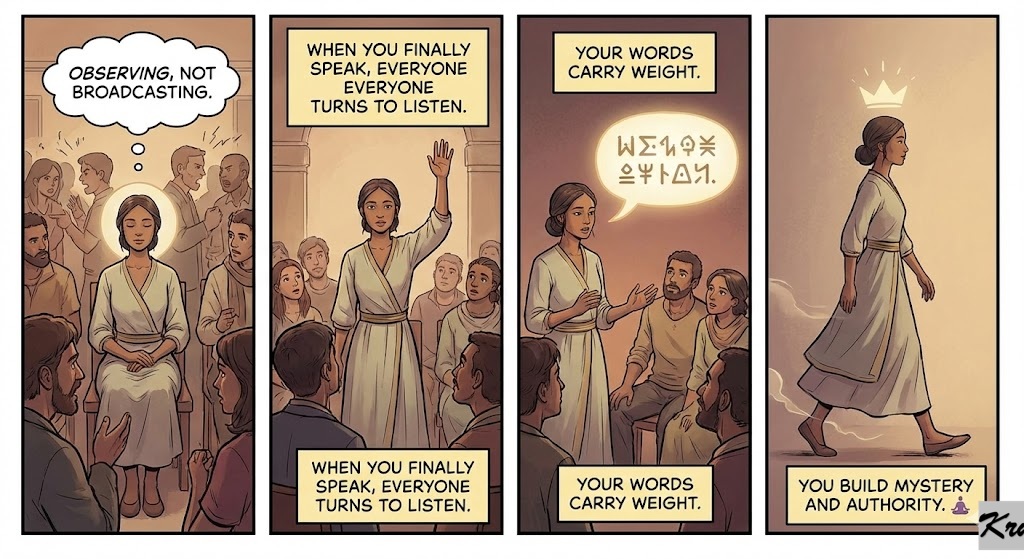
    The Result? When you finally speak, everyone turns to listen. Your words carry weight. You learn more because you are observing, not broadcasting. You build mystery and authority. 🧘


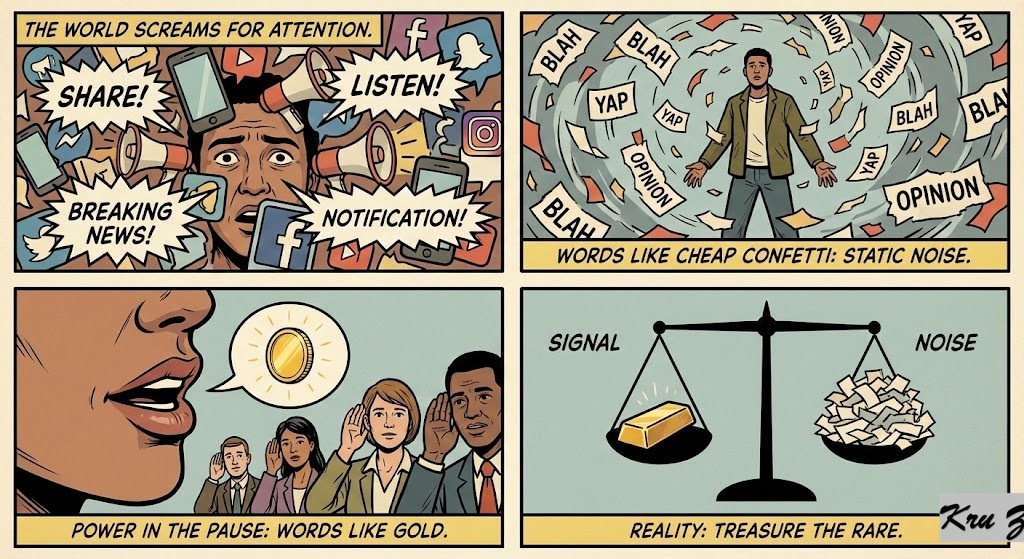
    ⚖️ The RealitySignal vs. Noise. We live in a world that screams for attention. Social media, notifications, and 24/7 news cycles tell us we must “share” everything. But physics and psychology agree: A constant signal is just static noise. True power is found in the pause. If you treat words like cheap confetti (throwing them everywhere), they lose value. If you treat words like gold (rare and heavy), people will treasure them.


    💎 The Secret

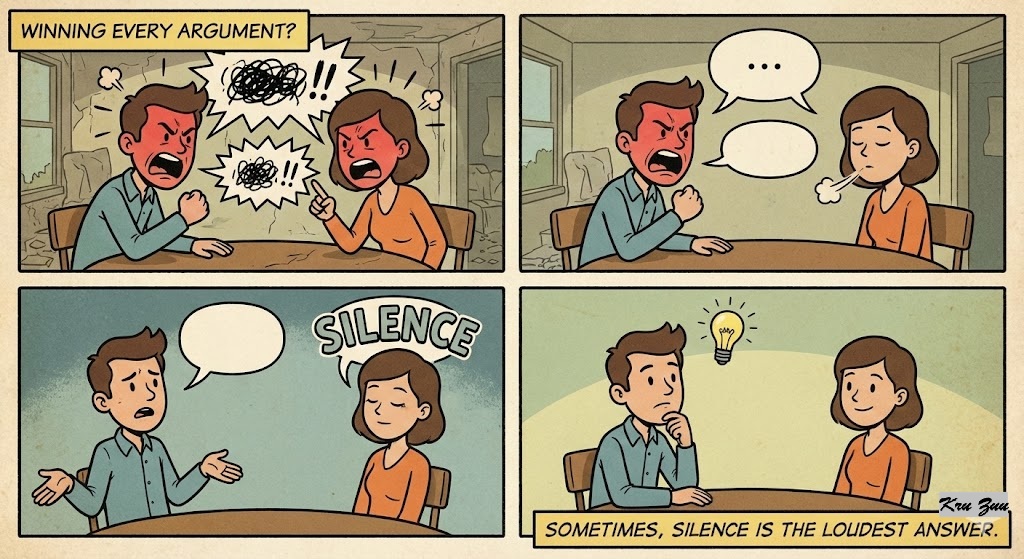
    You don’t have to win every argument. Sometimes, silence is the loudest answer.

    🧐 The Anatomy of the Proverb


    This is your reality check that restraint is often more valuable than action.


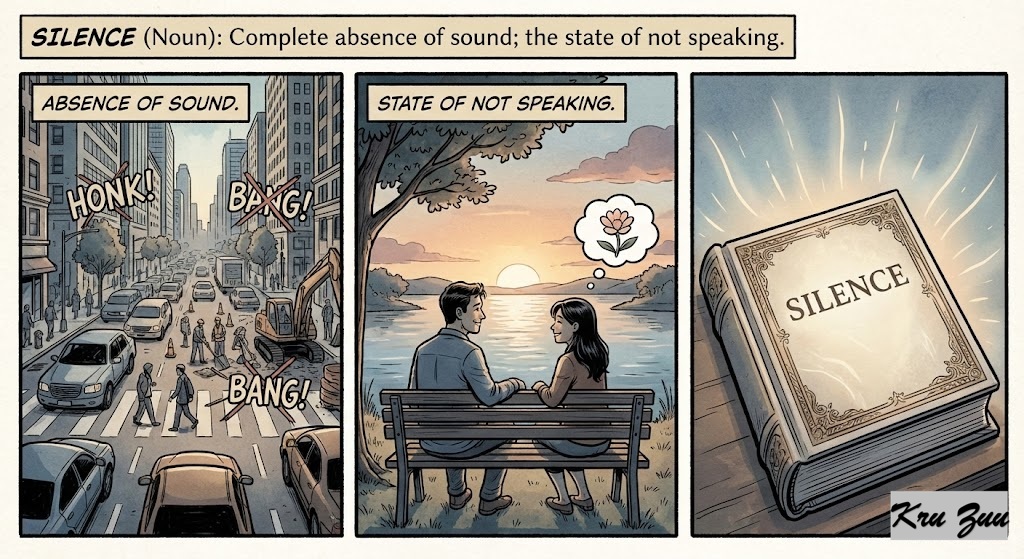
    Silence (Noun): Complete absence of sound; the state of not speaking.


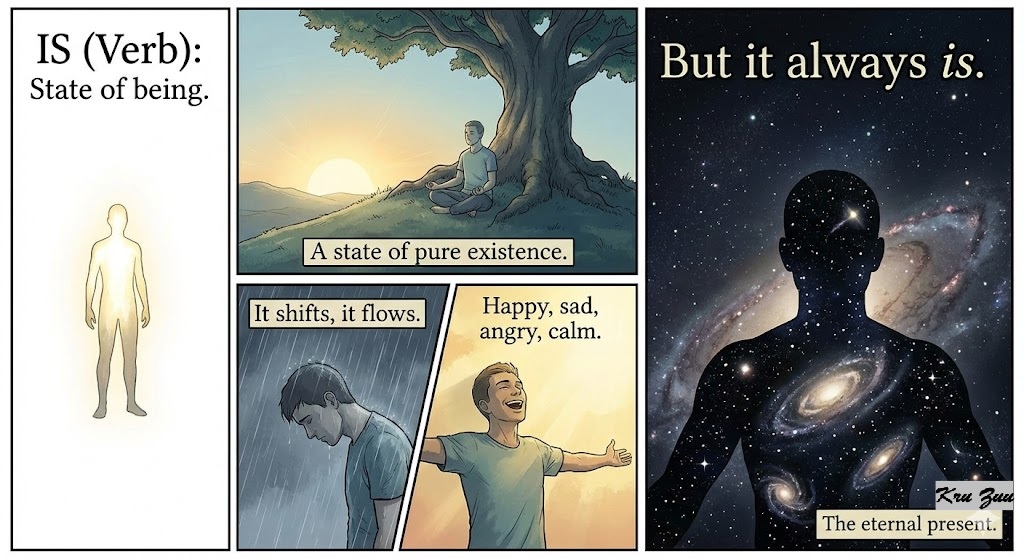
    Is (Verb): State of being.


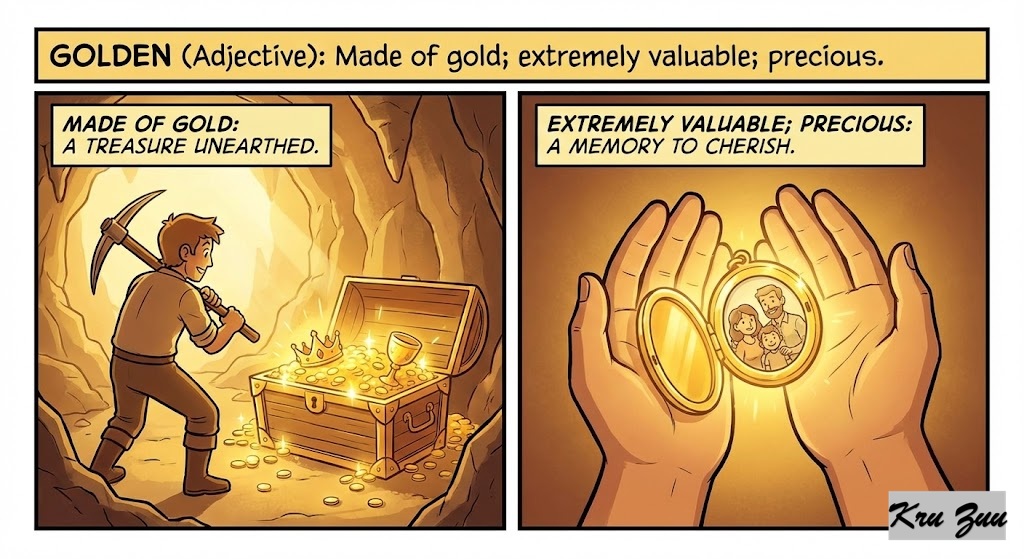
    Golden (Adjective): Made of gold; extremely valuable; precious.


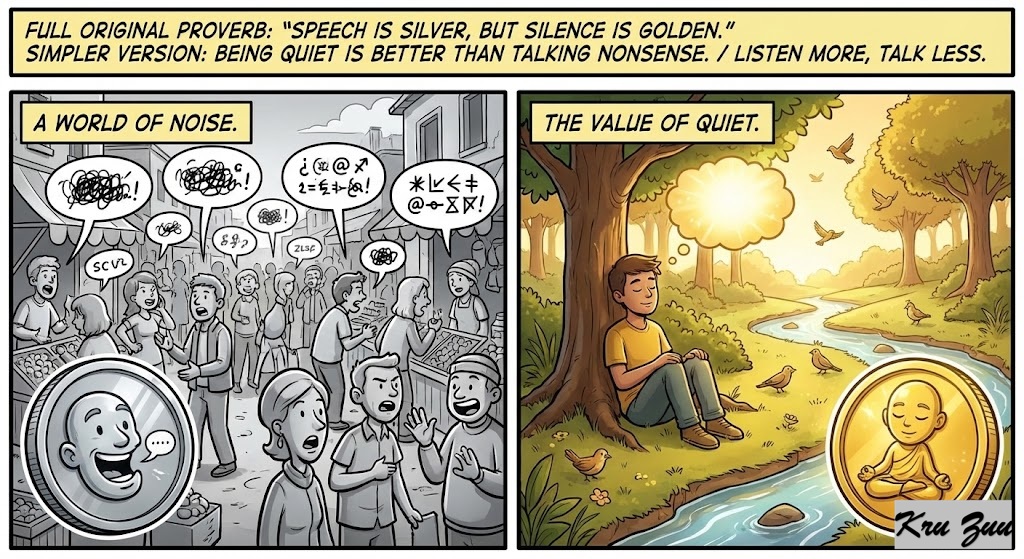
    Full Original Proverb:“Speech is silver, but silence is golden.”Simpler Version: Being quiet is better than talking nonsense. / Listen more, talk less.


    📚 Vocabulary Vault


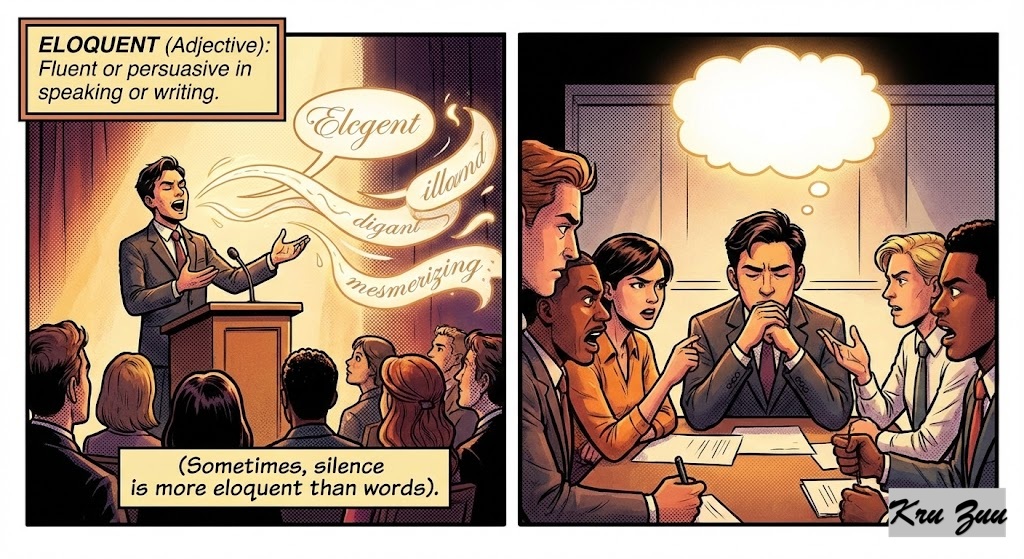
    Eloquent (Adjective): Fluent or persuasive in speaking or writing. (Sometimes, silence is more eloquent than words).


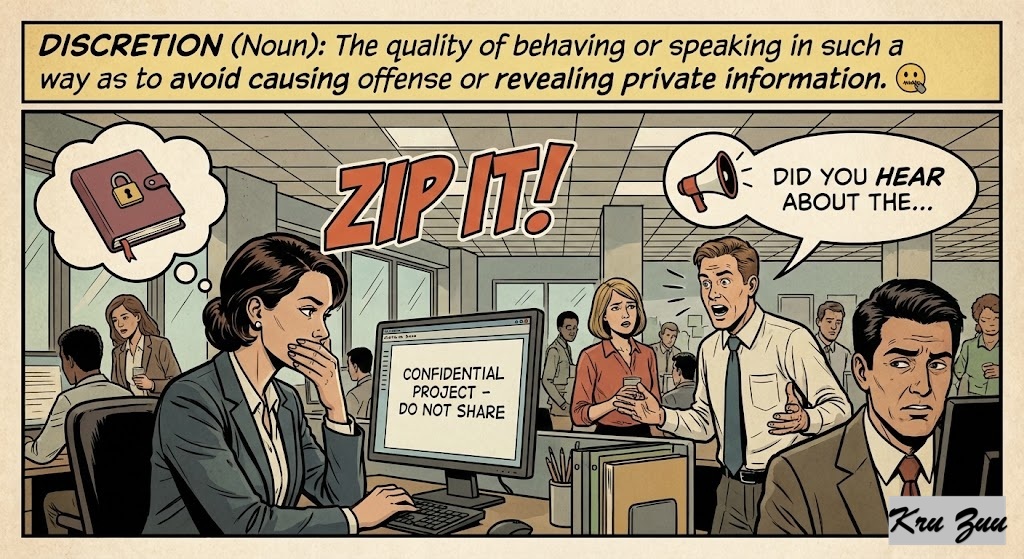
    Discretion (Noun): The quality of behaving or speaking in such a way as to avoid causing offense or revealing private information. 🤐


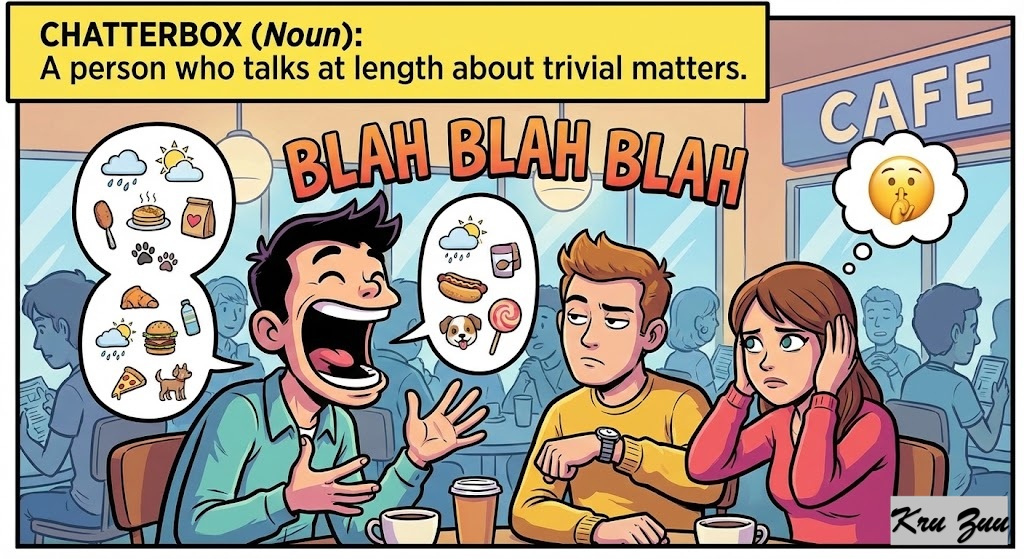
    Chatterbox (Noun): A person who talks at length about trivial matters.


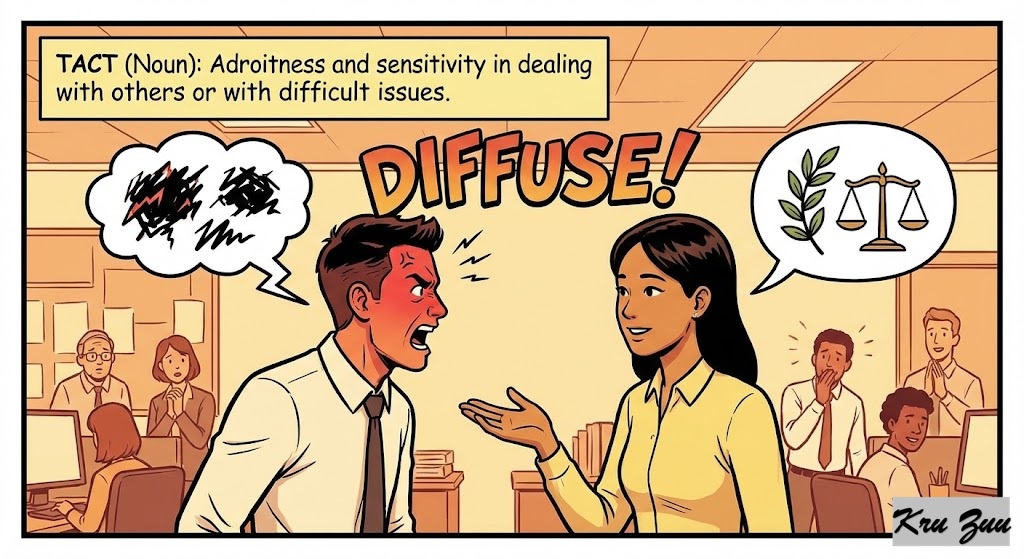
    Tact (Noun): Adroitness and sensitivity in dealing with others or with difficult issues.


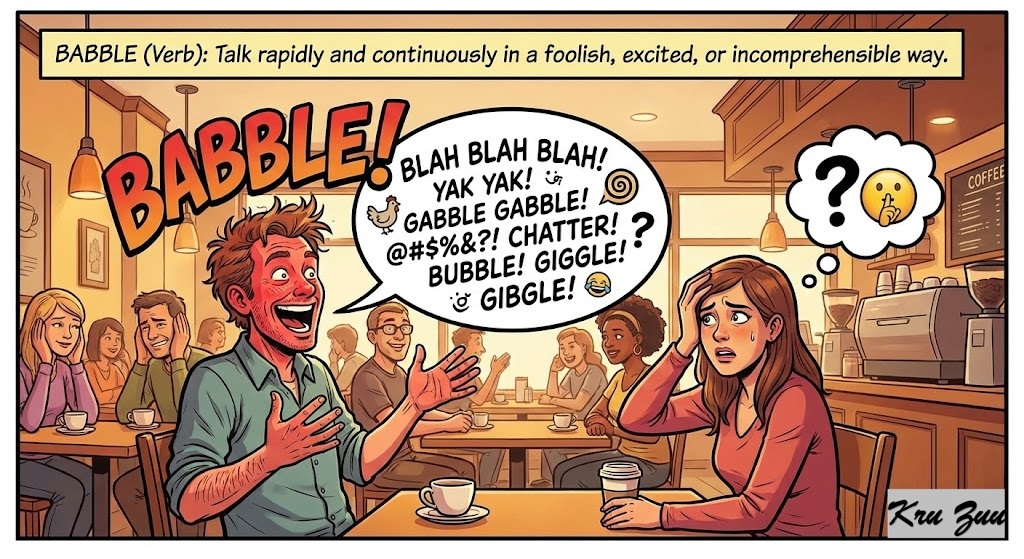
    Babble (Verb): Talk rapidly and continuously in a foolish, excited, or incomprehensible way.


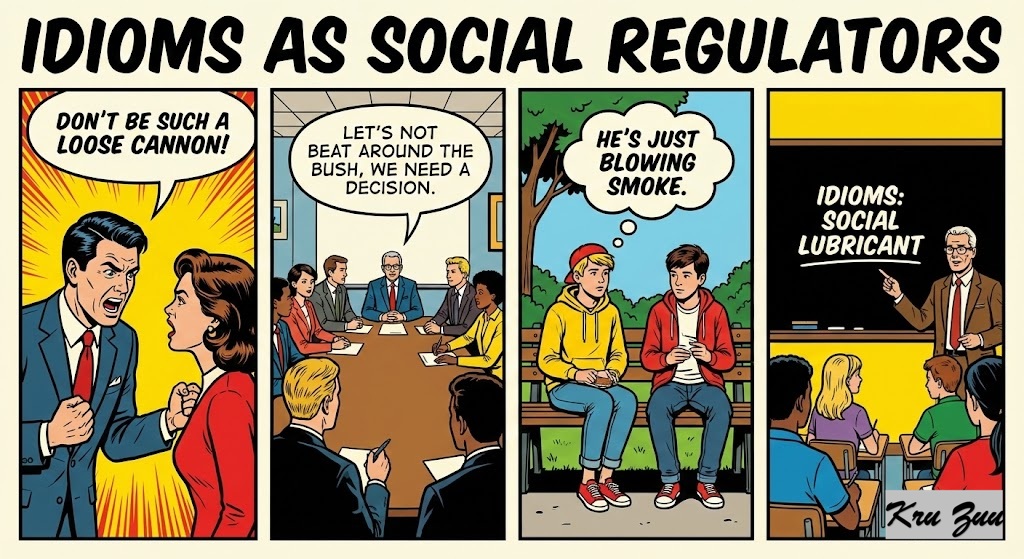
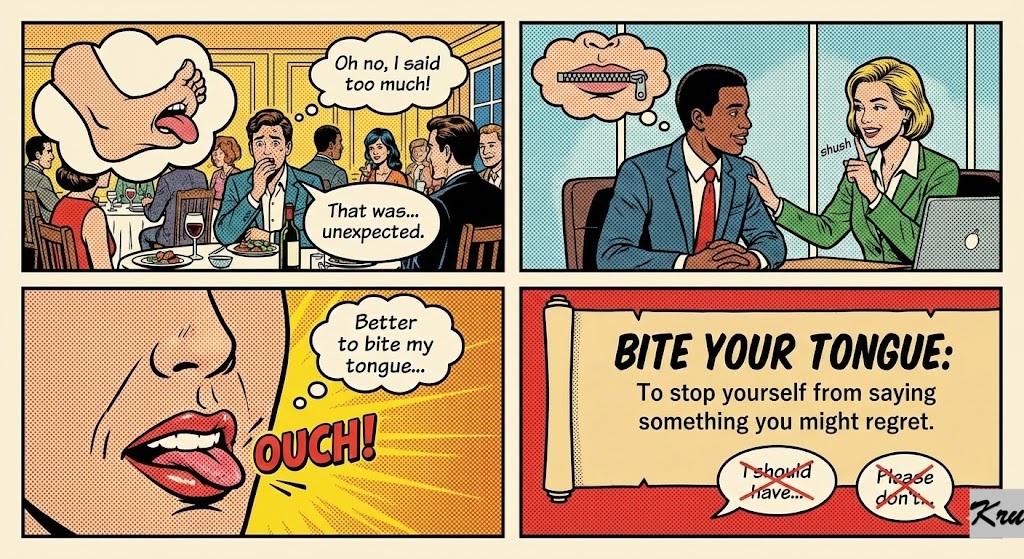
    🧠 Grammar Focus: Idioms as Social Regulators


    We often use this idiom to politely tell someone to stop talking or to express regret for speaking too much.


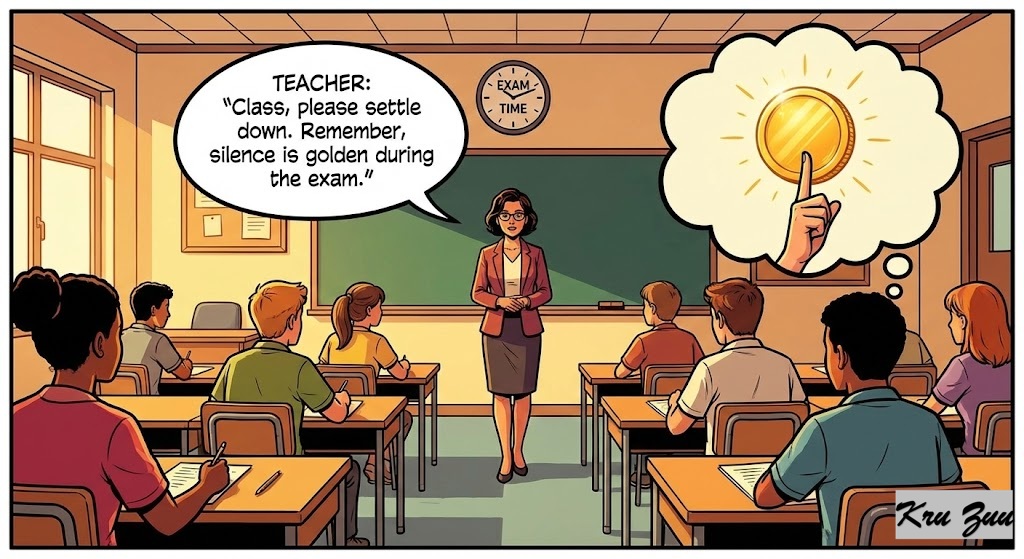
    Teacher: “Class, please settle down. Remember, silence is golden during the exam.”


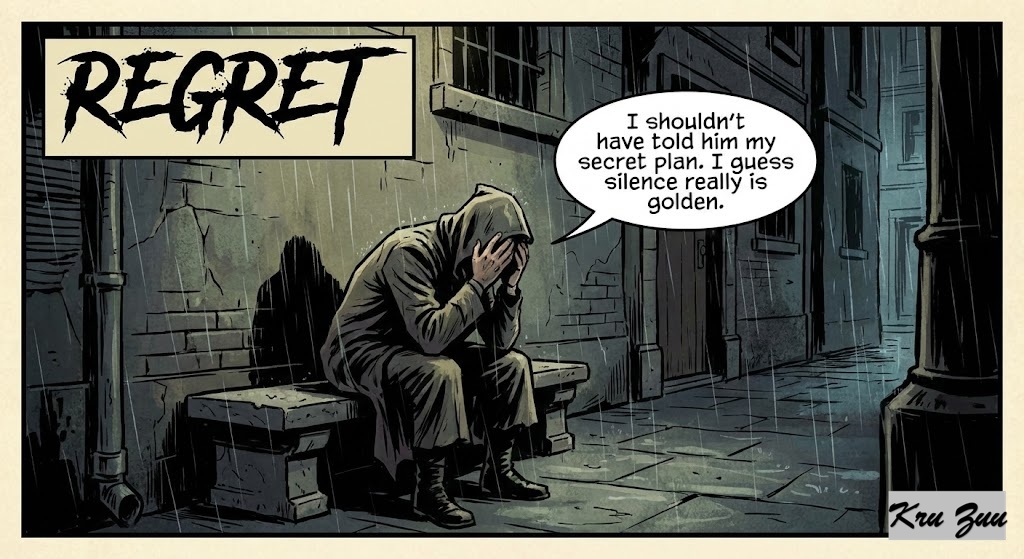
    Regret: “I shouldn’t have told him my secret plan. I guess silence really is golden.”

    📜 History: Origin and Spread


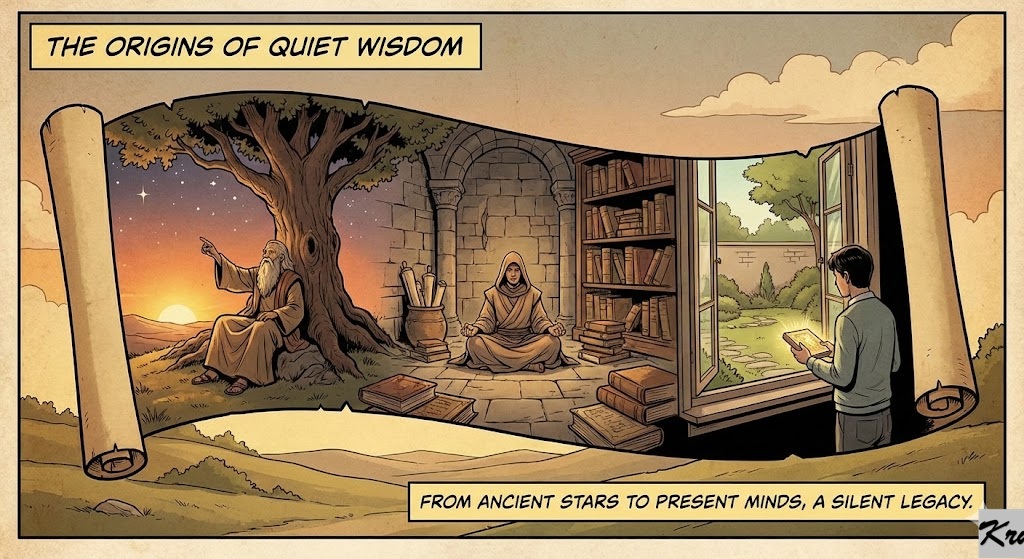
    Where did this quiet wisdom come from?


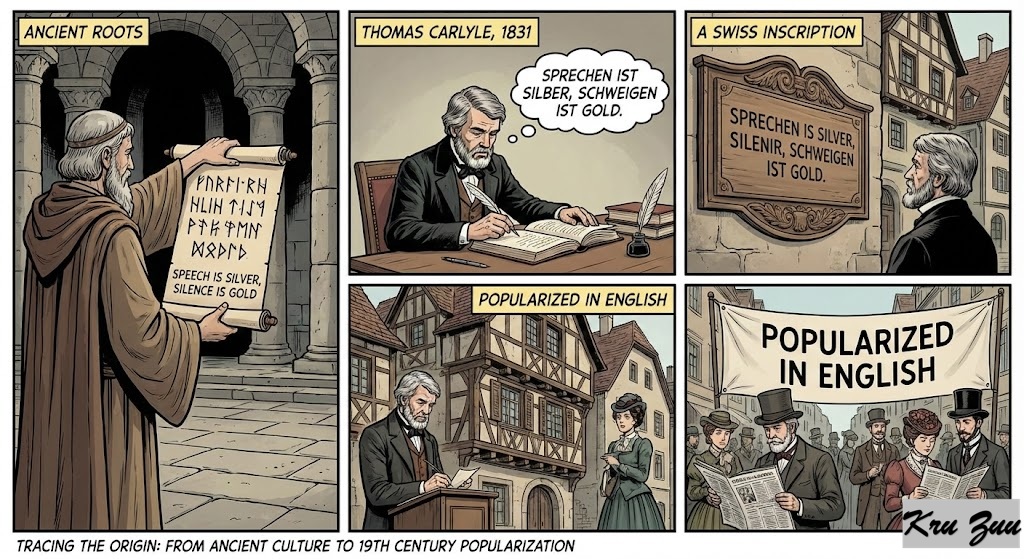
    The Origin: The phrase traces back to ancient culture. It was popularized in English by Thomas Carlyle in the 19th century (1831), who translated a Swiss/German inscription: “Sprechen ist Silber, Schweigen ist Gold.” (Speech is silver, Silence is gold).


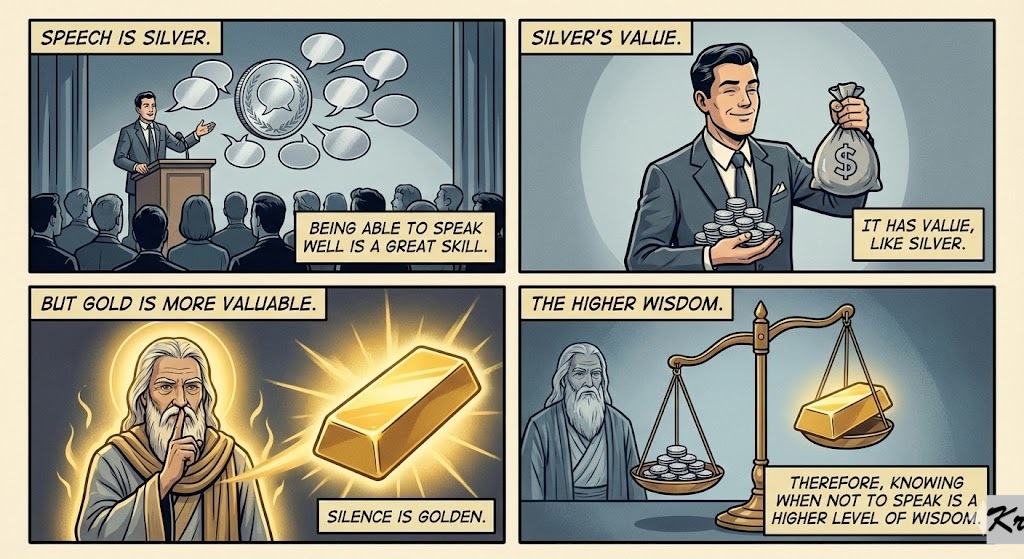
    The Logic: Silver is valuable. Being able to speak well is a great skill (Silver). But Gold is more valuable. Therefore, knowing when not to speak is a higher level of wisdom.


    Global Cousins


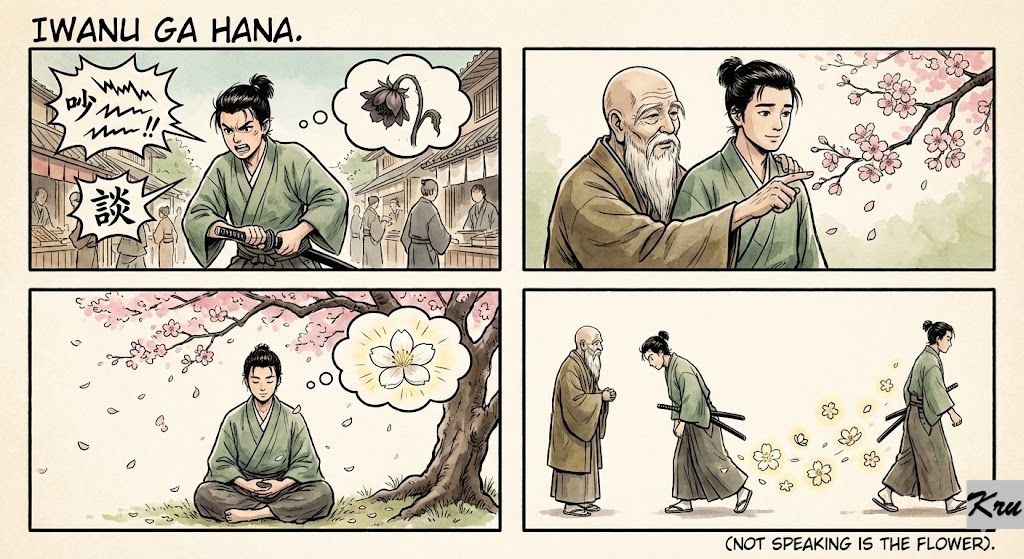
    🇯🇵 Japanese: “Iwanu ga hana” (Not speaking is the flower).


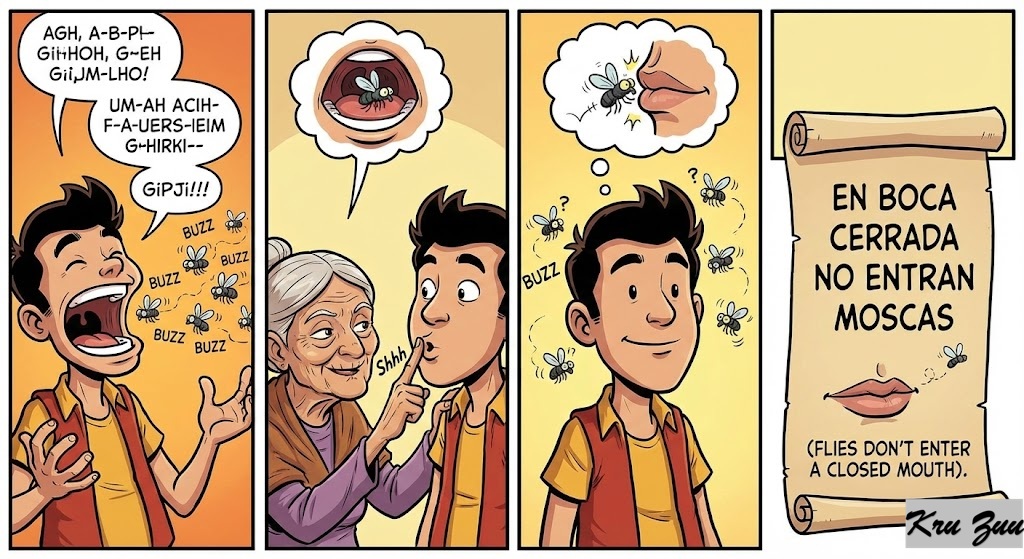
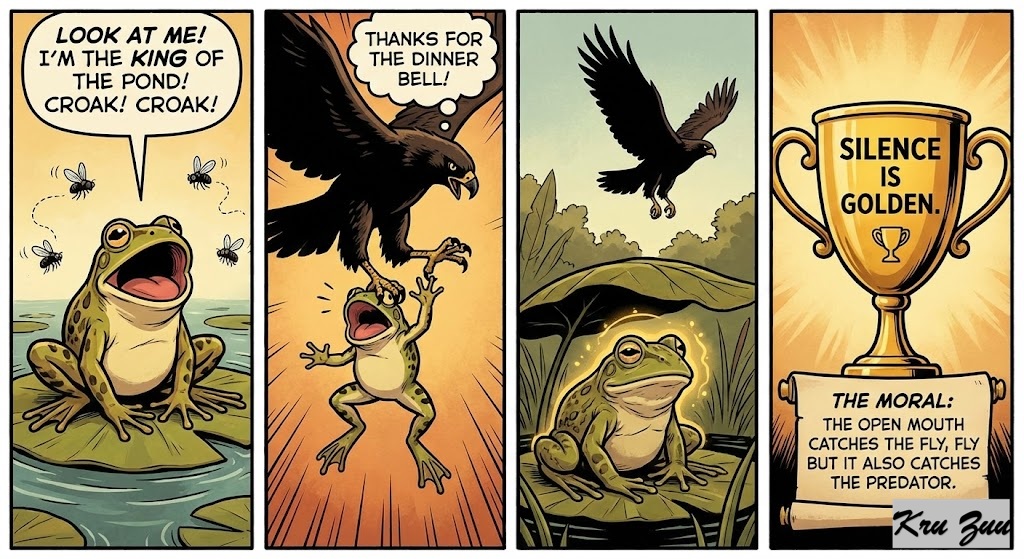
    🇪🇸 Spanish: “En boca cerrada no entran moscas” (Flies don’t enter a closed mouth).


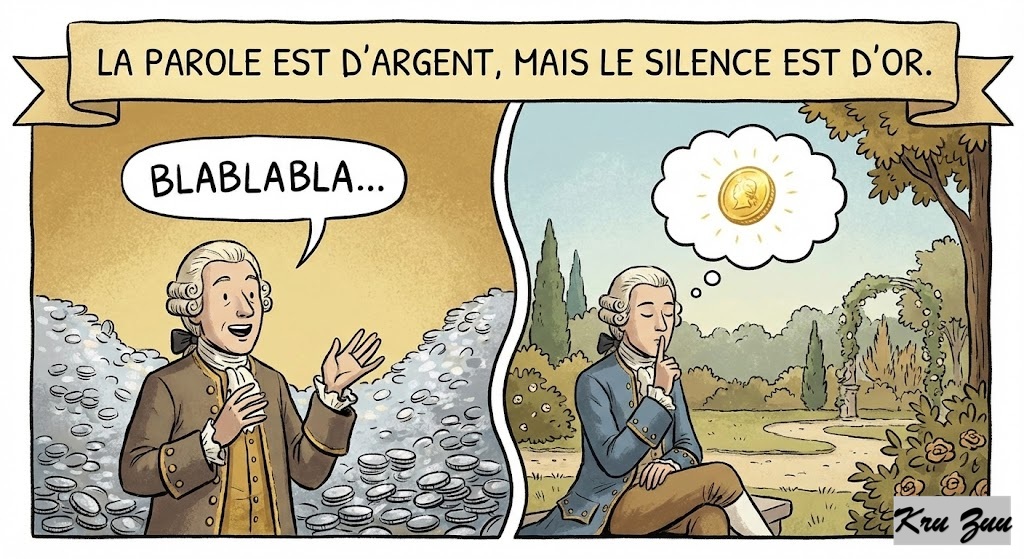
    🇫🇷 French: “La parole est d’argent, mais le silence est d’or.”

    🎭 Short Story: The Loudest Mistake 🤫🐱🐔🐸


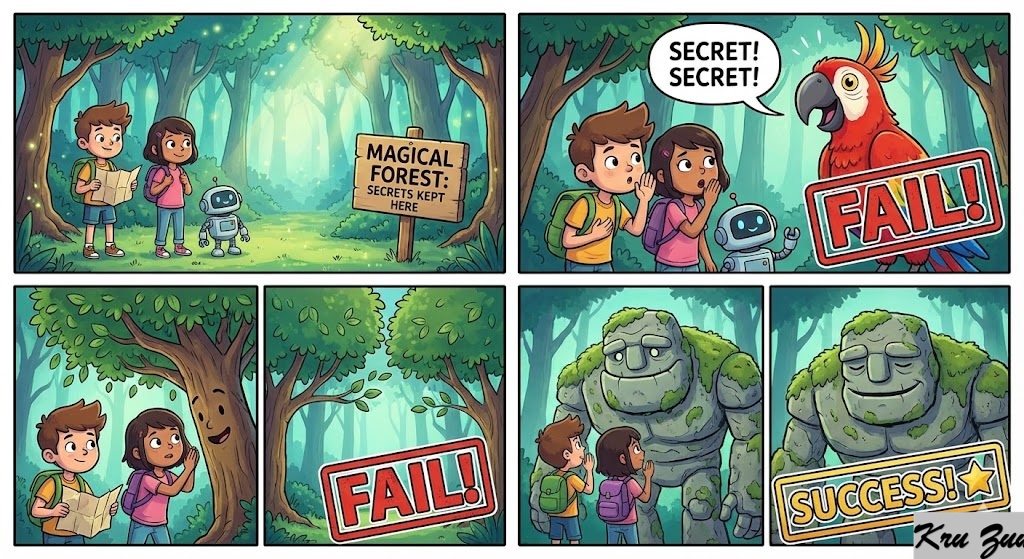
    Let’s visit the magical forest to see who can keep a secret.


    🌟 The Cast


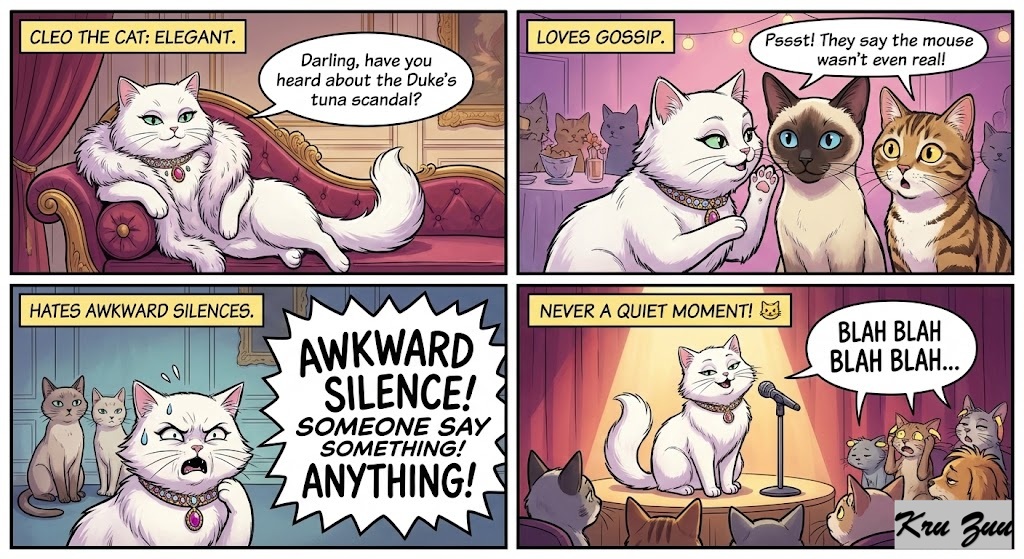
    Cleo the Cat: Elegant, loves gossip, hates awkward silences. 😼


    Cluck the Chicken: Nervous, fills every quiet moment with noise. 🐔


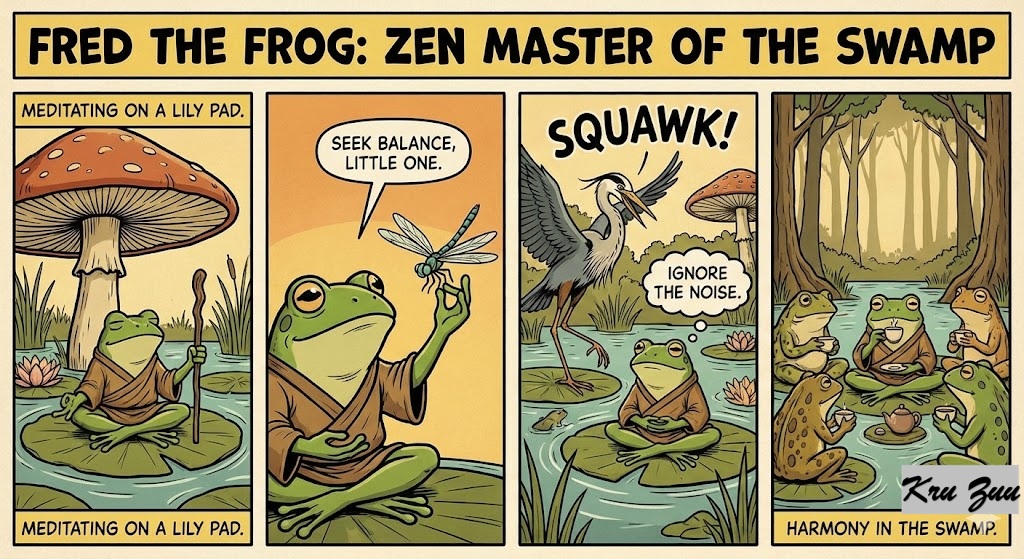
    Fred the Frog: The Zen master of the swamp. 🐸


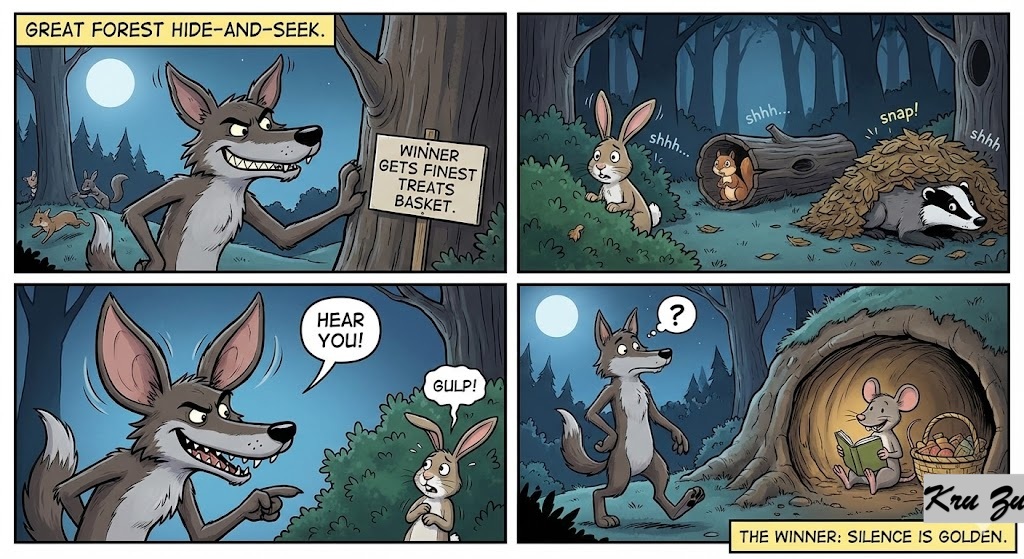
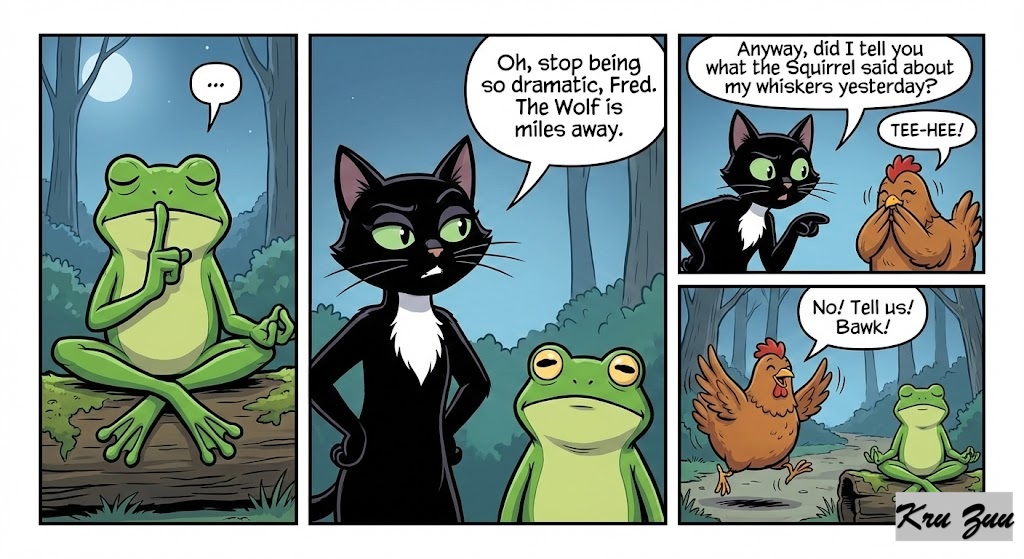
    The Situation: It is the night of the “Great Forest Hide-and-Seek.” The winner gets a basket of the finest treats. The seeker is the Big Bad Wolf, who has very sharp ears.


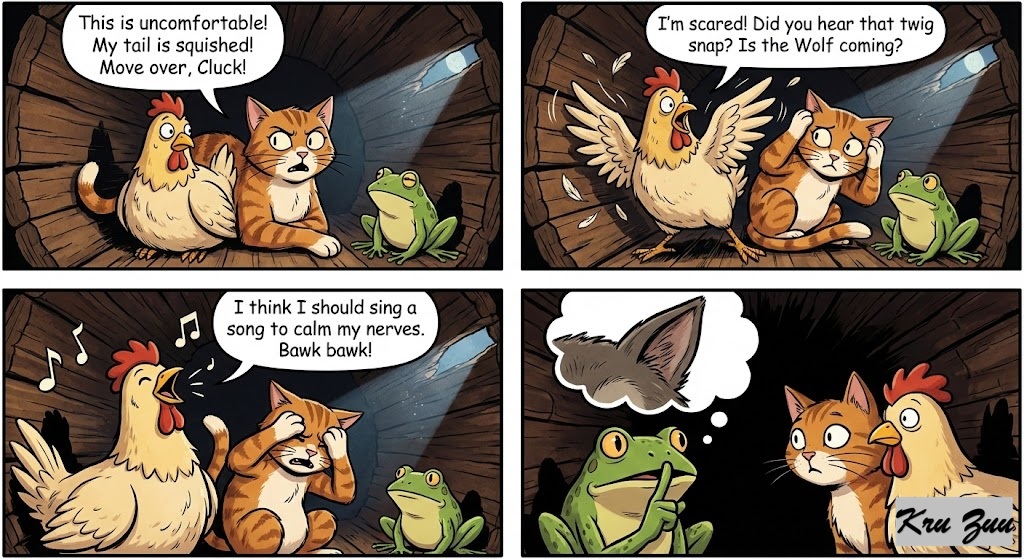
    The Conflict: Cleo, Cluck, and Fred find the perfect hiding spot inside a hollow log. It is dark and tight. “This is uncomfortable!” Cleo whispers loudly. “My tail is squished! Move over, Cluck!” “I’m scared!” Cluck squawks, flapping his wings. “Did you hear that twig snap? Is the Wolf coming? I think I should sing a song to calm my nerves. Bawk bawk!”


    The Reaction: Fred the Frog sits perfectly still. He closes his eyes. He breathes slowly. He puts a green finger to his lips. “…” Cleo rolls her eyes. “Oh, stop being so dramatic, Fred. The Wolf is miles away. Anyway, did I tell you what the Squirrel said about my whiskers yesterday?” Cluck giggles. “No! Tell us! Bawk!”


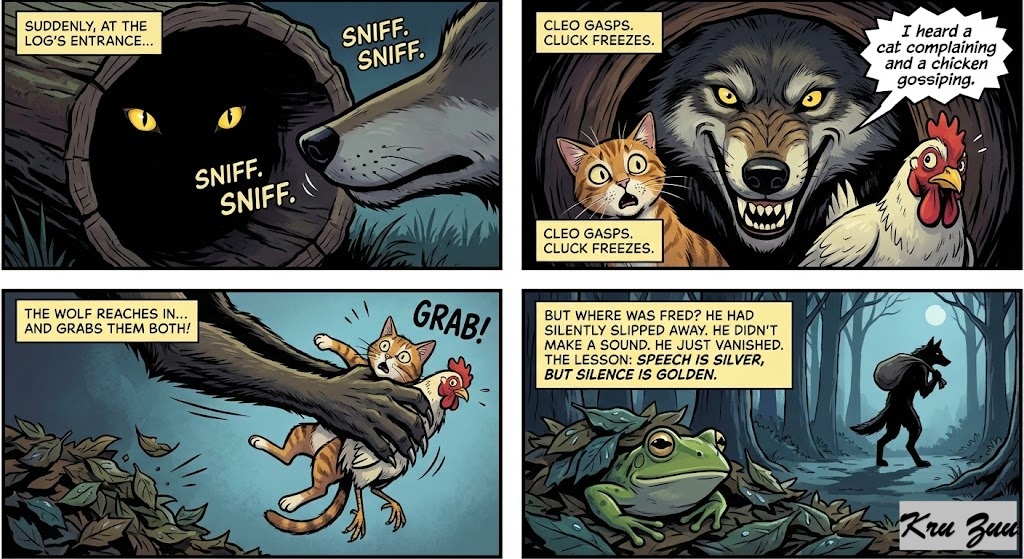
    The Lesson: Suddenly, two yellow eyes appear at the entrance of the log. Sniff. Sniff. The Wolf smiles. “I heard a cat complaining and a chicken gossiping.” Cleo gasps. Cluck freezes. The Wolf reaches in… and grabs them both! But where was Fred? In the moment the Wolf appeared, Fred had silently slipped under a pile of wet leaves. He didn’t make a sound. He didn’t brag. He didn’t scream. He just vanished.


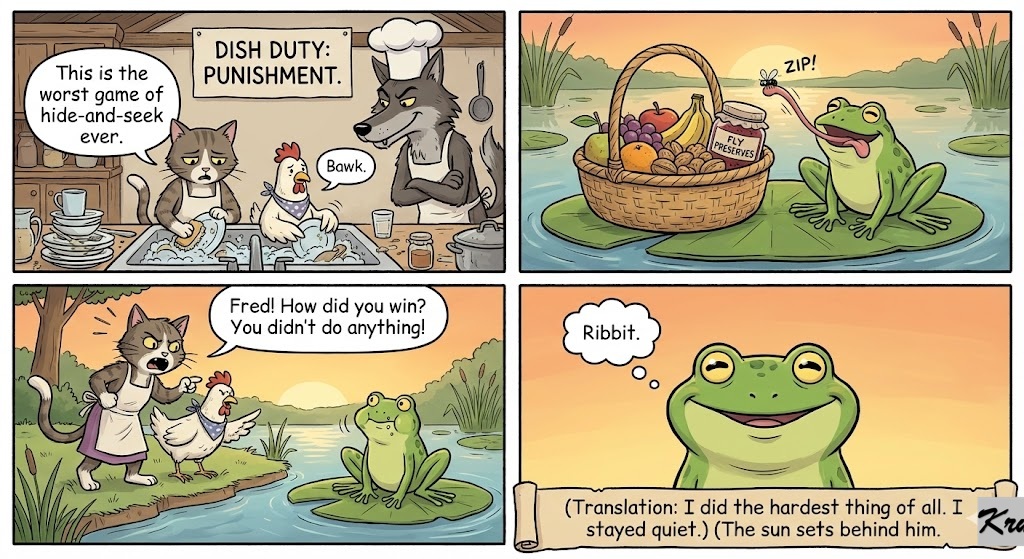
    The Resolution: Cleo and Cluck lost the game (and their treats). They spent the evening washing dishes for the Wolf as punishment. Fred won the basket of treats. He sat on his lily pad, eating a delicious fly. “Fred!” Cleo cried. “How did you win? You didn’t do anything!” Fred chewed slowly, swallowed, and smiled. “Ribbit.” (Translation: I did the hardest thing of all. I stayed quiet).


    The Moral: The open mouth catches the fly, but it also catches the predator. Silence is golden. 🏆

    🎓 Lesson for English Learners


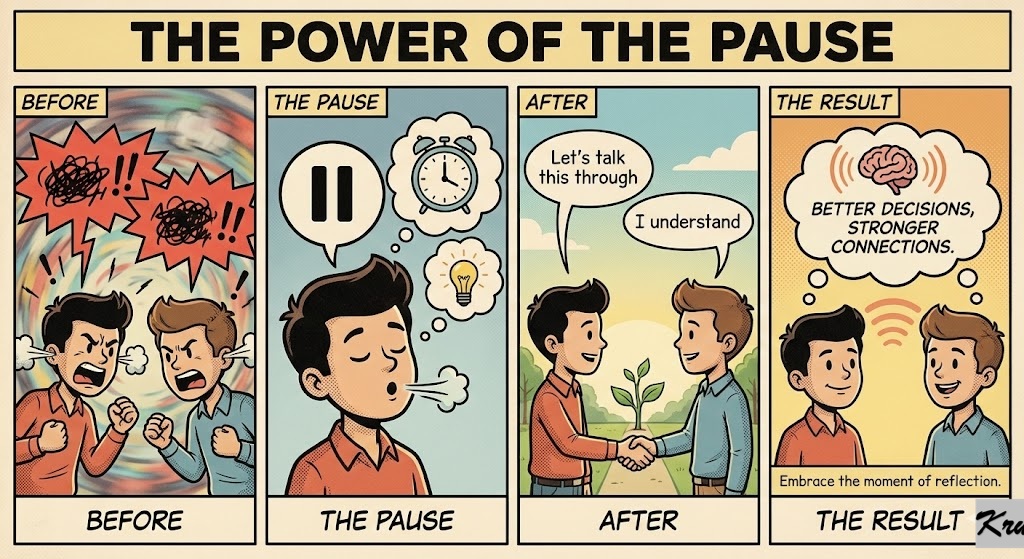
    The Power of the Pause.


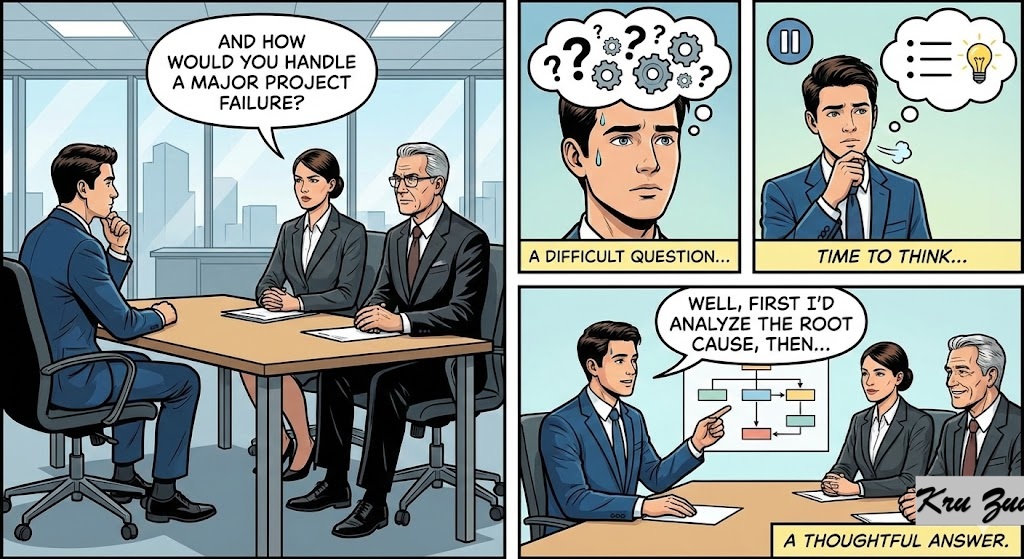
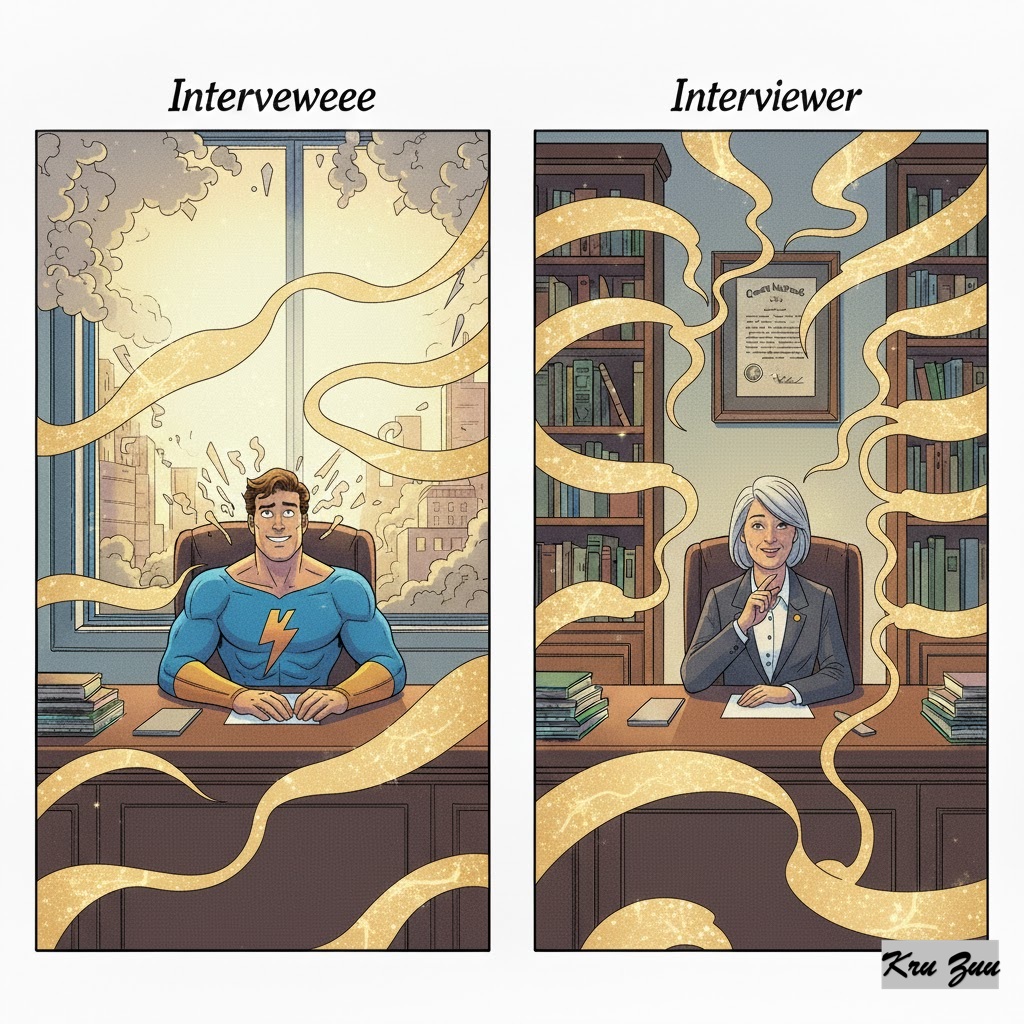
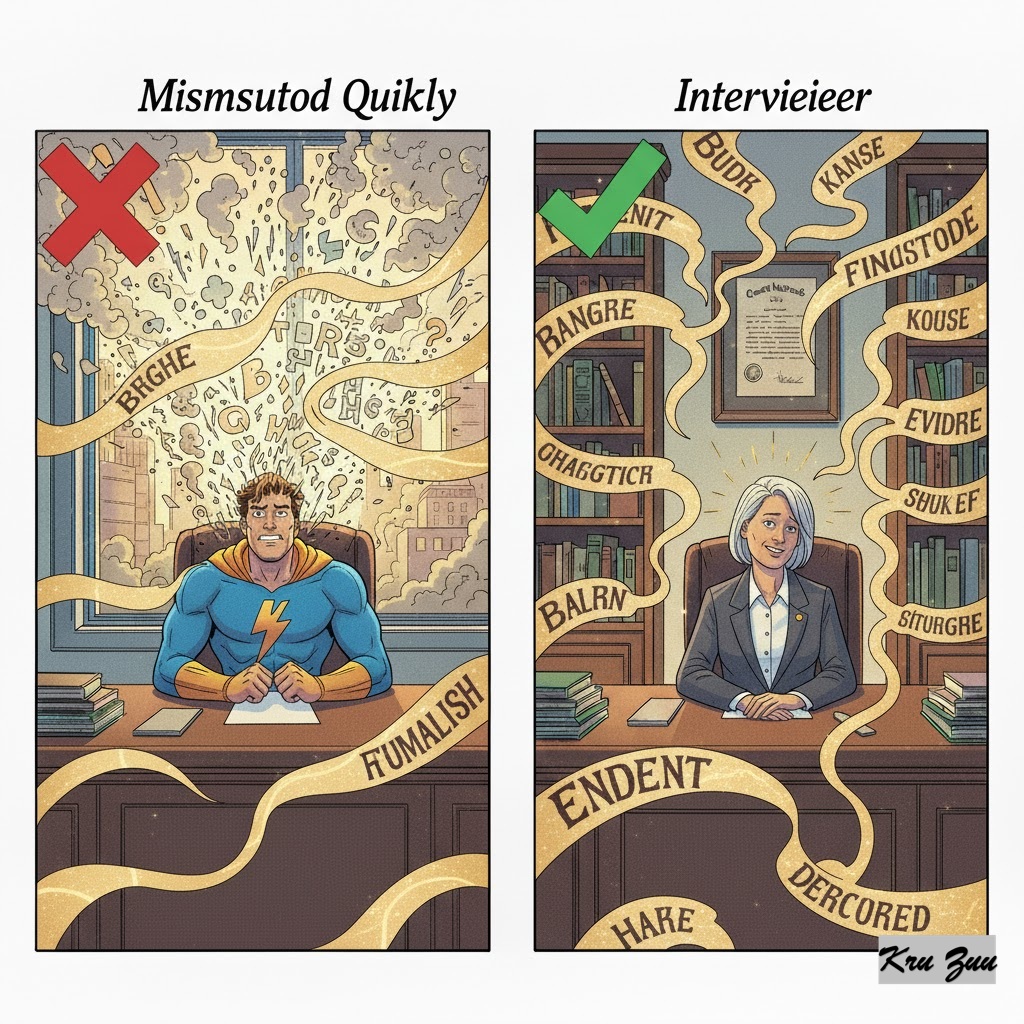
    Situation: You are in a job interview or a meeting. Someone asks you a difficult question.


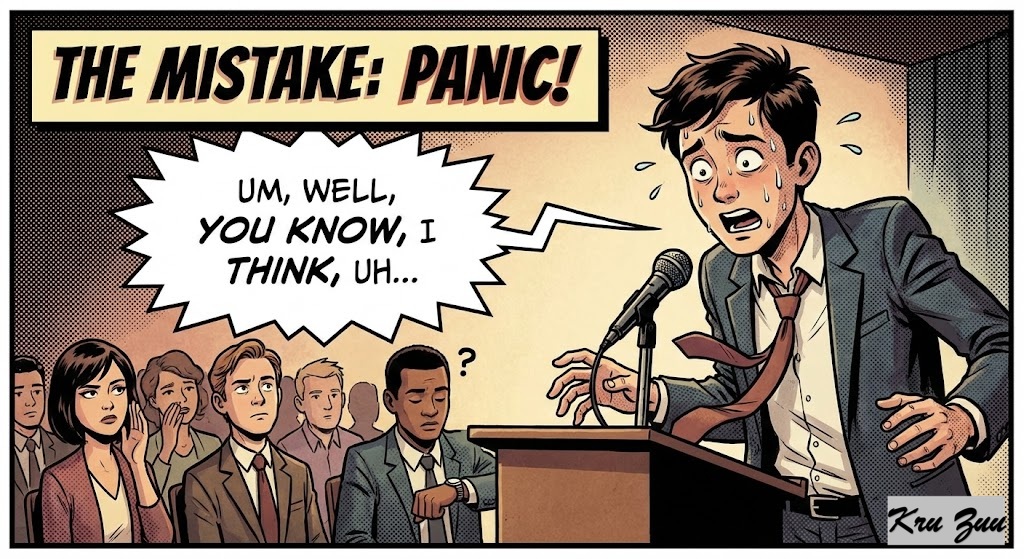
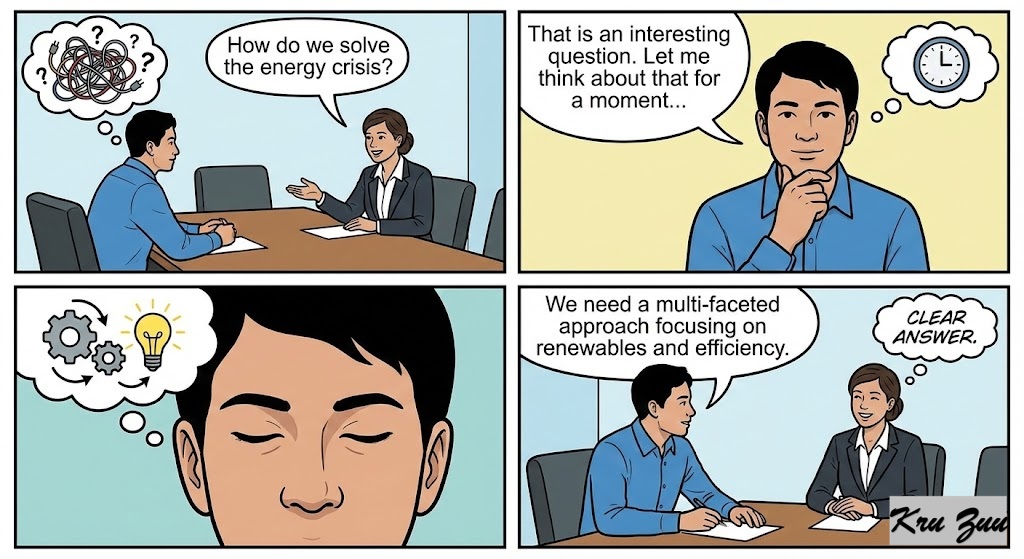
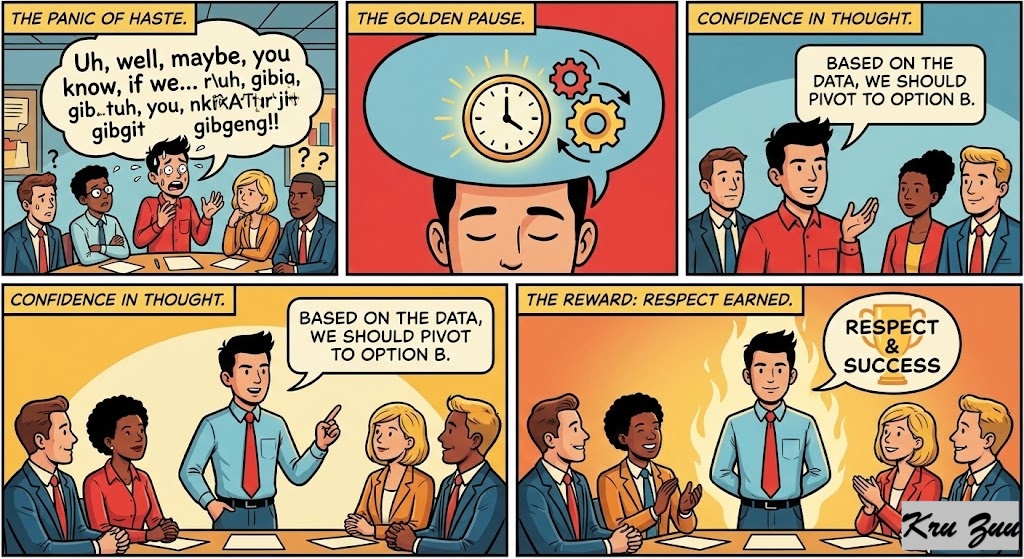
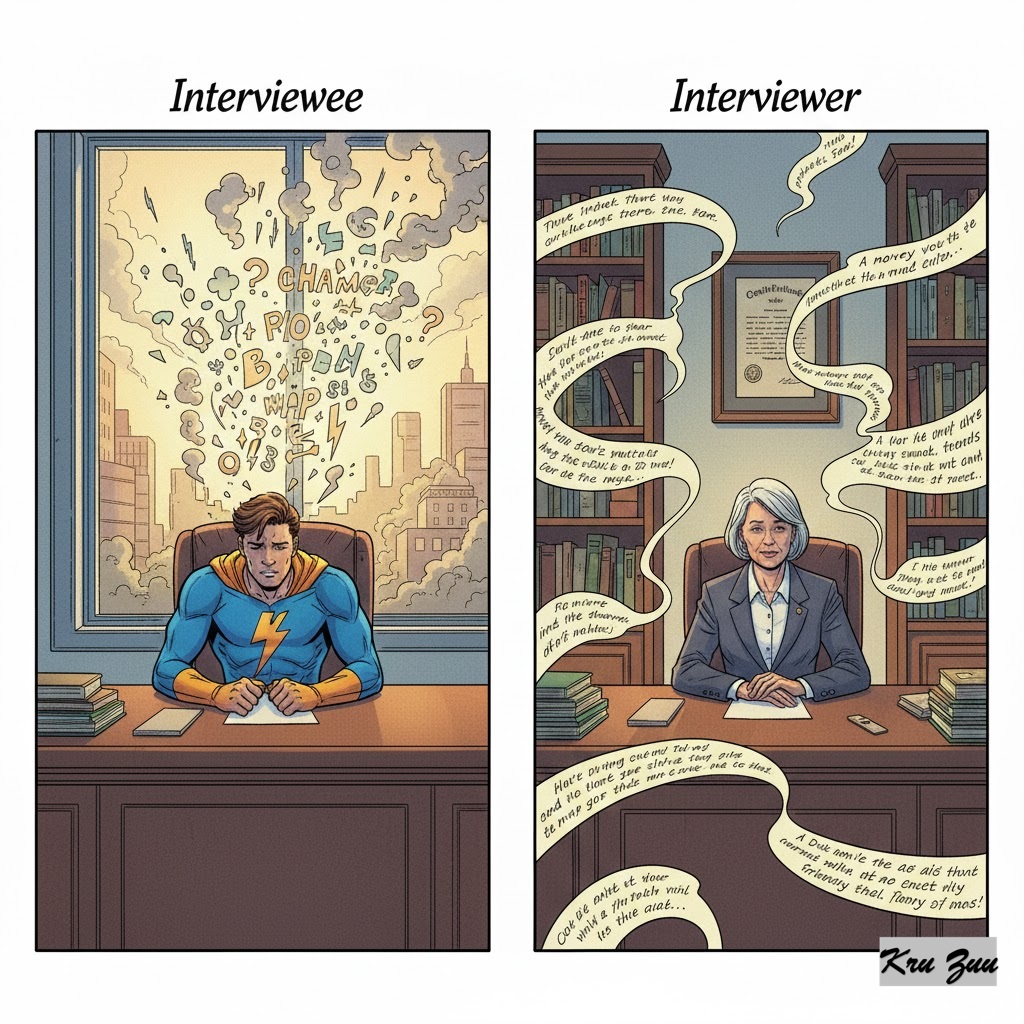
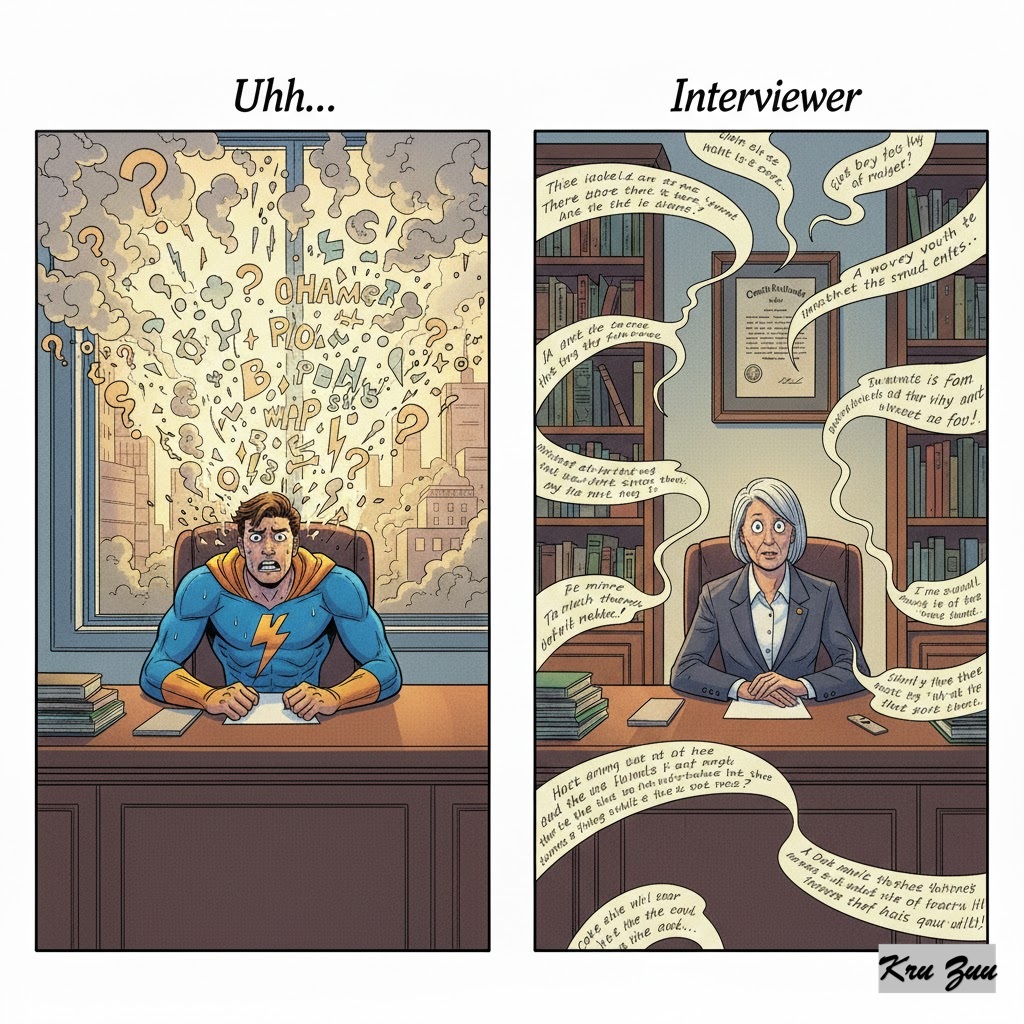
    The Mistake: You panic and start talking immediately (“Um, well, you know, I think, uh…”). You look nervous.


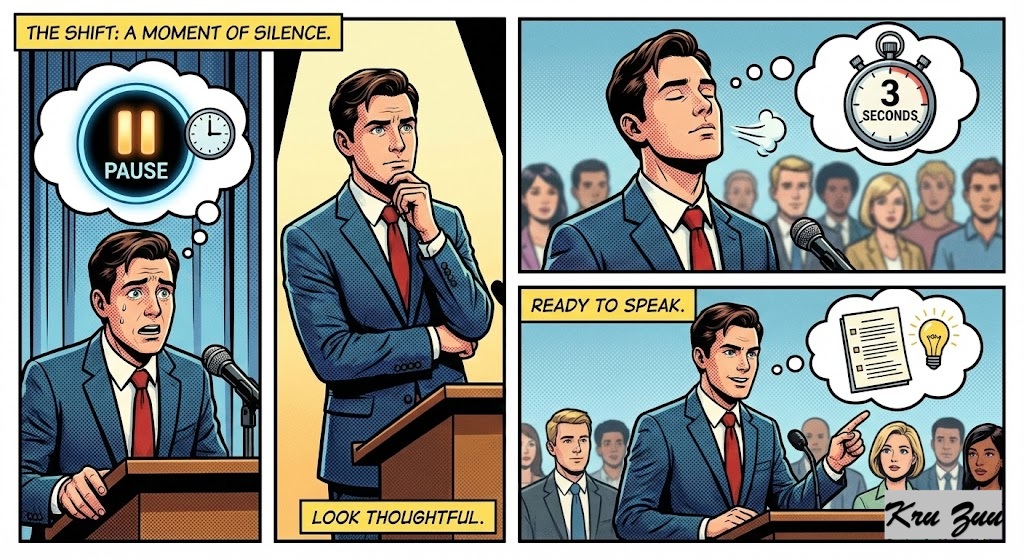
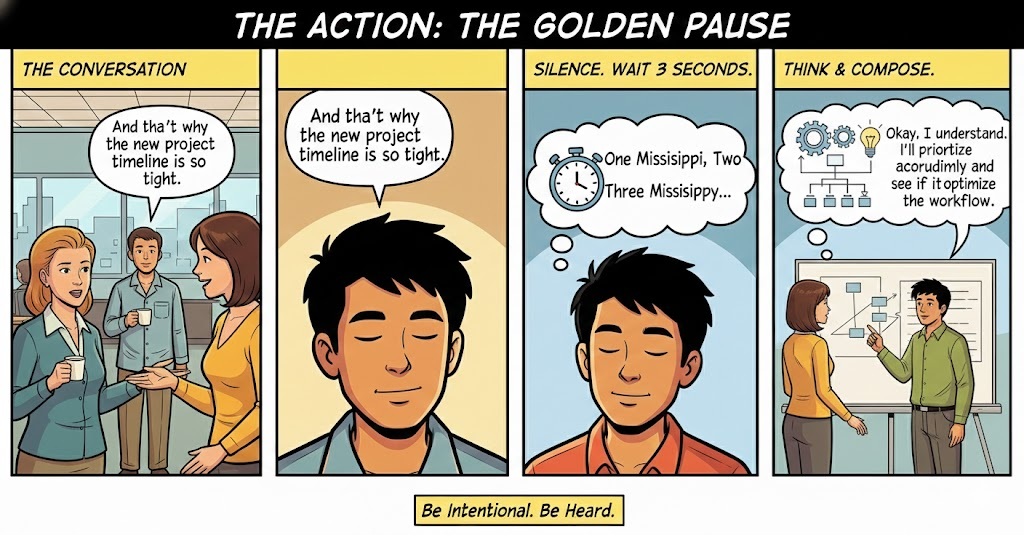
    The Shift: Use the “Golden Pause.” Take 3 seconds of silence. Look thoughtful.


    You Say: “That is an interesting question. Let me think about that for a moment…” (Then give a clear answer).


    Why: This shows confidence. It shows you think before you speak.


    💬 Your Turn: The “3-Second” Challenge 🚀


    Do you want to cure your “Villain” talking habits?


    The Challenge:
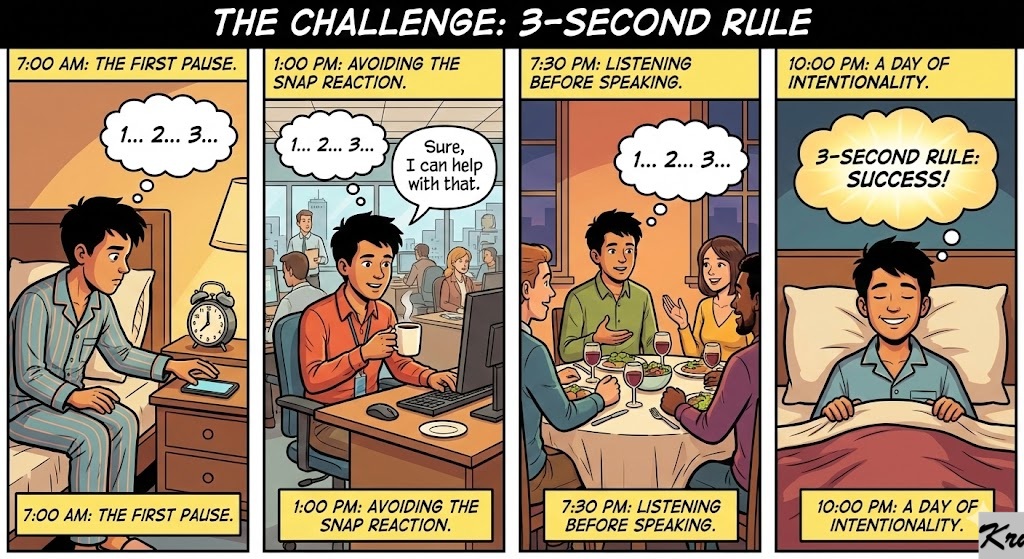
    For one whole day, follow the 3-Second Rule.


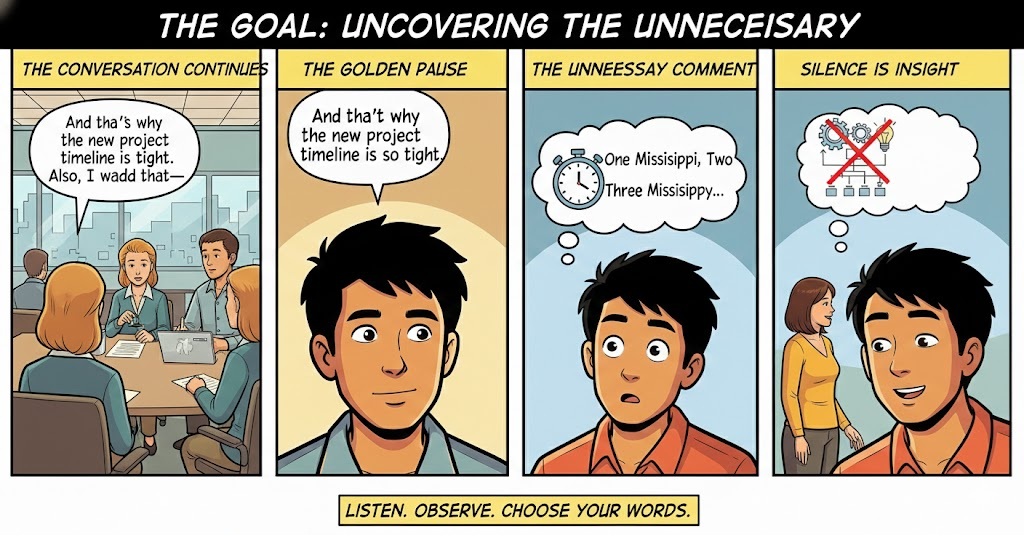
    The Action: Whenever someone finishes talking, count to 3 in your head (One Mississippi, Two Mississippi, Three Mississippi) before you respond.


    The Goal: You will realize that often, the other person wasn’t finished talking! Or, you will realize your comment wasn’t necessary.


    👇 Question for the comments: Have you ever said something you immediately regretted? Or has staying silent ever saved you? Tell us your story below!

    By Zubeyir YURTKURAN

    https://www.facebook.com/BrainBattleground/

    https://www.facebook.com/zubeyr.yurtkuran/

    https://www.instagram.com/zubeyryurtkuran/
    https://www.youtube.com/@BrainBattleground-b3p

    https://www.instagram.com/brainbattleground/

  • 🌳 The Daily Shield: The Law of Momentum

    🌳 The Daily Shield: The Law of Momentum

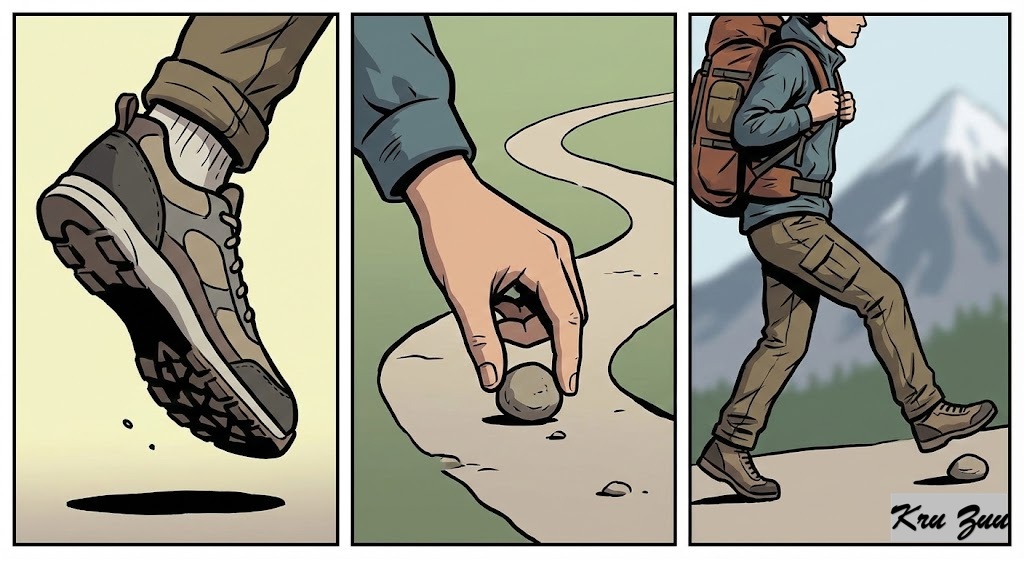
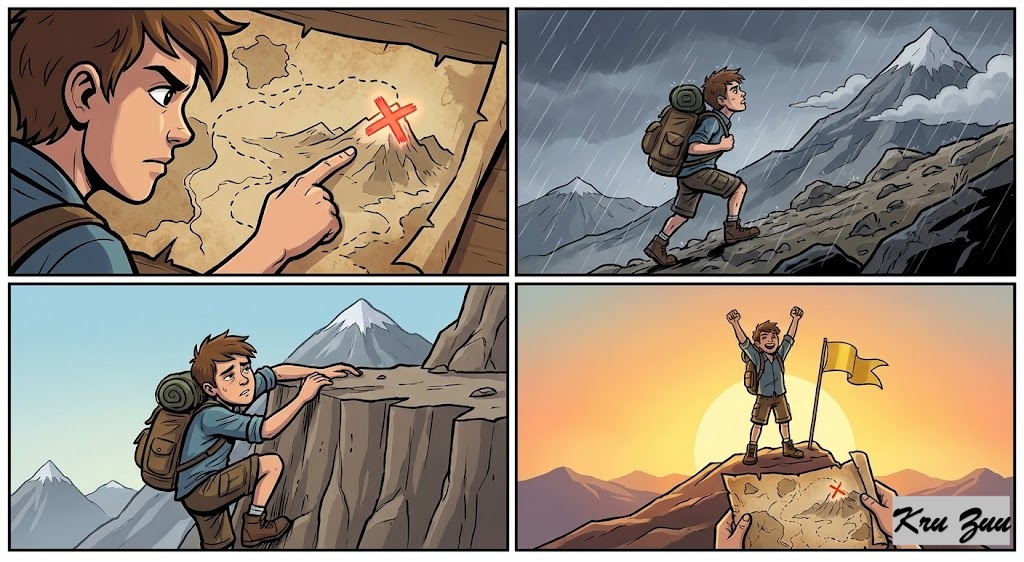
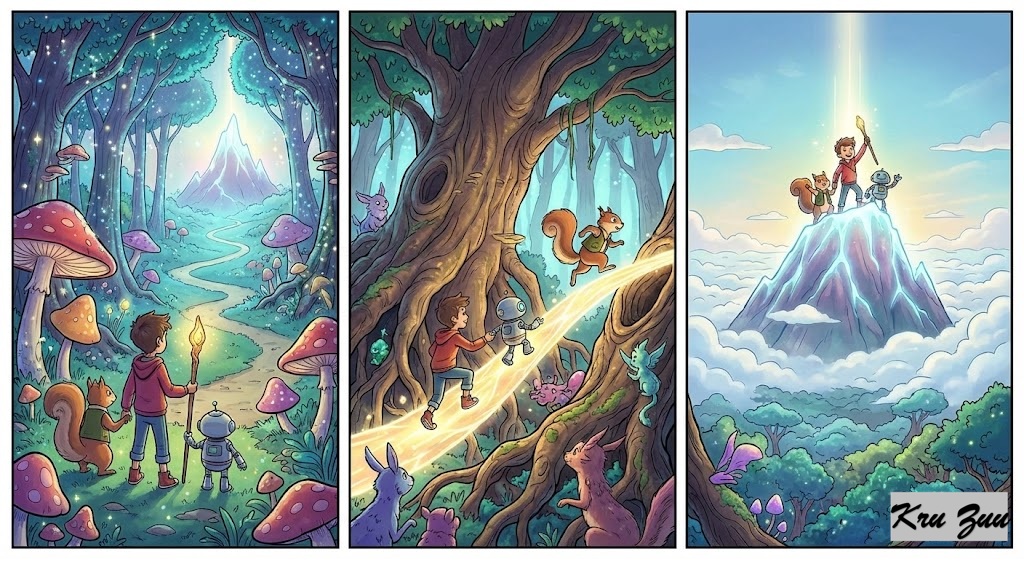
    “A journey of a thousand miles begins with a single step.”


    😈 The Villain (The Procrastinator)

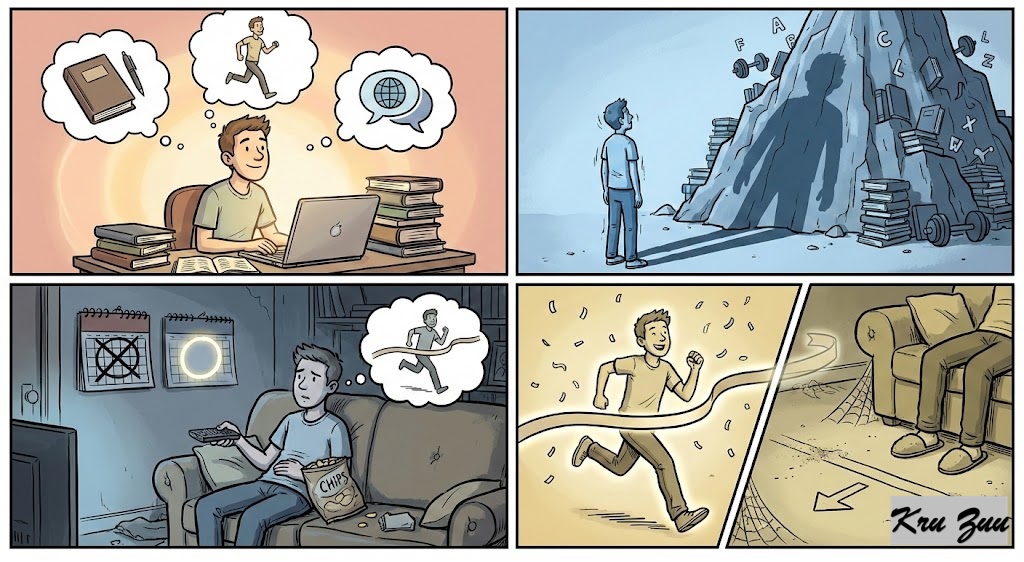
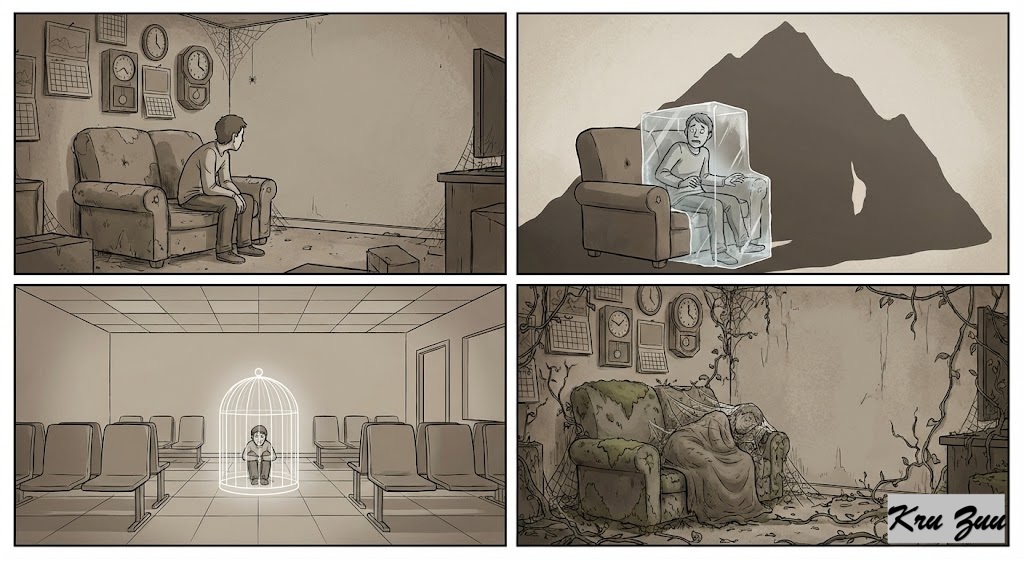
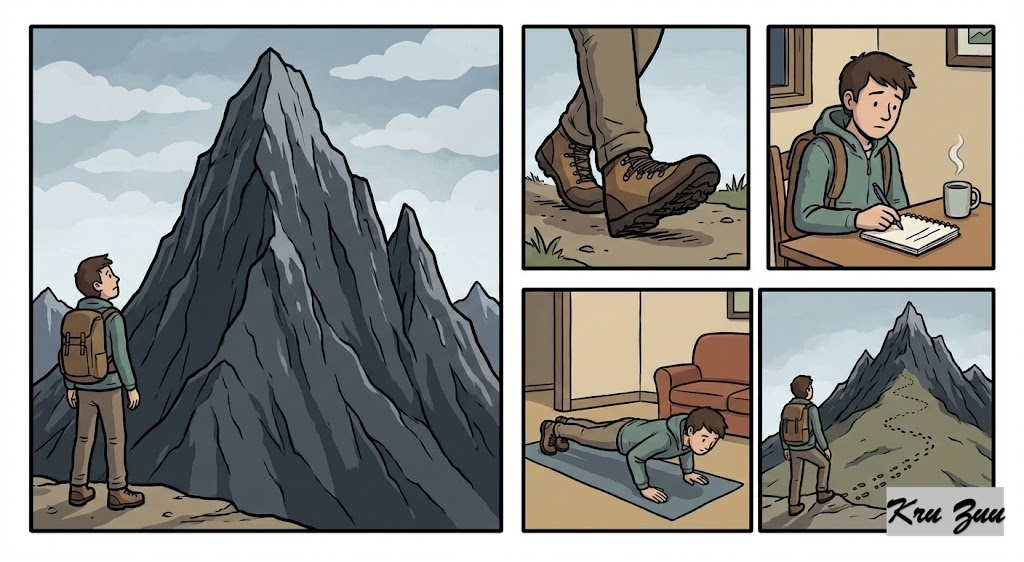
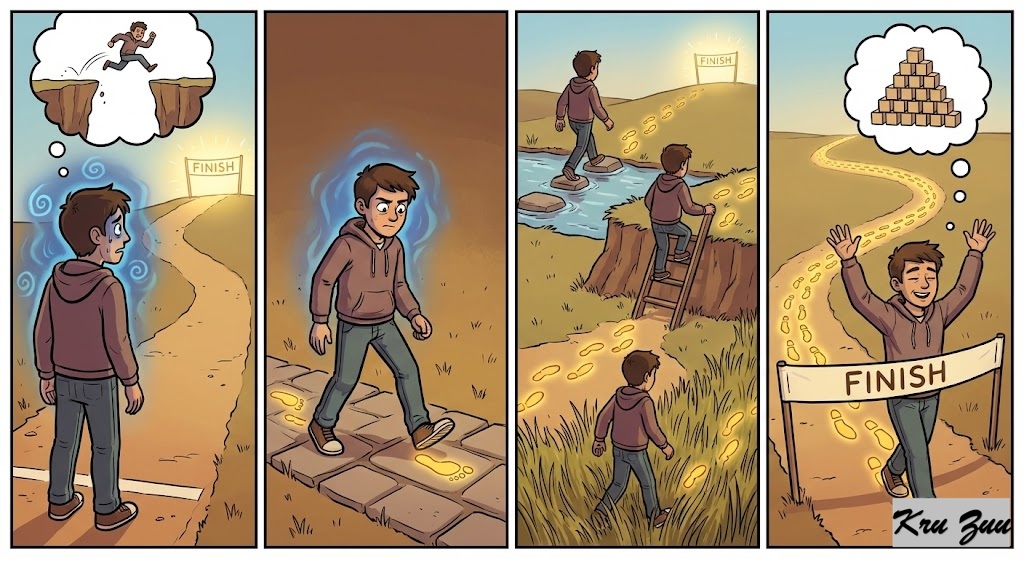
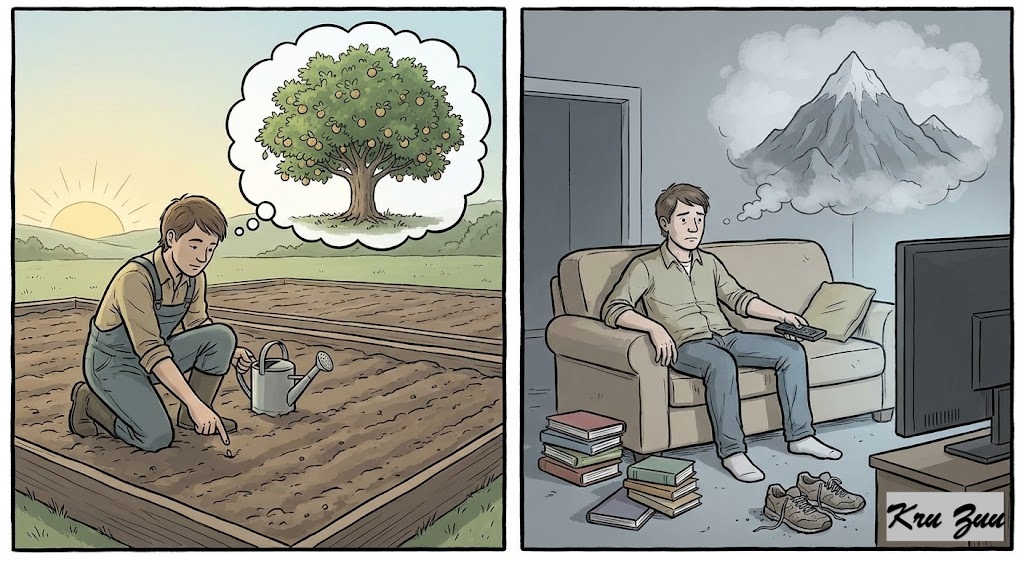
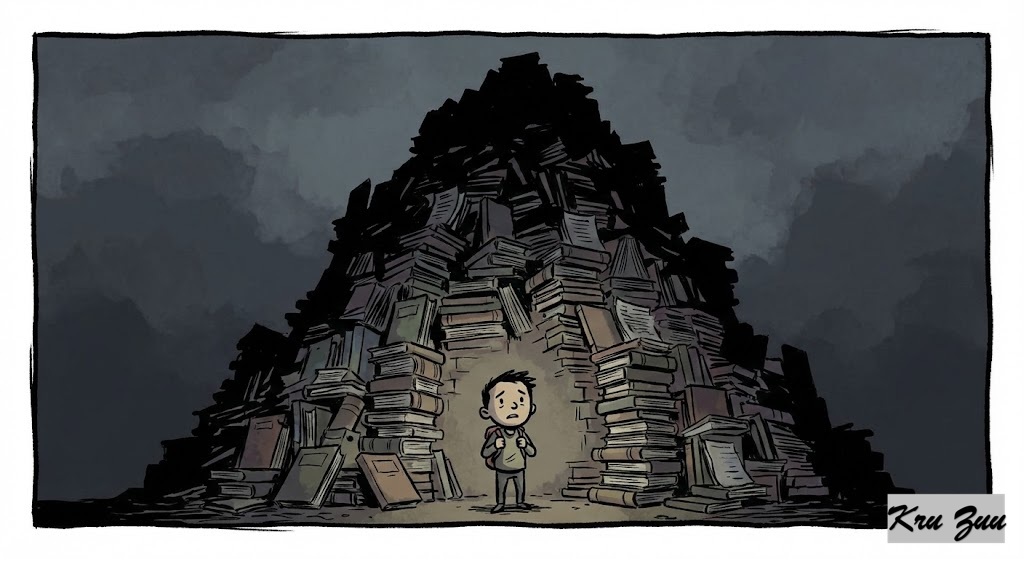
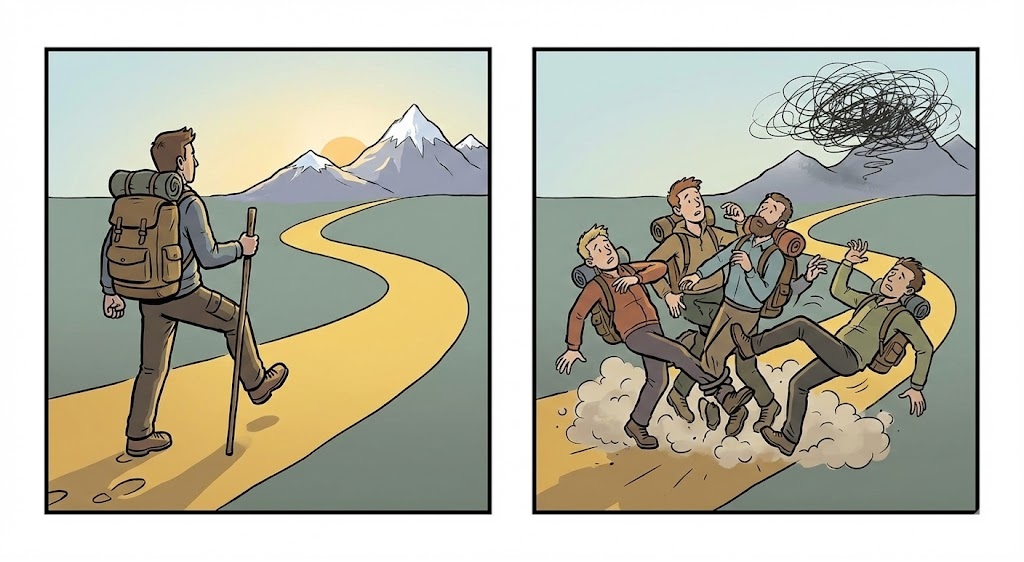
    You have a big dream. You want to learn English, lose weight, or write a book. But you look at the mountain ahead and you freeze. 🧊 “It’s too hard!” “It will take years!” “I’ll start next Monday (or next year).” You are obsessed with the finish line, so you never cross the starting line. You wait for the “perfect time” or “perfect mood.”

    The Result? You stay exactly where you are. You are paralyzed by the size of the task. You are trapped in the “Waiting Room of Life.” 🛋️


    😇 The Hero (The Walker)

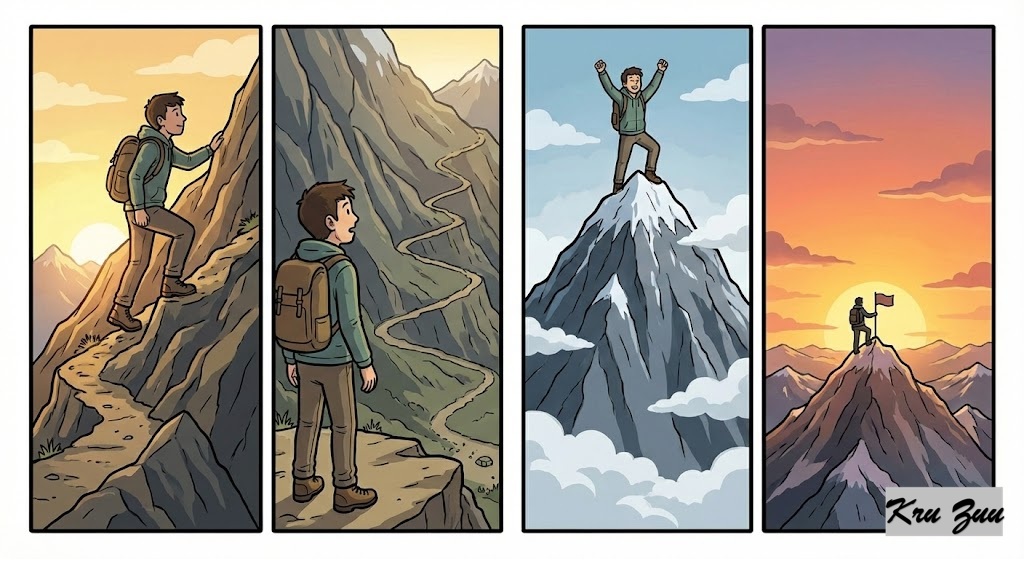
    You see the big mountain, but you look at your feet. 🦶 You don’t worry about Mile 500; you only focus on Step 1. You say: “I don’t have to finish today. I just have to start.” You write one sentence. You learn one word. You do one push-up. You respect the power of small progress.

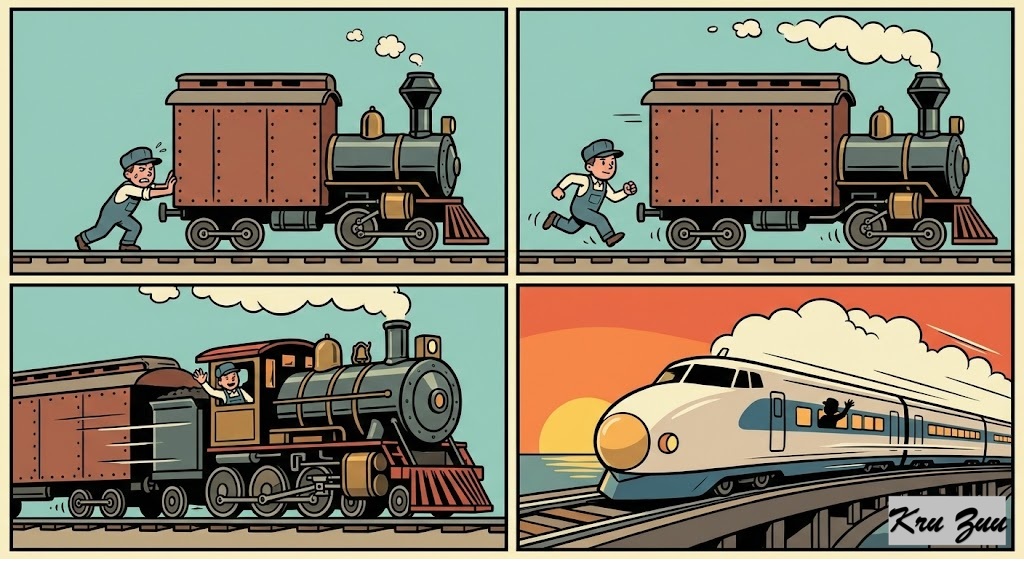
    The Result? You build momentum. Suddenly, you look back and realize you have climbed the mountain without even noticing the pain. You build consistency, not excuses. 🚀


    ⚖️ The Reality


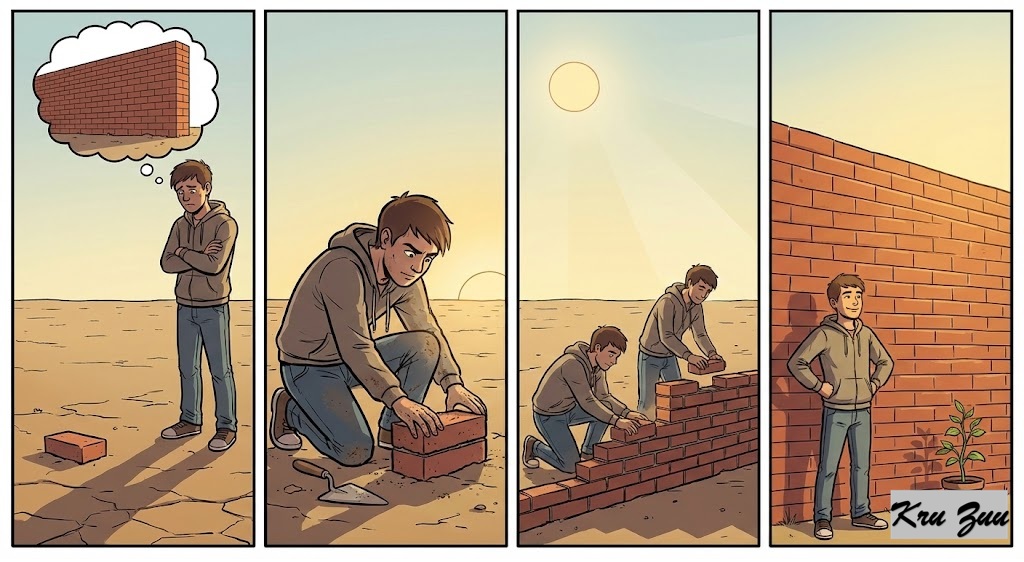
    Motion vs. Stagnation. We live in a world of “instant results.” We want the six-pack abs in 2 days, or fluency in English in 2 weeks. But big things are just a pile of small things added together. A blizzard is just billions of single snowflakes. A novel is just thousands of single words. If you refuse to take the first step because the journey looks long, you guarantee failure.


    💎 The Secret

    You cannot teleport to the finish line. Success is not a giant leap; it is a million tiny, boring steps taken one after another. Action cures fear.

    🧐 The Anatomy of the Proverb


    This is your reminder that every expert was once a beginner.


    Journey (Noun): A long trip or process of personal change.


    Thousand Miles (Noun Phrase): A metaphor for a very large, difficult, or long-term task.


    Single (Adjective): Just one; individual.


    Step (Noun): The movement of lifting your foot and putting it down; a small action.


    Simpler Version: Start small. / Don’t give up before you start.


    📚 Vocabulary Vault


    Daunting (Adjective): Seeming difficult to deal with; intimidating. (e.g., “The exam looked daunting.”) 😨


    Procrastinate (Verb): To delay or postpone action; putting off doing something.


    Momentum (Noun): The quantity of motion of a moving body; the strength or force gained by motion. 🚄


    Objective (Noun): A goal or aim.


    Consistent (Adjective): Acting or done in the same way over time, especially so as to be fair or accurate. (The key to success!).


    🧠 Grammar Focus: Singular vs. Plural Subjects


    Notice the grammar in the proverb: “A journey (singular subject) … begins (singular verb + s).” It is NOT “The journey begin.”


    Wrong: “Learning English take a long time.”
    Right: “Learning English takes a long time.”


    Tip: When a gerund (verb + ing, like “Learning”) is the subject, treat it as singular (It).

    📜 History: Origin and Spread


    Who said this wise sentence?


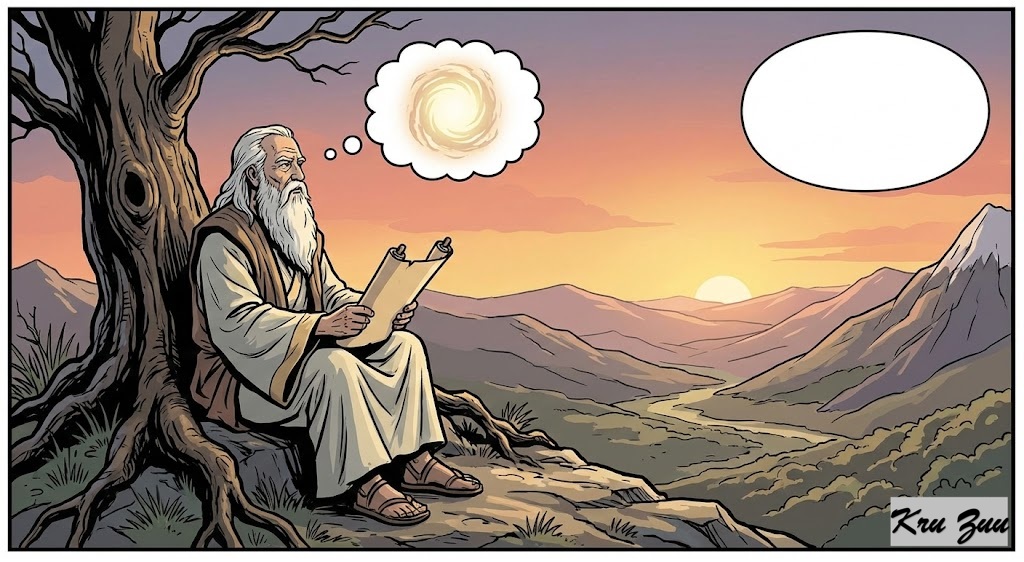
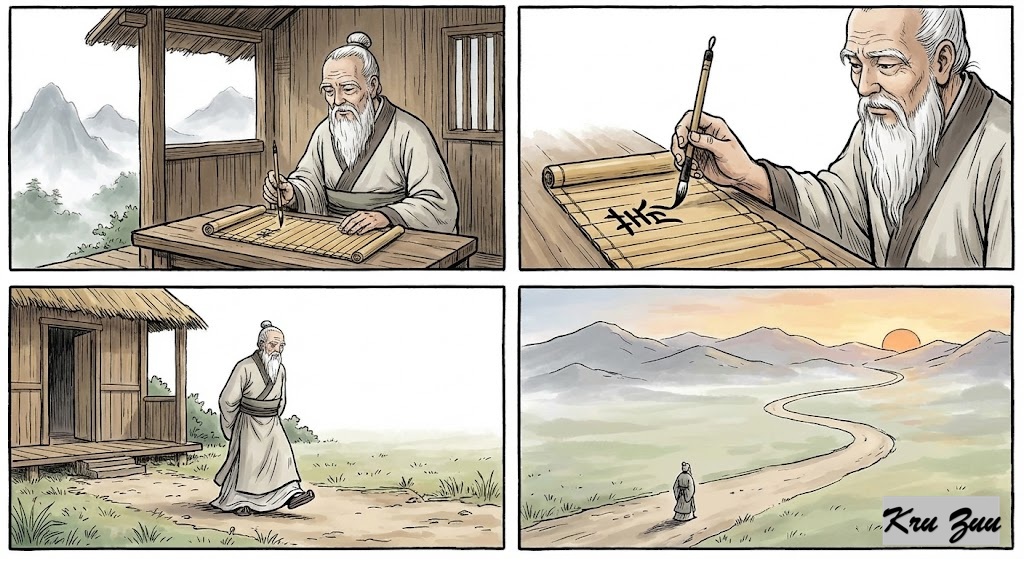
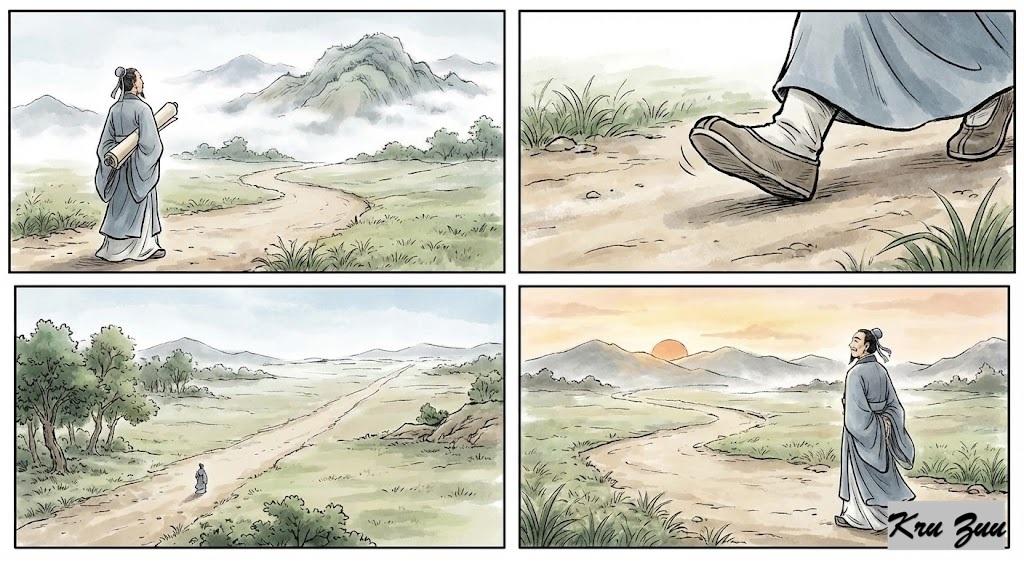
    The Origin: This is an ancient Chinese proverb, written by the philosopher Laozi (Lao Tzu) around the 6th century BC. It appears in the Tao Te Ching (Chapter 64).


    The Translation: The original Chinese text mentions “1,000 li” (a Chinese unit of distance). It translates literally to: “A journey of a thousand li starts beneath one’s feet.”


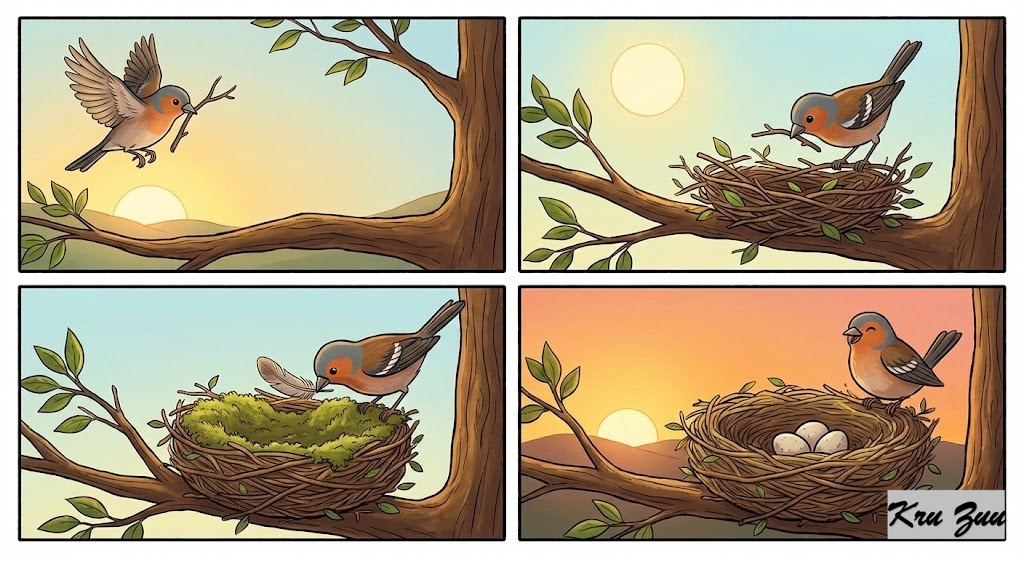
    Global Cousins


    🇫🇷 French: “Petit à petit, l’oiseau fait son nid.” (Little by little, the bird makes its nest).


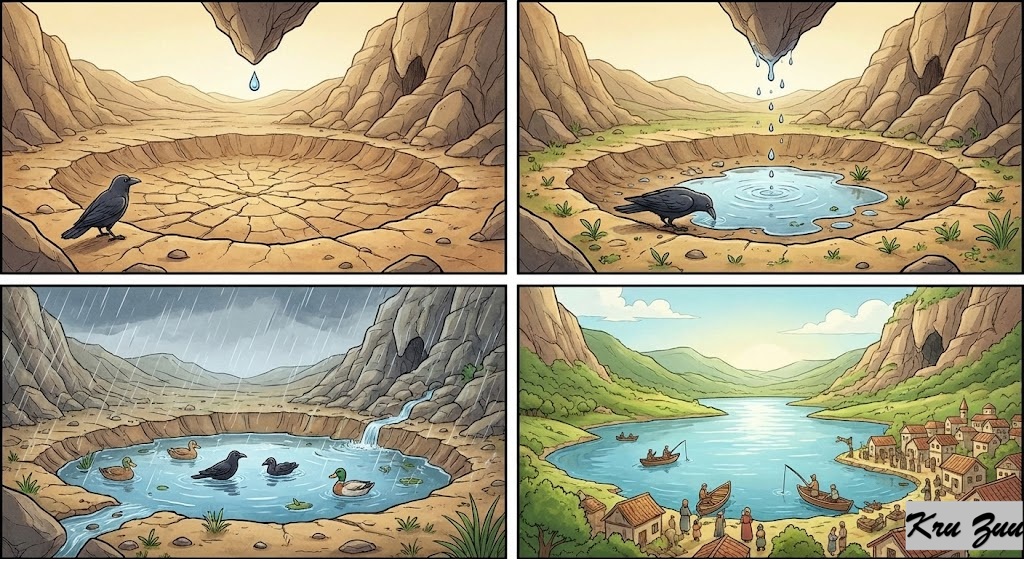
    🇹🇷 Turkish: “Damlaya damlaya göl olur.” (Drop by drop, it becomes a lake).


    🇮🇹 Italian: “Chi va piano, va sano e va lontano.” (He who goes slowly, goes safely and goes far).

    🎭 Short Story: The Mountain of Mangoes 🥭🐱🐔🐸


    Let’s visit the magical forest to see who reaches the top.


    🌟 The Cast


    Cleo the Cat: Stylish, lazy, wants instant success. 😼


    Cluck the Chicken: Nervous, overthinker, panic-prone. 🐔


    Fred the Frog: Quiet, steady, disciplined. 🐸


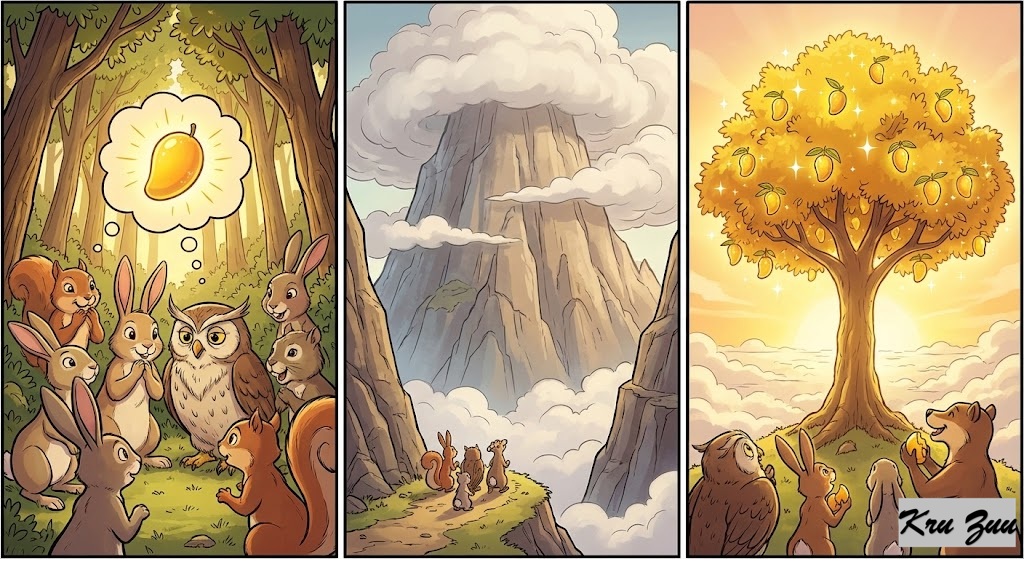
    The Situation: A rumor spreads in the forest. On top of the “High Peak Mountain,” there is a legendary Golden Mango Tree. The mangoes grant eternal happiness (and they are delicious). The mountain is huge. It touches the clouds.


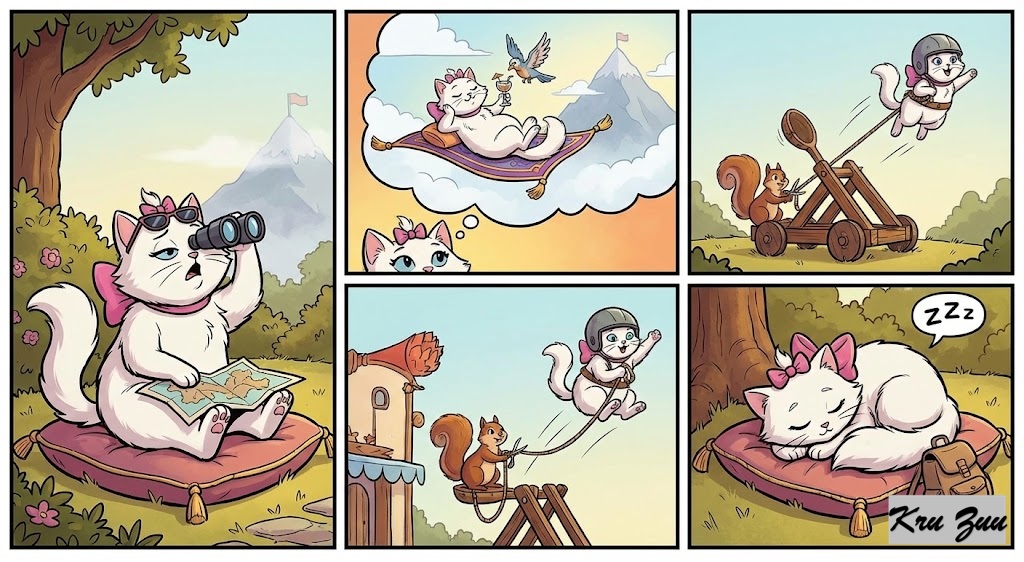
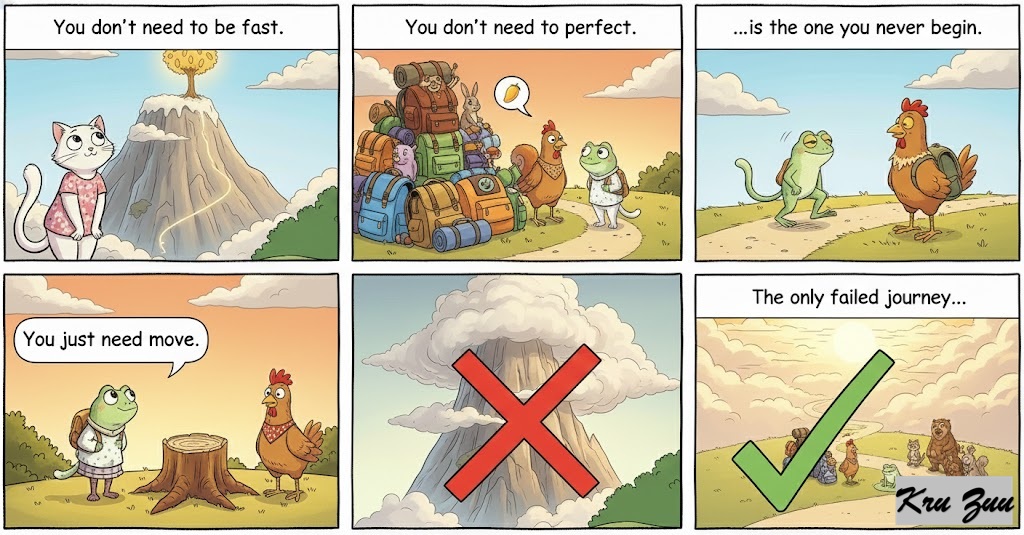
    The Conflict: Cleo looks up and sighs. “Ugh. That is miles away. My paws are too delicate for hiking. I need a magic carpet. Or maybe a catapult? I’m not going unless I can get there fast.” She sits down to nap.


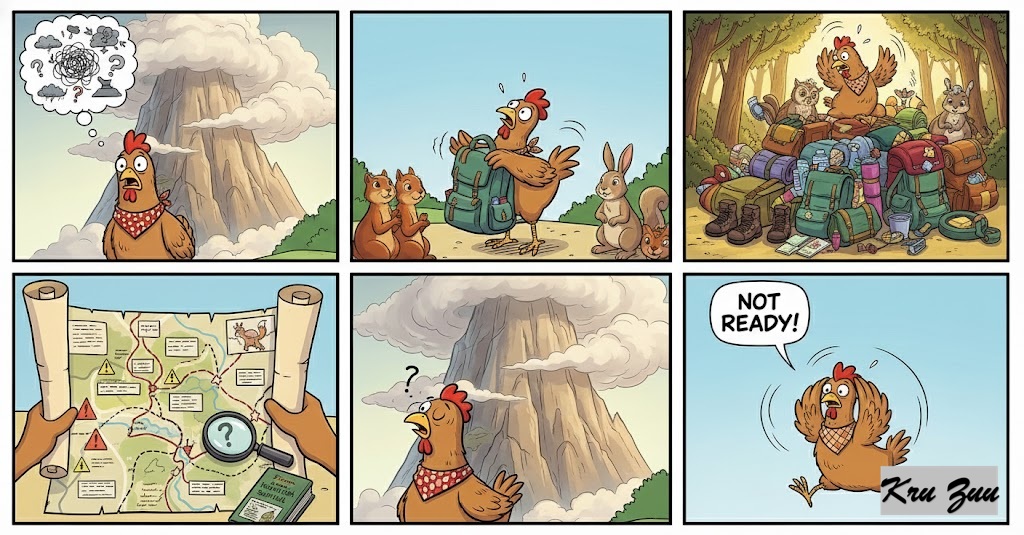
    Cluck looks up and panics. “Oh no! It’s too high! What if it rains? What if I get hungry? What if my shoes untie? I need to pack 50 bags! I need to plan the route! I’m not ready!” Cluck runs around in circles, packing and unpacking his backpack.


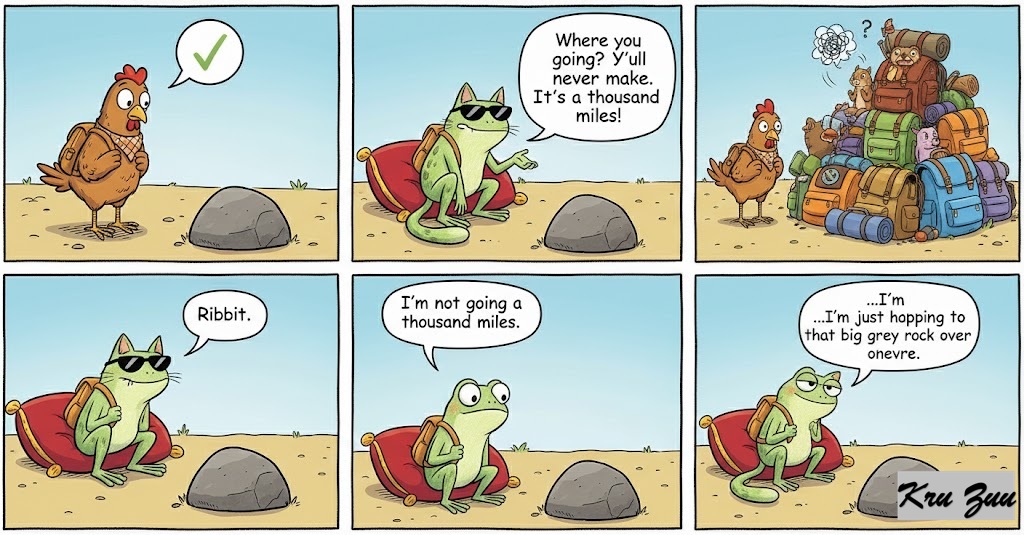
    The Reaction: Fred adjusts his backpack. He doesn’t look at the top of the mountain. He looks at the ground in front of him. “Ribbit,” says Fred. “Where are you going?” asks Cleo. “You’ll never make it. It’s a thousand miles!” “I’m not going a thousand miles,” Fred says calmly. “I am just hopping to that big gray rock over there.”


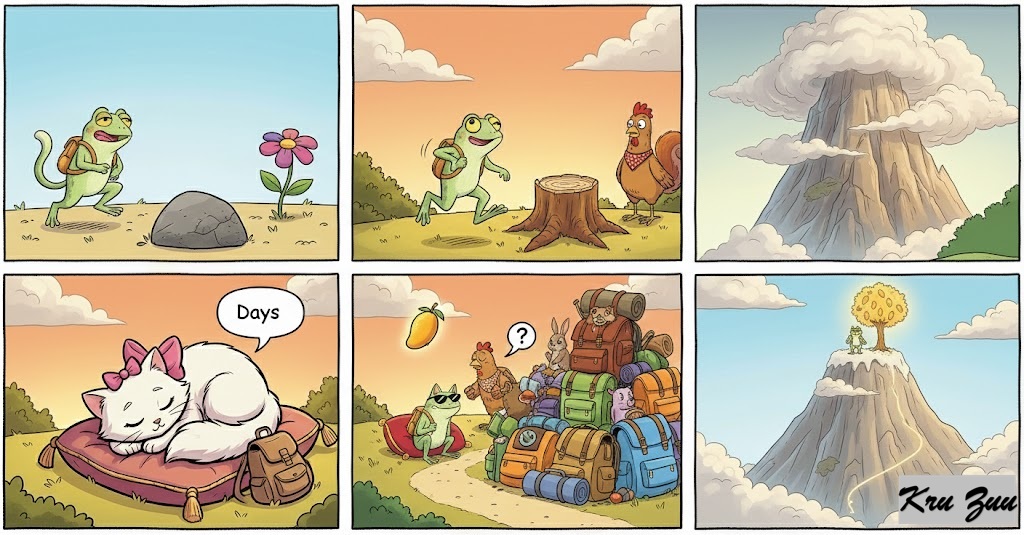
    The Lesson: Fred hops to the rock. Then he hops to a flower. Then to a tree stump. Days pass. Cleo is still sleeping at the bottom, waiting for a magic carpet. Cluck is still at the bottom, worrying about the weather forecast. But Fred? Fred is gone. He just kept hopping. One hop at a time. A week later, a mango falls from the sky and hits Cleo on the head. She looks up. Tiny Fred is waving from the top of the mountain. He didn’t have magic. He just didn’t stop.


    The Moral: You don’t need to be fast. You don’t need to be perfect. You just need to move. The only failed journey is the one you never begin.

    🎓 Lesson for English Learners


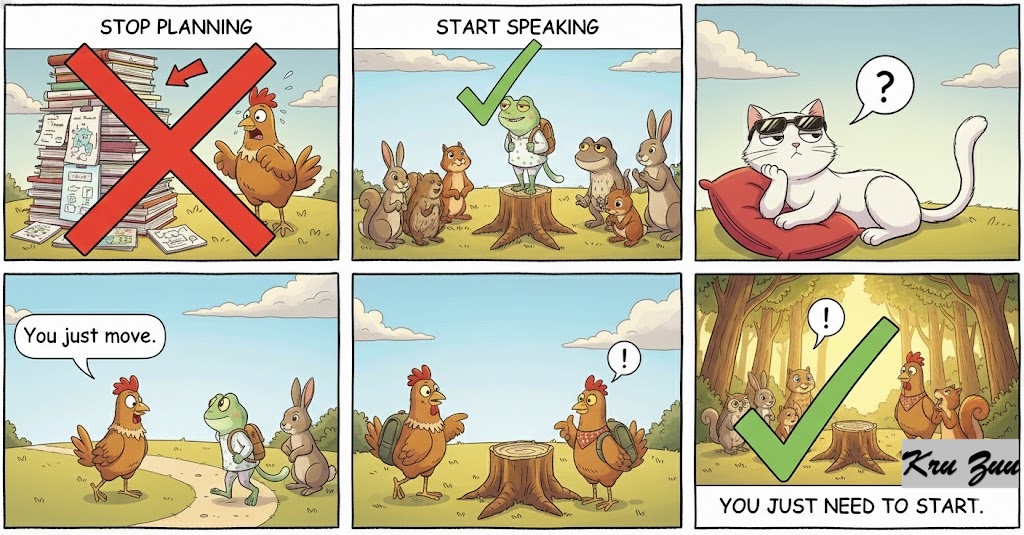
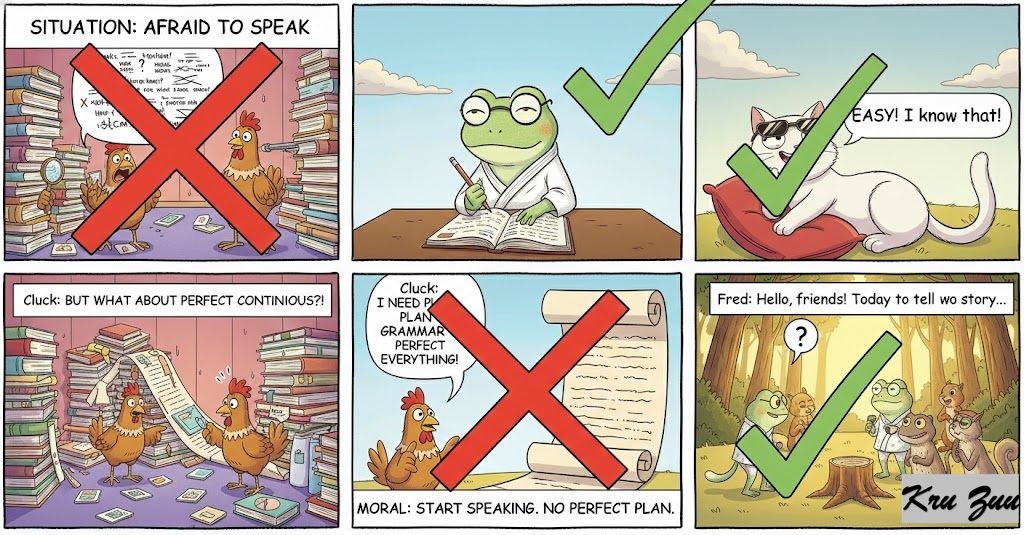
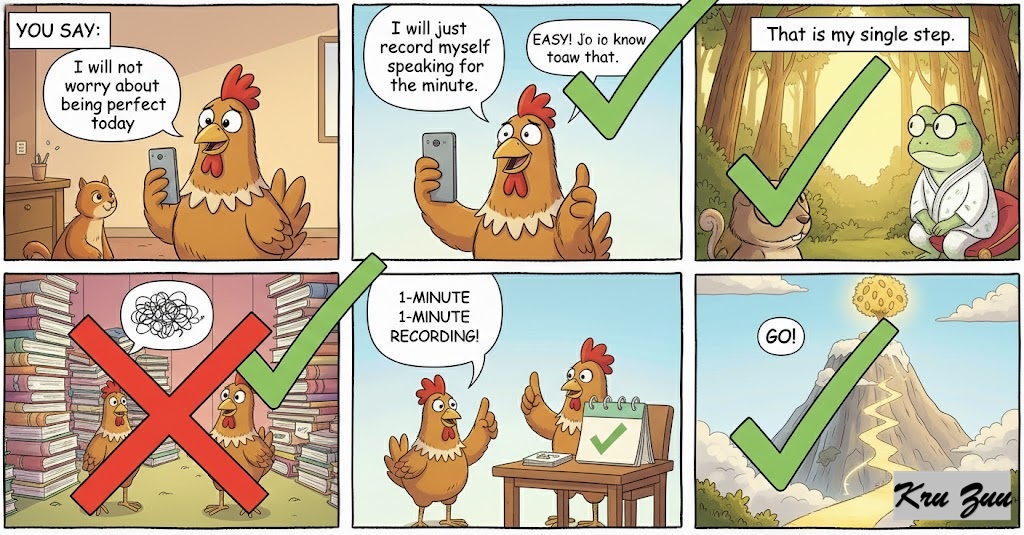
    Stop Planning, Start Speaking.


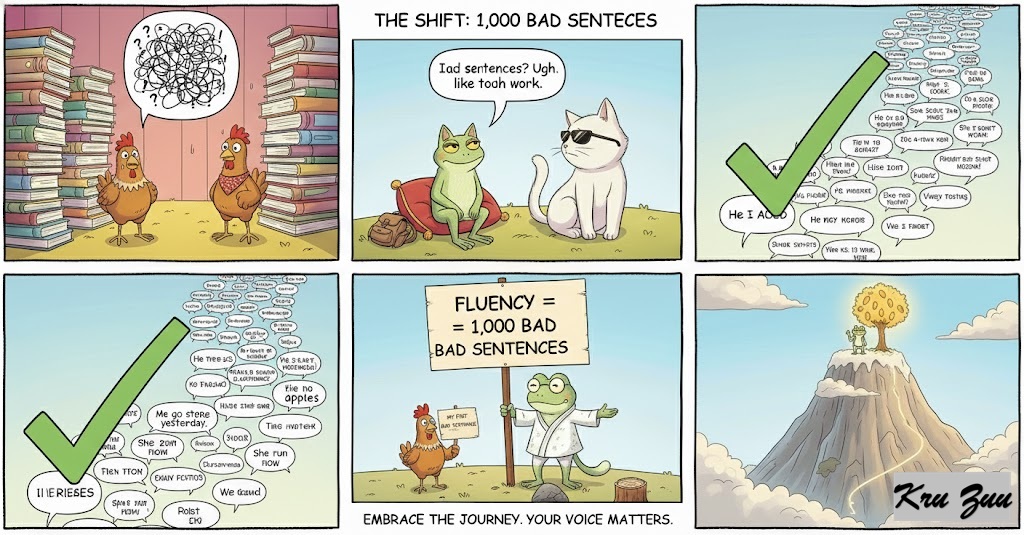
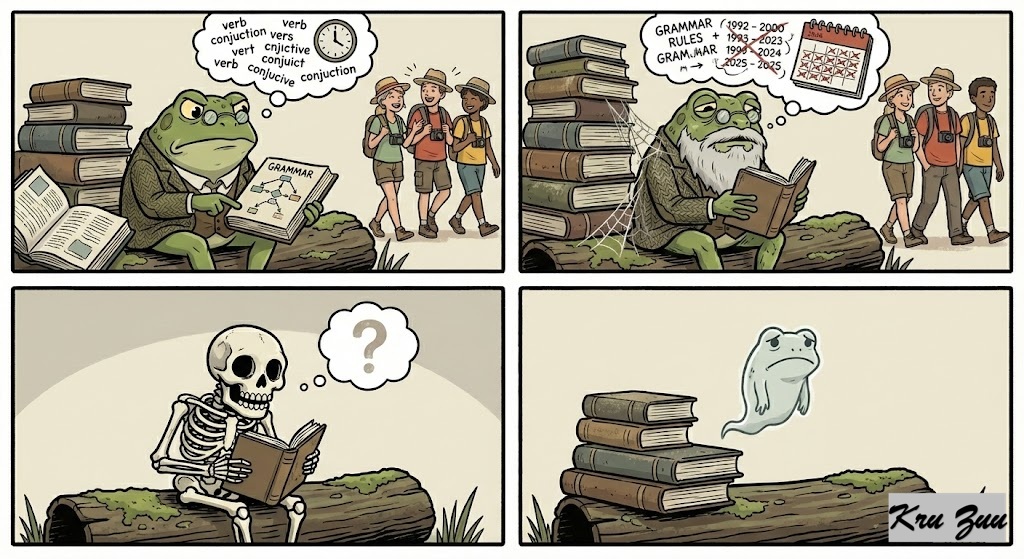
    Situation: You want to speak English fluently, but you are afraid of making mistakes. You spend all your time reading grammar books but never speaking.


    The Shift: Realize that fluency is built by 1,000 bad sentences.


    You Say: “I will not worry about being perfect today. I will just record myself speaking for 1 minute. That is my single step.”


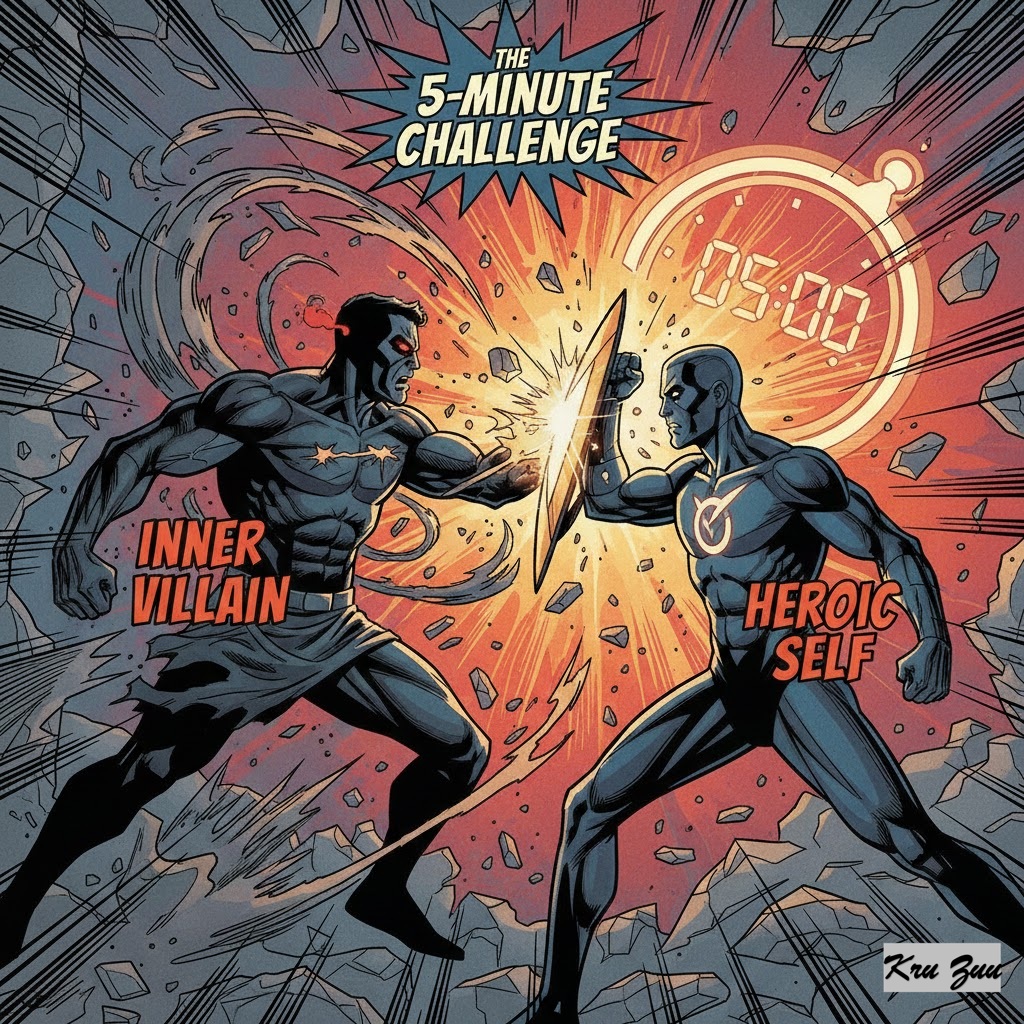
    💬 Your Turn: The “5-Minute” Challenge 🚀


    Do you want to defeat your inner “Villain”?


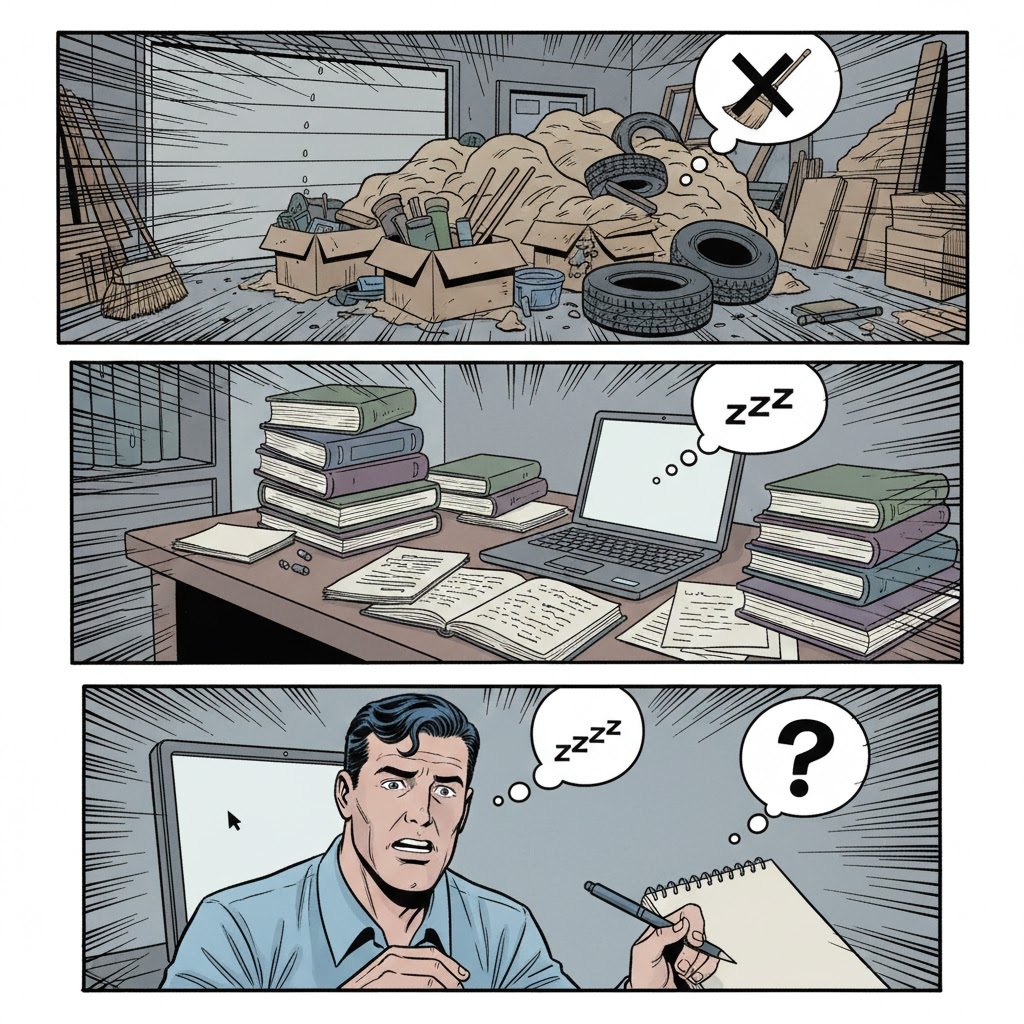
    The Challenge: Think of a task you have been avoiding (cleaning the garage, studying for an exam, writing a report).

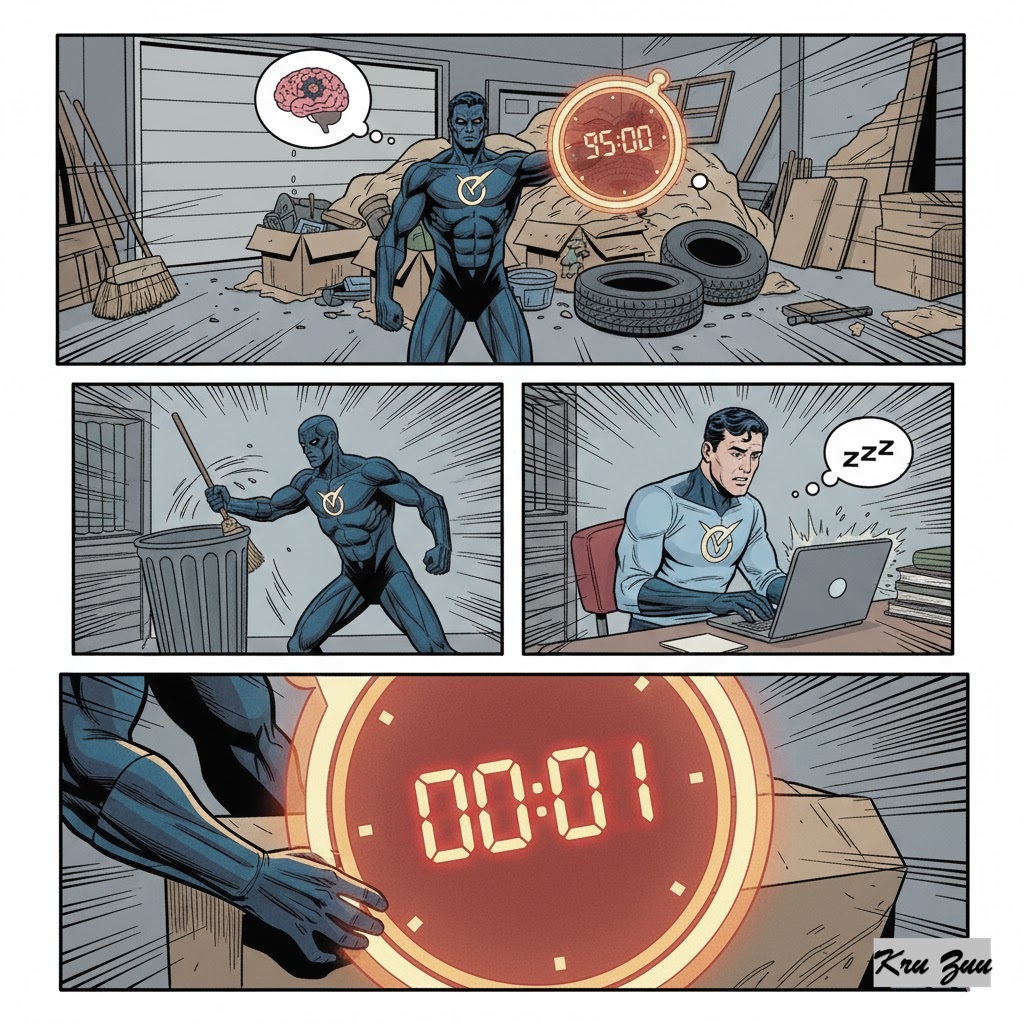
    The Action: Commit to doing it for ONLY 5 minutes. Tell yourself: “I will just do this for 5 minutes, then I can stop.”

    The Magic: Usually, once you start, the “pain” of starting disappears, and you will keep going. The hardest part is the first step.


    👇 Question for the comments: What is one big goal you have right now? What is the smallest step you can take today to start it? Tell us below!

    By Zubeyir YURTKURAN

    https://www.facebook.com/BrainBattleground/

    https://www.facebook.com/zubeyr.yurtkuran/

    https://www.instagram.com/zubeyryurtkuran/
    https://www.youtube.com/@BrainBattleground-b3p

    https://www.instagram.com/brainbattleground/

  • 💎 The Daily Shield: The Law of Hidden Value

    💎 The Daily Shield: The Law of Hidden Value

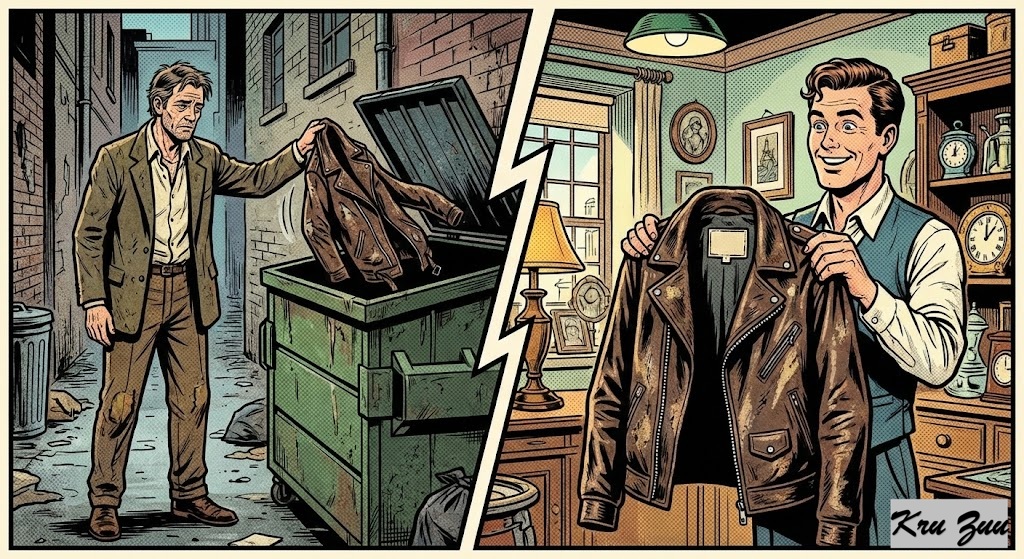
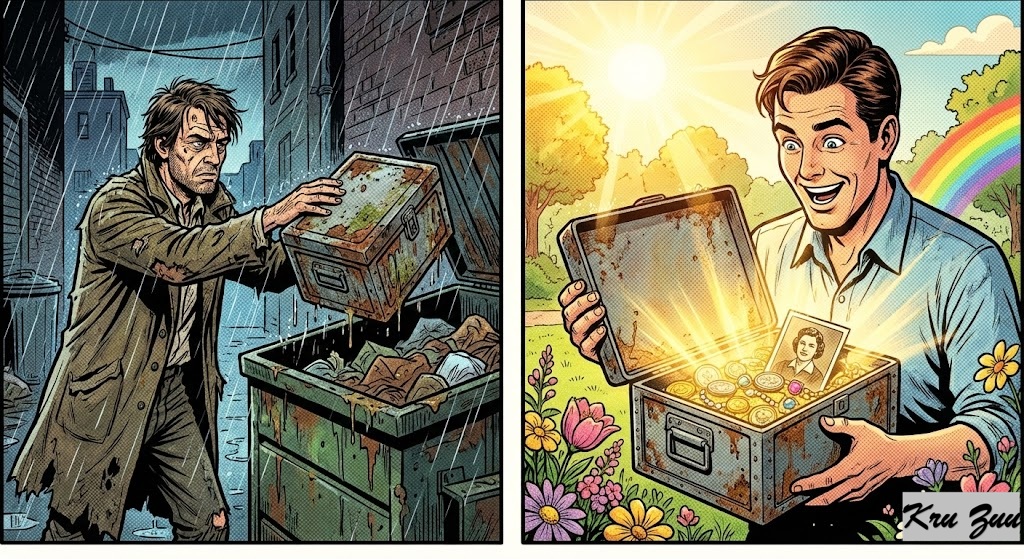
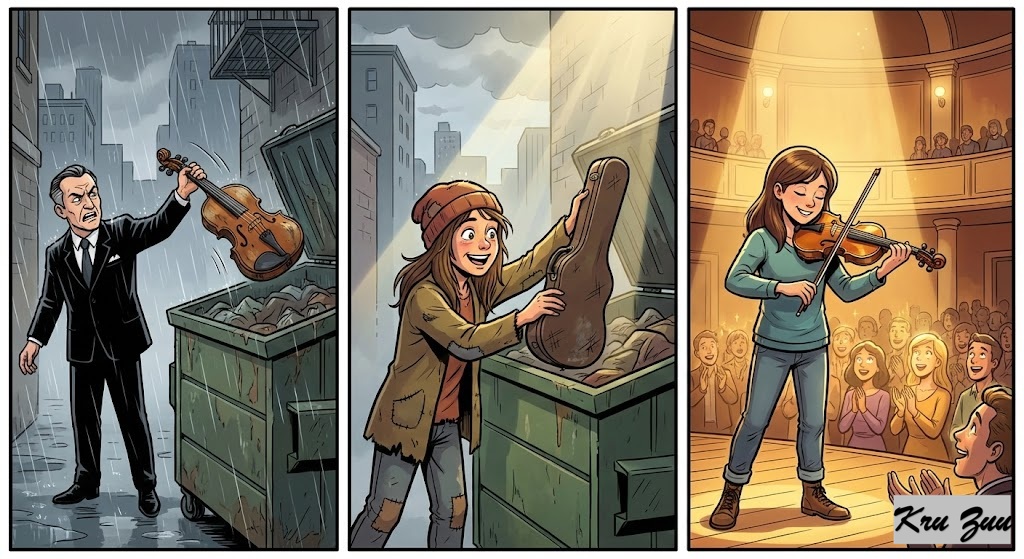
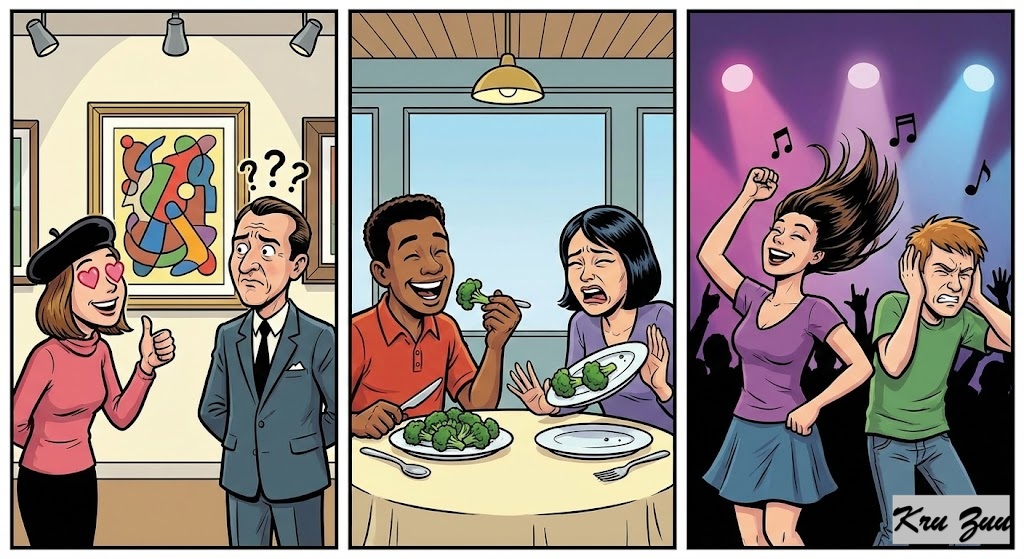
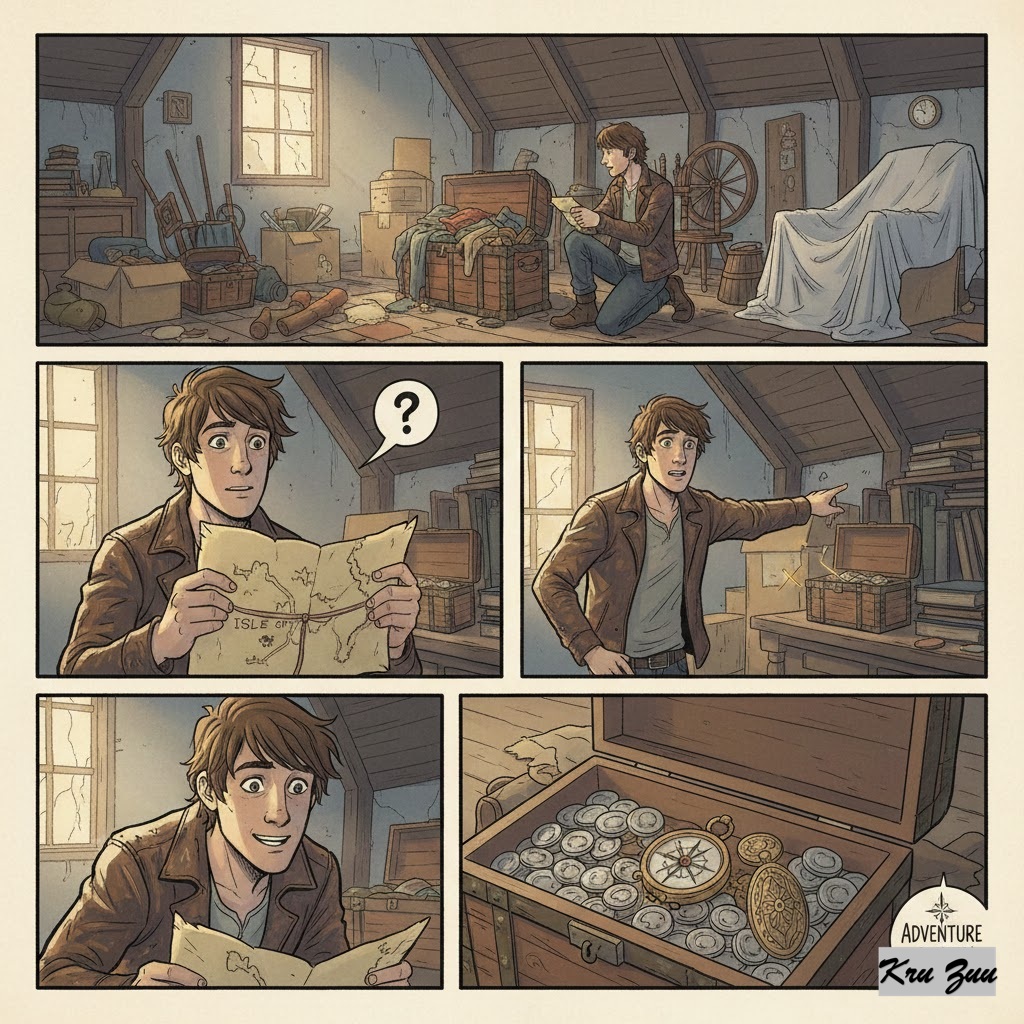
    “One man’s trash is another man’s treasure.”


    😈 The Villain (The Blind Consumer)


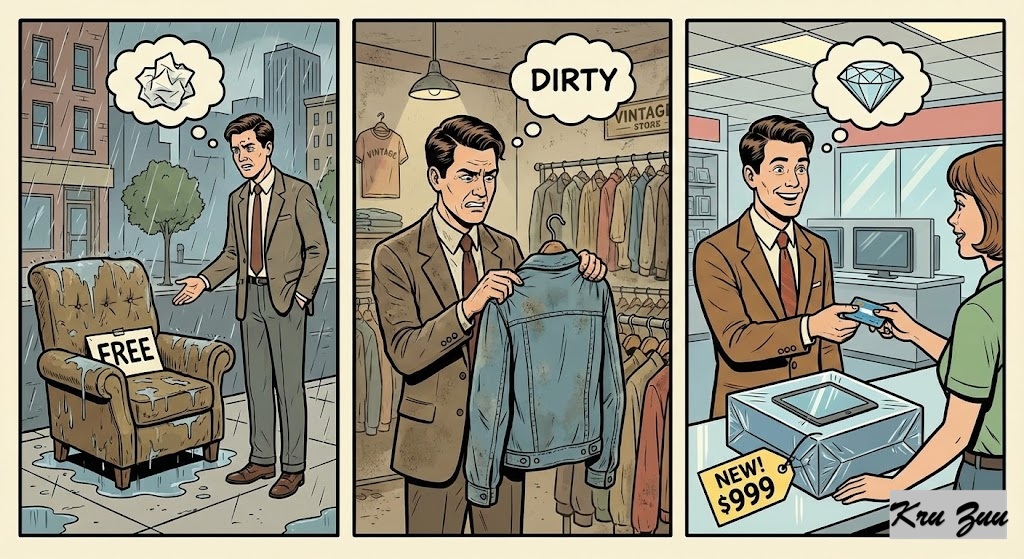
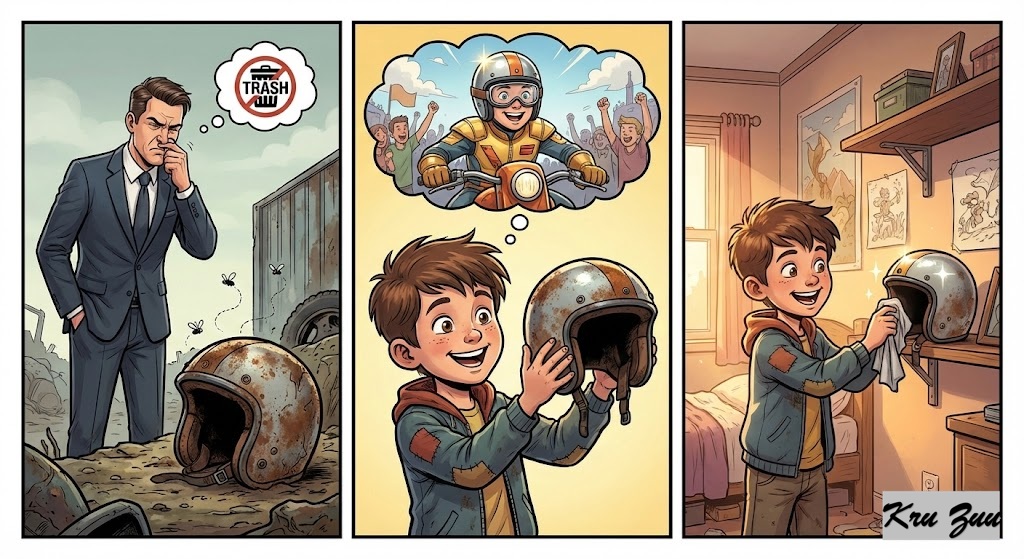
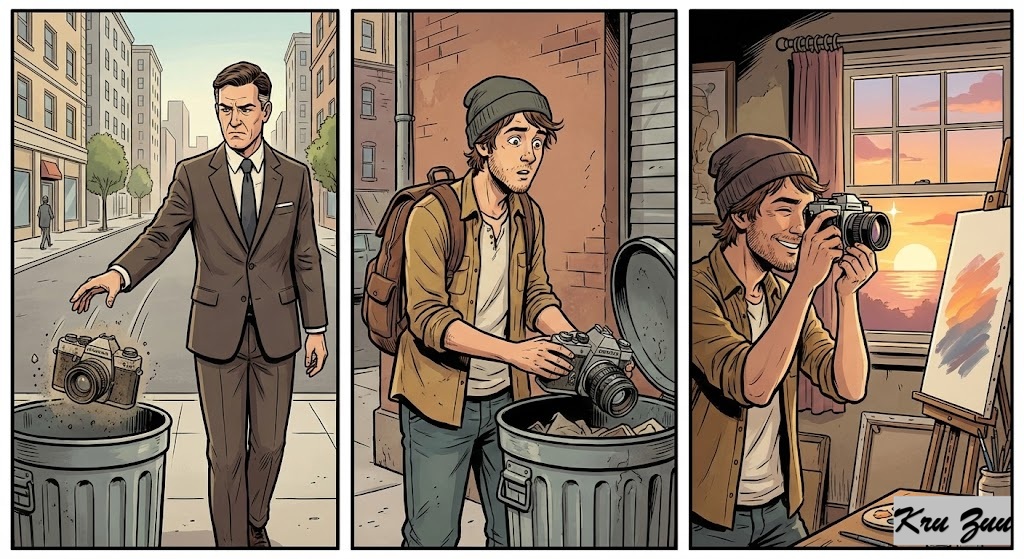
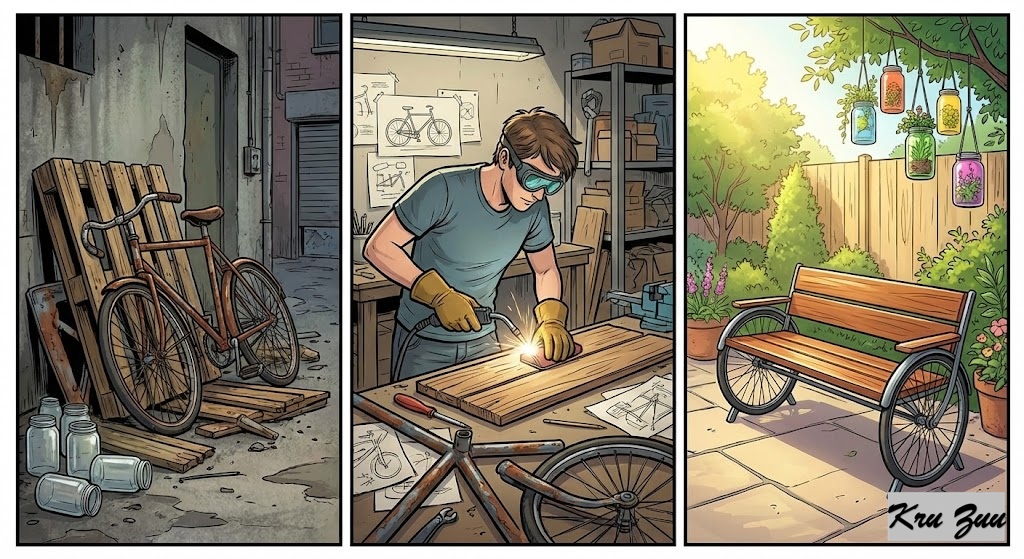
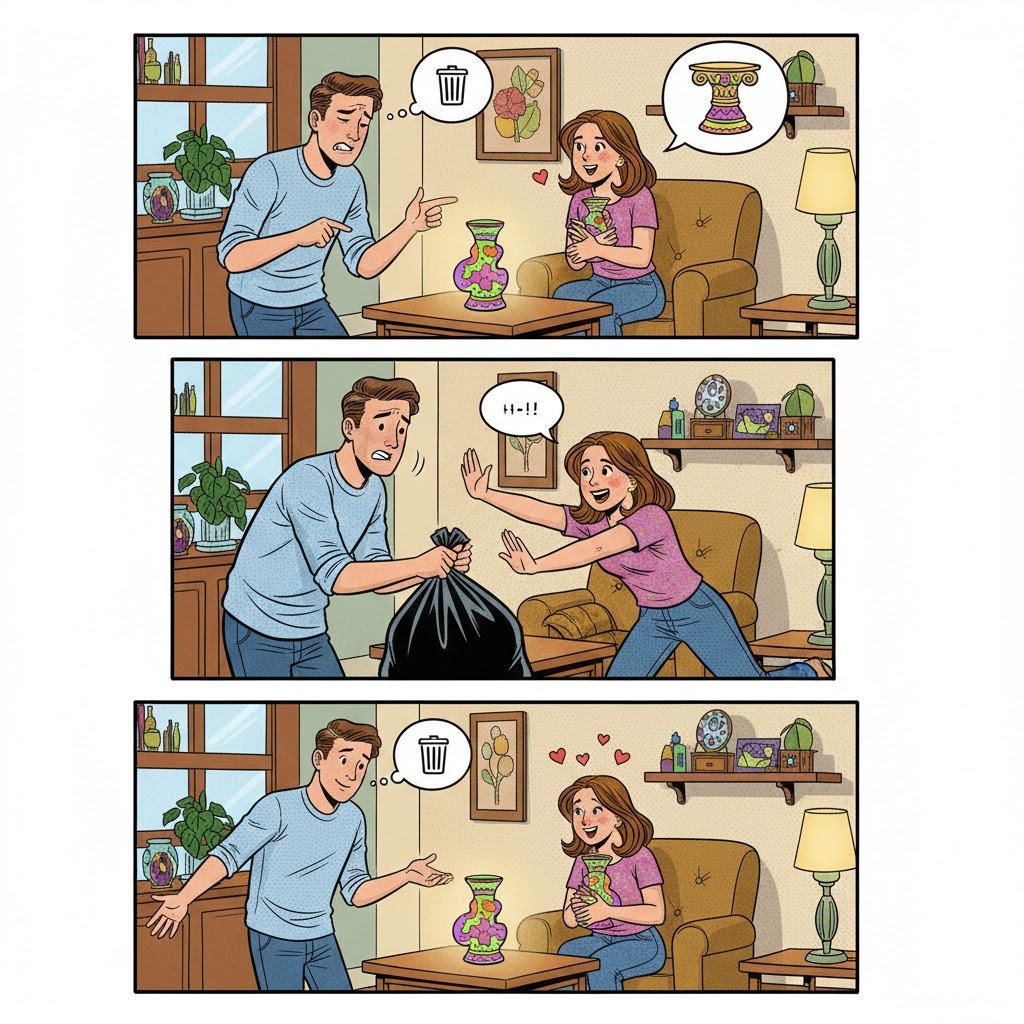
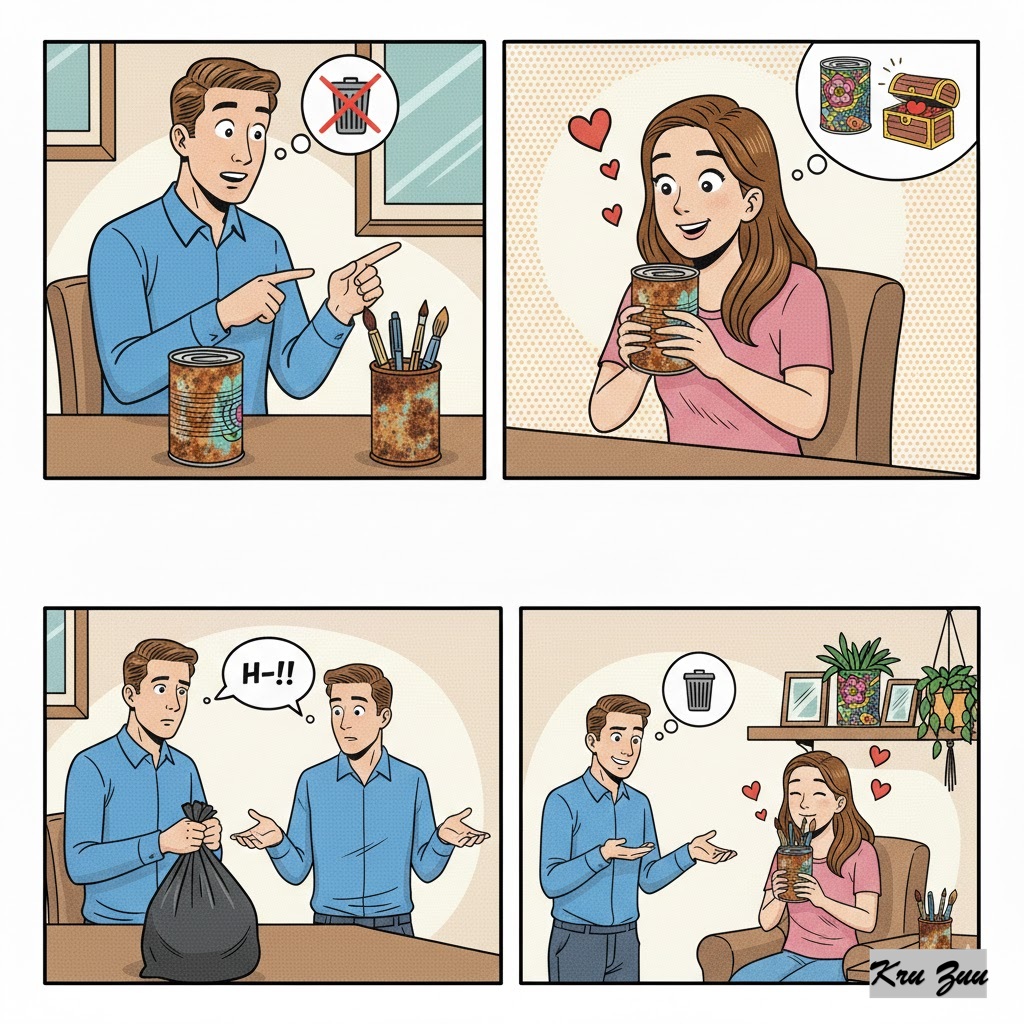
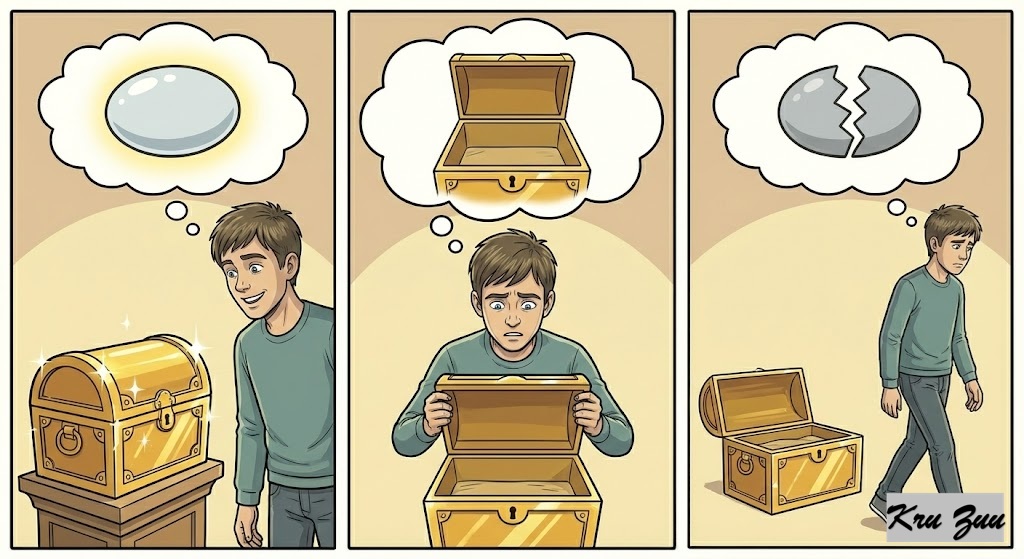
    You see an old chair on the sidewalk or a dusty vintage jacket. You think: “Ew, gross. Why is that junk still there?” 🗑️ You only value things that are shiny, brand-new, and straight off the shelf. You believe that Price = Value. If it’s cheap or used, it’s worthless to you.

    The Result? You spend a fortune chasing trends. Your home is full of generic items everyone else has. You lack the “vision” to see potential, and you’re stuck in a cycle of expensive, disposable consumption.


    😇 The Hero (The Alchemist)


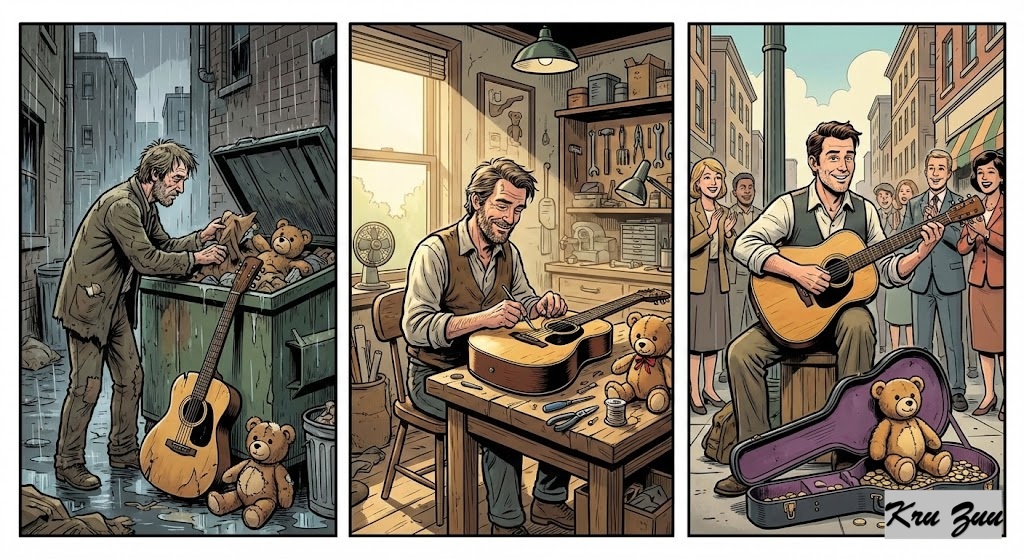
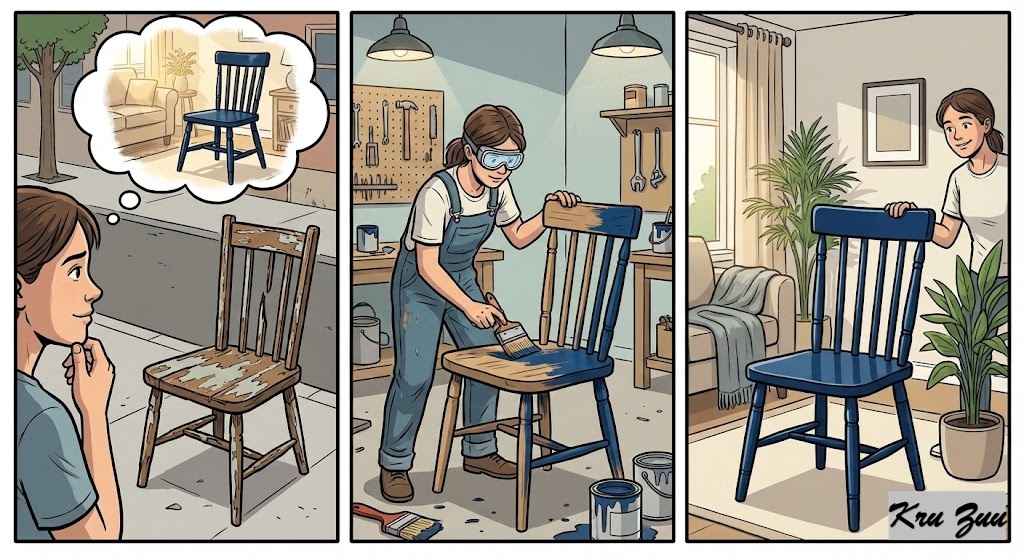
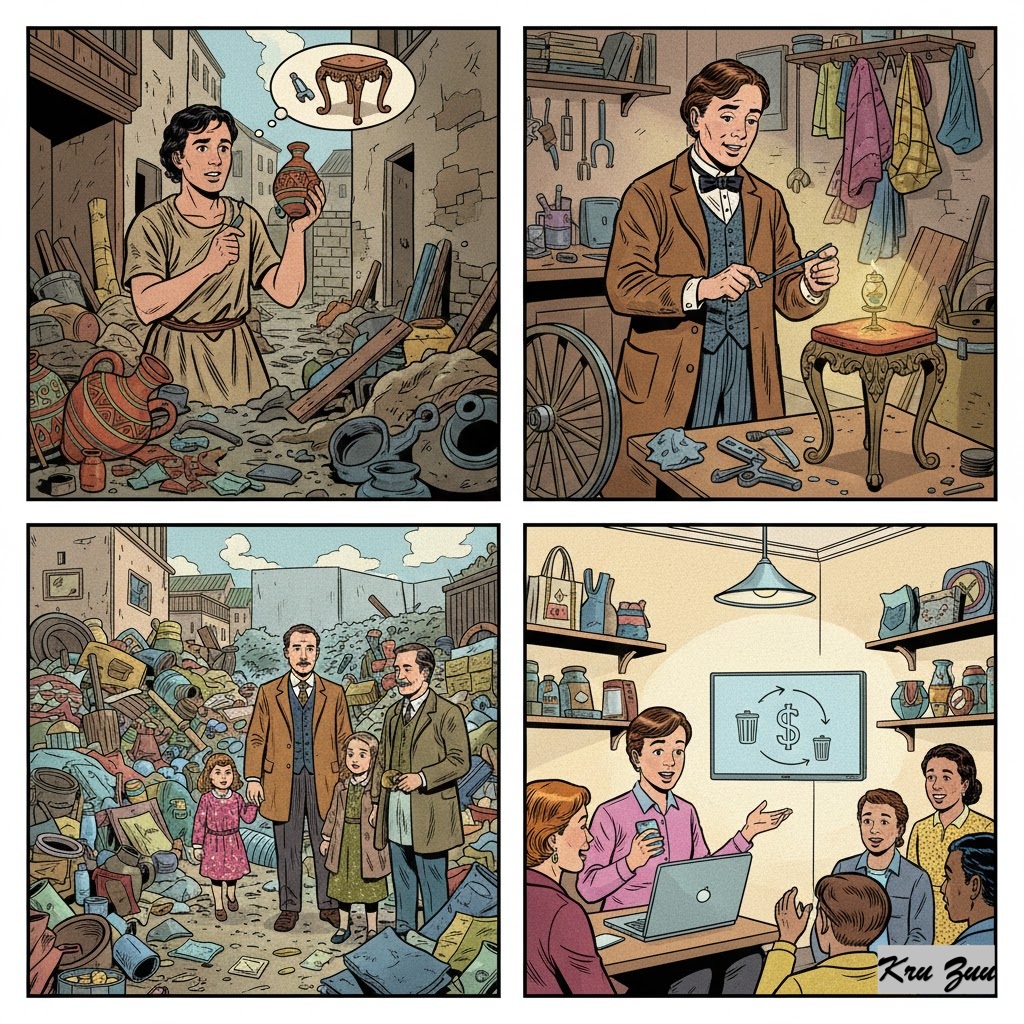
    You see the same old chair and think: “With a bit of sanding and blue paint, this is a masterpiece.” 🎨 You don’t look at what an object is; you look at what it can be. You recognize that value is subjective.

    The Result? You find incredible deals. Your life is filled with unique, soulful items. You save money while building a world of “treasures” that others missed. You understand that perspective is the ultimate wealth-builder. 🏰


    ⚖️ The Reality


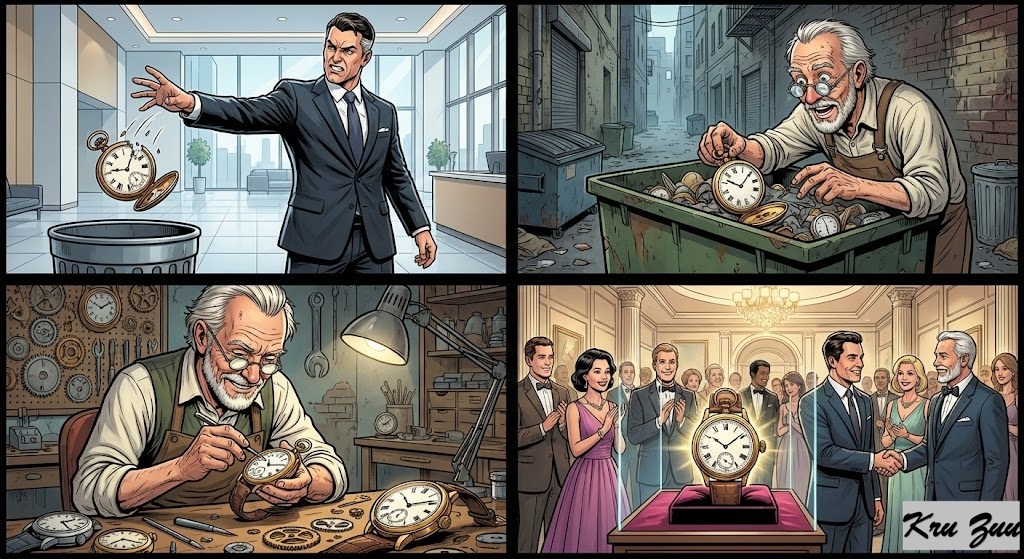
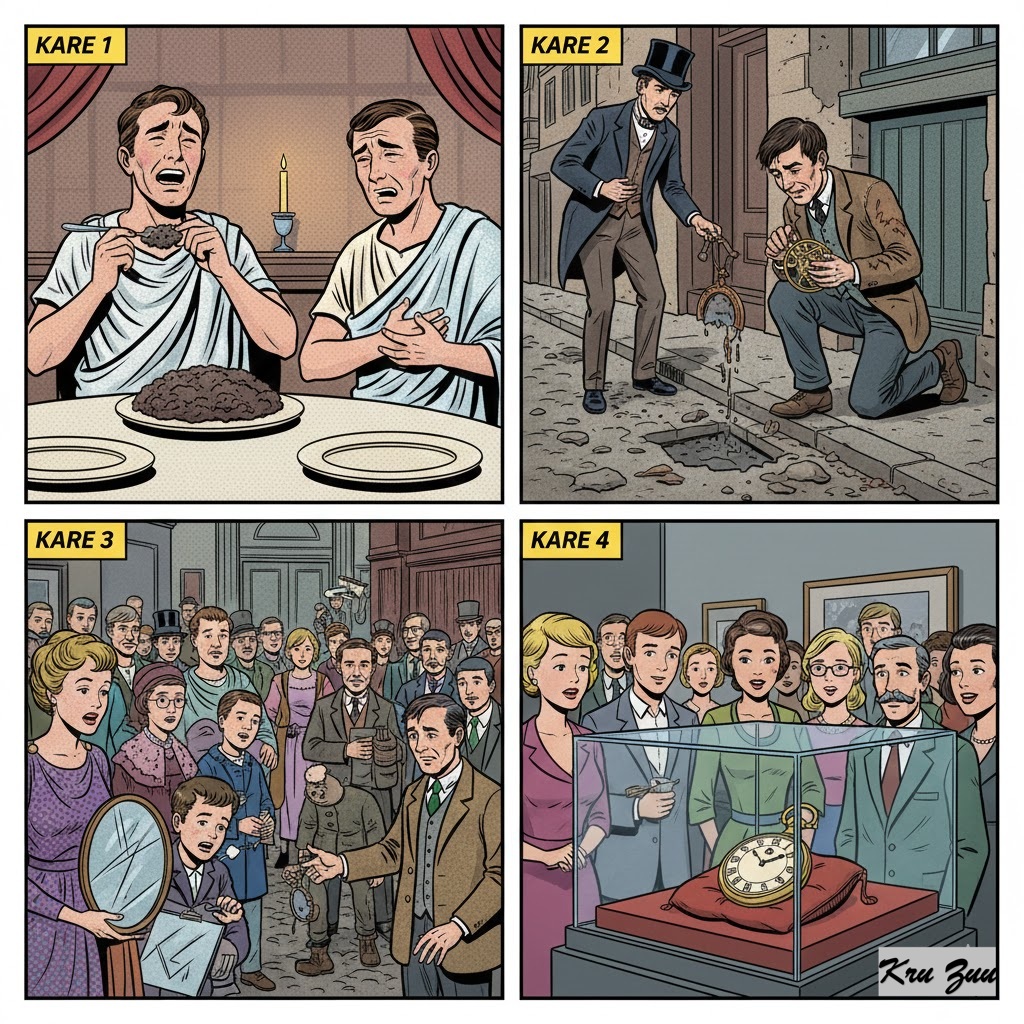
    Value is not a fixed number, it is a matter of perception. A broken watch is “trash” to a businessman, but a “treasure” to a watchmaker who needs parts. We live in a throw-away culture, but the most successful people find opportunities where others see obstacles. Wealth is often hidden in plain sight, disguised as “junk.”

    🧐 The Anatomy of the Proverb


    This is your reminder that worth is in the eye of the beholder.


    One man’s (Noun): A person’s subjective experience.


    Trash (Noun): Something discarded, worthless, or unwanted.


    Is another man’s (Phrase): Simultaneously becomes someone else’s.


    Treasure (Noun): Something of great value, beauty, or importance.


    Simpler Version: People have different ideas about what is valuable. / Don’t judge a book by its cover.


    📚 Vocabulary Vault


    Subjective (Adjective): Based on or influenced by personal feelings or tastes. 🎨


    Obsolete (Adjective): No longer produced or used; out of date.


    Upcycle (Verb): To reuse discarded objects or material in such a way as to create a product of higher quality or value than the original. ♻️


    Beholder (Noun): A person who sees or observes someone or something.


    Perception (Noun): The way in which something is regarded, understood, or interpreted.


    🧠 Grammar Focus: Idioms for Perspective


    We use this idiom to explain different tastes or to justify why we keep something others might find “ugly.”


    Friend: “Why do you keep that rusty old tin can on your desk?”


    You: “Actually, it’s a 1920s limited edition tea box. I’m using it as a pen holder. You know what they say: One man’s trash is another man’s treasure.”

    📜 History: Origin and Spread


    Where did this philosophy of “trash to cash” begin?


    The Origin: While the sentiment is ancient, the specific phrasing became popular in the mid-19th century. It mirrors the Latin proverb “Quod aliis cibus est aliis fuat acre venenum” (What is food to one may be bitter poison to others).


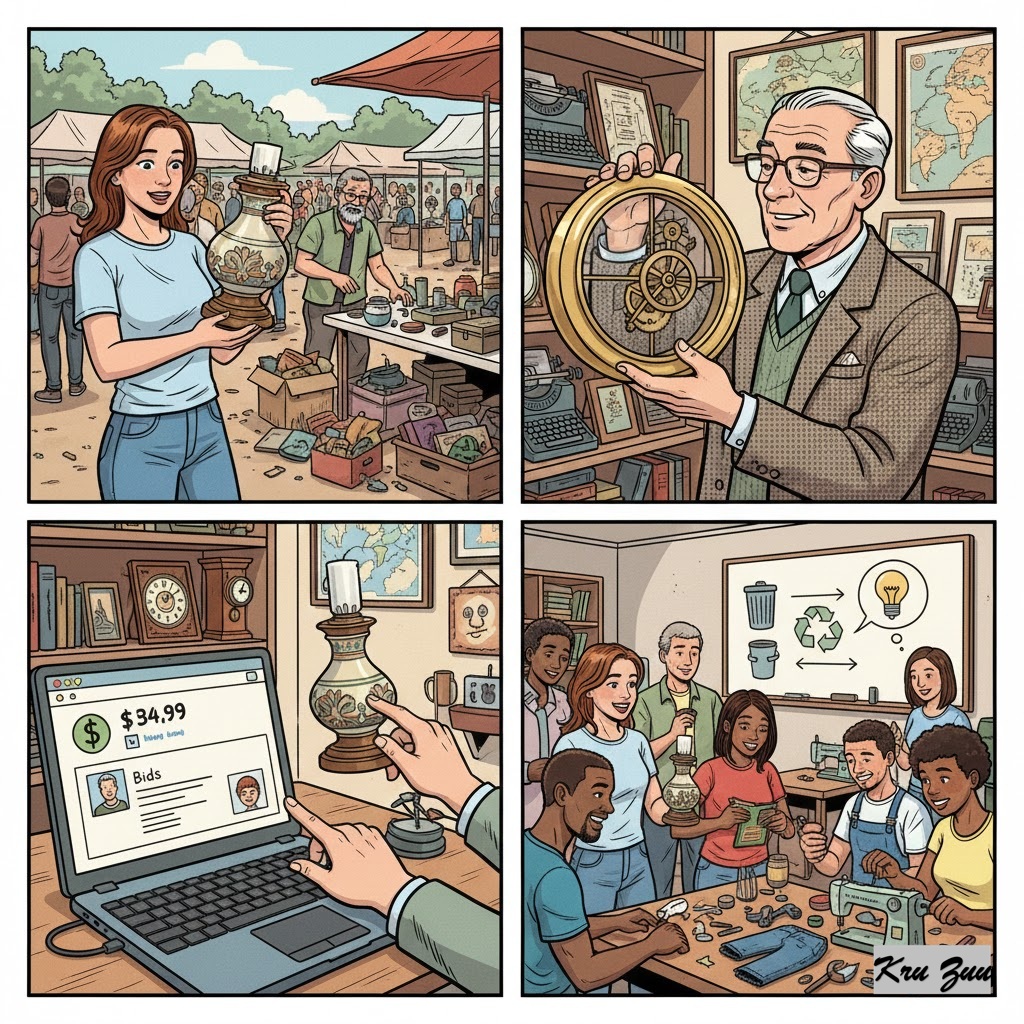
    The Logic: It’s the foundation of the Secondary Market (eBay, flea markets, antique shops). It highlights the human ability to innovate and find use where others find waste.


    Global Cousins


    🇫🇷 French: “Le bonheur des uns fait le malheur des autres.” (The happiness of some makes the unhappiness of others — similar context of differing perspectives).


    🇯🇵 Japanese: “Tade kuu mushi mo sukizuki.” (There are even bugs that eat knotweed, meaning tastes vary).

    🎭 Short Story: The Rusty Iron Key 🔑🐱🐔🐸


    🌟 The Cast


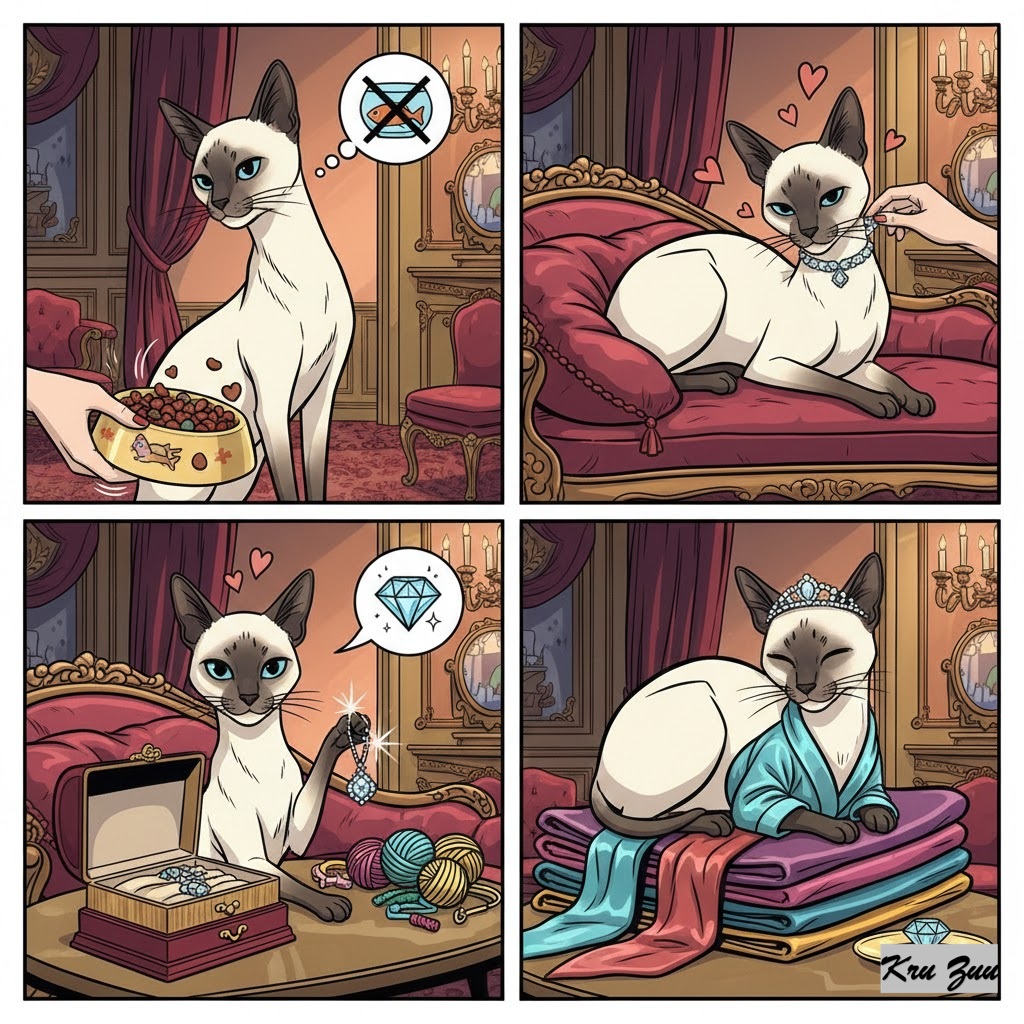
    Cleo the Cat: Elegant, only likes diamonds and silk. 😼


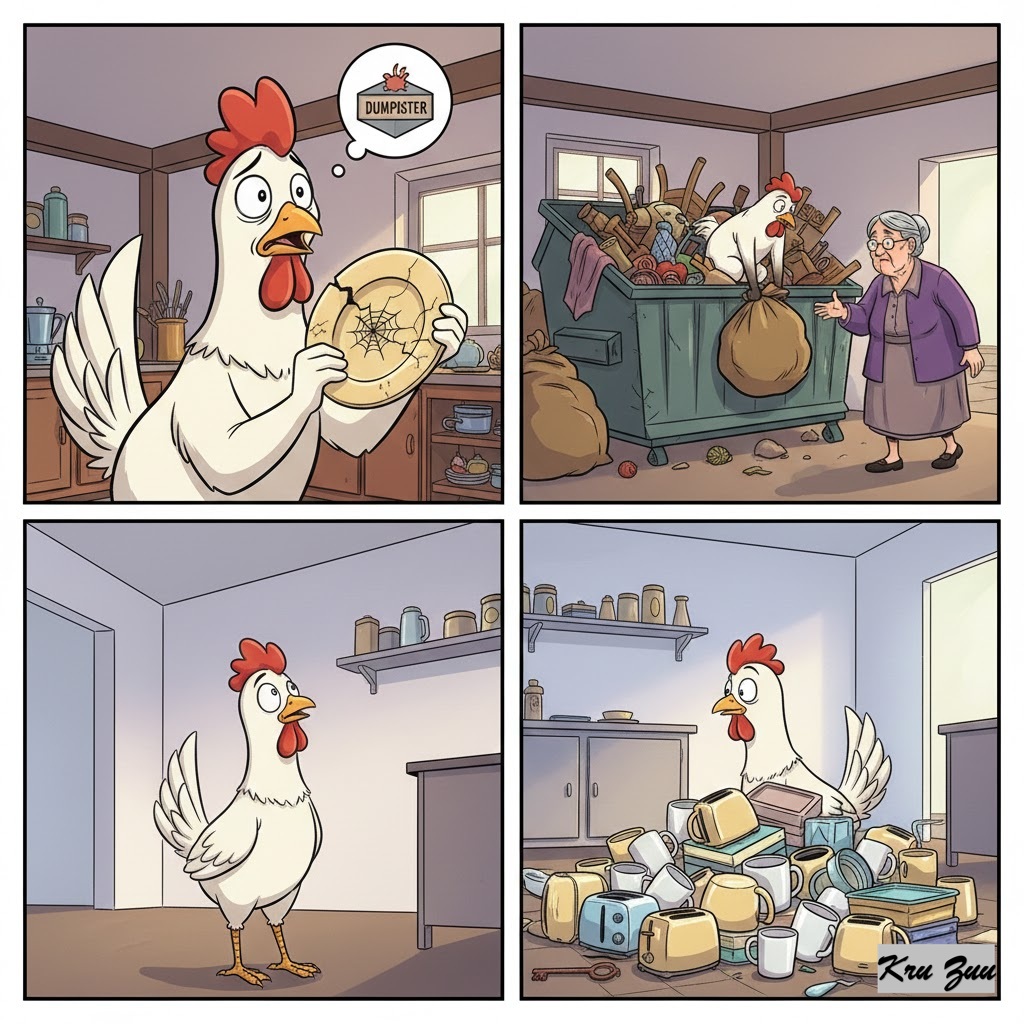
    Cluck the Chicken: Panics easily, throws away everything “old.” 🐔


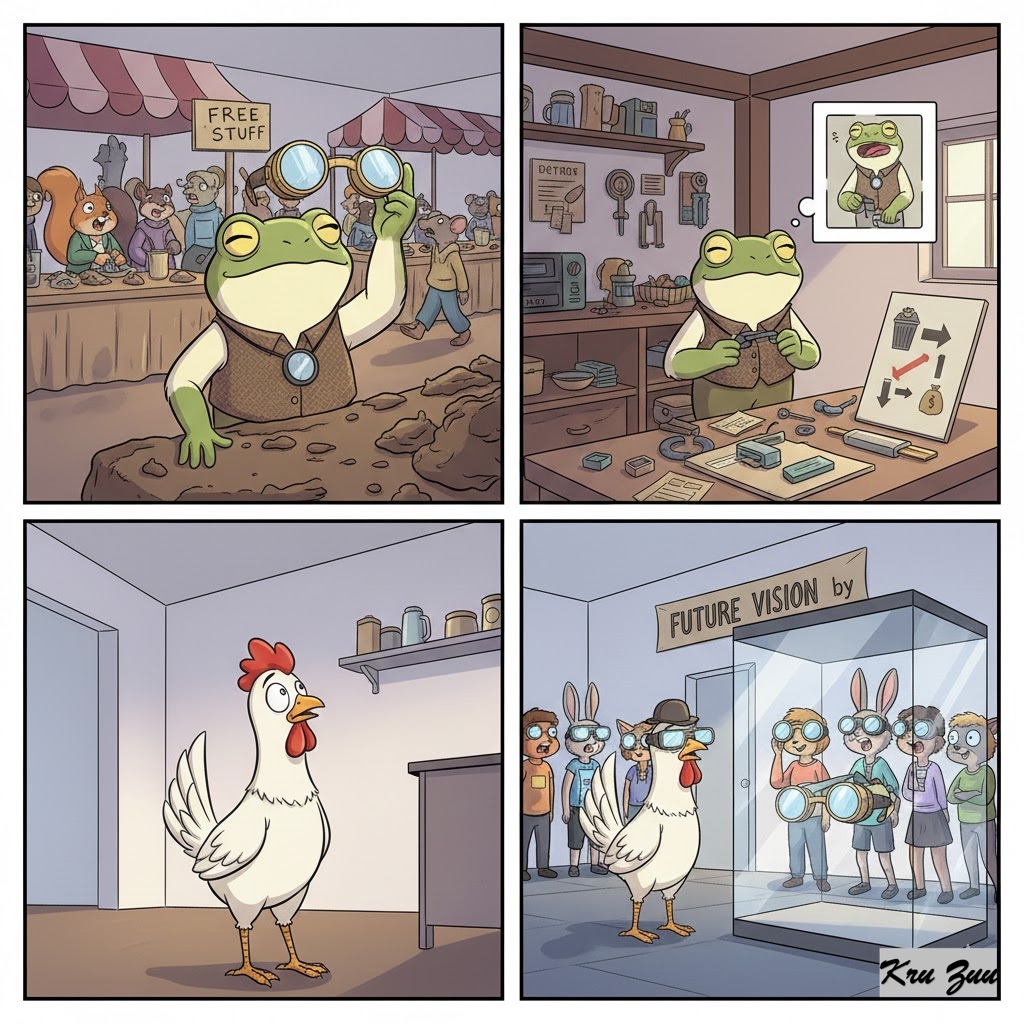
    Fred the Frog: The calm collector who sees the future. 🐸


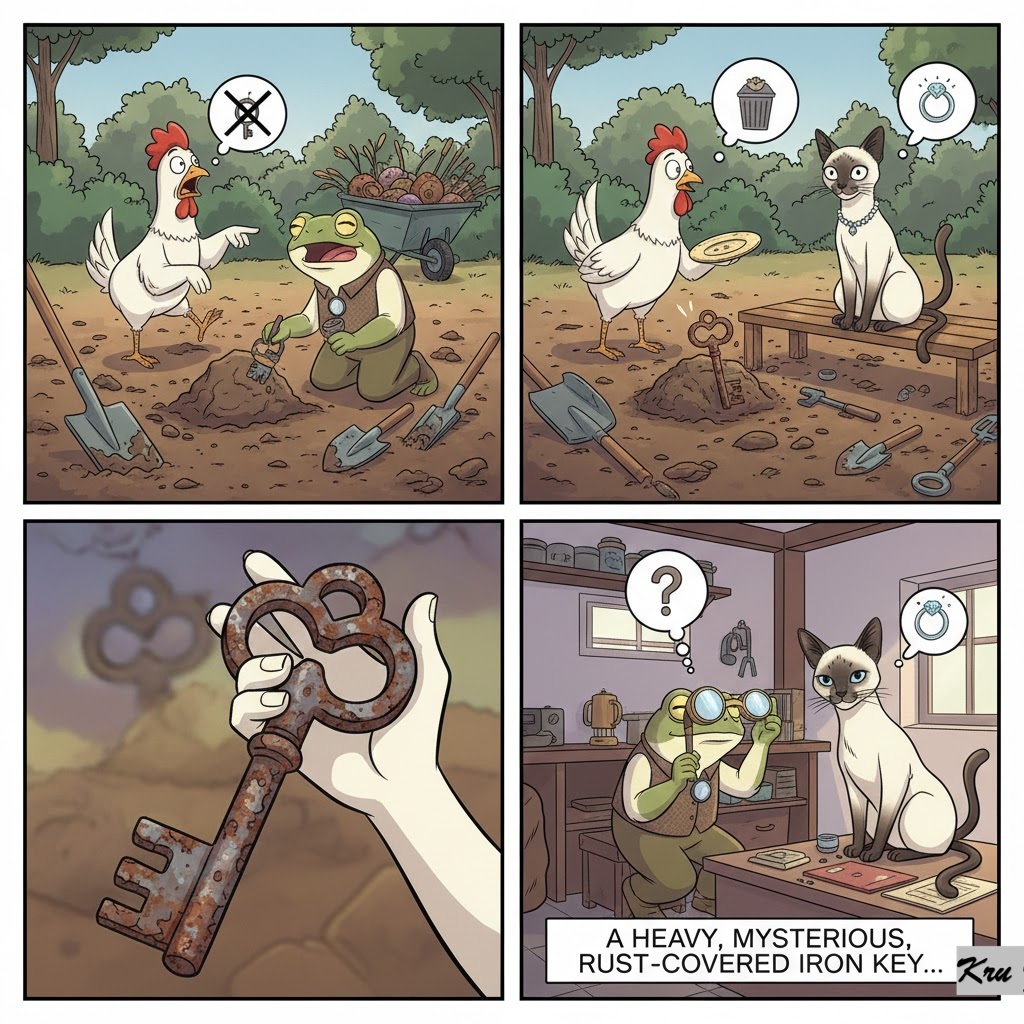
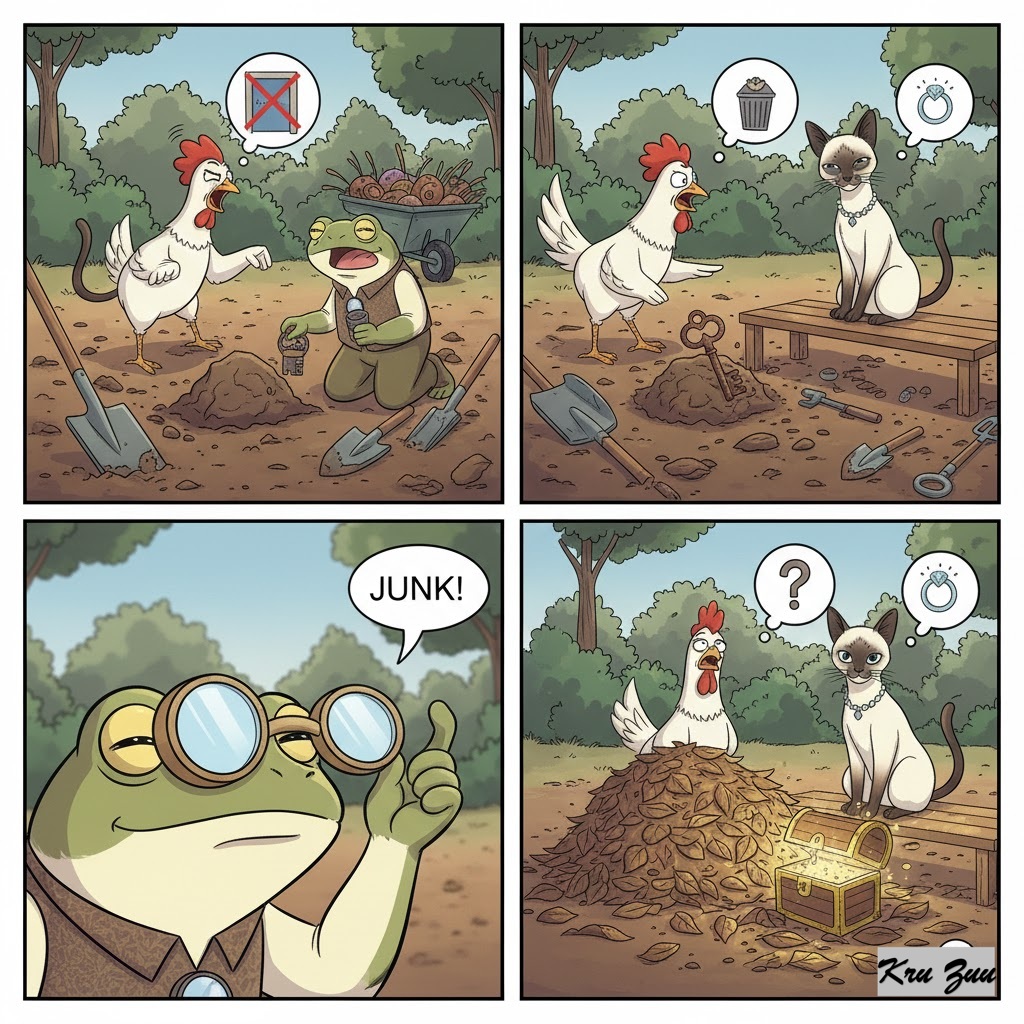
    The Situation: While cleaning the community garden, the trio finds a heavy, rusted, dirt-covered iron key.


    The Conflict: “Ugh! Get it away from me!” Cleo hissed, flicking her tail. “It’s filthy and probably covered in germs. It belongs in the bin!” Cluck squawked in agreement. “It’s useless! It doesn’t open my modern electronic coop door. It’s just heavy junk!” Cluck kicked the key into a pile of dead leaves.


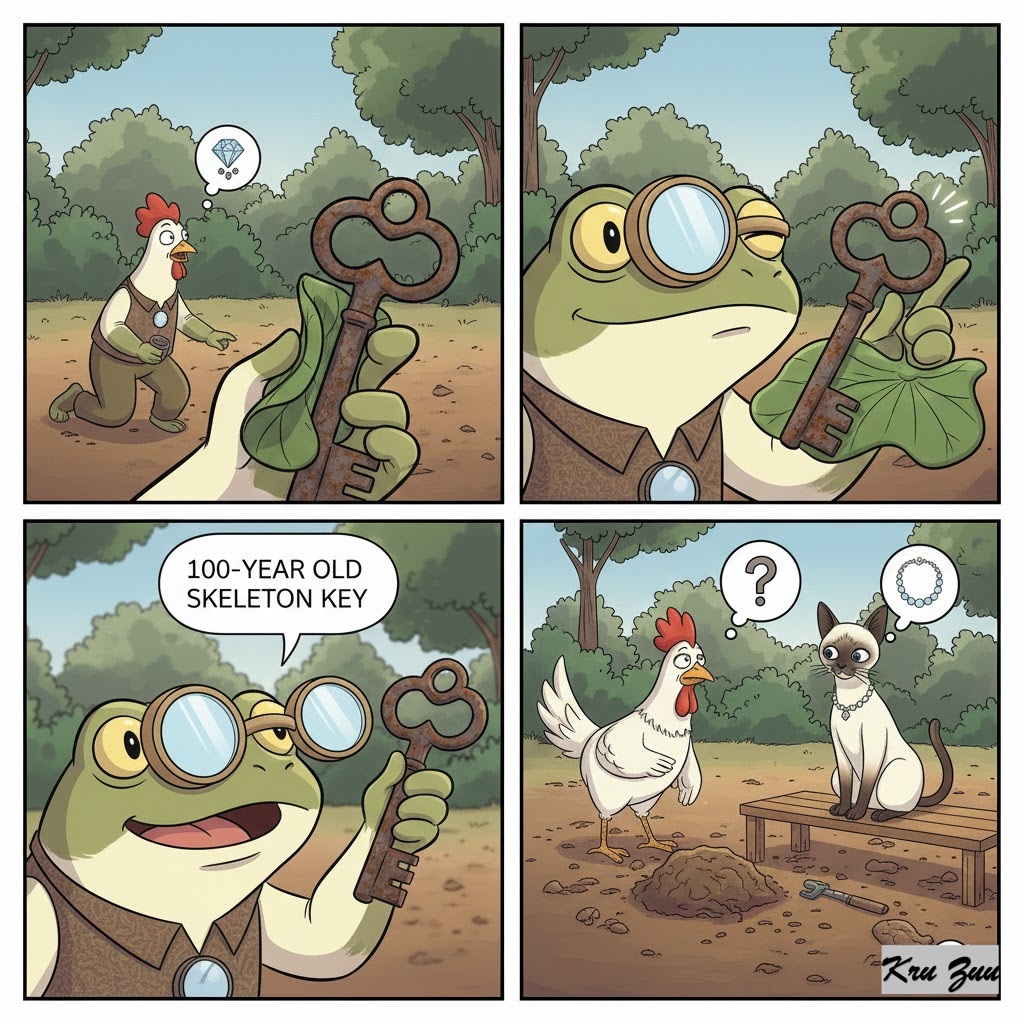
    The Reaction: Fred hopped over and picked up the key. He wiped away the mud with a lily pad. “Ribbit,” Fred whispered. “This isn’t junk. Look at the craftsmanship. This is a 100 year old skeleton key.”


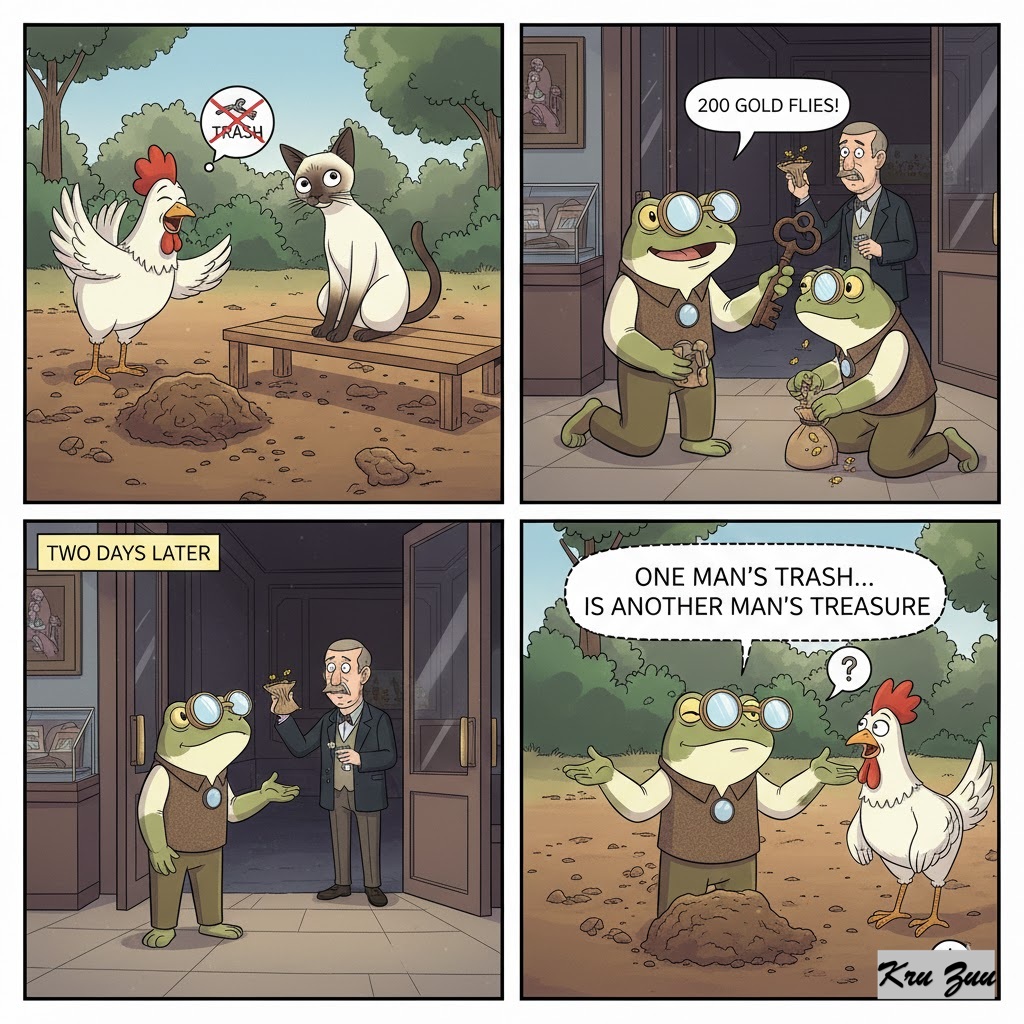
    The Resolution: Cleo laughed. “Have fun with your ‘trash,’ Fred.” Two days later, Fred returned. He had polished the key until it glowed like silver and attached it to a leather cord. He sold it to a local museum collector for 200 Gold Flies. Cleo and Cluck stared, mouths open. “You got all that for that piece of garbage?” Fred adjusted his glasses. “To you, it was a piece of metal. To the collector, it was the missing piece of history. One man’s trash, my friends… is another man’s treasure.”


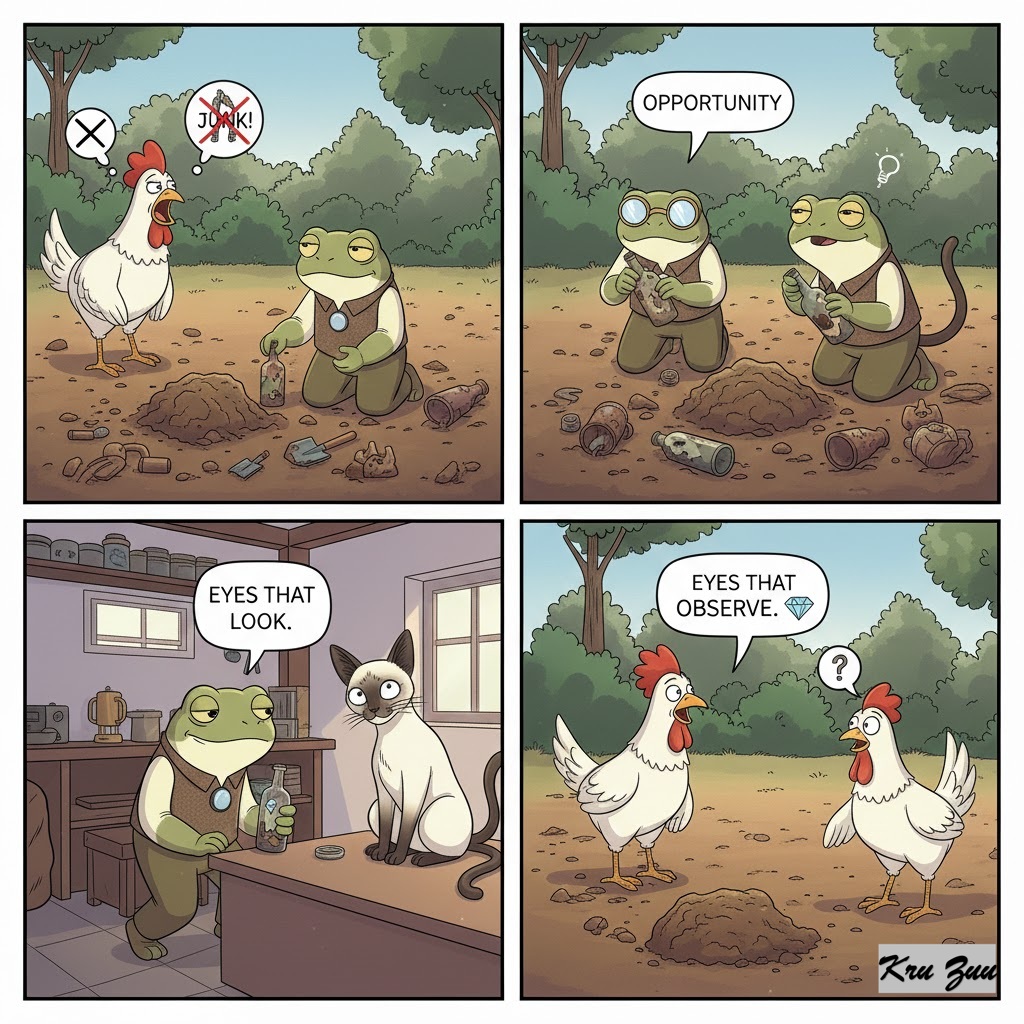
    The Moral: Eyes that look see “junk.” Eyes that observe see “opportunity.” 💎

    🎓 Lesson for English Learners


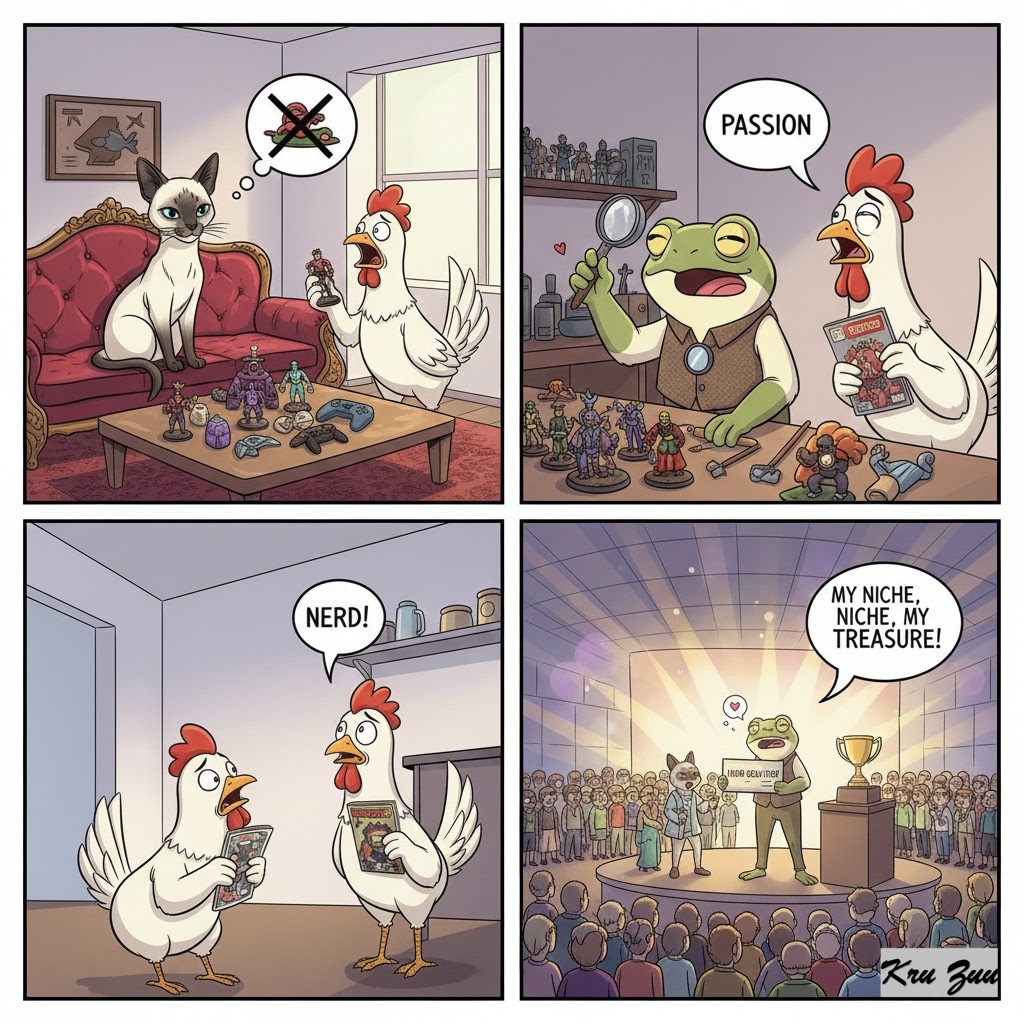
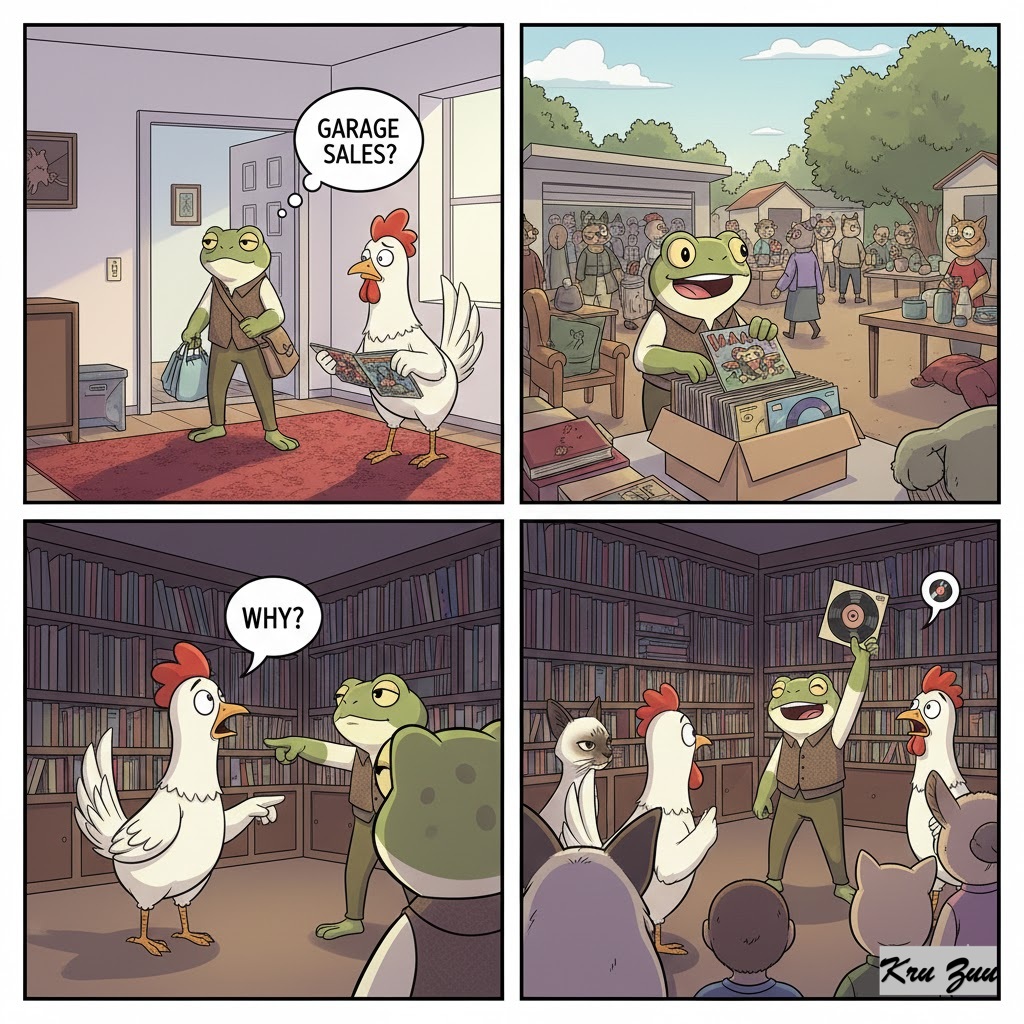
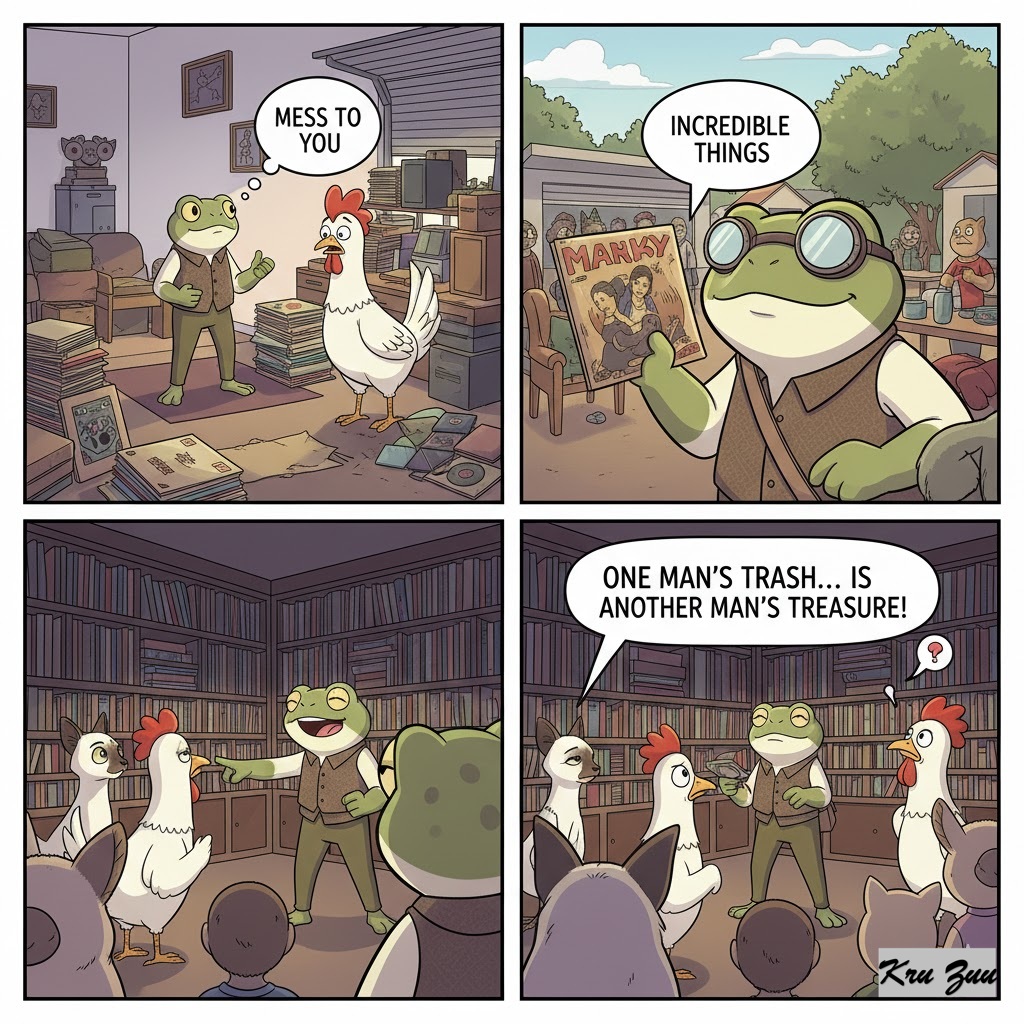
    Use it to defend your niche interests.


    Situation: Someone asks why you spend your weekends at garage sales or buying old vinyl records.


    You Say: “I know it looks like a mess to you, but I find incredible things there. After all, one man’s trash is another man’s treasure!”


    💬 Your Turn: The “Treasure” Challenge 🚀


    The Challenge:
    Look around your room or a local second-hand shop.

    The Action: Find one item that is “obsolete” (like a CD, an old jar, or a worn-out book).

    Ask yourself: “How could this be valuable to someone else? Could it be art? Could it be a tool? Could it be a memory?”


    👇 Question for the comments: What is the “weirdest” thing you own that you refuse to throw away? Why is it a treasure to you? Tell us below!

    By Zubeyir YURTKURAN

    https://www.facebook.com/BrainBattleground/

    https://www.facebook.com/zubeyr.yurtkuran/

    https://www.instagram.com/zubeyryurtkuran/
    https://www.youtube.com/@BrainBattleground-b3p

    https://www.instagram.com/brainbattleground/

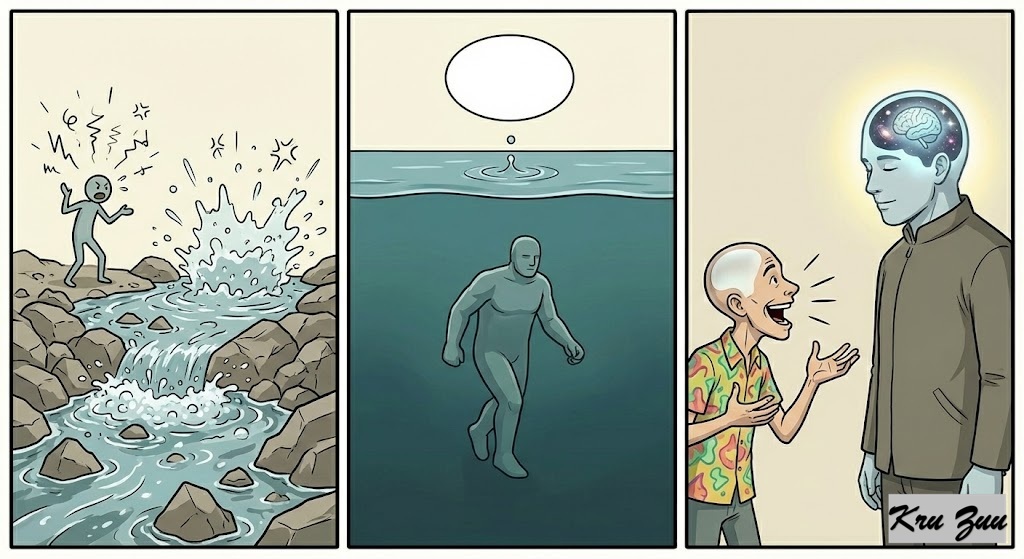
  • 🌊 The Daily Shield: The Law of Hidden Depth

    🌊 The Daily Shield: The Law of Hidden Depth

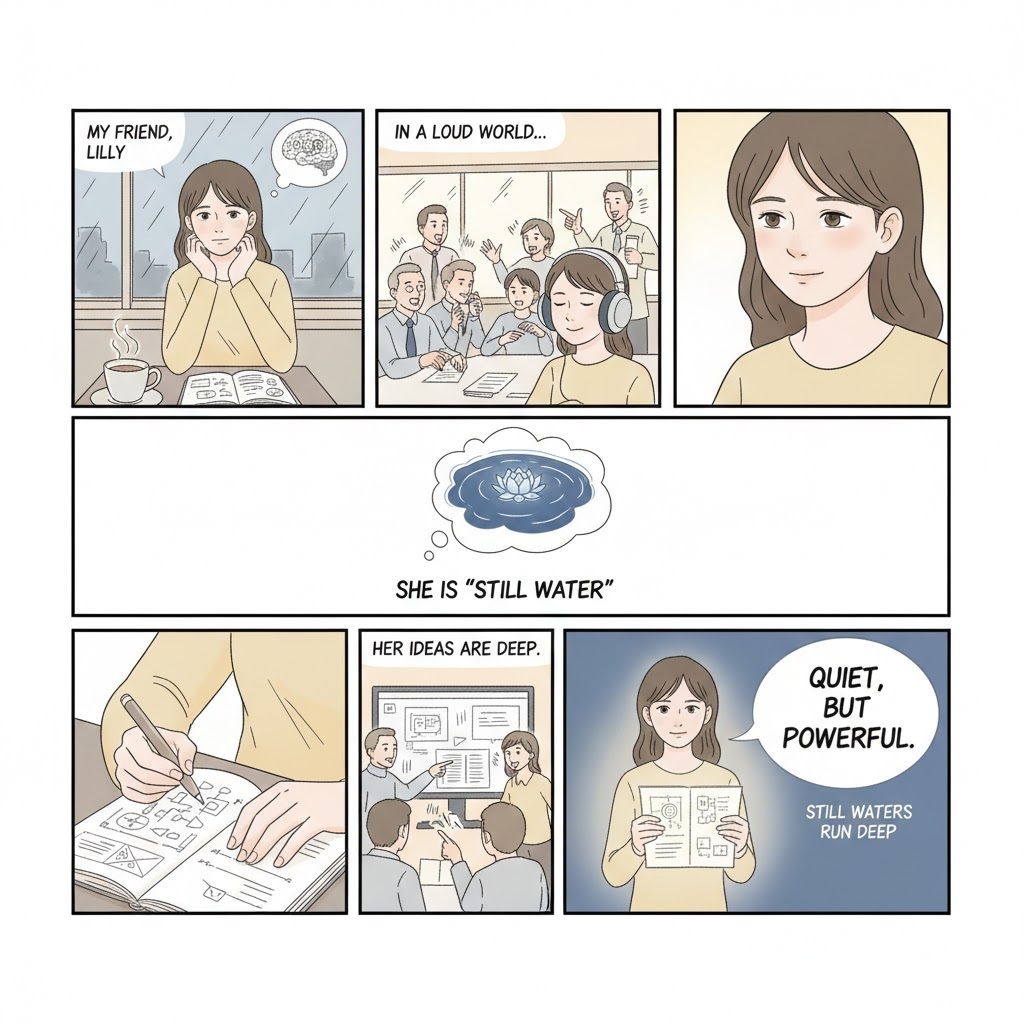
    “Still waters run deep.”


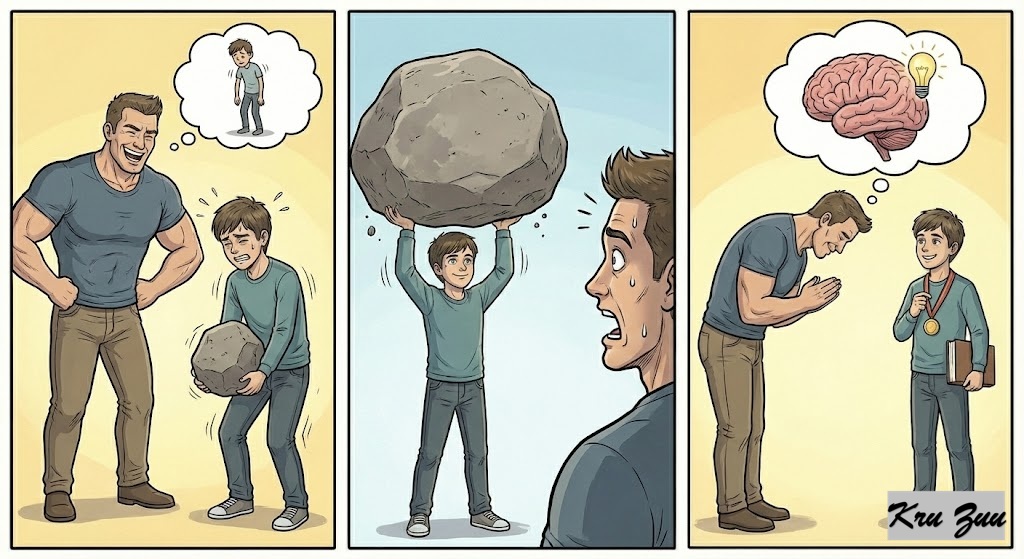
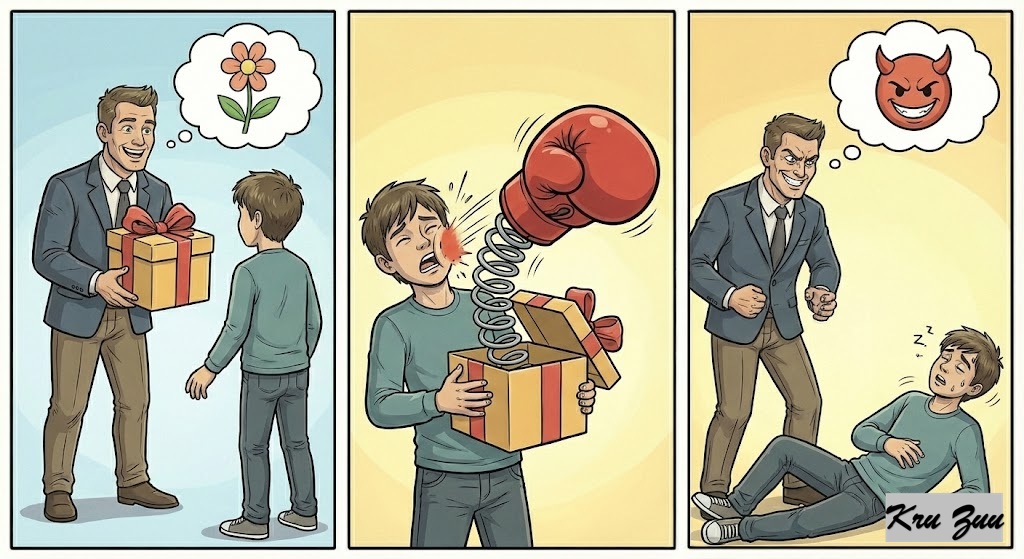
    😈 The Villain (The Surface Judge)

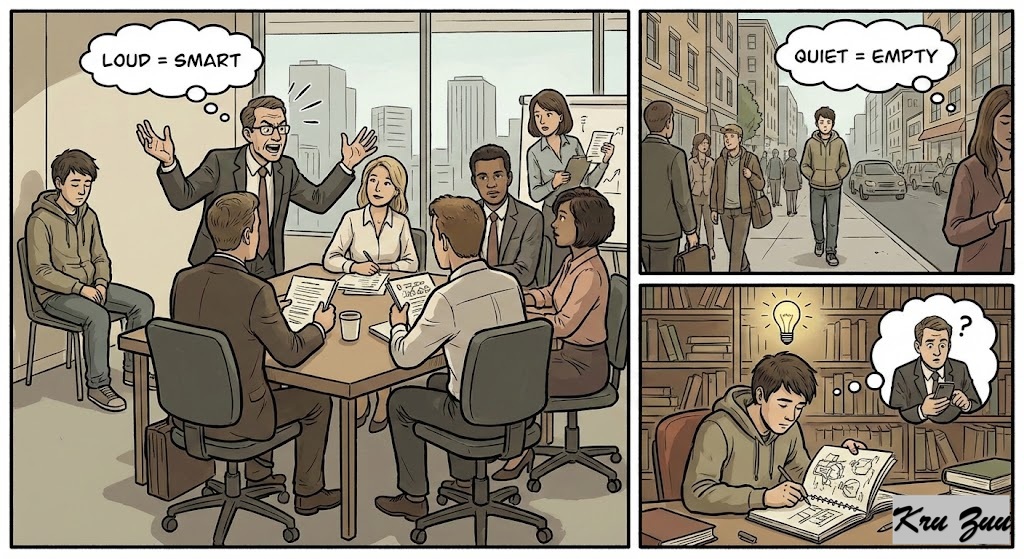
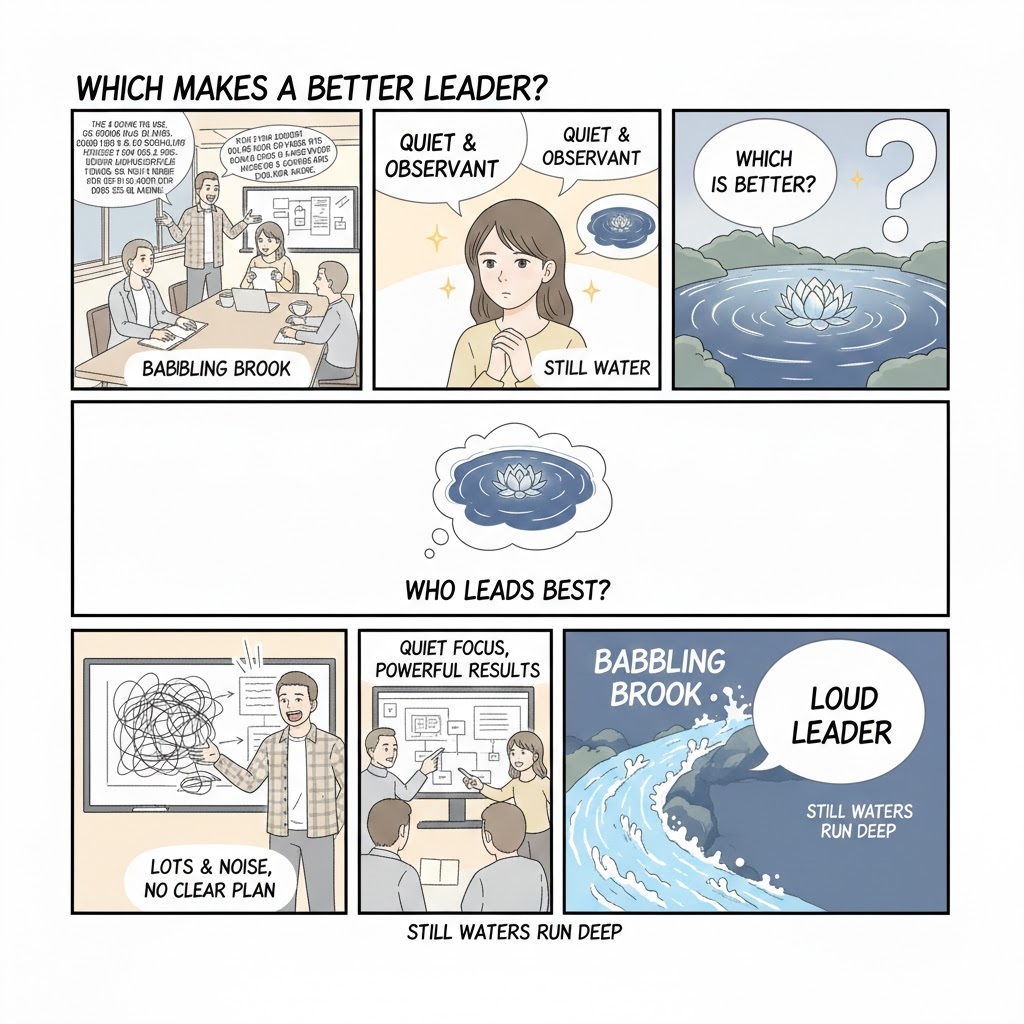
    You meet someone quiet. They don’t talk much in meetings. They don’t post every second on Instagram. What do you think? “They are boring.””They are shy.””They don’t know anything.” You judge the book by its cover. You assume that “Loud” equals “Smart” and “Quiet” equals “Empty.” You ignore the quiet ones.

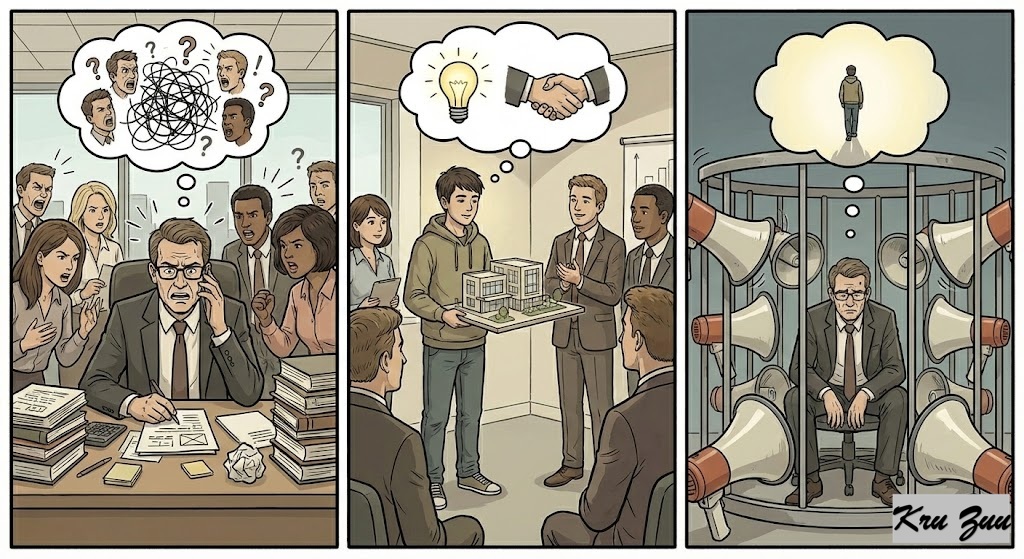
    The Result? You miss out on the smartest people in the room. You underestimate your competition. You are trapped in the “Noise Trap.” 📢


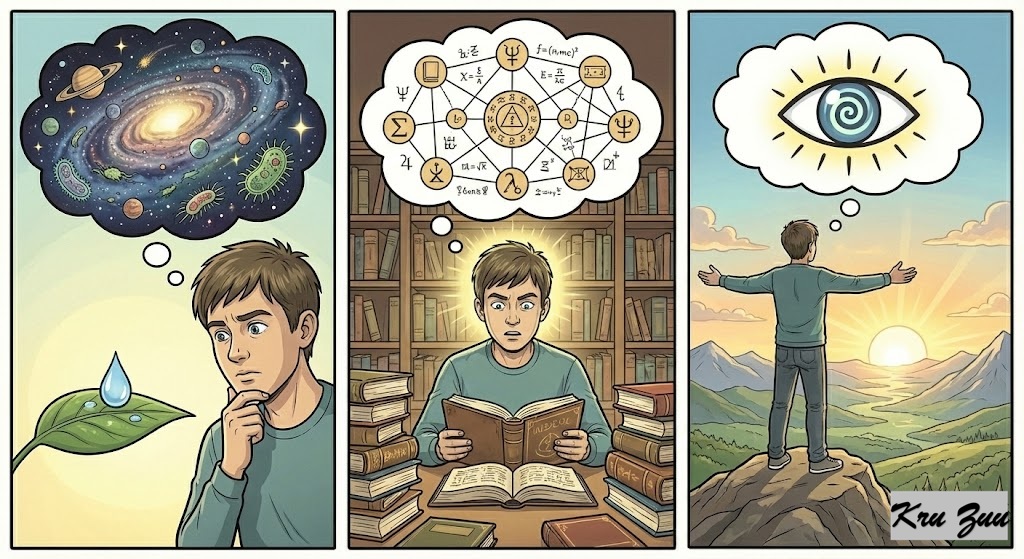
    😇 The Hero (The Deep Diver)

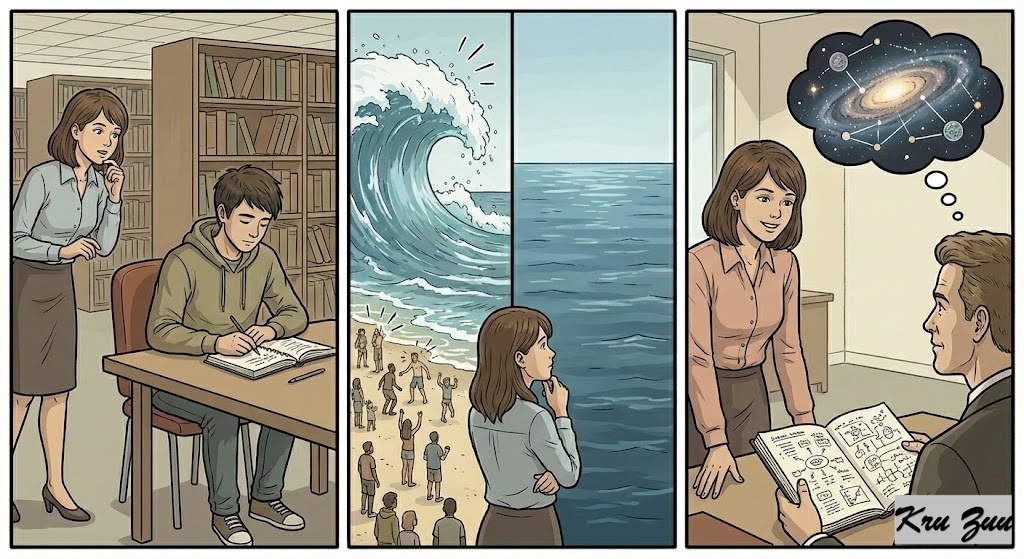
    You meet someone silent. Instead of thinking they are empty, you get curious. You know that the ocean is loudest at the beach (where it is shallow) but silent in the middle (where it is deep). You respect the silence. You realize that just because someone isn’t talking, doesn’t mean they aren’t thinking.

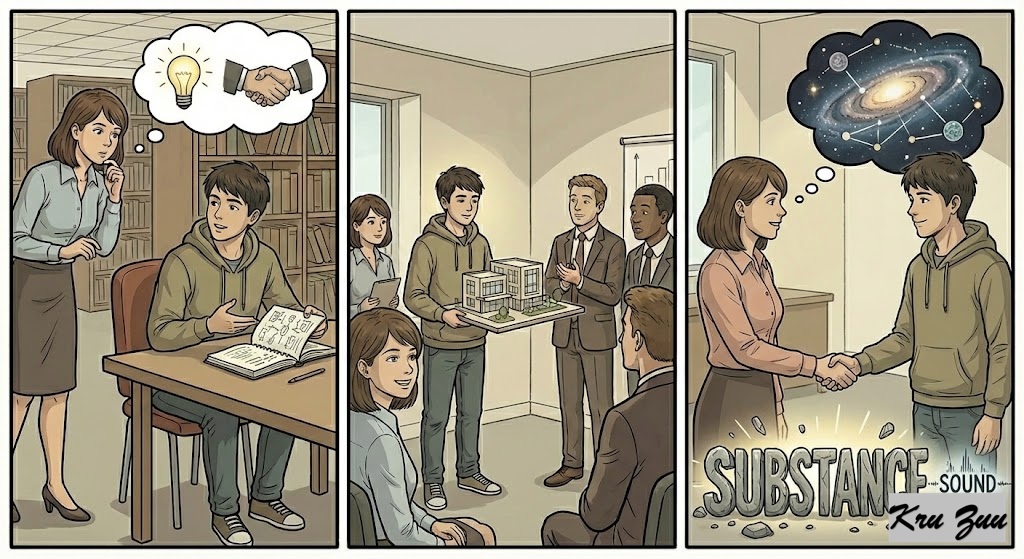
    The Result? When the quiet person finally speaks, you listen. You discover hidden talents, profound wisdom, and powerful allies. You value Substance over Sound. 🧘‍♂️


    ⚖️ The Reality


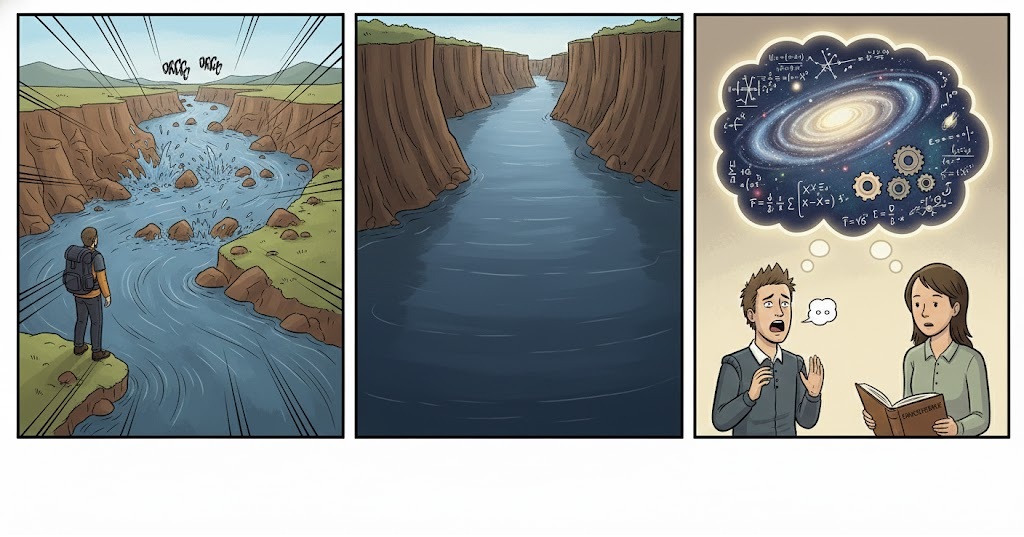
    Noise is easy. Silence is heavy. A shallow brook babbles and splashes noisily over the rocks. A massive, deep river moves silently because it has so much volume and power. People are the same. Those who talk the most often know the least. Those who are calm often hold the most power, passion, or intelligence inside.


    💎 The Secret: Never mistake silence for weakness. The quietest person in the room is often the most observant.

    🧐 The Anatomy of the Proverb


    This is your reminder to look beyond the surface.


    Still (Adjective): Motionless; calm; quiet.


    Waters (Noun): Rivers, lakes, or oceans (metaphor for a person’s mind or character).


    Run (Verb): To flow or move.


    Deep (Adverb/Adj): Extending far down; profound; complex.


    Simpler Version: Quiet people are often very complex or interesting. / Calm exteriors hide strong emotions.


    📚 Vocabulary Vault


    Introvert (Noun):
    A person who prefers calm environments and often enjoys spending time alone. 🐢


    Underestimate (Verb): To think someone is less capable or intelligent than they really are.


    Deceptive (Adjective): Giving an appearance different from the true one; misleading.


    Profound (Adjective): Very great or intense; having deep insight.


    Superficial (Adjective): Existing only on the surface; not deep. (The opposite of this idiom!)


    🧠 Grammar Focus: Metaphors


    This idiom is a Metaphor. We aren’t actually talking about water; we are talking about human personality.


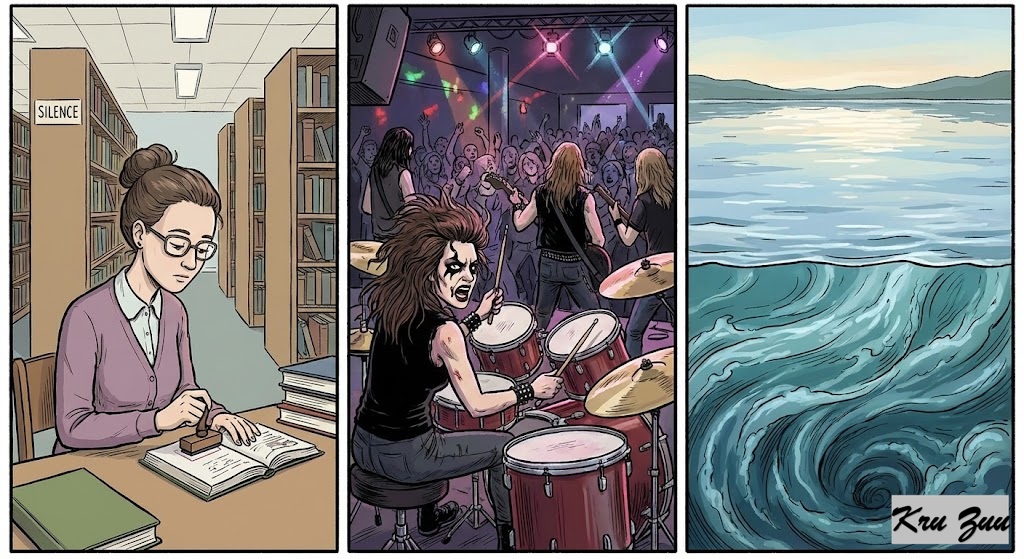
    Example: “I was surprised that the quiet librarian is actually a heavy metal drummer! Well, still waters run deep.”

    📜 History: Origin and Spread


    Where did this poetic wisdom come from?


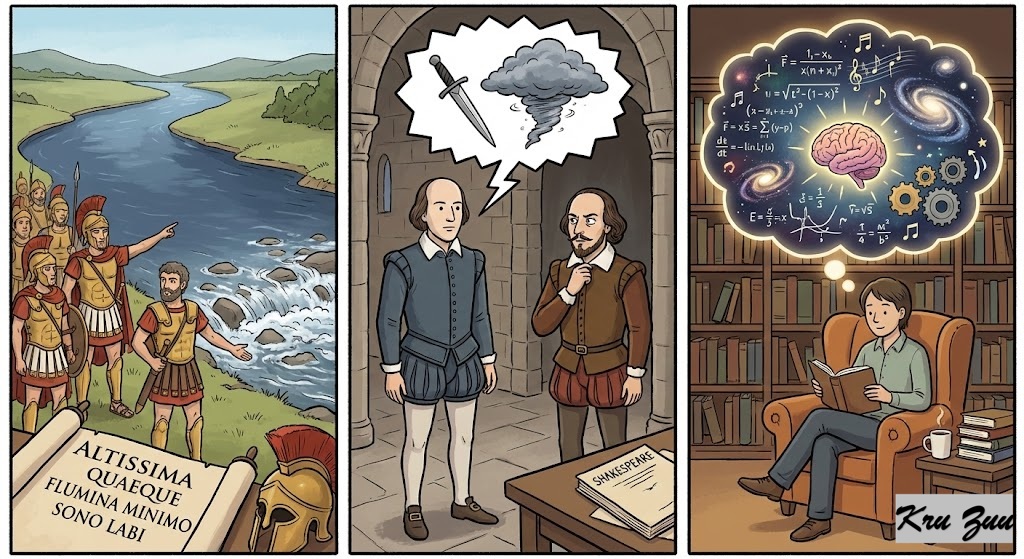
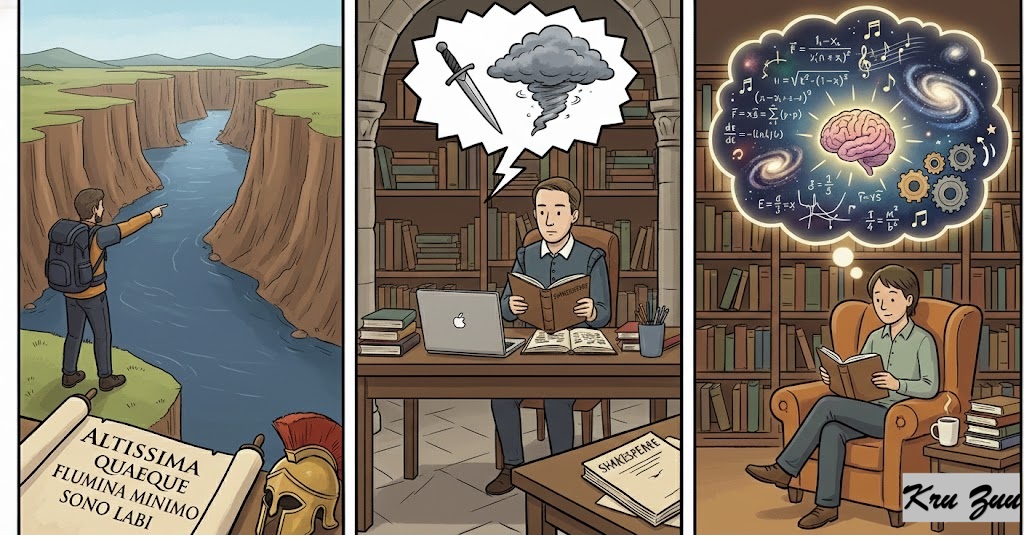
    The Origin: It has ancient roots! It likely comes from the Latin phrase “Altissima quaeque flumina minimo sono labuntur” (The deepest rivers flow with the least sound). It was popularized in English by William Shakespeare in his play Henry VI (1590), where a character says: “Smooth runs the water where the brook is deep.”


    The Logic: If you look at nature, shallow water hits rocks and makes noise. Deep water creates a massive, silent current.


    Global Cousins


    🇹🇷 Turkish:“Ummadığın taş baş yarar” (The stone you didn’t expect breaks your head) OR “Sessiz atın çiftesi pek olur” (The silent horse kicks hard).


    🇪🇸 Spanish:“Del agua mansa me libre Dios” (God save me from the calm water).


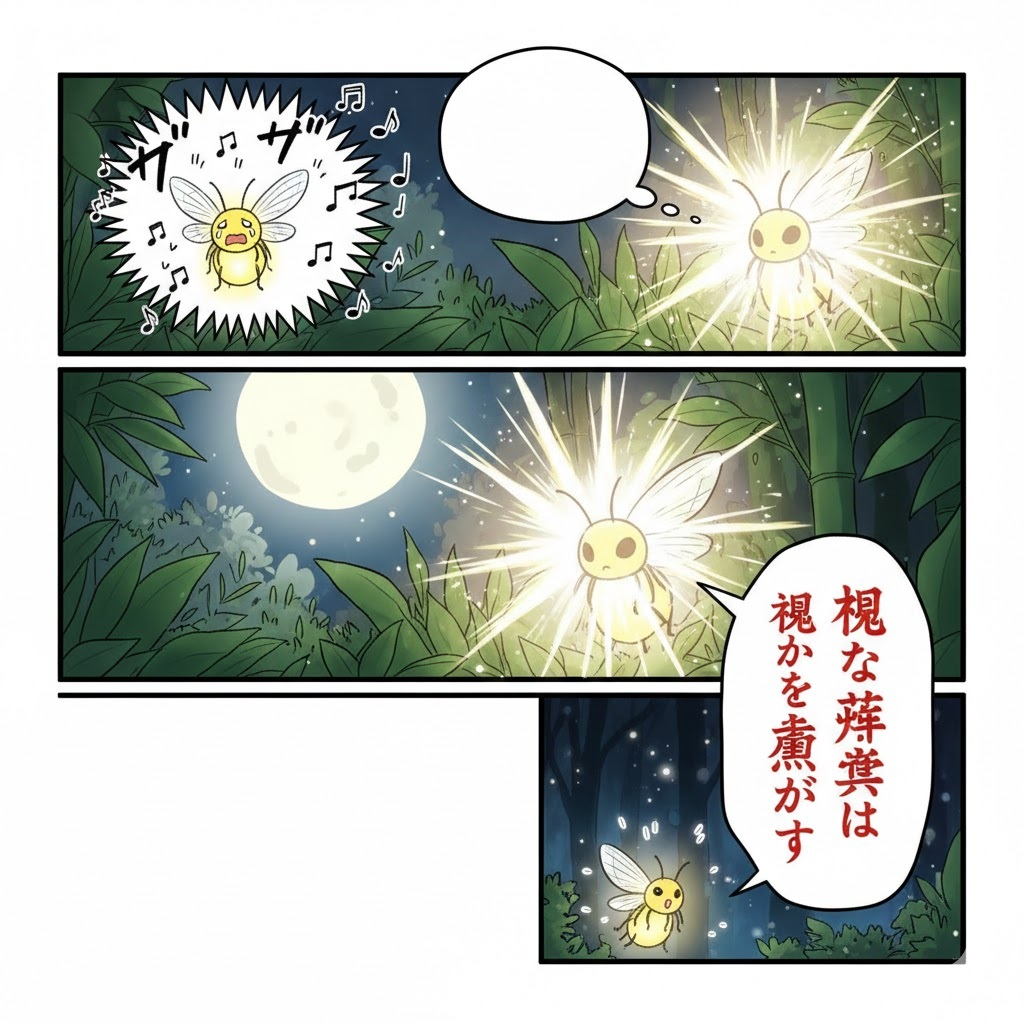
    🇯🇵 Japanese:“The mute firefly burns more than the one that cries.” (Wow! 🔥)

    🎯 Impact on Life: The Pros & Cons


    ✅ The Pros (The Mystery)


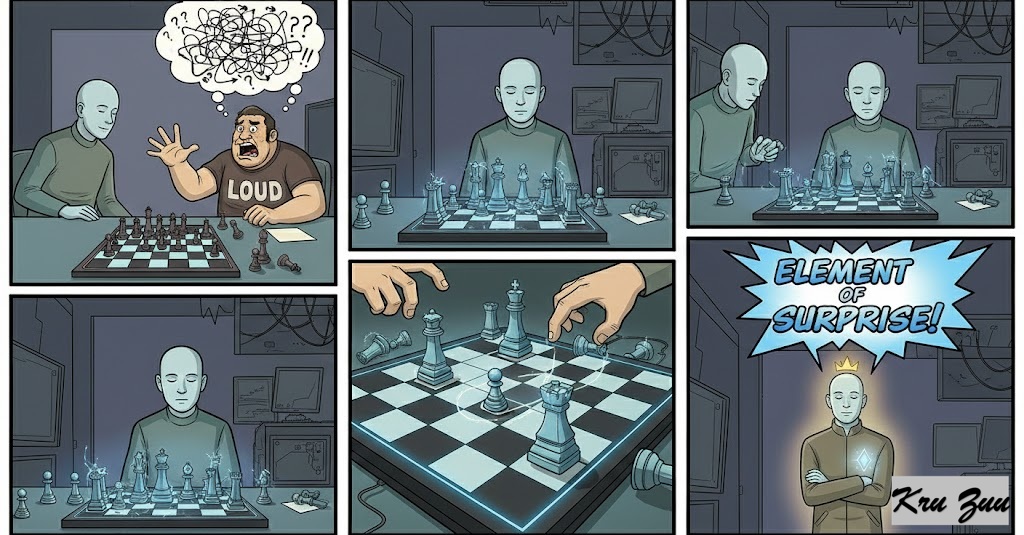
    Power: If you are “still water,” people can’t read your next move. You have the element of surprise.


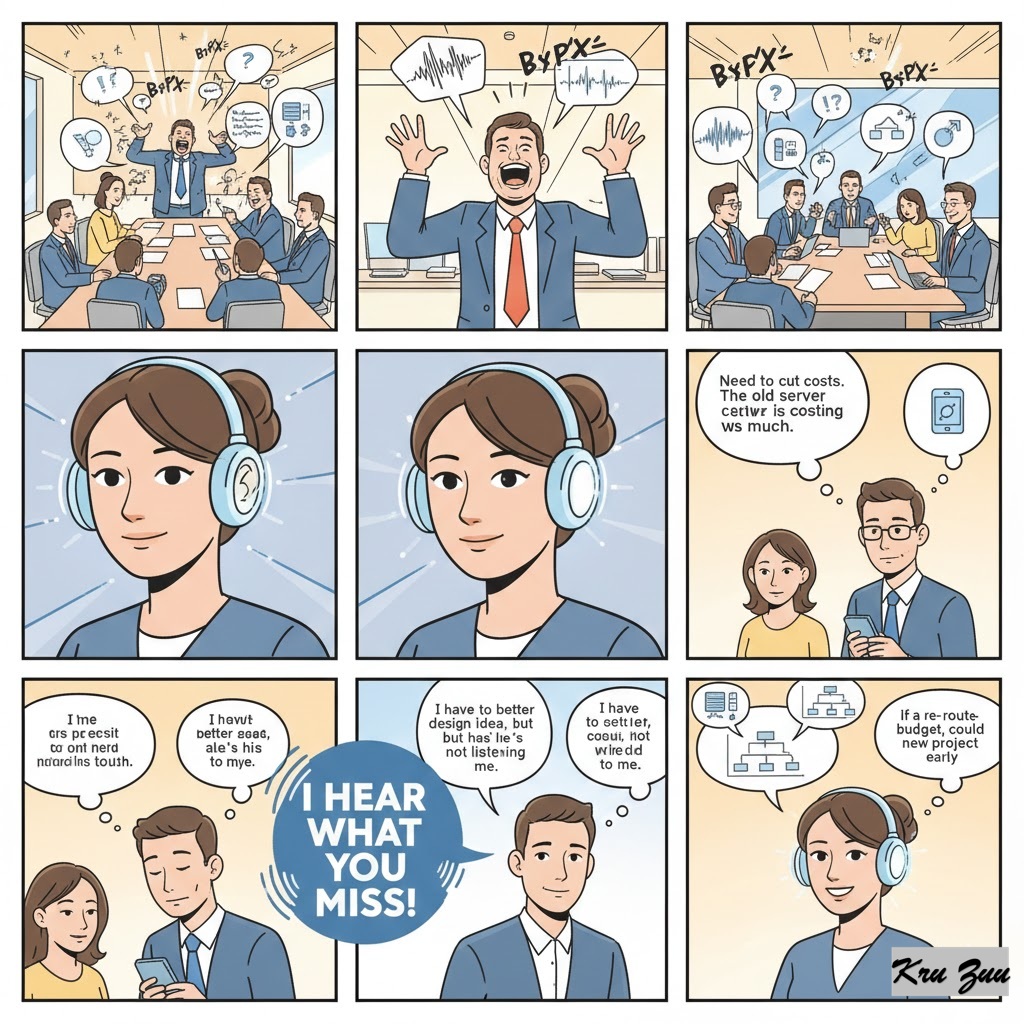
    Listening: By being quiet, you hear things the loud people miss.


    ❌ The Cons (The Danger)


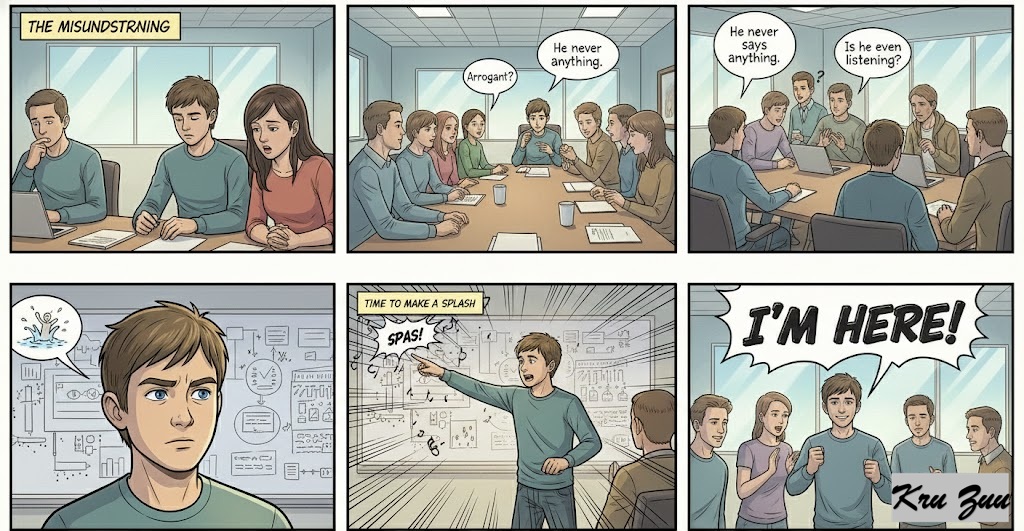
    Misunderstanding: People might think you are arrogant or uninterested because you don’t speak much. Sometimes, you need to make a little “splash” so people know you are there.

    🎭 Short Story: The Forest Talent Show 🐸🐱🐔


    Let’s visit the magical forest to see who really has the talent.


    🌟 The Cast


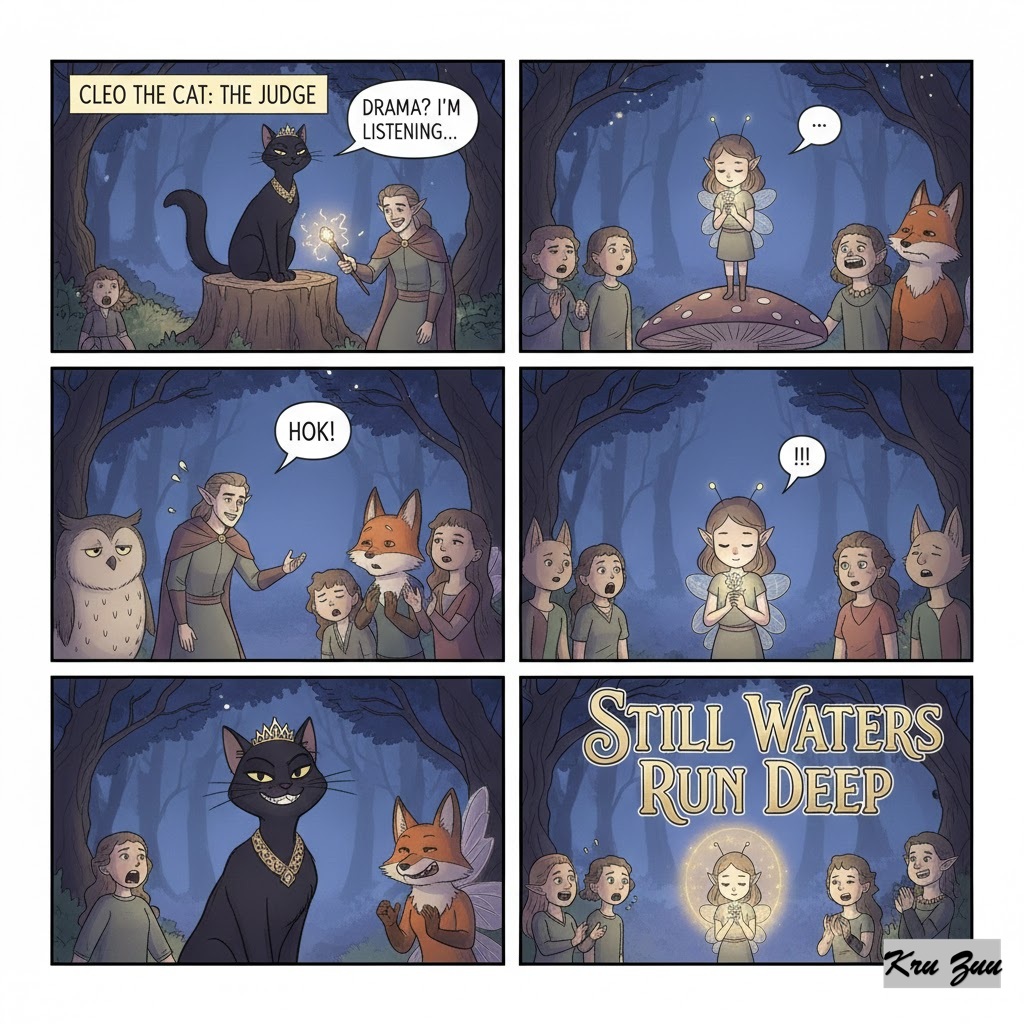
    Cleo the Cat: The Judge. Stylish, critical, and loves drama. 😼


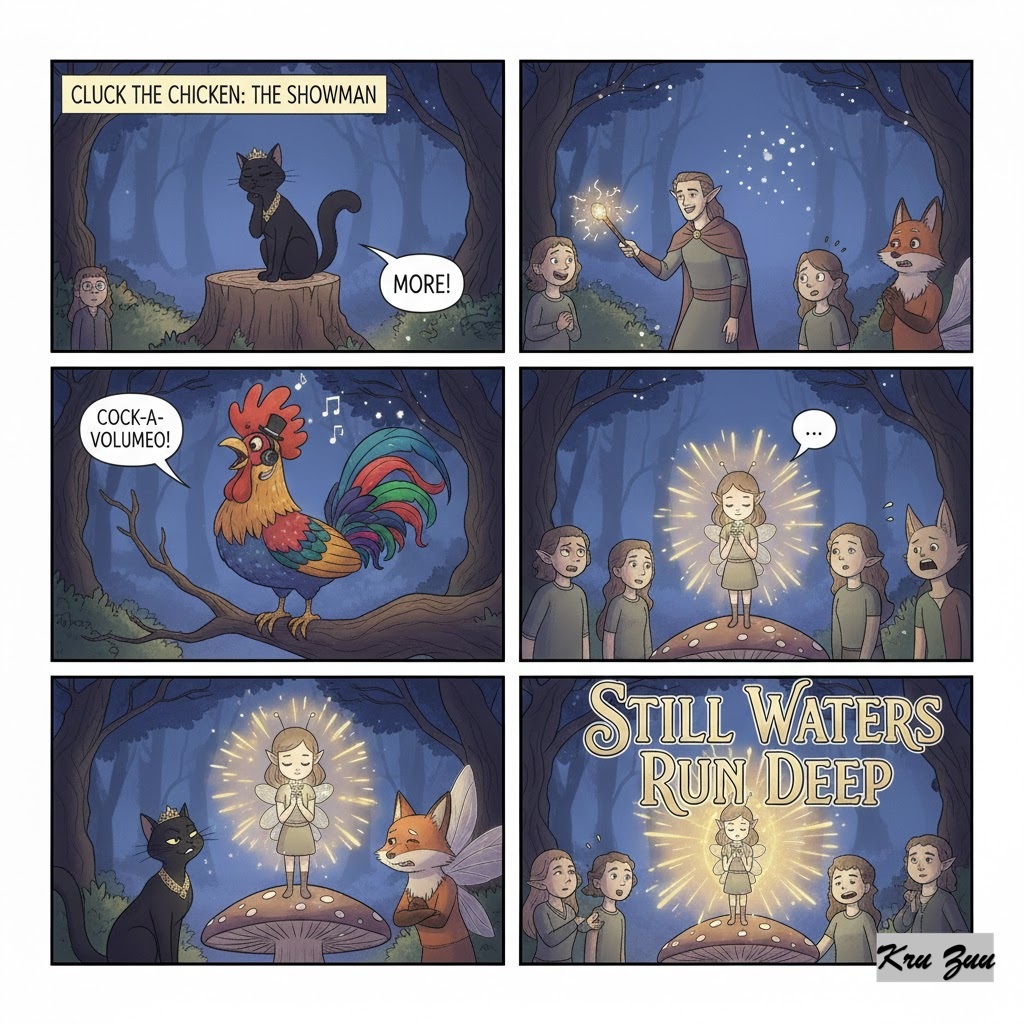
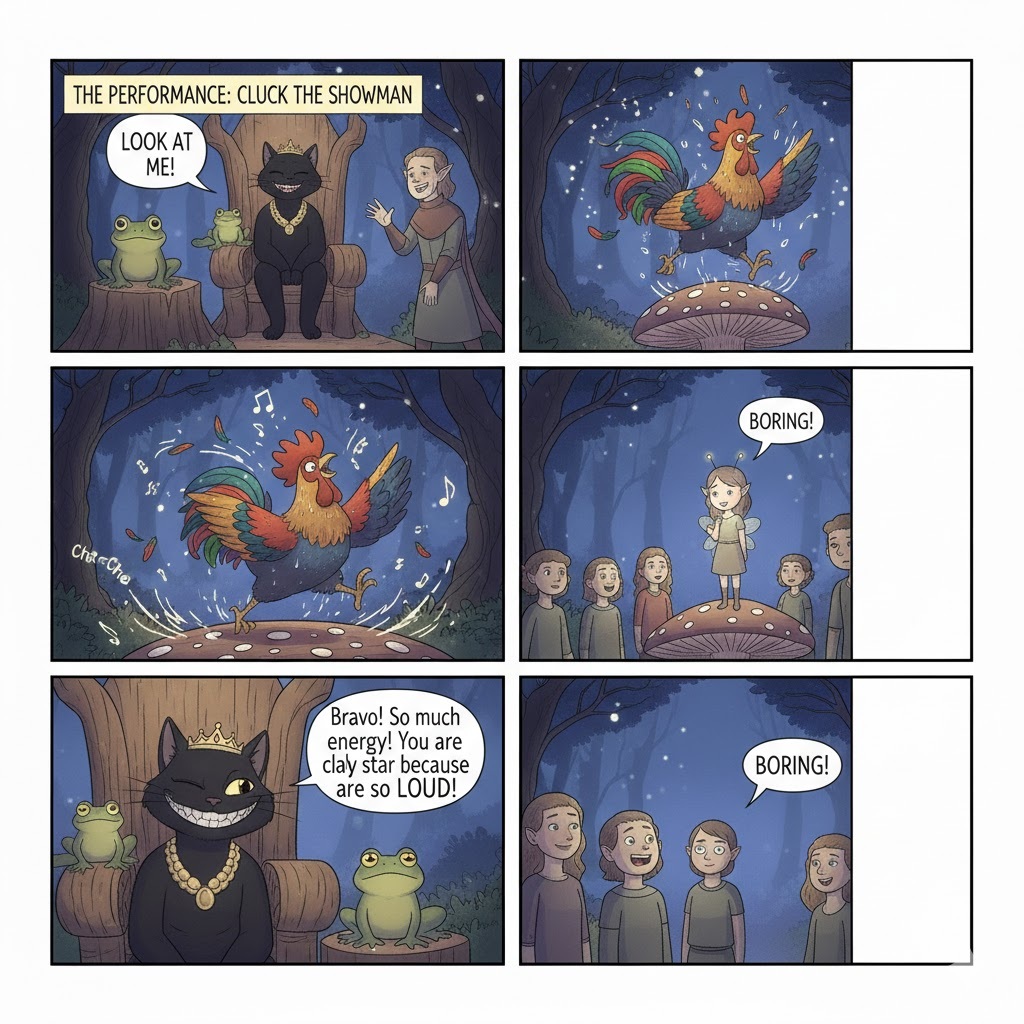
    Cluck the Chicken: The Showman. Loud, colorful, and loves his own voice. 🐔


    Fred the Frog: The Observer. Tiny, green, and completely silent. 🐸


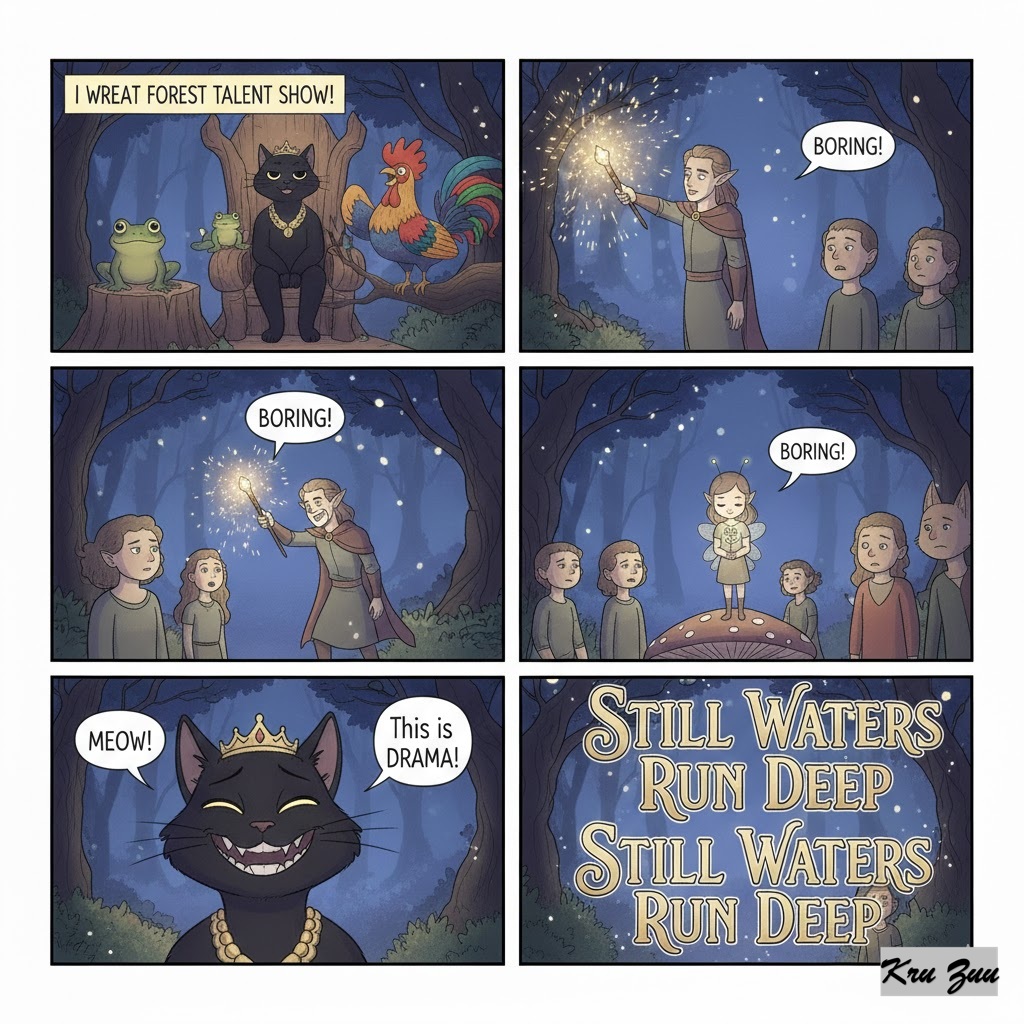
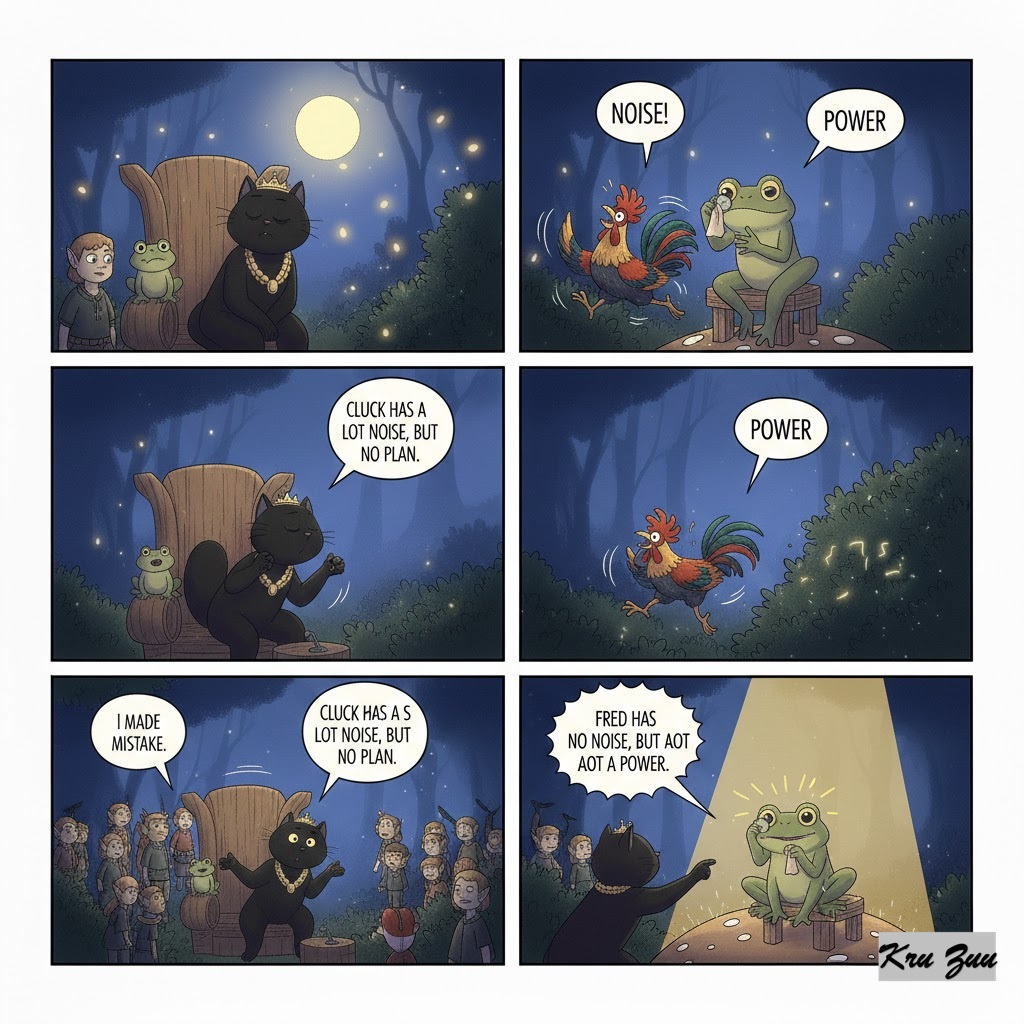
    The Situation: It was the night of the “Great Forest Talent Show.” Cleo sat on the judge’s throne. She wanted entertainment!


    The Performance: First up was Cluck. He exploded onto the stage! “LOOK AT ME!” he squawked. He flapped his wings furiously. He danced the ‘Cha-Cha’. He told ten jokes in one minute. He was sweating, screaming, and running in circles. Cleo clapped. “Bravo! So much energy! You are clearly a star because you are so LOUD!”


    Then, it was Fred’s turn. Fred hopped onto the stage. He sat on a stool. He didn’t move. He didn’t speak. Cluck laughed from the side. “Boring! He is just a frozen frog! He has nothing inside his head!” Cleo yawned. “Next! This frog is empty.”


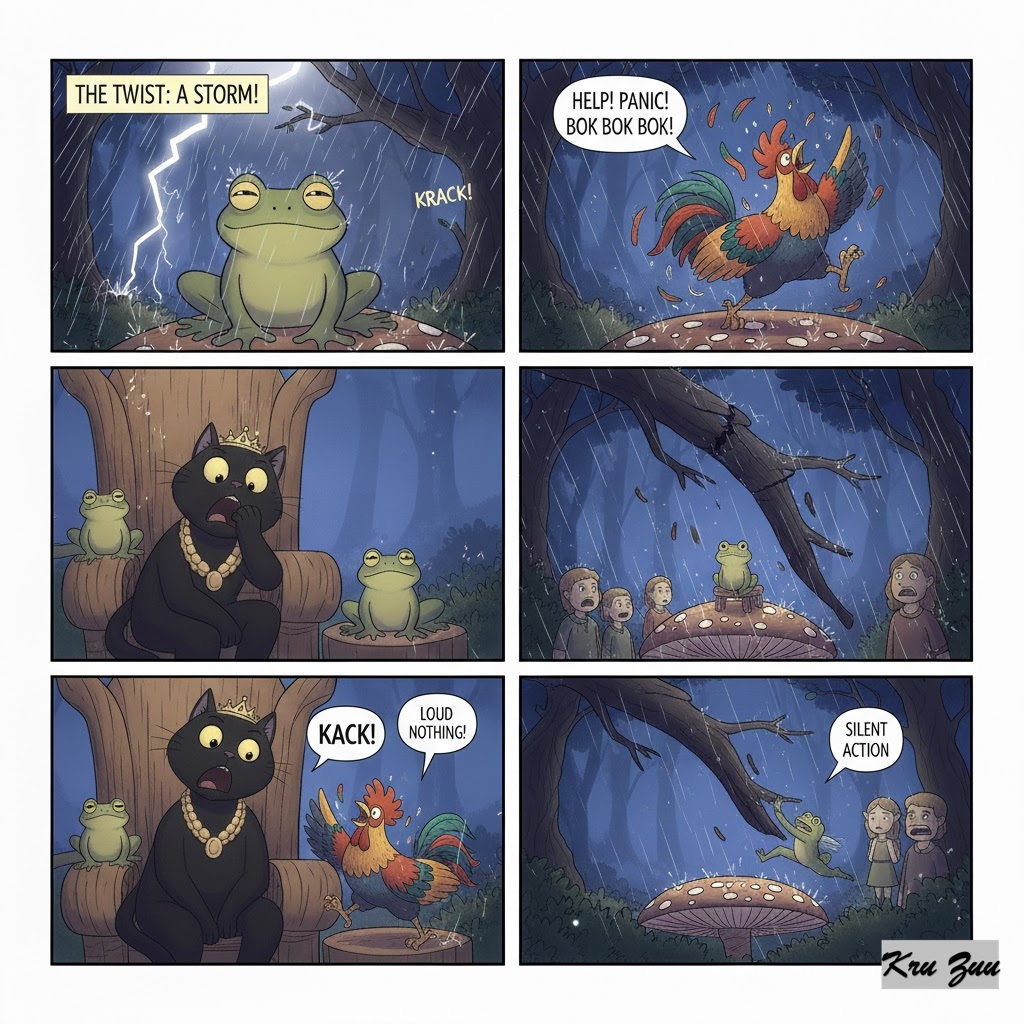
    The Twist: Suddenly, a storm broke out! ⛈️ The lights went off. The wind howled. A giant, heavy tree branch cracked and was about to fall right onto Cleo! Cluck ran around screaming, “HELP! PANIC! BOK BOK BOK!” He was making a lot of noise, but doing nothing.


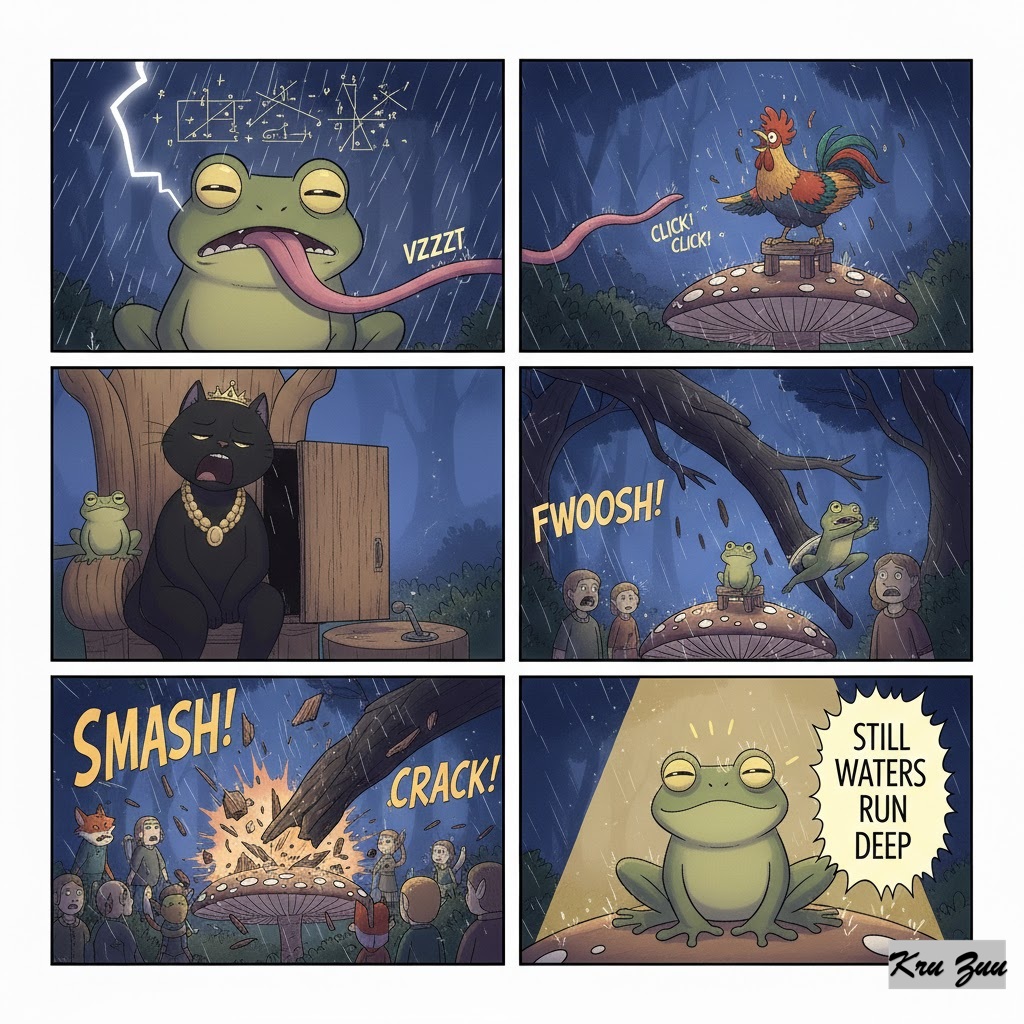
    In the darkness, Fred didn’t scream. He didn’t panic. With a calm, deep breath, Fred calculated the angle. He used his long, sticky tongue to pull a lever on the stage wall. CLICK. A trapdoor opened instantly under Cleo, sliding her to safety just one second before the tree smashed her throne. 💥


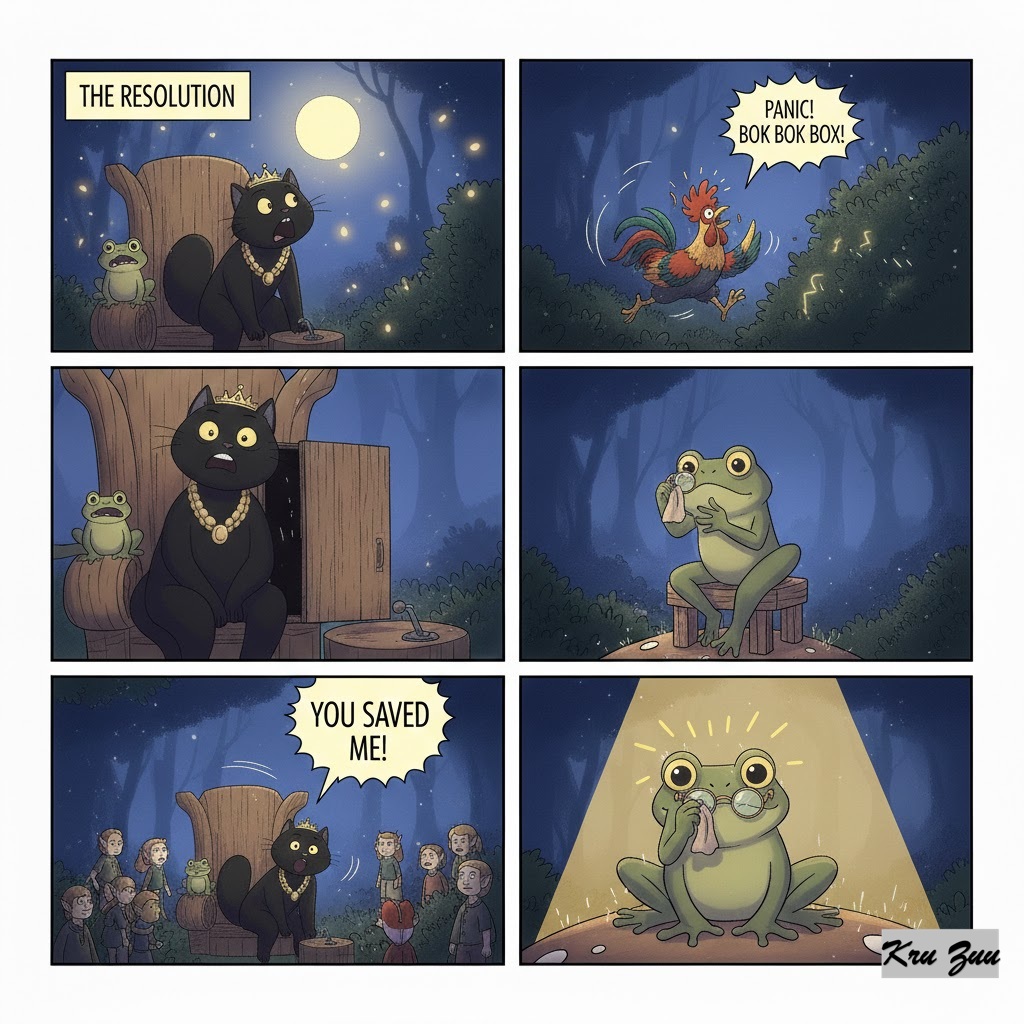
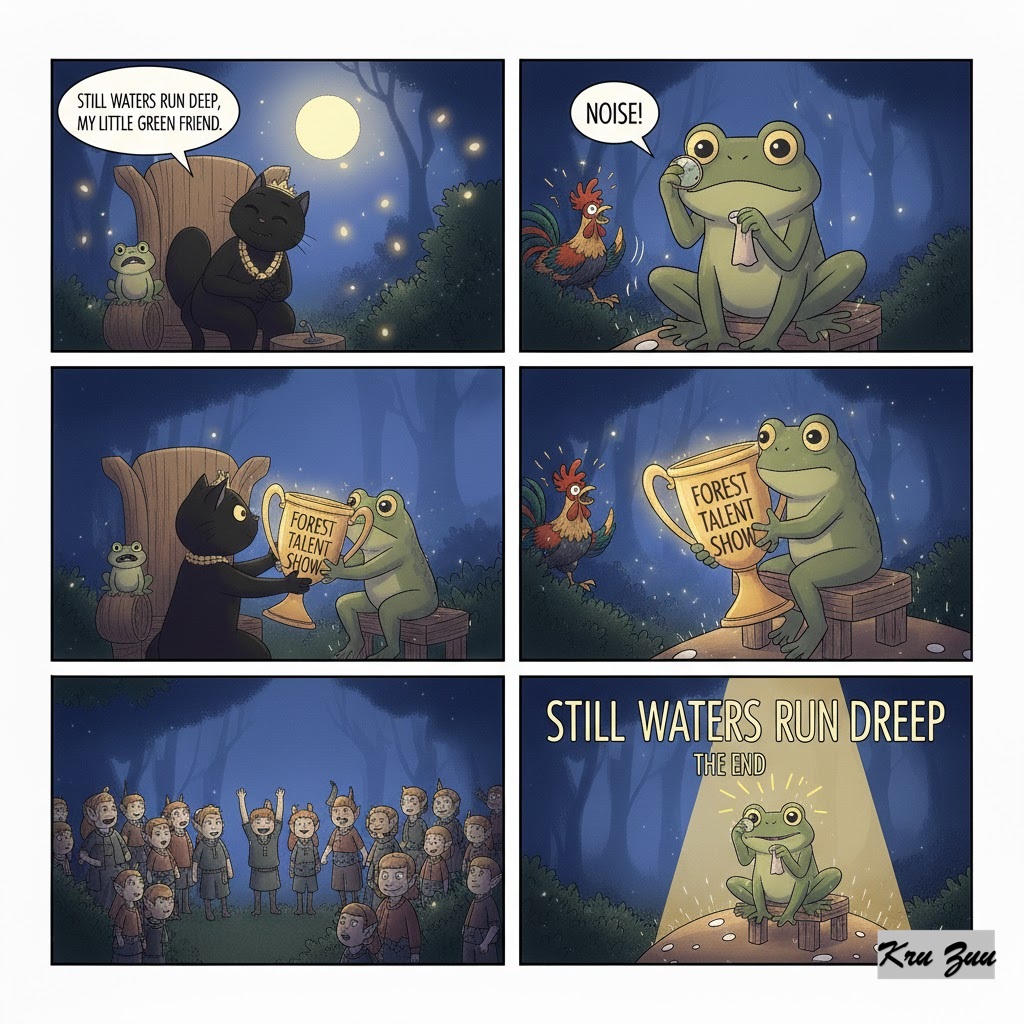
    The Resolution: When the lights came back on, Cleo crawled out of the safe tunnel. Cluck was still running around screaming at a bush. Fred was sitting calmly on his stool, polishing his glasses.


    Cleo looked at the screaming Chicken, and then at the silent Frog who saved her life. “I made a mistake,” Cleo whispered. “Cluck has a lot of noise, but no plan. Fred has no noise, but a lot of power.”


    She handed the trophy to Fred. “Still waters run deep, my little green friend.”


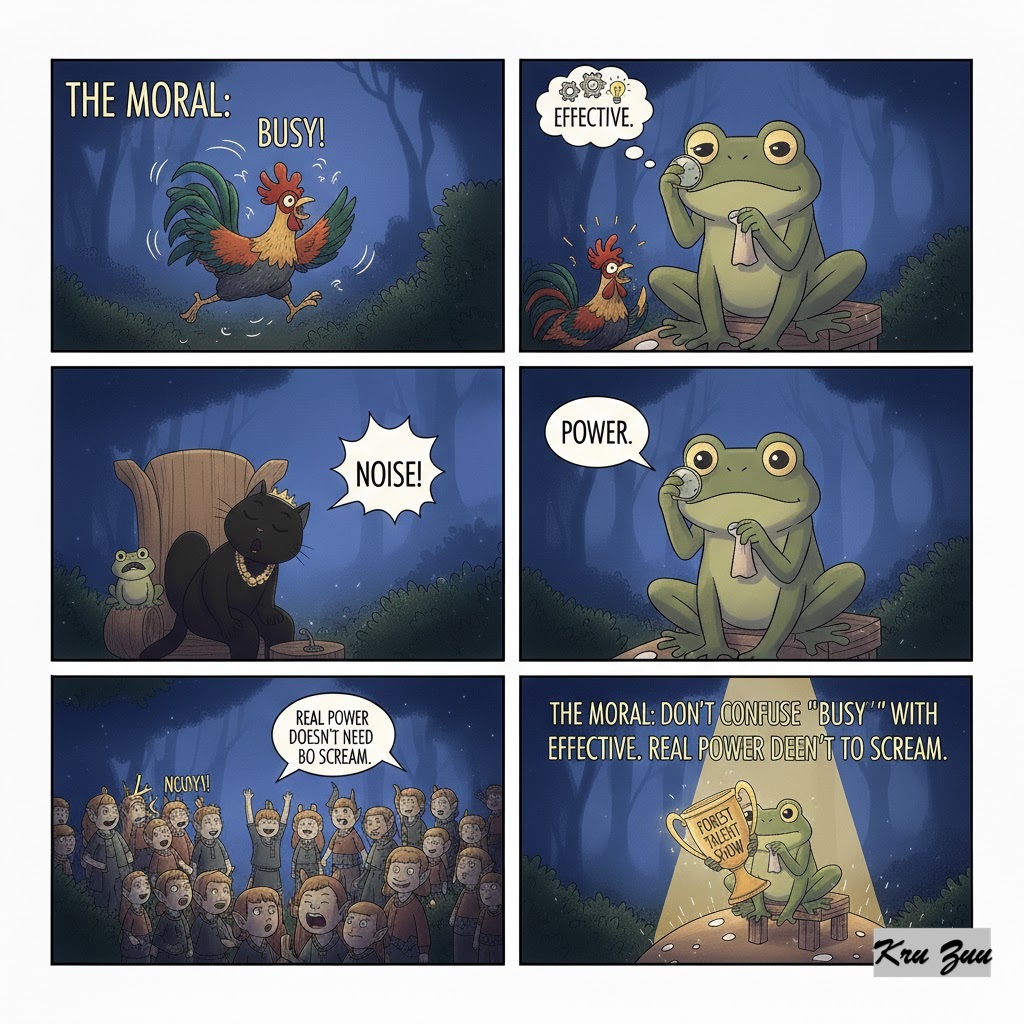
    The Moral: Don’t confuse “Busy” with “Effective.” Real power doesn’t need to scream. 🏆

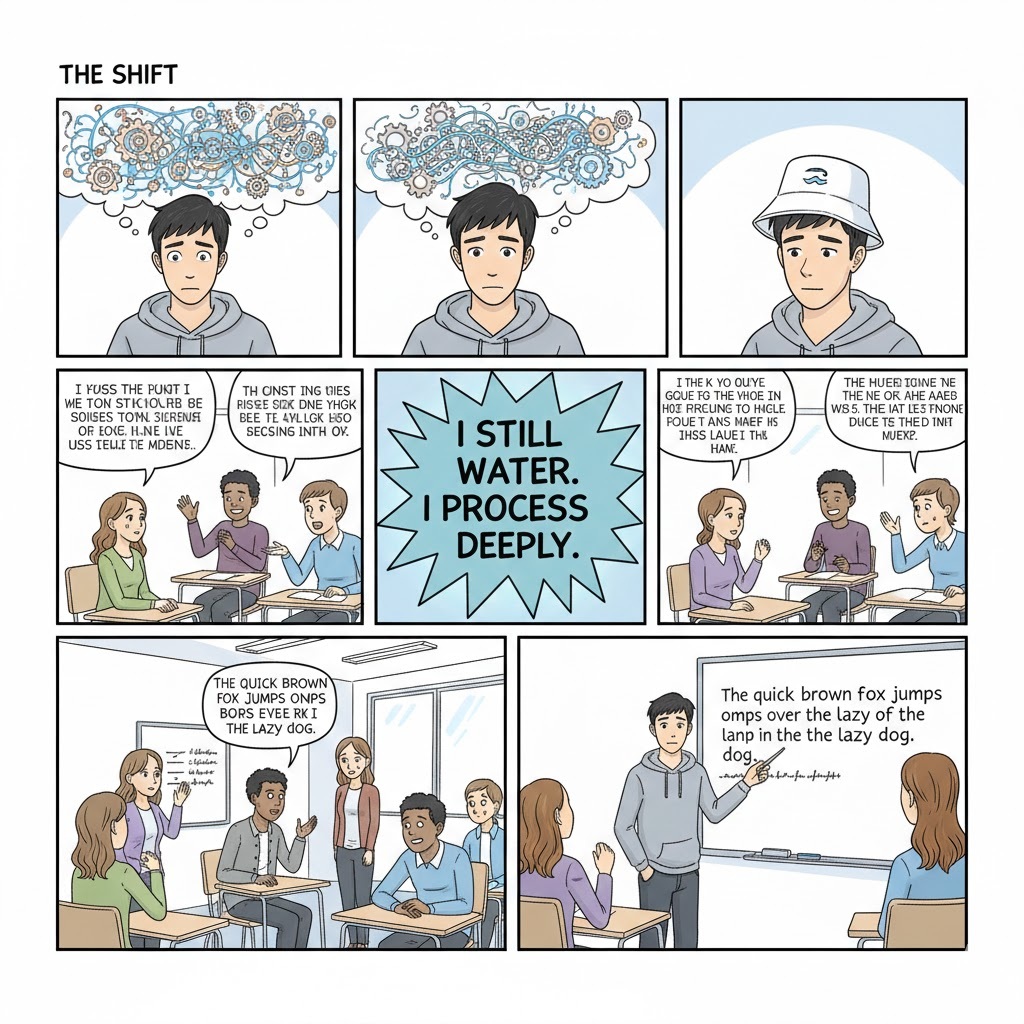
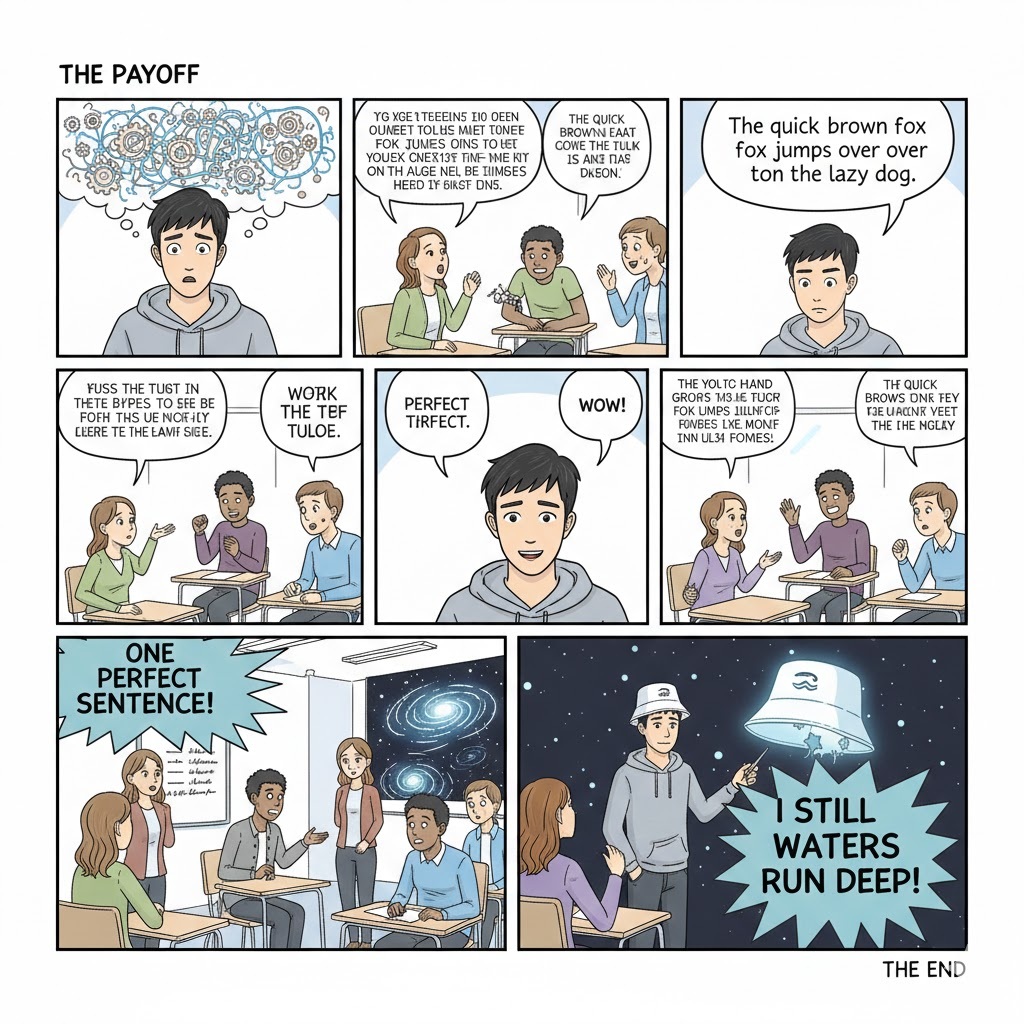
    🎓 Lesson for English Learners


    Don’t Fear the Silence.


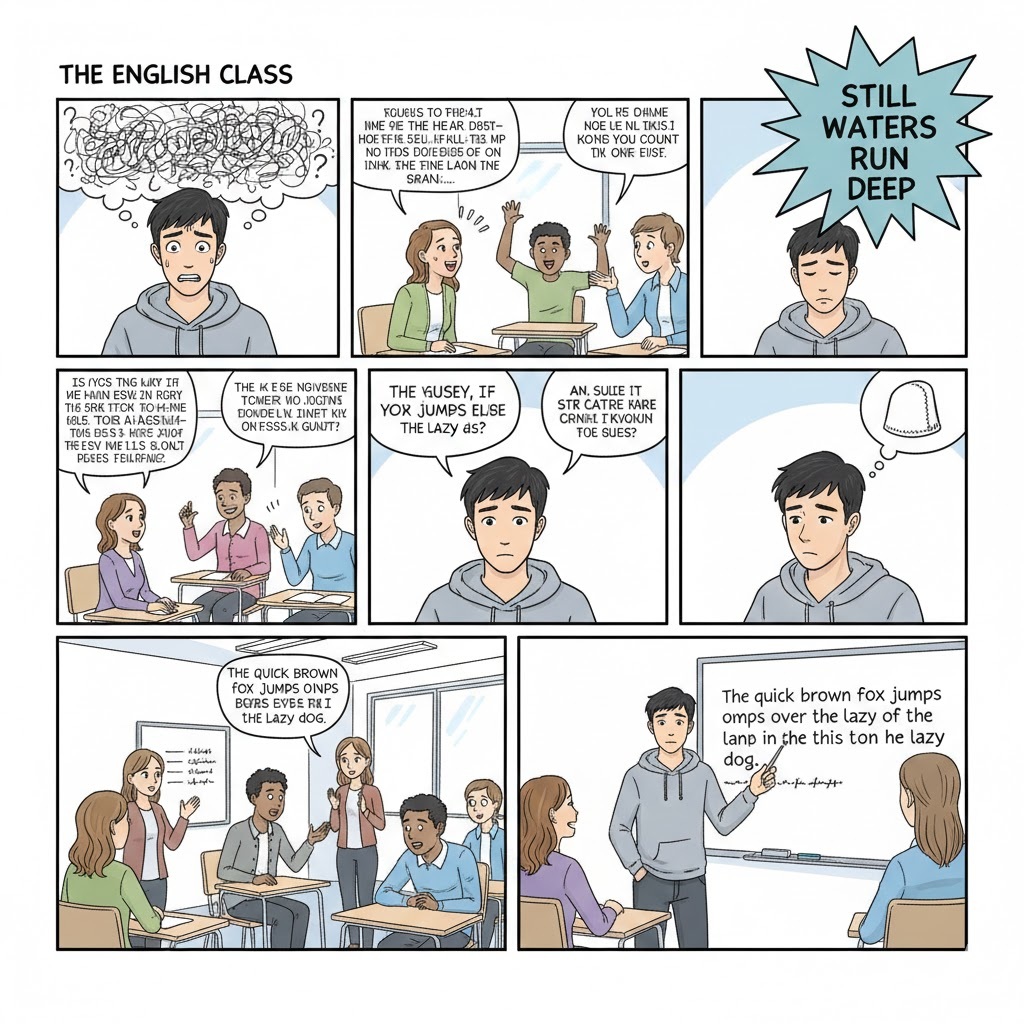
    Situation: You are in an English class. You don’t speak much because you are translating in your head. You feel stupid because others are talking fast (but making mistakes).


    The Shift: Remind yourself that you are “Still Water.” You are processing deeply.


    You Say: When you are ready, speak one perfect, thoughtful sentence.


    Phrase to use:“I may be quiet, but I am listening. Still waters run deep!”


    💬 Your Turn: The Observer Challenge 🚀


    Do you know someone who is very quiet?


    The Challenge: This week, talk to the quietest person in your office or class. Ask them a deep question like, “What is your passion?” or “What do you think about [Topic]?”


    The Prediction: I bet you will be shocked by how interesting their answer is.


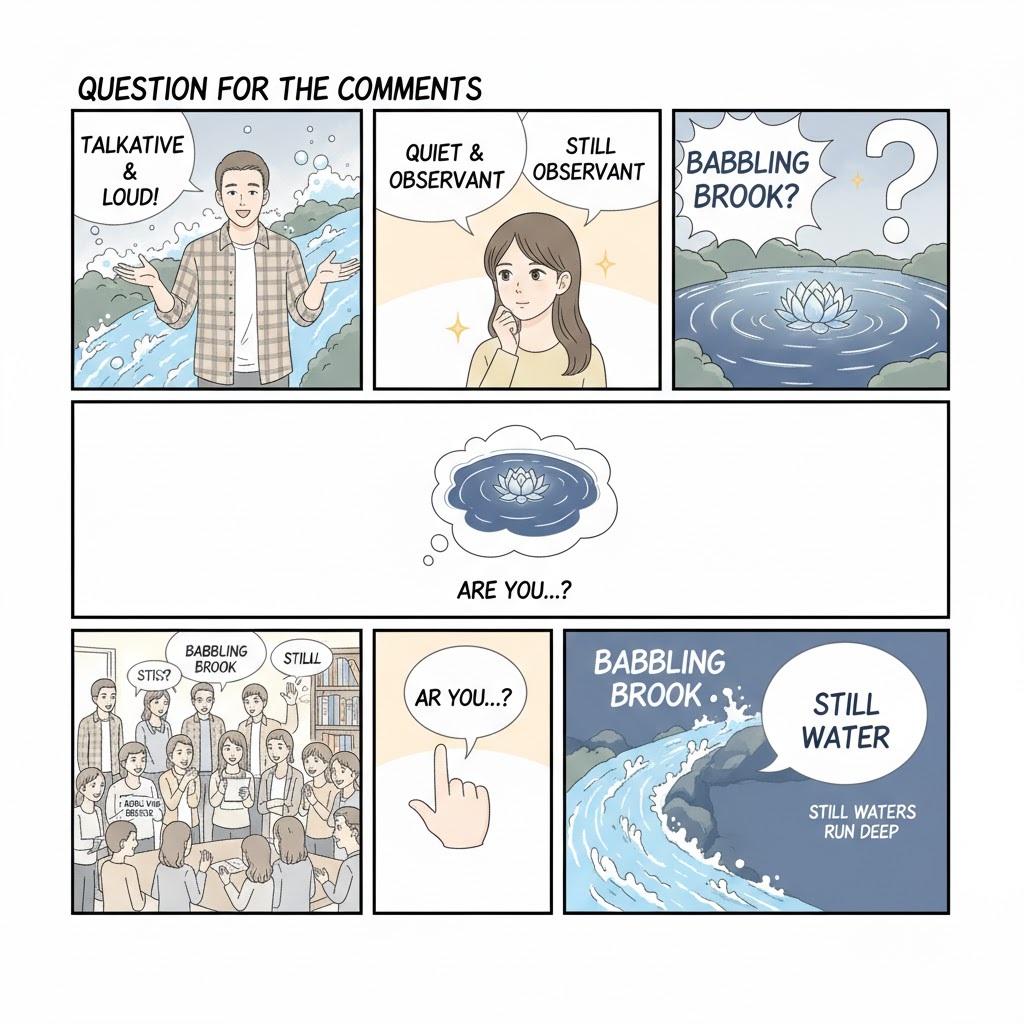
    👇 Question for the comments: Are you a “Babbling Brook” (talkative) or “Still Water” (quiet)?

    Which one do you think makes a better leader?

    Let me know below!

    By Zubeyir YURTKURAN

    https://www.facebook.com/BrainBattleground/

    https://www.facebook.com/zubeyr.yurtkuran/

    https://www.instagram.com/zubeyryurtkuran/
    https://www.youtube.com/@BrainBattleground-b3p

    https://www.instagram.com/brainbattleground/

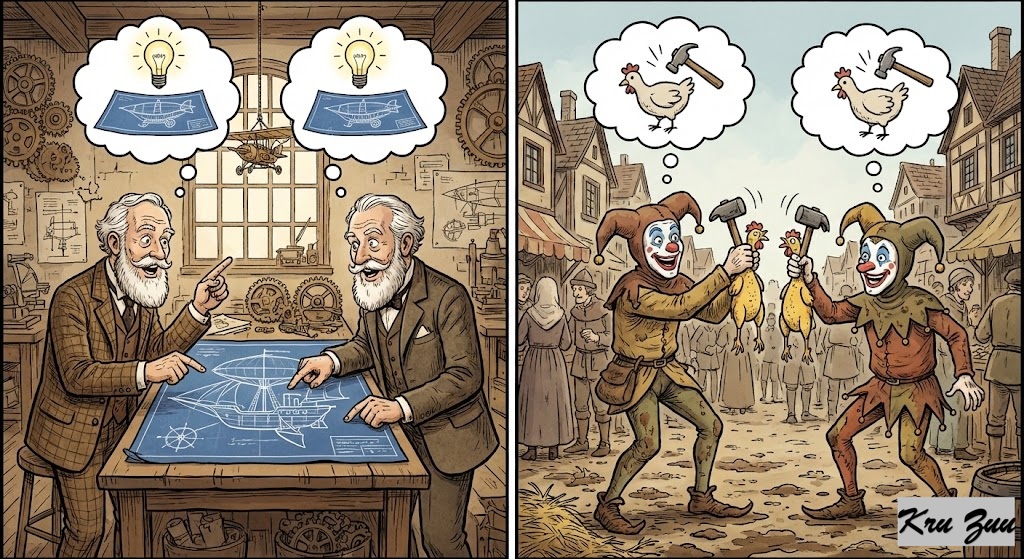
  • 🧠 The Daily Shield: The Law of Connection

    🧠 The Daily Shield: The Law of Connection

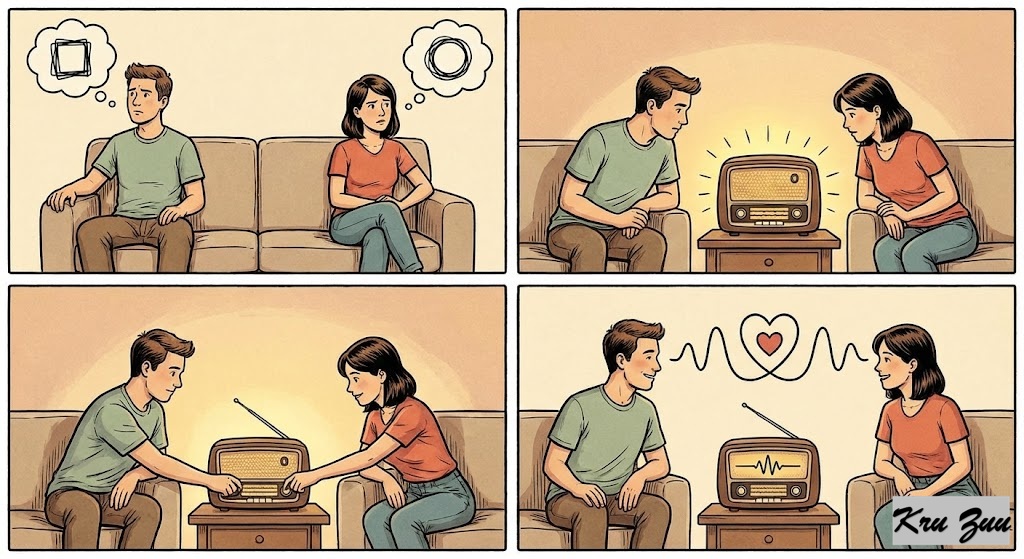
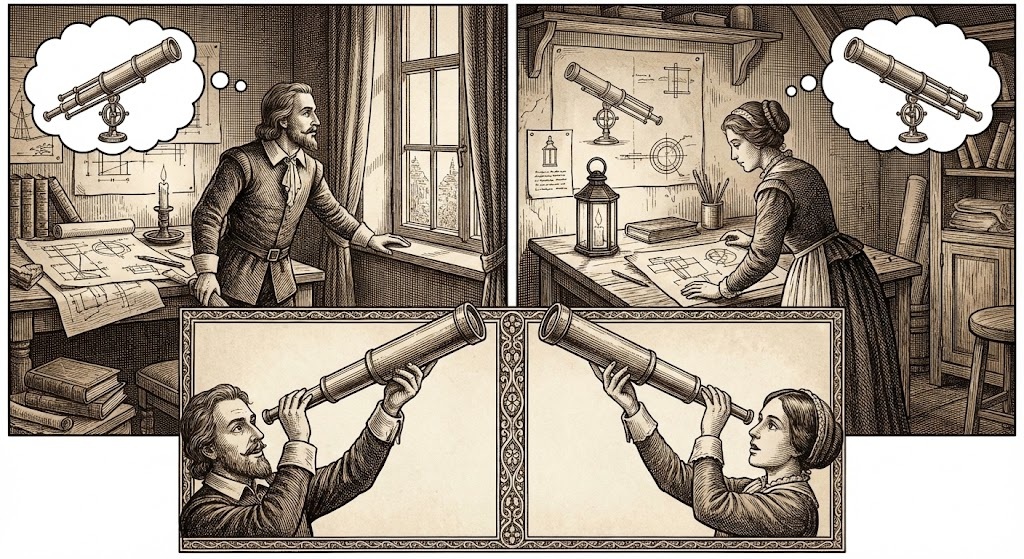
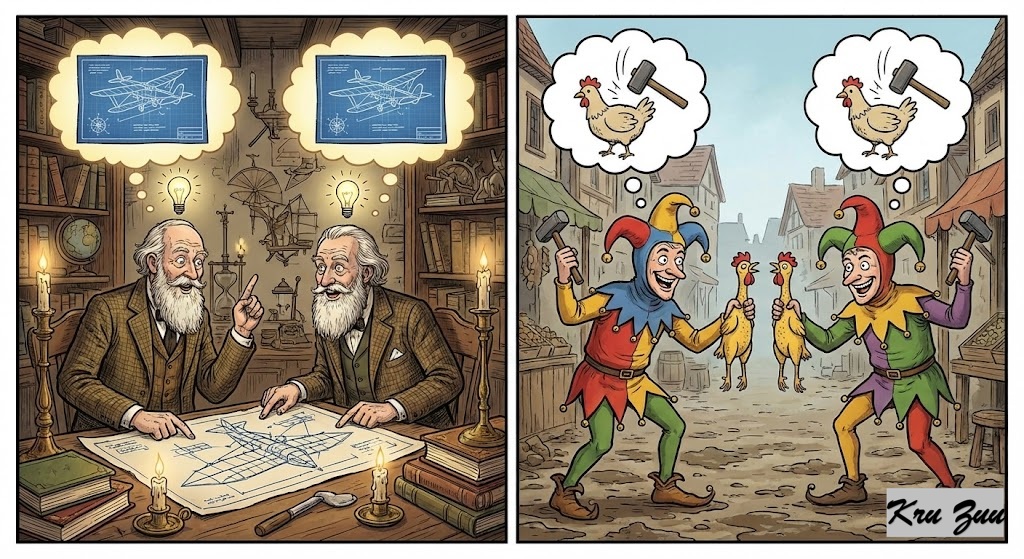
    “Great minds think alike.”


    😈 The Villain (The Intellectual Snob)

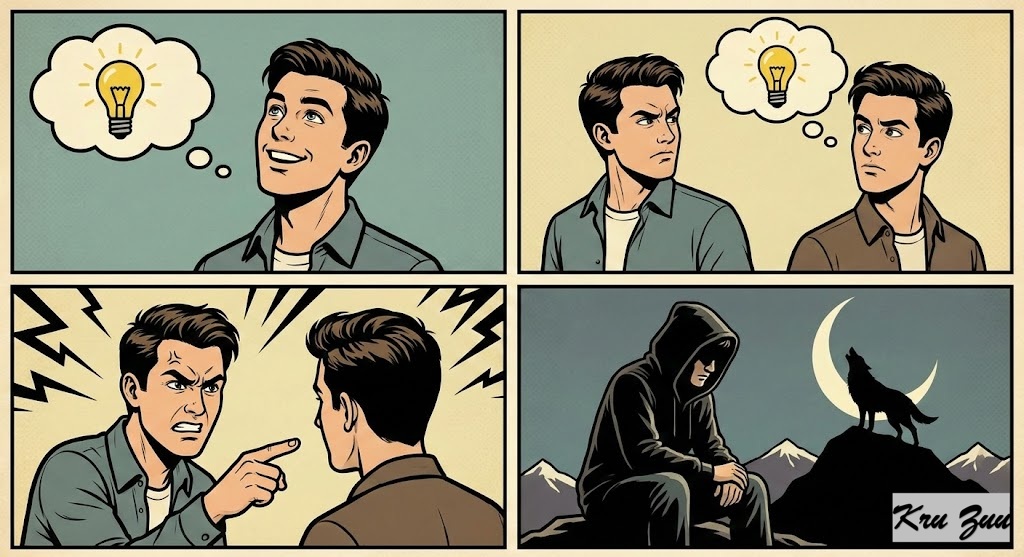
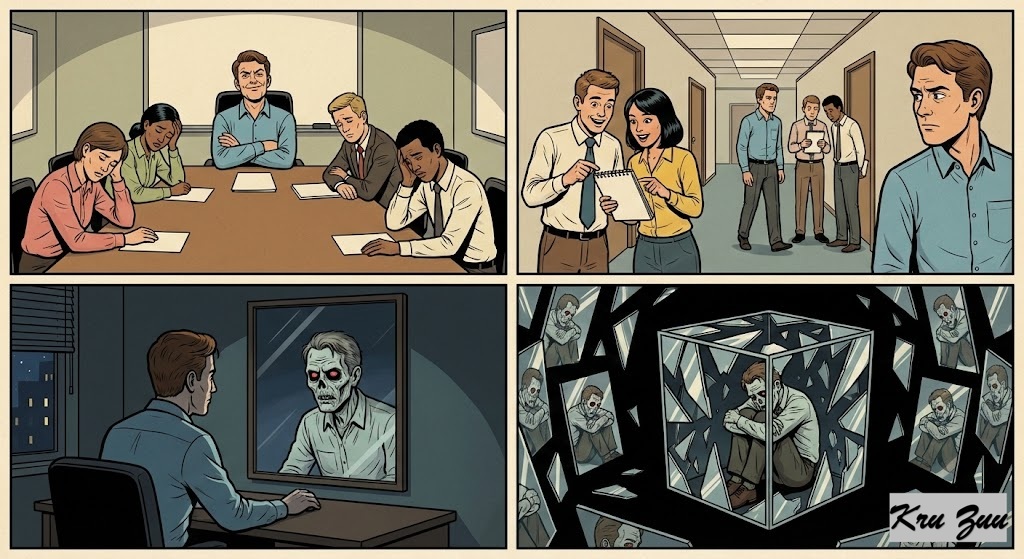
    You have an idea. Someone else suggests the same thing. What do you do? You get annoyed. 😒 “Hey, I thought of that first!””Stop copying me!” You believe your ideas are special property. You see shared thoughts as theft, not connection. You want to be the “Lone Wolf” genius.

    The Result? You isolate yourself. People feel awkward sharing ideas with you. You kill the momentum of the team because you are too busy claiming credit. You are trapped in the “Ego Trap.” 🧟‍♂️


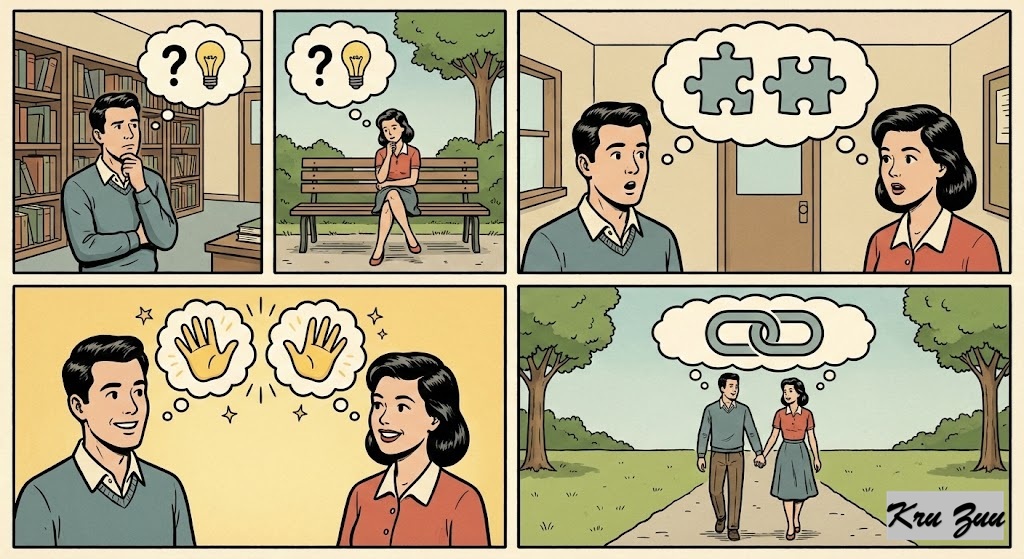
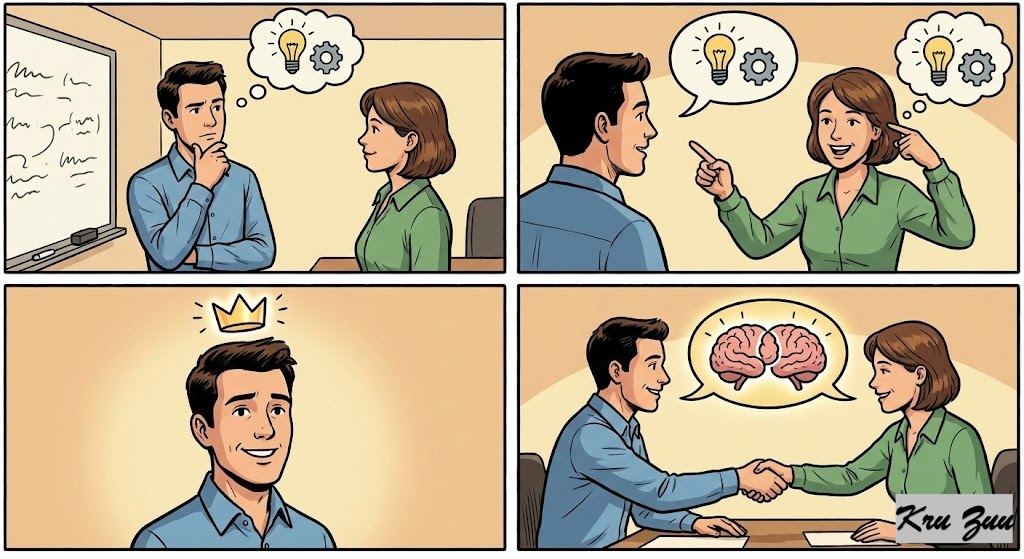
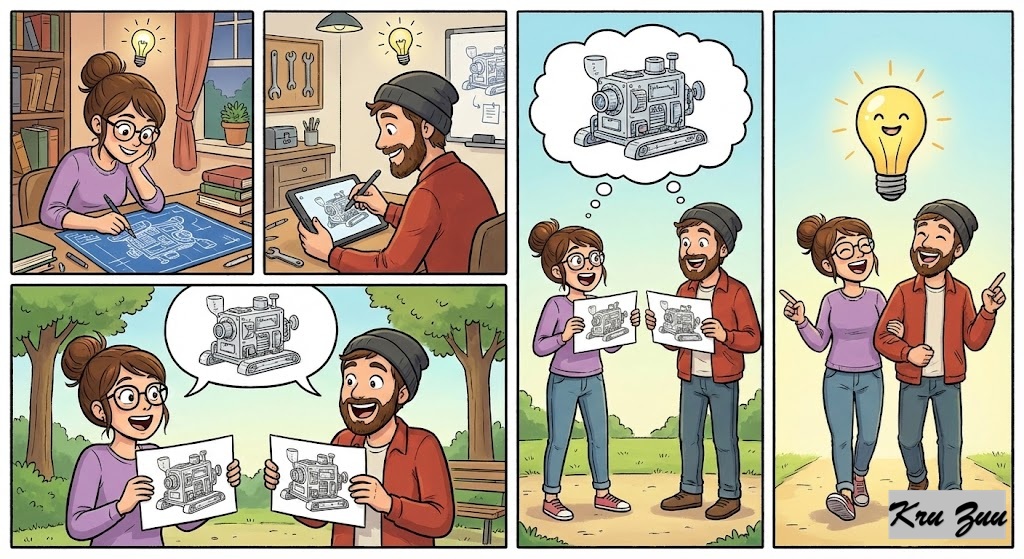
    😇 The Hero (The Synergist): You are brainstorming. A colleague blurts out the exact solution you were just thinking of. Instead of getting jealous, you smile. 😄 You point at them and say: “Great minds think alike!” You validate their intelligence, which validates yours. You realize that shared thinking isn’t copying, it’s alignment.

    The Result? Instant rapport. The other person feels smart and connected to you. You create a bond of trust (“We are on the same wavelength”). You build a tribe, not just a resume. ⚡


    ⚖️ The Reality


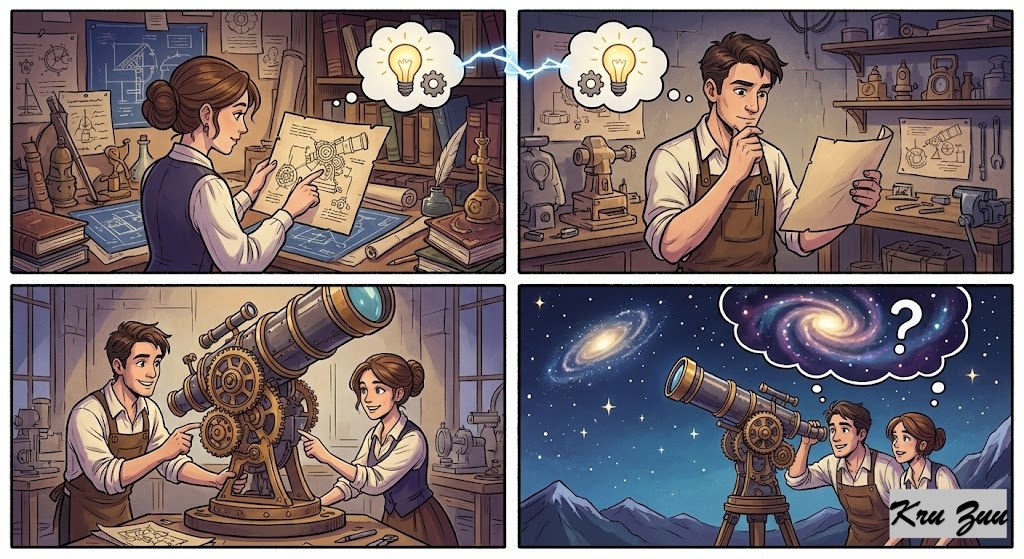
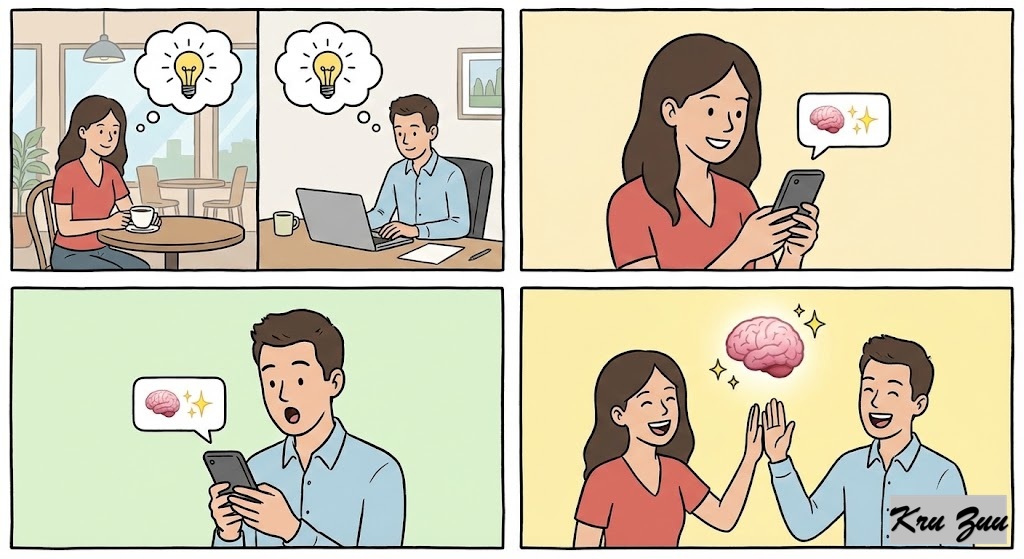
    We are social creatures. When two people arrive at the same conclusion independently, it is a powerful signal of compatibility. It means your values, logic, or instincts are aligned. It is a moment of “mental high-five.” 👋


    💎 The Secret

    Using this phrase isn’t just about being right; it is a tool to make the other person feel good. It says, “You are smart because you think like me.”

    🧐 The Anatomy of the Proverb


    This is your go-to phrase for those “Jinx!” moments.


    Great Minds (Noun Phrase): Intelligent people; thinkers; visionaries.


    Think (Verb): To process thoughts/ideas.


    Alike (Adverb):
    In a similar way; identically.


    Simpler Version: Smart people have the same ideas. / We are on the same page.


    📚 Vocabulary Vault


    Synergy (Noun):
    When the combined effect is greater than the sum of separate effects. (1+1=3). 🚀


    Telepathy (Noun): The supposed communication of thoughts by means other than the known senses. (e.g., “It’s like we have telepathy!”).


    Validation (Noun): Recognition or affirmation that a person’s feelings or opinions are valid or worthwhile.


    Coincidence (Noun): A remarkable concurrence of events or circumstances without apparent causal connection.


    Wavelength (Noun):Idiom: “To be on the same wavelength” (To think similarly). 📻

    📜 History: Origin and The Twist


    Where did this compliment come from?


    The Origin: The idea has been around since the early 1600s. The original recorded phrase in English was “Great wits jump” (meaning “jump to the same conclusion”). It evolved into “Great minds think alike” over time.


    The Twist (The Humorous Truth): Did you know this idiom has a second half that is often left out? The full phrase is historically known as:”Great minds think alike, though fools seldom differ.”


    Translation: Smart people might have the same idea, but stupid people also follow the crowd! Note: We usually only use the first half (the polite half) in business and friendship! 😉

    🎯 Impact on Life: The Pros & Cons


    ✅ The Pros (The Bond)


    Speed:
    You don’t have to explain yourself. The other person already “gets it.”


    Confidence: Knowing someone supports your idea makes you more likely to succeed.


    ❌ The Cons (The Echo Chamber)


    Groupthink:
    If everyone thinks alike, no one is spotting the mistakes. Sometimes you need a “Great Mind” who thinks differently to challenge you.

    🎭 Short Story: The Mystery of the Locked Box 📦


    Let’s visit the magical forest to see how mental connection works.


    🌟 The Cast


    Cleo the Cat: Elegant, logical, loves puzzles. 😼


    Cluck the Chicken: Impulsive, hungry, relies on gut instinct. 🐔


    Fred the Frog: The wise, green observer. 🐸


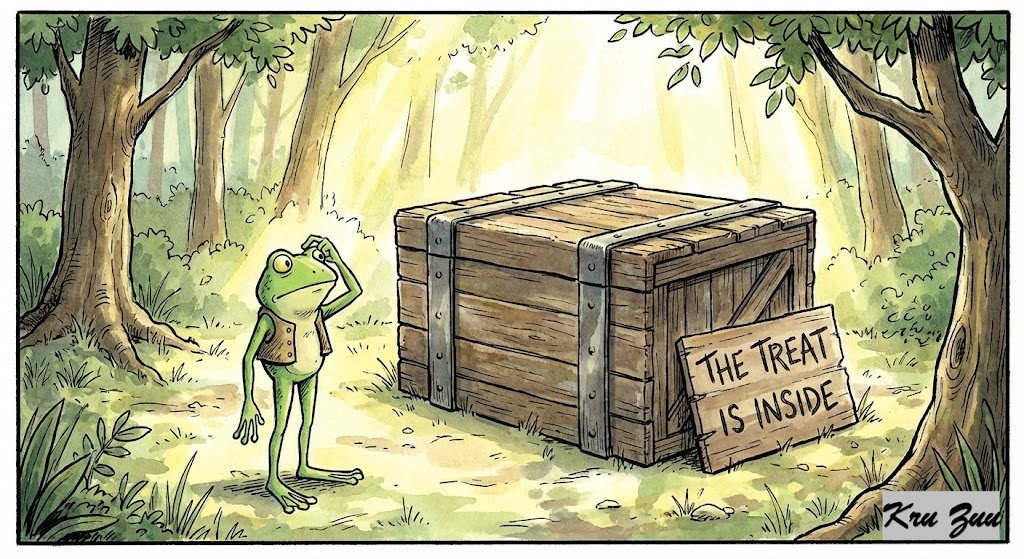
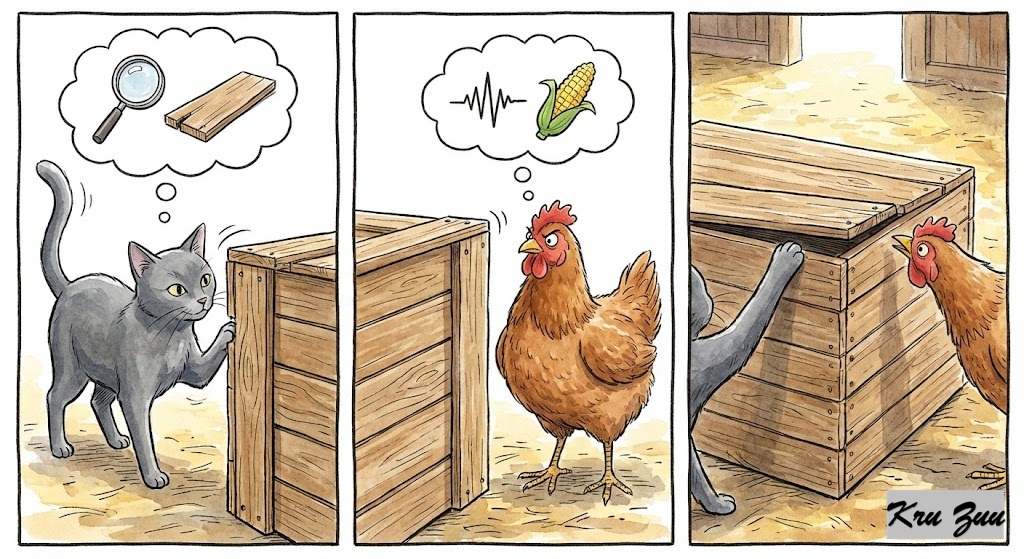
    The Situation: Fred the Frog has placed a mysterious, heavy wooden box in the middle of the clearing. It has no keyhole. It has no handle. Just a sign that says: “The treat is inside.”


    The Conflict:
    Cleo circles the box, analyzing the wood grain. She thinks hard. “The wood is loose on the top right corner. I need something thin to pry it open.” Cluck stares at the box, thinking about the corn inside. He feels a vibration. “The top right corner looks weak. I need something flat to poke it.”


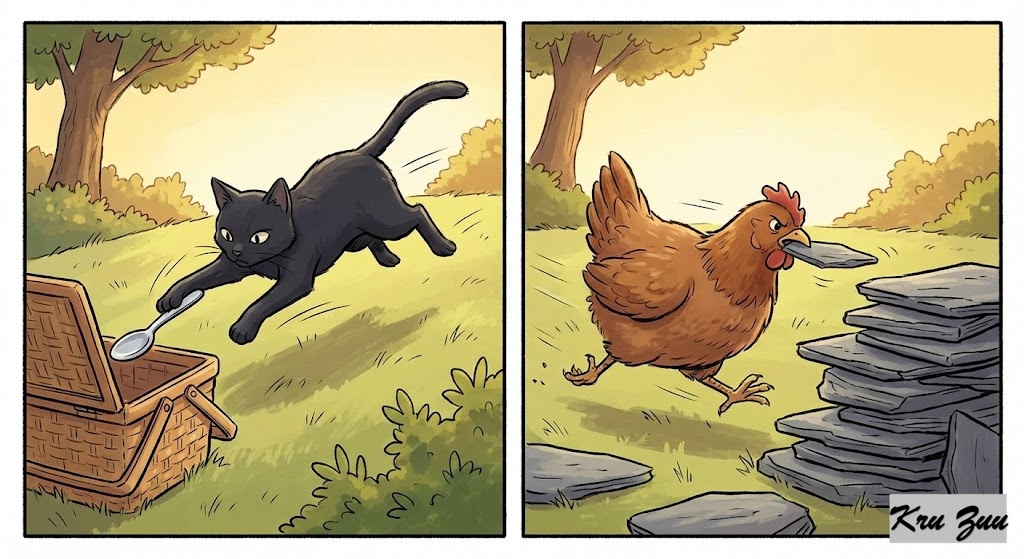
    The Climax: Without saying a word to each other… Cleo runs to the left and grabs a flat, silver spoon from a picnic basket. 🥄 Cluck runs to the right and grabs a flat, loose slate of rock. 🪨


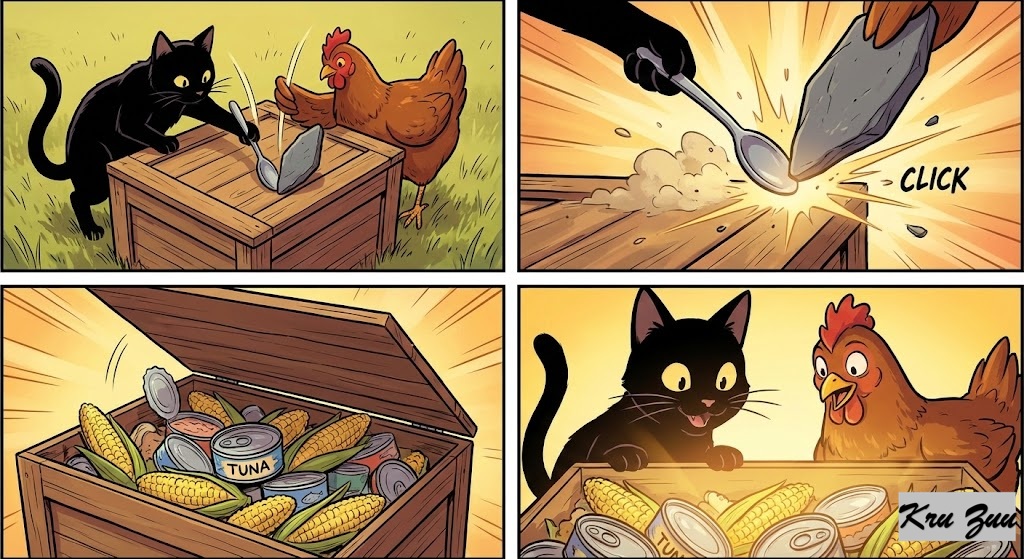
    They both run back to the box and jam their tools into the exact same spot (the top right corner) at the exact same time. Click! The box pops open. It is filled with tuna and corn!


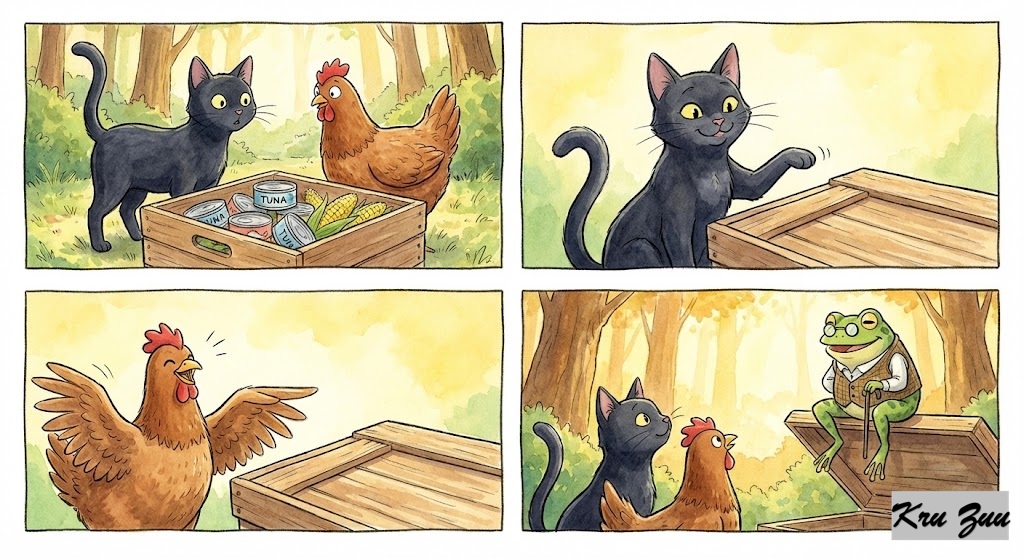
    The Resolution: They look at each other, shocked. Cleo smiles, her tail twitching. “I was going for the leverage point.” Cluck laughs. “I just knew that was the weak spot!” Fred the Frog hops onto the open lid. He adjusts his tiny glasses. “Ribbit,” Fred says. “Different species, different styles, but the same solution. Great minds think alike.”


    The Moral: You don’t have to be identical to be compatible. When you find someone who solves problems the way you do, hold onto them. That is your teammate.

    🎓 Lesson for English Learners


    Context is Key.


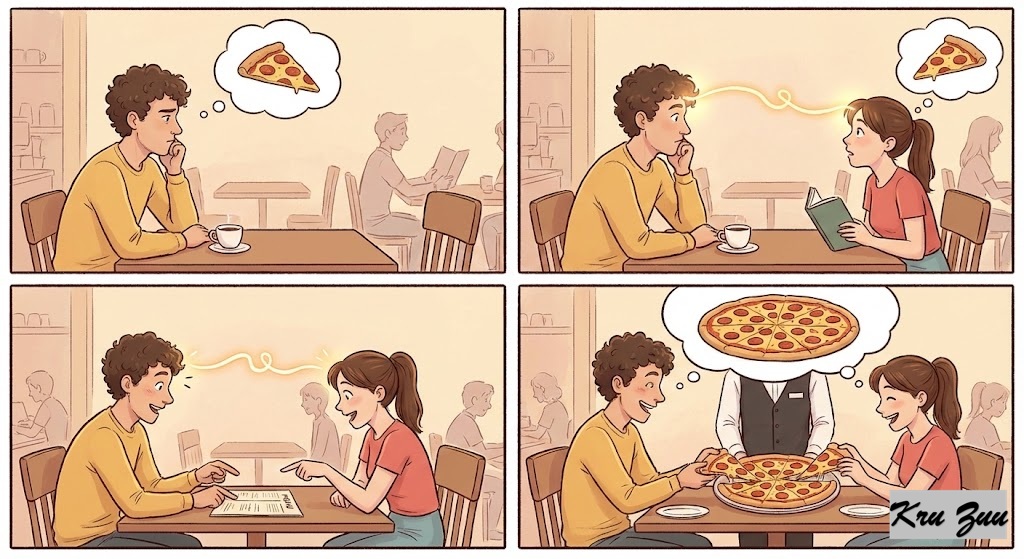
    Situation: You and your friend both reach for the last slice of pizza at the same time.


    You Say: “Great minds think alike!” (This is funny/playful).


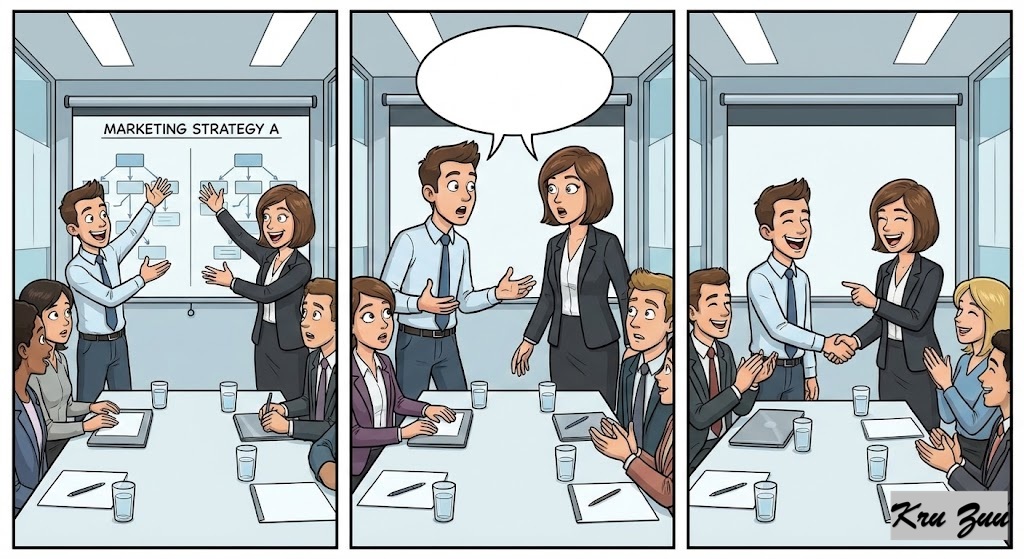
    Situation: You and your boss both suggest the same marketing strategy in a meeting.


    You Say: “Great minds think alike!” (This is complimentary and builds a professional bond).


    💬 Your Turn: The Connection Challenge 🚀


    Is there someone in your life (a partner, a best friend, a coworker) who often finishes your sentences?


    The Challenge:
    The next time this happens, the next time you both say the same thing or text each other at the same moment, do not ignore it.

    The Action: Immediately send them a message or say: “Great minds think alike! 🧠✨”


    Celebrate the connection. It turns a coincidence into a relationship builder.


    👇 Question for the comments: Who is your “Mind Twin”? Tag the person who always seems to know what you are thinking!

  • ⏳ The Daily Shield: The Law of Patience -1

    ⏳ The Daily Shield: The Law of Patience -1

    “Haste makes waste.”


    😈 The Villain (The Speed Demon)


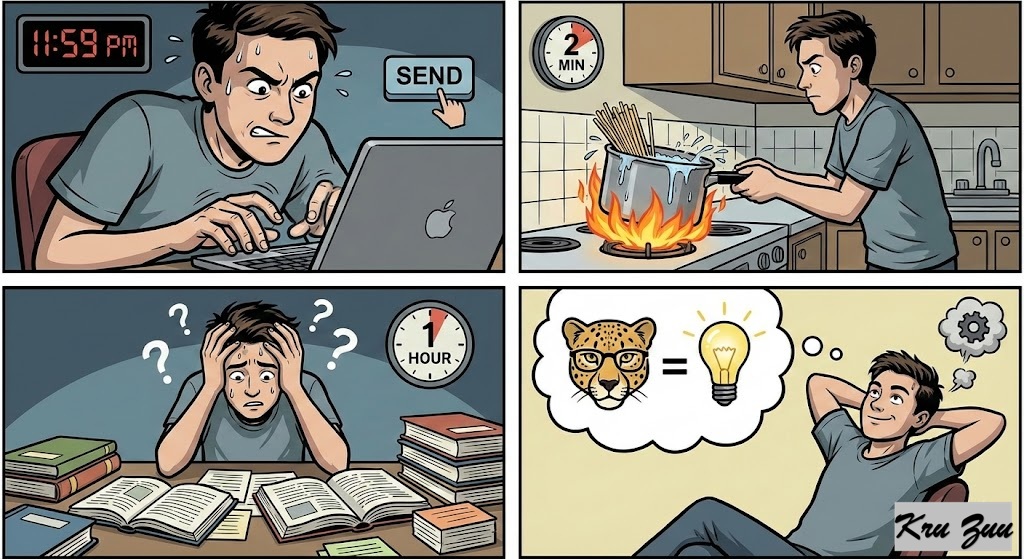
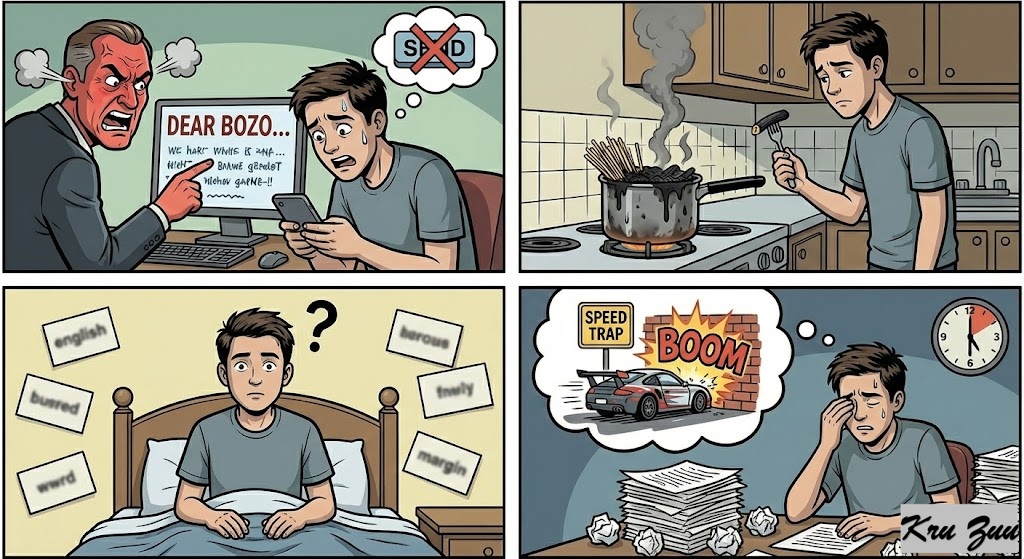
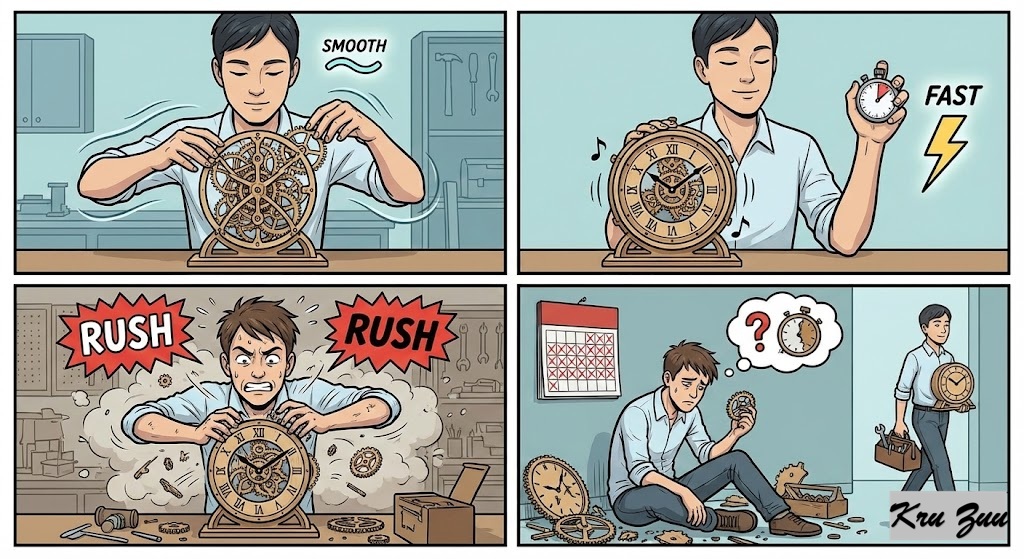
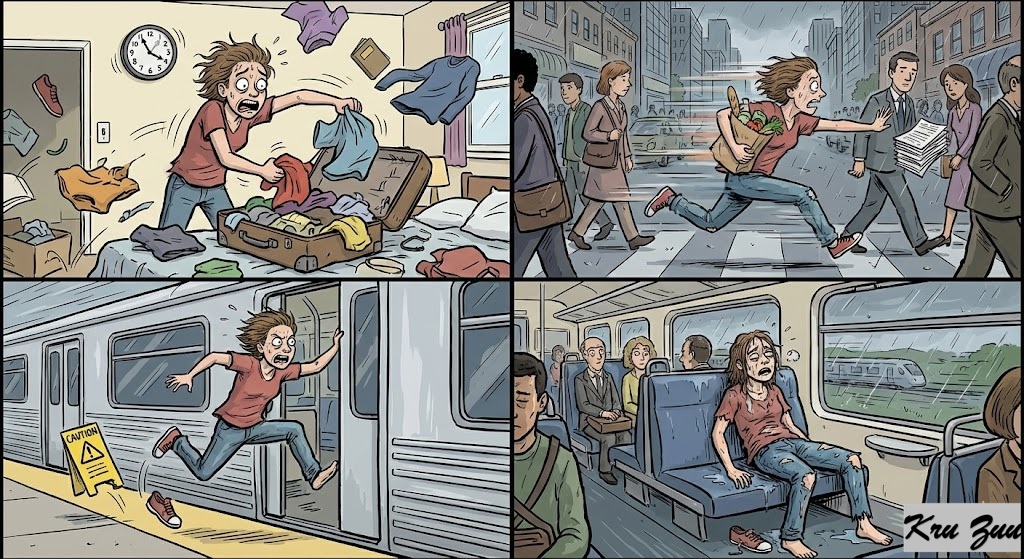
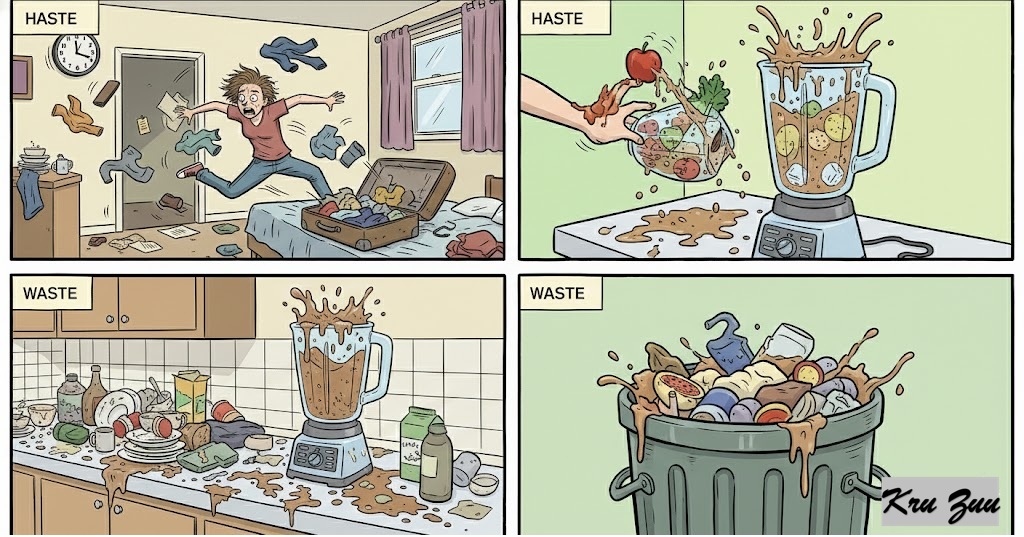
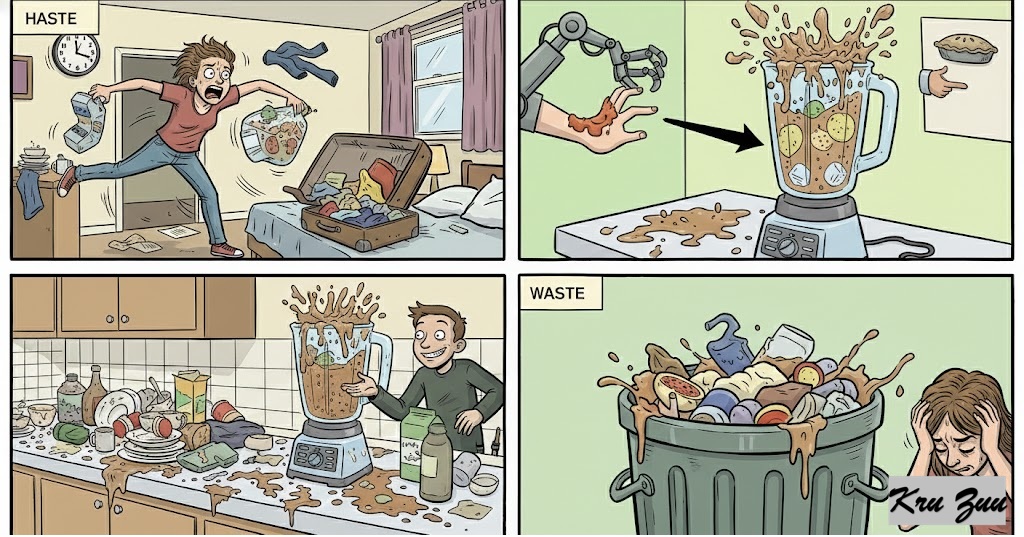
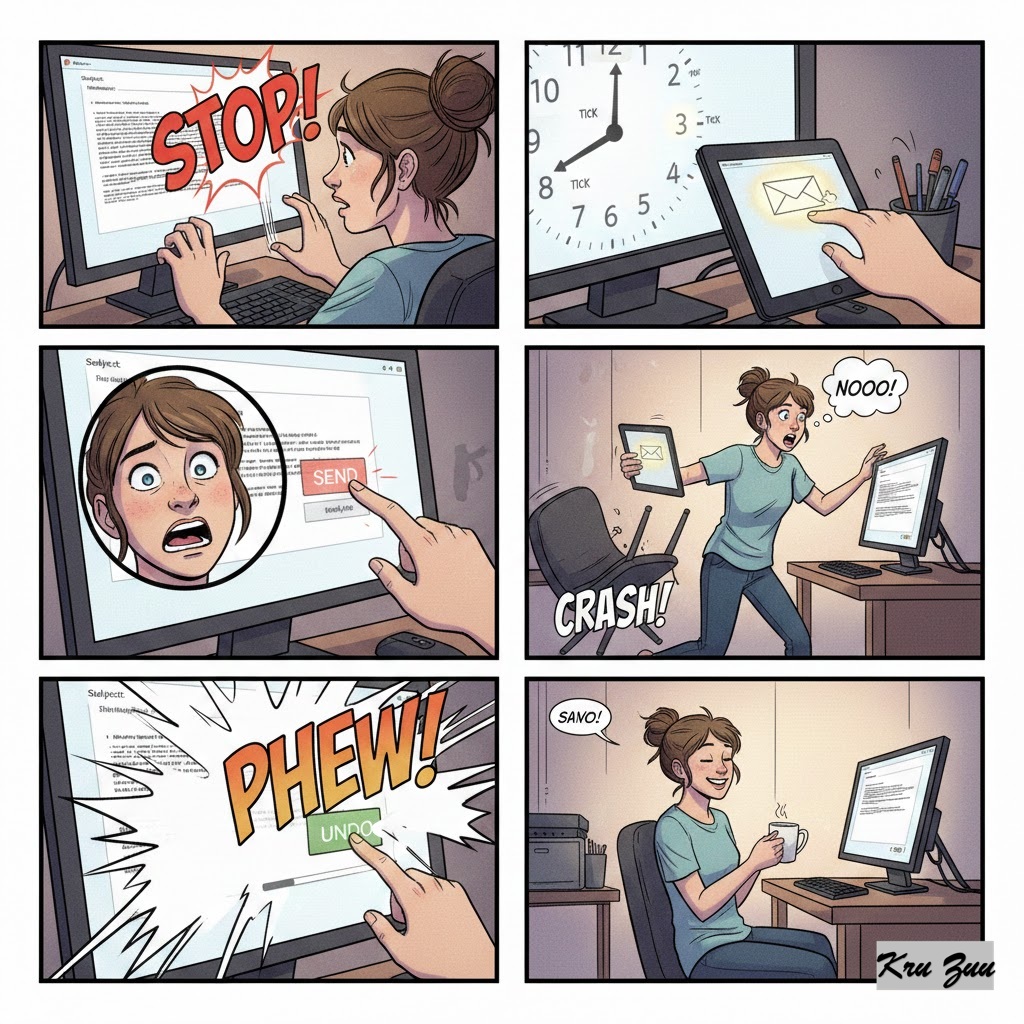
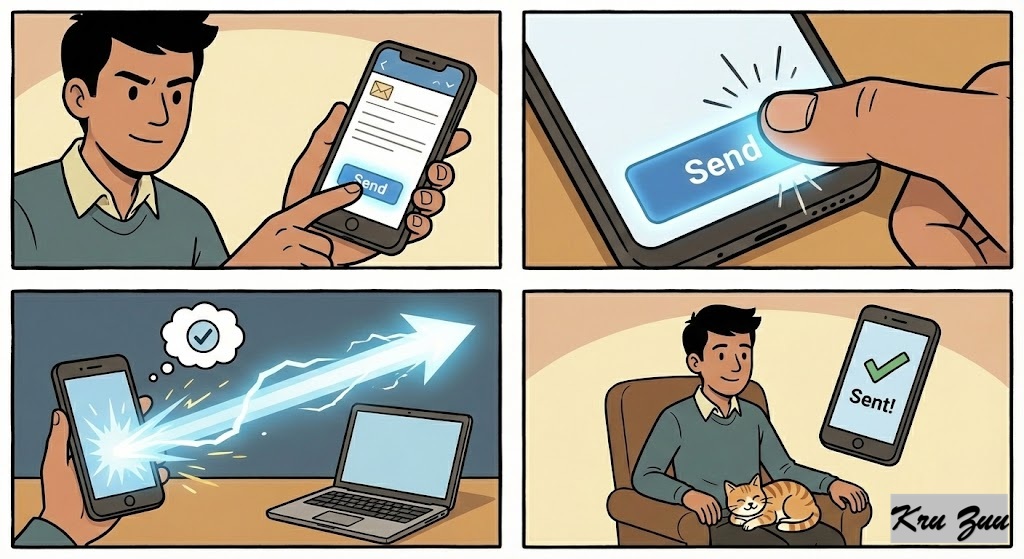
    You have a goal. You want it now. You type the email without proofreading and hit send. You cook the pasta on maximum heat to save 2 minutes. You try to learn 100 English words in one hour. You convince yourself that “Fast” equals “Smart.”

    The Result? The email has a typo that insults your boss. The pasta is burnt on the outside and crunchy on the inside. You remember zero vocabulary words the next day. You have to fix everything. You actually spend double the time correcting your mistakes. You are a victim of the “Speed Trap.” 🏎️💥


    😇 The Hero (The Architect)


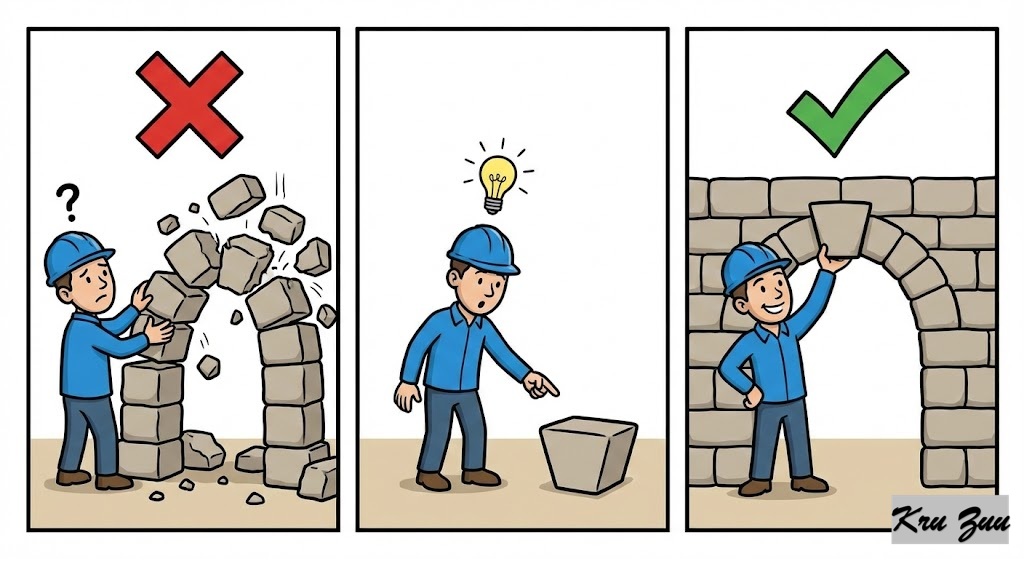
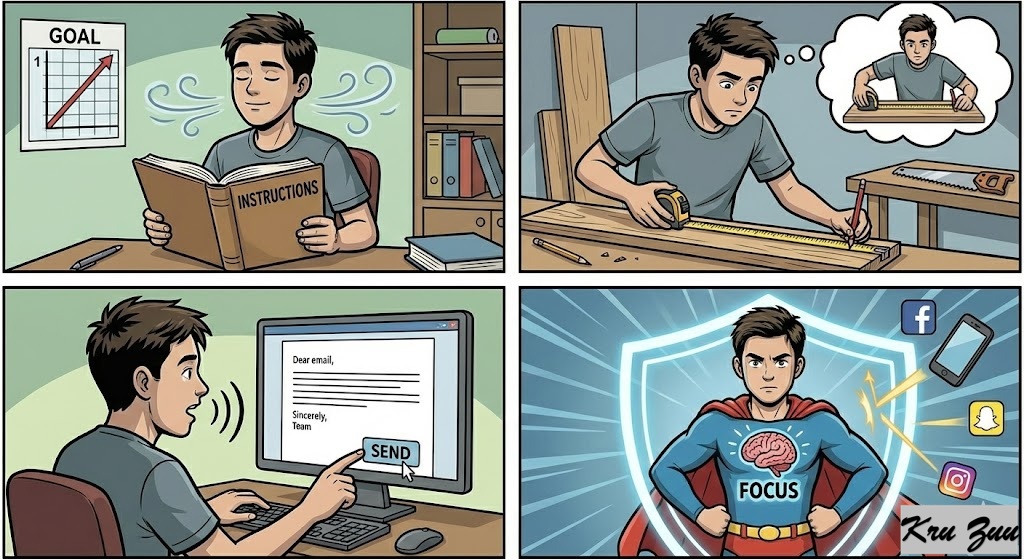
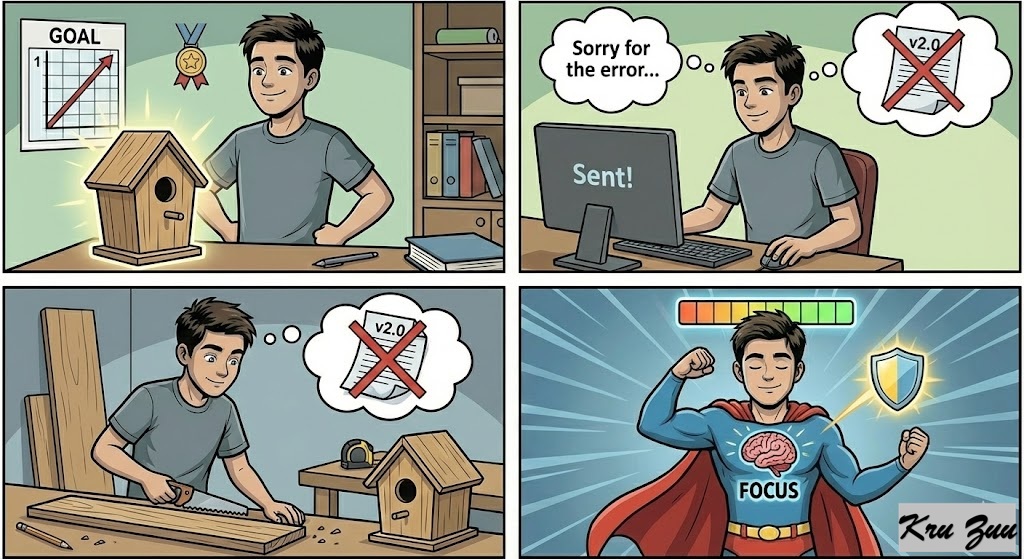
    You have a goal. You take a deep breath. You read the instructions first. You measure twice, cut once. You write the email, pause, read it aloud, and then click send. You treat focus as your superpower.

    The Result? The work is flawless. There are no apologies to make. No “Version 2.0” is needed. You finish with energy to spare because you didn’t panic. You are slow, but you are smooth. 🛡️


    ⚖️ The Reality


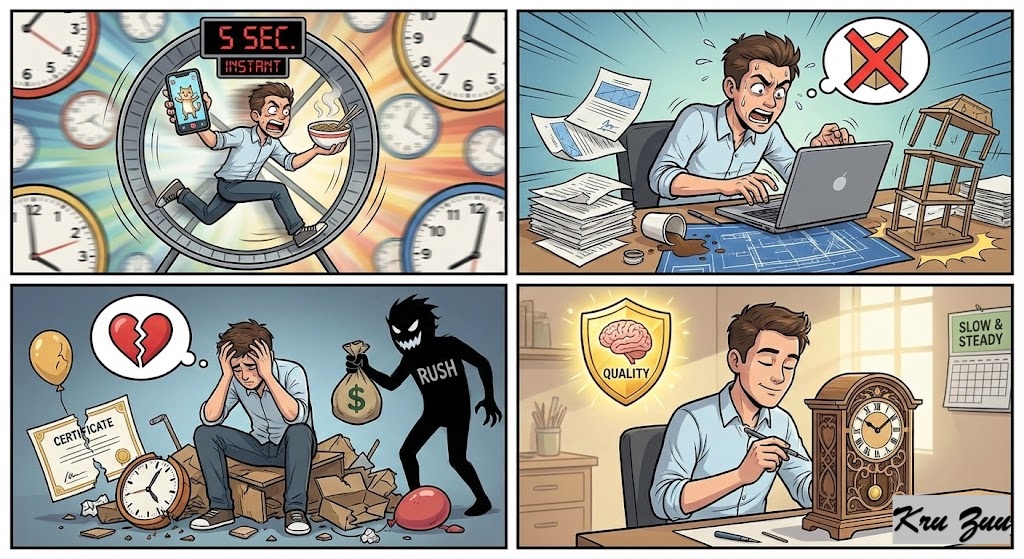
    Speed is a liar. We live in a world of 5-second TikToks and instant noodles. We think if we aren’t running, we are losing. But in reality, rushing is the most expensive way to work. It costs you accuracy, quality, and dignity.


    💎 The Secret

    Slow is smooth, and smooth is fast. If you don’t have time to do it right, when will you have time to do it over?

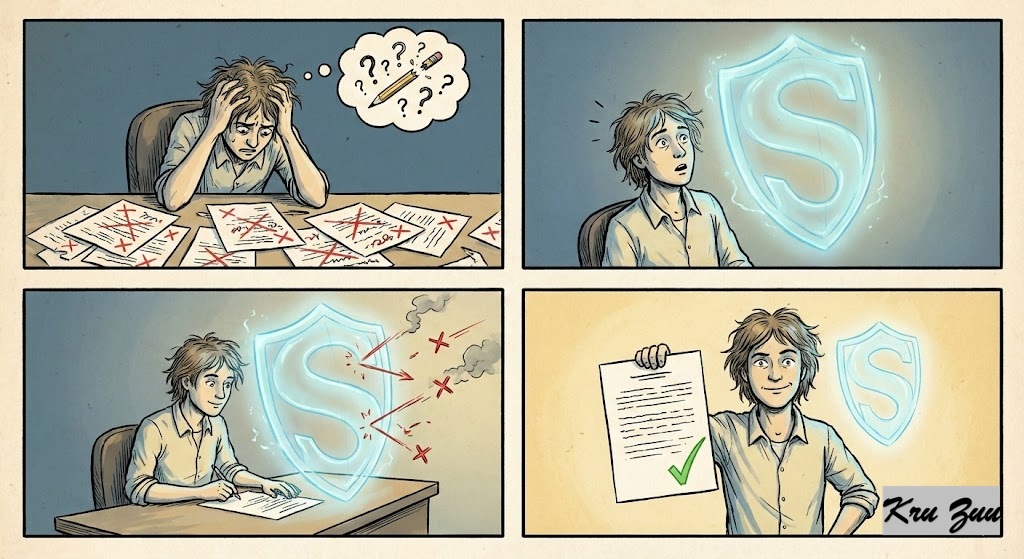
    🧐 The Anatomy of the Proverb


    This is your shield against sloppy mistakes.


    Haste (Noun): Excessive speed or urgency of movement or action; hurry. (The bad kind of fast). 🌪️


    Makes (Verb): Causes to happen.


    Waste (Noun): Material that is not wanted; the act of using something carelessly. 🗑️


    Simpler Version: If you rush, you will ruin it.


    📚 Vocabulary Vault


    Efficient (Adjective): Achieving maximum productivity with minimum wasted effort. (The goal!) 🎯


    Sloppy (Adjective): Careless and unsystematic; messy.


    Thorough (Adjective): Complete with regard to every detail; not superficial.


    Correction (Noun): The action of setting right what is wrong.


    Patience (Noun): The capacity to accept or tolerate delay without getting angry. 🧘


    🧠 Grammar Focus: The Rhyme & Cause


    Why do we remember this phrase? Because it rhymes!


    Haste / Waste: The sound /eɪst/ connects the cause (Haste) directly to the bad result (Waste).


    Cause and Effect


    Subject: Haste


    Verb: Makes


    Object: Waste


    Note: It treats “Haste” as an uncountable abstract noun (singular).

    📜 History: Origin and Spread


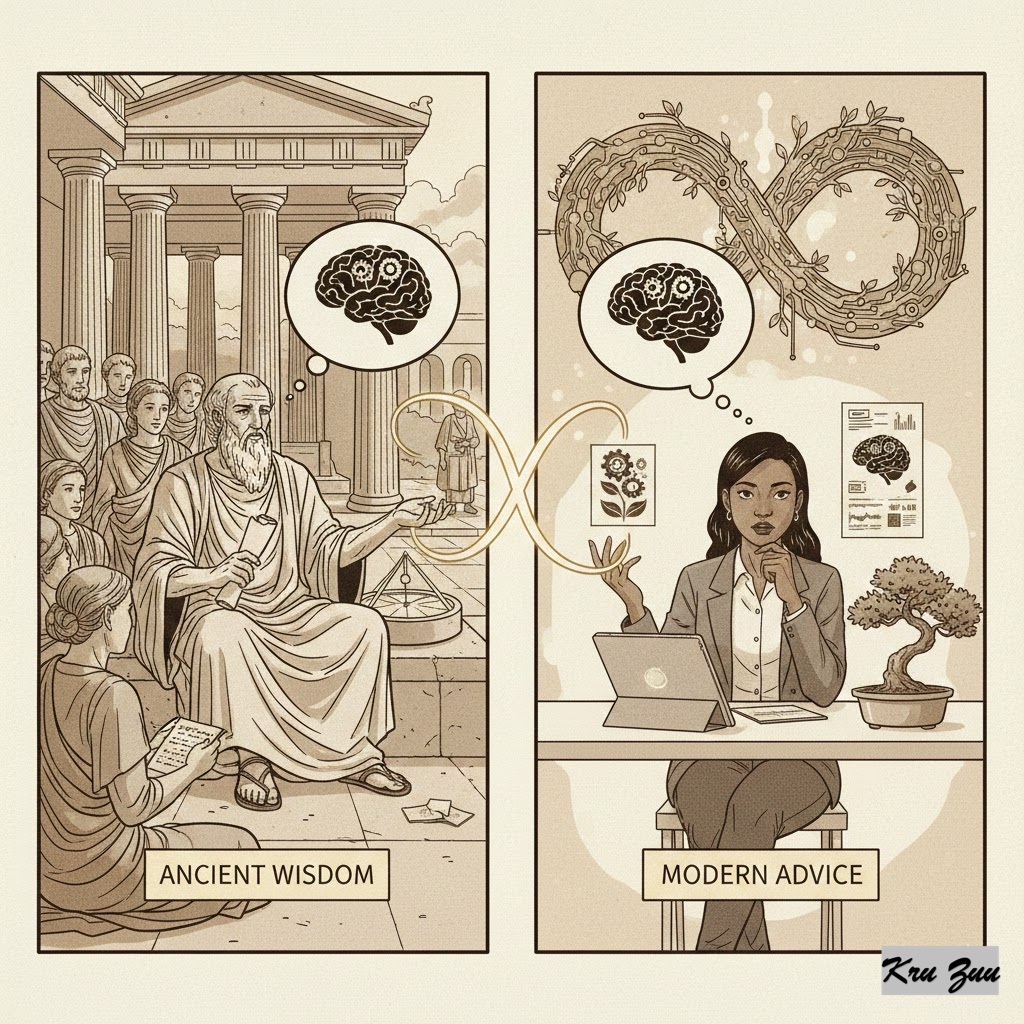
    This isn’t just modern advice; it is ancient wisdom.


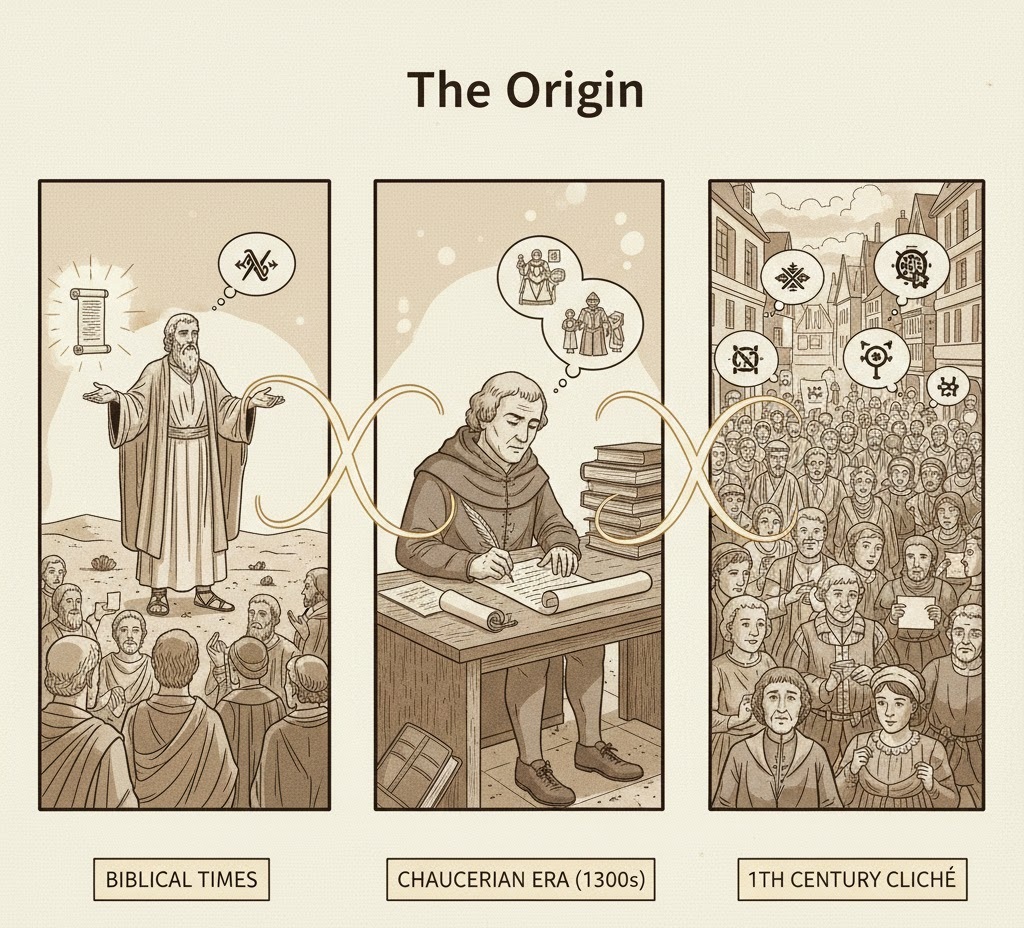
    The Origin: This concept appears in the Bible and the works of Chaucer (1300s), but became a “cliché” in the 16th century.


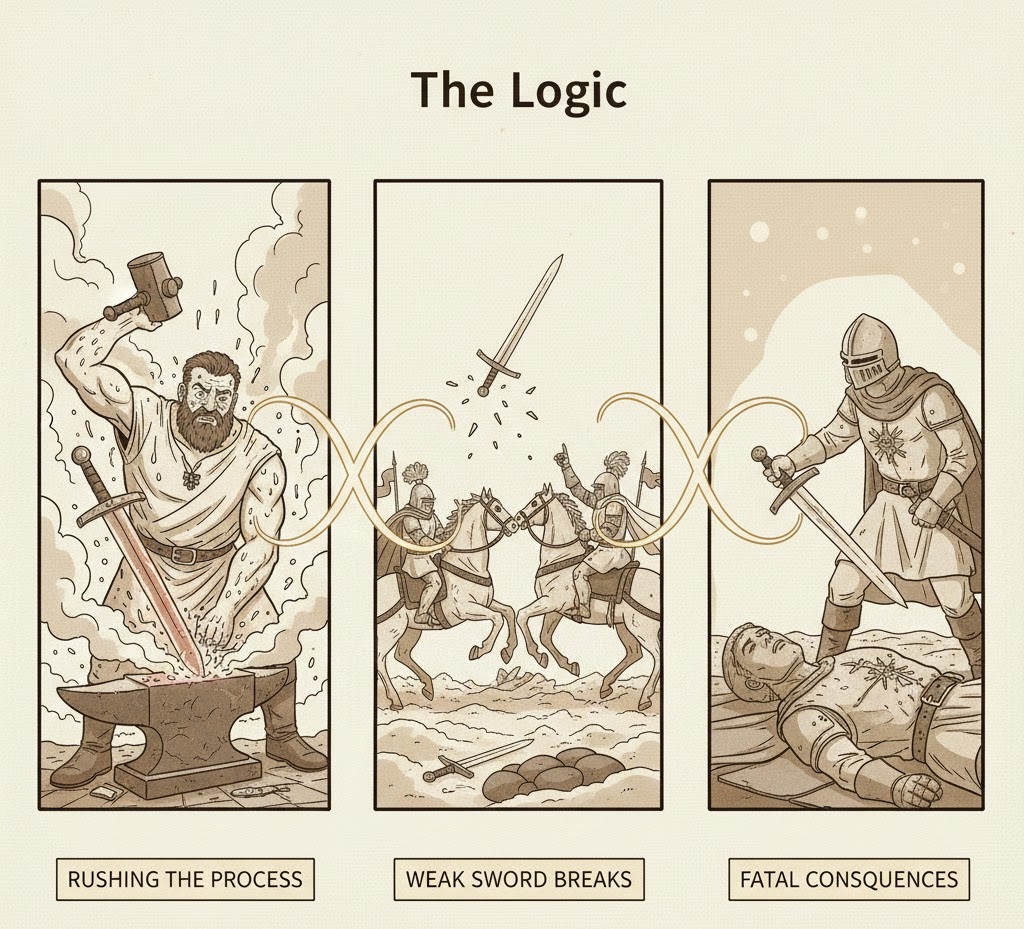
    The Logic: In the old days, if a blacksmith rushed making a sword, the sword would break in battle. Rushing could literally kill you.


    Global Cousins


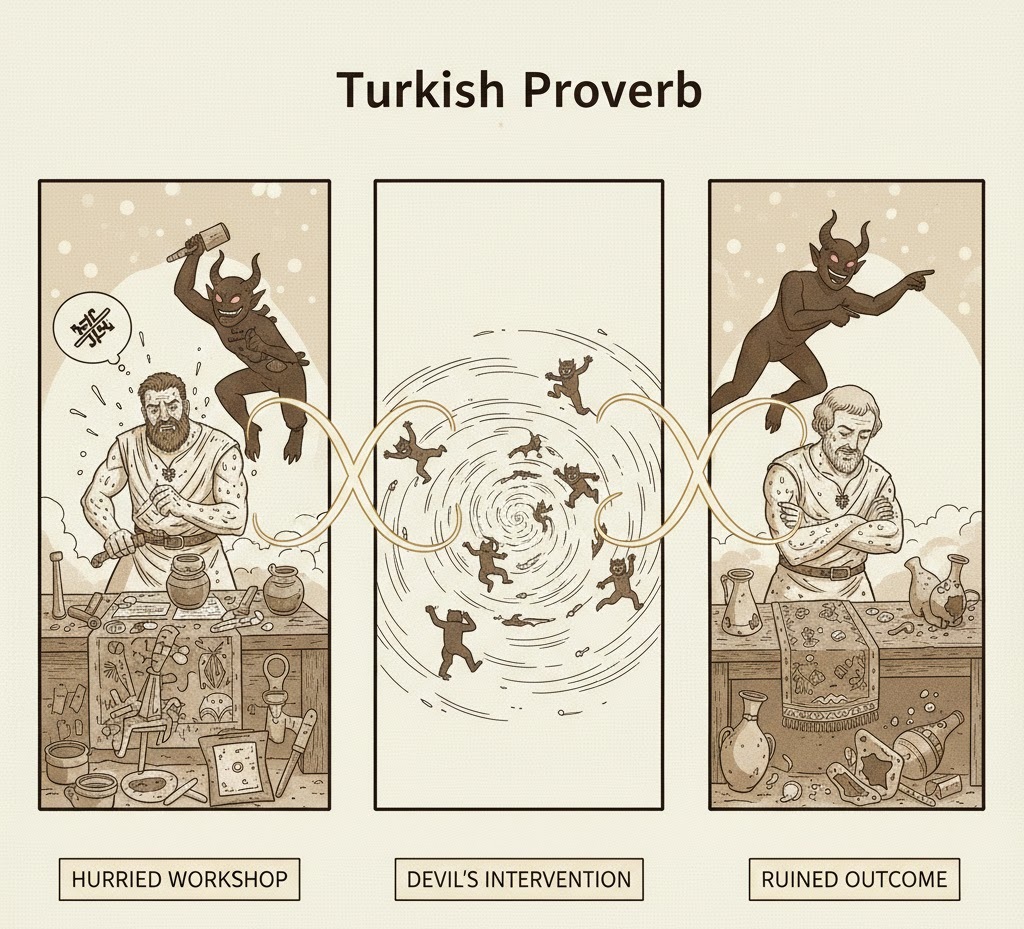
    🇹🇷 Turkish:“Acele işe şeytan karışır.” (The devil mixes in with hurried work.) — A powerful warning!


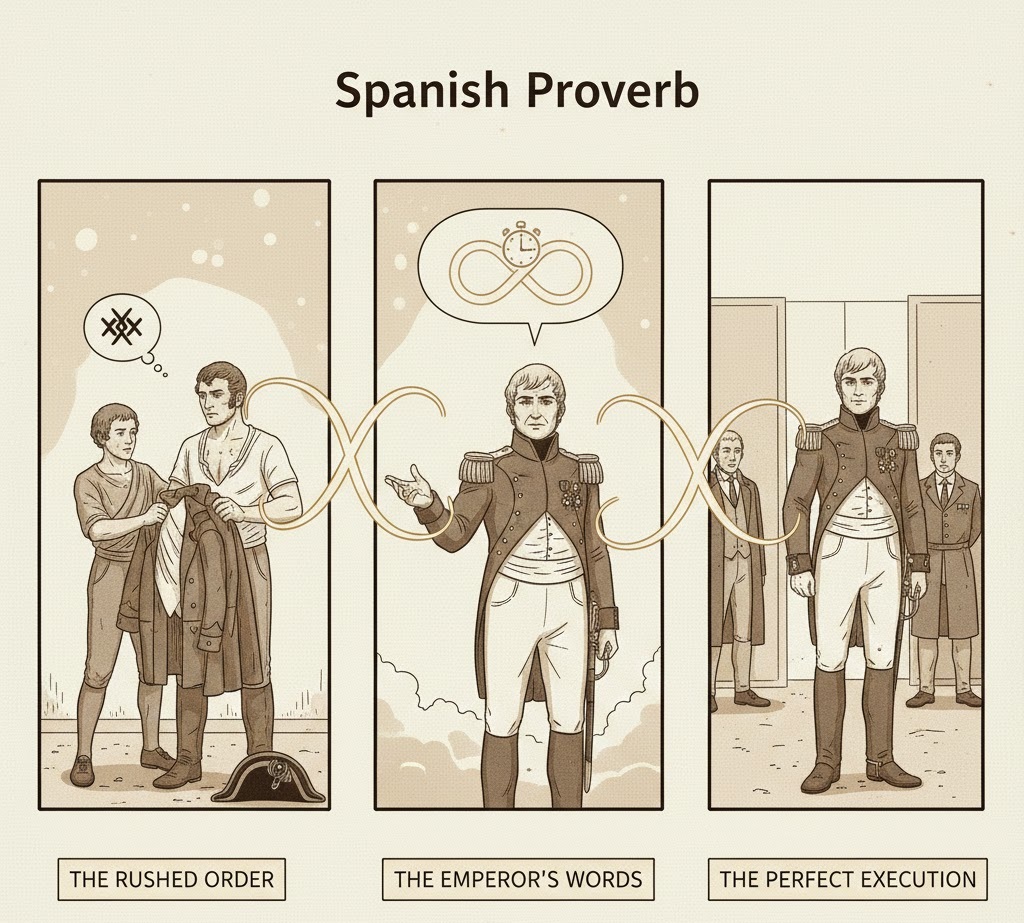
    🇪🇸 Spanish:“Vísteme despacio que tengo prisa.” (Dress me slowly, for I am in a rush.) — Attributed to Napoleon; implying that because time is short, we cannot afford a mistake.


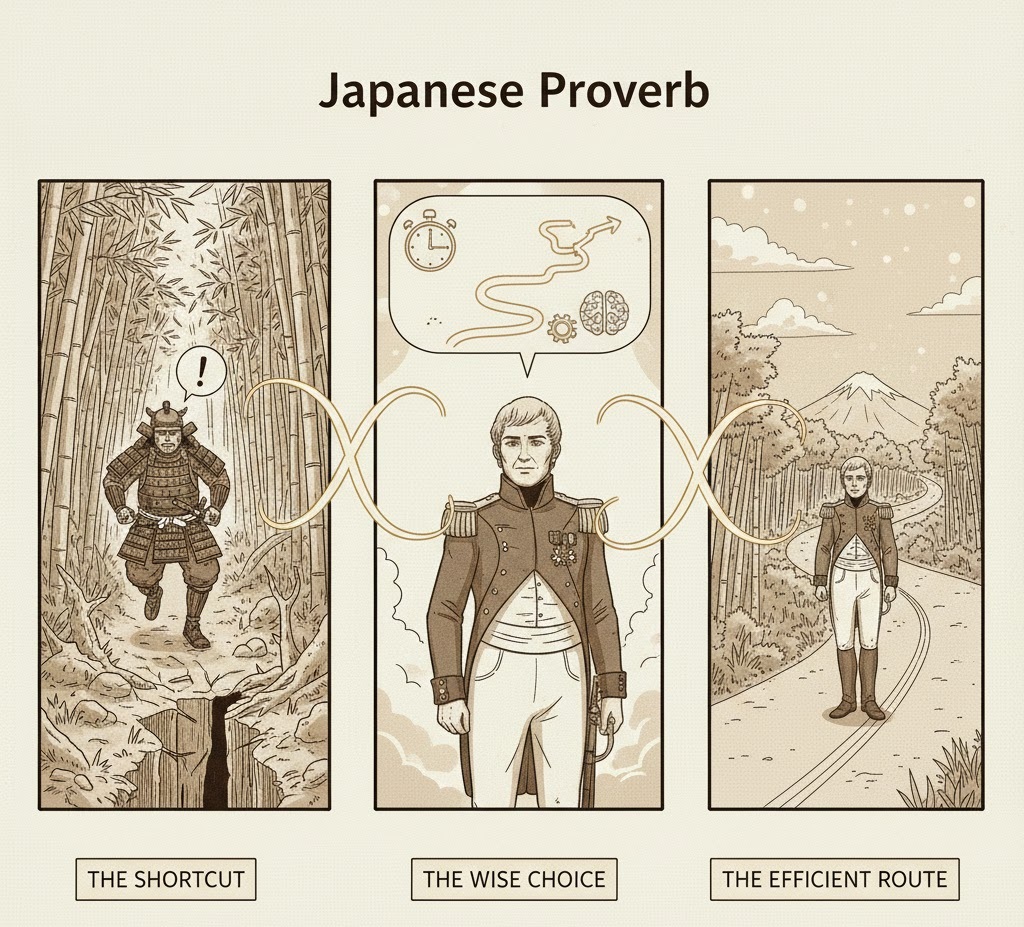
    🇯🇵 Japanese:“Isogaba maware.” (If you are in a rush, go the long way around.)

    🎯 Impact on Life: The Pros & Cons


    ✅ The Pros (The Masterpiece)


    Reputation: People trust you because your work is always correct.


    Calm: You avoid the adrenaline spike of “panic fixing.”


    ❌ The Cons (The Perfectionism Trap)


    Analysis Paralysis:
    Don’t be so slow that you never finish. The goal is “No Mistakes,” not “Forever.”

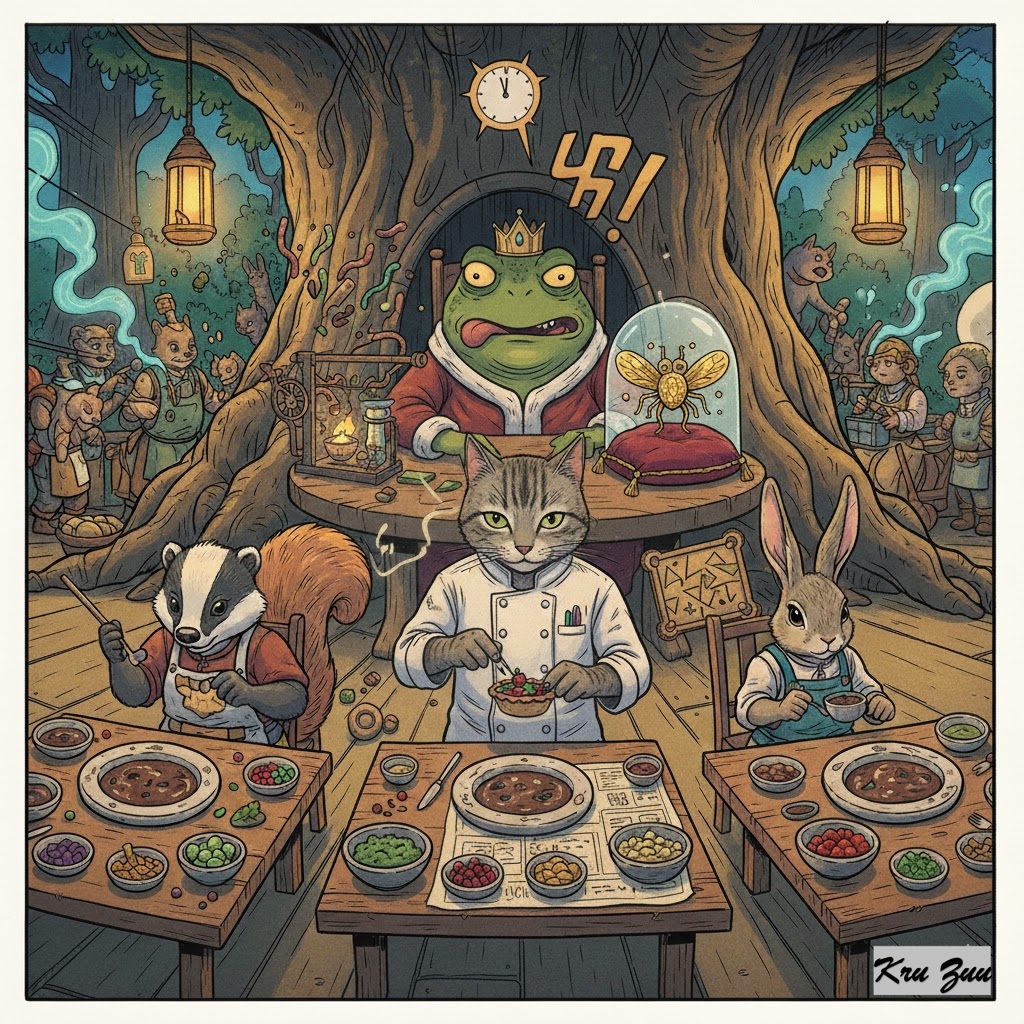
    🎭 Short Story: The Forest Chef Competition


    Let’s visit the Great Forest Kitchen.


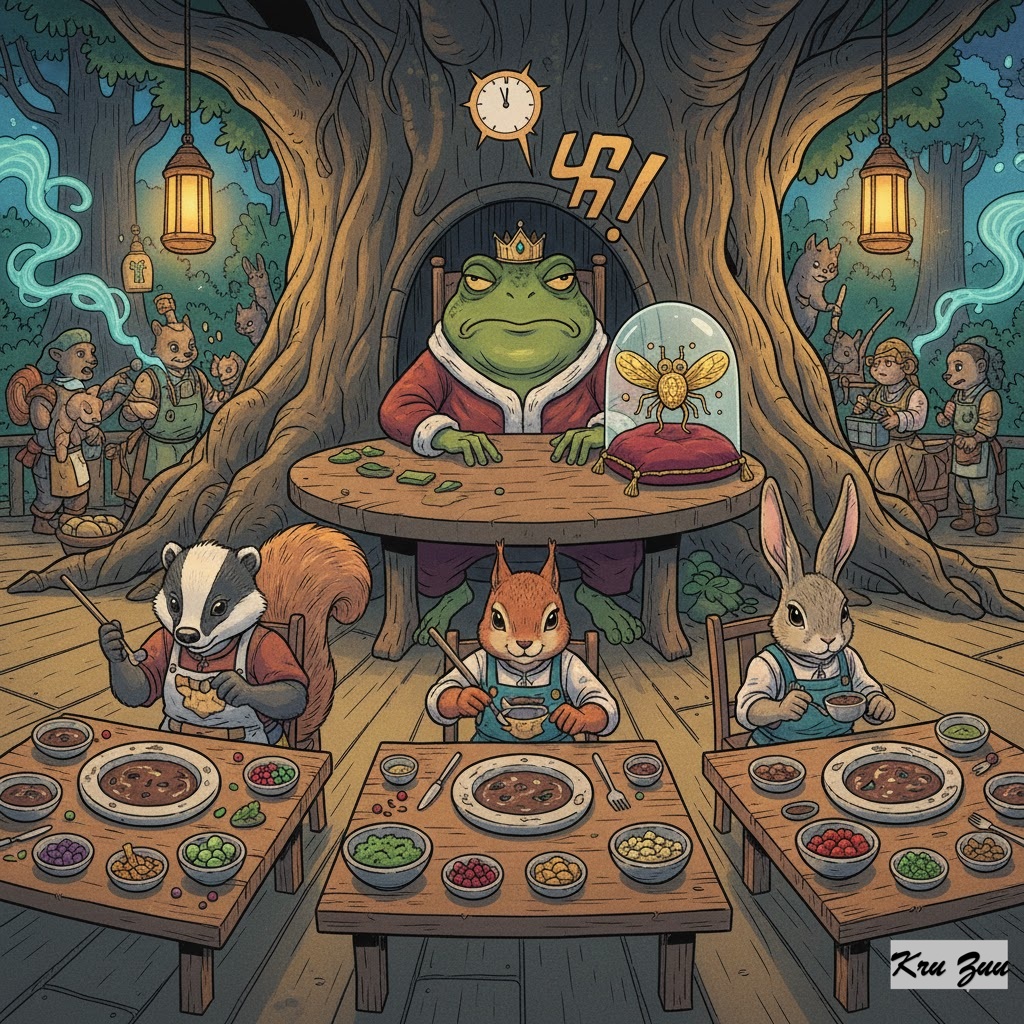
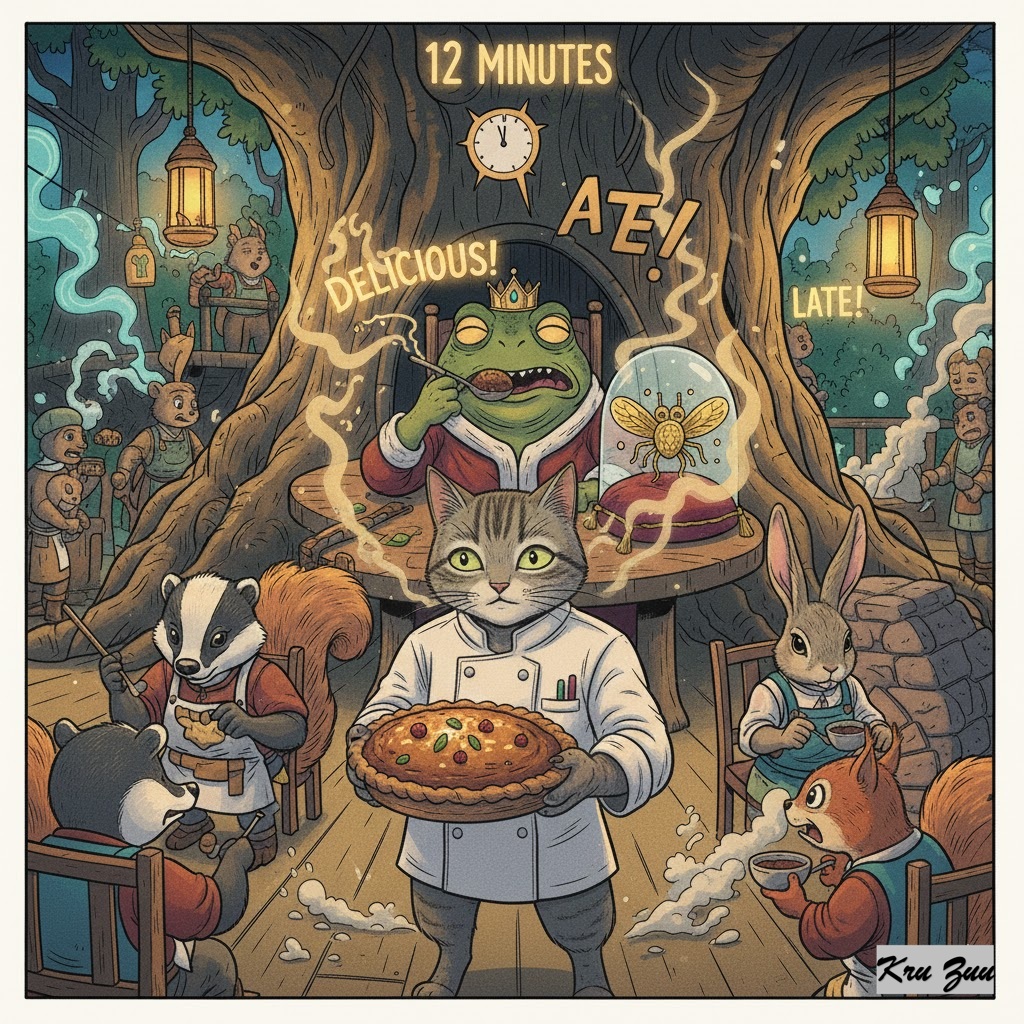
    🌟 The Setup: There is a contest to bake the perfect Mud Pie. The prize is a Golden Fly. The Judge is Mr. Frog 🐸. He is hungry and impatient. “I want my pie in 10 minutes!” he croaks.


    The Competitors


    Chico the Chicken 🐔 (The Rusher)


    Luna the Cat 🐱 (The Planner)


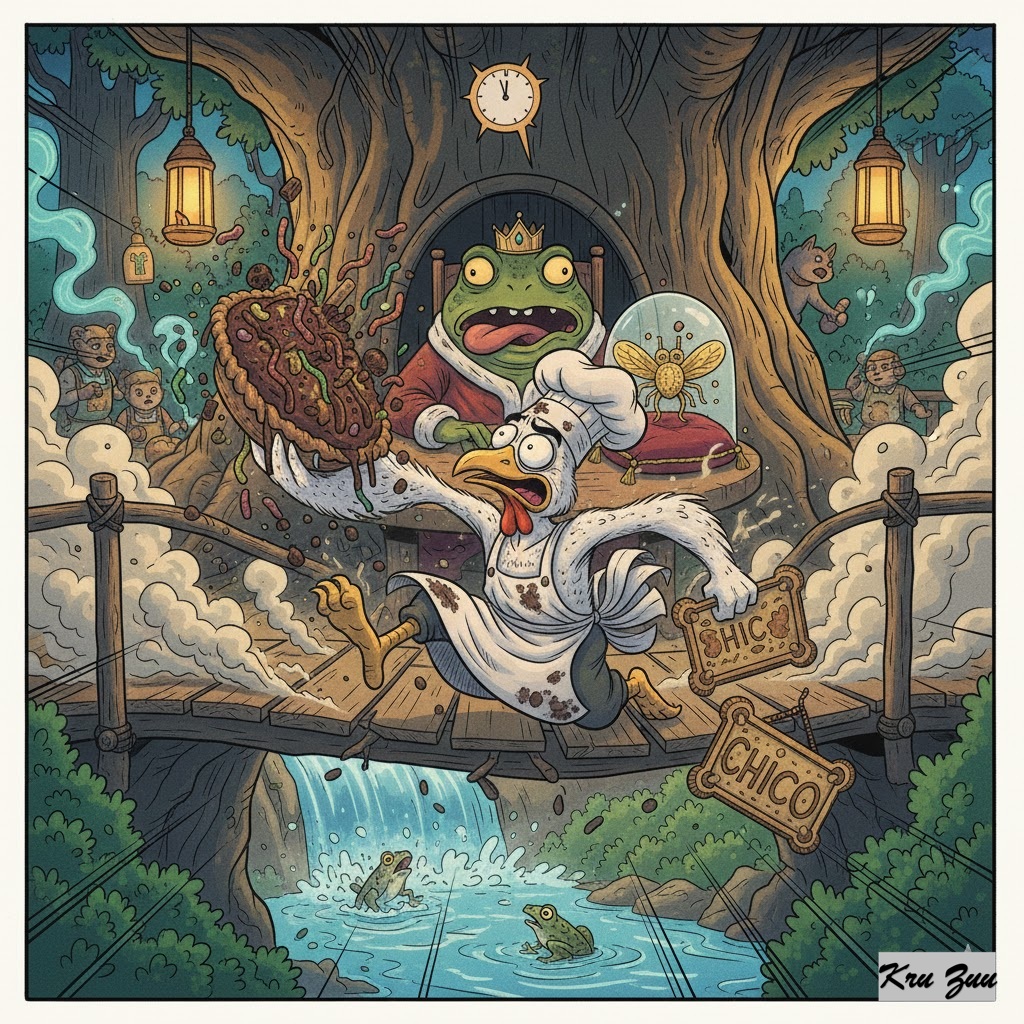
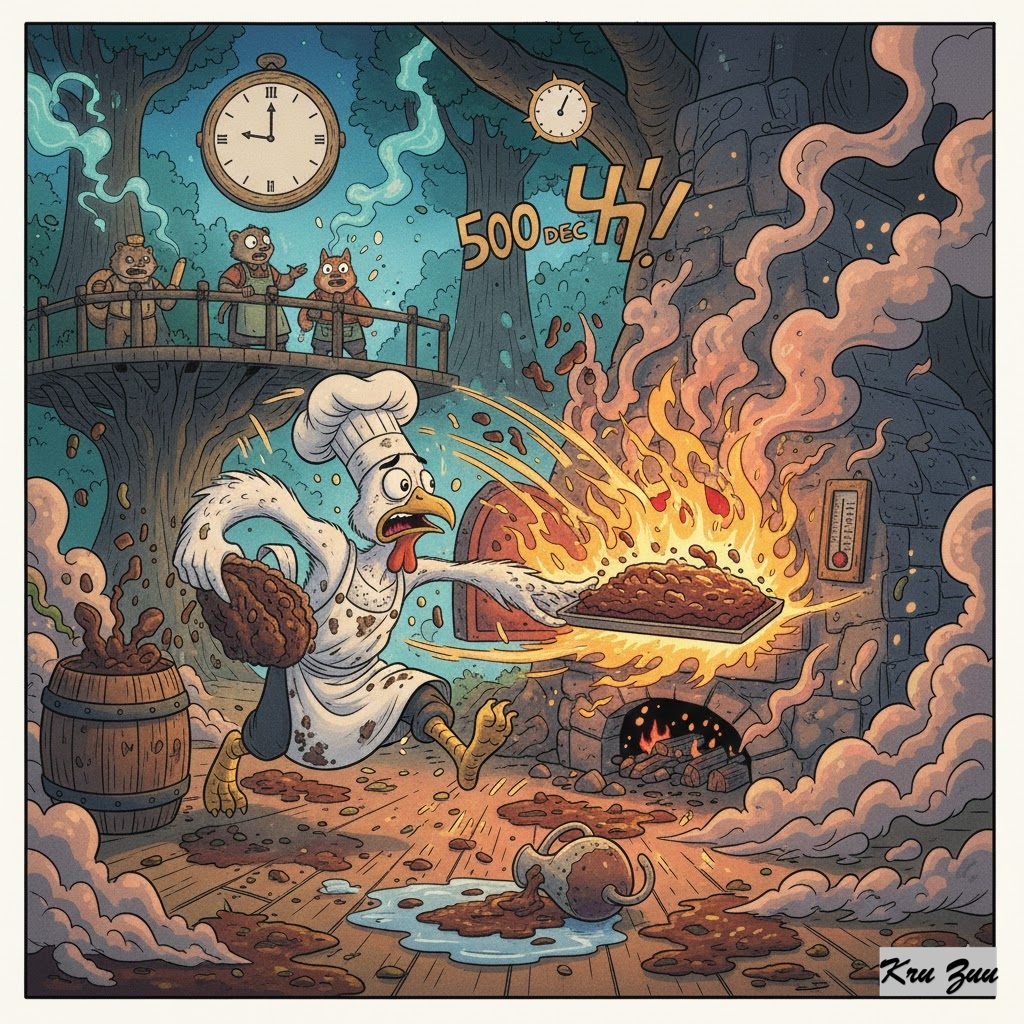
    The Conflict: Chico the Chicken panics. “10 minutes?! I must fly!” He throws the mud into the bowl. He doesn’t measure the water. He turns the oven to 500 degrees to cook it faster. He flaps his wings to fan the flames. “Faster! Faster!” he clucks.


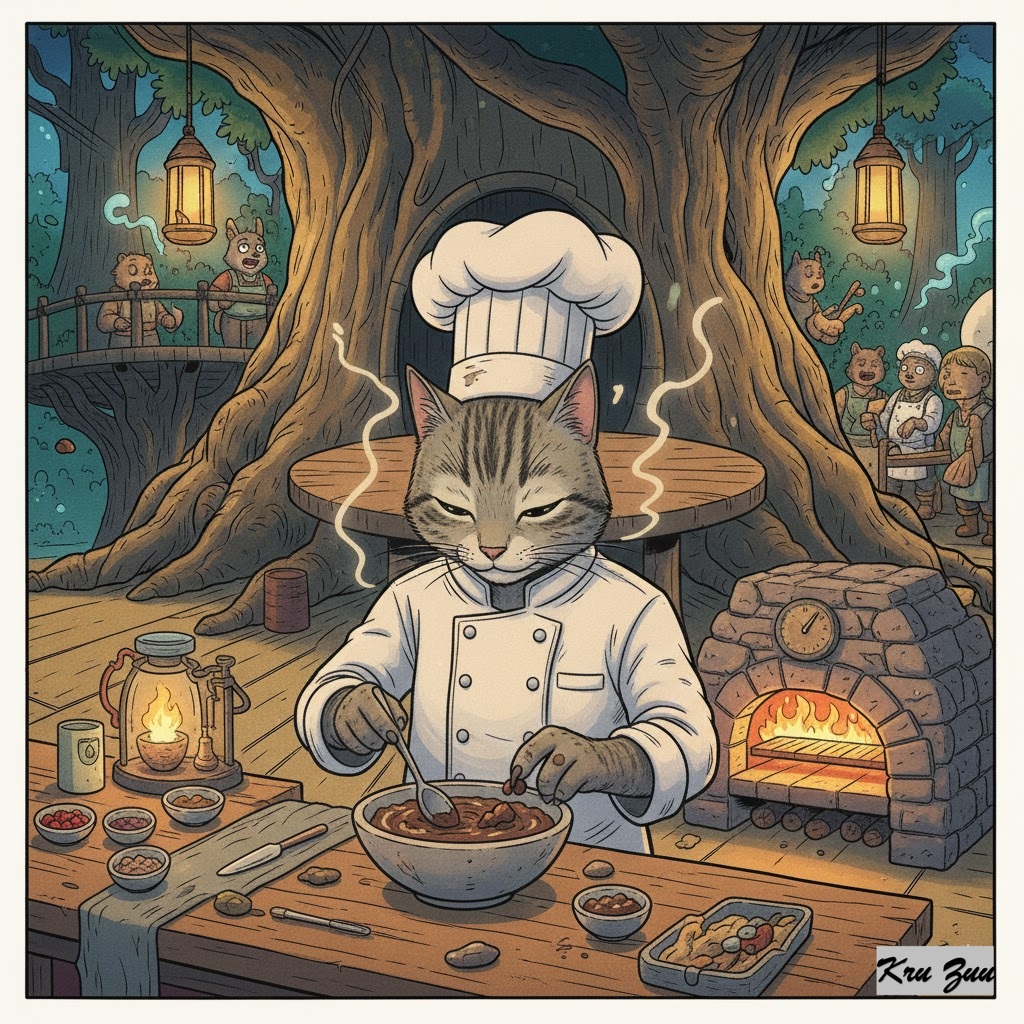
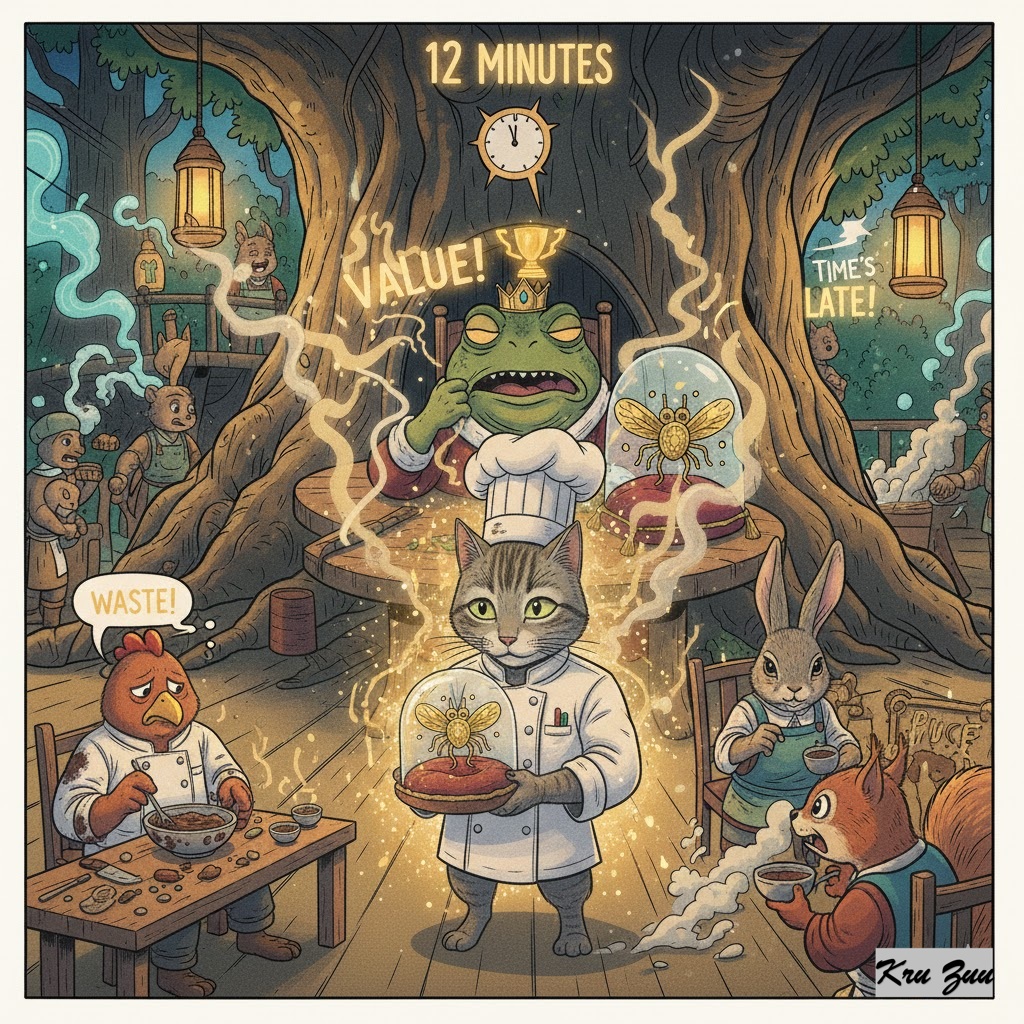
    Luna the Cat stays calm. She looks at Mr. Frog. “A good pie takes 12 minutes,” she thinks. She carefully mixes the mud. She picks out the rocks. She sets the oven to a gentle heat. She moves with grace.


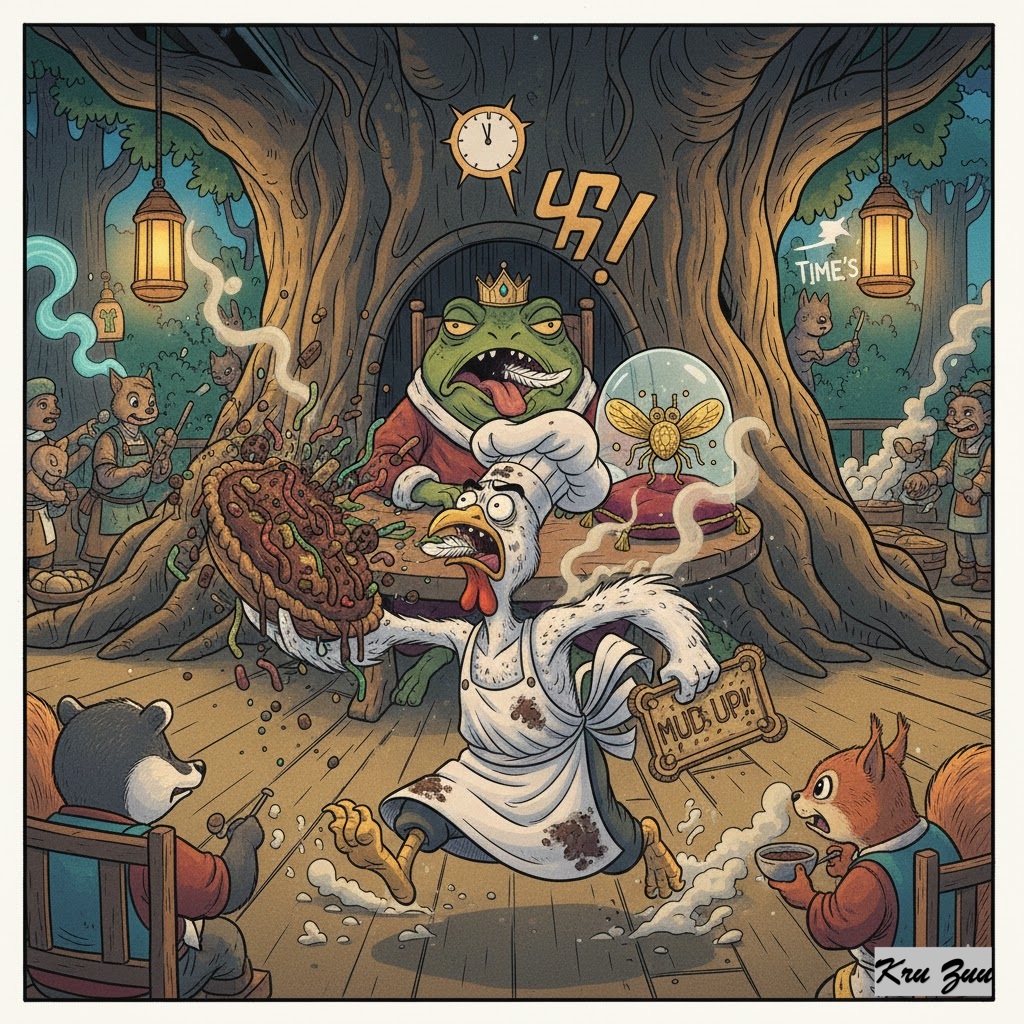
    The Climax: Mr. Frog yells, “TIME’S UP!” Chico the Chicken proudly presents his pie. It is smoking. Mr. Frog takes a bite… and spits it out! 🤮 “It is burnt on the outside and frozen on the inside! And… is this a feather in my pie?!”


    Luna the Cat presents her pie 2 minutes late. Mr. Frog is angry she is late, but he takes a bite. His eyes widen. “Perfect texture. Zero rocks. Delicious.”


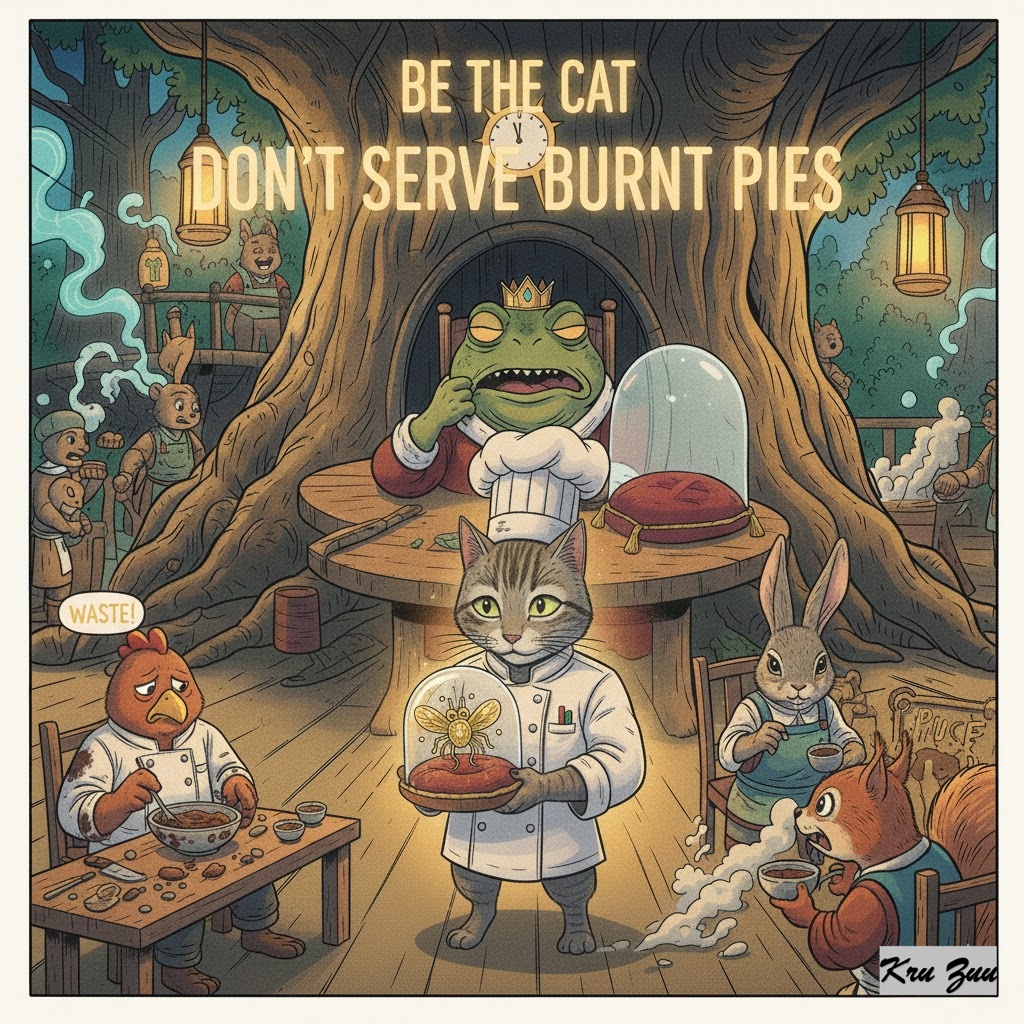
    The Moral: Chico the Chicken finished first, but he created garbage. He had to start over (Waste). Luna the Cat finished late, but she created value. Mr. Frog gave the Golden Fly to the Cat. 🏆


    Be the Cat. Don’t serve burnt pies.

    🎓 Lesson for English Learners


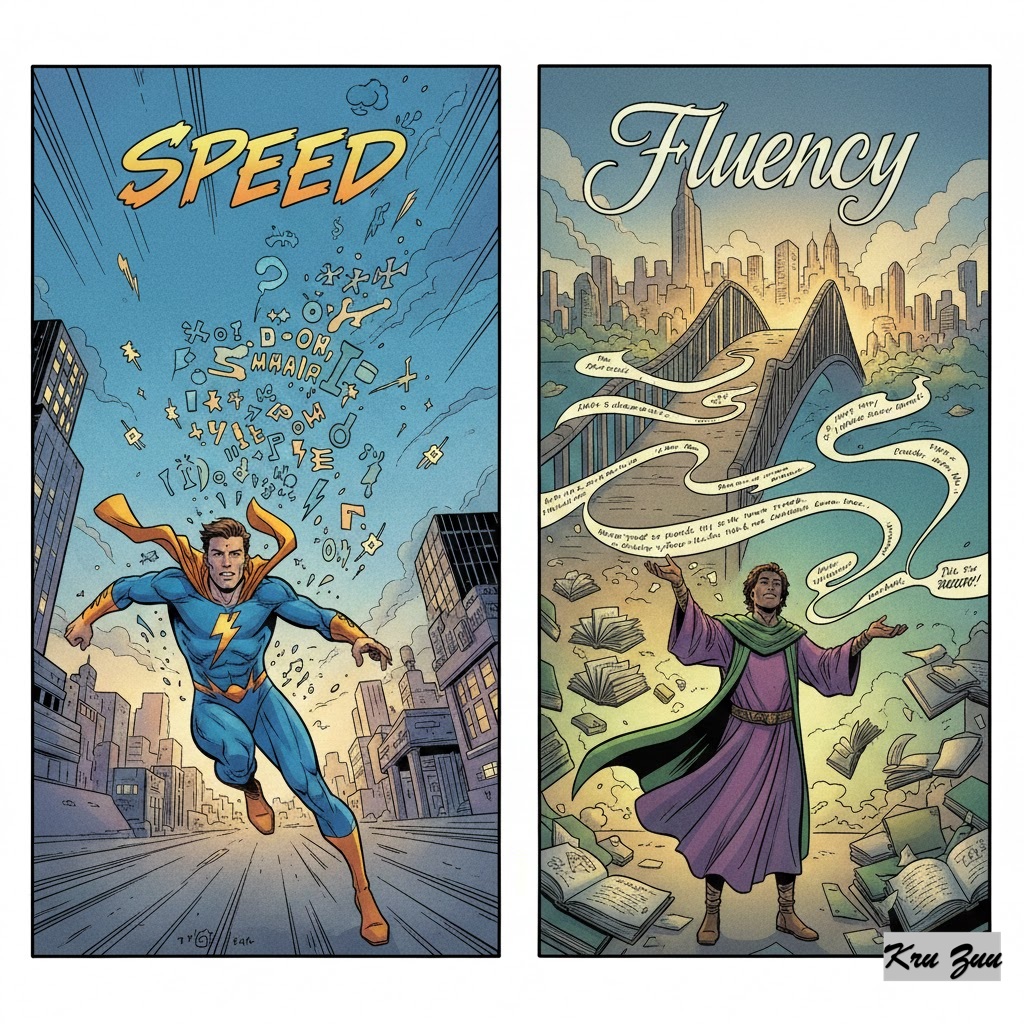
    Don’t confuse Speed with Fluency.


    Situation: You are in a job interview speaking English.


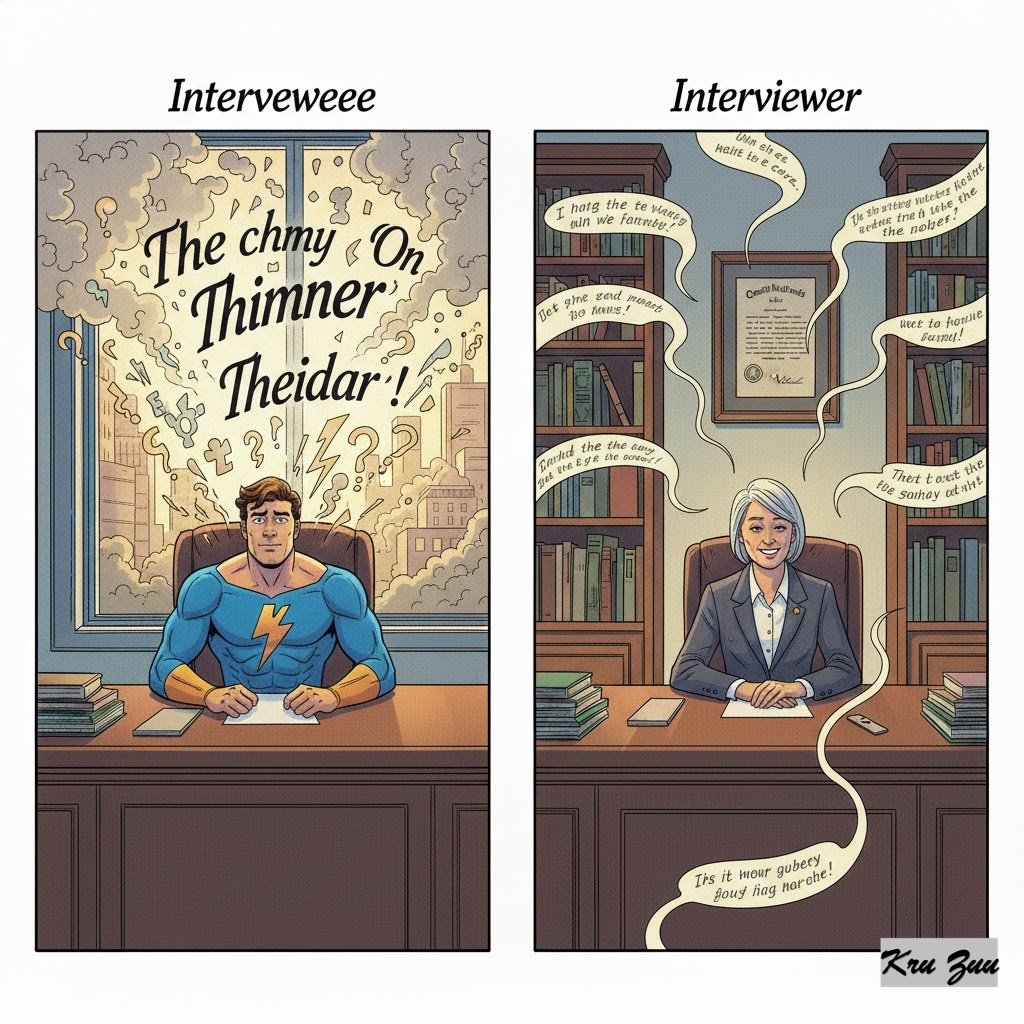
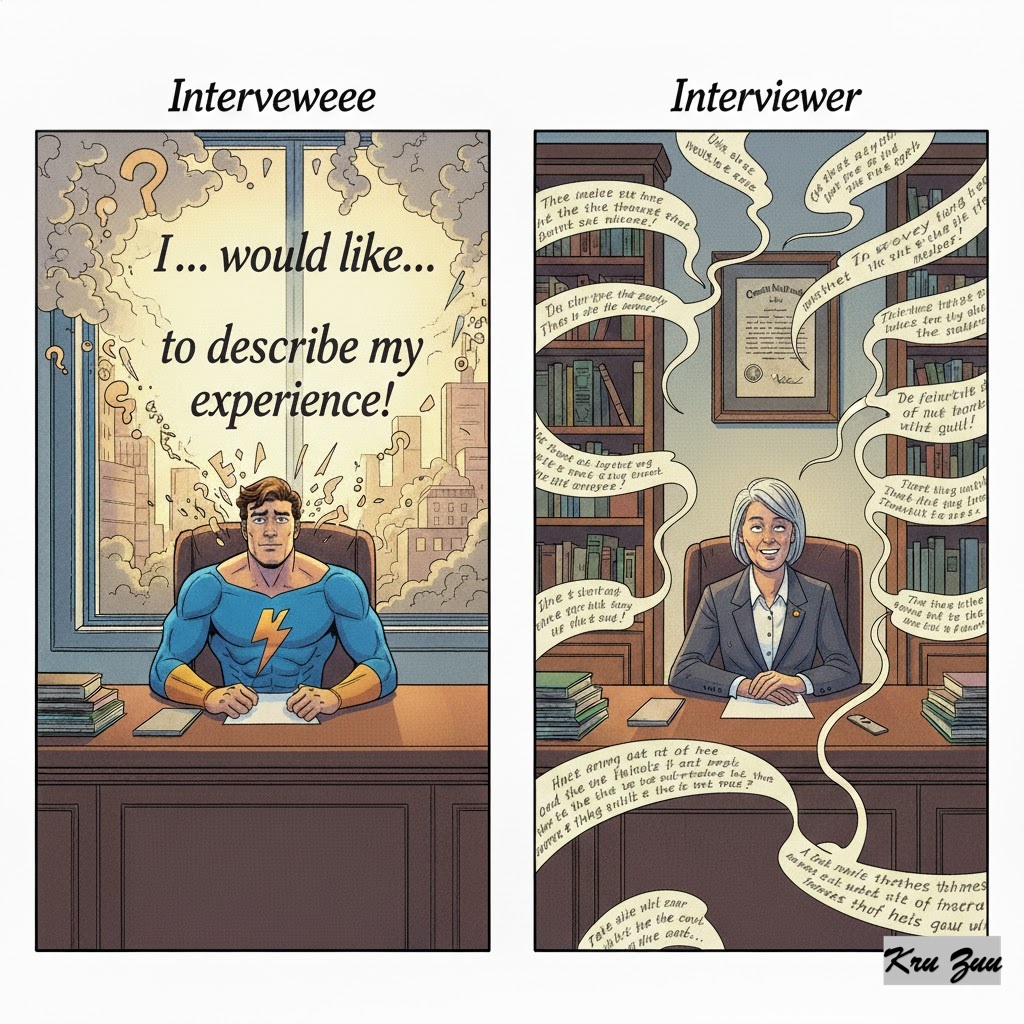
    The Mistake: You try to speak at 100mph because you think “Fast speakers = Native speakers.” You stumble, use the wrong tense, and say “Uhhh” 20 times.


    The Fix: Slow down. Speak clearly.


    You Say: “I… would like… to describe my experience.”


    Result: You sound confident and thoughtful.


    Remember: It is better to be understood slowly than to be misunderstood quickly.


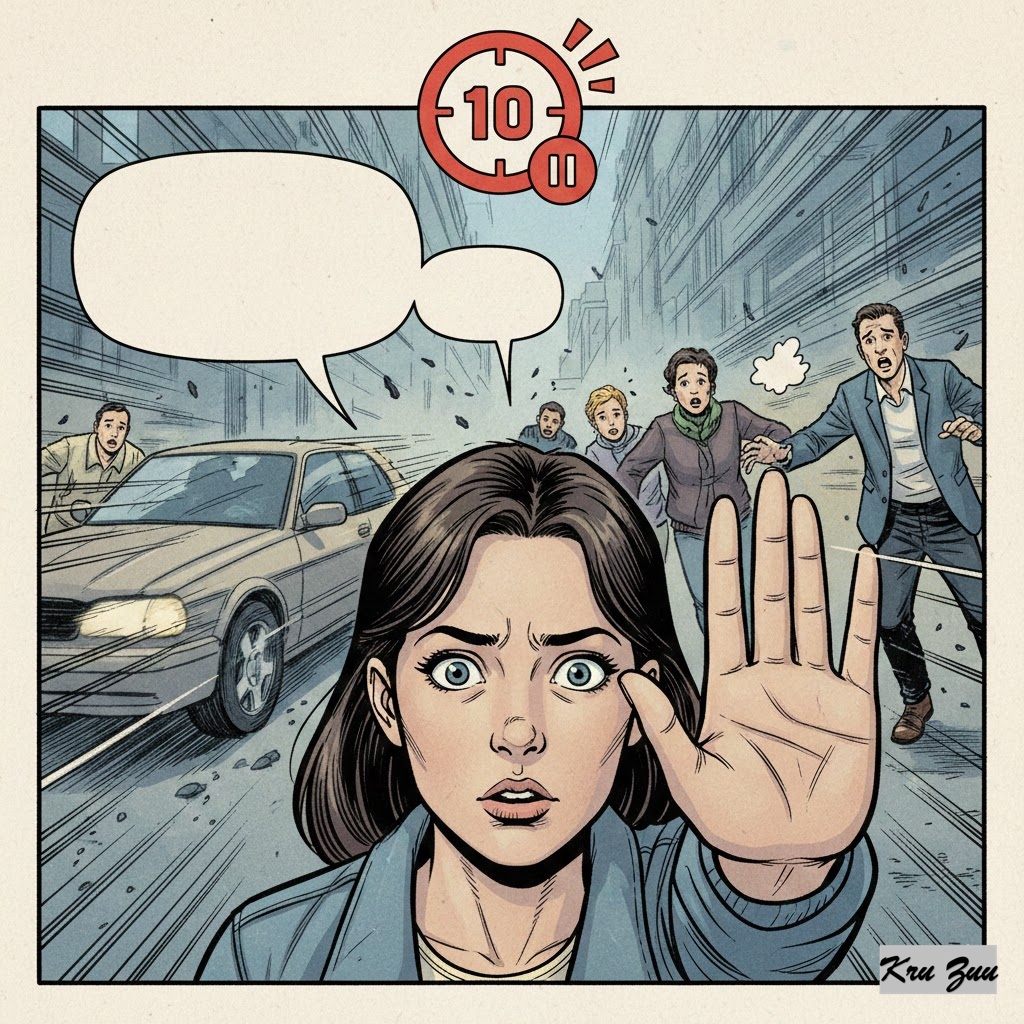
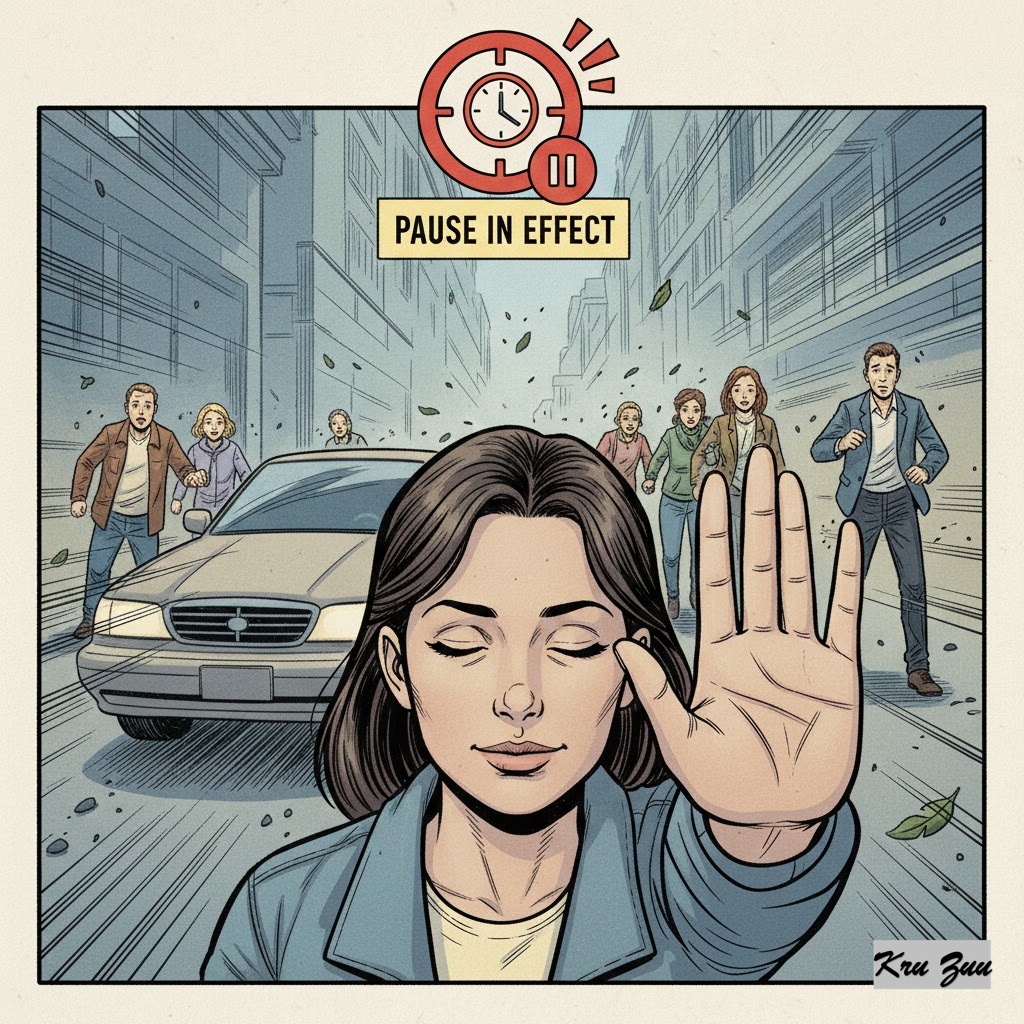
    💬 Your Turn: The 10-Second Pause 🛑


    We are breaking the cycle of rushing today.


    The Challenge: Before you send your next text message, email, or comment on social media…


    Stop typing.


    Take your hands off the keyboard.


    Count to 10.


    Read it one last time.


    Question: Tell us a time when you rushed something and it went horribly wrong! Did you ruin a meal? Send a text to the wrong person? Tell us in the comments! 👇

    By Zubeyir YURTKURAN

    https://www.facebook.com/BrainBattleground/

    https://www.facebook.com/zubeyr.yurtkuran/

    https://www.instagram.com/zubeyryurtkuran/
    https://www.youtube.com/@BrainBattleground-b3p

    https://www.instagram.com/brainbattleground/

  • ⚔️ The Daily Shield: The Law of Momentum

    ⚔️ The Daily Shield: The Law of Momentum

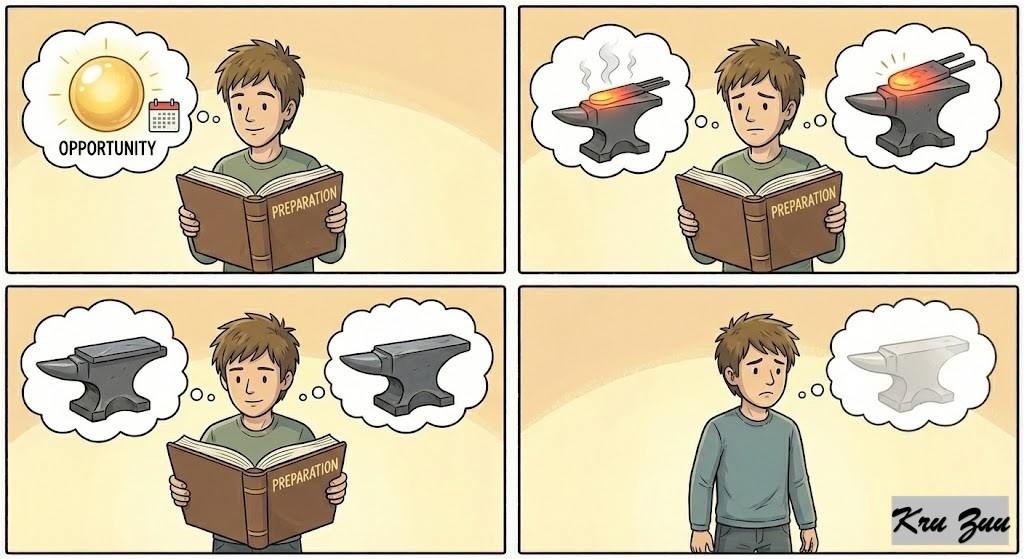
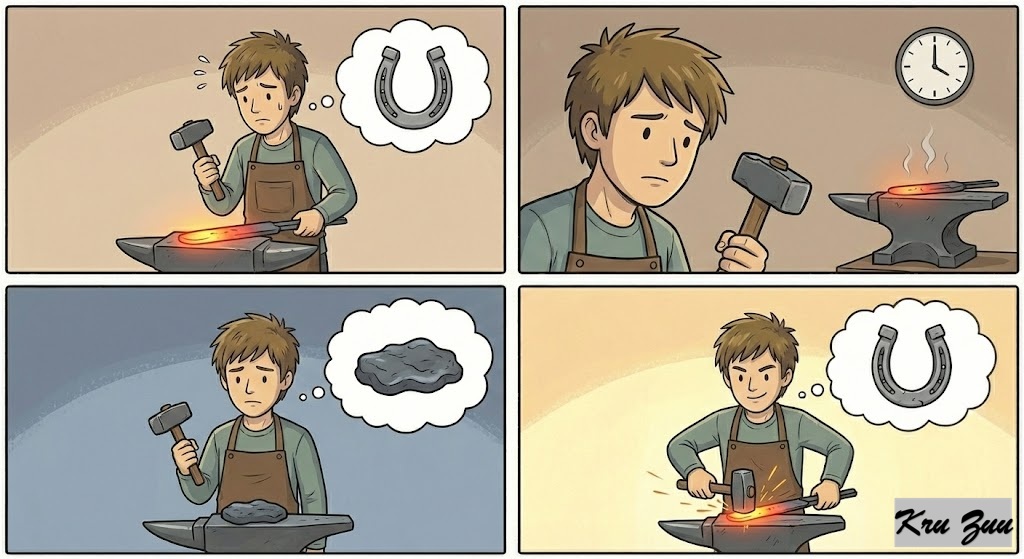
    “Strike while the iron is hot.”


    🥶 The Villain (The Hesitator)


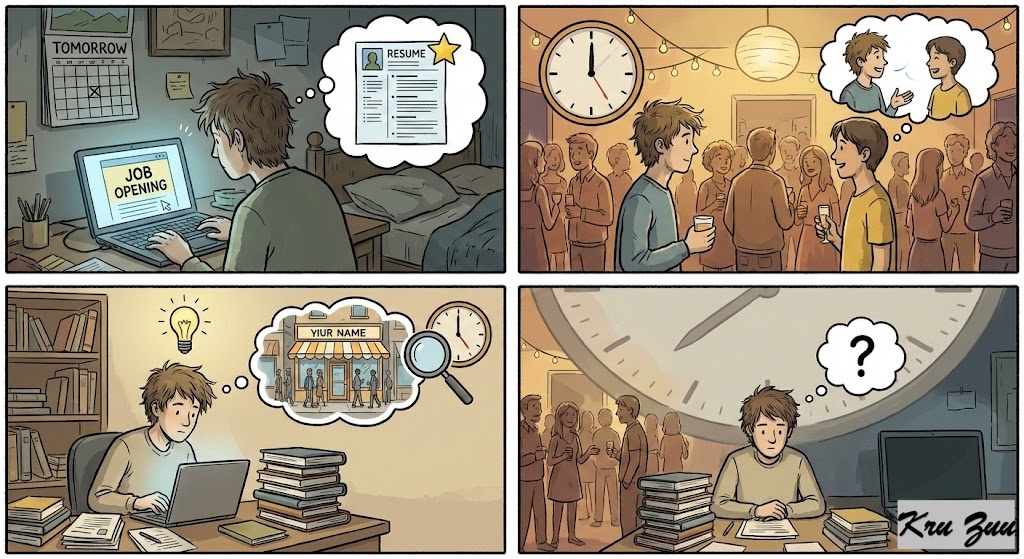
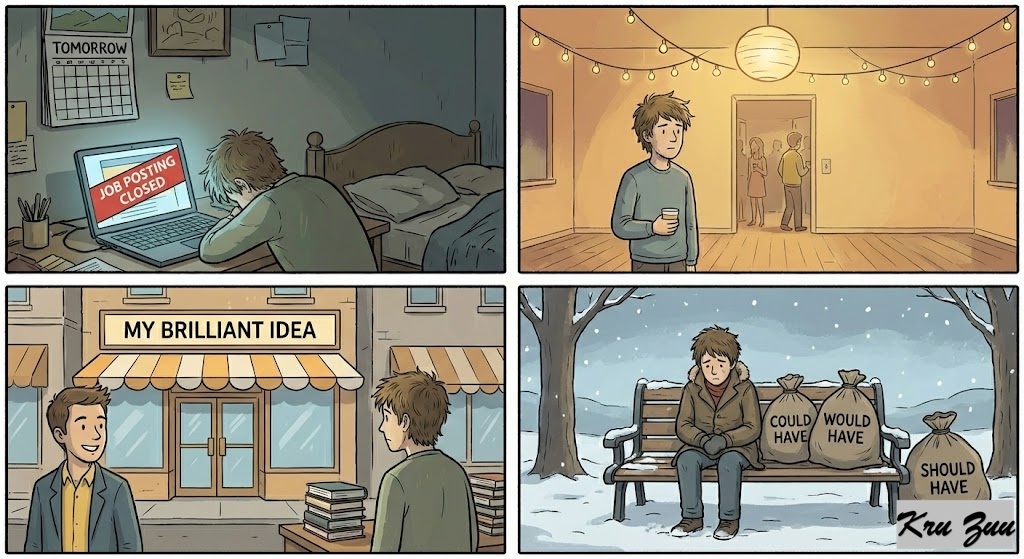
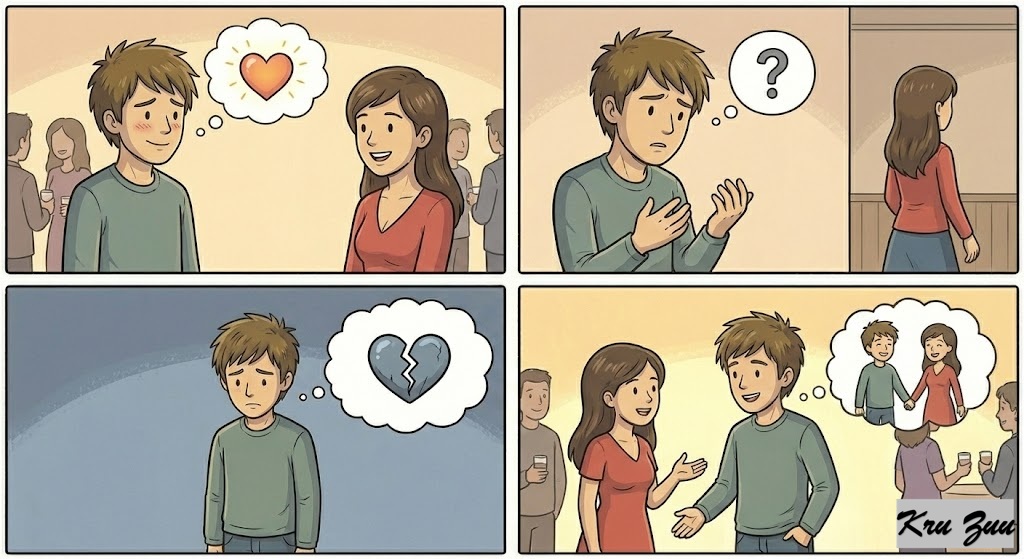
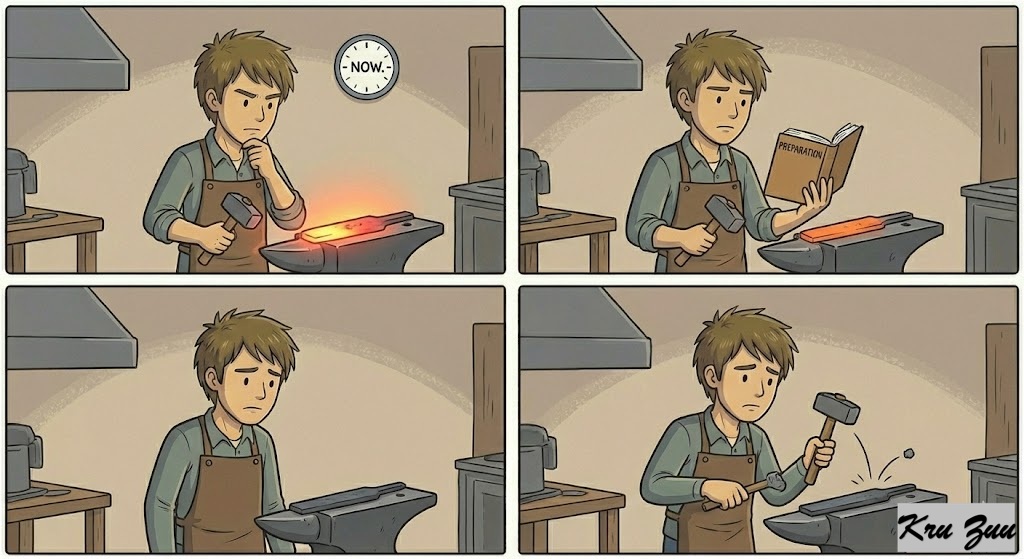
    You see a job opening that is perfect for you. You say, “I’ll apply tomorrow; I need to update my CV perfectly first.” You see a person you want to talk to at a party. You wait for the “right moment.” You have a brilliant idea for a business, but you decide to “research more” first.

    The Result? The job posting closes. The person leaves the party. Someone else launches your business idea. You are left standing in the cold, holding a bag full of “Could have,” “Would have,” and “Should have.” The opportunity didn’t wait for you. It vanished. ❄️


    🔥 The Hero (The Striker)


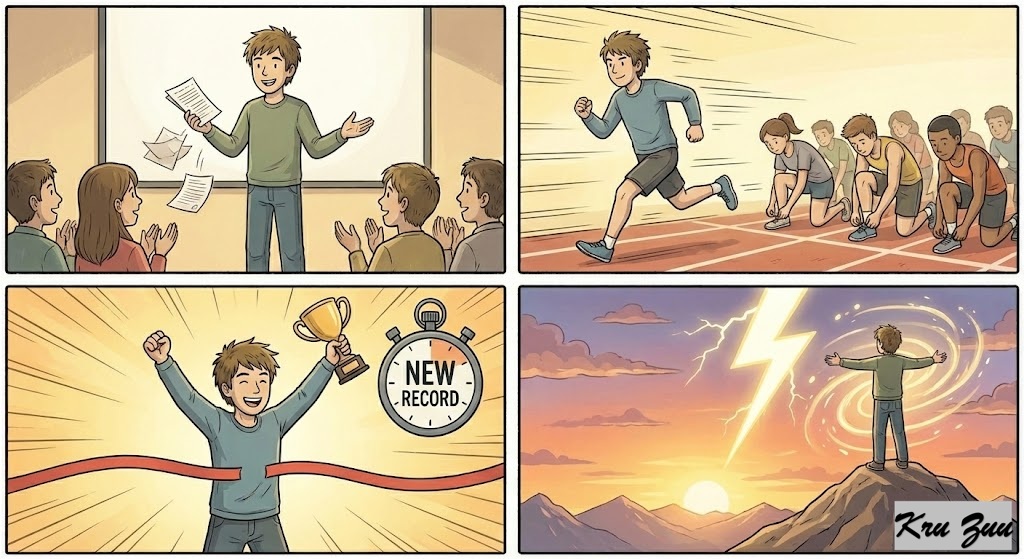
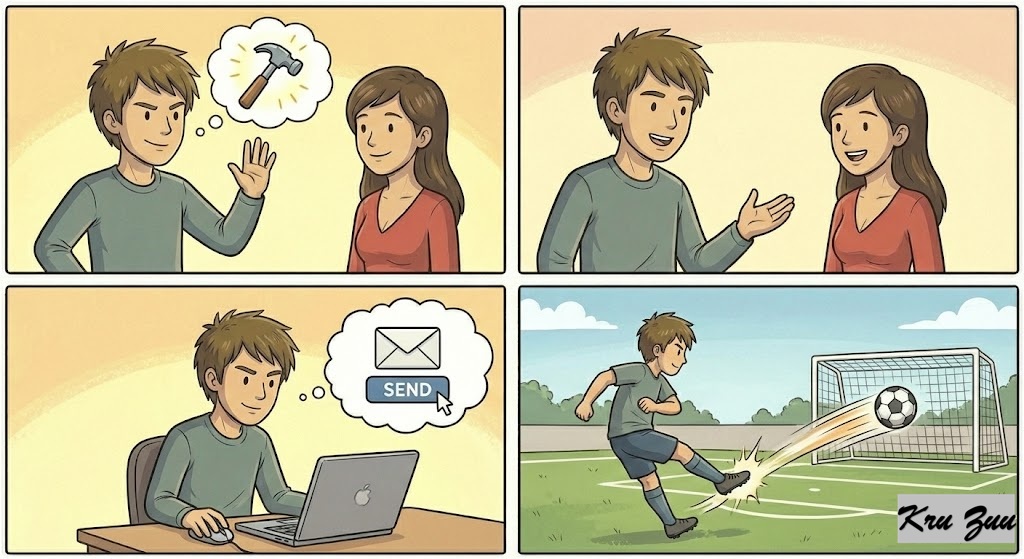
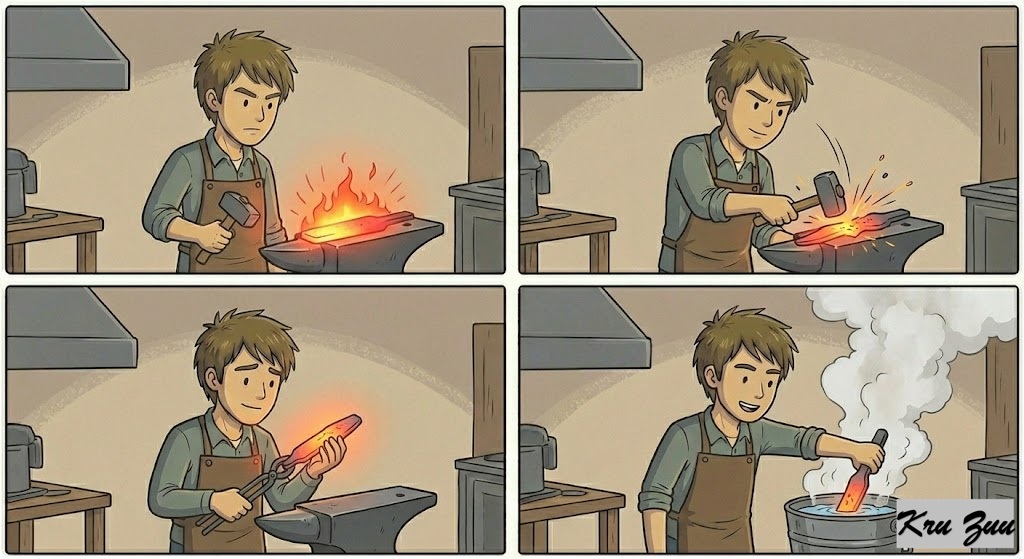
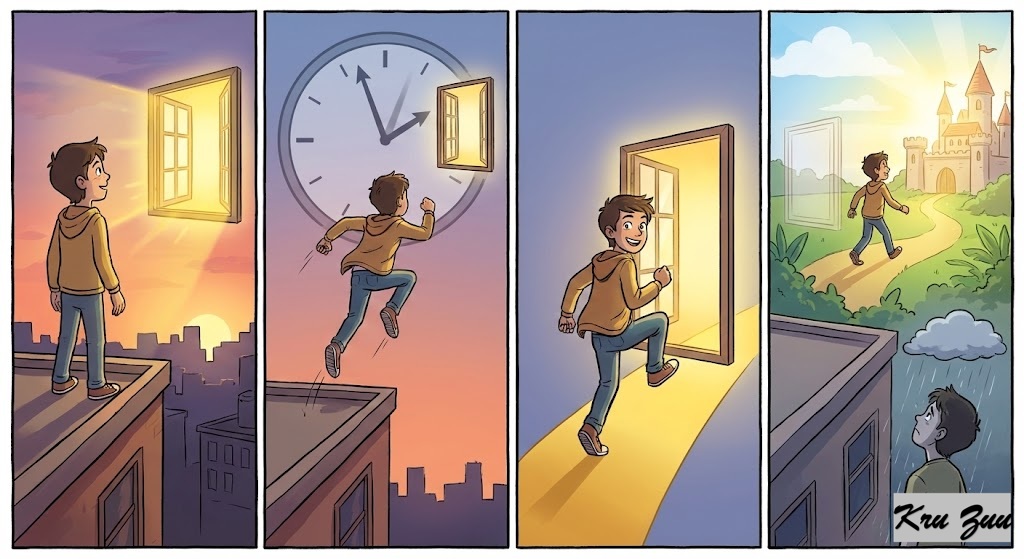
    You see the window of opportunity open. It’s scary. You aren’t 100% ready. But you know that speed is a weapon. You send the email now. You say “Hello” now. You launch the beta version now.

    The Result? You might make a mistake, but you are in the game. You are moving. You grab the win while others are still tying their shoelaces. You understand that the universe loves speed. ⚡


    ⚖️ The Reality


    Opportunities have an expiration date. Ideally, we want to be 100% prepared. But in reality, by the time you are 100% prepared, the chance is usually gone. The “Iron” (the opportunity) cools down and hardens rapidly.


    💎 The Secret

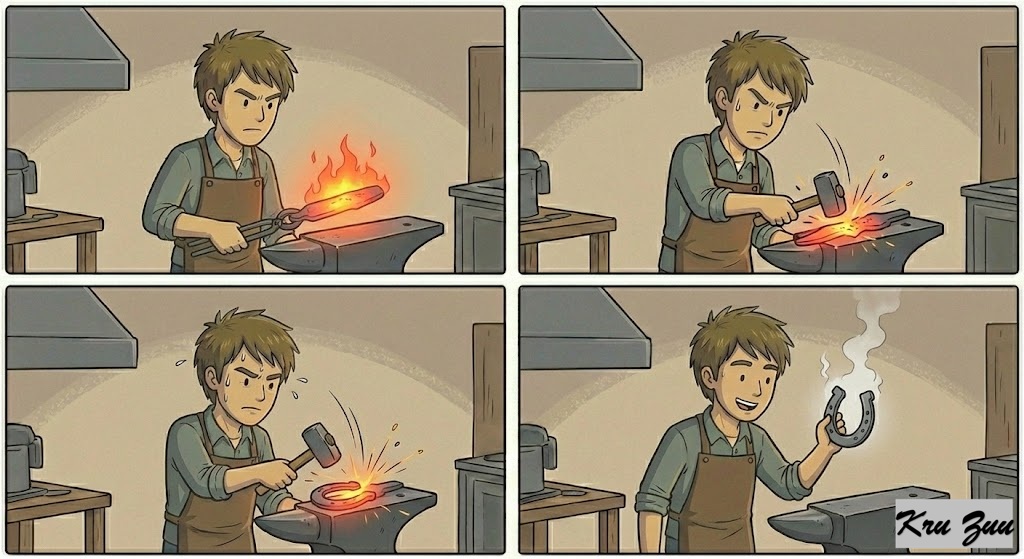
    You don’t need to be perfect; you just need to be present. It is better to strike imperfectly than to stare at the hammer until the metal goes cold.

    🧐 The Anatomy of the Proverb


    This is the ultimate rule for success and dating!


    Strike (Verb): To hit forcibly; to take action. 🔨


    While (Conjunction): During the time that; at the same time as.


    Iron (Noun): The metal (representing the opportunity).


    Hot (Adjective): Ready to be shaped.


    Simpler Version: Act immediately when you have the chance.


    📚 Vocabulary Vault


    Momentum (Noun): The force that keeps an object moving. (Action creates momentum!). 🚀


    Fleeting (Adjective): Lasting for a very short time. (Opportunities are fleeting). 💨


    Decisive (Adjective): Having the ability to make decisions quickly and effectively.


    Hesitation (Noun): The action of pausing before doing something. (The enemy of speed).


    Window of Opportunity (Phrase):
    A short period of time during which an action can be taken. 🪟


    🧠 Grammar Focus: Time Clauses with “While”


    This proverb uses a Time Clause to show two things happening at once.


    Structure: [Action Verb] + while + [Condition].


    The Logic: You must do the action during the condition. Once the condition ends, the action is useless.


    Examples


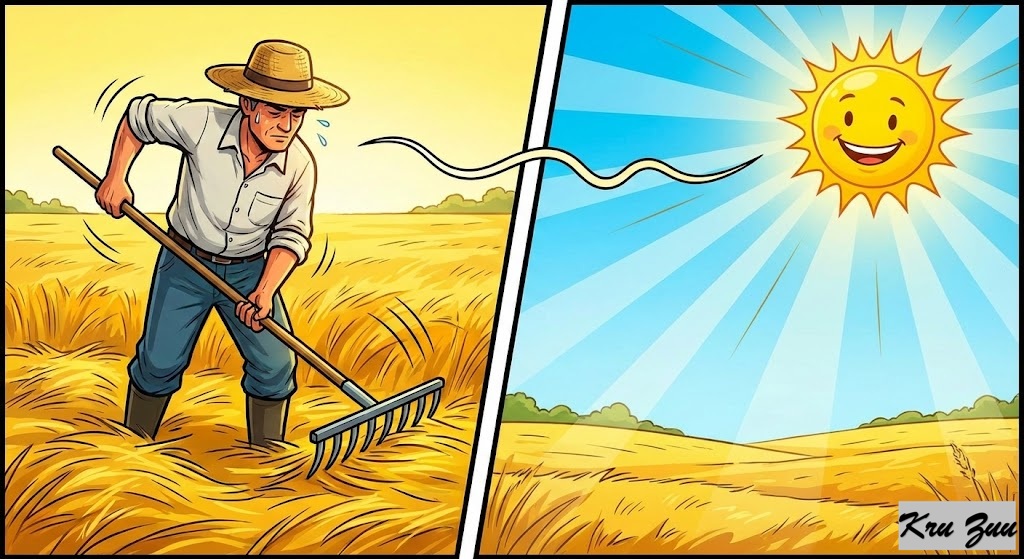
    “Make hay while the sun shines.” (Another famous idiom!)
    “Listen while the teacher is speaking.”
    “Enjoy your youth while you are young.”

    📜 History: Origin and Spread


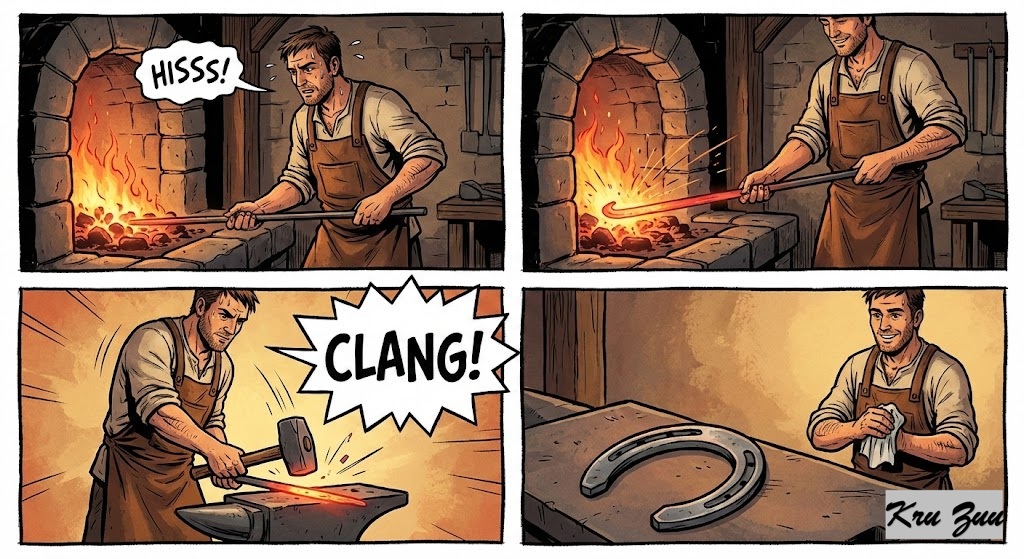
    This idiom comes straight from the blacksmith’s workshop.


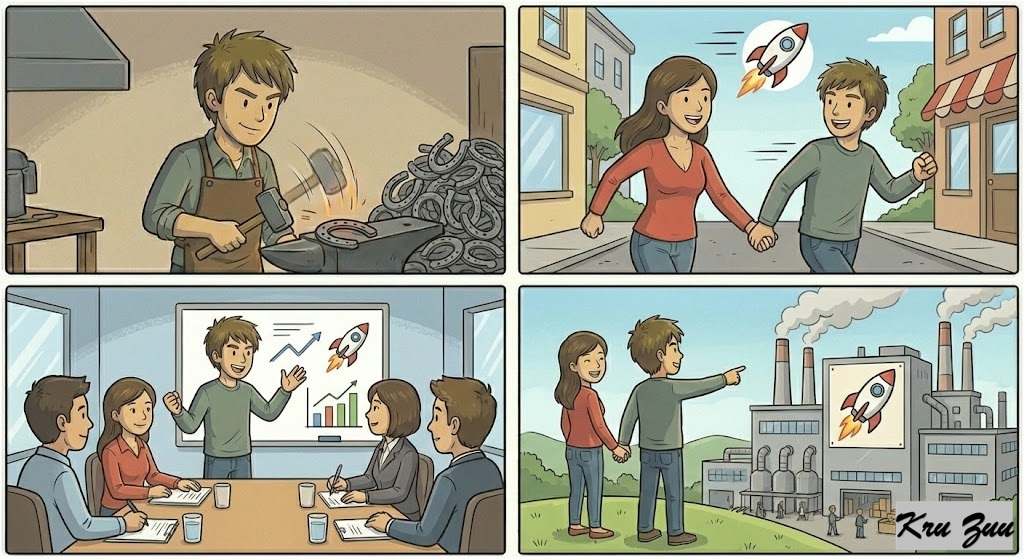
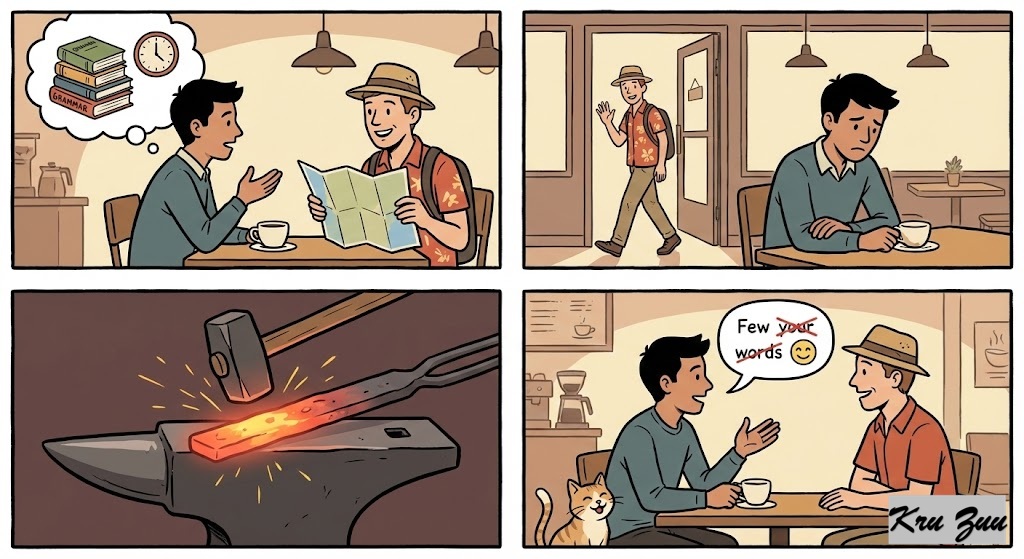
    The Origin: In medieval times, blacksmiths had to heat iron in a fire until it glowed red. Only then was it soft enough to hammer into a sword or horseshoe. If they waited even 30 seconds, the iron would cool, turn hard, and shatter if hit.


    Global Cousins


    🇹🇷 Turkish:“Demir tavında dövülür.” (Iron is beaten at its proper heat/temper.) — Identical meaning!


    🇮🇹 Italian:“Batti il ferro finché è caldo.”


    👺 Latin:“Carpe Diem” (Seize the day) — The spiritual ancestor of this phrase.

    🎯 Impact on Life: The Pros & Cons


    ✅ The Pros (The Winner’s Edge)


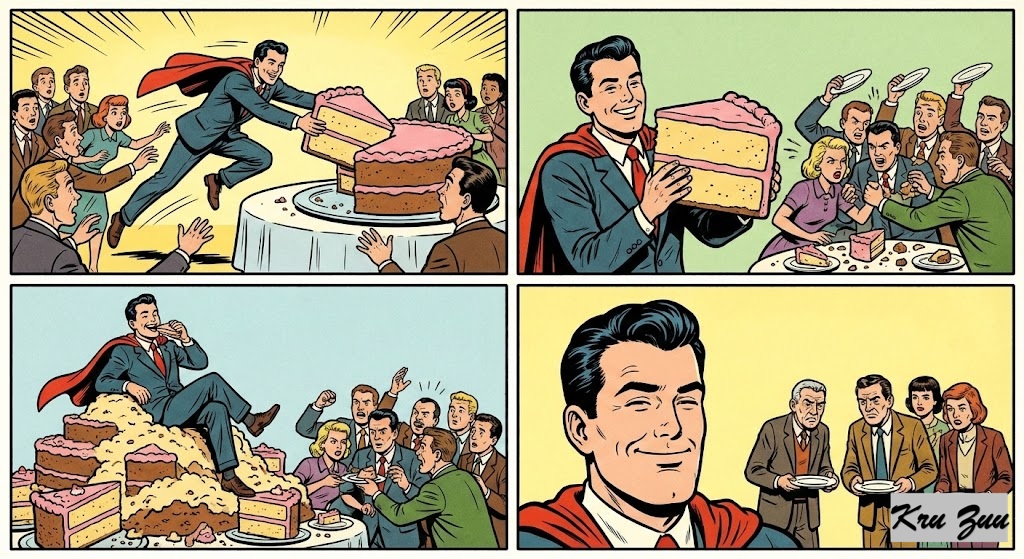
    First Mover Advantage: The first person to act usually gets the biggest slice of the cake.


    Confidence: Taking action kills fear. Waiting feeds fear.


    ❌ The Cons (The Reckless Risk)


    Impulsiveness:
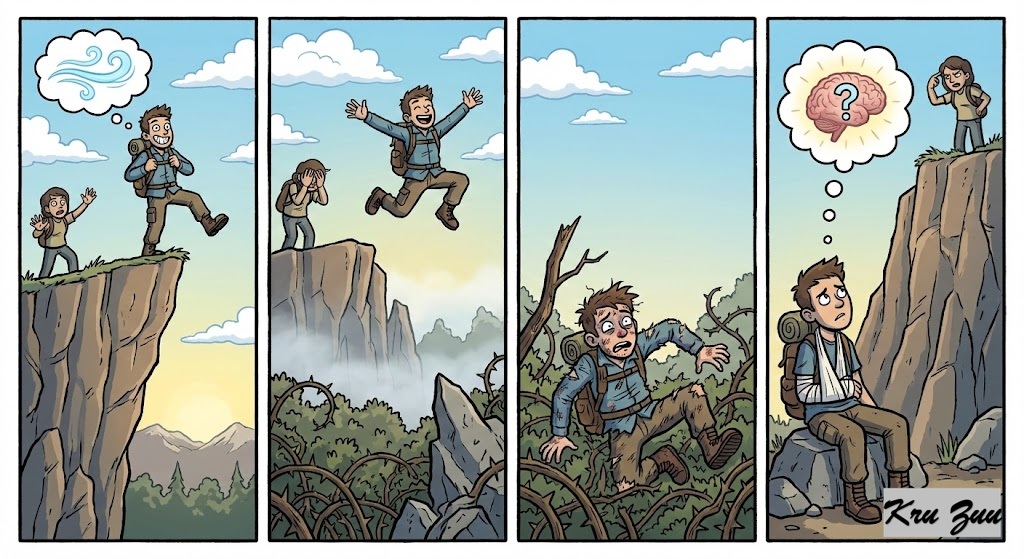
    Striking too fast without looking can be dangerous. Don’t jump off a cliff just because “the air is nice.” Use common sense!

    🎭 Short Story: The Open Gate 🚪


    Let’s visit the barnyard to see this law in action.


    🌟 The Characters


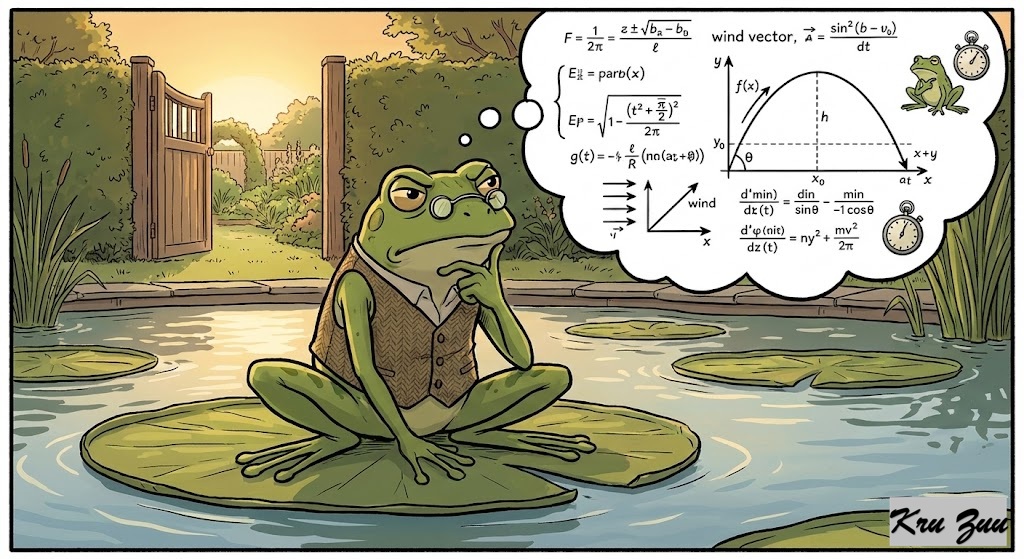
    🐸 Freddie the Frog: The Philosopher (Overthinks everything).


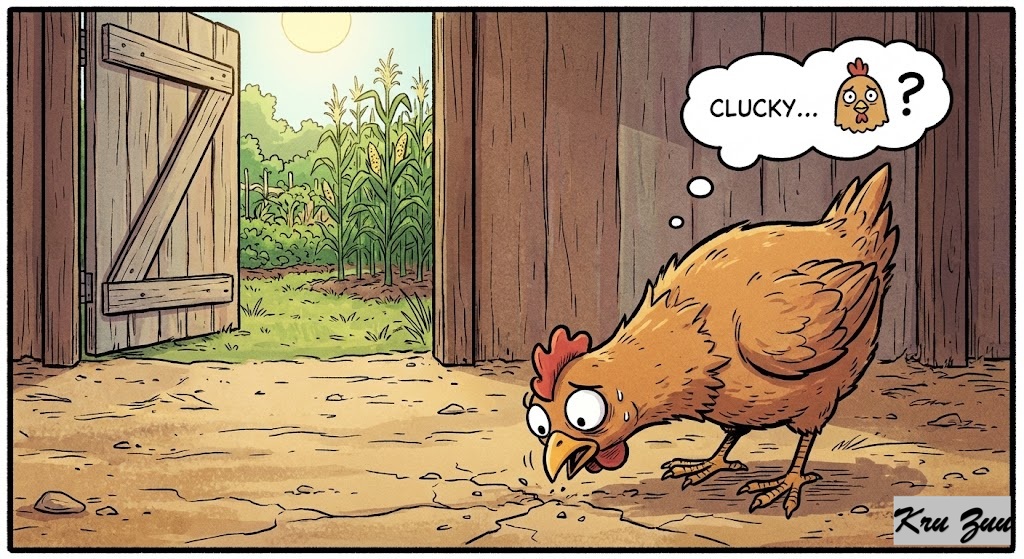
    🐔 Clucky the Chicken: The Worrier (Scared of everything).


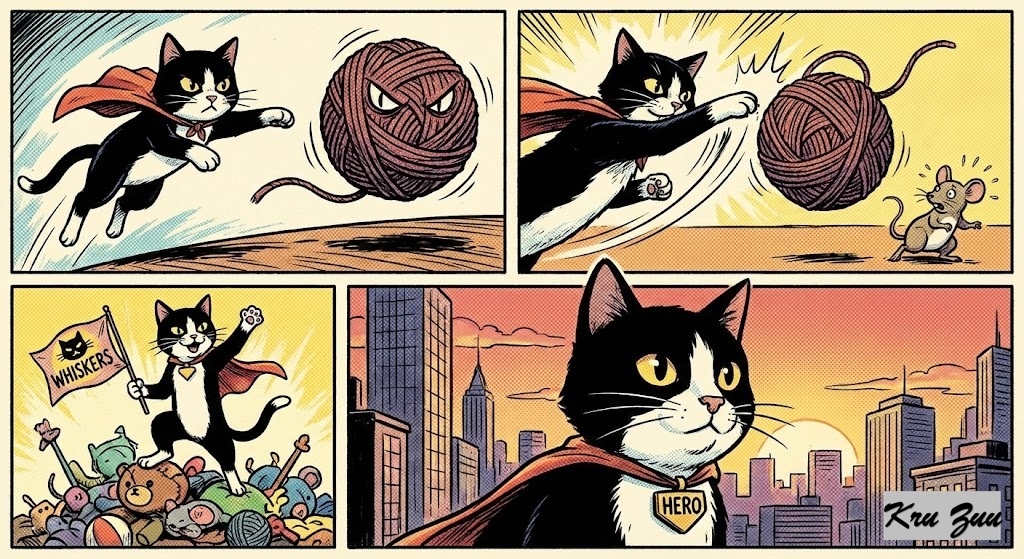
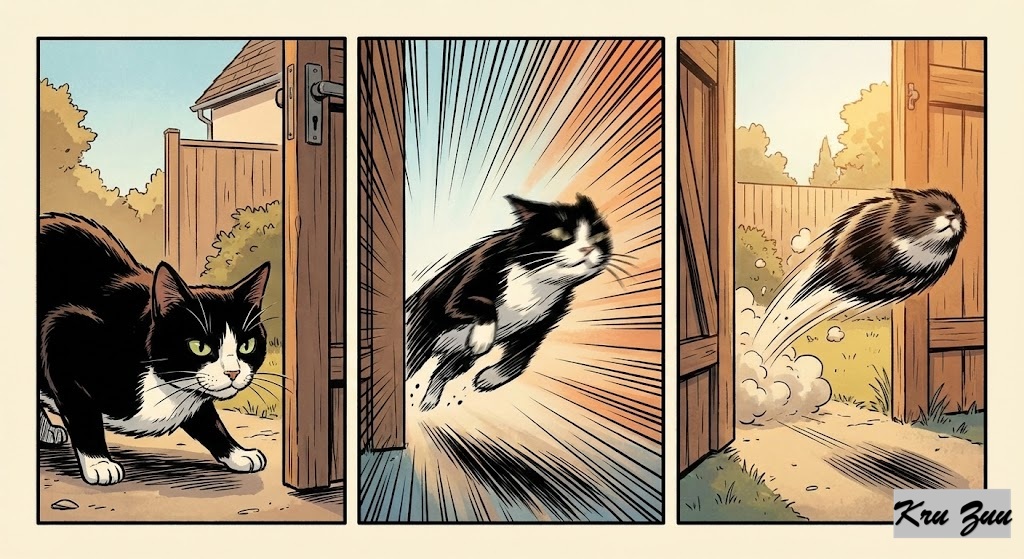
    🐱 Whiskers the Cat: The Striker (The Hero).


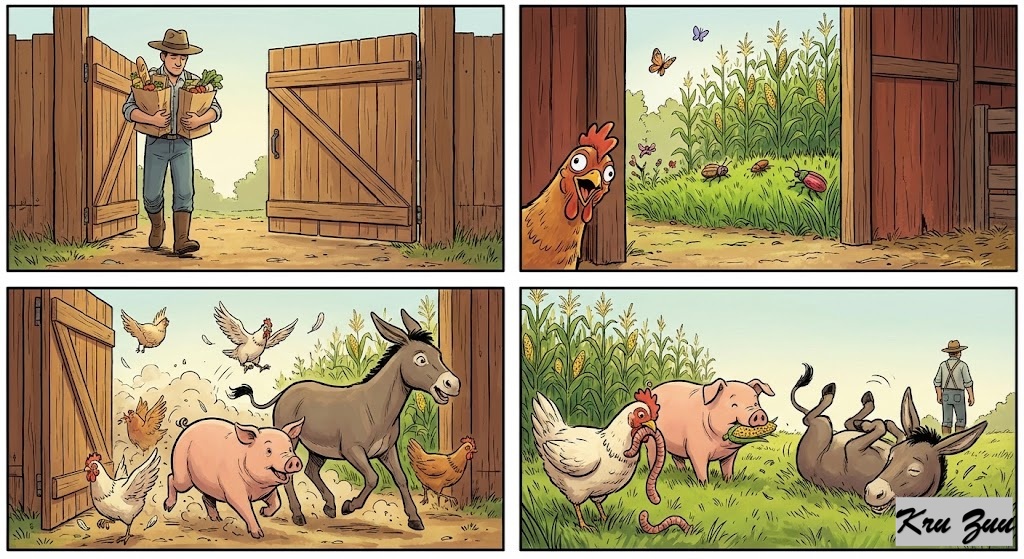
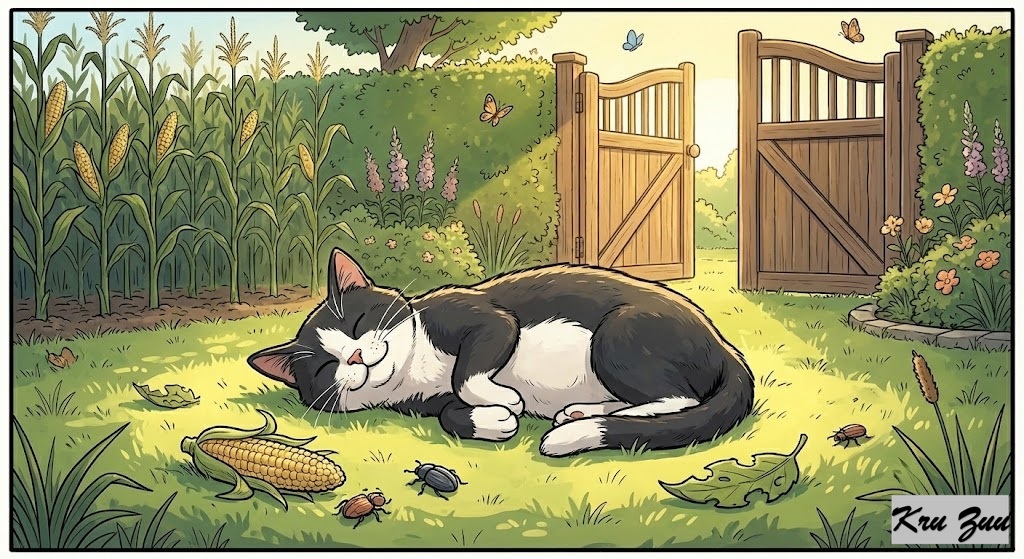
    The Situation: The Farmer is carrying groceries. For exactly 10 seconds, he leaves the garden gate wide open. Inside, there is a paradise of bugs, corn, and soft grass.


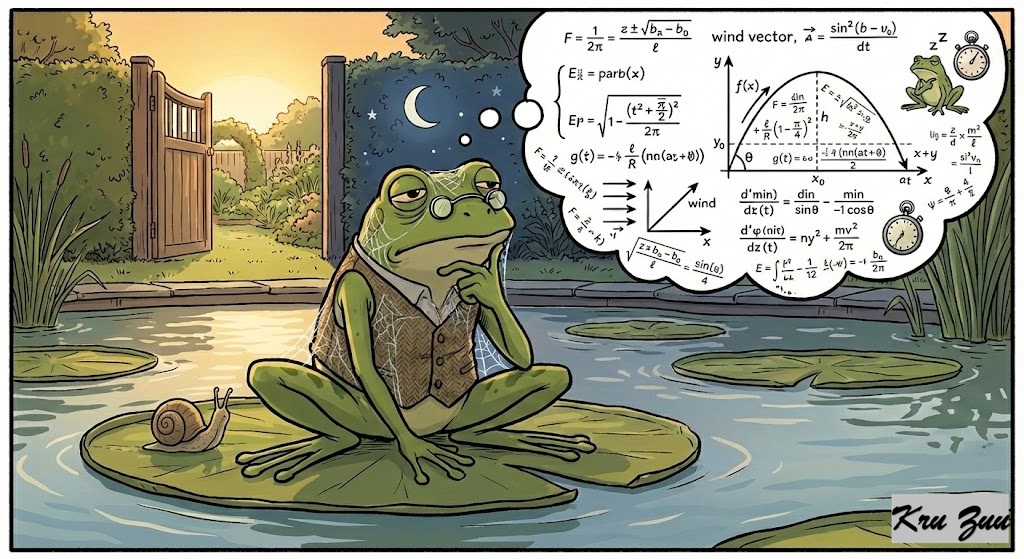
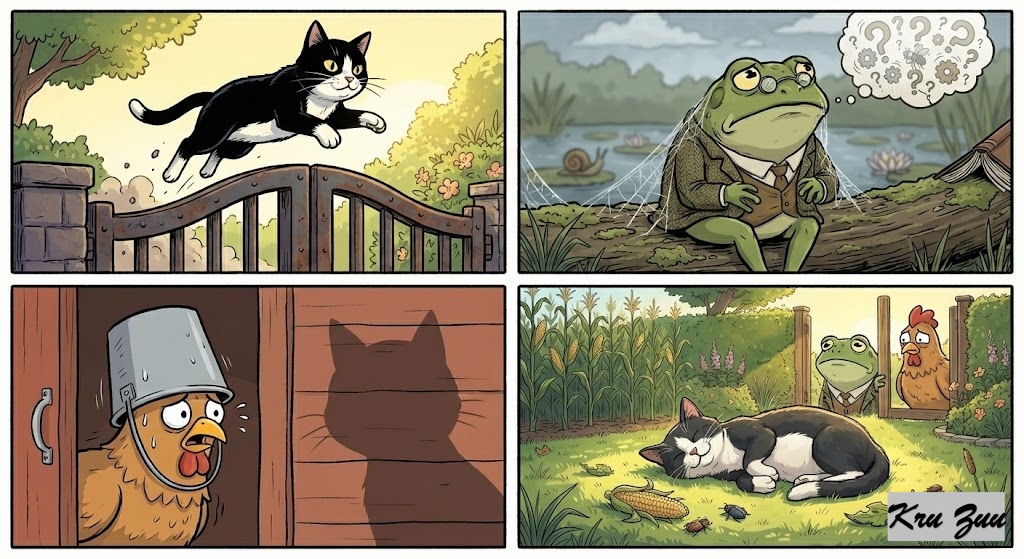
    The Reaction:🐸 Freddie the Frog sees the gate. He sits on his lily pad. “Hmm,” he croaks. “The humidity is good, but I need to calculate the trajectory of my jump. If I wait for the wind to die down, my jump will be 4% more aerodynamic.”

    Result: He stays on the lily pad, calculating.


    🐔 Clucky the Chicken sees the gate. She flaps her wings nervously. “Oh my!” she clucks. “It looks delicious. But what if the Farmer sees me? What if I trip? Maybe I should wait until the Farmer goes to sleep tonight. Yes, that is safer.”

    Result: She pecks at the dry dirt, waiting for “safe.”


    🐱 Whiskers the Cat sees the gate. Whiskers doesn’t think. Whiskers doesn’t calculate wind speed. Whiskers sees the gap. 1, 2, ZOOM. Whiskers shoots through the gap like a fuzzy bullet.


    The Outcome


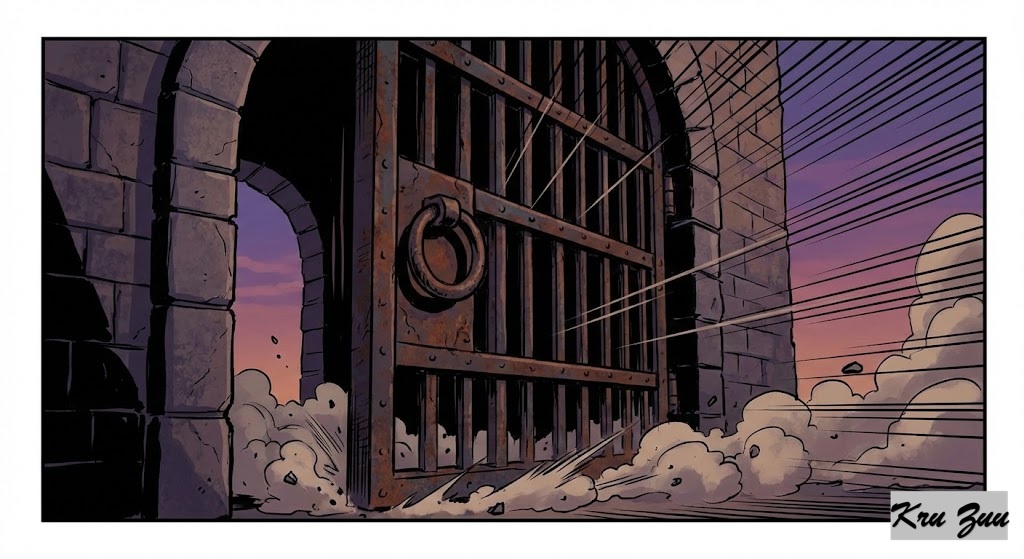
    CLANG. The gate slams shut.


    Freddie is still calculating his jump.


    Clucky is still hungry and safe in the dirt.


    Whiskers is inside the garden, napping in the sun after eating a feast.


    The Moral: The world belongs to the Cats. Don’t be a Frog calculating the wind. Don’t be a Chicken waiting for safety. Jump.

    🎓 Lesson for English Learners


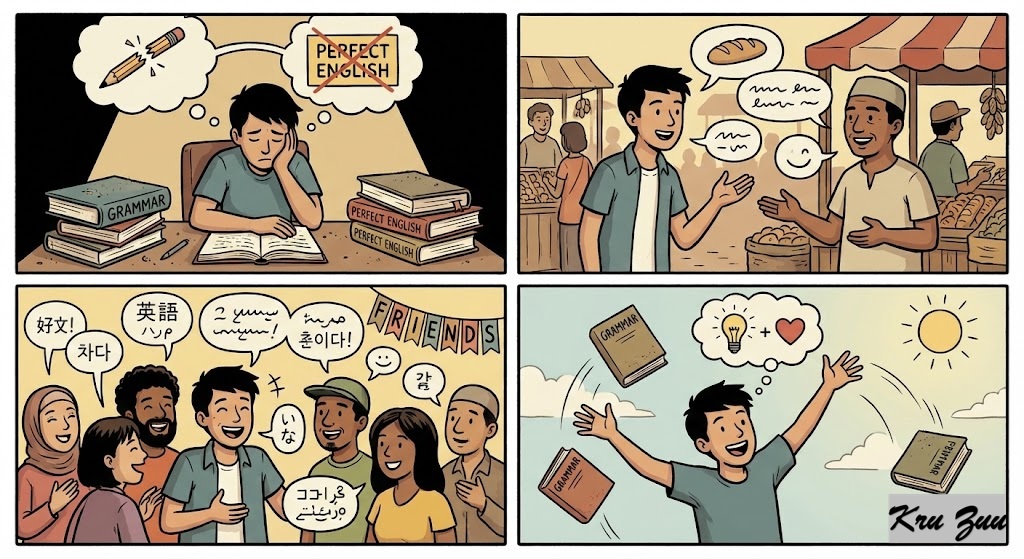
    Don’t wait for “Perfect English.”


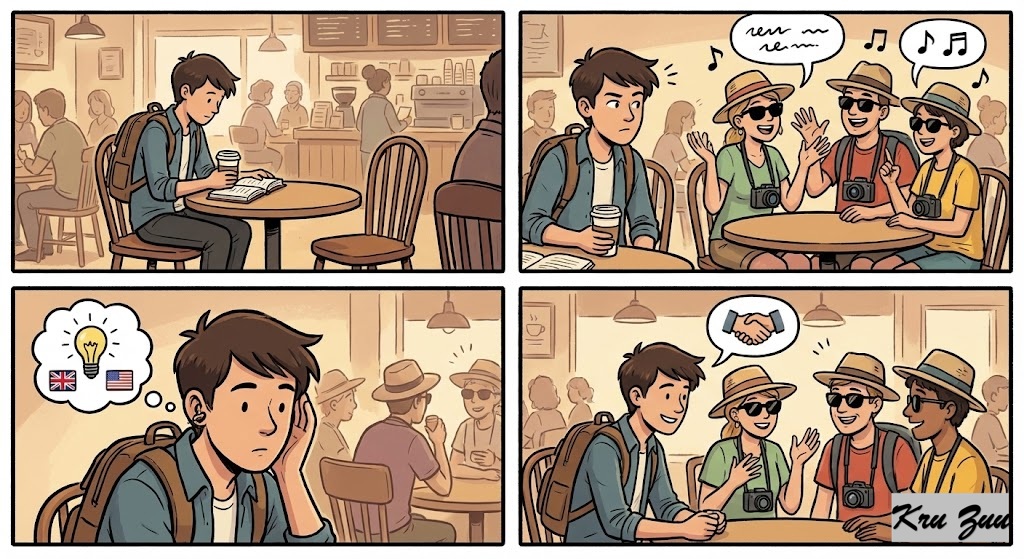
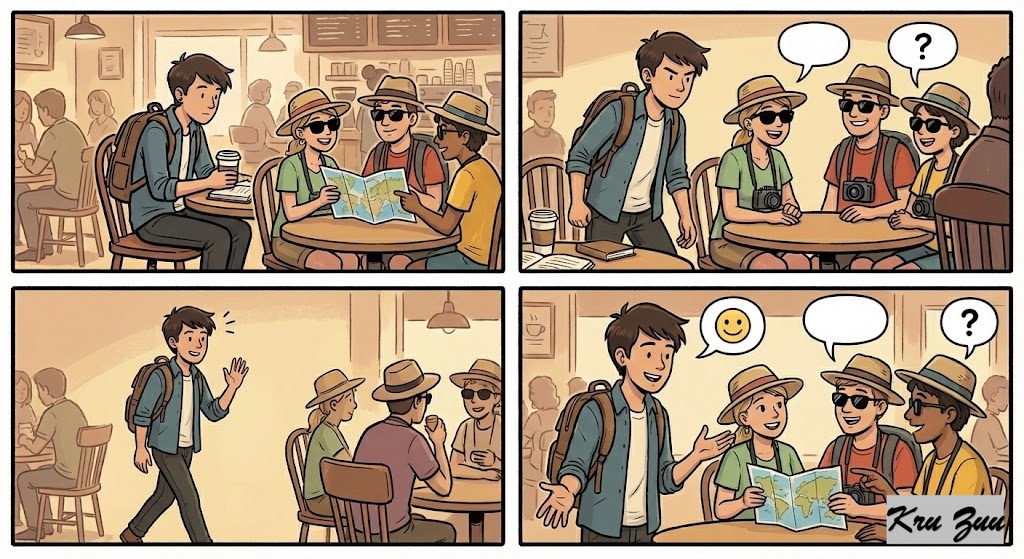
    Situation: You are in a coffee shop. You hear tourists speaking English.


    The Frog approach: “I will talk to them once I master the Present Perfect Continuous tense.”


    The Cat approach: You stand up, walk over, and say, “Hi! Where are you from?”


    Why? Because 5 minutes later, they will leave. The iron will be cold. Speak now, fix your grammar later.


    💬 Your Turn: The “5-Second Rule” 🚀


    When you feel an instinct to act on a goal, you must physically move within 5 seconds, or your brain will kill the idea.


    The Challenge: Is there an email you need to send? A text to a crush? A domain name you want to buy?


    The Action: Do it. Strike. Don’t think. Just click “Send.”


    👇 Tell us in the comments: What is an opportunity you missed because you waited too long? Let’s mourn it together, then move on!

    By Zubeyir YURTKURAN

    https://www.facebook.com/BrainBattleground/

    https://www.facebook.com/zubeyr.yurtkuran/

    https://www.instagram.com/zubeyryurtkuran/
    https://www.youtube.com/@BrainBattleground-b3p

    https://www.instagram.com/brainbattleground/

  • 🖋️ The Daily Shield: The Law of Influence

    🖋️ The Daily Shield: The Law of Influence

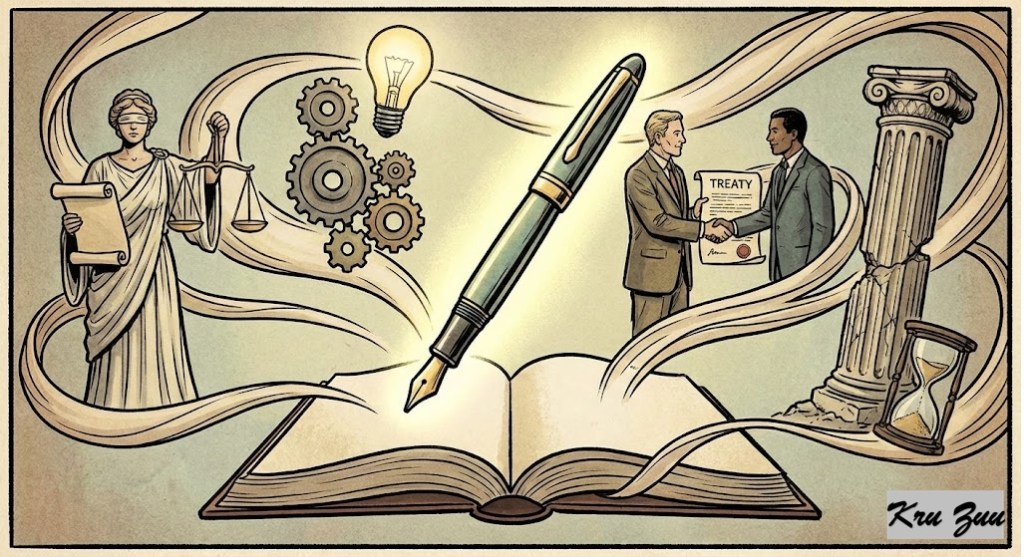
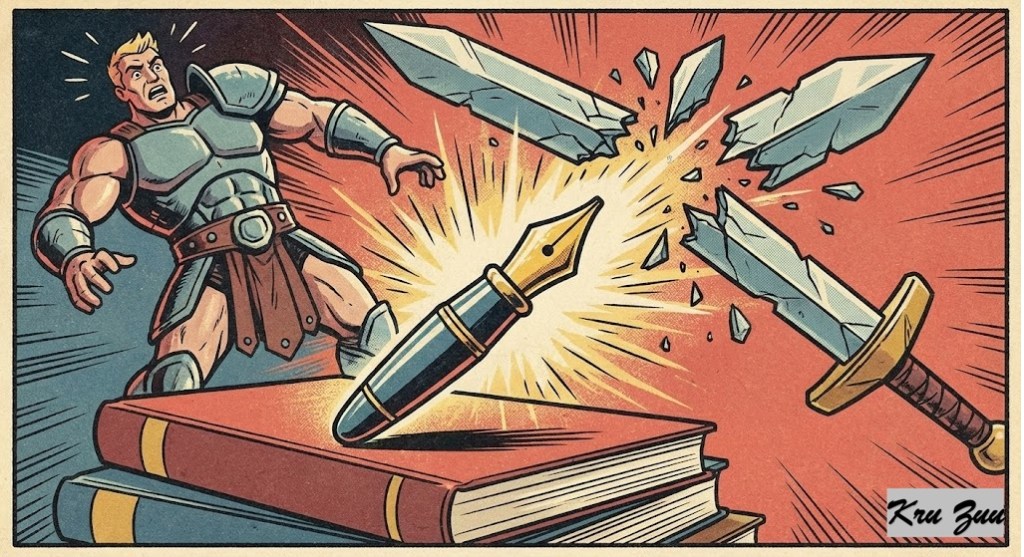
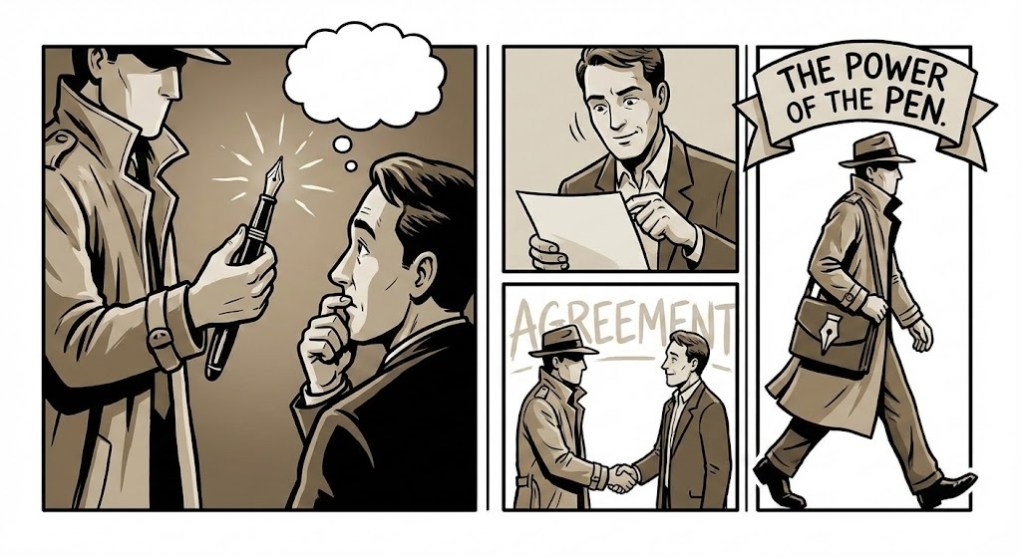
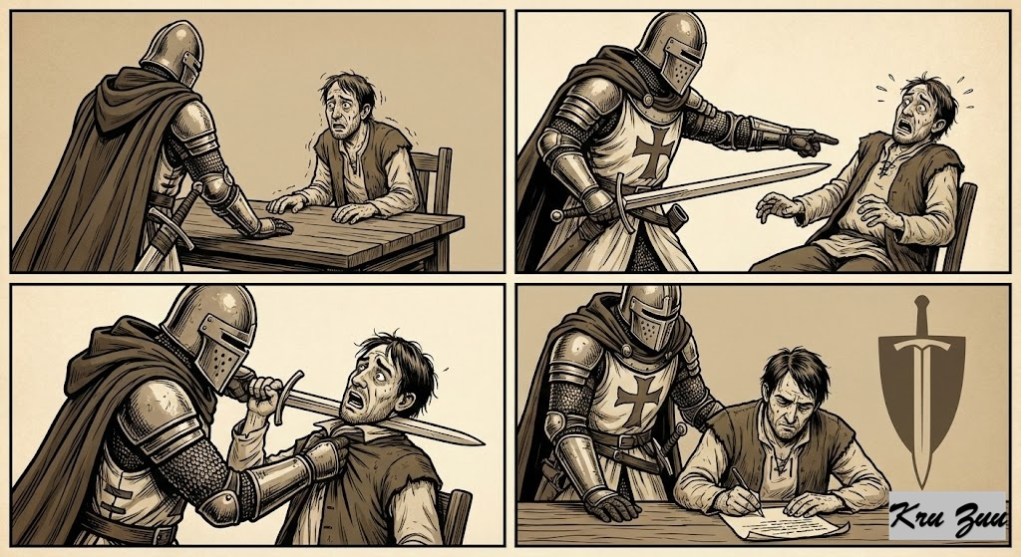
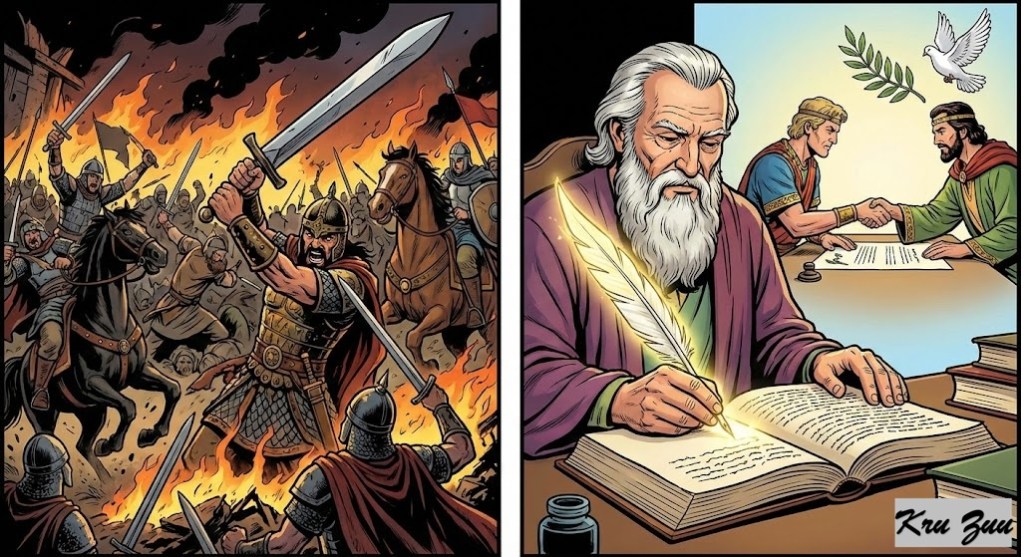
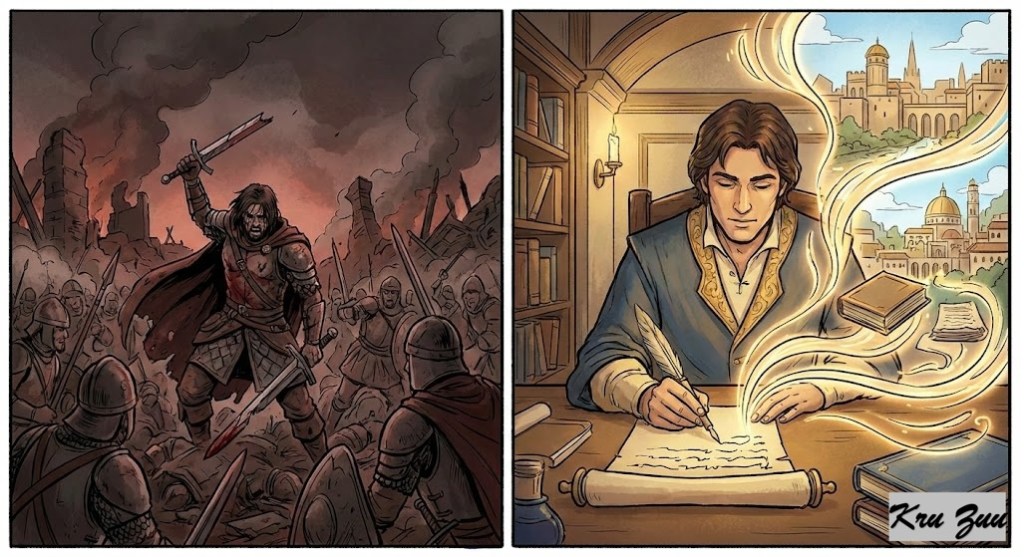
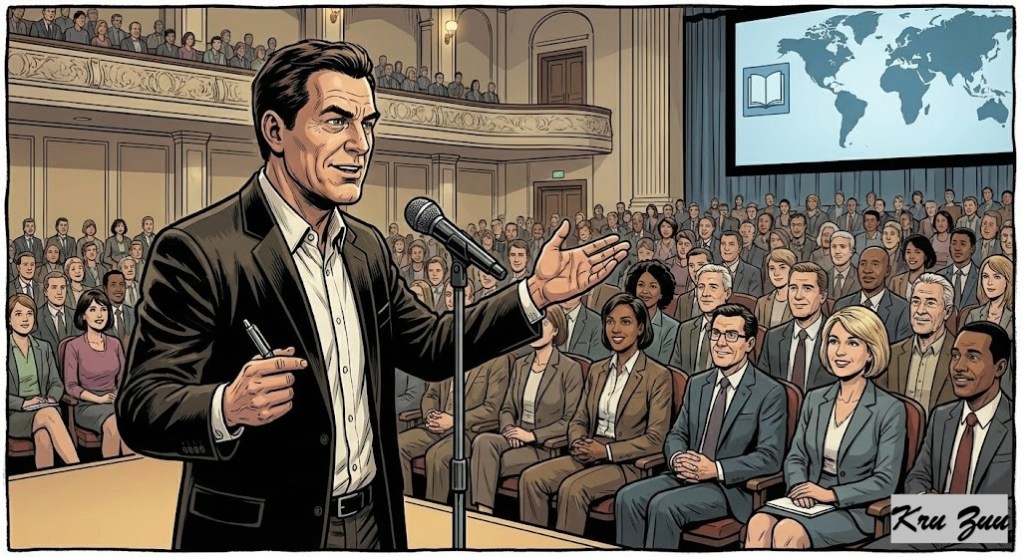
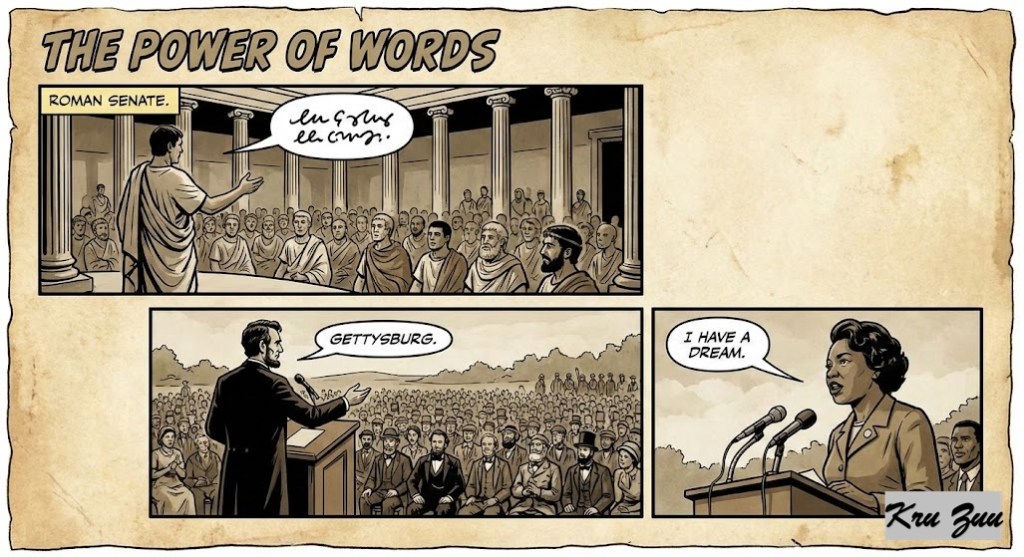
    “The pen is mightier than the sword.”


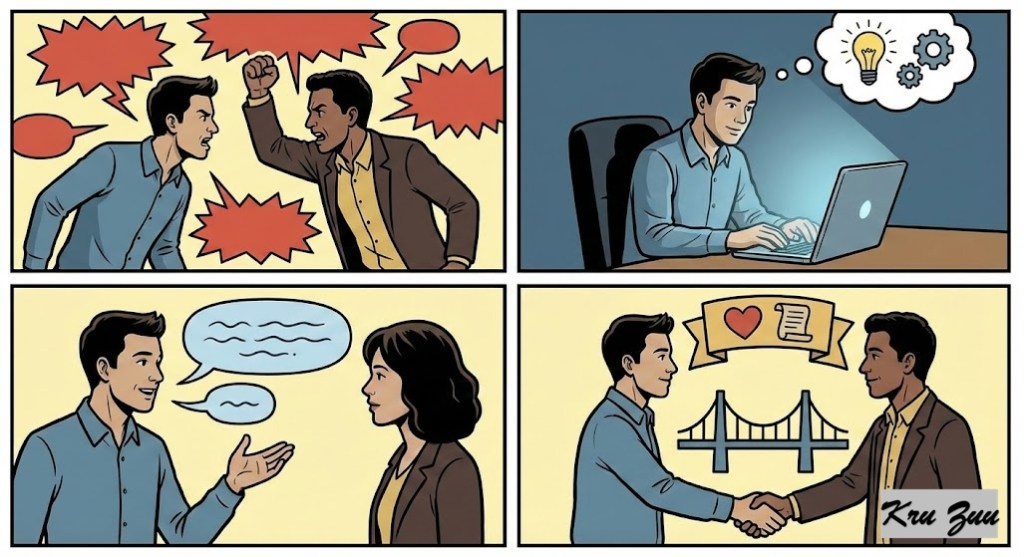
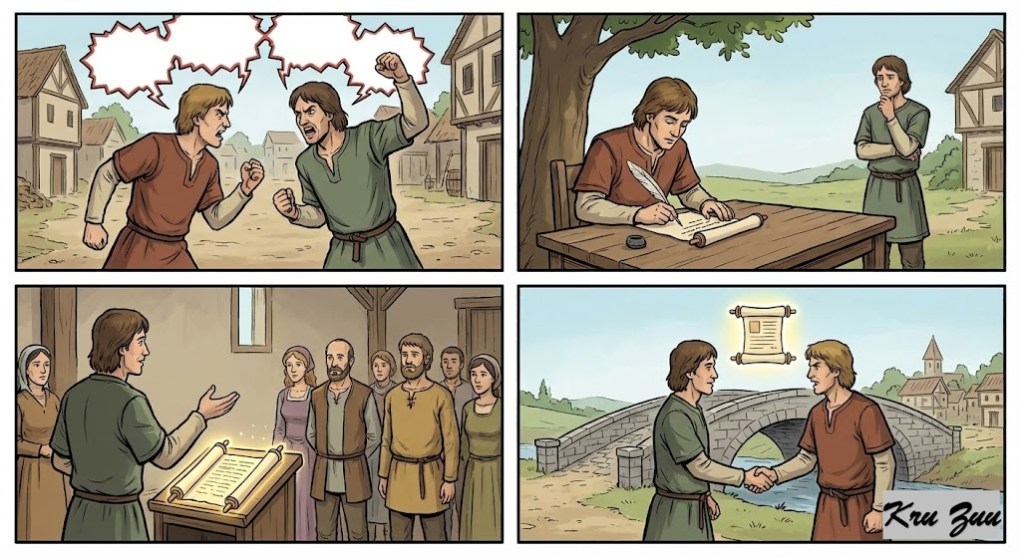
    😈 The Villain (The Barbarian)


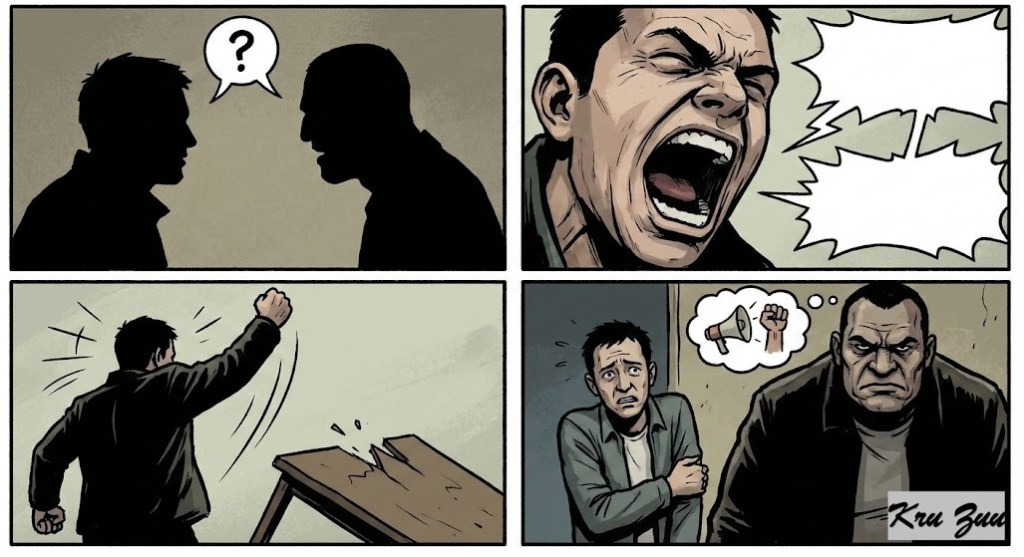
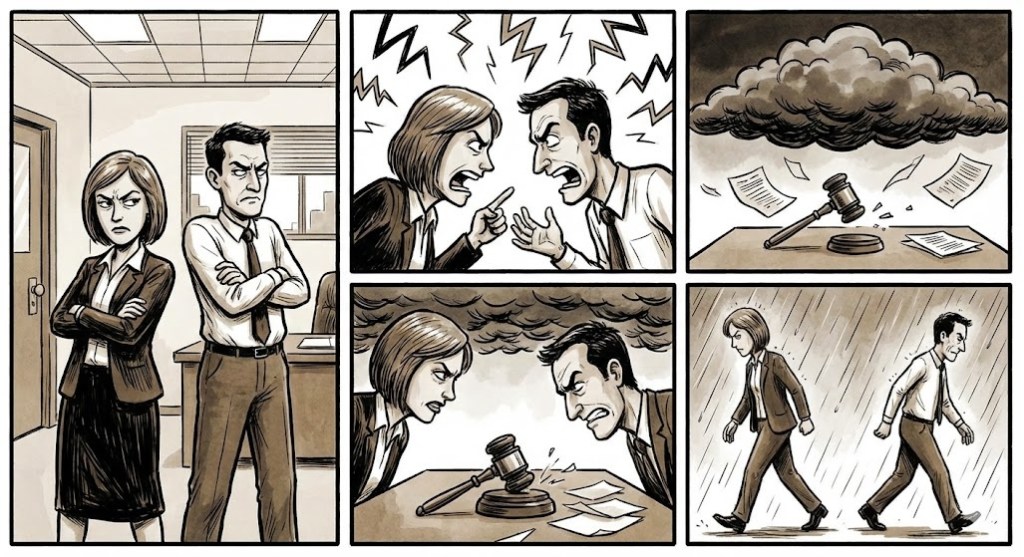
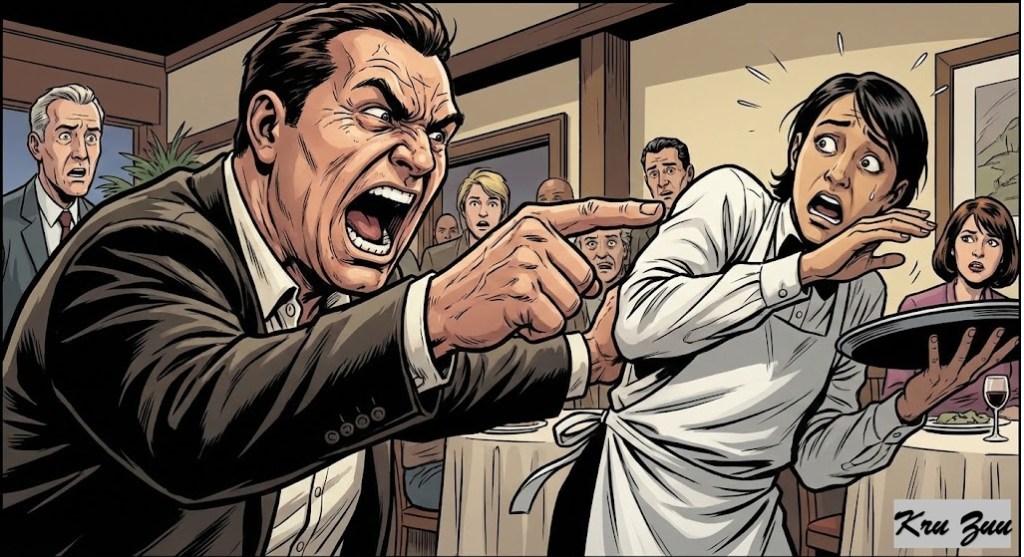
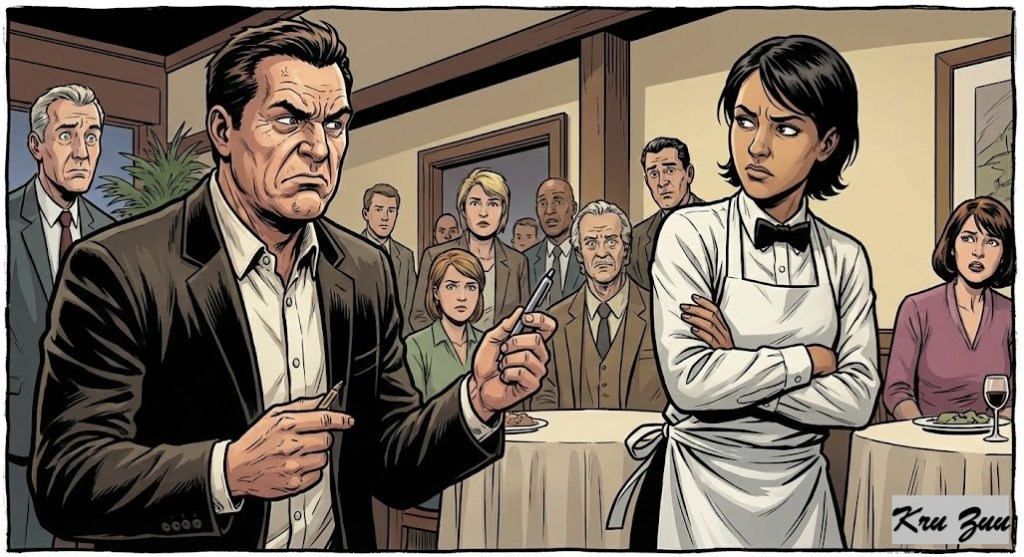
    You encounter a problem. Maybe someone disagrees with you, or you want something someone else has. Your instinct? Scream. Shout. Threaten. Use force. You think, “If I am louder and stronger, I win.”

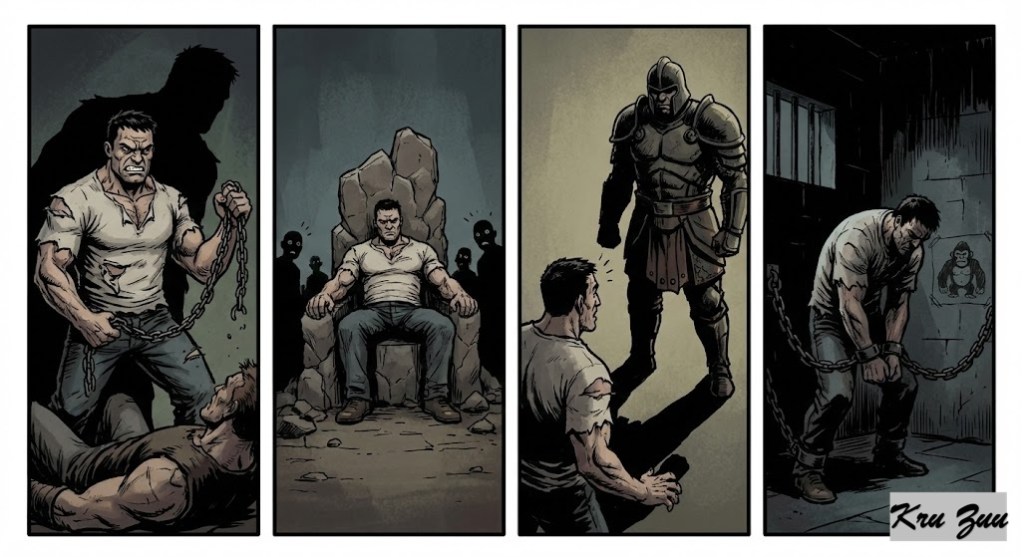
    The Result? You might win the battle, but you lose the war. You create enemies. People fear you, but they don’t respect you. Physical force is temporary; eventually, someone stronger than you will come along. You are a slave to Brute Force. 🦍


    😇 The Hero (The Diplomat)


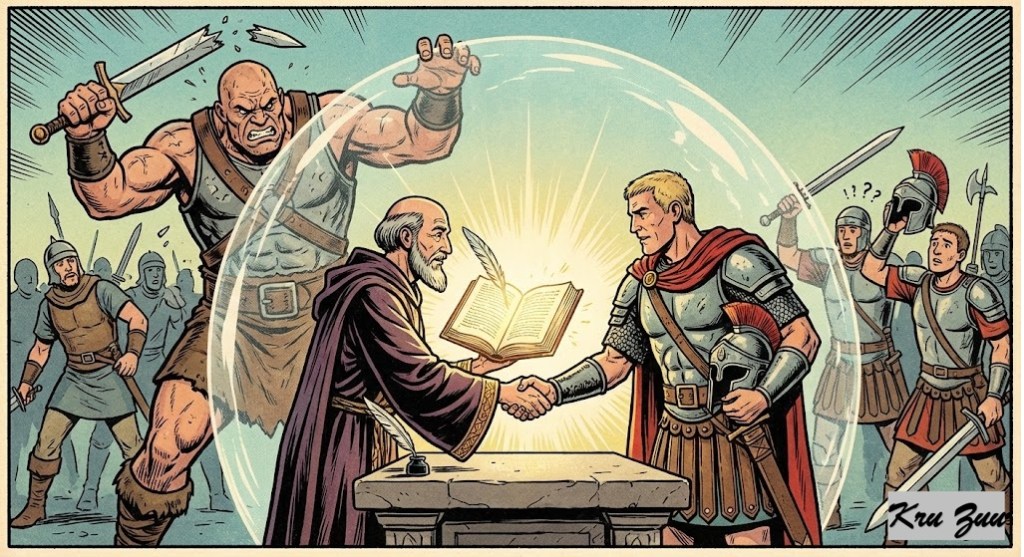
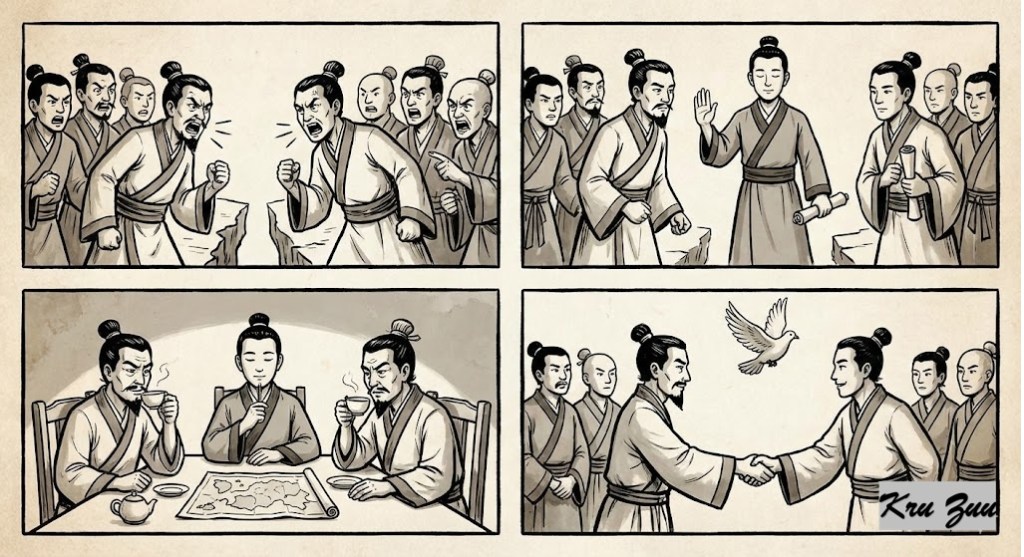
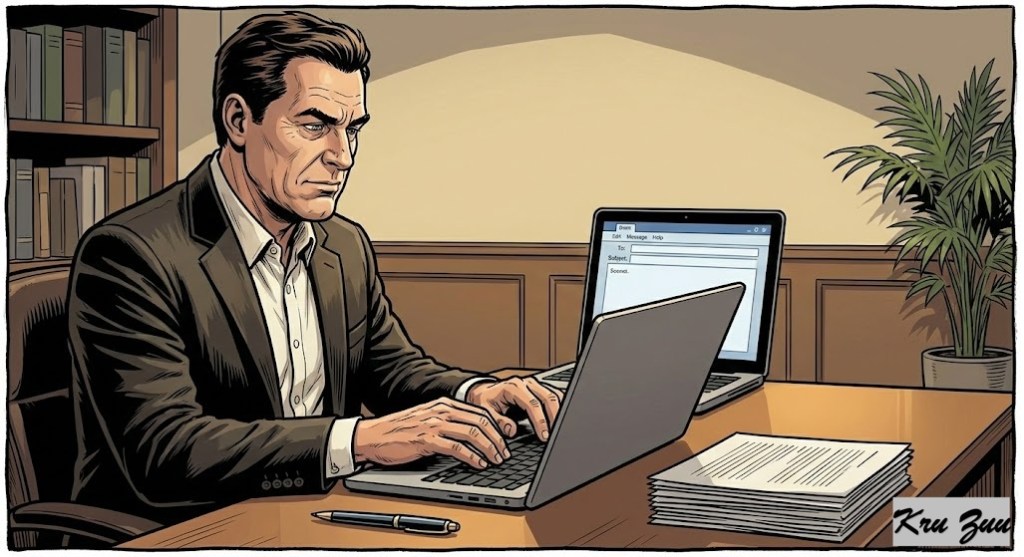
    You face a conflict. Instead of raising your voice (or your fist), you sharpen your mind. You write a persuasive email. You speak with logic and emotion. You use words to change how people think.

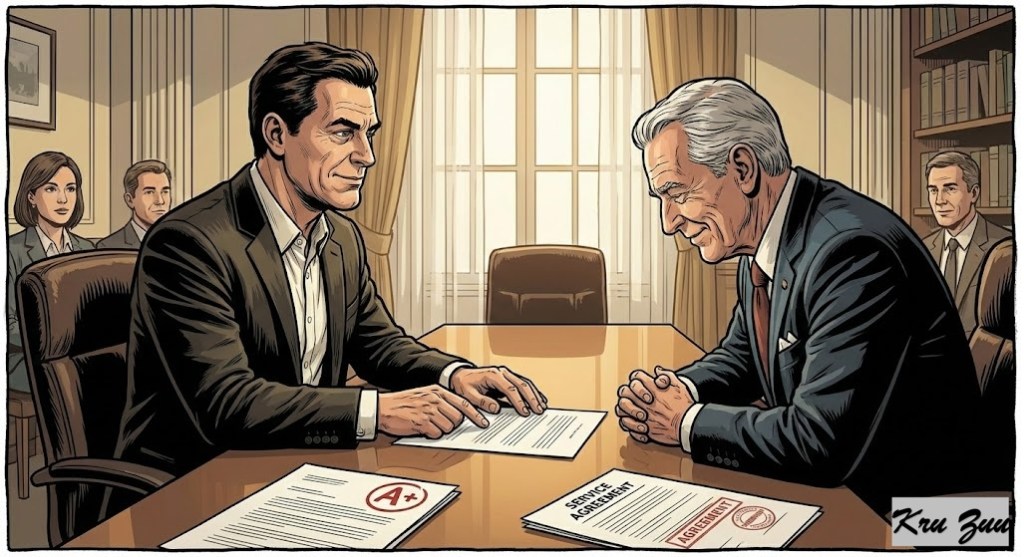
    The Result? You solve the problem without bloodshed. You turn enemies into allies. You create a change that lasts forever because you changed the mind, not just the situation. You wield the ultimate weapon: The Truth. 📜


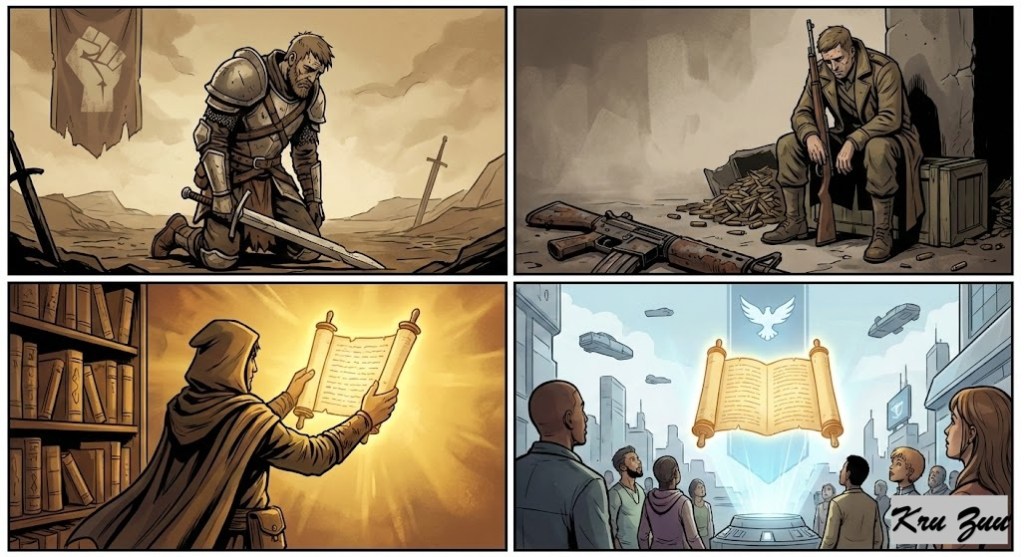
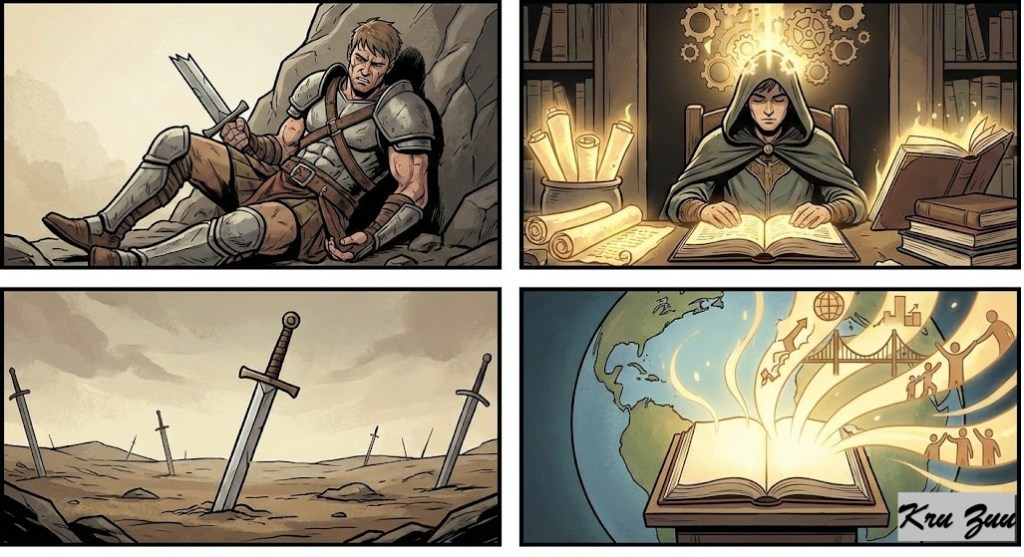
    ⚖️ The Reality


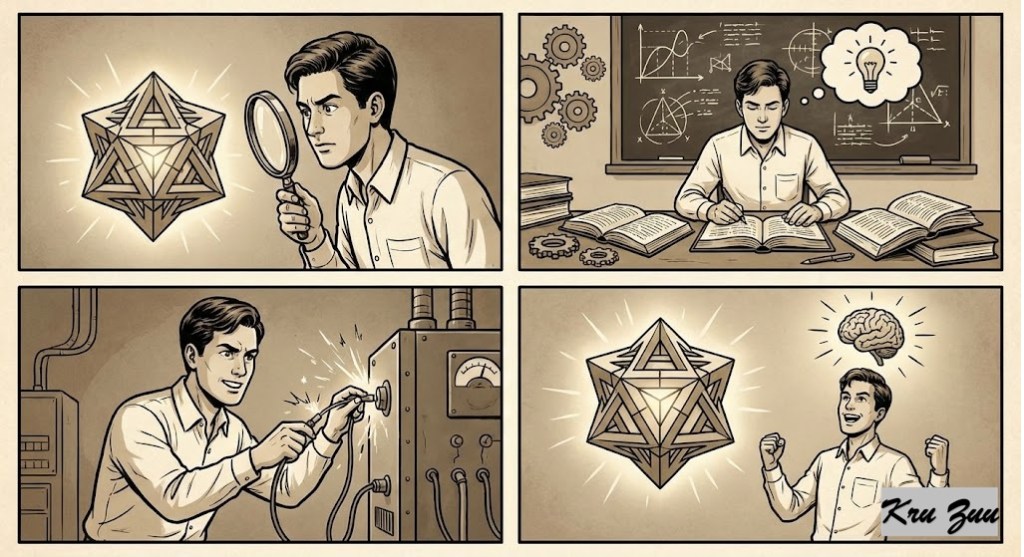
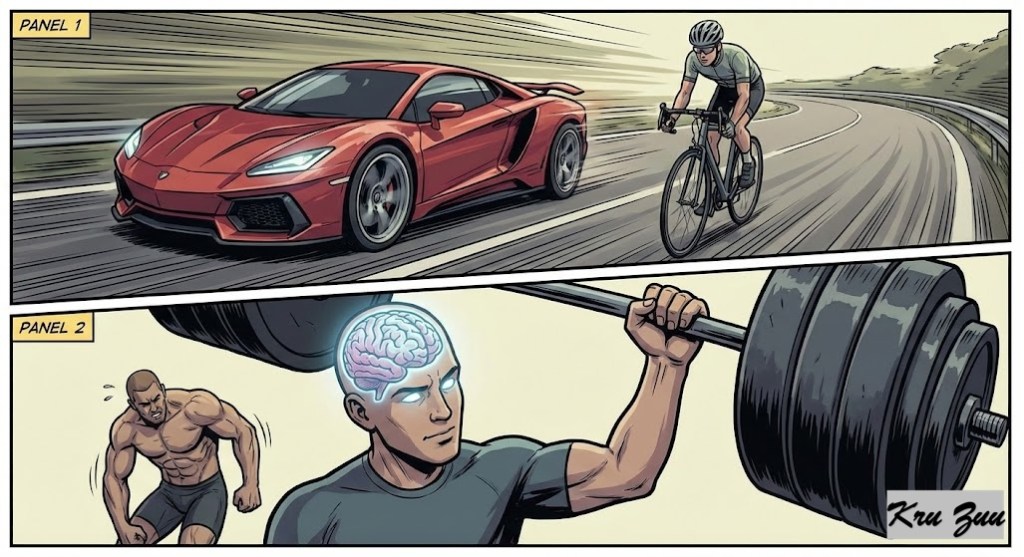
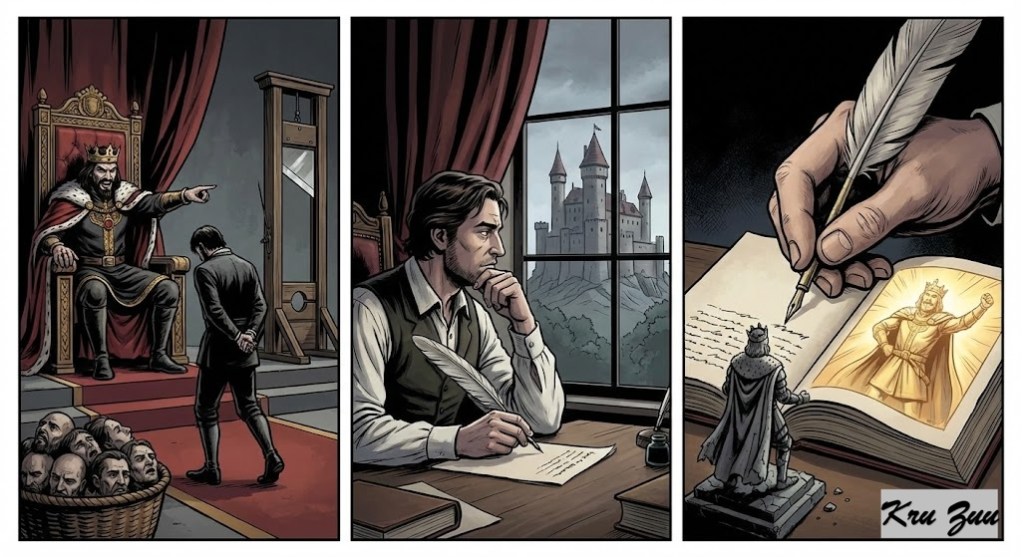
    Muscles get tired. Swords rust. Guns run out of bullets. But an Idea? An idea written down can live for 1,000 years. It can start revolutions, stop wars, and build nations. Violence forces the body to obey; Words inspire the soul to follow.


    💎 The Secret


    Physical strength is limited. Intellectual strength is infinite. A sword can kill one man, but a book can change the world.

    🧐 The Anatomy of the Proverb


    This proverb teaches the power of communication over violence.


    The Pen (Noun): A tool for writing. (Symbolizes: Intellect, diplomacy, communication, laws, history).


    Mightier (Adjective – Comparative): Stronger; having more power. 💪


    The Sword (Noun): A weapon with a long metal blade. (Symbolizes: Violence, war, physical force, coercion). ⚔️


    Simpler Version: Thinking and talking are more effective than fighting.


    📚 Vocabulary Vault


    Persuasion (Noun): The act of convincing someone to do or believe something. (The superpower of the “Pen”).


    Conflict (Noun): A serious disagreement or argument.


    Diplomacy (Noun): The art of dealing with people in a sensitive and effective way.


    Intellect (Noun): The faculty of reasoning and understanding objectively. 🧠


    Coercion (Noun): Persuading someone to do something by using force or threats. (The method of the “Sword”).


    🧠 Grammar Focus: Comparatives


    This proverb is a perfect example of Comparative Adjectives.


    The Rule: When comparing two things, we usually add “-er” to short adjectives and use “than”.


    Mighty (Strong/Powerful) ➡️ Mightier (Note: The ‘y’ turns into ‘ier’).


    Strong ➡️ Stronger


    Sharp ➡️ Sharper


    Example Structure: [Noun A] + [is] + [Adjective-er] + [than] + [Noun B].


    My car is faster than your bike.


    Your brain is stronger than your muscles.

    📜 History: Origin and Spread


    Where did this famous phrase come from?


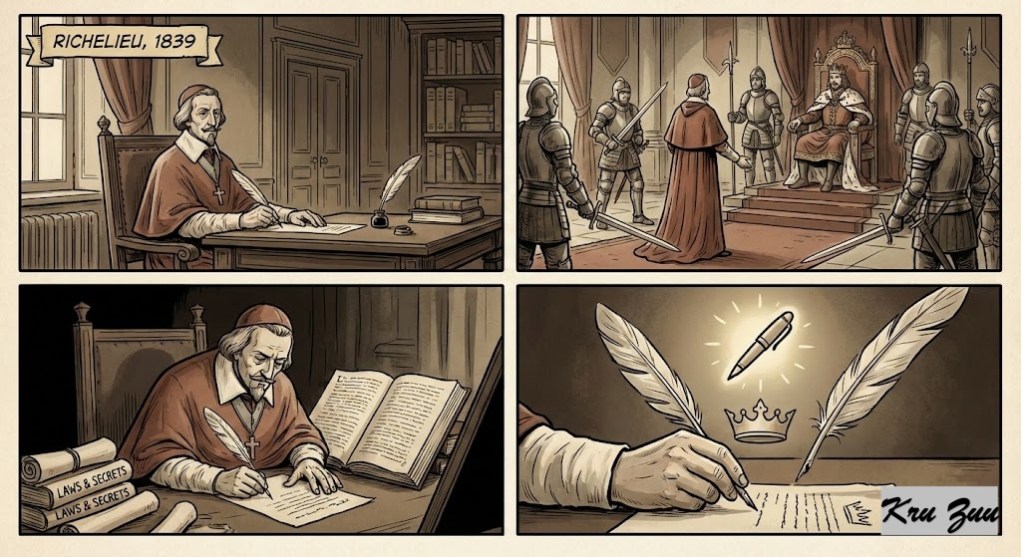
    The Origin:
    It was written by the English author Edward Bulwer-Lytton in 1839 for his play Richelieu. The main character discovers that he can control the King not by fighting him, but by writing laws and secrets.


    The Logic: Kings can cut off heads, but writers decide how history remembers those Kings.


    Global Cousins


    🇹🇷 Turkish:
    “Kalem kılıçtan keskindir.” (The pen is sharper than the sword). — Almost identical!


    🇪🇸 Spanish: “La pluma es más poderosa que la espada.”


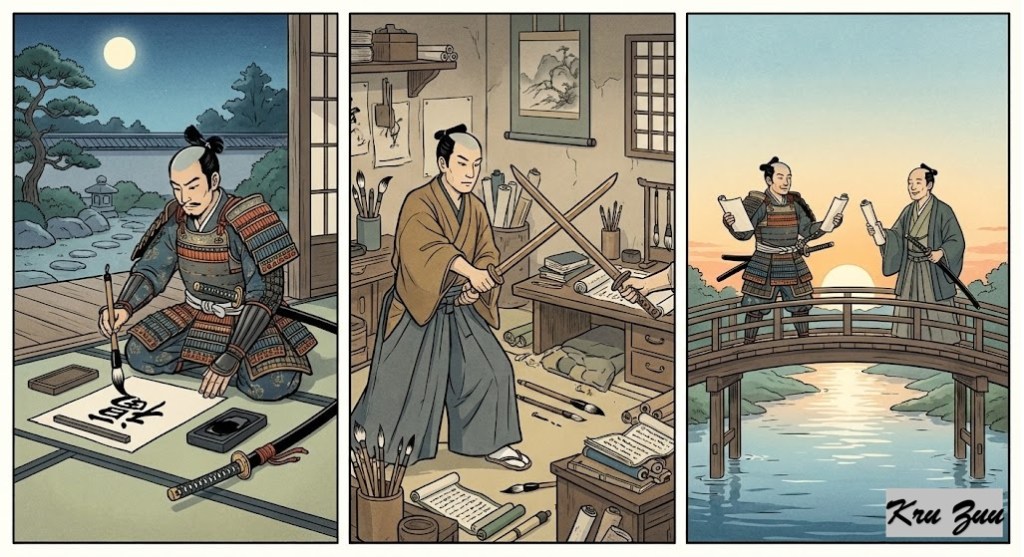
    🇯🇵 Japanese: “Bunbu Ryodo” (The pen and the sword in accord) — Suggesting you need balance.

    🎭 Short Story: The Barnyard Battle


    Let’s see why words win, featuring our animal friends.


    🌟 The Cast


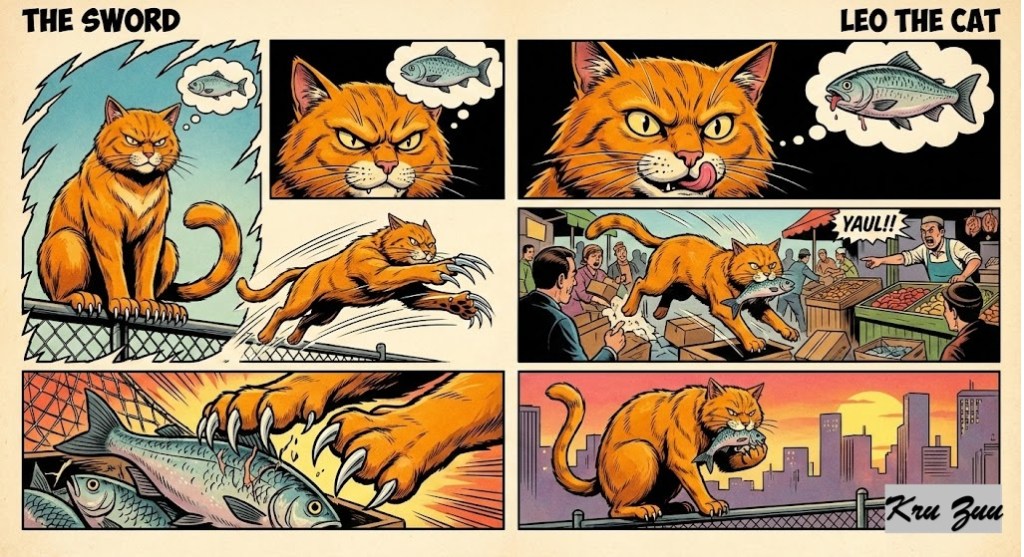
    Leo the Cat:
    Big, strong claws, hungry. Represents The Sword. 😼


    Bella the Chicken: Delicious, scared, physically weak. Represents The Victim. 🐔


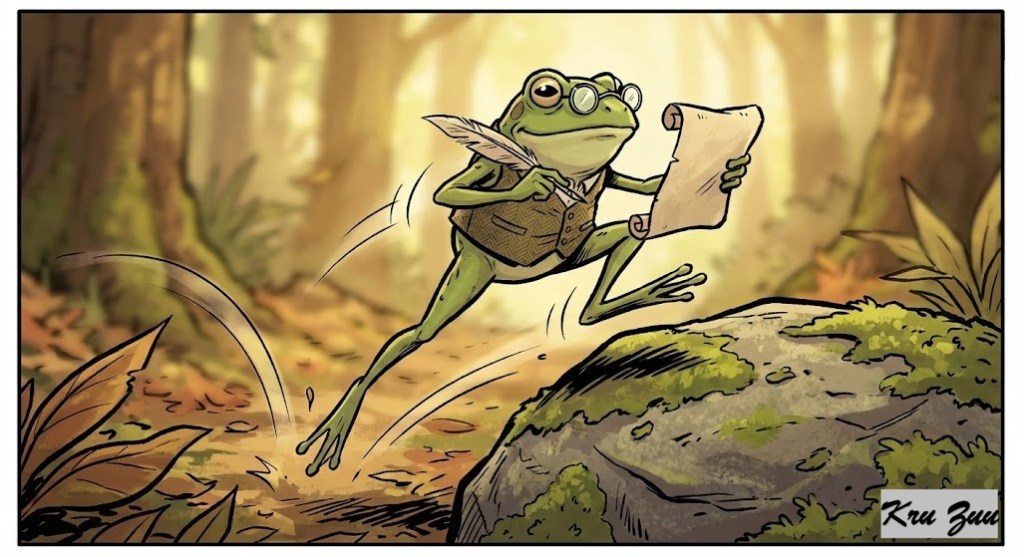
    Professor Croak (The Frog): Small, wears glasses, loves to read. Represents The Pen. 🐸


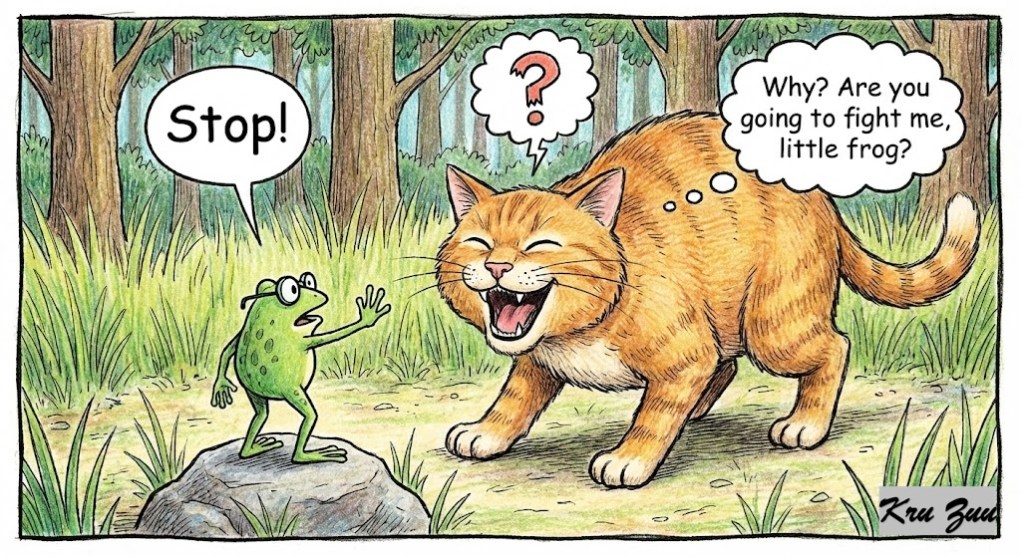
    The Plot: It was a sunny Tuesday. Leo the Cat cornered Bella the Chicken against the barn wall. “I am going to eat you!” Leo hissed, showing his sharp claws. “I am stronger than you. I am faster than you. Physical force wins!”


    Bella trembled. She couldn’t fight. She was doomed.


    Suddenly, Professor Croak hopped onto a rock. He didn’t have claws. He didn’t have muscles. He held a piece of paper and a pen.


    “Stop!” croaked the Professor. “Why?” laughed Leo. “Are you going to fight me, little frog?”


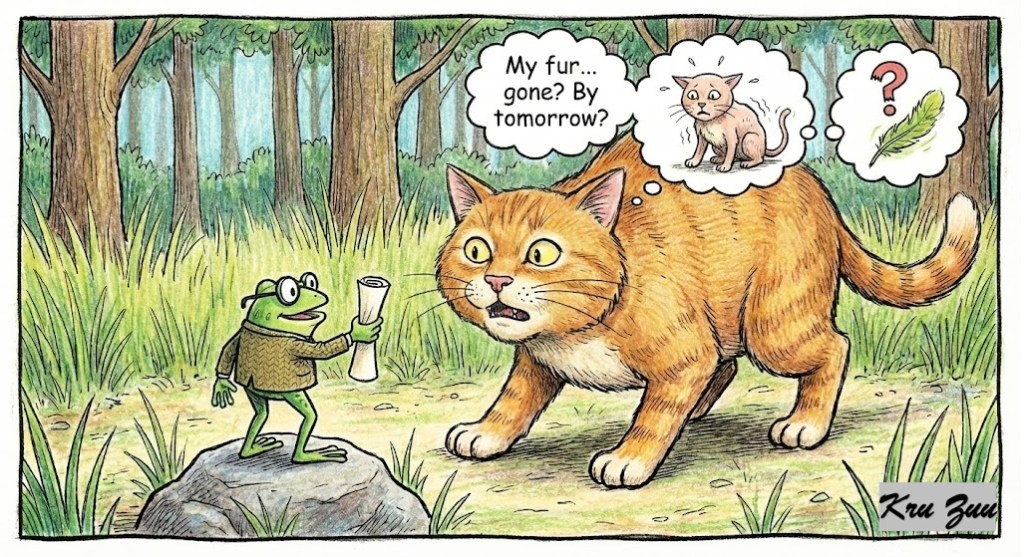
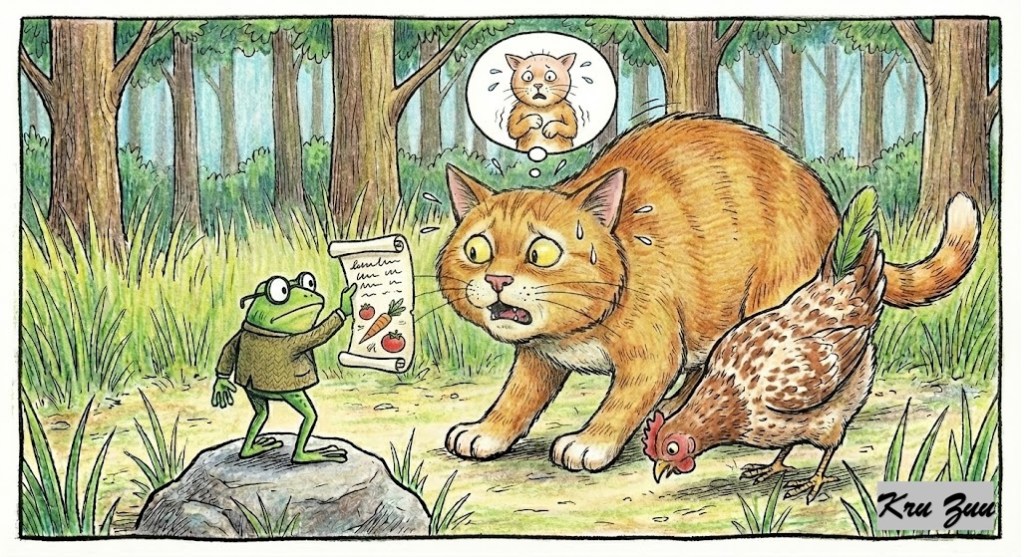
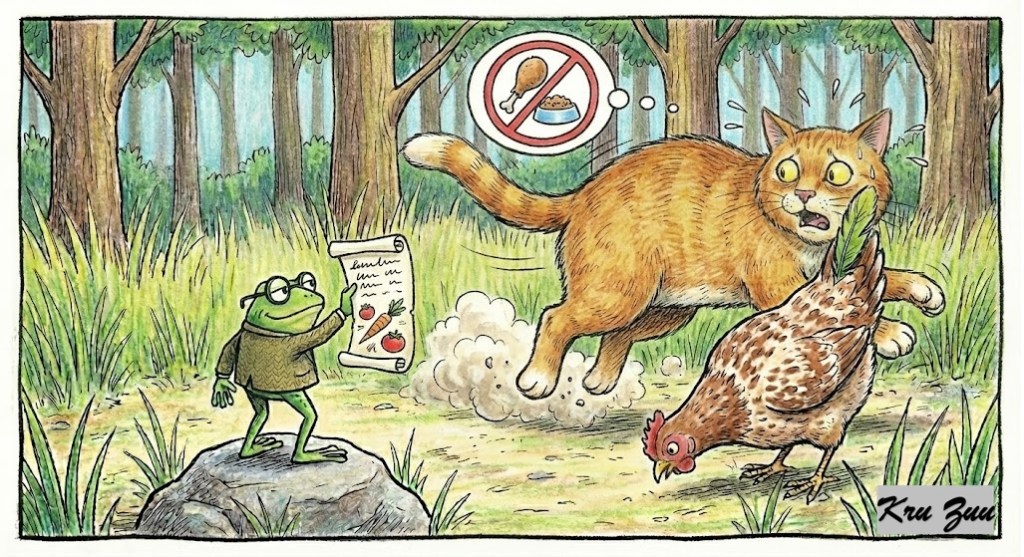
    “No,” said Professor Croak calmly. “But I just wrote a letter to the Farmer. In this letter, I explained that Bella has the ‘Green-Feather Flu’. It is very contagious to cats. If you bite her, your beautiful fur will fall out by tomorrow morning.”


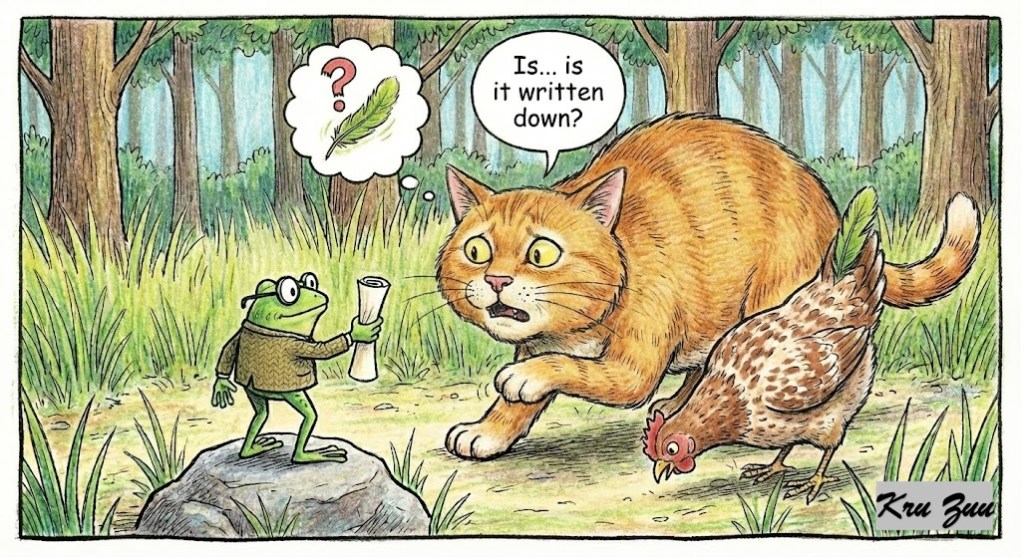
    Leo froze. He looked at Bella. She looked fine, but… was that a green feather? “Is… is it written down?” Leo asked nervously.


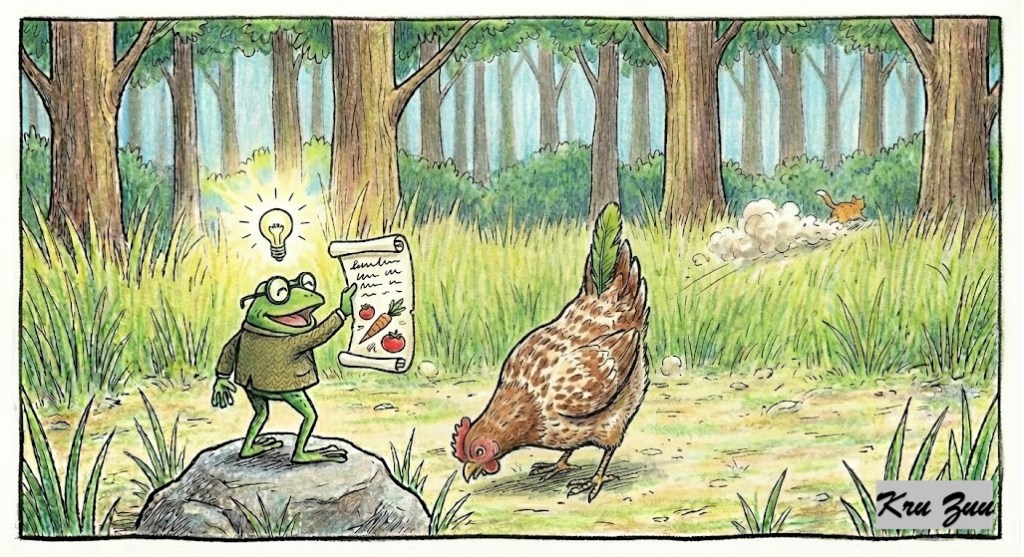
    “Yes,” said the Frog, holding up the paper (which was actually just a grocery list, but Leo couldn’t read). “It is documented. The Pen has spoken.”


    Leo panicked. He valued his fur more than his dinner. “I’m not hungry anyway!” he shouted and ran away.


    The Moral: Professor Croak couldn’t fight the Cat (The Sword). But using his intelligence and a “written” lie (The Pen), he saved the day. Smart beats Strong.

    🎓 Lesson for English Learners


    Words unlock doors that kicks cannot.


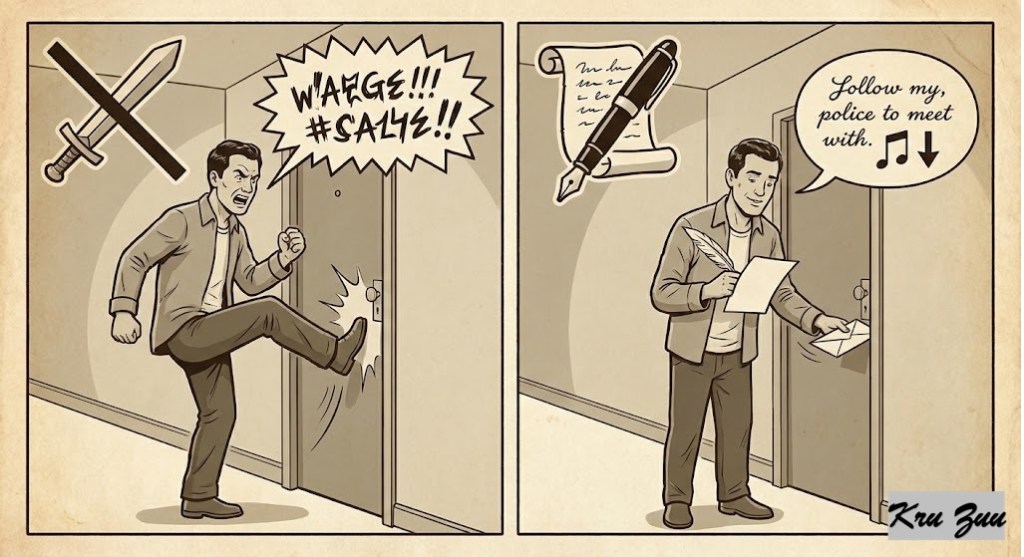
    Situation: You are unhappy with a grade or a service. The “Sword”

    Approach: You shout at the teacher or the waiter.

    Result? They get defensive. You get nothing. The “Pen”

    Approach: You write a polite, logical email explaining your point using the correct vocabulary.

    Result? They listen. They respect you. You get what you want.


    Your Goal: Don’t just learn English to order coffee. Learn English to persuade, to negotiate, and to tell your story. That is real power.


    💬 Your Turn: The Writer’s Challenge 🚀


    History is full of speeches and letters that changed the world.


    The Challenge:
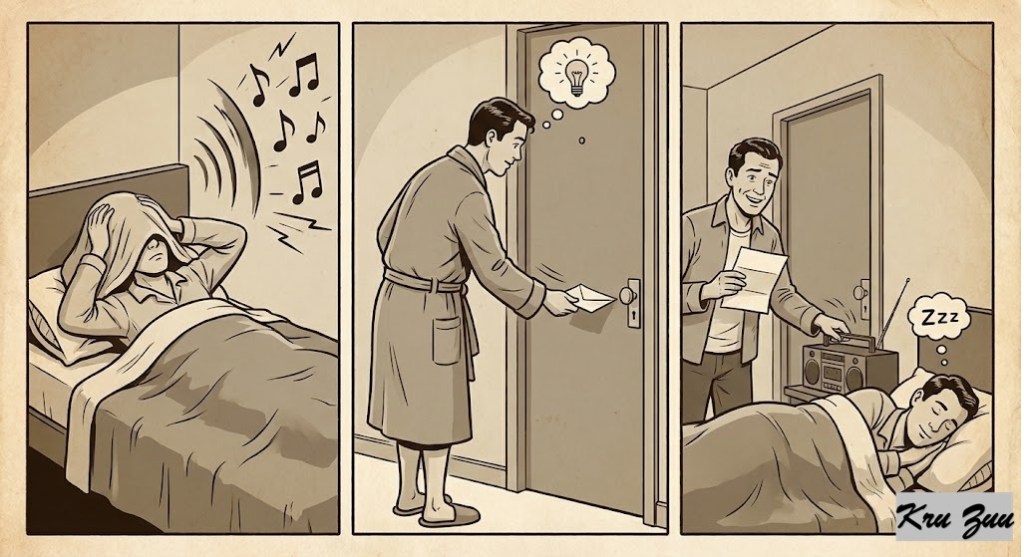
    Think of a problem you have right now (maybe a noisy neighbor, or a friend who is angry). Don’t fight. Write a 3-sentence message to solve it politely.


    Example:Instead of: “Shut up!” (Sword) ⚔️ Write: “Hey! I have a big exam tomorrow and the music is a bit loud. Could you please turn it down? Thanks!” (Pen) 🖋️


    Question: When was the last time you used “words” to get out of trouble? Tell us in the comments! 👇

    By Zubeyir YURTKURAN

    https://www.facebook.com/BrainBattleground/

    https://www.facebook.com/zubeyr.yurtkuran/

    https://www.instagram.com/zubeyryurtkuran/
    https://www.youtube.com/@BrainBattleground-b3p

    https://www.instagram.com/brainbattleground/