Tag: jesus

  • 💘 The Daily Shield: The Law of Invisible Red Flags

    💘 The Daily Shield: The Law of Invisible Red Flags

    “Love is blind.”


    😈 The Villain (The Hopeless Romantic)

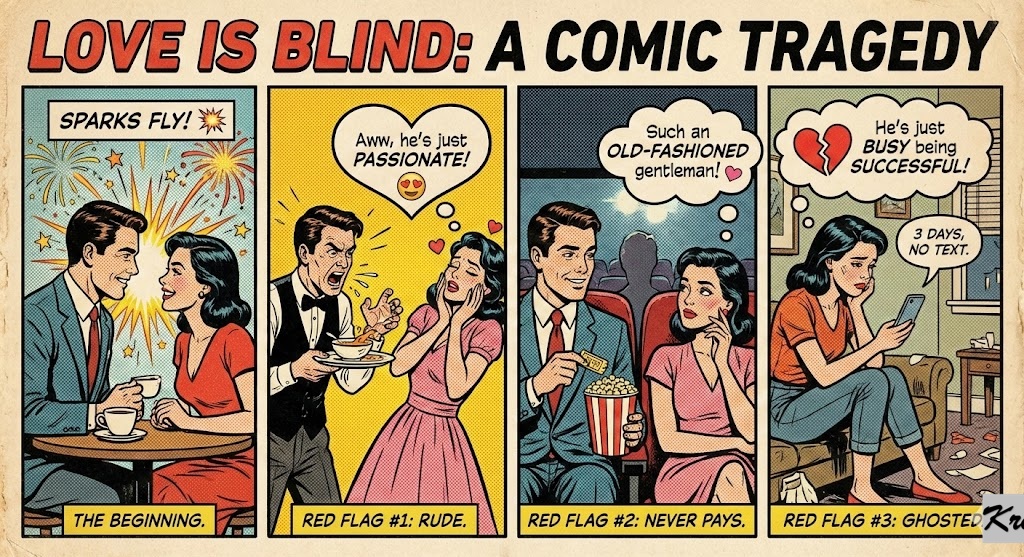
    You meet someone new. Sparks fly. 🎇 Suddenly, logic leaves the building. They are rude to the waiter? “Oh, he’s just passionate.” She never pays for anything? “She’s just old-fashioned.” They ghost you for three days? “They are just so busy being successful!” You ignore the warning signs. You project your fantasy onto a flawed reality.
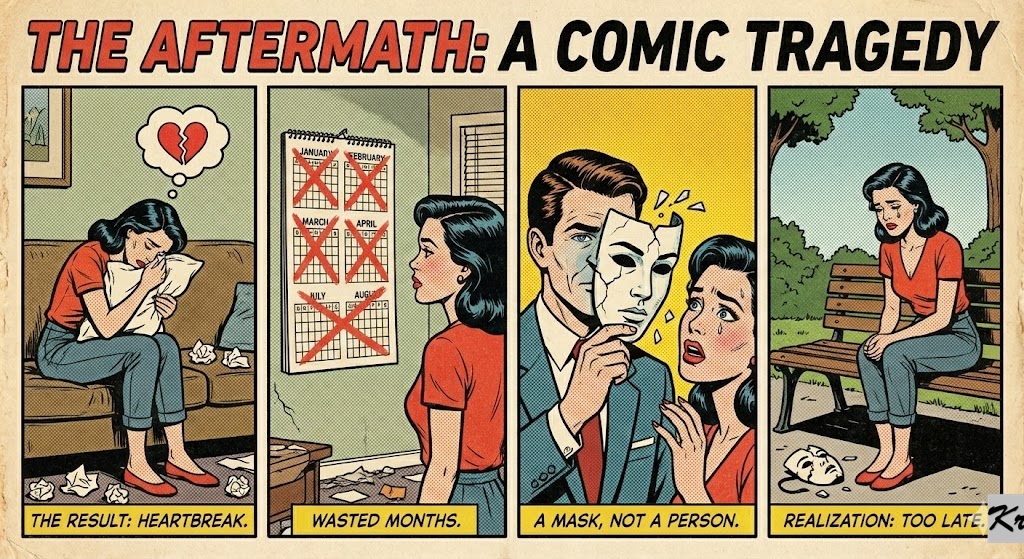
    The Result? You get heartbroken. You waste months on a relationship that was doomed from day one. You realize too late that you fell in love with a mask, not a person. 🎭

    😇 The Hero (The Conscious Partner)

    You feel the chemistry, but you keep your eyes open. 👀 You love them, but you acknowledge their flaws. You think: “He is funny, but he is terrible with money. Can I live with that?” or “She is beautiful, but she has a bad temper. Is she working on it?” You don’t ignore the red flags; you address them.
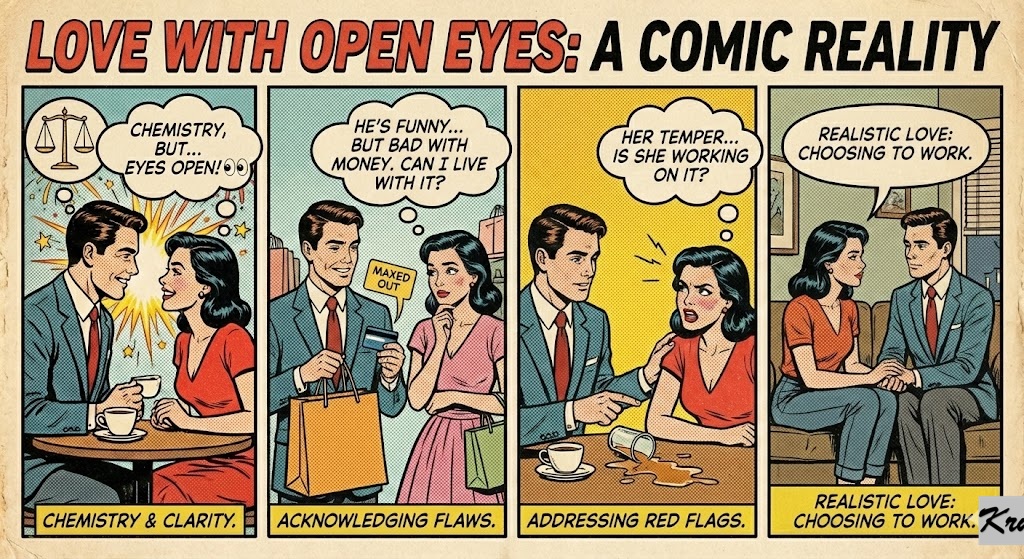
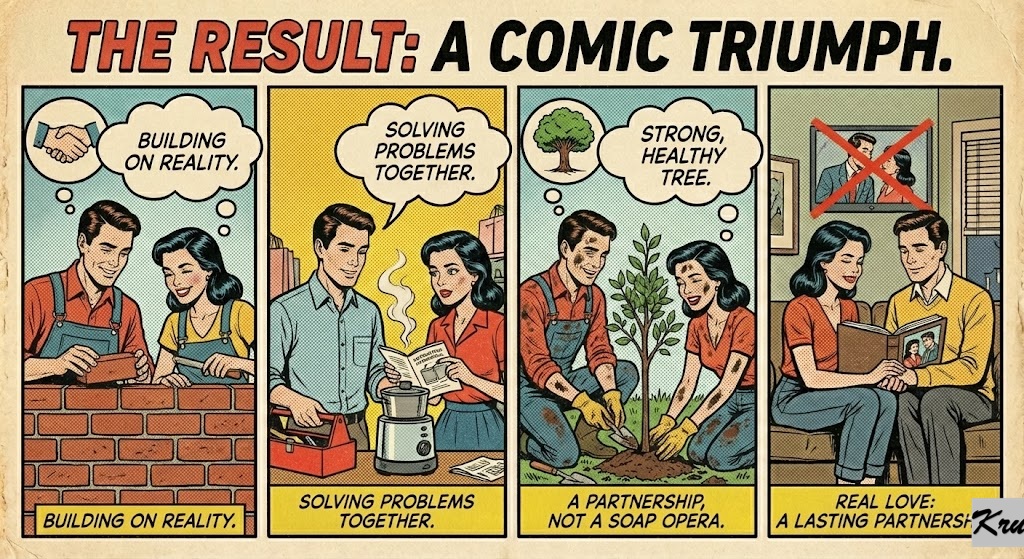
    The Result? You build a relationship based on trust and reality, not fantasy. When problems happen, you solve them because you saw them coming. You build a partnership, not a soap opera. 🤝

    ⚖️ The Reality


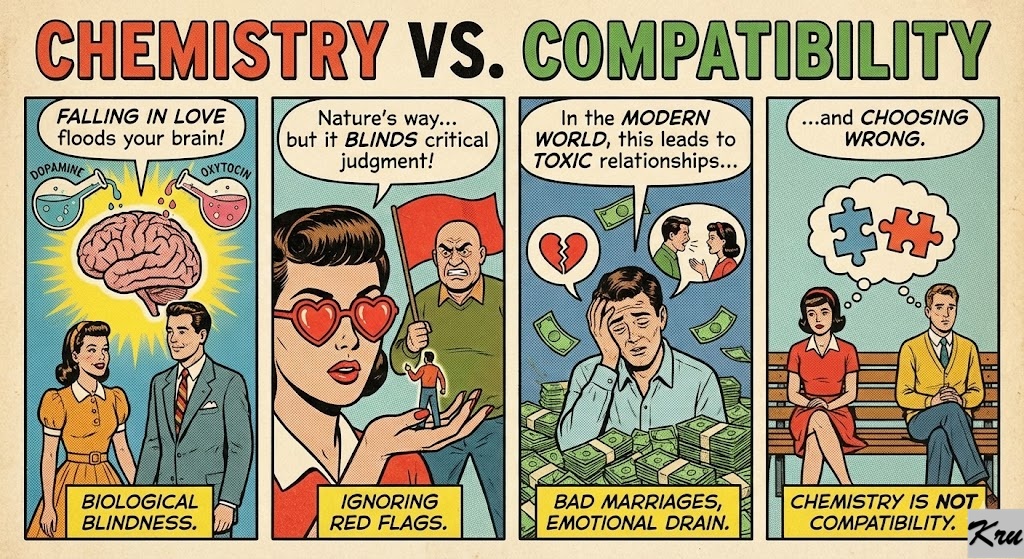
    Chemistry vs. Compatibility. Biologically, falling in love floods your brain with dopamine and oxytocin. These chemicals literally “blind” the critical judgment part of your brain. It is nature’s way of making sure humans pair up. But in the modern world, this biological blindness can lead to toxic relationships, bad marriages, and emotional drain.

    💎 The Secret

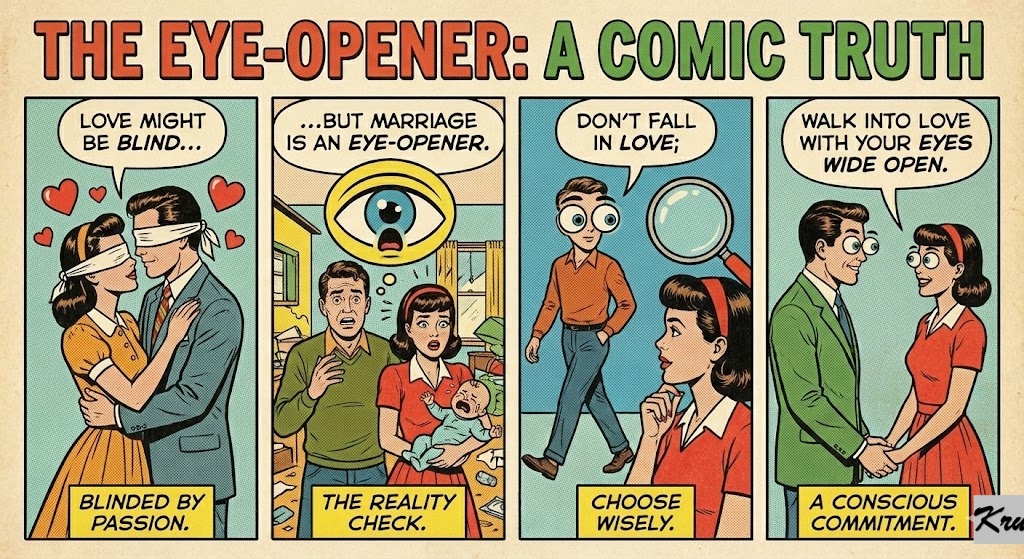
    Love might be blind, but marriage (or long-term commitment) is an eye-opener. Don’t fall in love; walk into love with your eyes wide open.
    🧐 The Anatomy of the Proverb


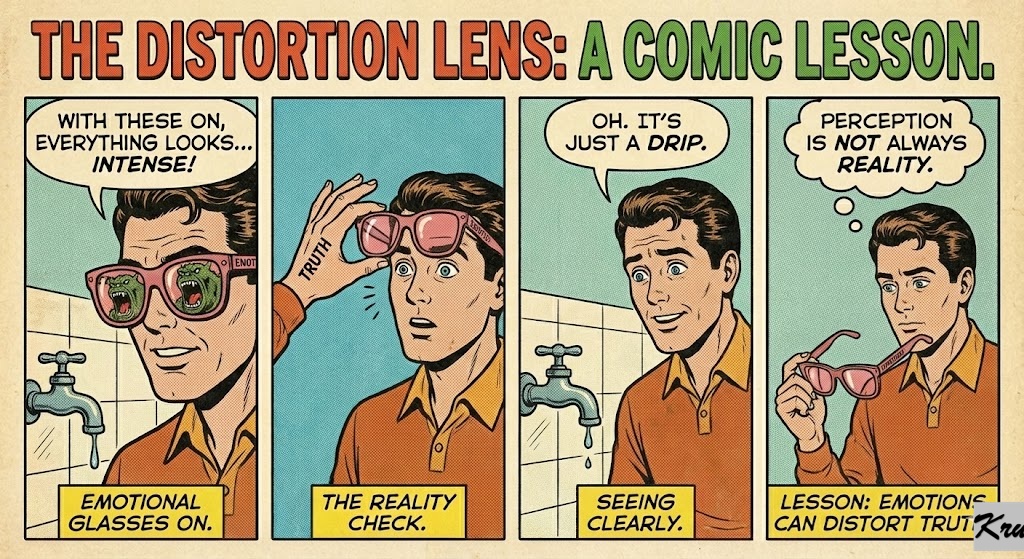
    This is your reality check that emotions can distort your perception of the truth.

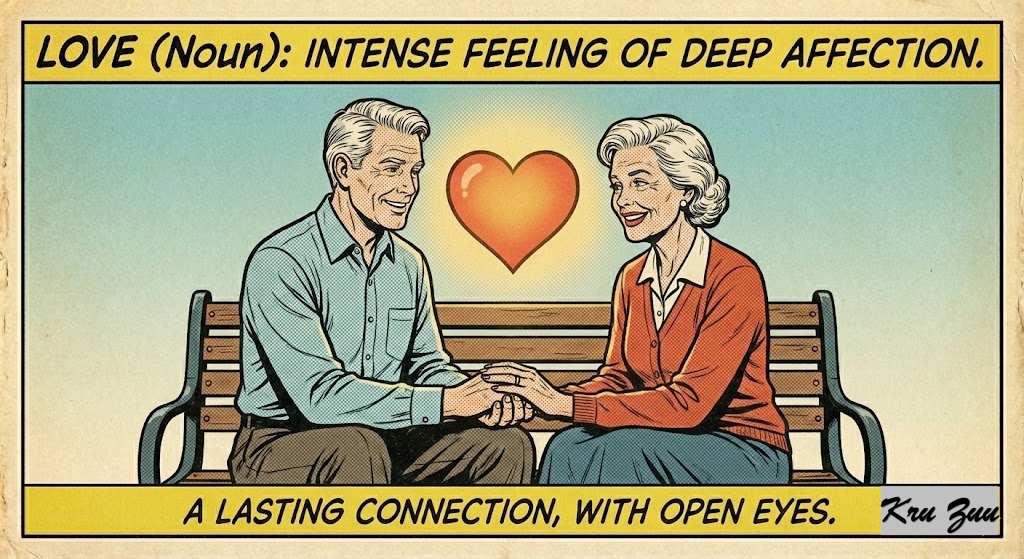
    Love (Noun): Intense feeling of deep affection.

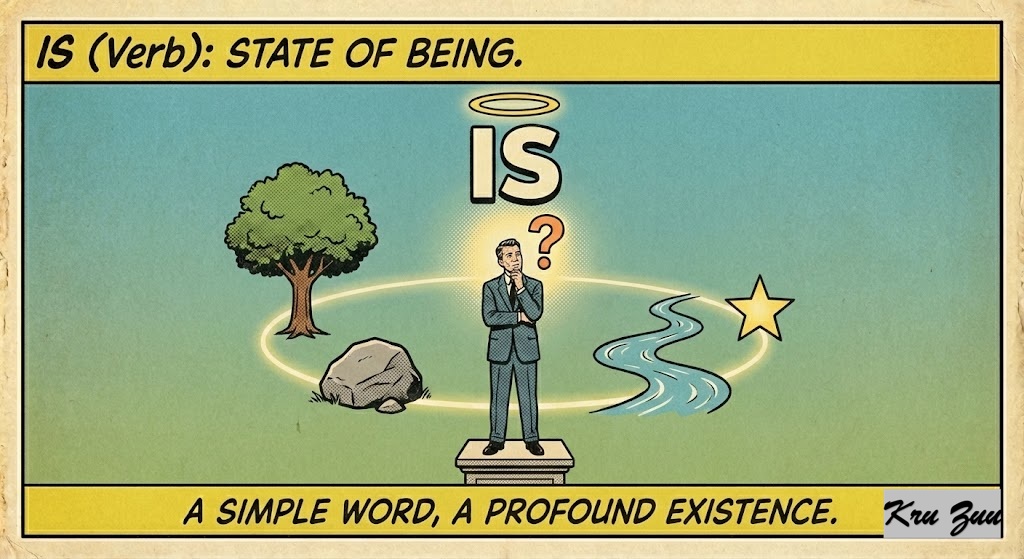
    Is (Verb): State of being.

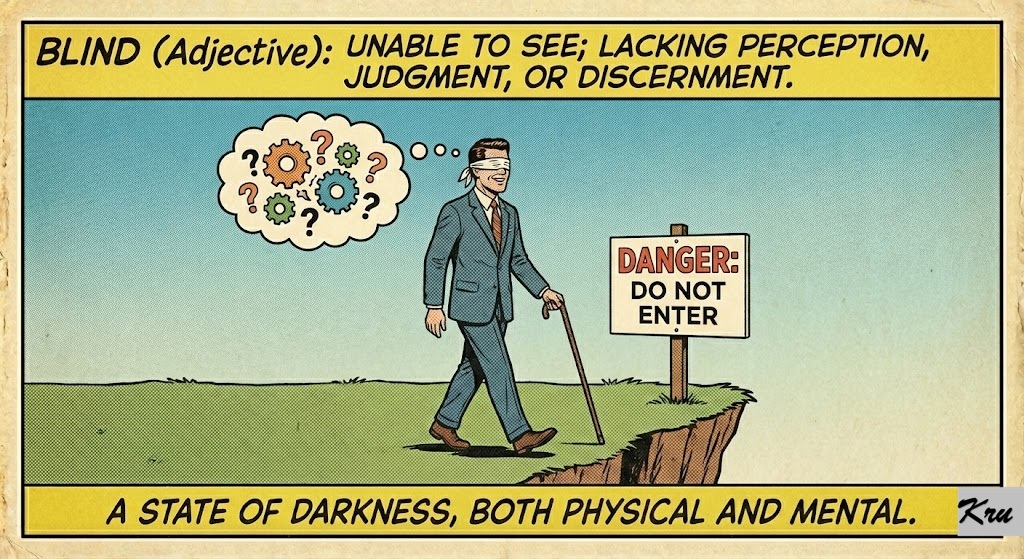
    Blind (Adjective): Unable to see; lacking perception, judgment, or discernment.

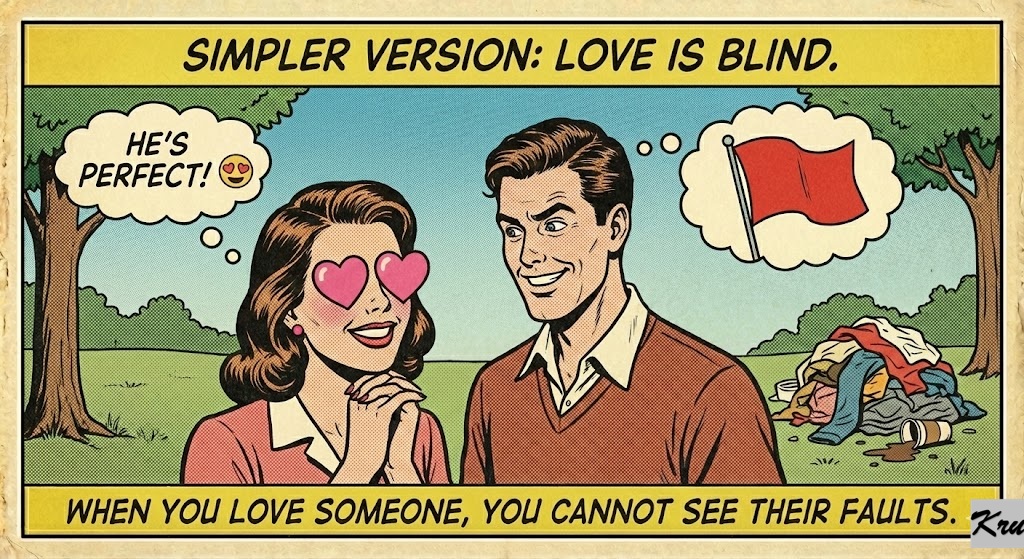
    Simpler Version: When you love someone, you cannot see their faults.

    📚 Vocabulary Vault


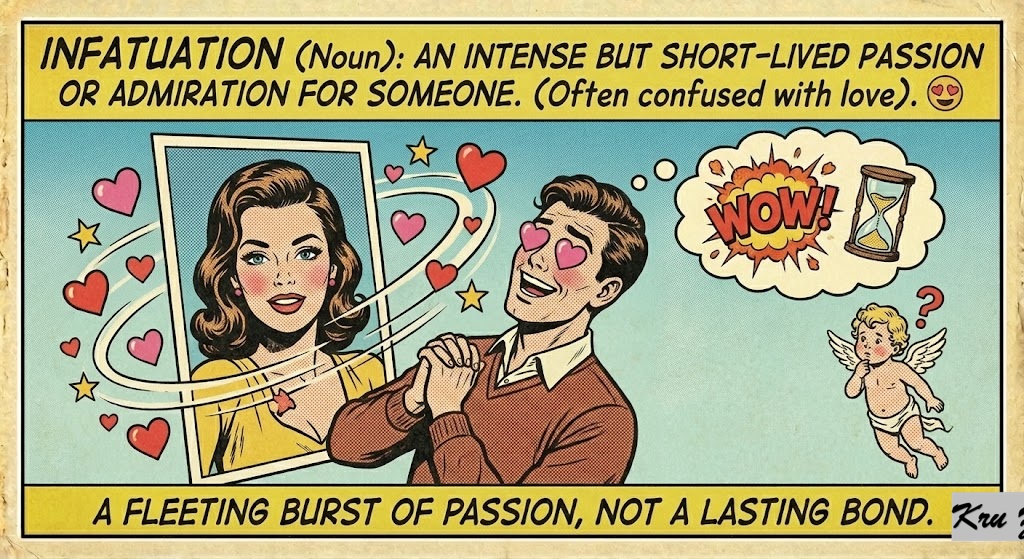
    Infatuation (Noun): An intense but short-lived passion or admiration for someone. (Often confused with love). 😍

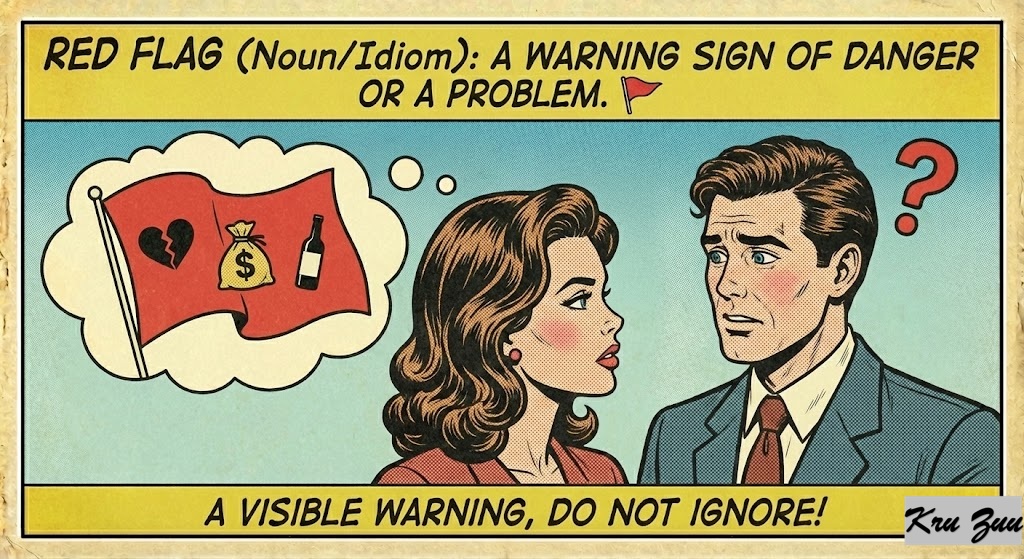
    Red Flag (Noun/Idiom): A warning sign of danger or a problem. 🚩

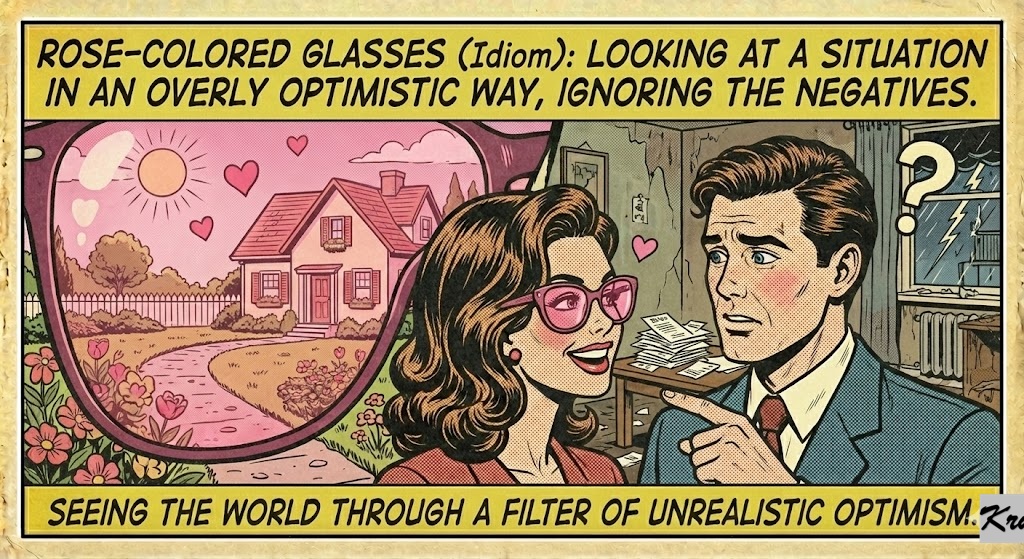
    Rose-colored glasses (Idiom): Looking at a situation in an overly optimistic way, ignoring the negatives.
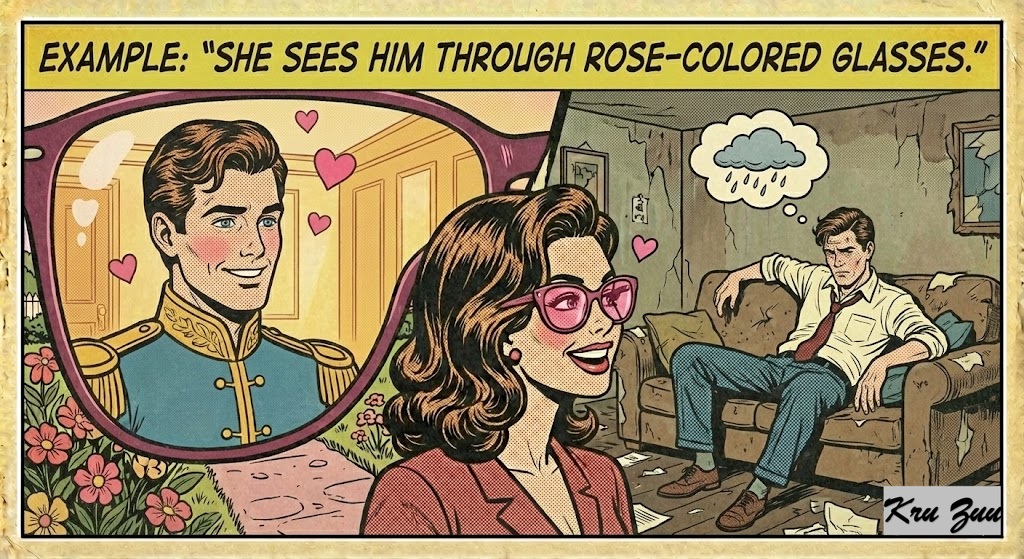
    Example: “She sees him through rose-colored glasses.” 🕶️

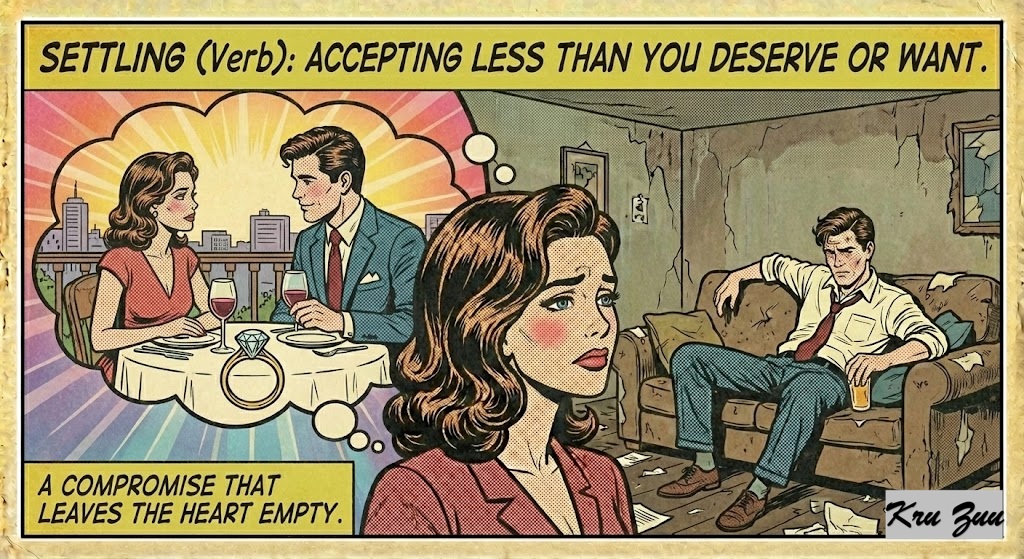
    Settling (Verb): Accepting less than you deserve or want.

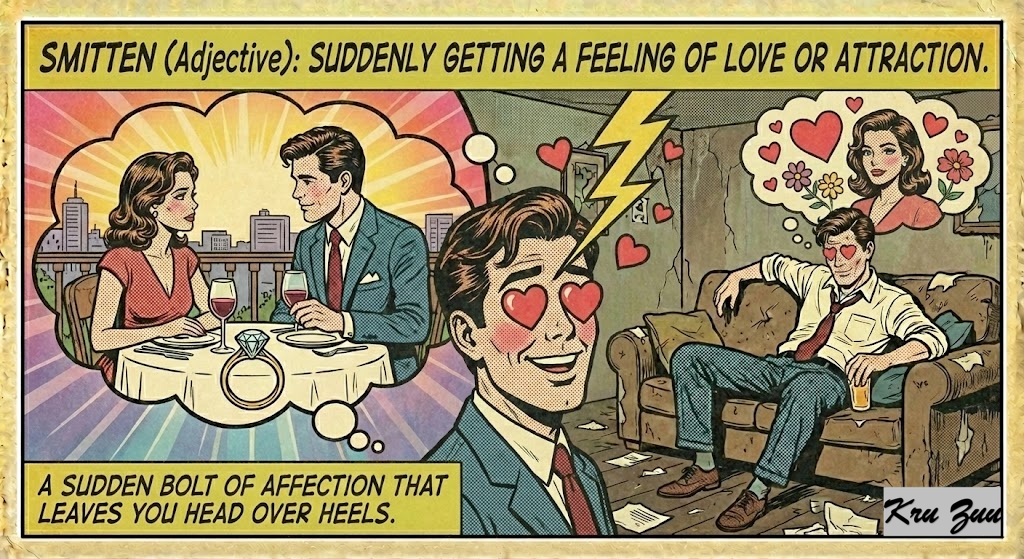
    Smitten (Adjective): Suddenly getting a feeling of love or attraction.

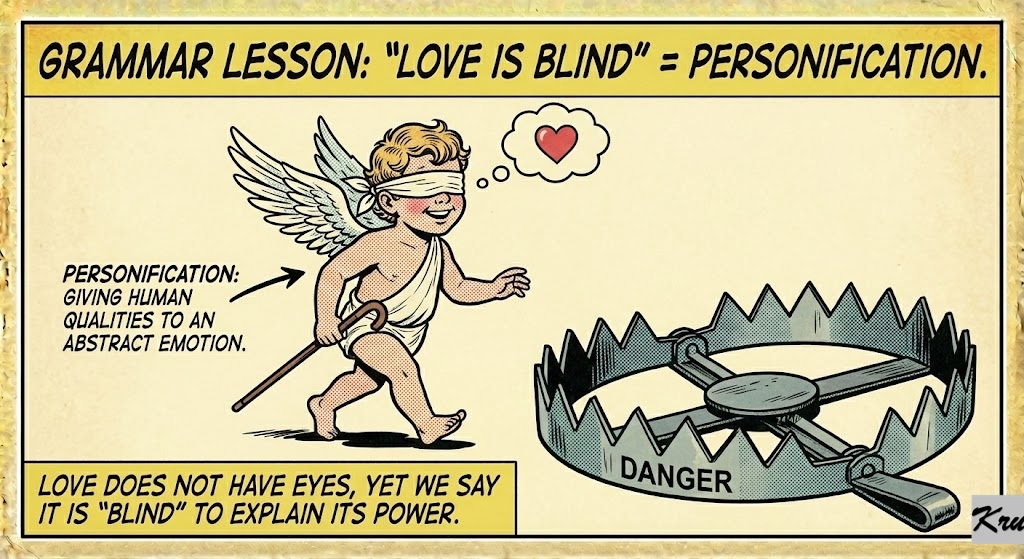
    🧠 Grammar Focus: Personification


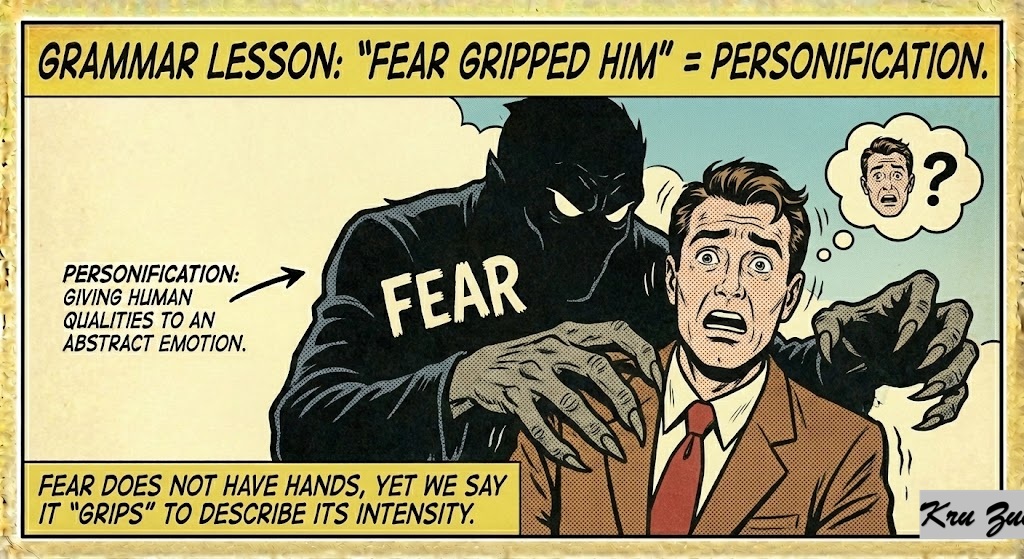
    “Love is blind.” Grammatically, this is Personification. Love is an abstract emotion. It does not have eyes. It cannot literally be blind. However, we give it human qualities to explain how powerful it is. It acts like a person who has lost their sight.

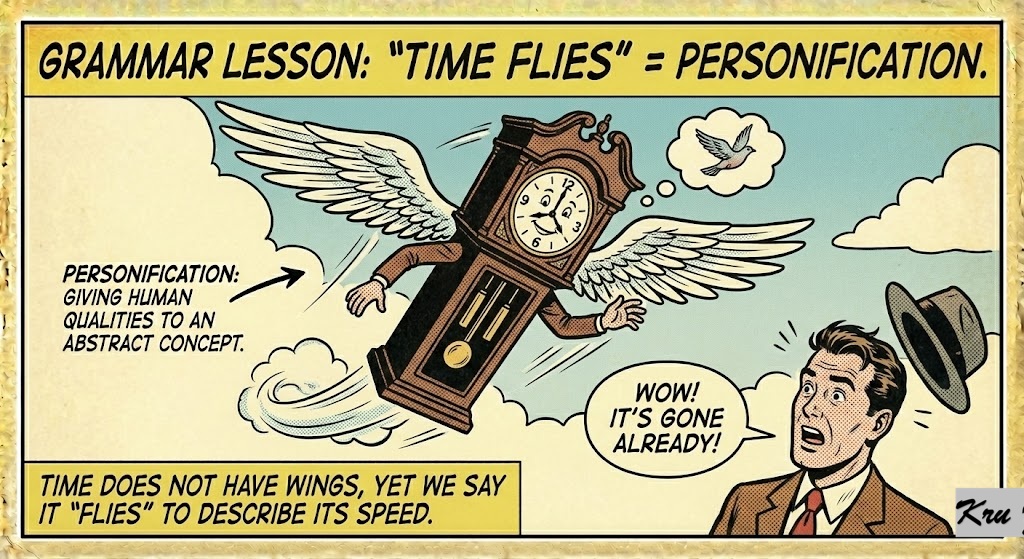
    Other examples


    “Time flies.” (Time doesn’t have wings).

    “Fear gripped him.” (Fear doesn’t have hands).
    📜 History: Origin and Spread


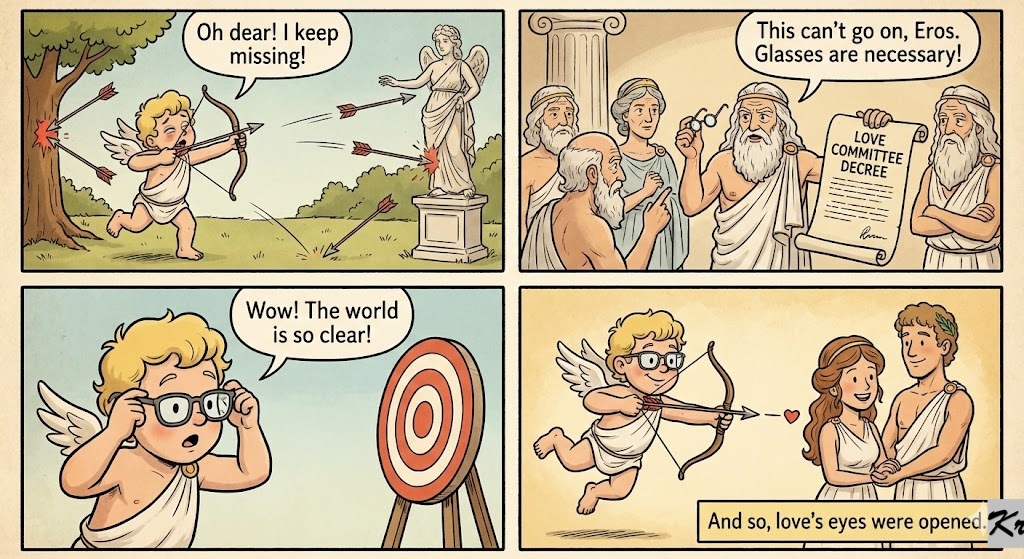
    Who first decided that Cupid needs glasses?

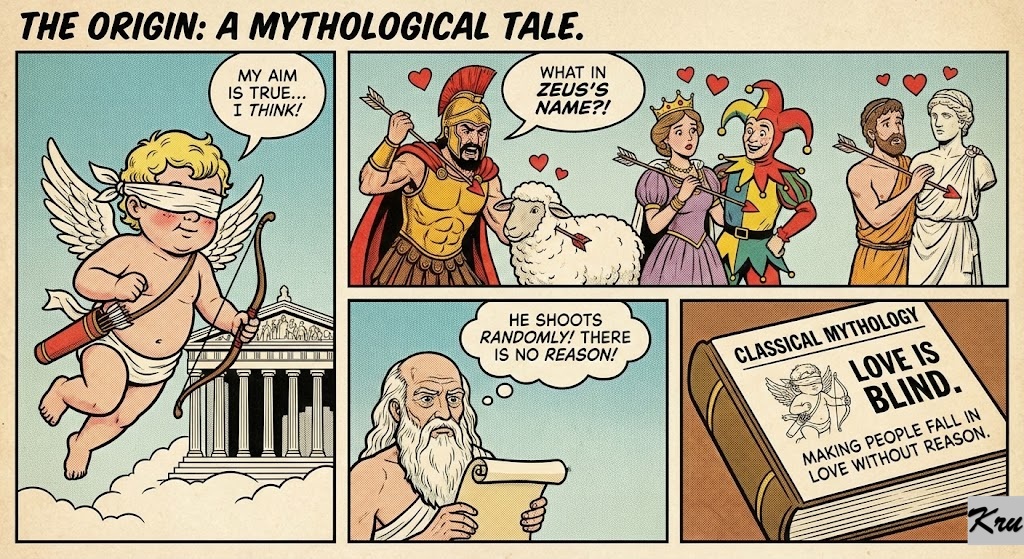
    The Origin: This idea is ancient. In Classical Mythology, Cupid (the god of affection) is often depicted wearing a blindfold. He shoots his arrows randomly, making people fall in love without reason.

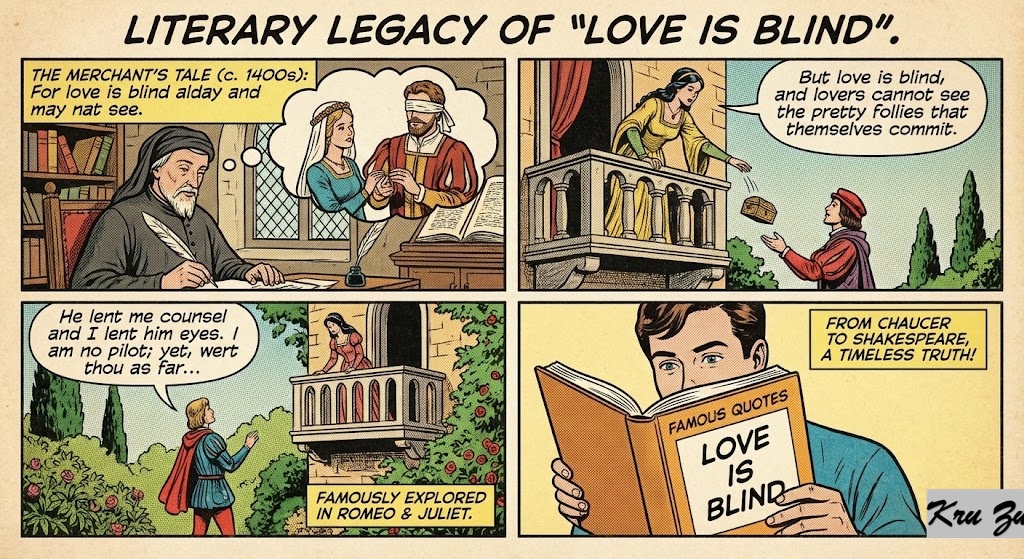
    The Writer: Geoffrey Chaucer used the phrase in the 1400s, but William Shakespeare made it famous in The Merchant of Venice and Romeo and Juliet.

    Global Cousins


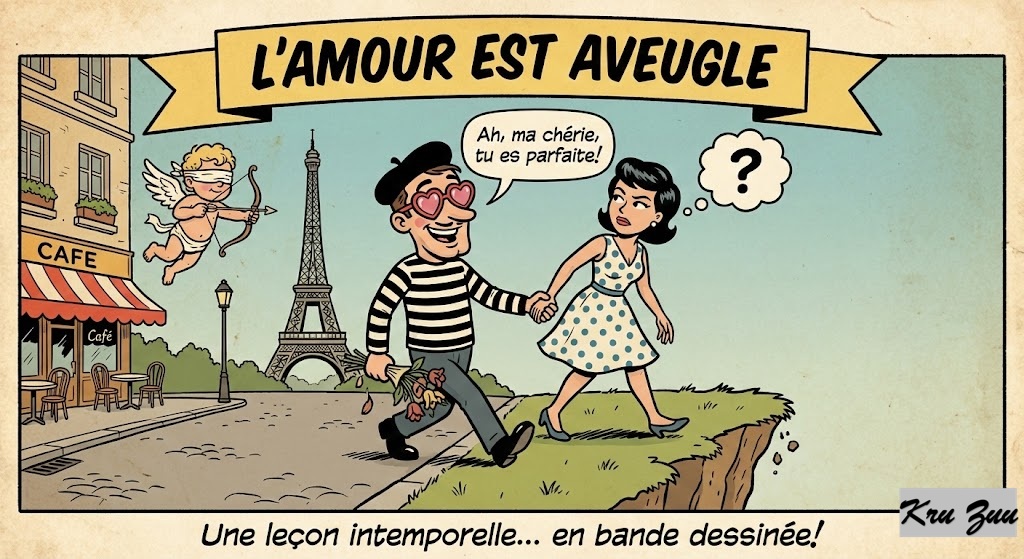
    🇫🇷 French: “L’amour est aveugle.” (Love is blind – direct translation).

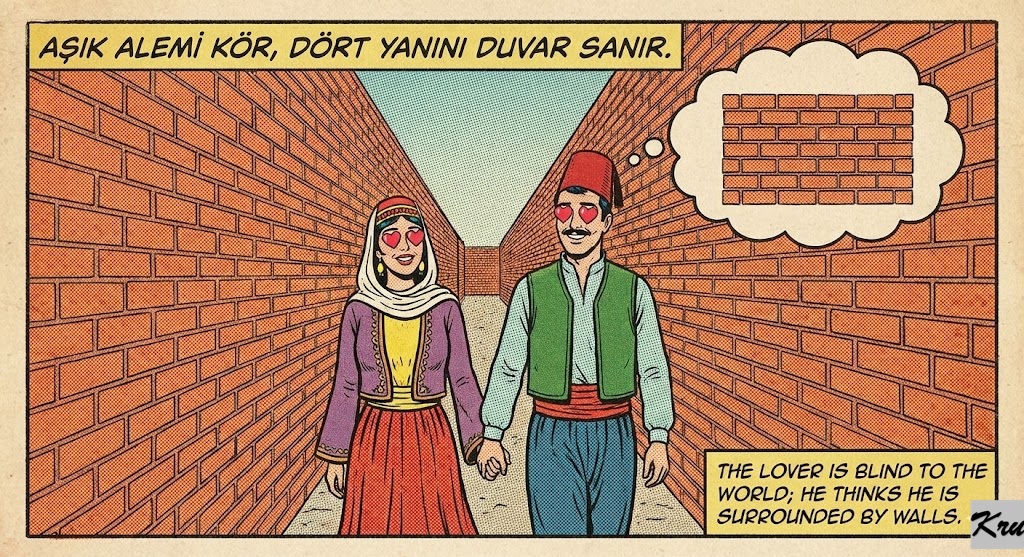
    🇹🇷 Turkish: “Aşık alemi kör, dört yanını duvar sanır.” (The lover is blind to the world; he thinks he is surrounded by walls).

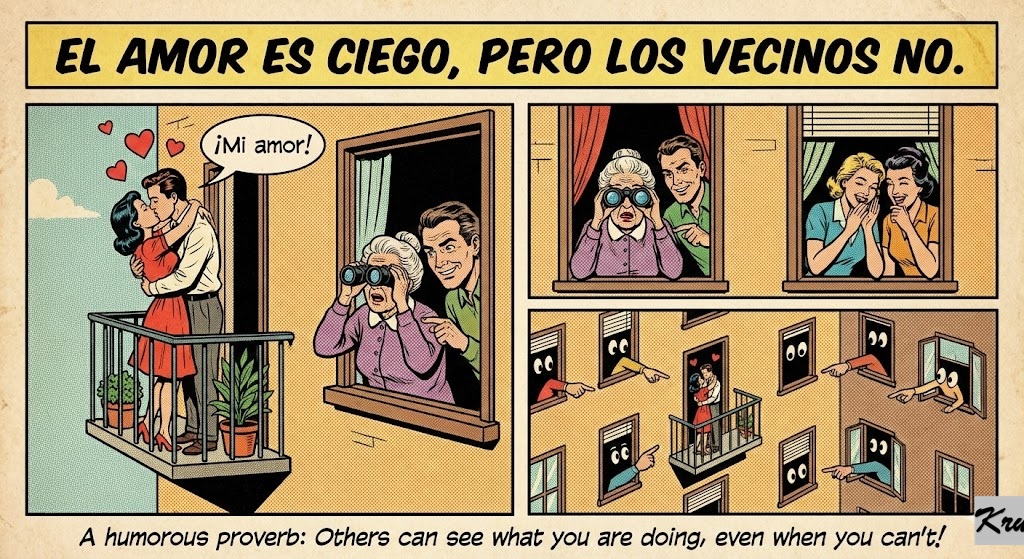
    🇪🇸 Spanish: “El amor es ciego, pero los vecinos no.” (Love is blind, but the neighbors are not! meaning others can see what you are doing).
    🎭 Short Story: The Statue of Perfection 🗿🐱🐔🐸


    Let’s visit the forest to see who has their “love goggles” on.
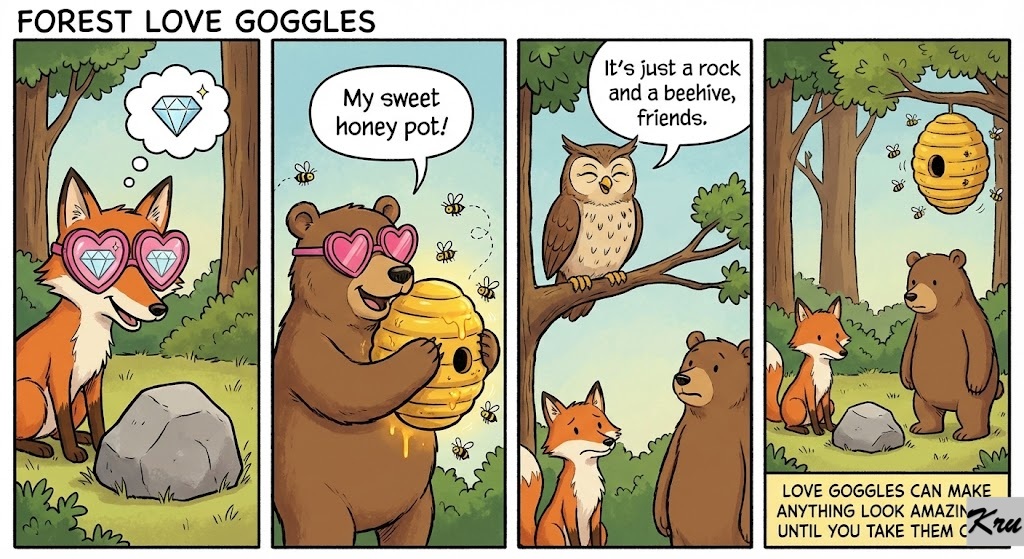

    🌟 The Cast


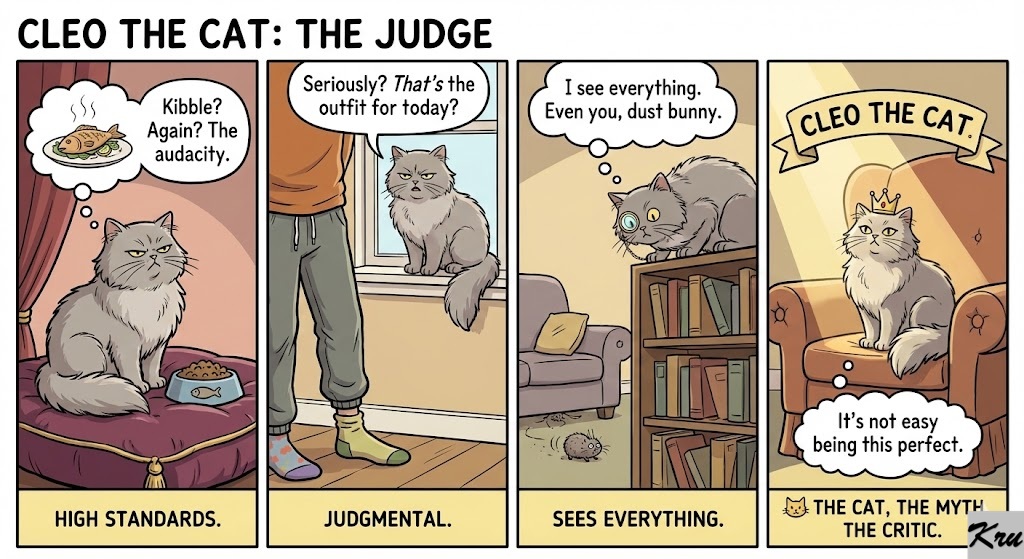
    Cleo the Cat: High standards, judgmental, sees everything. 😼

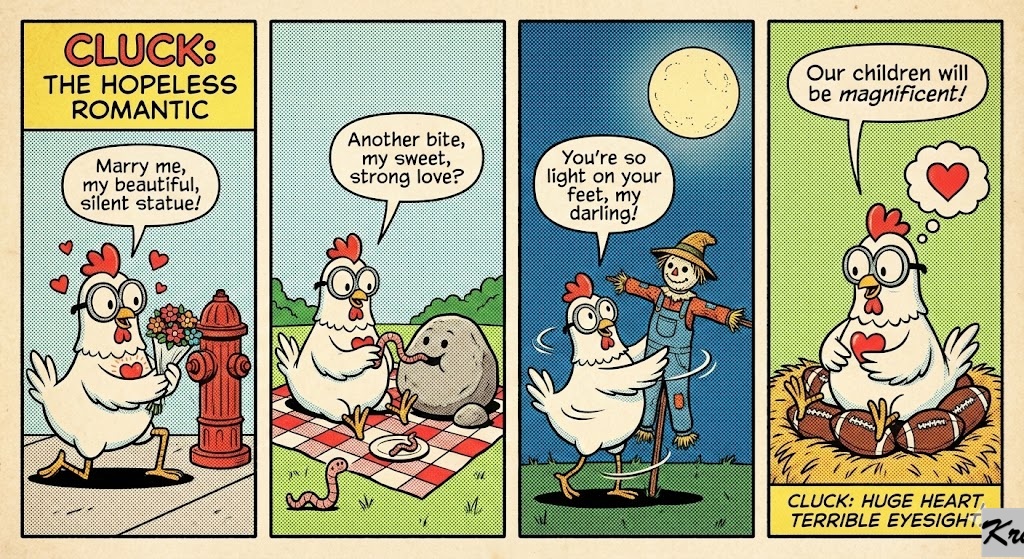
    Cluck the Chicken: Falls in love instantly, huge romantic heart, terrible eyesight. 🐔

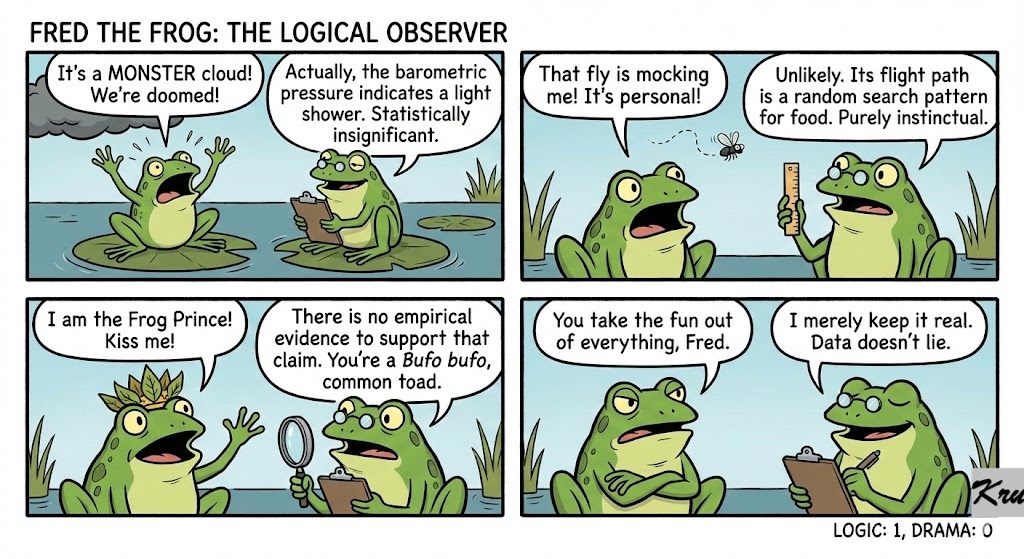
    Fred the Frog: The logical observer, keeps it real. 🐸

    The Situation: Cluck the Chicken comes running into the town square, flapping her wings excitedly. “Guys! Guys! I met Him! I met the perfect guy! He is tall, strong, dark, and mysterious!”
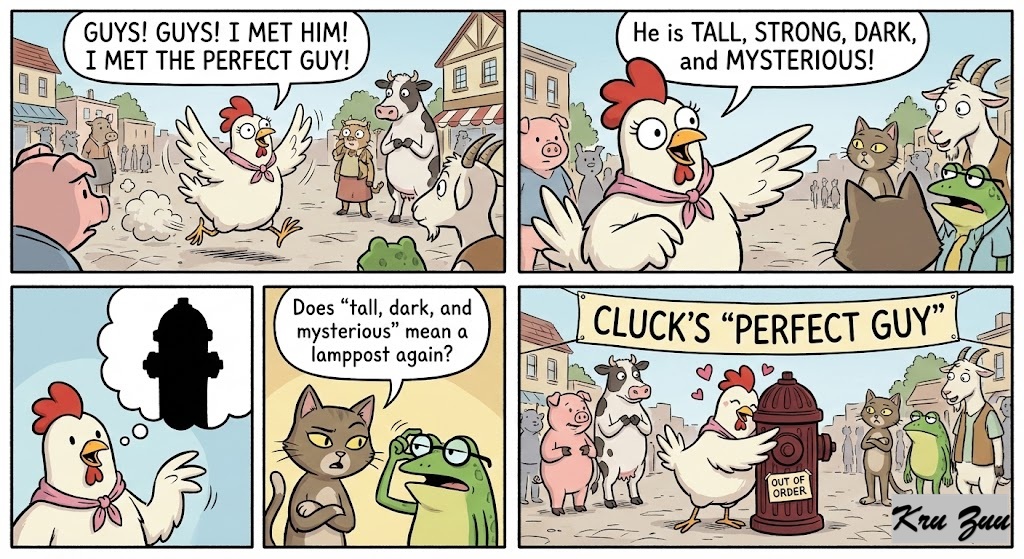

    Cleo looks up from filing her nails. “Oh? Does he have a name? Or just a vibe?”
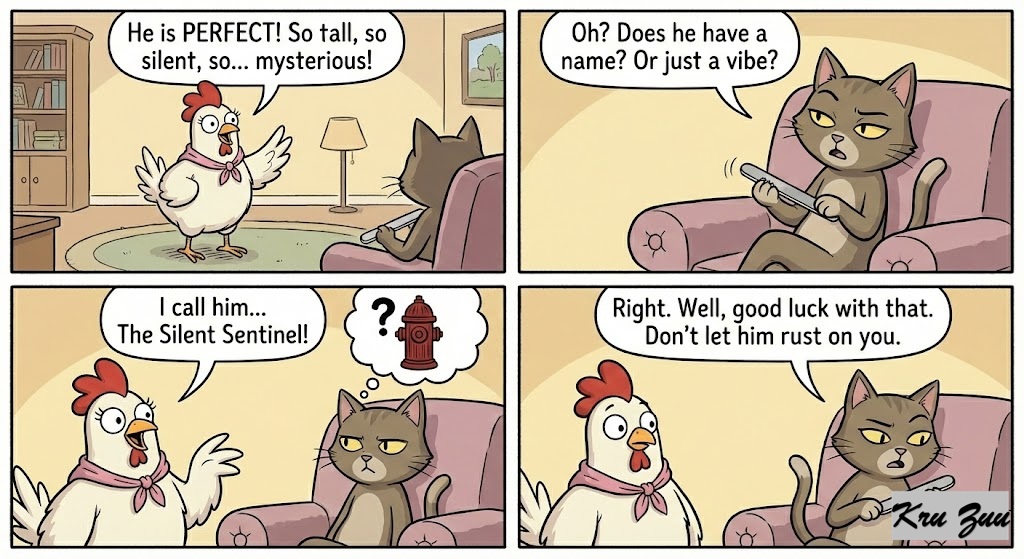

    “His name is Rocky,” Cluck sighs. “He is the strong, silent type. He listens to everything I say. He hasn’t interrupted me once in three hours!”
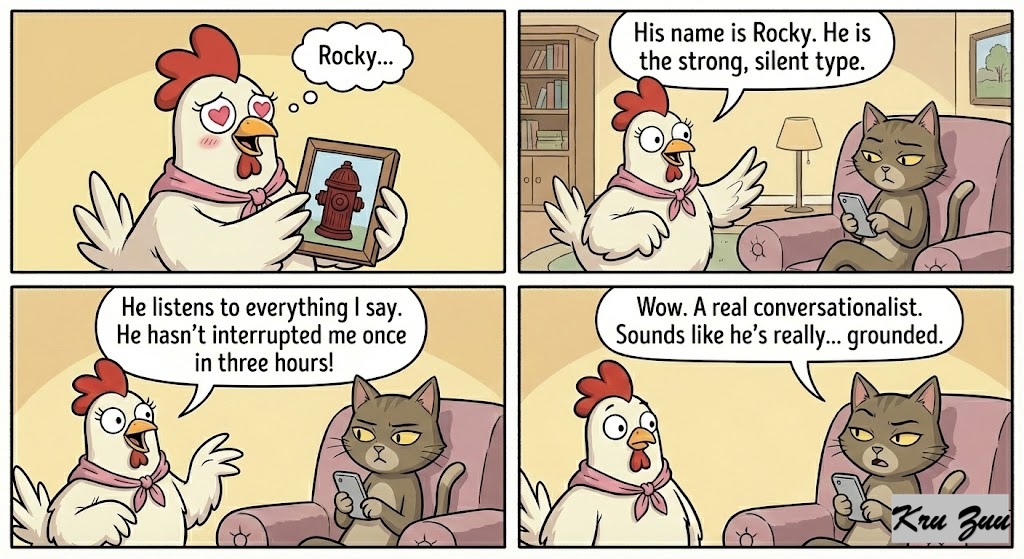

    The Conflict: Fred the Frog frowns. “Rocky? Where is he?” “He’s by the garden,” Cluck says. “Come meet him!”
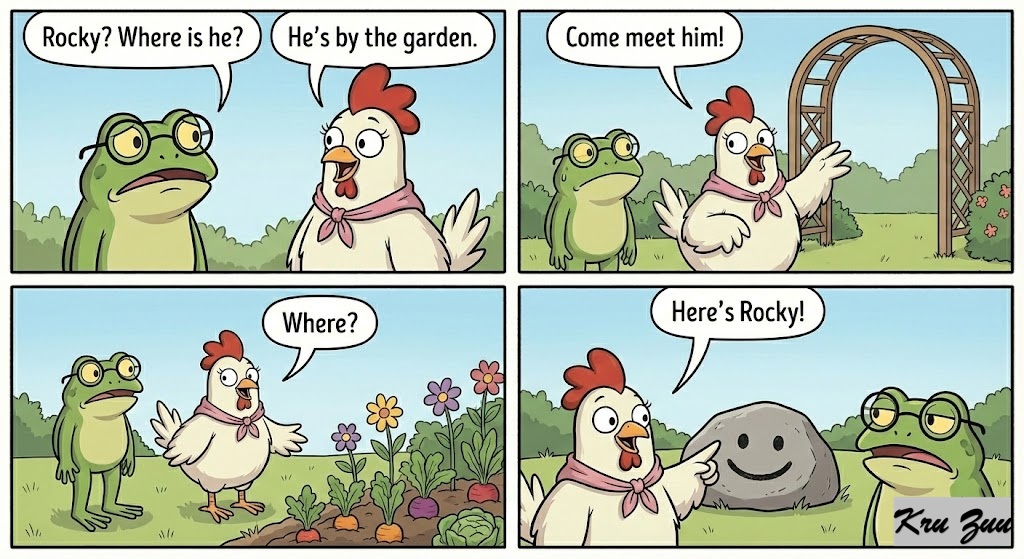

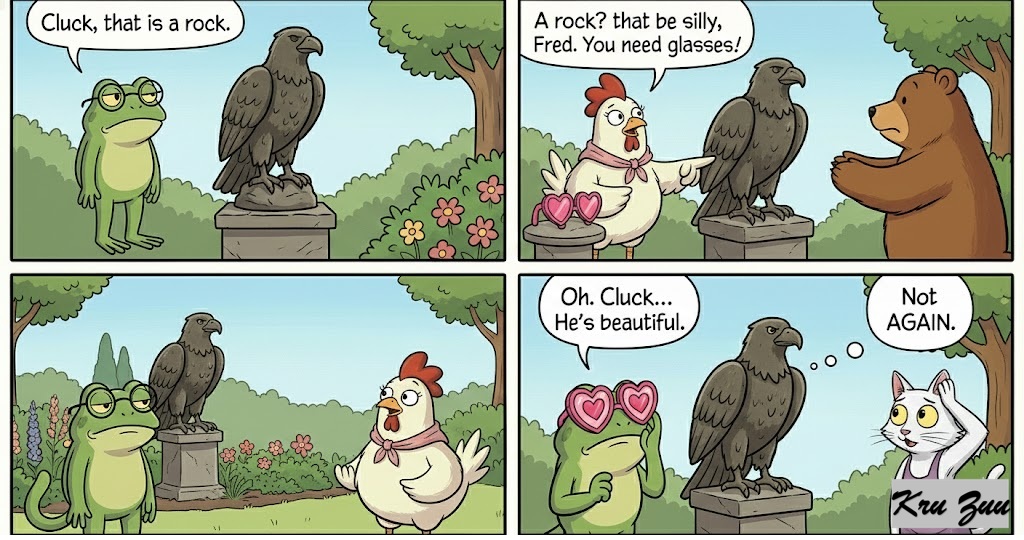
    They walk to the garden. Standing there is not a rooster. It is not a duck. It is a dark, stone garden statue of an Eagle. 🗿
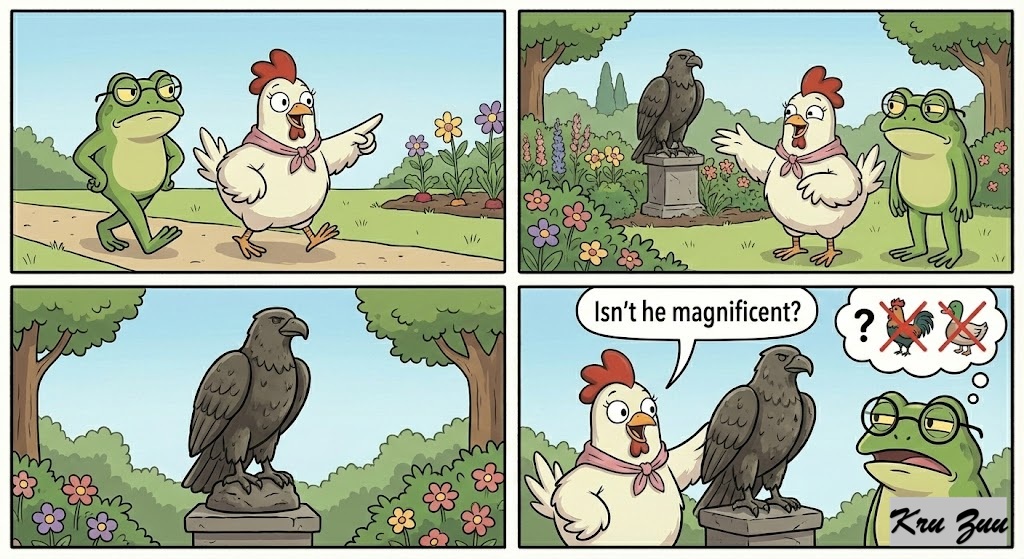

    “Cluck,” Fred says slowly. “That is a rock.”

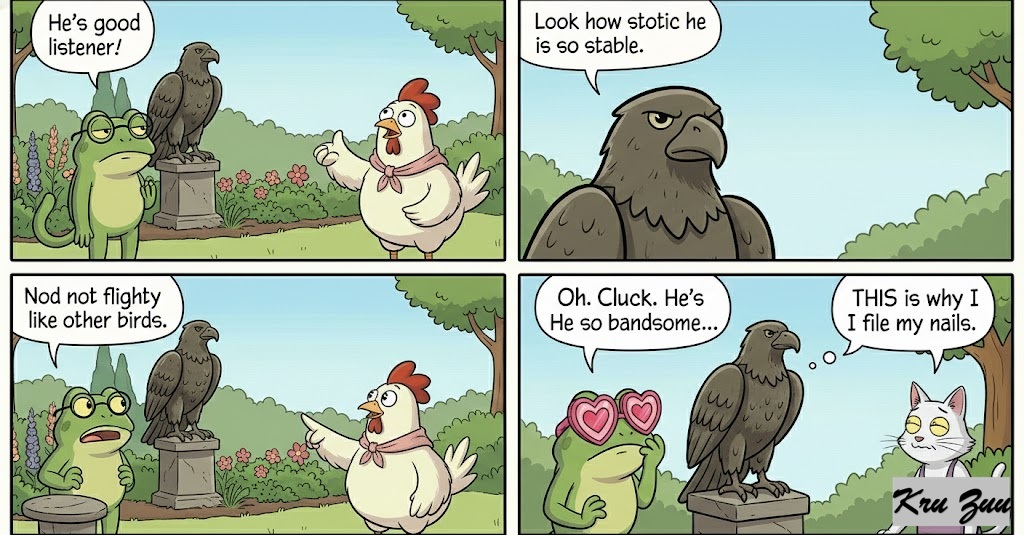
    “He’s a good listener!” Cluck defends him. “Look how stoic he is. He’s so stable. He’s not flighty like other birds.”

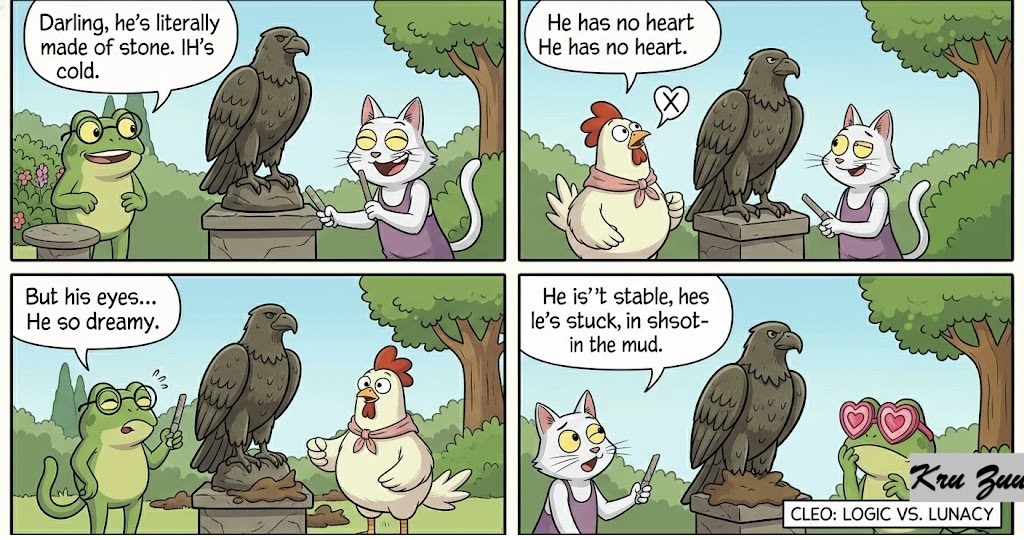
    Cleo laughs. “Darling, he’s literally made of stone. He’s cold. He has no heart. He isn’t stable; he’s stuck in the mud.”

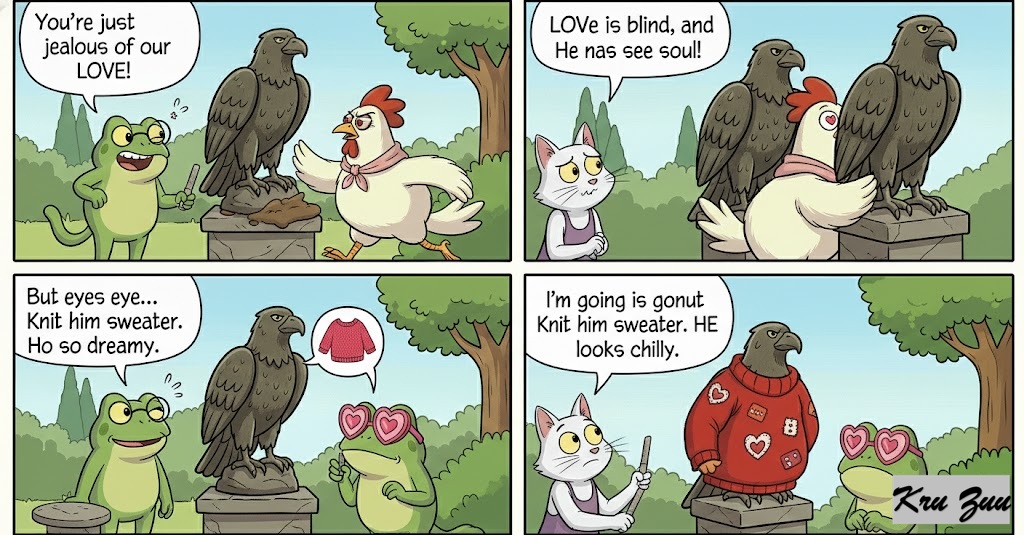
    The Reaction: “You are just jealous of our love!” Cluck yells. “Love is blind, and I see his soul!” She runs over and hugs the cold stone statue. “I’m going to knit him a sweater. He looks chilly.”

    Fred looks at Cleo. “Should we tell her?” Cleo shakes her head. “No. Wait for the rain.”
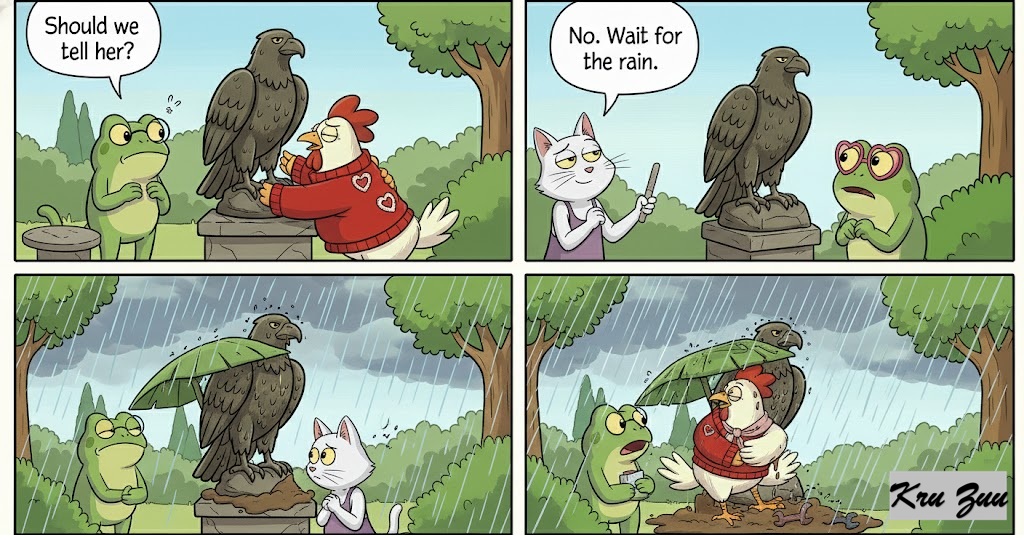

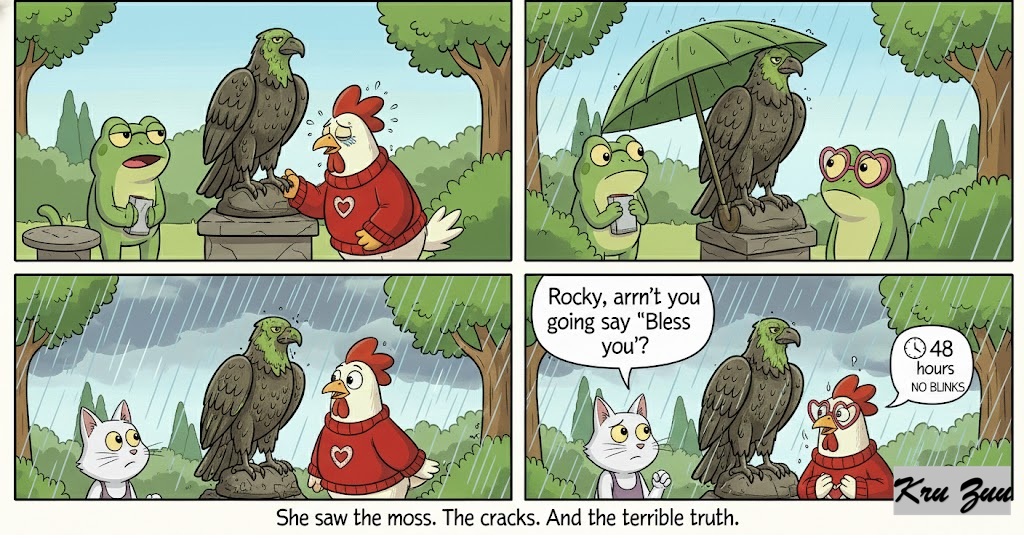
    The Resolution: Two days later, it rained heavily. Cluck stood by “Rocky” with an umbrella, but Rocky didn’t say thank you. He didn’t move. Moss started growing on his beak. Finally, Cluck sneezed. “Rocky, aren’t you going to say ‘Bless you’?” Silence. Cluck finally stepped back. She looked, really looked, and saw the moss. She saw the cracks in the stone. She realized he hadn’t blinked in 48 hours.

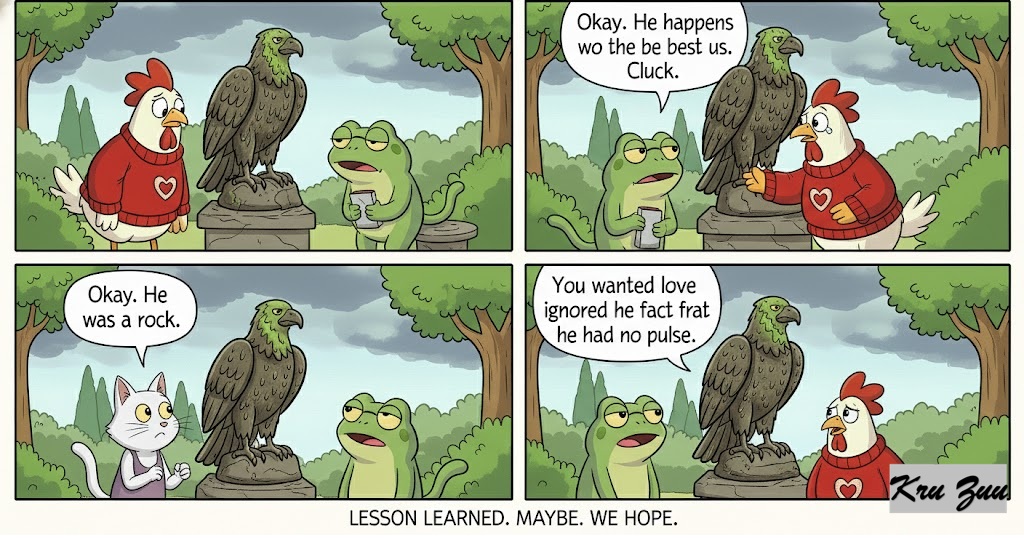
    The Lesson: Cluck walked back to her friends, head down. “Okay. He was a rock.” Fred patted her wing. “It happens to the best of us, Cluck. You wanted love so badly, you ignored the fact that he had no pulse.”

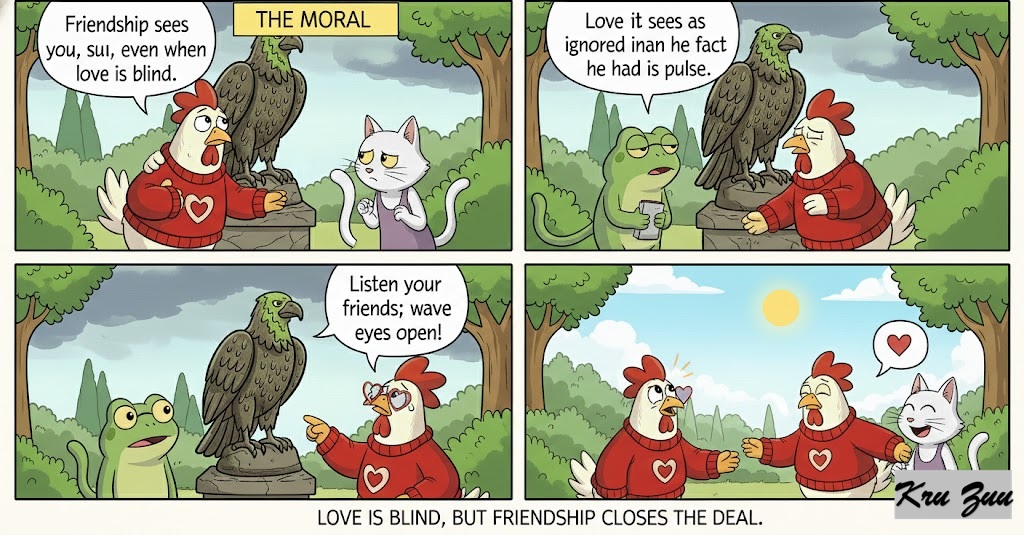
    The Moral: Love is blind, but friendship closes the deal. Listen to your friends; they have their eyes open.
    🎓 Lesson for English Learners


    How to give advice without being mean.
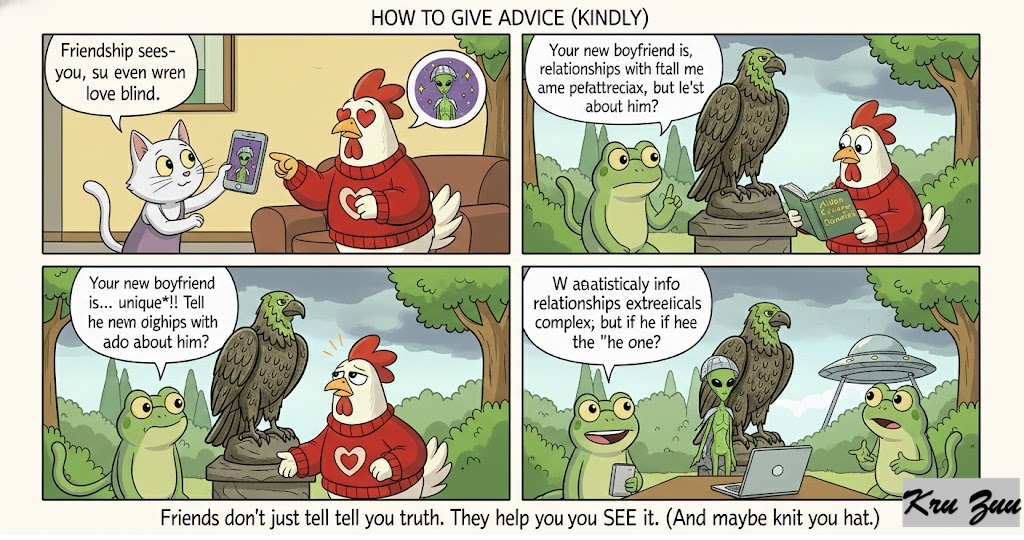

    Situation: Your friend is dating someone who treats them badly. You want to warn them, but you don’t want to fight.
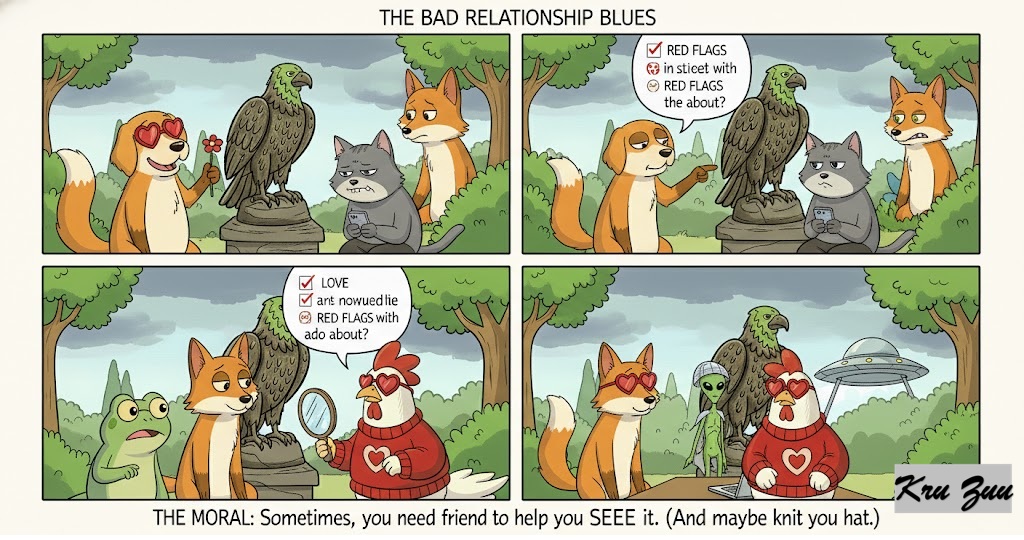
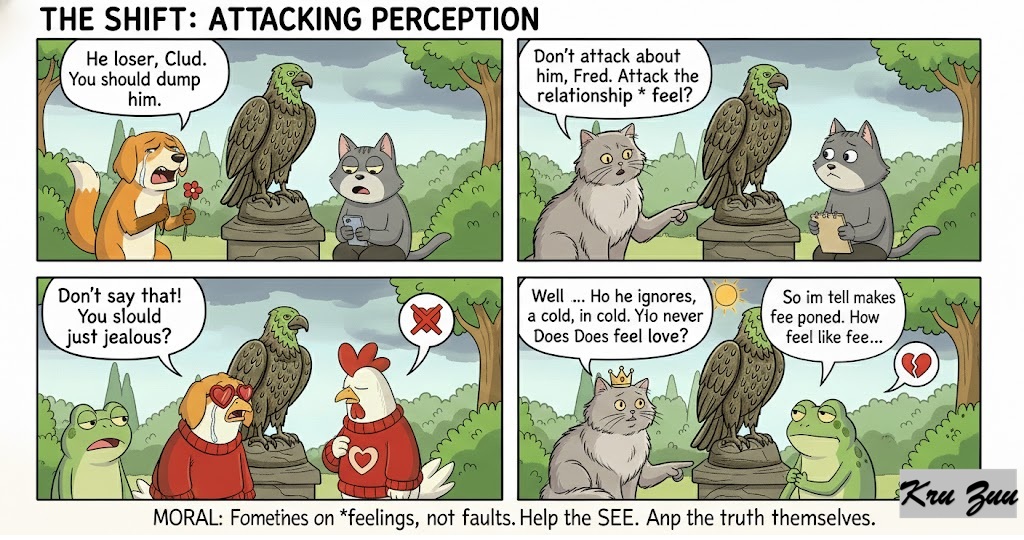
    The Shift: Don’t attack the partner (“He is a loser”). Attack the perception.
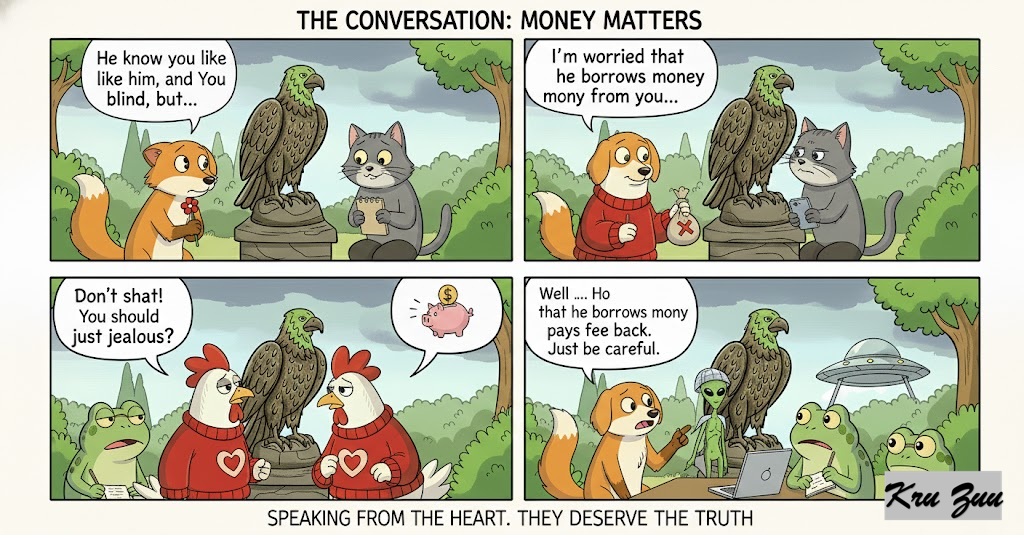
    You Say: “I know you really like him, and love is blind, but I’m worried that he borrows money from you and never pays it back. Just be careful.”

    💬 Your Turn: The “Red Flag” Challenge 🚀


    Do you want to cure your “Villain” romantic habits?
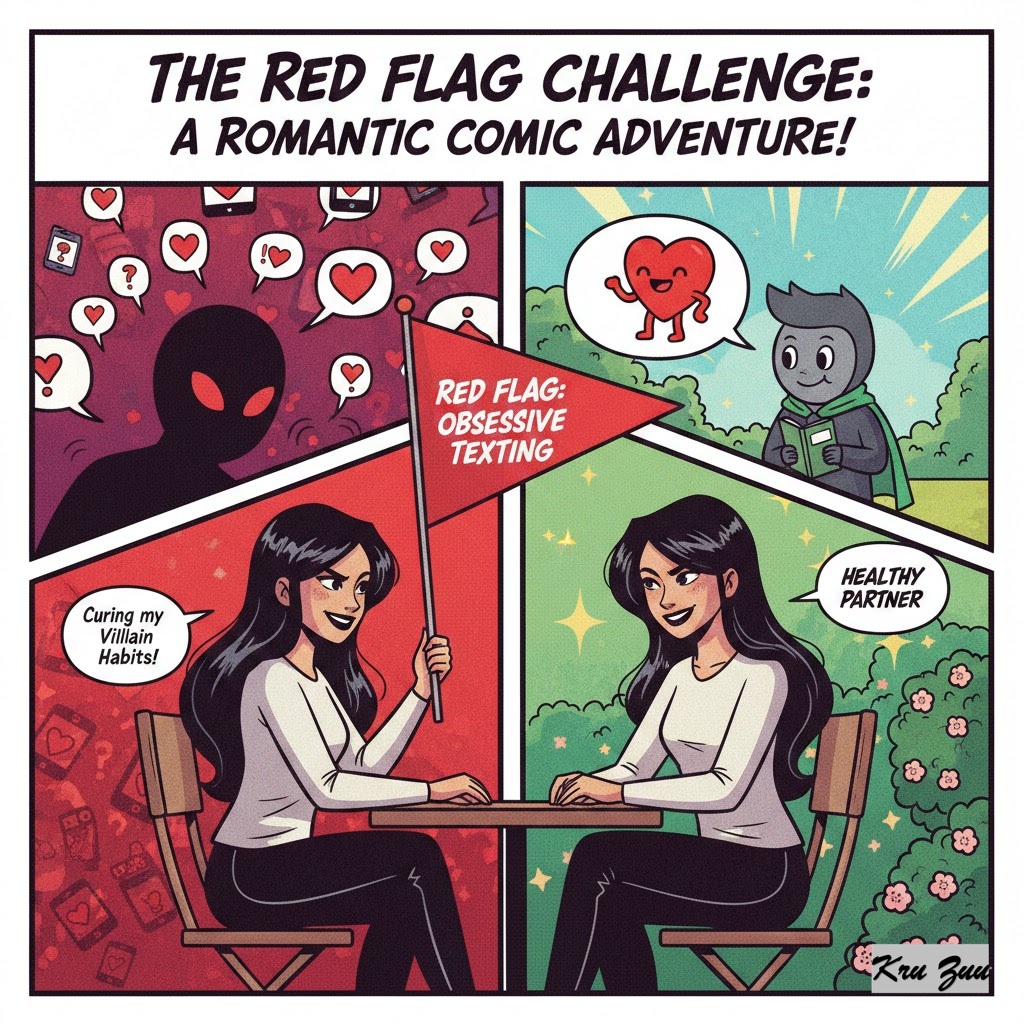

    The Challenge:
    Think of a past relationship or crush that didn’t work out.
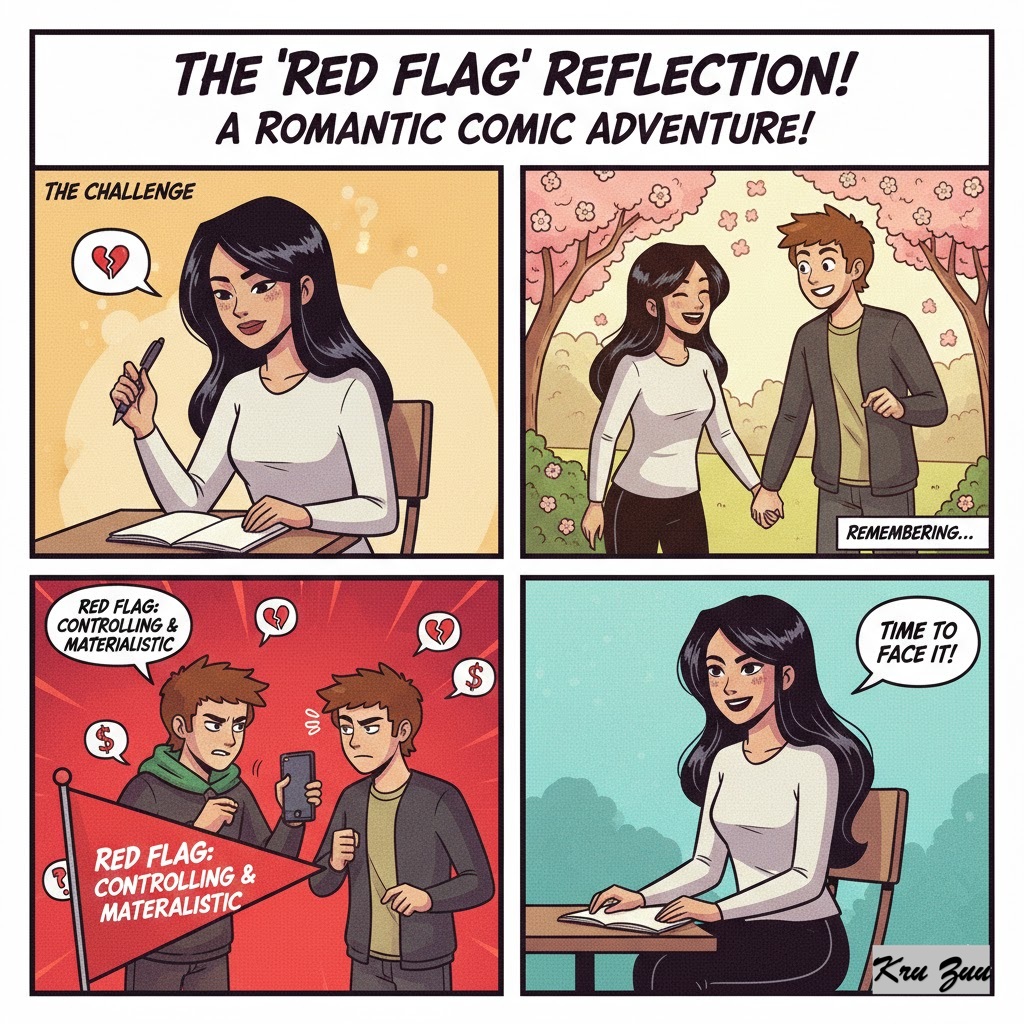
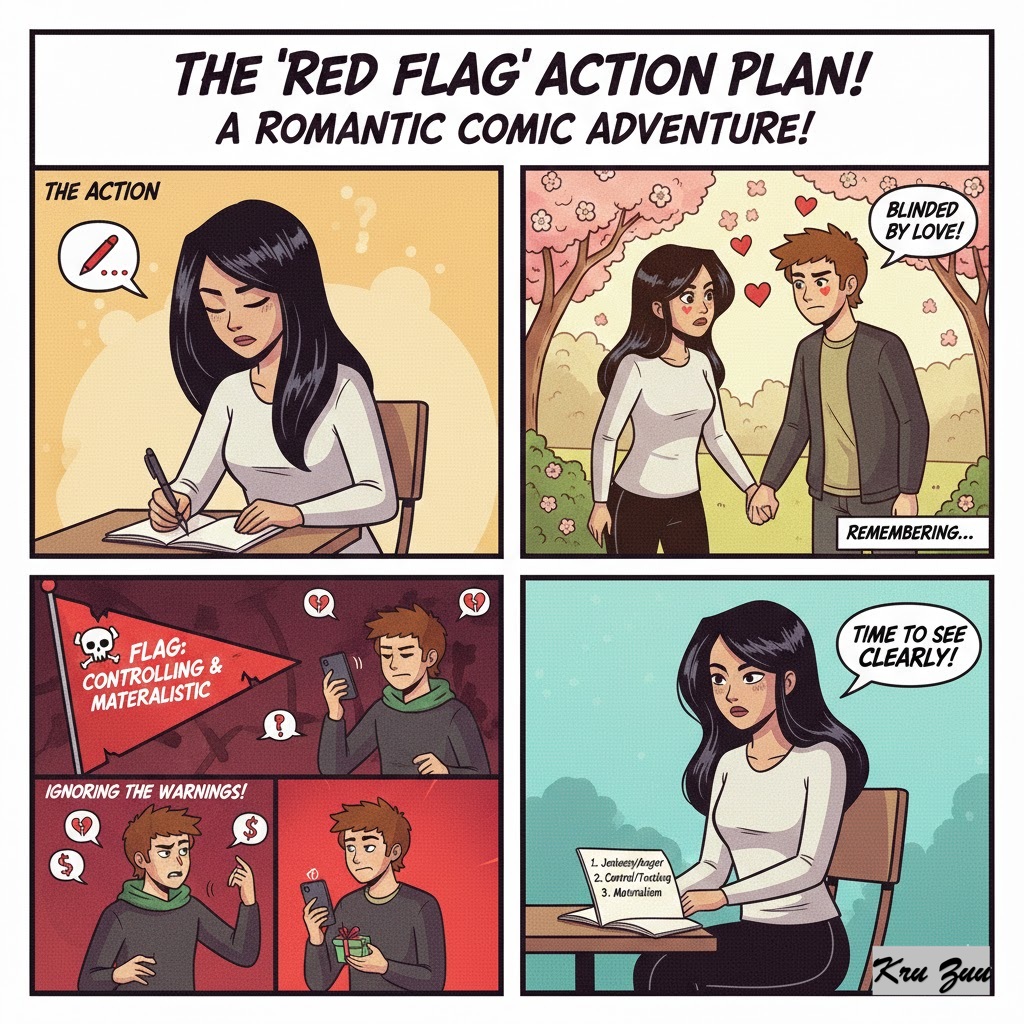
    The Action: Write down three “Red Flags” (warning signs) that you ignored at the beginning because you were “blind.”

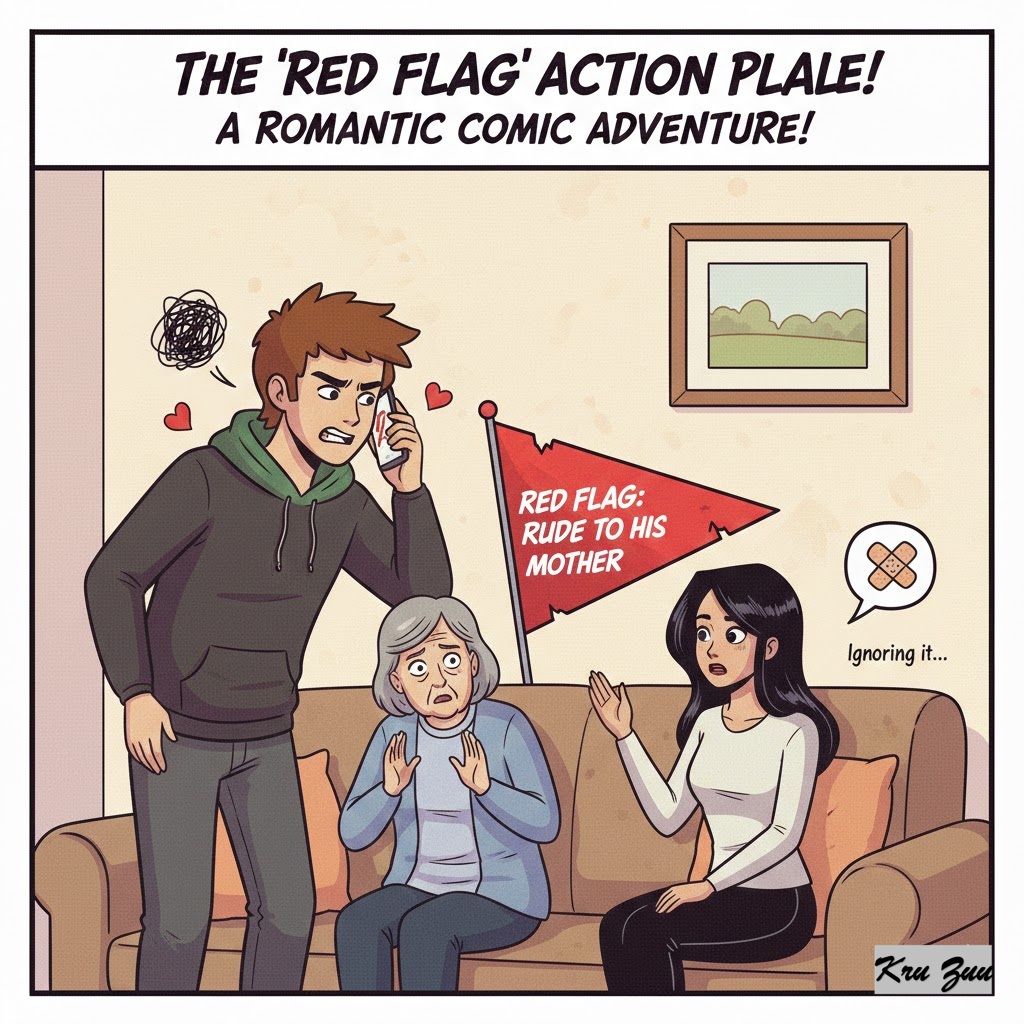
    Example: I ignored that he was rude to his mother.

    Example: I ignored that she hated all my friends.
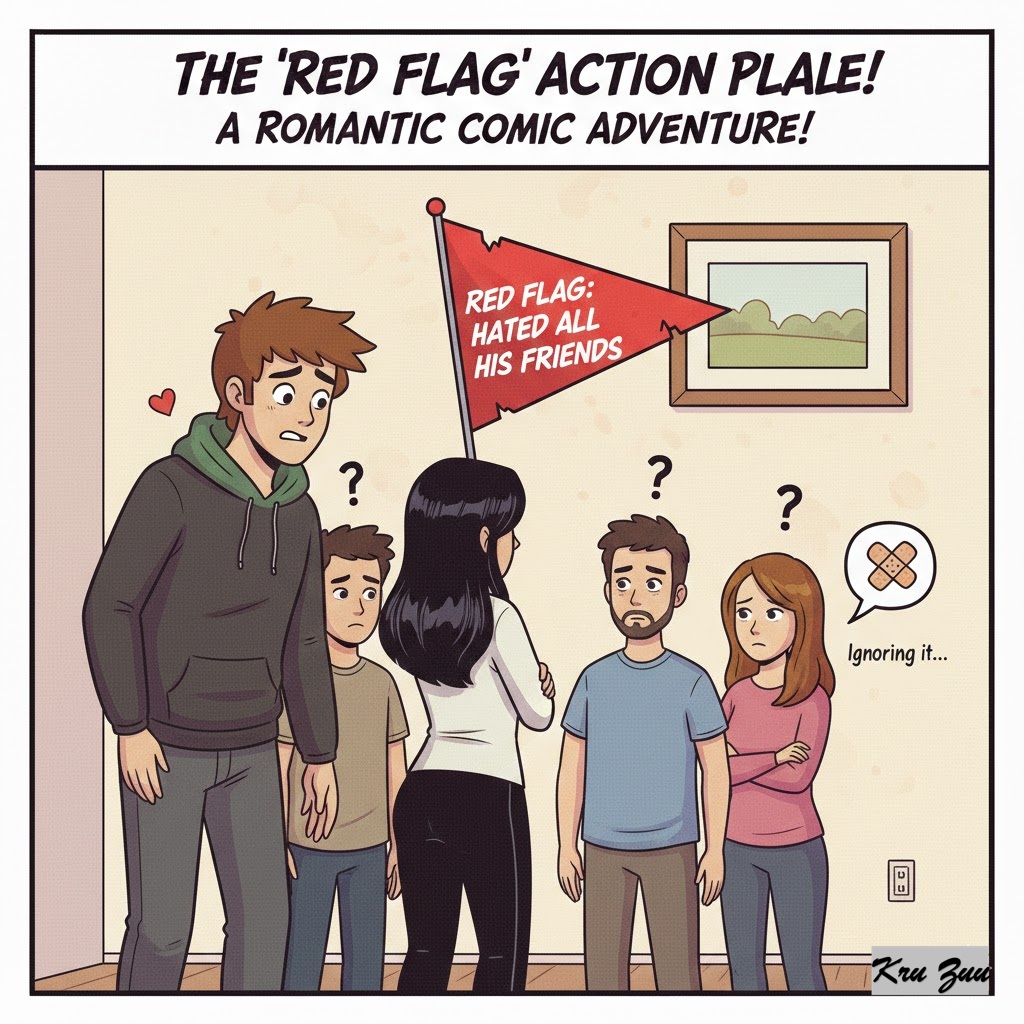

    👇 Question for the comments: Have you ever worn “Rose-colored glasses”? What is one funny thing you overlooked in a partner because you were in love? Tell us below!

    By Zubeyir YURTKURAN

    https://www.facebook.com/BrainBattleground/

    https://www.facebook.com/zubeyr.yurtkuran/

    https://www.instagram.com/zubeyryurtkuran/

    https://www.youtube.com/@BrainBattleground-b3p

    https://www.instagram.com/brainbattleground/

  • 💎 The Daily Shield: The Law of Hidden Value

    💎 The Daily Shield: The Law of Hidden Value

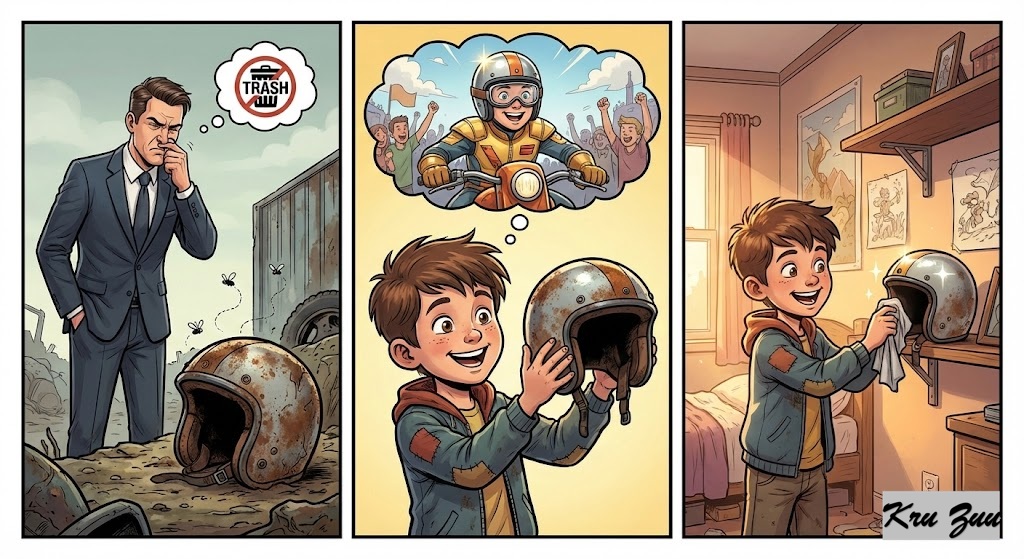
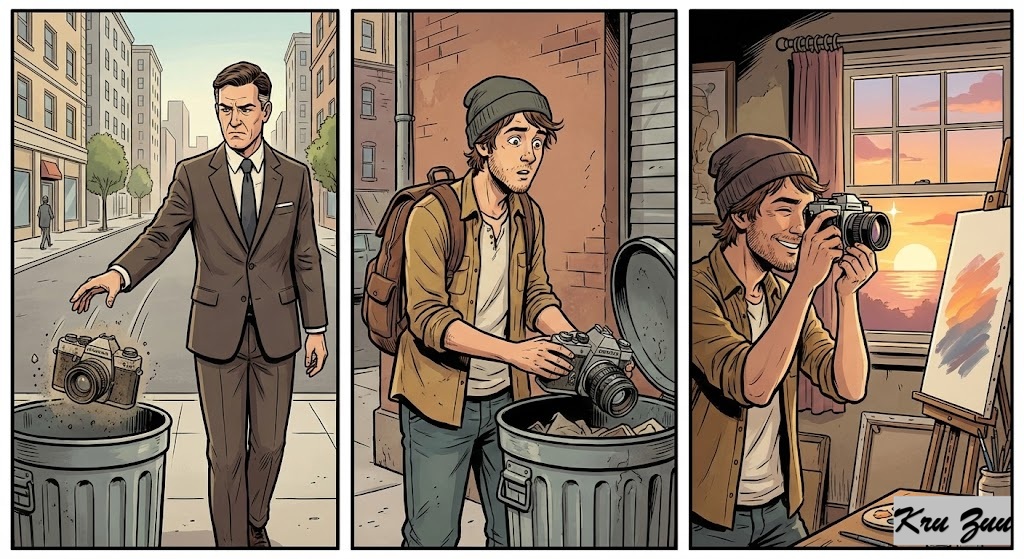
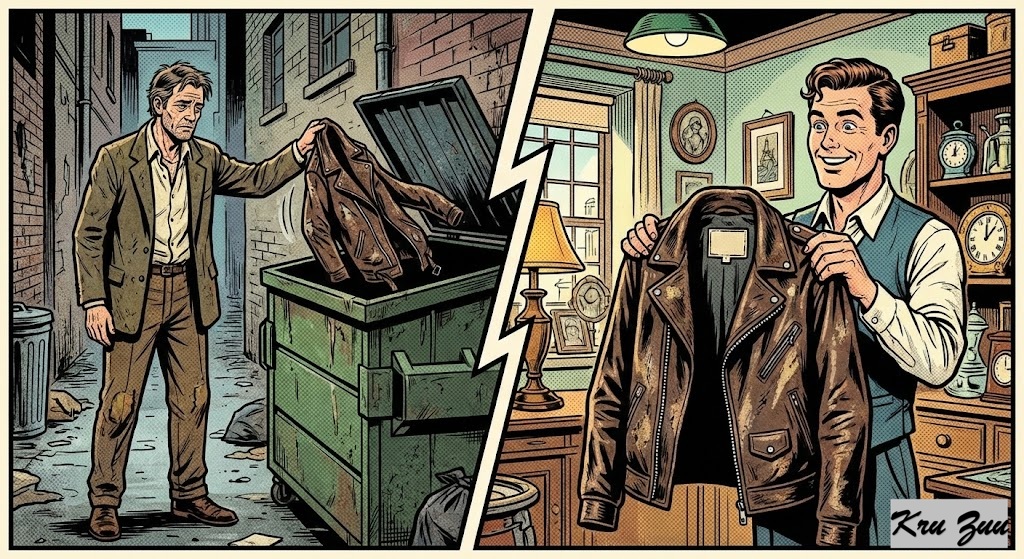
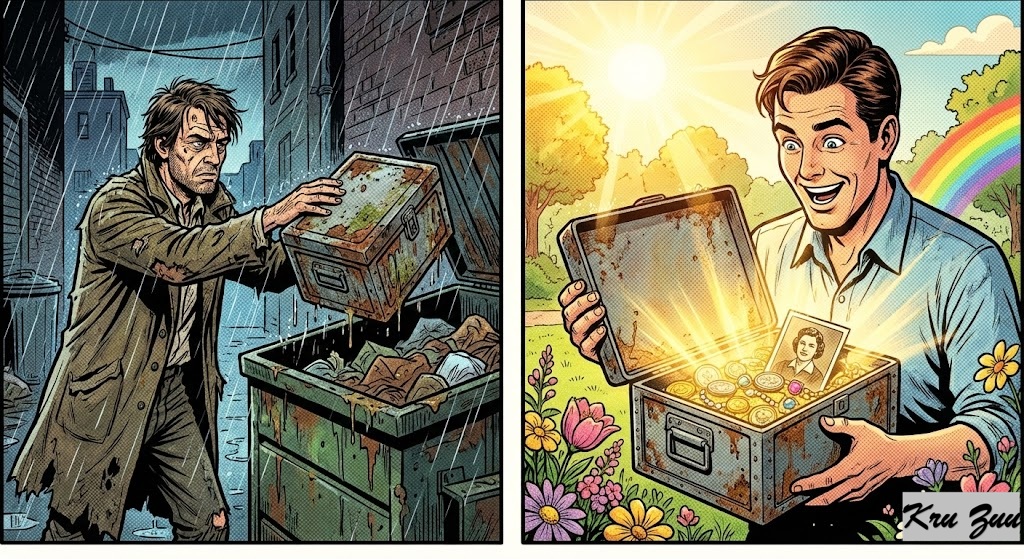
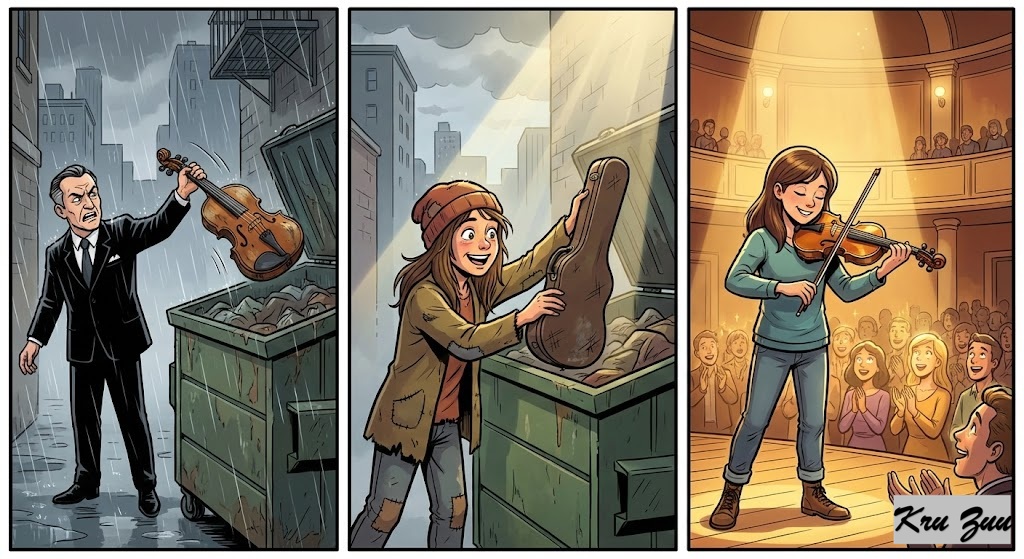
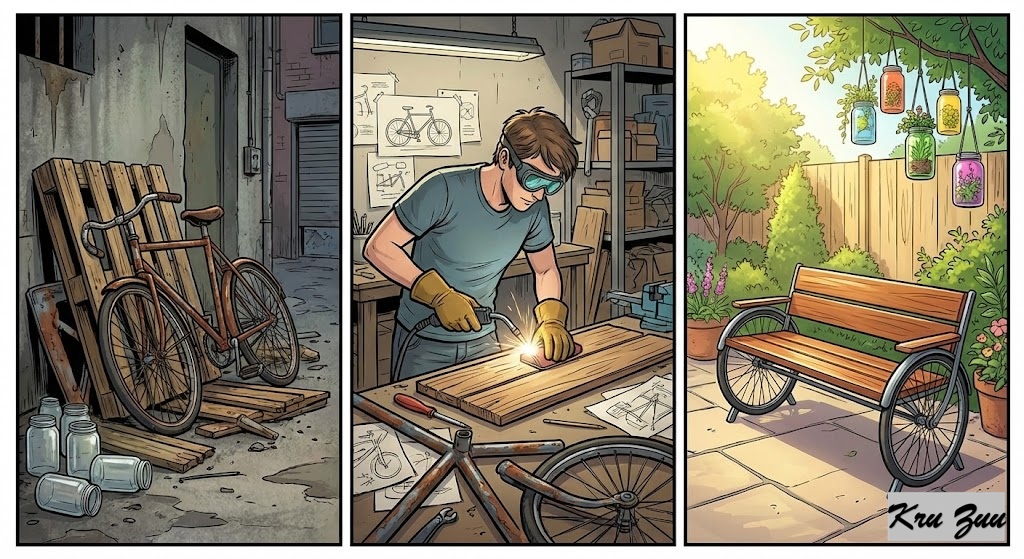
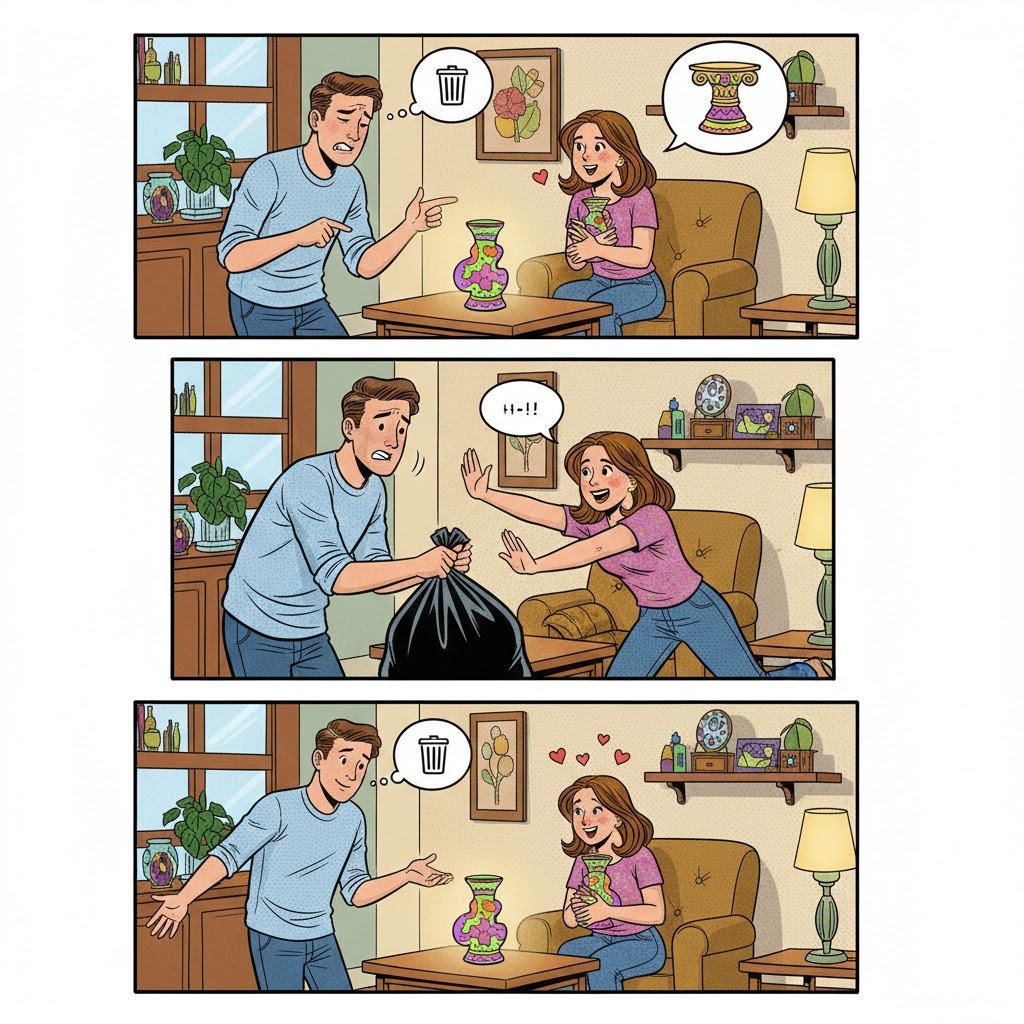
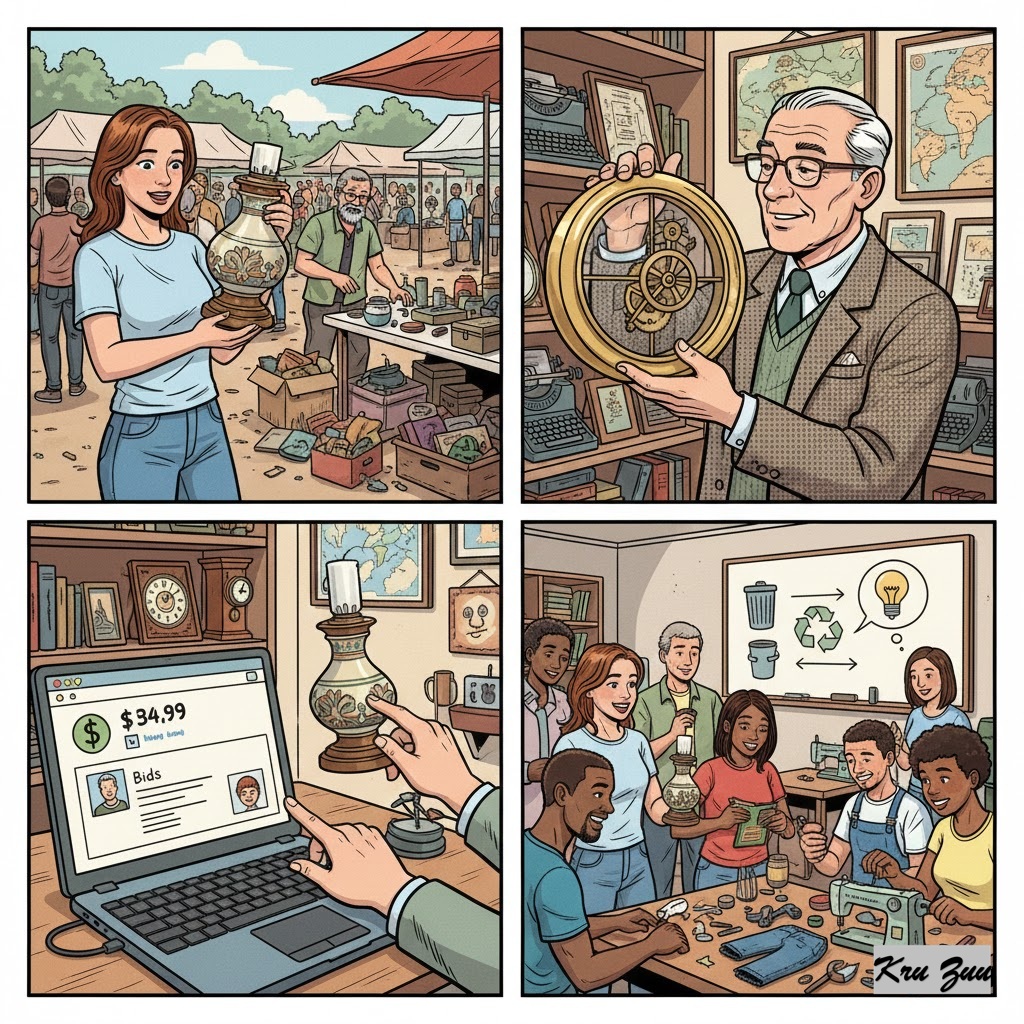
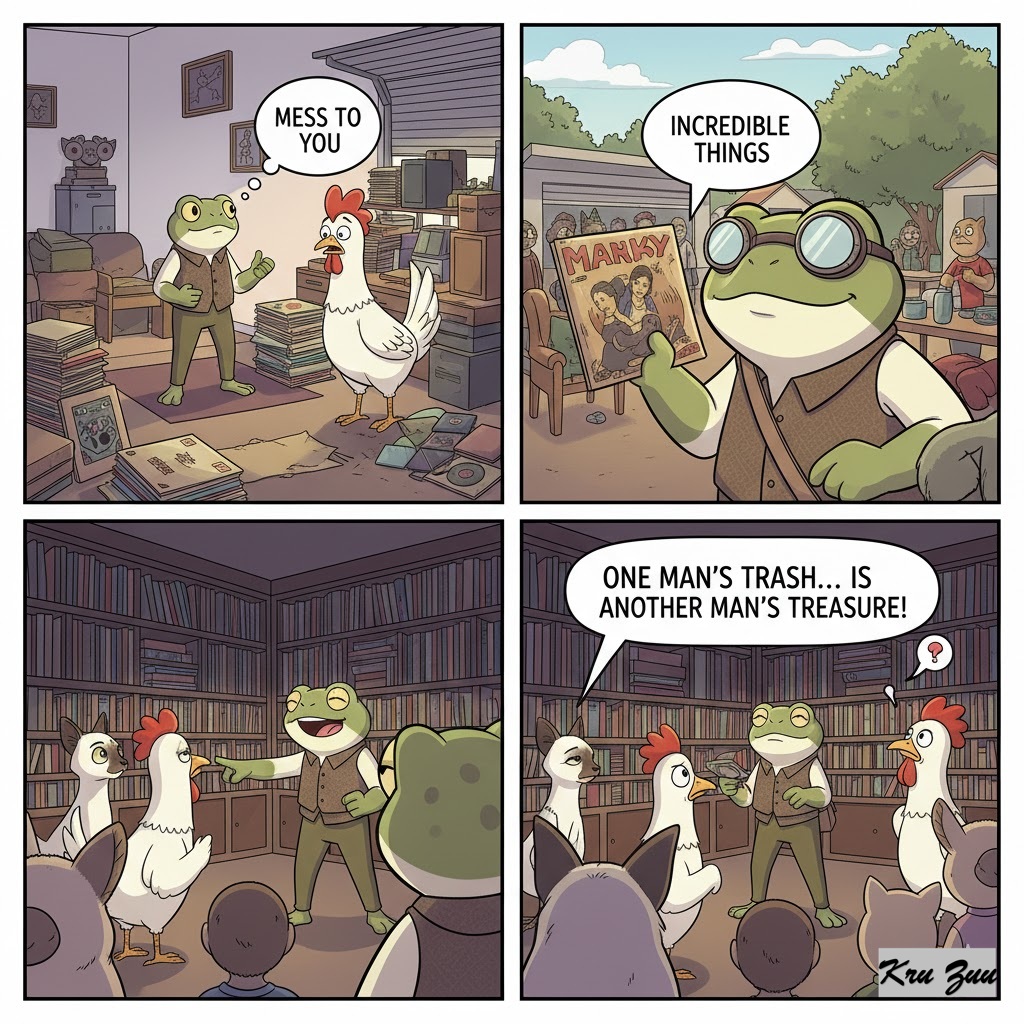
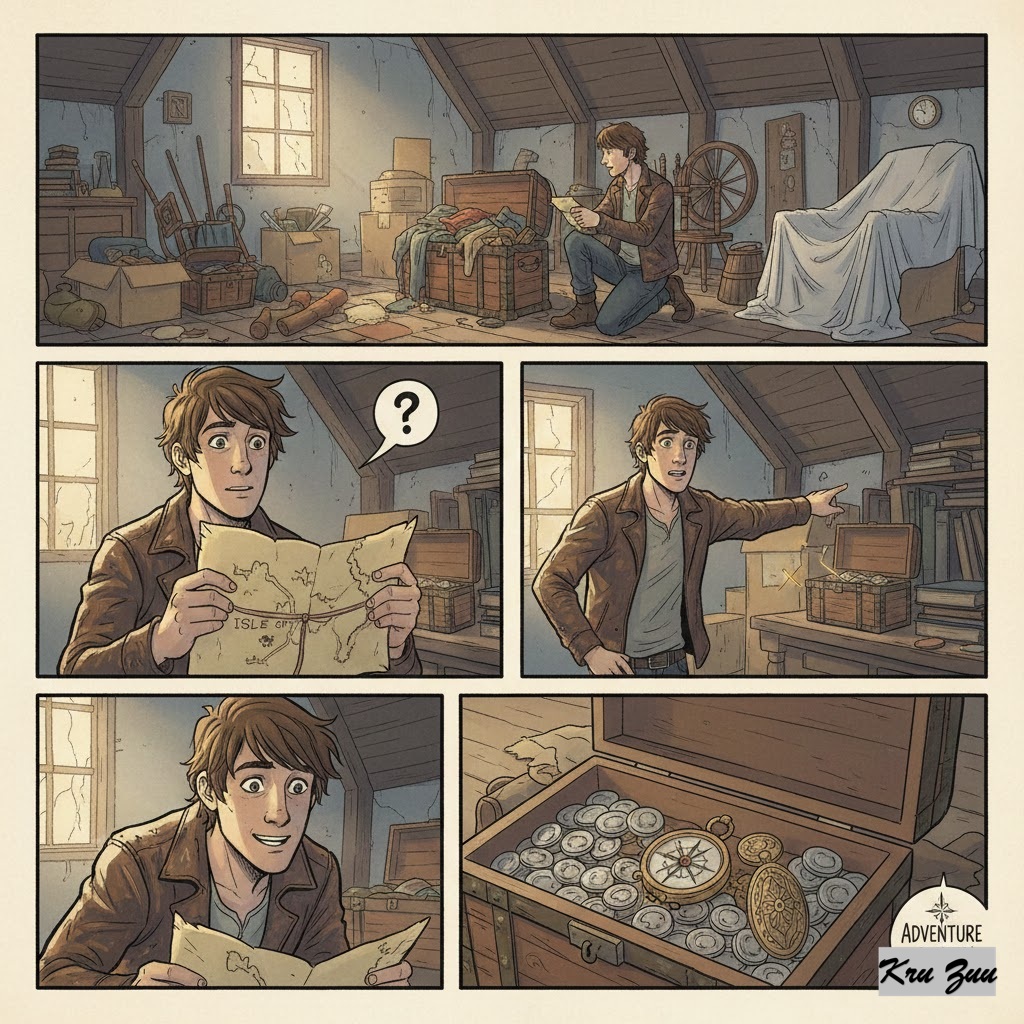
    “One man’s trash is another man’s treasure.”


    😈 The Villain (The Blind Consumer)


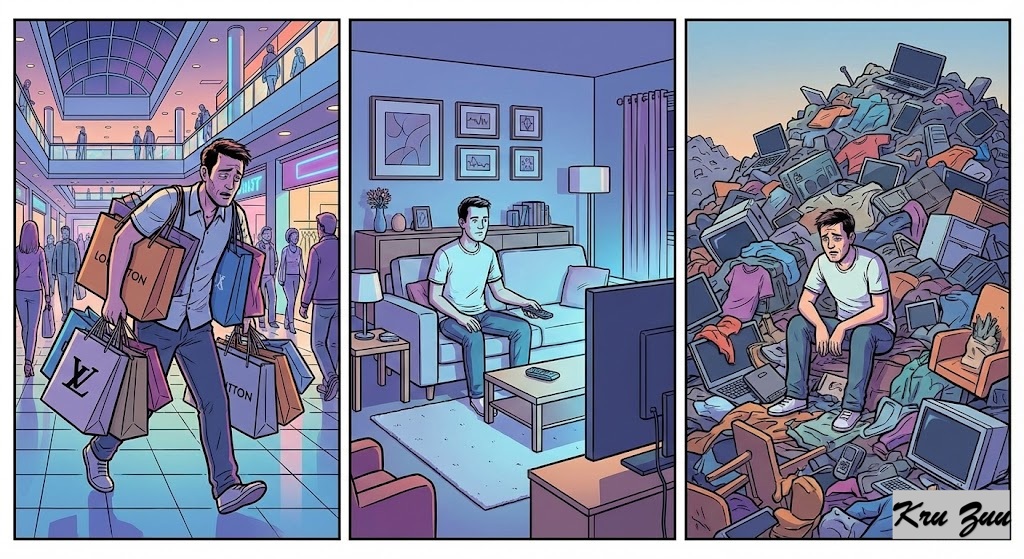
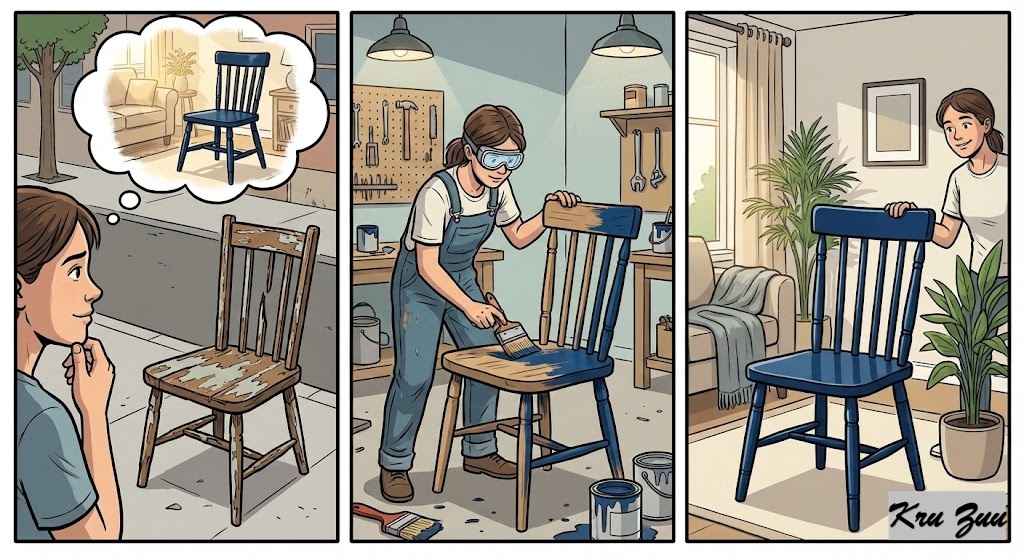
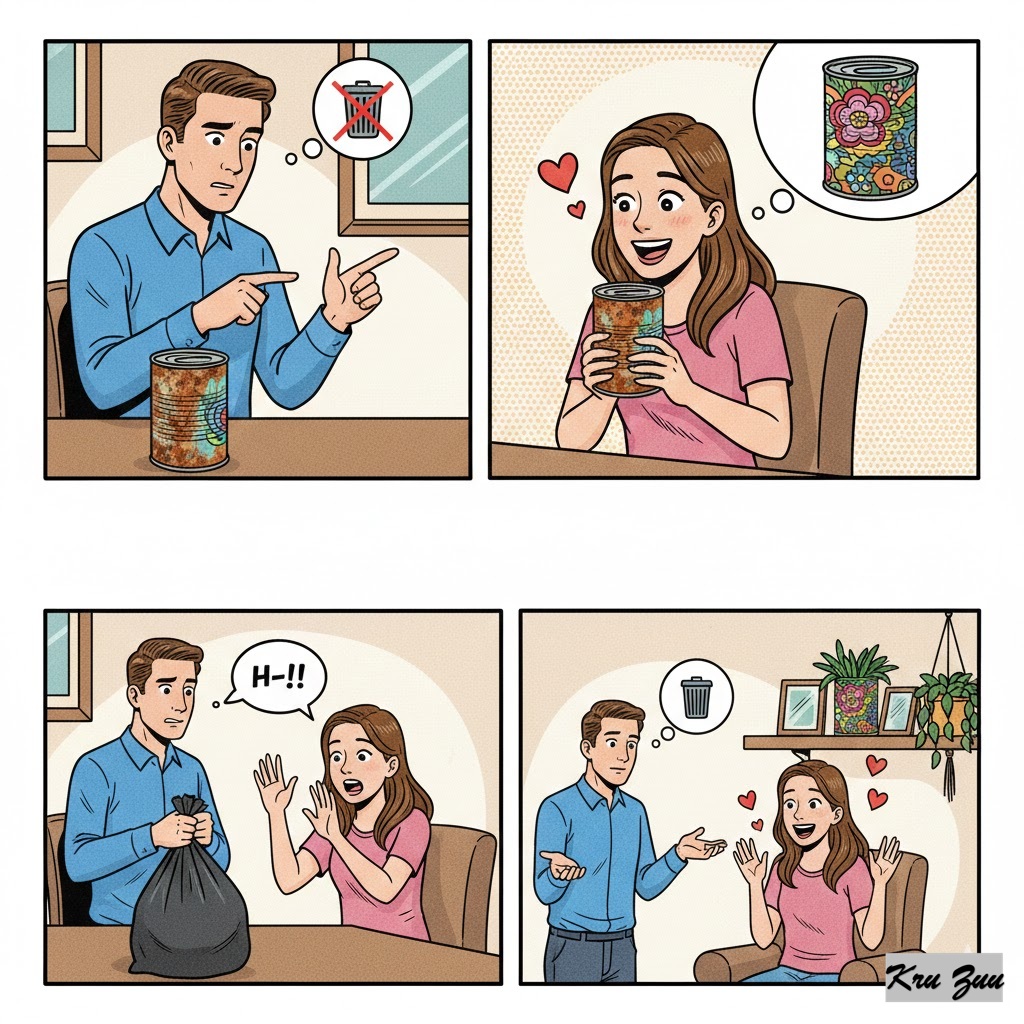
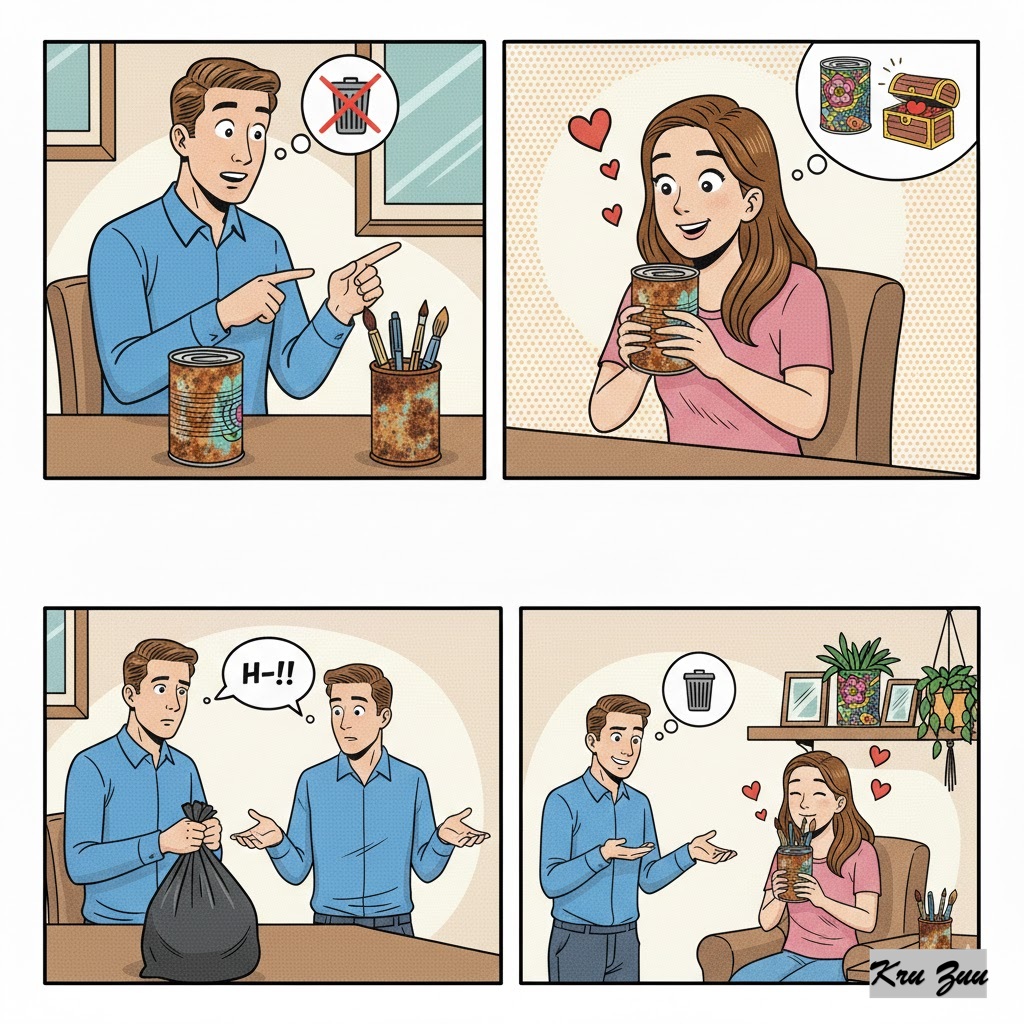
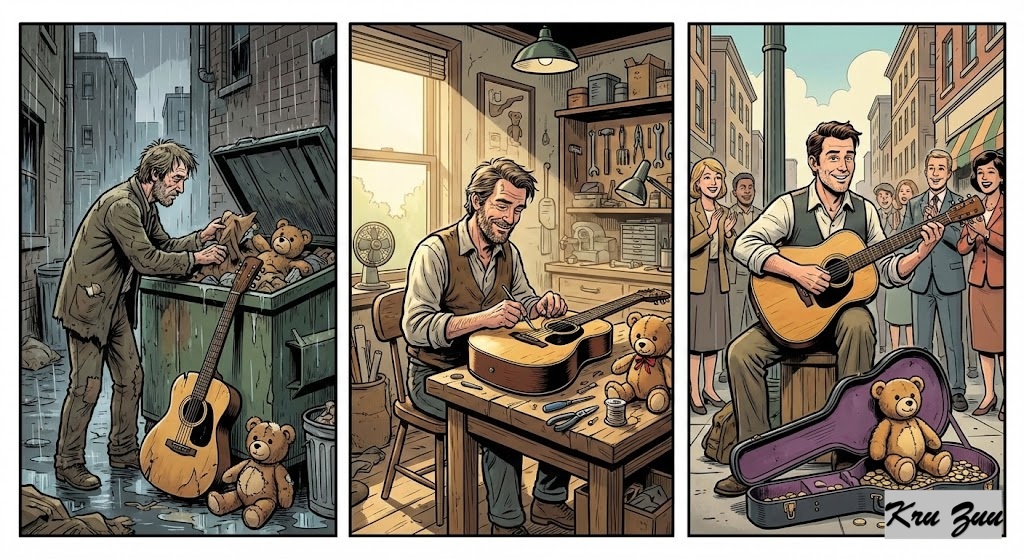
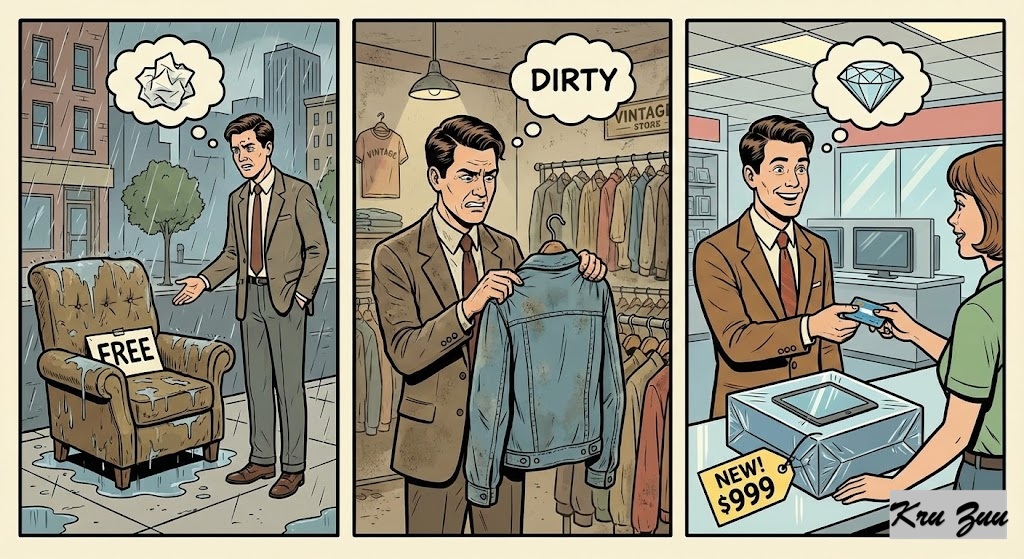
    You see an old chair on the sidewalk or a dusty vintage jacket. You think: “Ew, gross. Why is that junk still there?” 🗑️ You only value things that are shiny, brand-new, and straight off the shelf. You believe that Price = Value. If it’s cheap or used, it’s worthless to you.

    The Result? You spend a fortune chasing trends. Your home is full of generic items everyone else has. You lack the “vision” to see potential, and you’re stuck in a cycle of expensive, disposable consumption.


    😇 The Hero (The Alchemist)


    You see the same old chair and think: “With a bit of sanding and blue paint, this is a masterpiece.” 🎨 You don’t look at what an object is; you look at what it can be. You recognize that value is subjective.

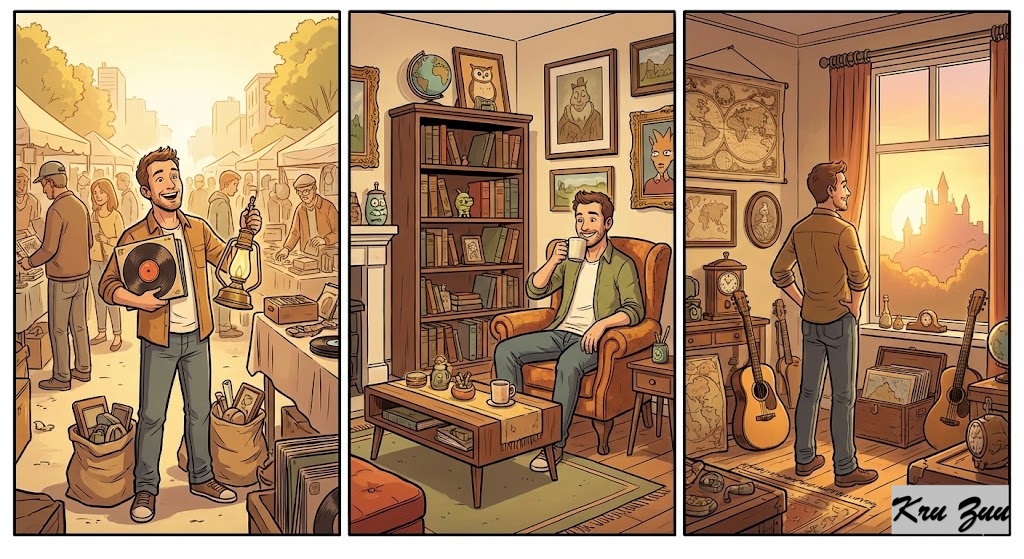
    The Result? You find incredible deals. Your life is filled with unique, soulful items. You save money while building a world of “treasures” that others missed. You understand that perspective is the ultimate wealth-builder. 🏰


    ⚖️ The Reality


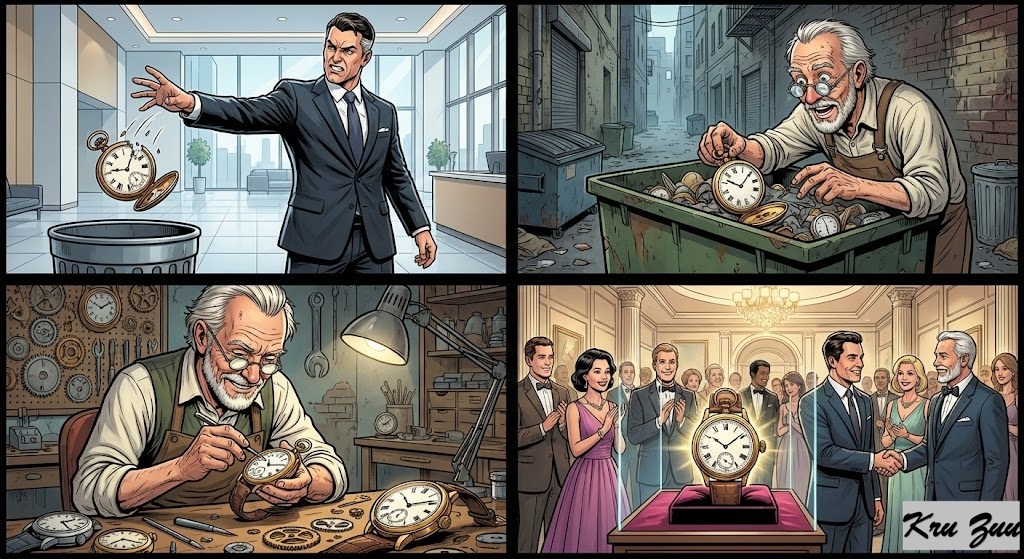
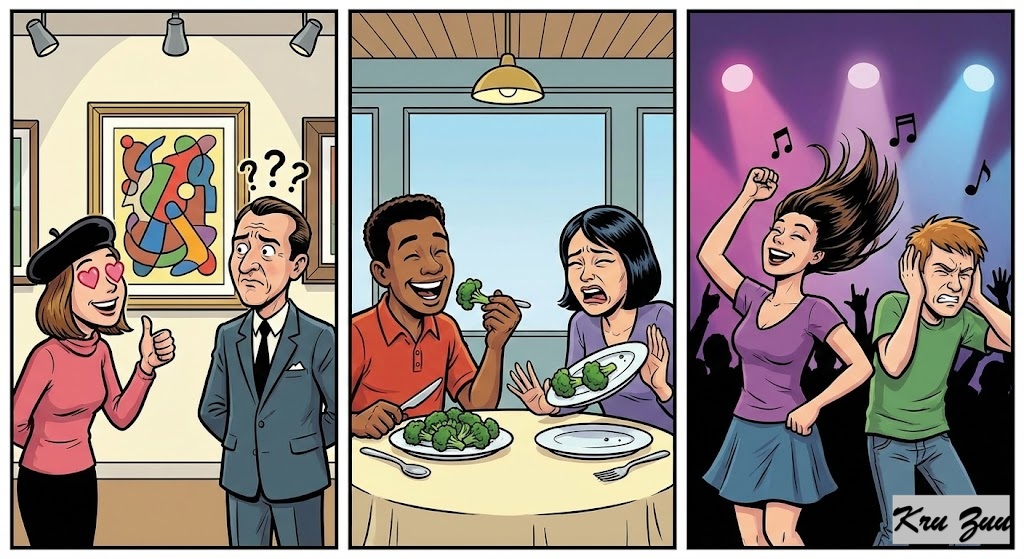
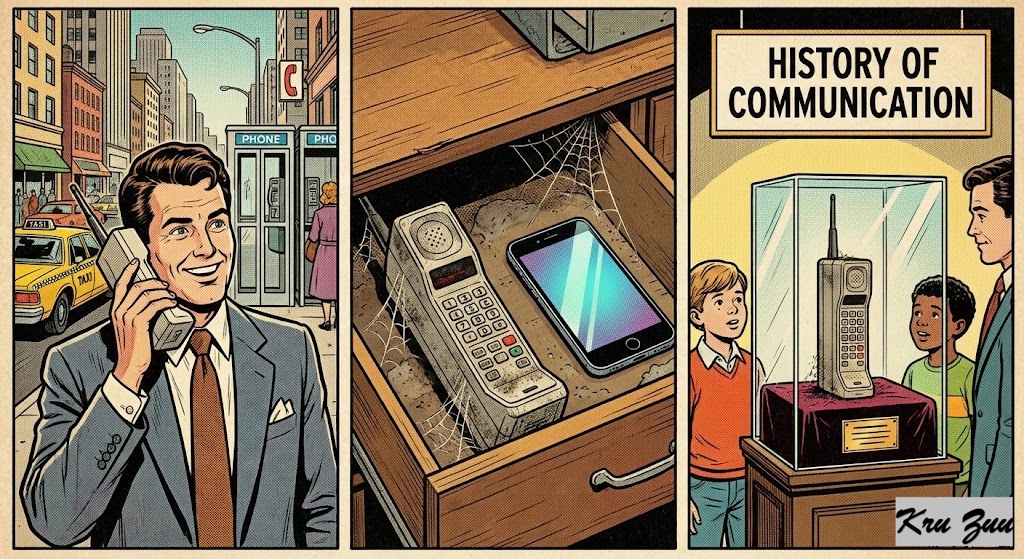
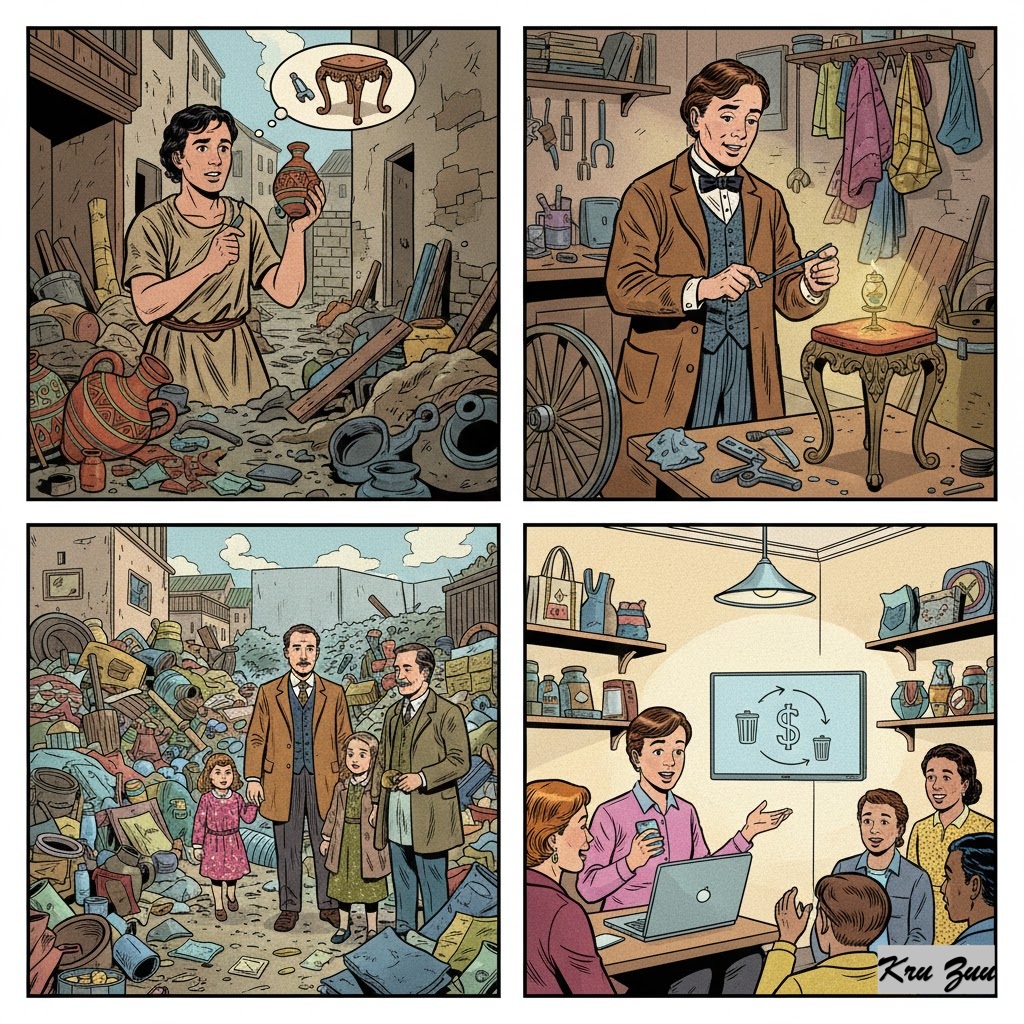
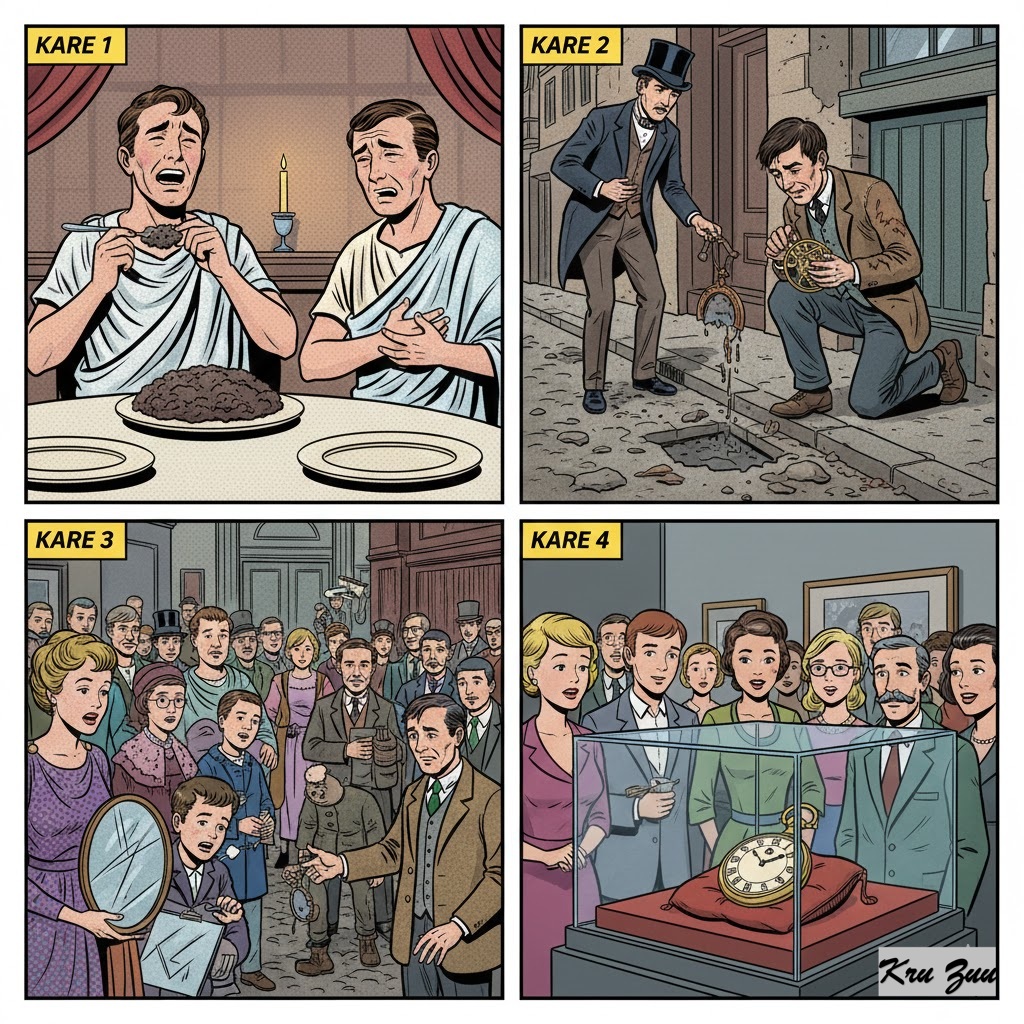
    Value is not a fixed number, it is a matter of perception. A broken watch is “trash” to a businessman, but a “treasure” to a watchmaker who needs parts. We live in a throw-away culture, but the most successful people find opportunities where others see obstacles. Wealth is often hidden in plain sight, disguised as “junk.”

    🧐 The Anatomy of the Proverb


    This is your reminder that worth is in the eye of the beholder.


    One man’s (Noun): A person’s subjective experience.


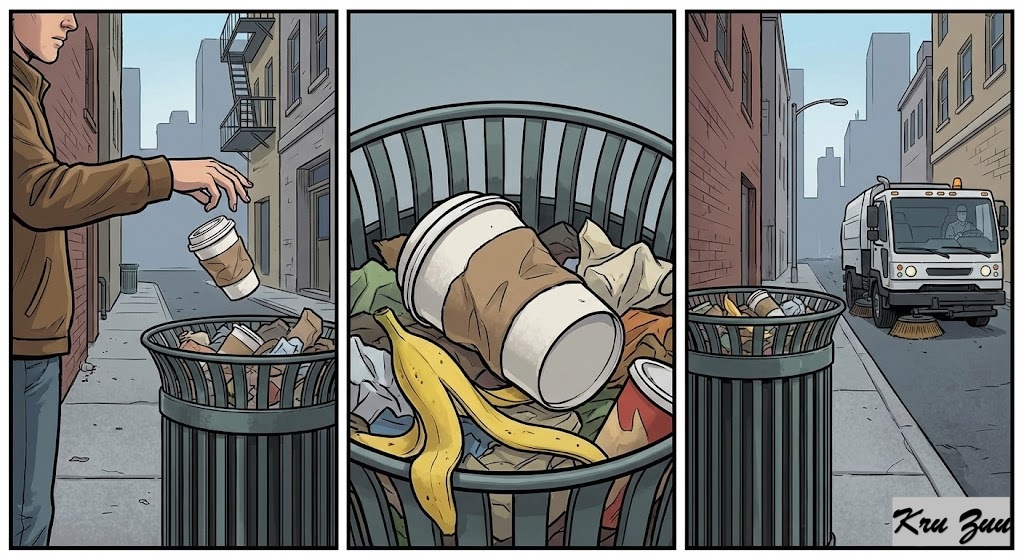
    Trash (Noun): Something discarded, worthless, or unwanted.


    Is another man’s (Phrase): Simultaneously becomes someone else’s.


    Treasure (Noun): Something of great value, beauty, or importance.


    Simpler Version: People have different ideas about what is valuable. / Don’t judge a book by its cover.


    📚 Vocabulary Vault


    Subjective (Adjective): Based on or influenced by personal feelings or tastes. 🎨


    Obsolete (Adjective): No longer produced or used; out of date.


    Upcycle (Verb): To reuse discarded objects or material in such a way as to create a product of higher quality or value than the original. ♻️


    Beholder (Noun): A person who sees or observes someone or something.


    Perception (Noun): The way in which something is regarded, understood, or interpreted.


    🧠 Grammar Focus: Idioms for Perspective


    We use this idiom to explain different tastes or to justify why we keep something others might find “ugly.”


    Friend: “Why do you keep that rusty old tin can on your desk?”


    You: “Actually, it’s a 1920s limited edition tea box. I’m using it as a pen holder. You know what they say: One man’s trash is another man’s treasure.”

    📜 History: Origin and Spread


    Where did this philosophy of “trash to cash” begin?


    The Origin: While the sentiment is ancient, the specific phrasing became popular in the mid-19th century. It mirrors the Latin proverb “Quod aliis cibus est aliis fuat acre venenum” (What is food to one may be bitter poison to others).


    The Logic: It’s the foundation of the Secondary Market (eBay, flea markets, antique shops). It highlights the human ability to innovate and find use where others find waste.


    Global Cousins


    🇫🇷 French: “Le bonheur des uns fait le malheur des autres.” (The happiness of some makes the unhappiness of others — similar context of differing perspectives).


    🇯🇵 Japanese: “Tade kuu mushi mo sukizuki.” (There are even bugs that eat knotweed, meaning tastes vary).

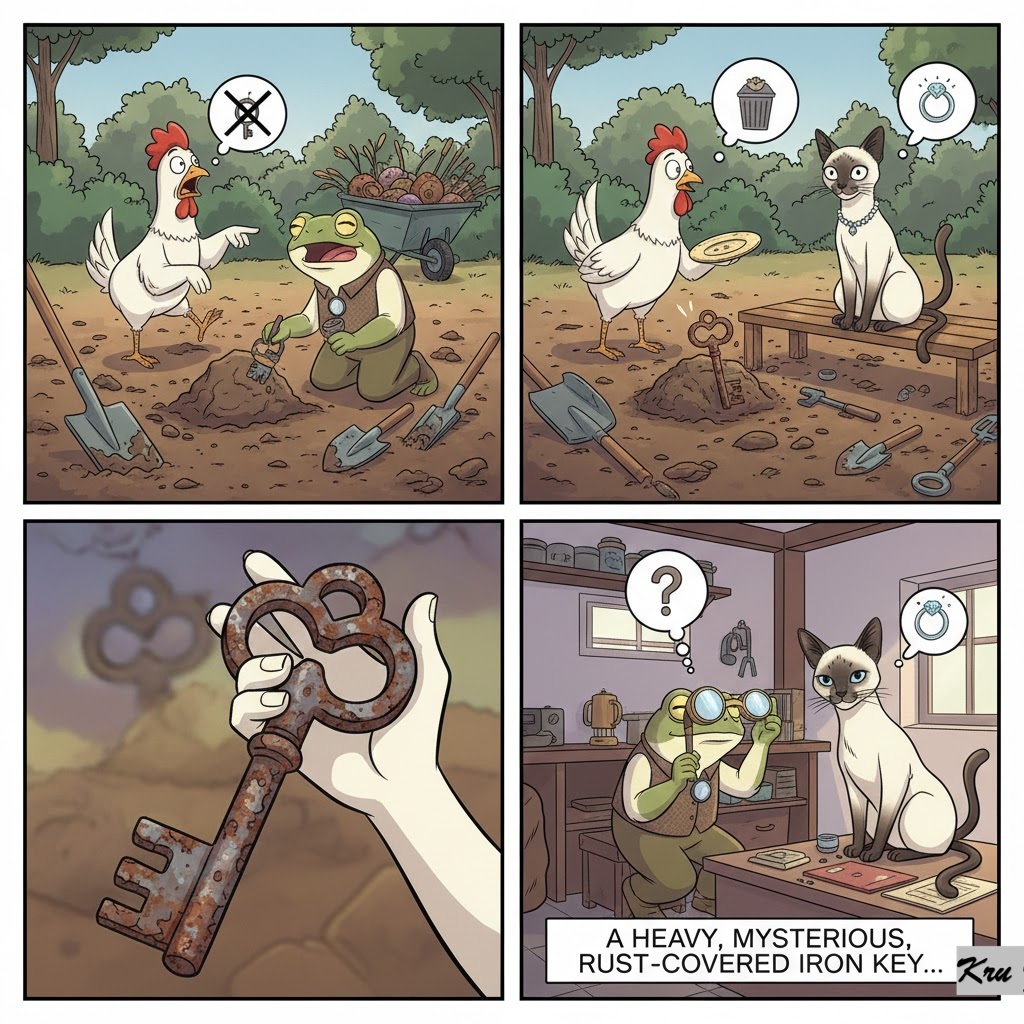
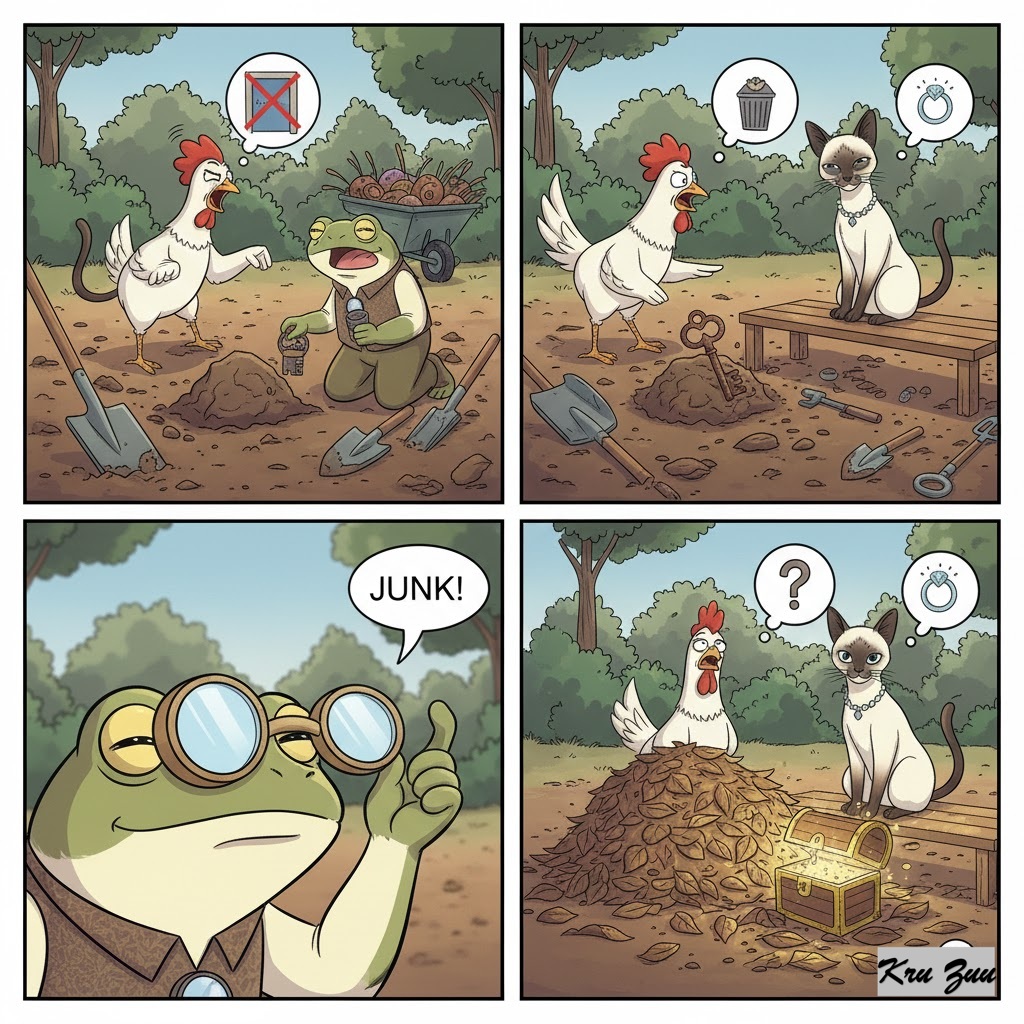
    🎭 Short Story: The Rusty Iron Key 🔑🐱🐔🐸


    🌟 The Cast


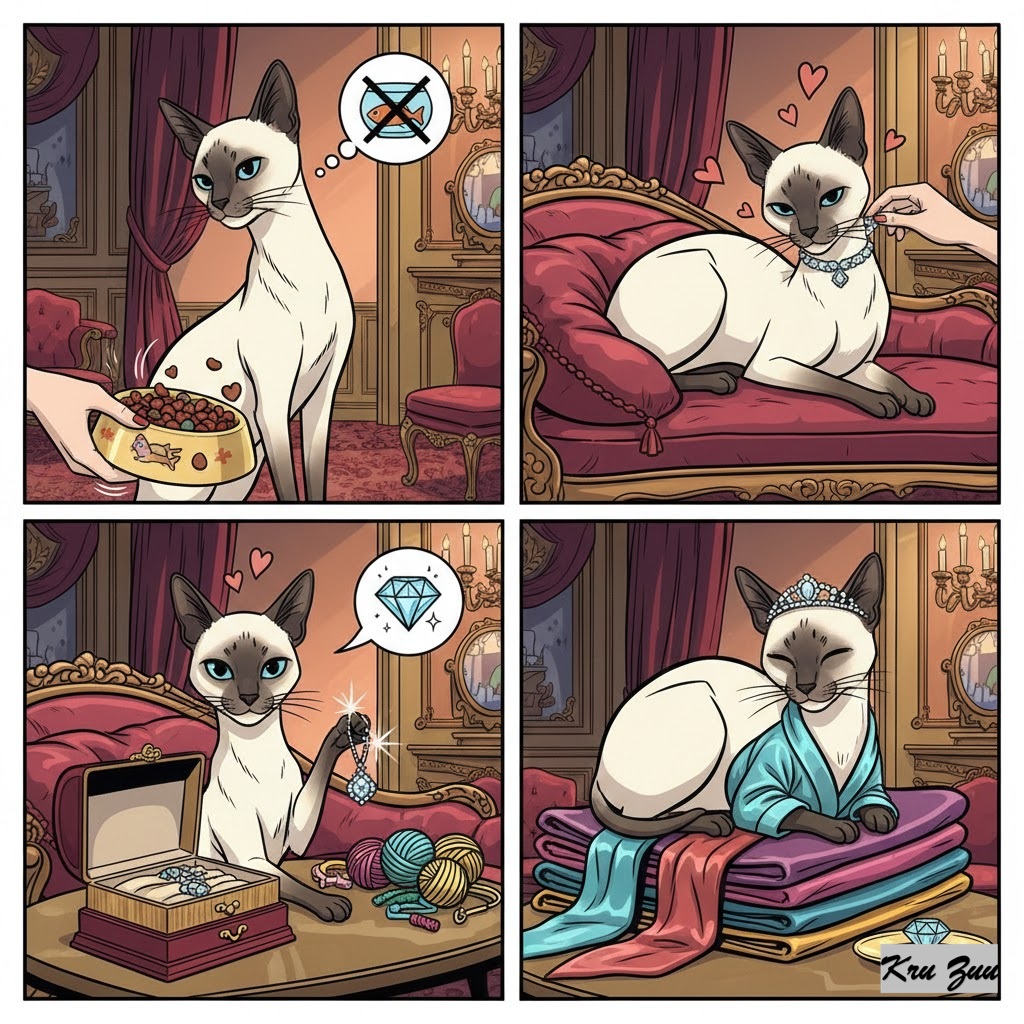
    Cleo the Cat: Elegant, only likes diamonds and silk. 😼


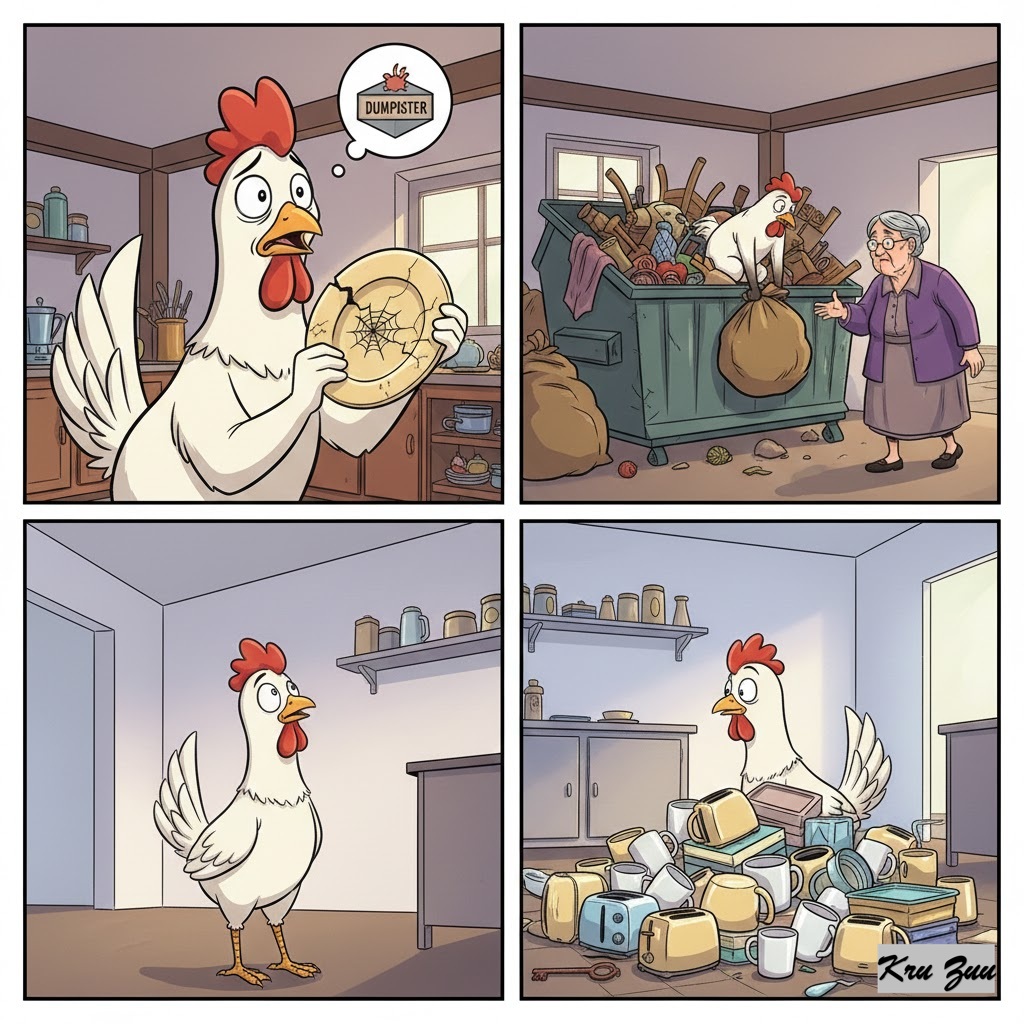
    Cluck the Chicken: Panics easily, throws away everything “old.” 🐔


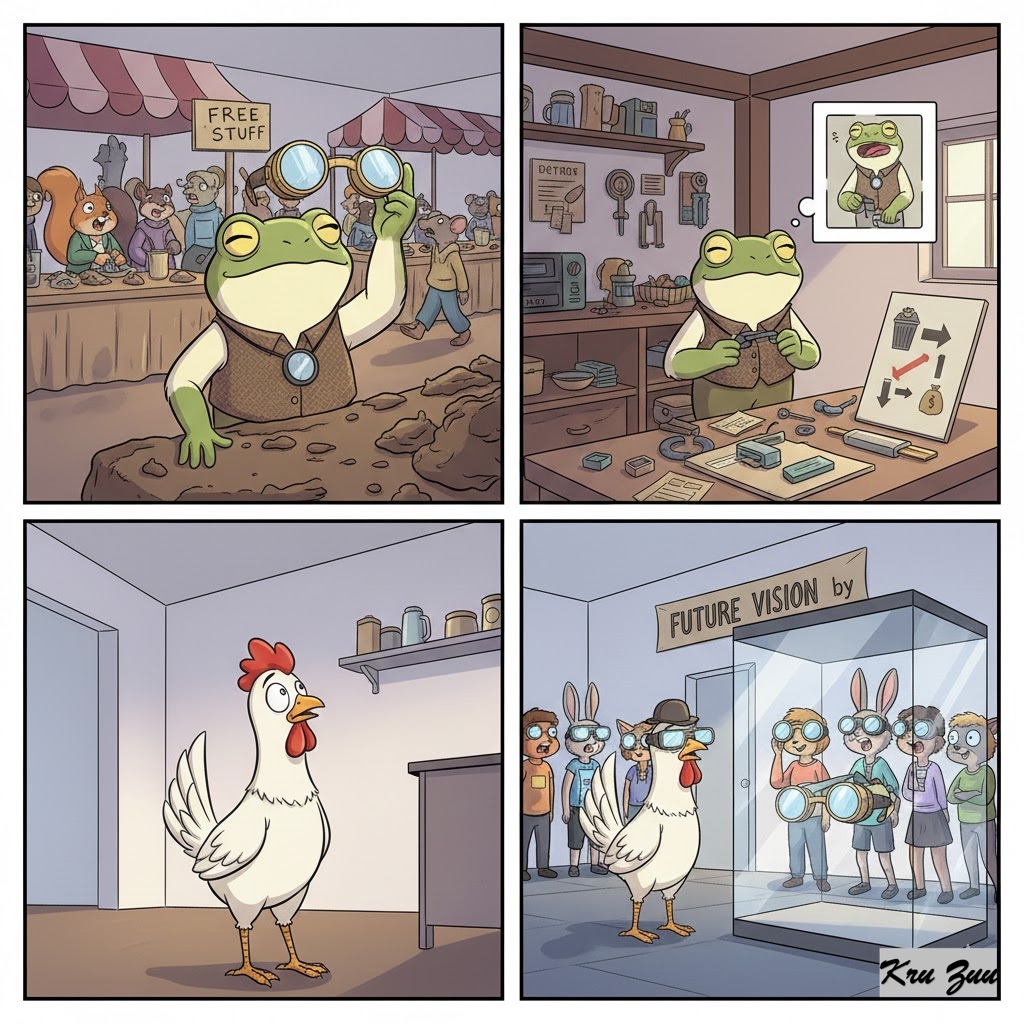
    Fred the Frog: The calm collector who sees the future. 🐸


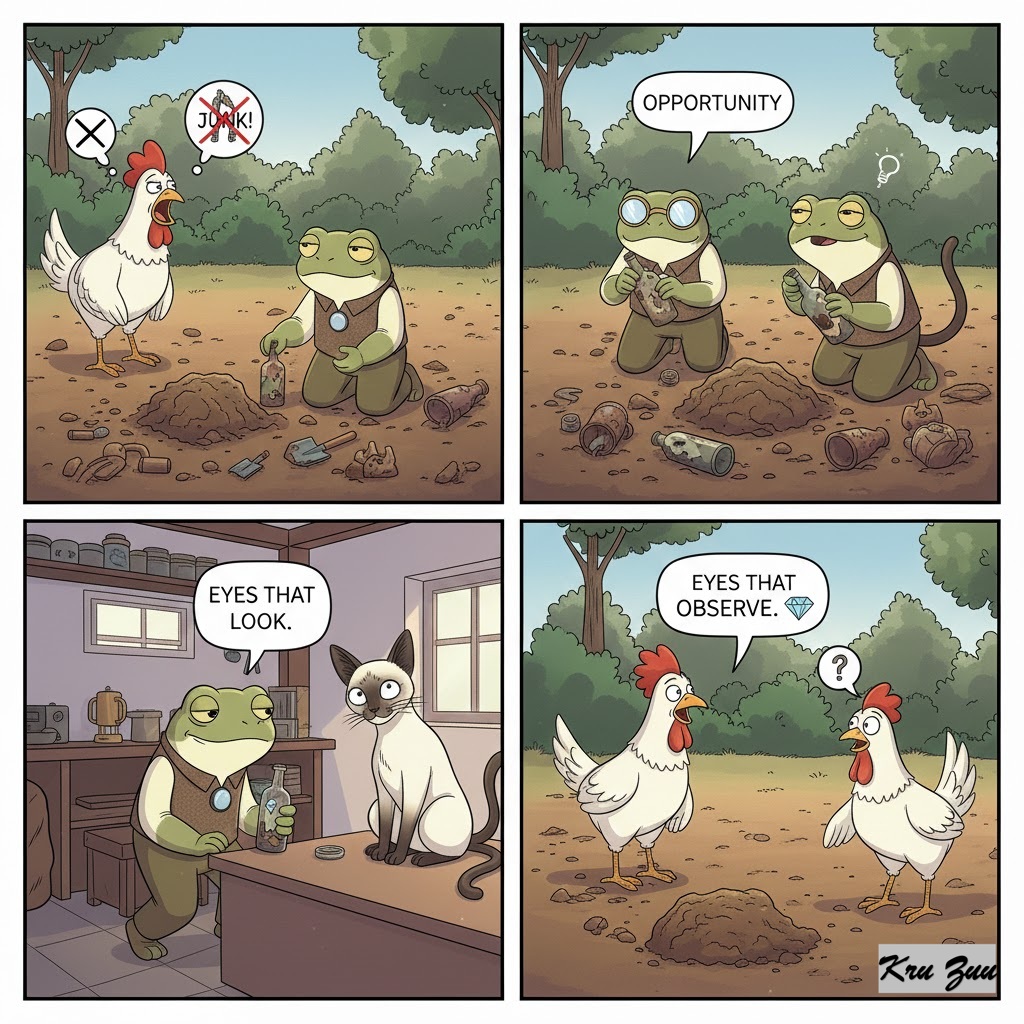
    The Situation: While cleaning the community garden, the trio finds a heavy, rusted, dirt-covered iron key.


    The Conflict: “Ugh! Get it away from me!” Cleo hissed, flicking her tail. “It’s filthy and probably covered in germs. It belongs in the bin!” Cluck squawked in agreement. “It’s useless! It doesn’t open my modern electronic coop door. It’s just heavy junk!” Cluck kicked the key into a pile of dead leaves.


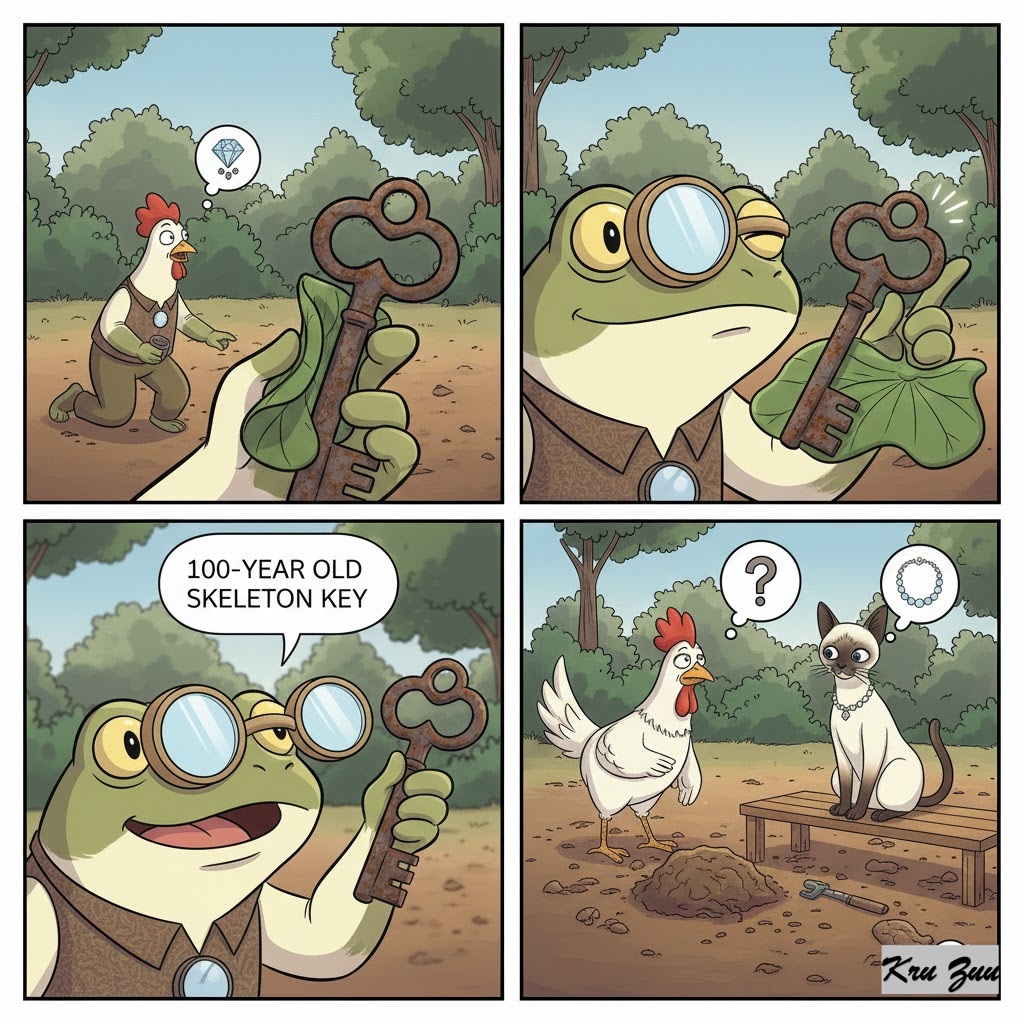
    The Reaction: Fred hopped over and picked up the key. He wiped away the mud with a lily pad. “Ribbit,” Fred whispered. “This isn’t junk. Look at the craftsmanship. This is a 100 year old skeleton key.”


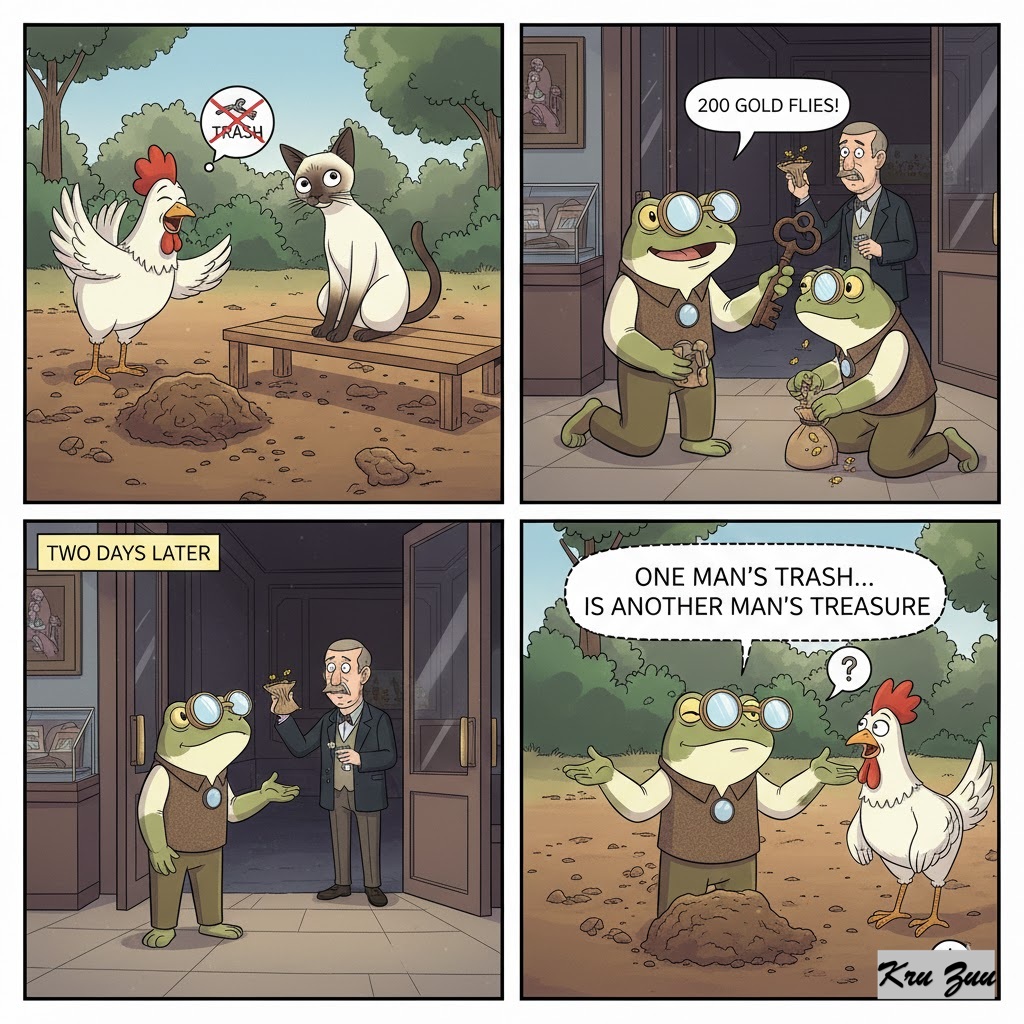
    The Resolution: Cleo laughed. “Have fun with your ‘trash,’ Fred.” Two days later, Fred returned. He had polished the key until it glowed like silver and attached it to a leather cord. He sold it to a local museum collector for 200 Gold Flies. Cleo and Cluck stared, mouths open. “You got all that for that piece of garbage?” Fred adjusted his glasses. “To you, it was a piece of metal. To the collector, it was the missing piece of history. One man’s trash, my friends… is another man’s treasure.”


    The Moral: Eyes that look see “junk.” Eyes that observe see “opportunity.” 💎

    🎓 Lesson for English Learners


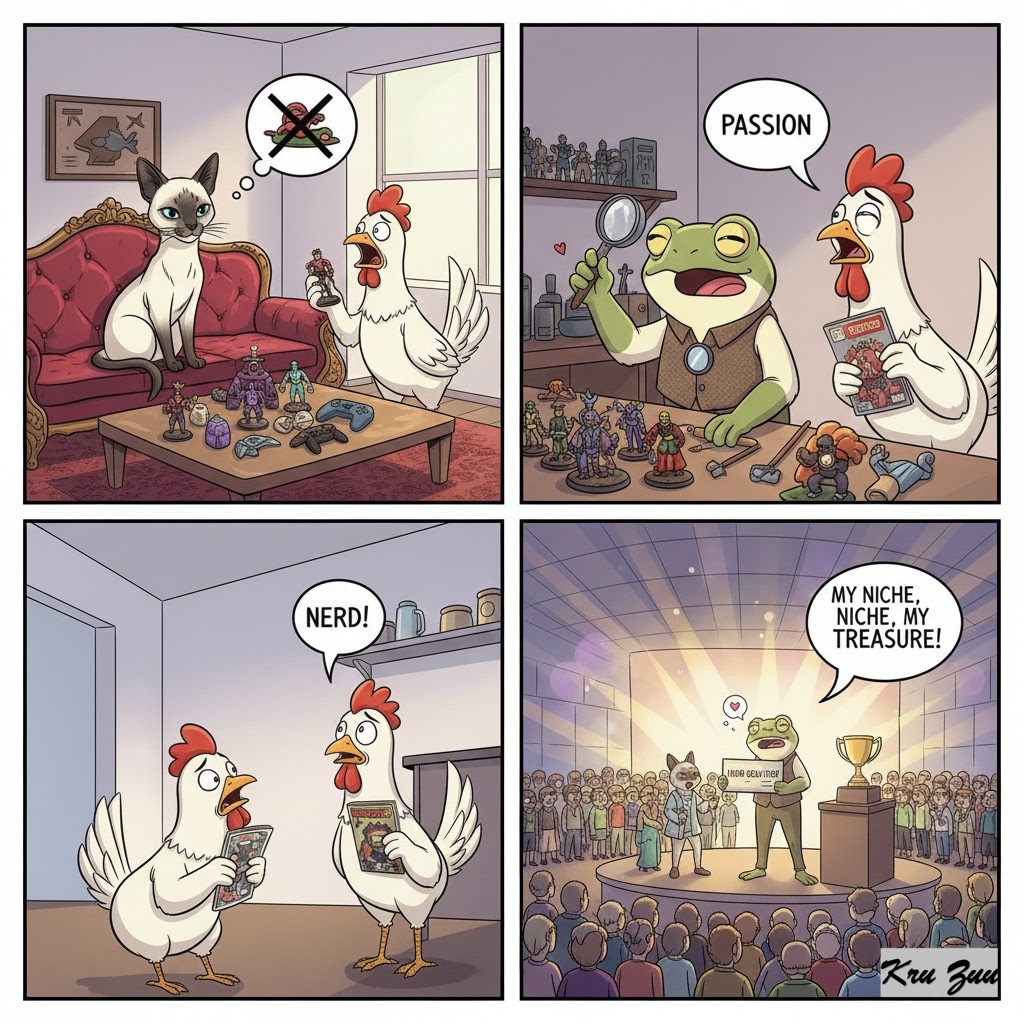
    Use it to defend your niche interests.


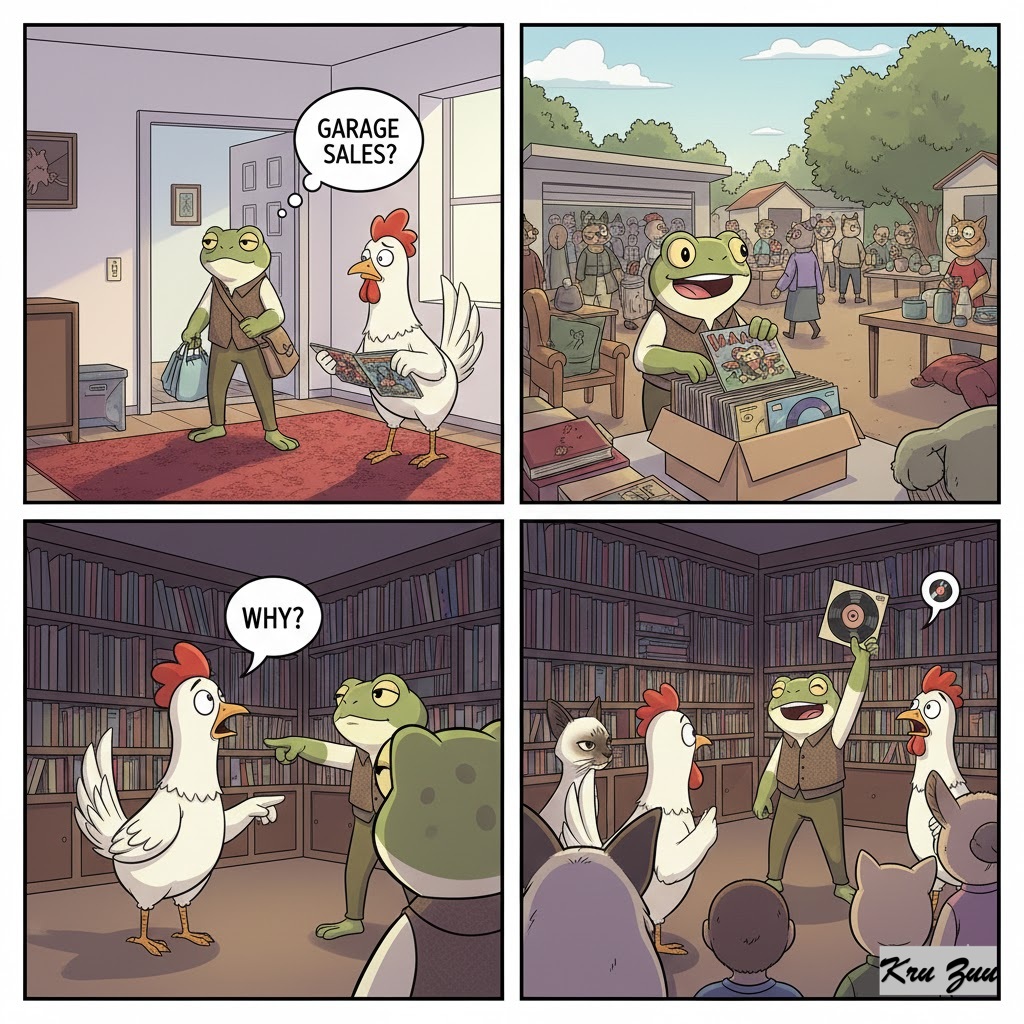
    Situation: Someone asks why you spend your weekends at garage sales or buying old vinyl records.


    You Say: “I know it looks like a mess to you, but I find incredible things there. After all, one man’s trash is another man’s treasure!”


    💬 Your Turn: The “Treasure” Challenge 🚀


    The Challenge:
    Look around your room or a local second-hand shop.

    The Action: Find one item that is “obsolete” (like a CD, an old jar, or a worn-out book).

    Ask yourself: “How could this be valuable to someone else? Could it be art? Could it be a tool? Could it be a memory?”


    👇 Question for the comments: What is the “weirdest” thing you own that you refuse to throw away? Why is it a treasure to you? Tell us below!

    By Zubeyir YURTKURAN

    https://www.facebook.com/BrainBattleground/

    https://www.facebook.com/zubeyr.yurtkuran/

    https://www.instagram.com/zubeyryurtkuran/
    https://www.youtube.com/@BrainBattleground-b3p

    https://www.instagram.com/brainbattleground/

  • Talk is Cheap: The Truth About “Actions Speak Louder Than Words”

    Talk is Cheap: The Truth About “Actions Speak Louder Than Words”

    🔥 The Word: I’m going to study all night and ace the big exam! 🎮 The Action: You spend 3 hours playing video games, and suddenly realize you haven’t studied for the test tomorrow.


    🔥 The Word: I’ll just scroll through TikTok “for 5 minutes.” 📱 The Action: You look up to see that two hours have vanished without gaining anything.


    🔥 The Word: I’ll finish this project perfectly, I promise. 🛠️ The Action: You haven’t started a single step because you were waiting for the “perfect time” or the “perfect plan.”


    Life has a strict rule that successful people know well: “Actions Speak Louder Than Words.”


    In this post, we are looking at the most famous proverb about getting things done. Put down your phone, focus your mind, and let’s dive into the power of execution. 🚀

    The Anatomy of the Proverb


    Let’s look at the mechanics of this famous phrase.


    📚 Vocabulary Vault


    Action (Noun):
    A thing done, often in pursuit of a purpose. (Reading a book, sending an email, writing code). 🛠️


    Word (Noun): A spoken or written statement; the expression of an intention. (I will do, I will start, I will try). 📝


    🧠 Grammar Focus


    This sentence is a comparative idiom that delivers a strong message.
    Formula: Action + [speak louder than] + Word.
    The Meaning: Deeds and accomplishments carry more value and impact than mere promises or intentions. A Word is a promise, but an Action is the fulfillment of that promise.

    History: Intention is Not Enough


    Who turned this idea into a famous saying? People have always criticized those who talk big but fail to deliver.


    The Origin: While there is no single inventor of the exact phrase, the philosophy is ancient. It echoes the sentiment of the Roman poet Ovid, who lived in the 1st Century BC: “Deeds are words, and words are merely air.”


    The Lesson: Success depends not on how well you speak, but on how much you do.

    Impact on Life: The Pros & Cons


    Is living by action alone a good way to live? Let’s weigh the options.


    ✅ The Pros (Why it helps)


    Trustworthiness: When you say you will do something and then you actually do it, people trust you. Trust is the most valuable asset in life and career.


    Momentum: It stops procrastination. Instead of waiting for the “perfect moment,” it encourages you to take a small step now. Every small action builds momentum. 🧗


    Focus: It teaches you to spend your energy on producing results rather than crafting excuses or making intricate, non-executed plans.


    ❌ The Cons (Why it can be tricky)


    The Perfectionist Trap: The pressure to constantly act might cause you to rush without proper planning. Actions that are poorly thought out can lead to failure.


    Neglecting Communication: Sometimes, saying something (asking for feedback, stating an intention) is important. Focusing solely on action might cause you to neglect crucial planning and communication with others. 🧘

    Short Story: The Empty Basket


    To understand this better, let’s visit our friends on the farm again.


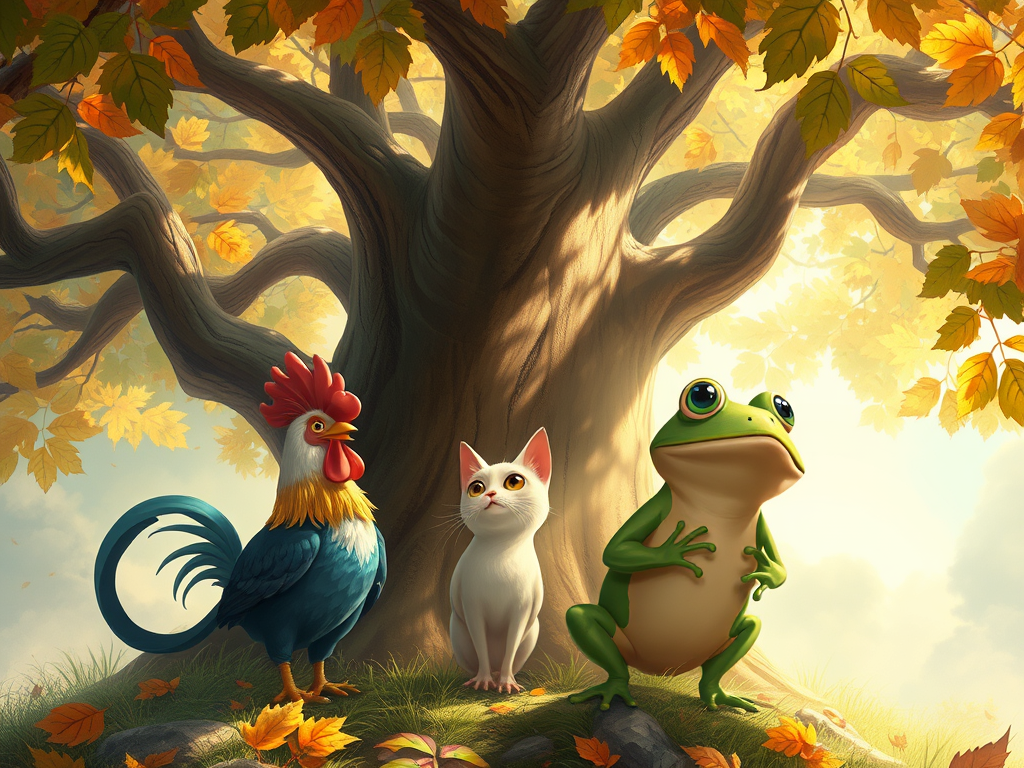
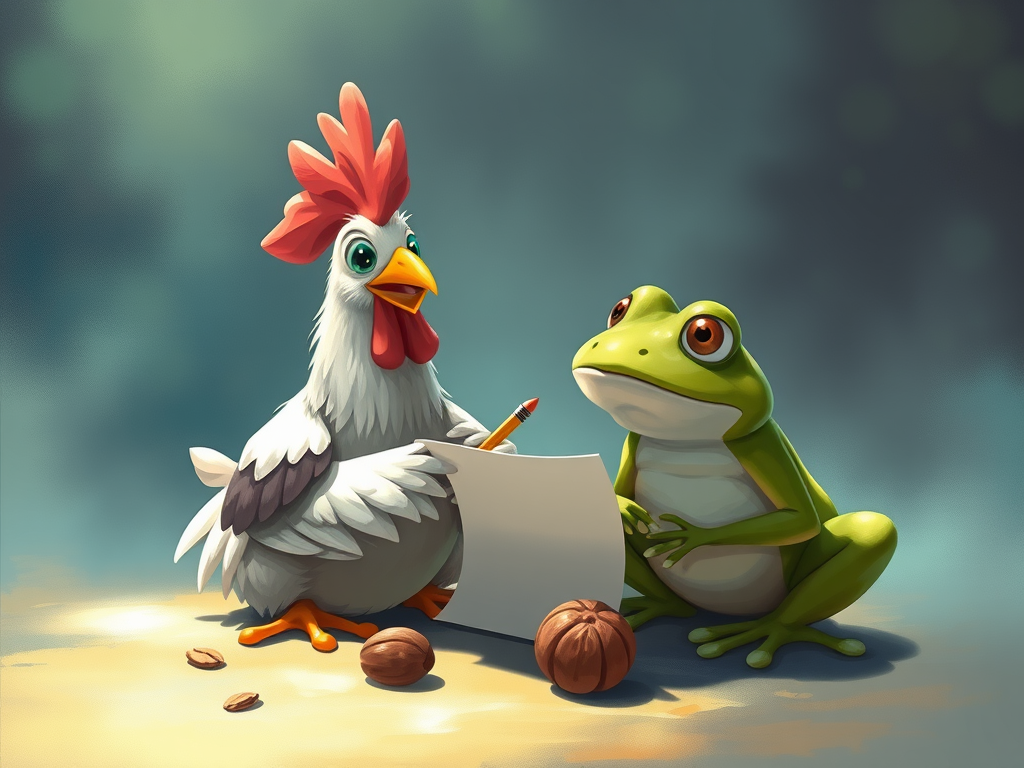
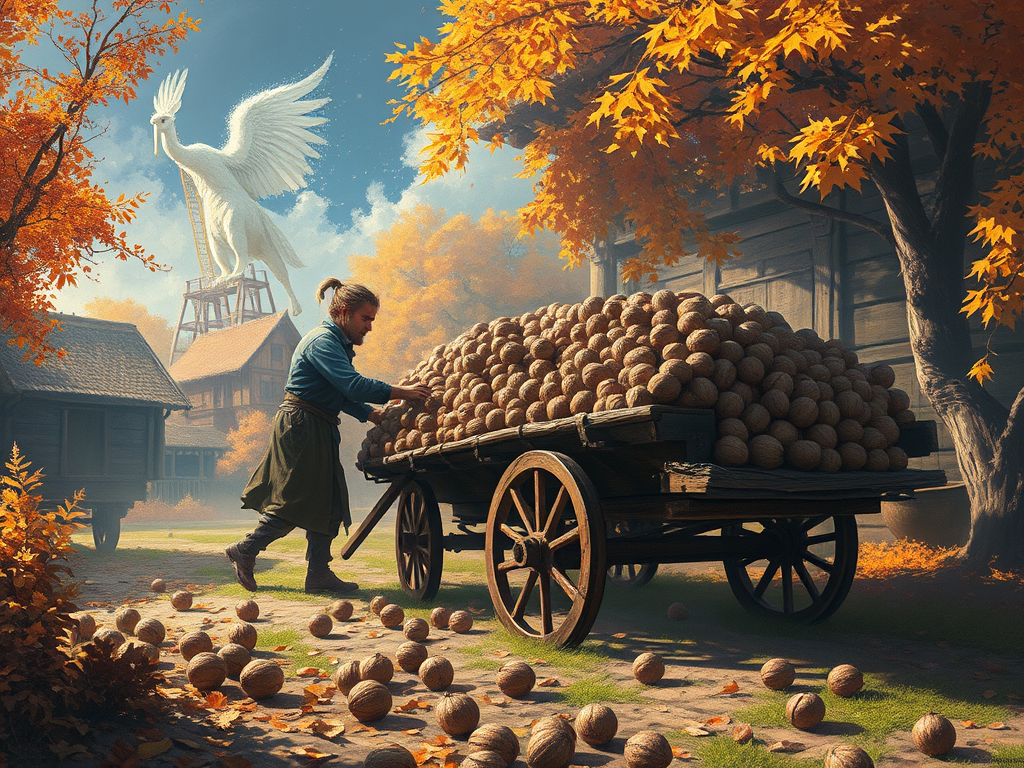
    It was a bright autumn morning. Percy the Chicken, Luna the Cat, and Fred the Frog were sitting under the Great Walnut Tree. 🌳


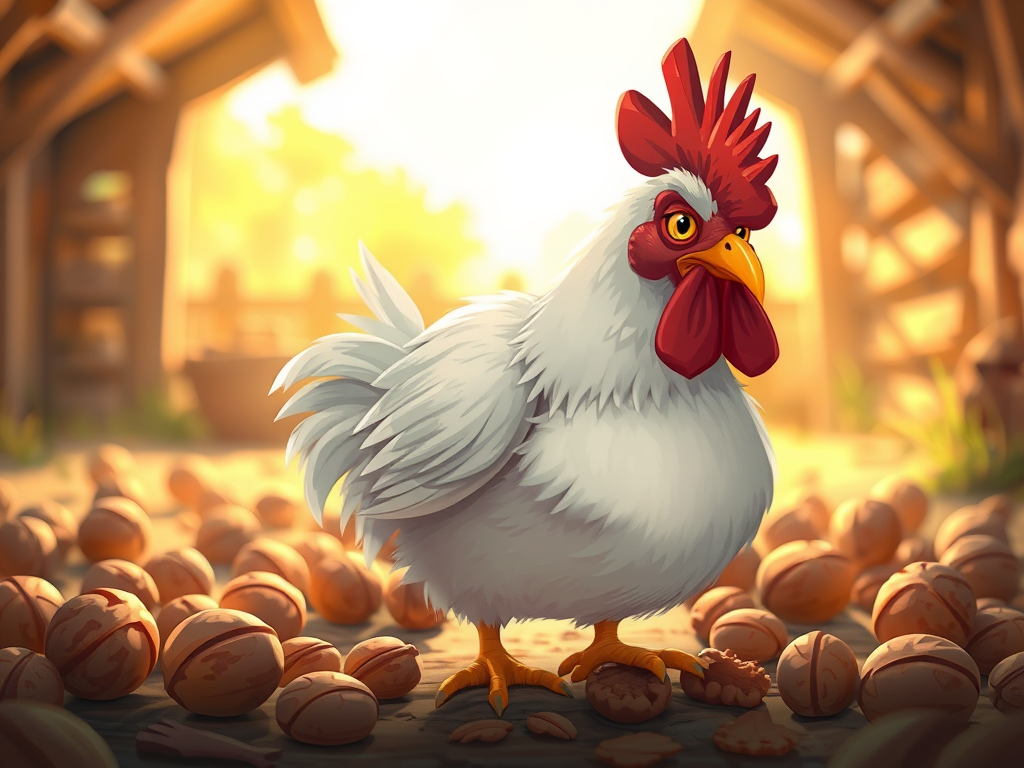
    “Today,” announced Percy, puffing out his chest, “I am going to work hard and gather all these walnuts! I will bake a magnificent cake, and the whole farm will be impressed!” 📣


    Luna the Cat rolled her eyes. “That sounds lovely, Percy. But you are just talking.”


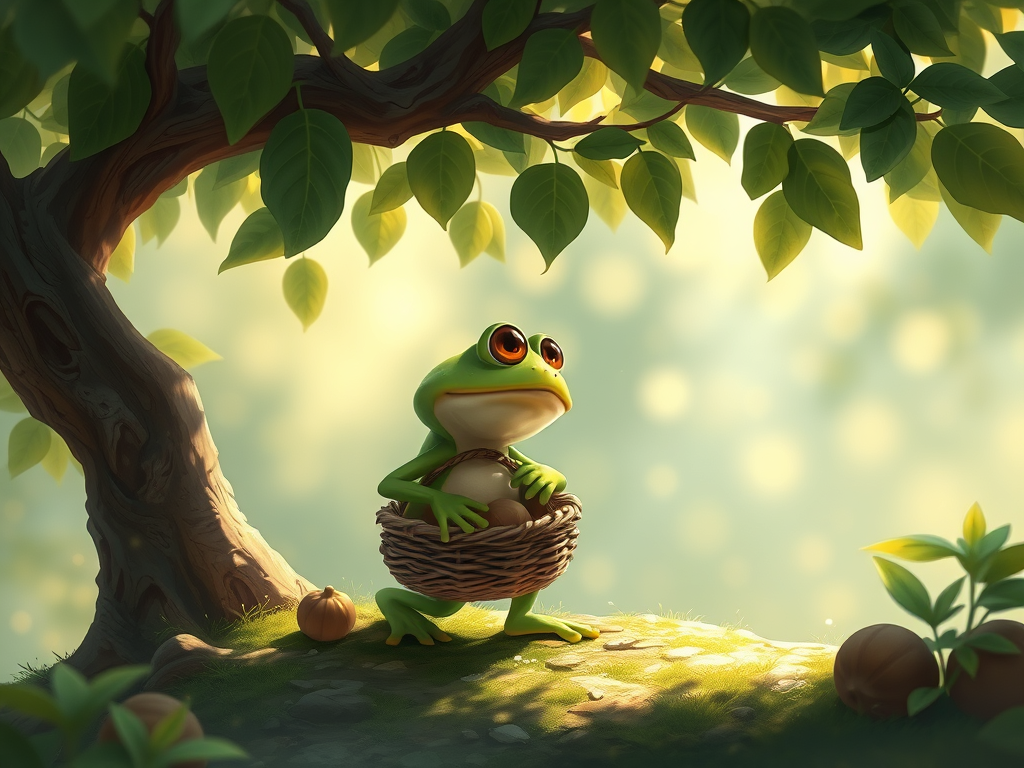
    Fred the Frog, with his small basket, had already begun hopping under the tree. He worked slowly but surely, picking up the fallen walnuts and placing them in his basket. 🐸


    Percy ignored him. He continued to dream out loud, looking at the nuts. “First, I must create a detailed plan. What is the best recipe for my cake? Are these walnuts of suitable quality?” Percy spent a full hour talking about his perfect plan and how wonderful his cake would be. 😴


    An hour passed. Suddenly, the farmer arrived with a large cart to collect all the scattered walnuts for himself.


    Percy squawked in surprise. “No! My walnuts! I was just about to start!”


    Fred sat on a dry rock, holding his full basket. “While you were talking about your cake, I was collecting these,” Fred said. “Your basket was full of imaginary biscuits. My basket is full of real walnuts.”


    Percy stared sadly at his empty basket.


    “I see now,” Percy whispered sadly. “I only spoke. Fred took action. My words were worthless.”


    In this story, the characters represent how we manage our intentions:
    Percy
    : Empty Words (The one who talks a lot and procrastinates) 😵
    Fred: Action/Execution (The one who uses the moment wisely) 🤓
    The Farmer: Missed Opportunity (The value lost while you were only talking) 🌪️

    Learning English takes action. You cannot buy fluency.
    If you study for 10 minutes every day (Fred’s method), you are executing your plan.
    If you only say “I will start tomorrow” and wait until the night before the exam (Percy’s method), you will find that your goal remains only a hollow promise.


    💬 What about you? When you have a new idea, do you start with a small, immediate action, or do you keep planning until everything is perfect? Tell me in the comments! 👇

    By Zubeyir YURTKURAN

    https://www.facebook.com/BrainBattleground/

    https://www.facebook.com/zubeyr.yurtkuran/

    https://www.instagram.com/zubeyryurtkuran/
  • “Do We See Through Conscience, or March to the Media’s Tune?”

    “Do We See Through Conscience, or March to the Media’s Tune?”

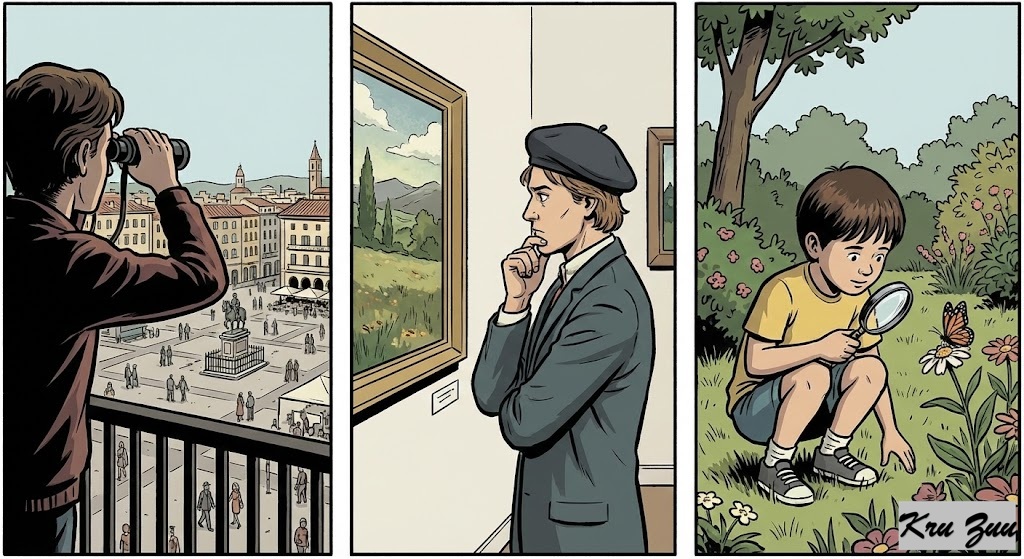
    When Did We Open Our Eyes? Or Were the Truths Always There, Hidden in Plain Sight?

    Was the world a better place when we were children?

    Or did we just think it was because we were too young to understand? Wars, betrayals for personal gain, favoritism, clinging to the powerful, idolizing the wealthy… Were these always there, but we simply couldn’t see them?

    Maybe growing up isn’t just about age maybe it’s about waking up.

    Real Faces, Fake Masks, and the Games of Perception

    Those once praised are now labeled as threats.

    “Did they really change, or are we only now beginning to see clearly?”

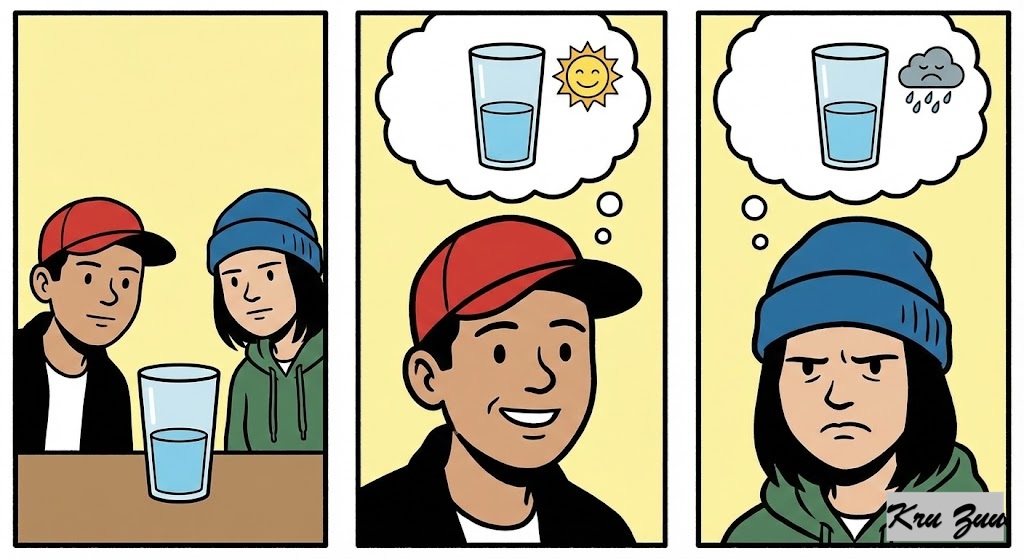
    Sometimes the truth isn’t black or white. Perhaps they were always the same. But we were shown a carefully crafted illusion. Media images, social conditioning, selective storytelling… What if the opinions we hold weren’t formed by our own minds but injected into us through calculated influence?

    When Interests Take Over, Does Innocence Stand a Chance?

    It’s easy to glorify someone but what if that praise hides personal agendas?

    And what if someone who was quiet, kind, and pure suddenly becomes a target? Maybe they just stood in the way of the wrong people.

    Today’s world, with its fast and flashy media, almost commands us to think a certain way. Reflection? It’s discouraged. Independent thinking? Inconvenient.

    But we must pause.

    Before You Judge, Listen to the Whole Story

    No one is completely good or evil overnight. Everyone has a past. A story. A journey.

    Before judging someone, have we truly listened to their full story?

    Look at their values. Their decisions in difficult times. Their perspective on life, their dreams for the future. These are what truly reveal who they are not a tweet, not a trending post, not a viral video.

    Are Our Minds Being Controlled While Our Conscience Sleeps?

    One of the greatest traps in modern society is this: Accepting without questioning.

    A headline, a trending hashtag, a viral clip… and suddenly, we’ve formed an opinion.

    But what if we took a step back? What if we just asked ourselves:

    “Does this really feel right?”

    If your heart feels a discomfort, even a small one, then it’s time to pause. The eyes can be deceived, the ears misled but the conscience is rarely wrong.

    Justice Means Staying Fair Even to the Ones We Love Most

    When someone you love does something wrong, staying silent is easy.

    But real justice begins there.

    No matter who the person is friend or foe standing for what’s right is both a moral duty and a true act of care. Perhaps your courage will be the very thing that helps them correct their path. Sometimes, the hardest truth is the greatest gift you can give.

    Let Courage, Justice, and Conscience Be Your Compass

    We live in a world full of noise, manipulation, and confusion. But ultimately, we decide who we are.

    Think with reason. Feel with empathy. Judge with conscience.

    Let courage guide your steps. Let justice shape your words. Let conscience light your path.

    Don’t rush to judge. Learn to understand. And above all, in a world full of shadows, choose to stay human.

    And Now… It’s Your Turn.

    If you’ve made it this far, perhaps a part of you has already begun to question not just the world, but the lens through which you see it.

    The masks, the media, the noise… They won’t stop.

    But your awareness? That’s your shield.

    Your conscience? That’s your compass.

    Your courage? That’s your power.

    So before you follow the crowd, pause.

    Before you condemn someone, listen.

    Before you believe what you’re told, think.

    Because true strength doesn’t lie in loud opinions or fast judgments.

    It lies in the quiet courage to remain human in a world that constantly tries to take that from you.

    Stay awake.

    Stay curious.

    Stay kind.

    And above all… stay true to the voice inside you that still knows the difference between illusion and truth.

    With love and respect,
    Zübeyir Yurtkuran