Tag: family

  • 🌳 The Daily Shield: The Law of Rooted Character

    🌳 The Daily Shield: The Law of Rooted Character

    “The apple doesn’t fall far from the tree.”


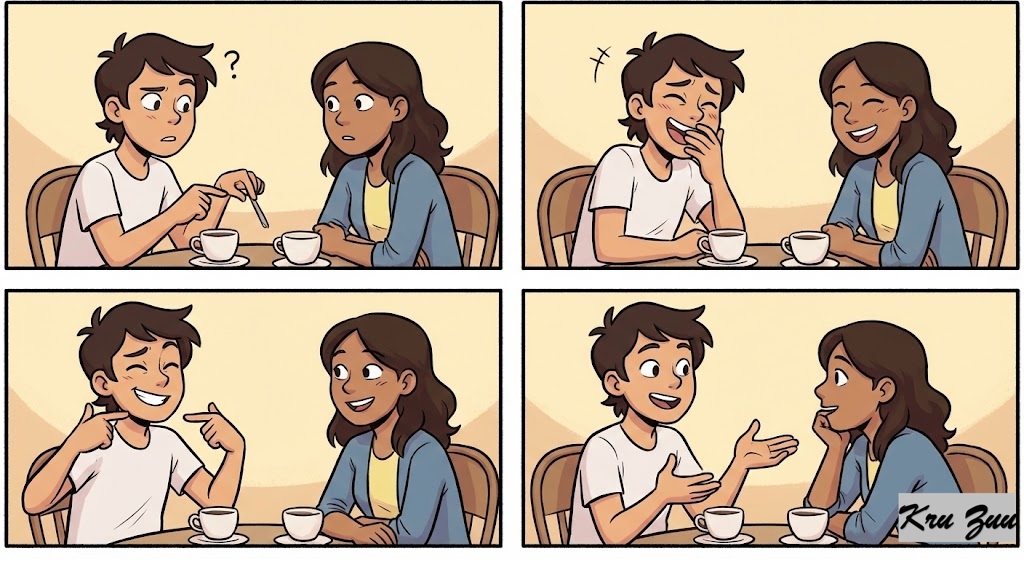
    😈 The Villain (The Blame Shifter)


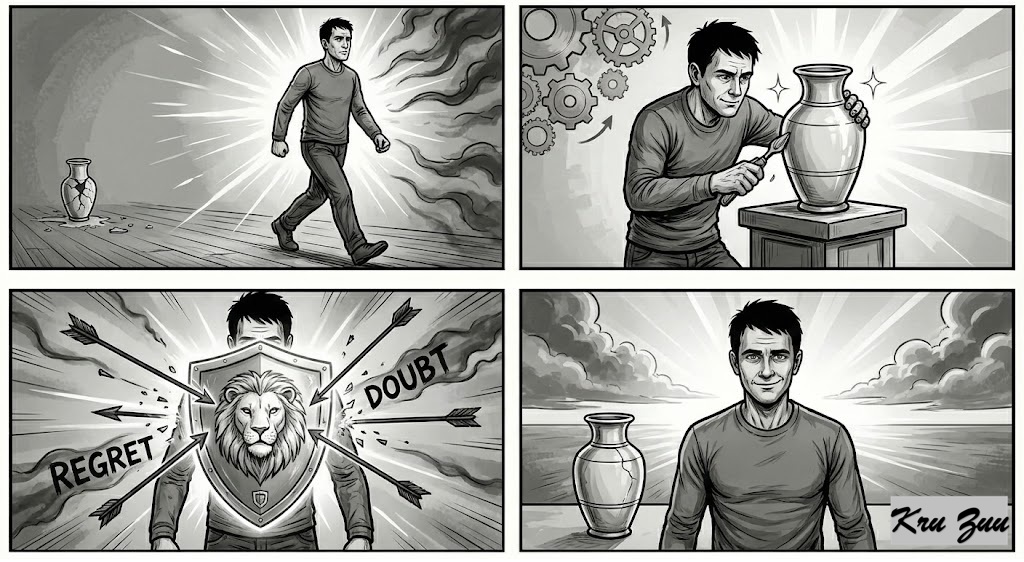
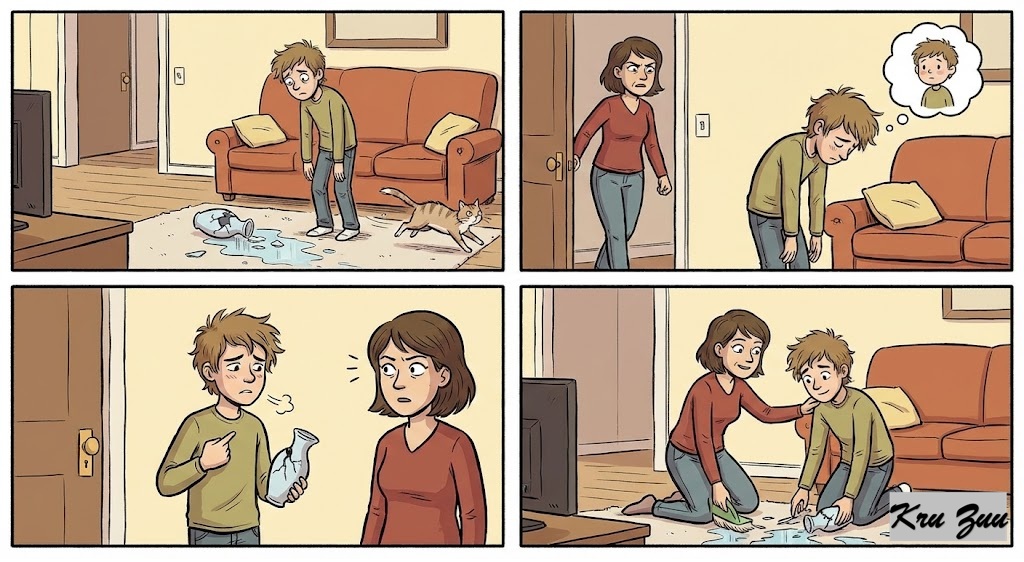
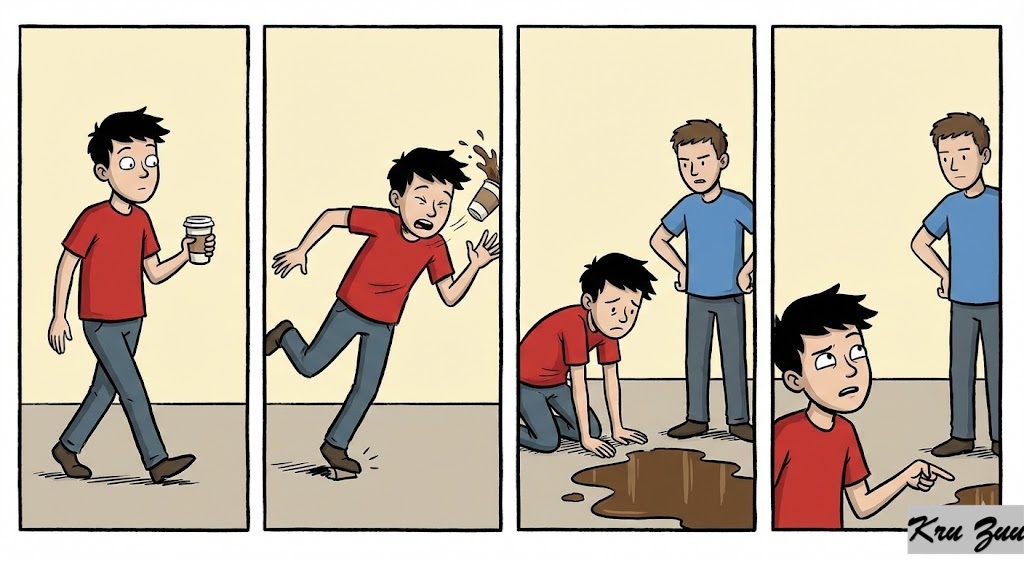
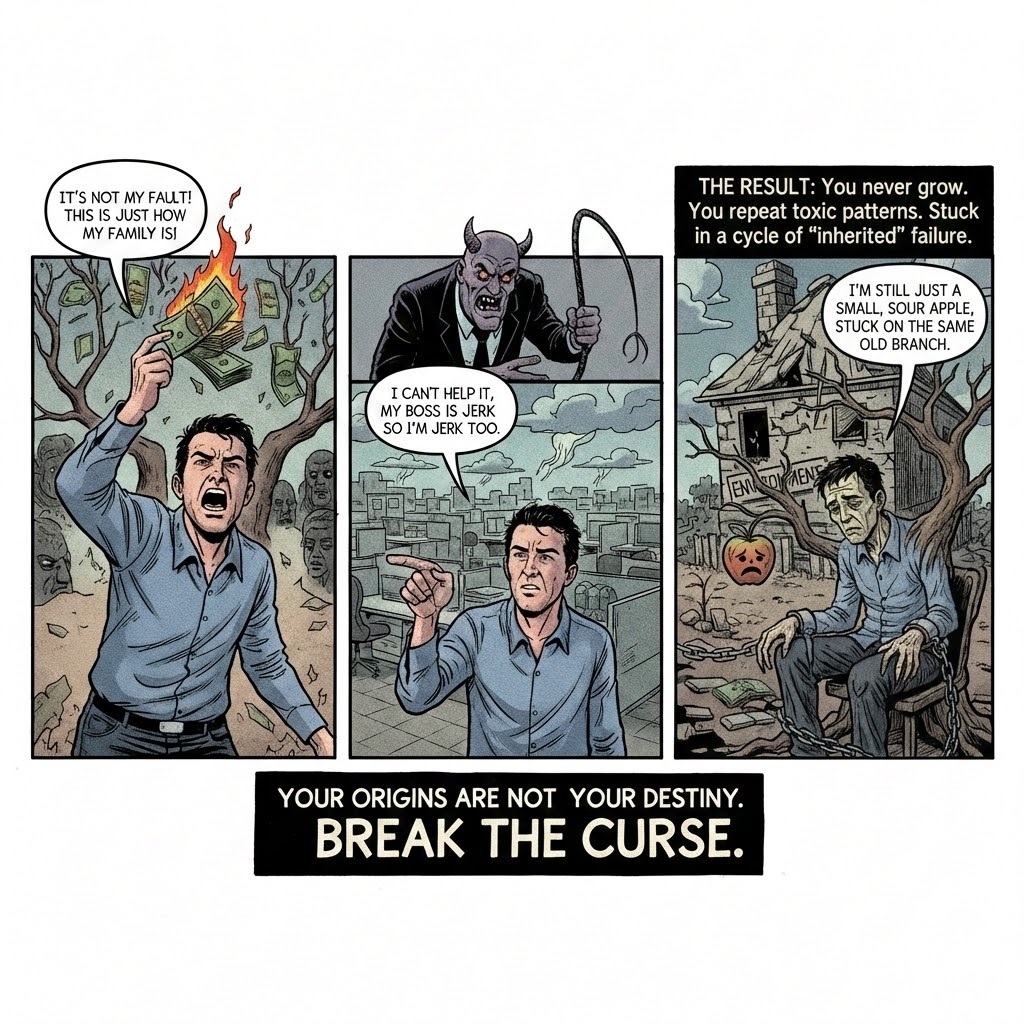
    You make a mistake. You lose your temper. You act dishonestly. 💸 “It’s not my fault! This is just how my family is!””I can’t help it, my boss is a jerk so I’m a jerk too.””I was raised this way, I’m just a product of my environment.” You treat your character like a fixed curse. You use your origins as an excuse for your poor choices today.
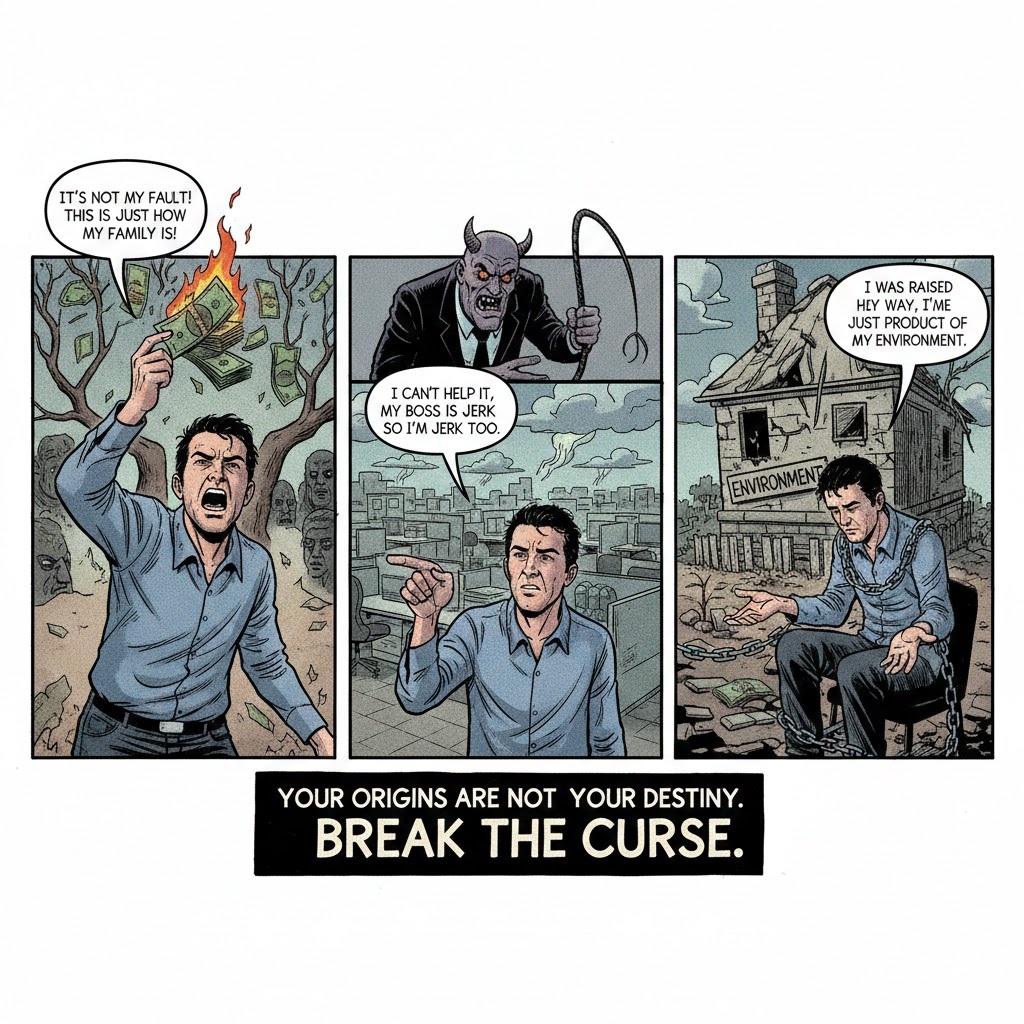
    The Result? You never grow. You repeat the same toxic patterns. You feel stuck in a cycle of “inherited” failure. You stay a small, sour apple because you refuse to see that you are still attached to the same old branch. 🍎

    😇 The Hero (The Cycle Breaker)


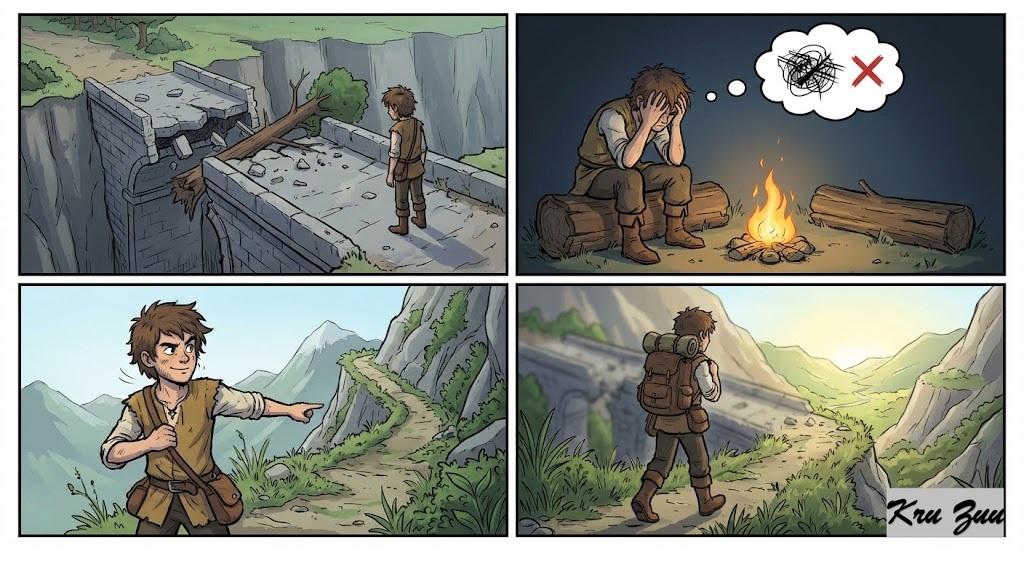
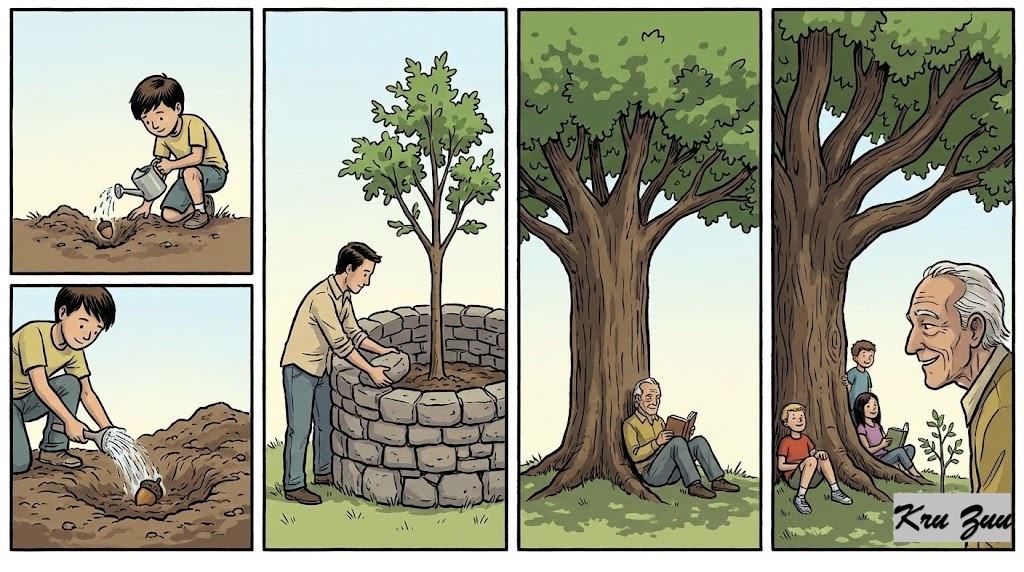
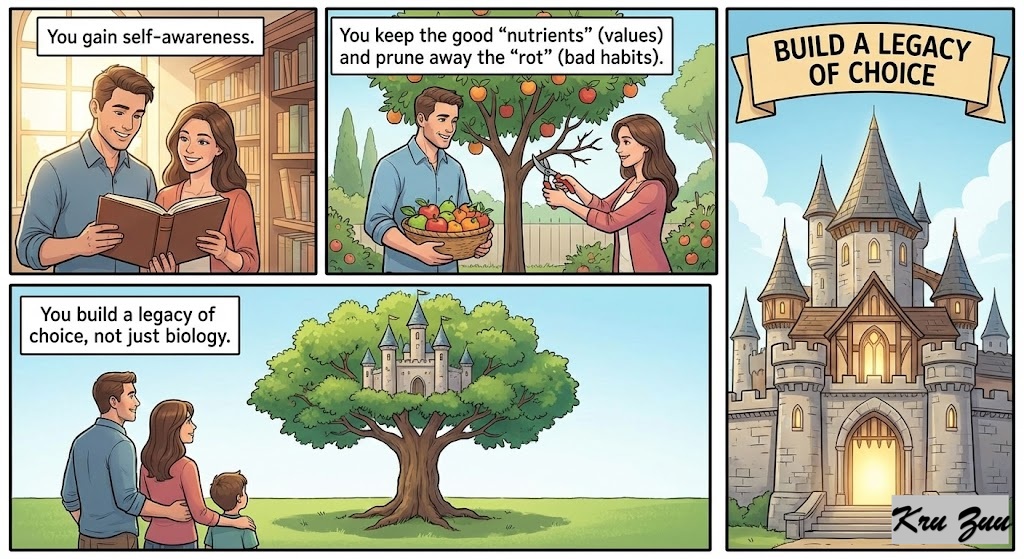
    You observe your habits. You look at your parents, your mentors, or your peers. 🛑 You acknowledge the influence: “I see that my father was always late, and now I am too.” But instead of accepting it, you take responsibility. You think: “The tree gave me my start, but I decide which way I grow.”
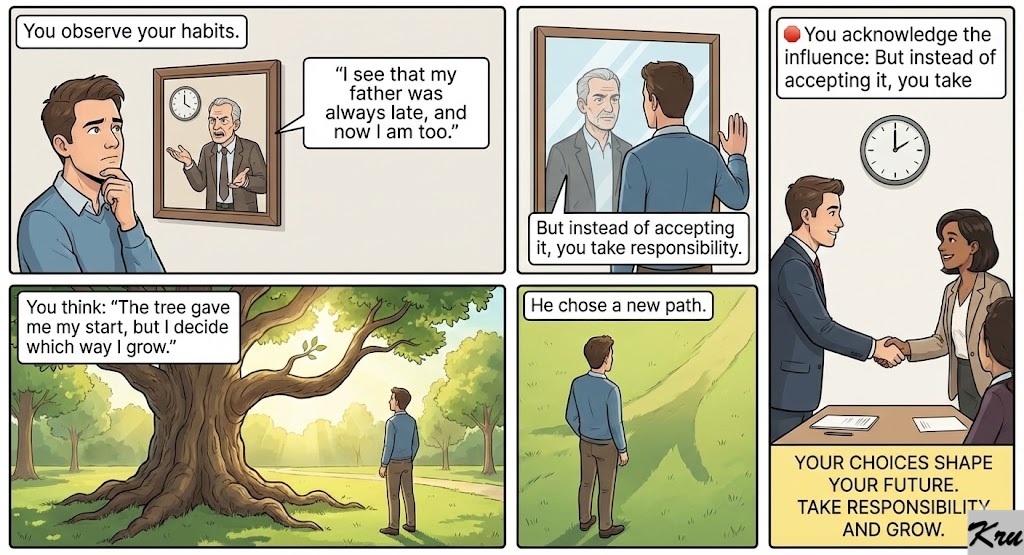
    The Result? You gain self-awareness. You keep the good “nutrients” (values) and prune away the “rot” (bad habits). You build a legacy of choice, not just biology. 🏰

    ⚖️ The Reality


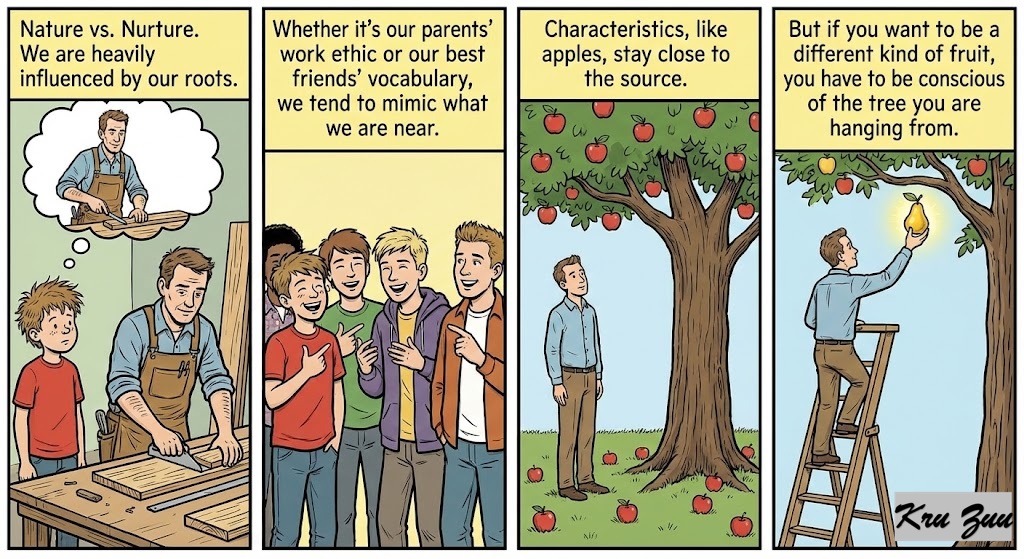
    Nature vs. Nurture. We are heavily influenced by our roots. Whether it’s our parents’ work ethic or our best friends’ vocabulary, we tend to mimic what we are near. Characteristics, like apples, stay close to the source. But while the proverb highlights similarity, it also serves as a warning: if you want to be a different kind of fruit, you have to be conscious of the tree you are hanging from.

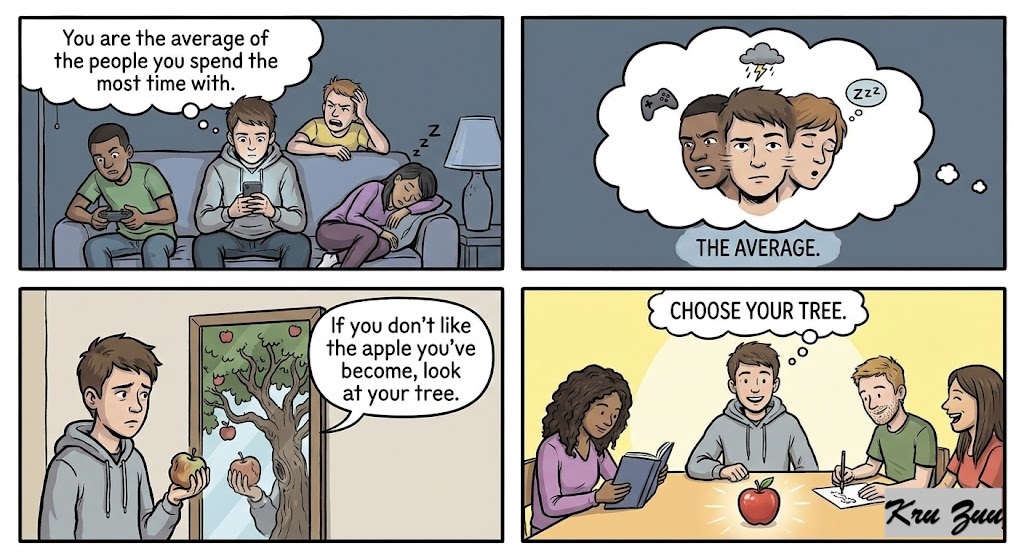
    The Secret: You are the average of the people you spend the most time with. If you don’t like the apple you’ve become, look at your tree.
    🧐 The Anatomy of the Proverb


    This is a biological metaphor for behavioral inheritance.
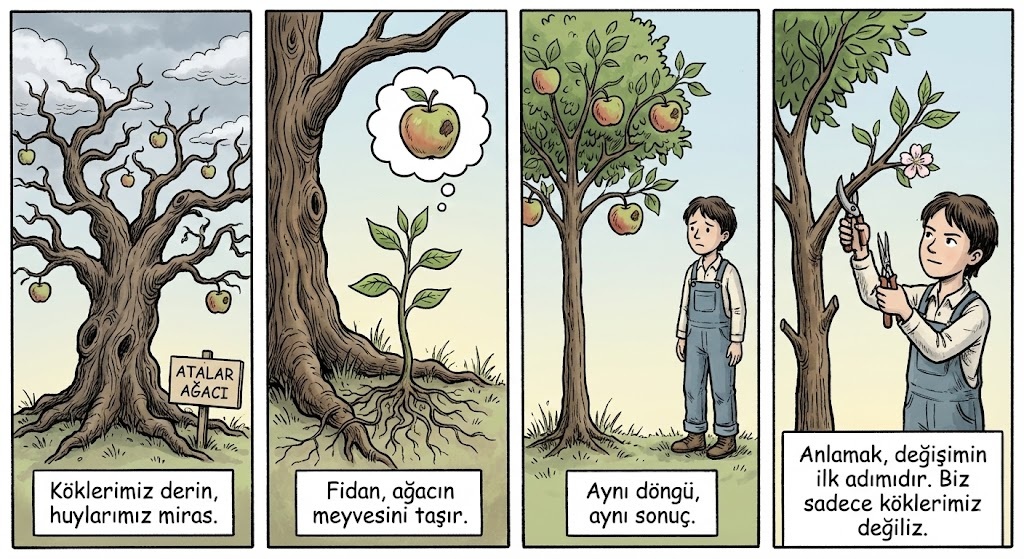

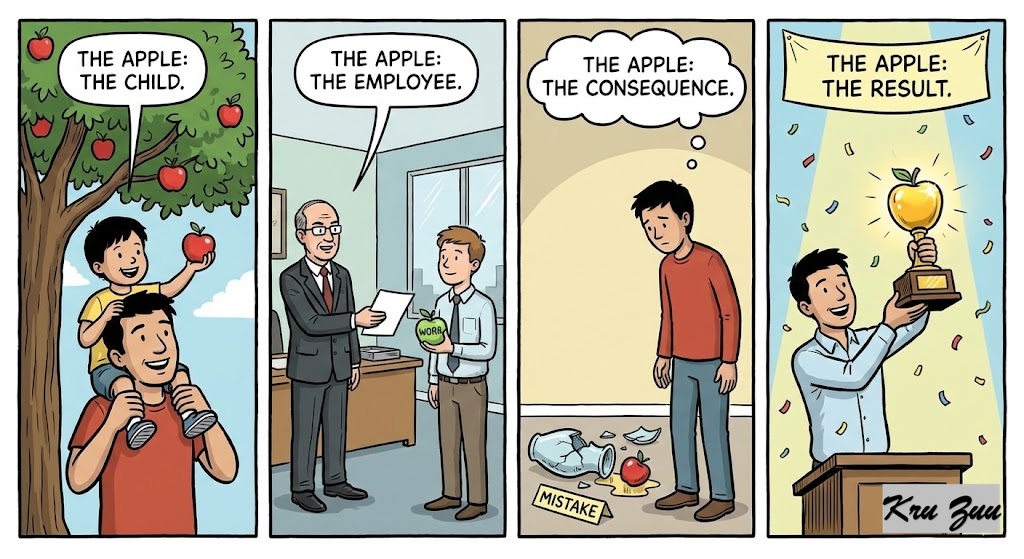
    The Apple (Noun): The child, the employee, the consequence, or the result.

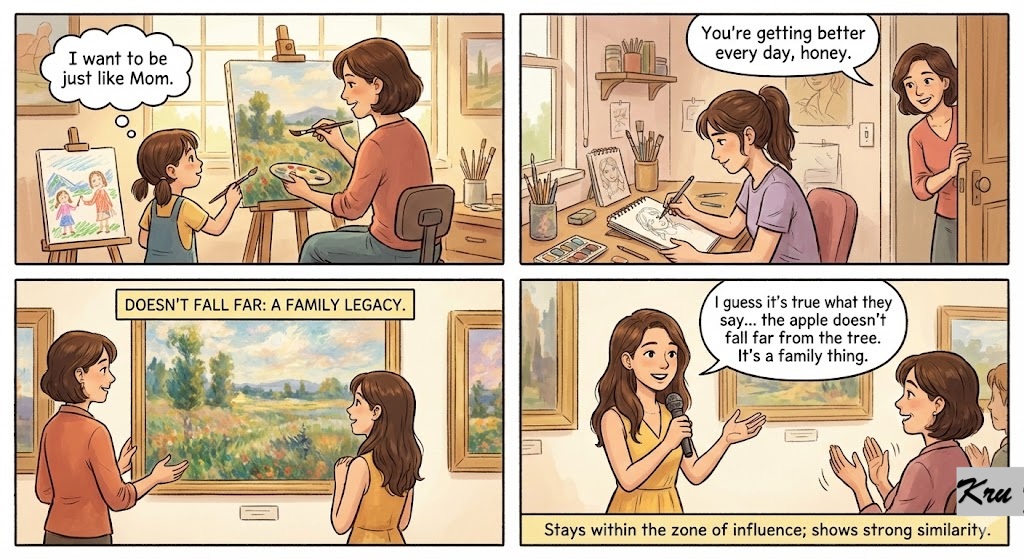
    Doesn’t Fall Far (Adverbial Phrase): Stays within the zone of influence; shows strong similarity.

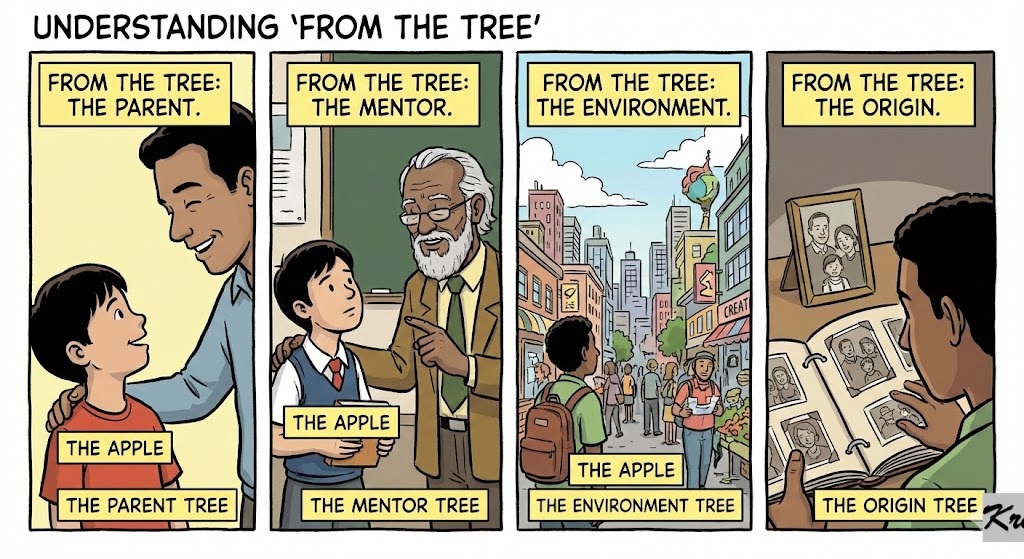
    From The Tree (Prepositional Phrase): The parent, the mentor, the environment, or the origin.

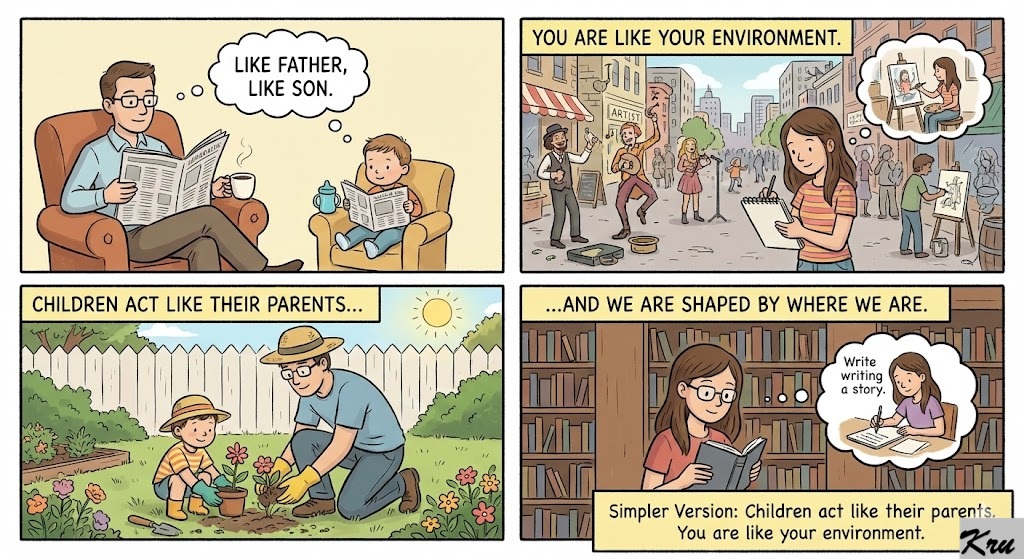
    Simpler Version: Children act like their parents. / You are like your environment.

    📚 Vocabulary Vault


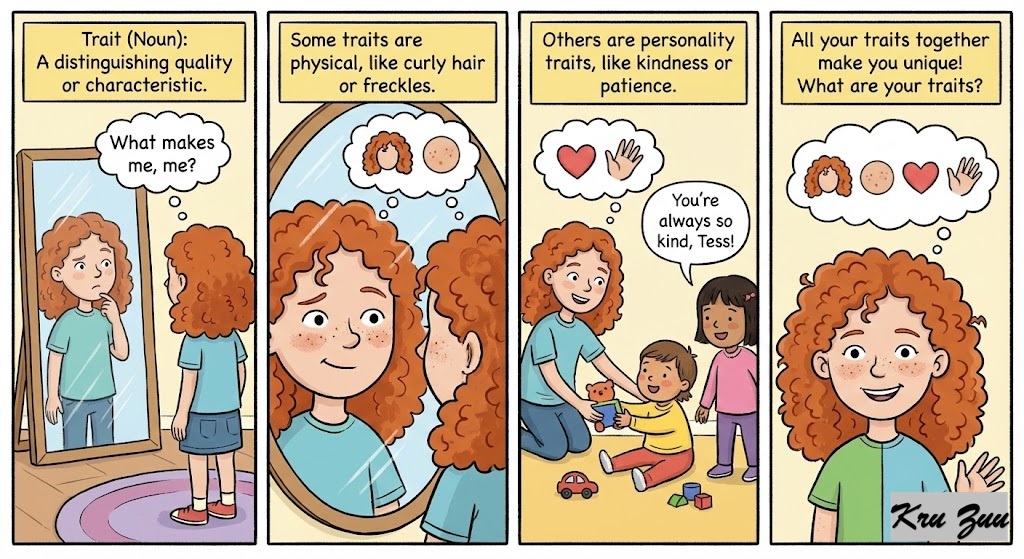
    Trait (Noun): A distinguishing quality or characteristic.

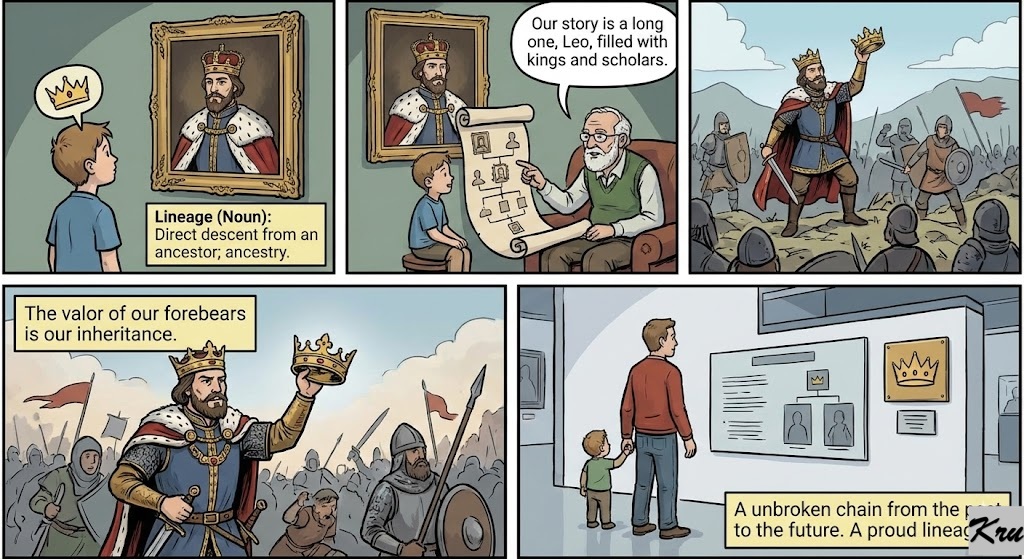
    Lineage (Noun): Direct descent from an ancestor; ancestry. 👑

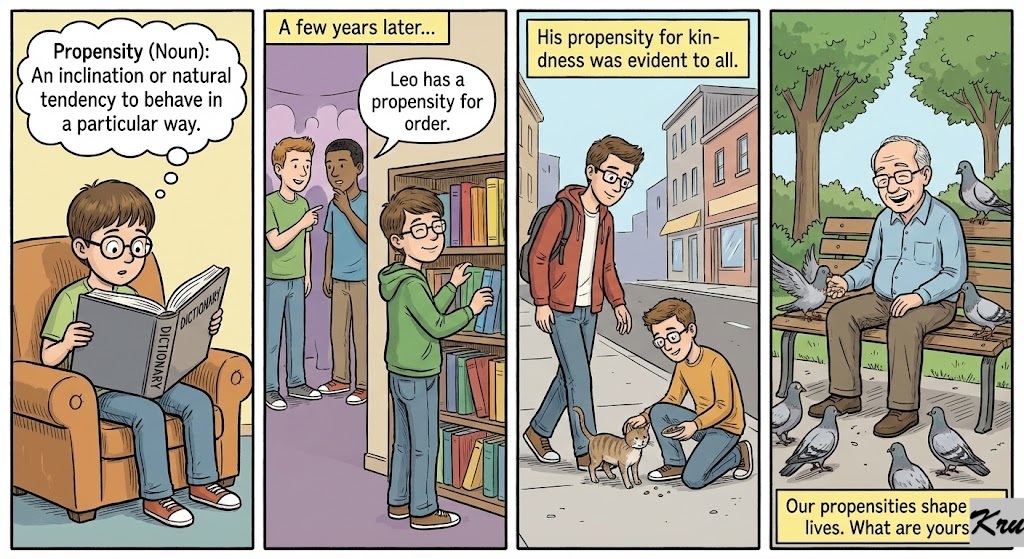
    Propensity (Noun): An inclination or natural tendency to behave in a particular way.

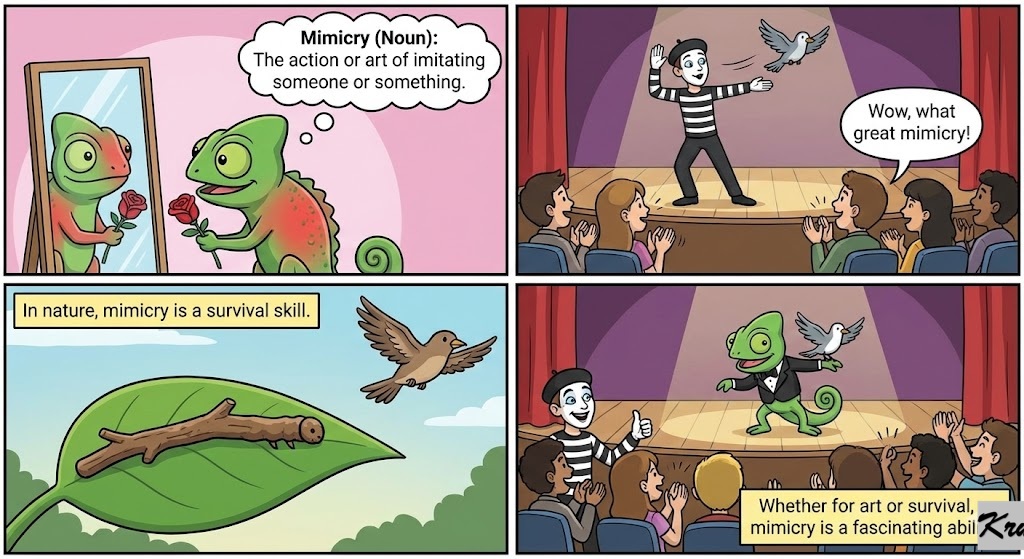
    Mimicry (Noun): The action or art of imitating someone or something.

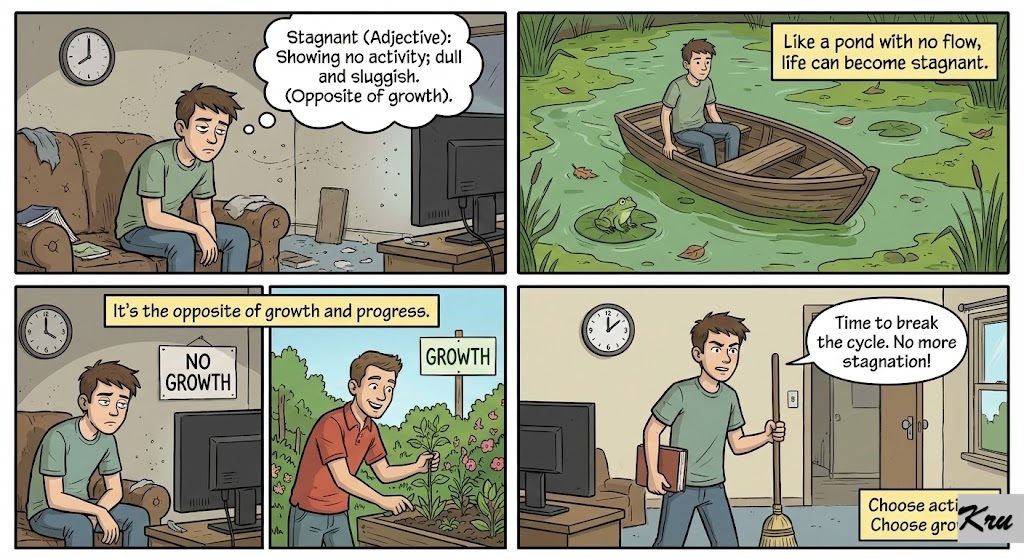
    Stagnant (Adjective): Showing no activity; dull and sluggish. (Opposite of growth).

    🧠 Grammar Focus: Idioms for Observation


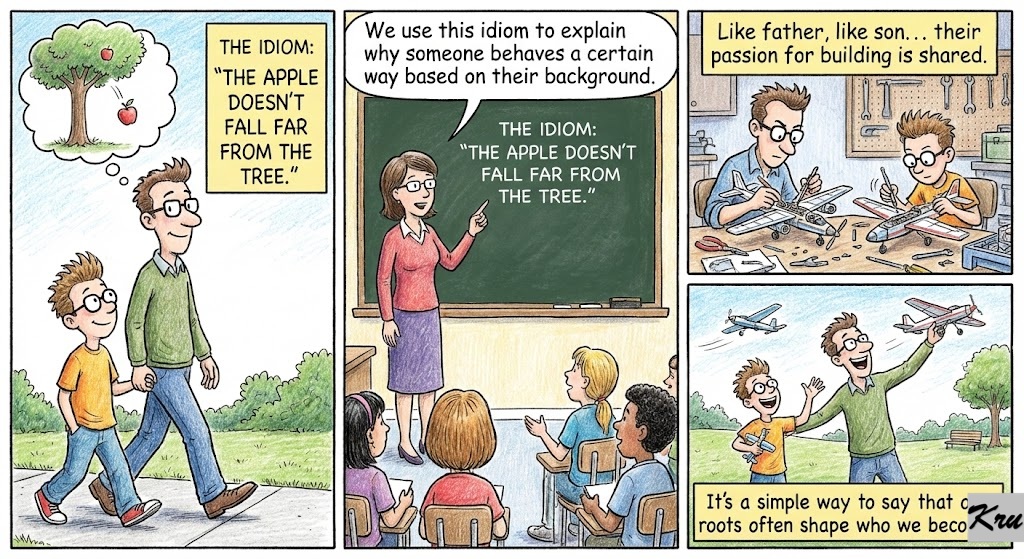
    We use this idiom to explain why someone behaves a certain way based on their background.

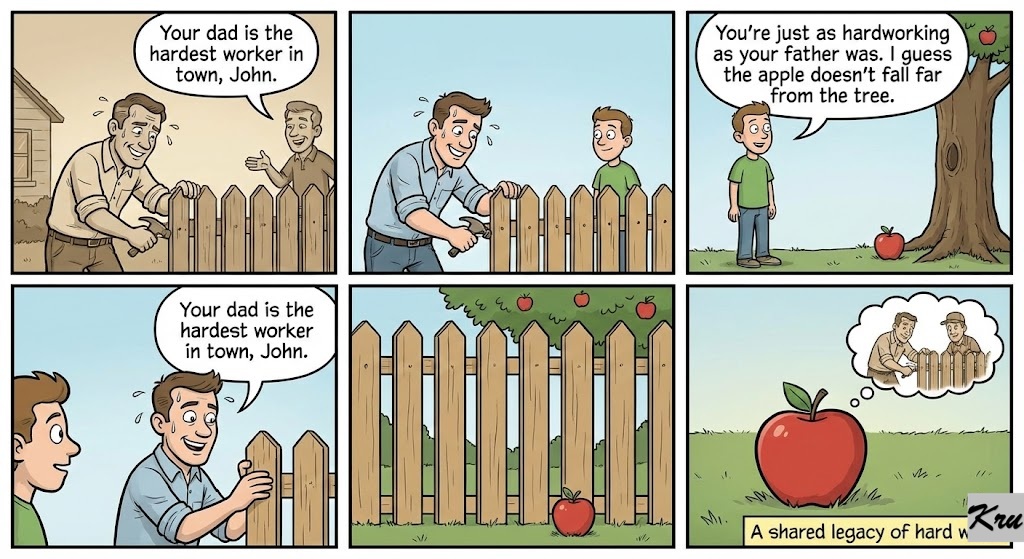
    Example: “John is just as hardworking as his father was. I guess the apple doesn’t fall far from the tree.”

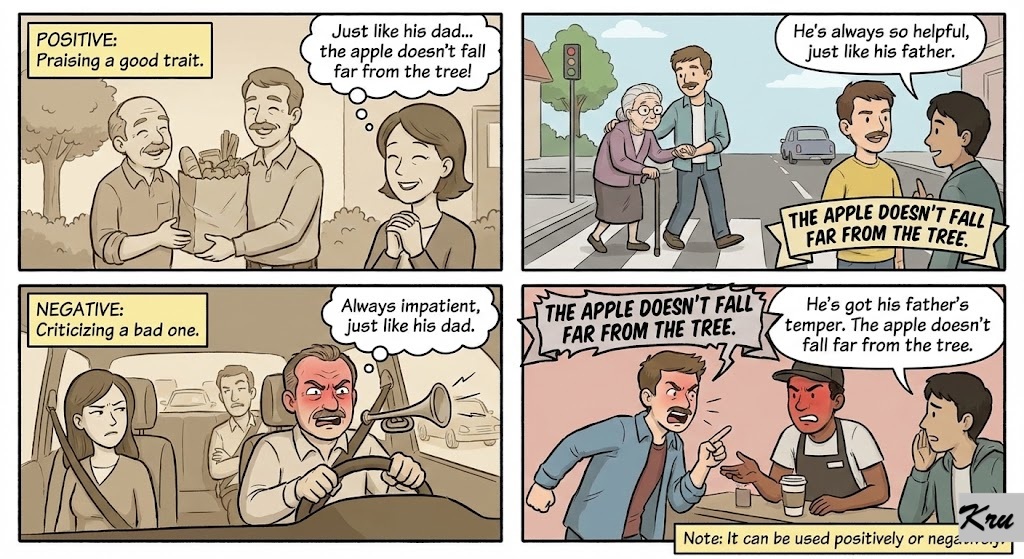
    Note: It can be used positively (praising a good trait) or negatively (criticizing a bad one).
    📜 History: Origin and Spread


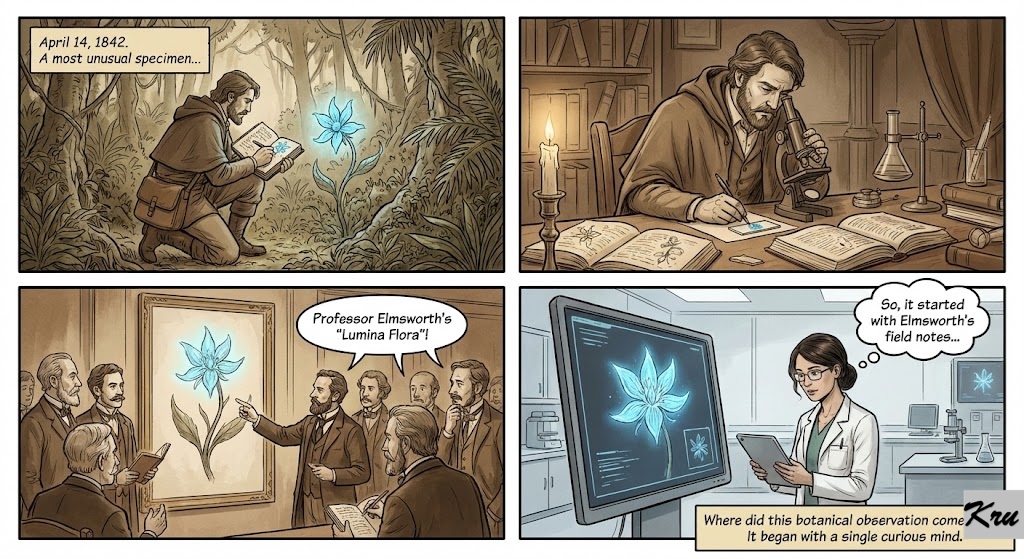
    Where did this botanical observation come from?

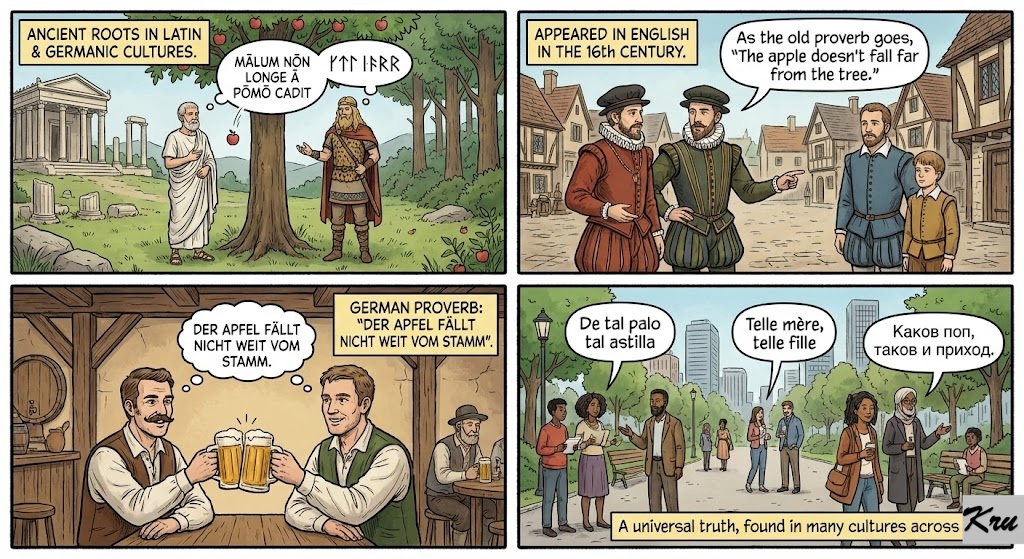
    The Origin: This is an ancient proverb found in many cultures. It appeared in English in the 16th century but has roots in German (Der Apfel fällt nicht weit vom Stamm) and Latin.

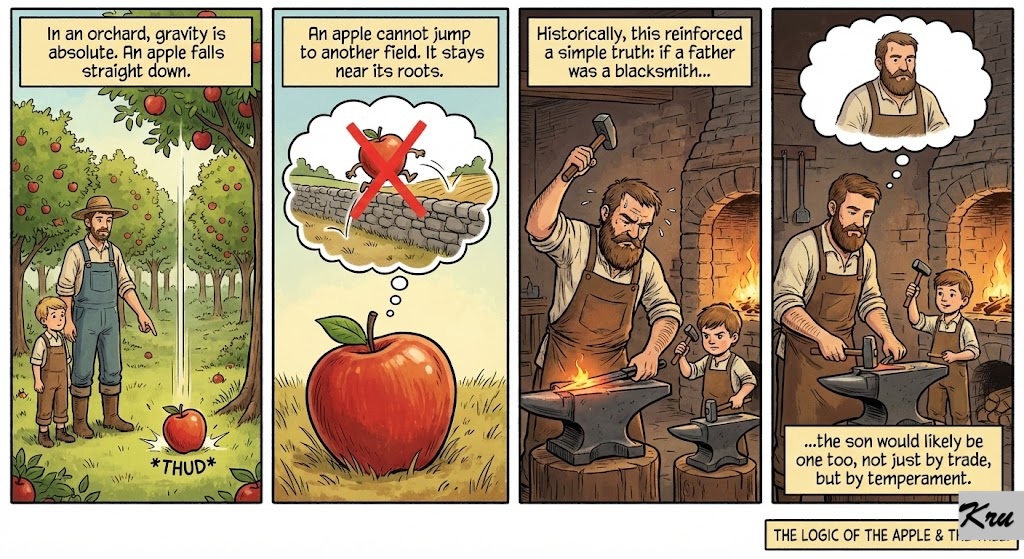
    The Logic: In an orchard, gravity is absolute. An apple cannot jump to another field. Historically, it reinforced the idea that if a father was a blacksmith, the son would likely be one too, not just by trade, but by temperament.

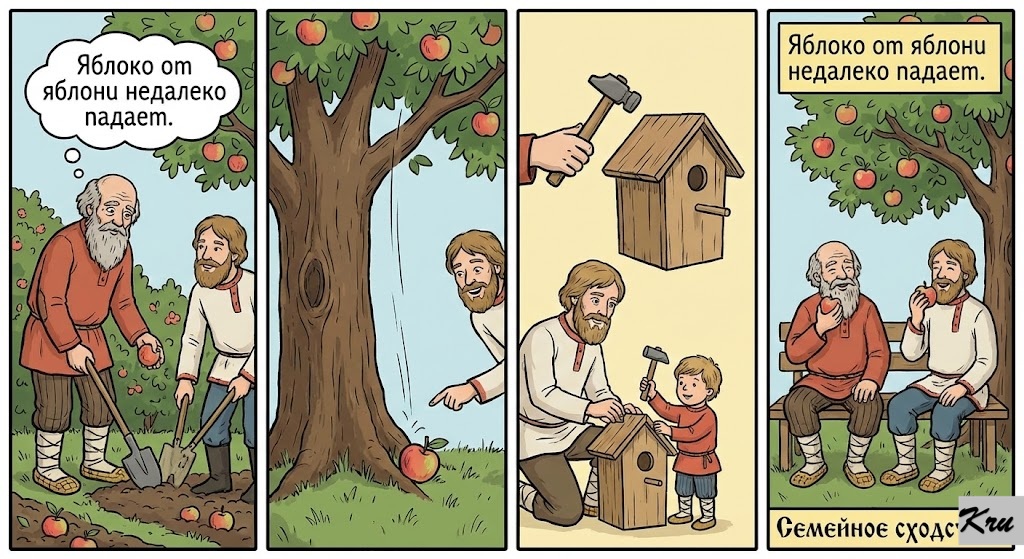
    Global Cousins


    🇷🇺 Russian: “The apple stays close to the apple tree.”

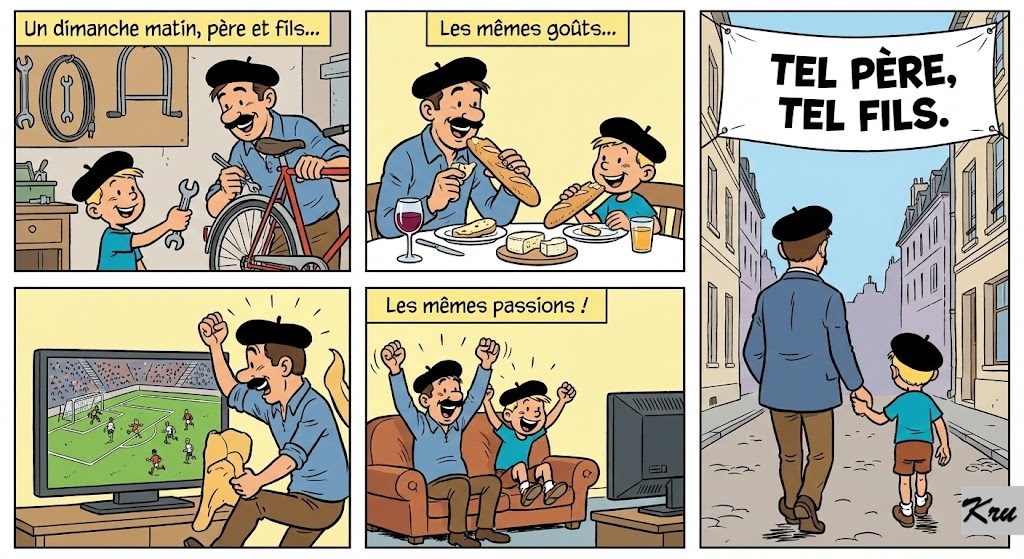
    🇫🇷 French: “Tel père, tel fils.” (Like father, like son).

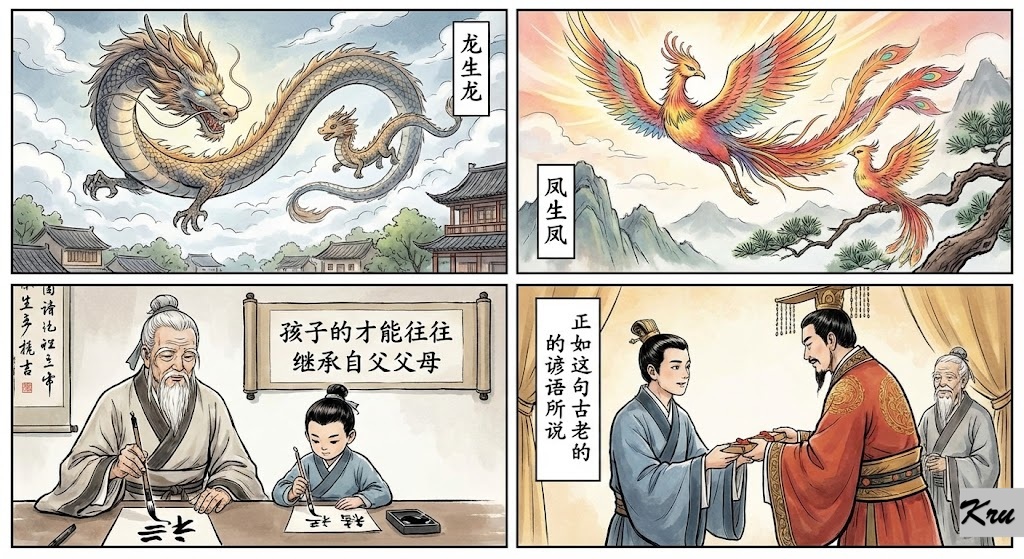
    🇨🇳 Chinese: “Dragons give birth to dragons, phoenixes give birth to phoenixes.” (Meaning children inherit their parents’ status/talents).
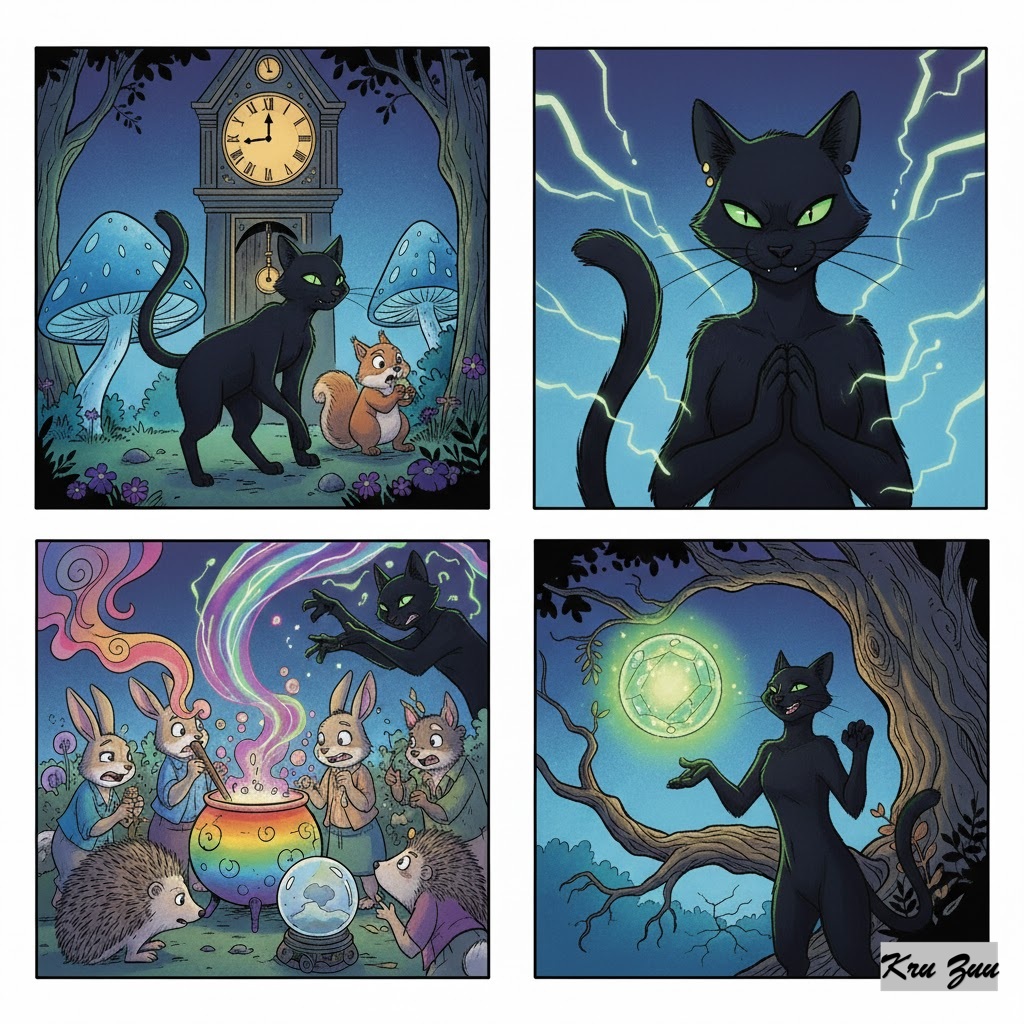
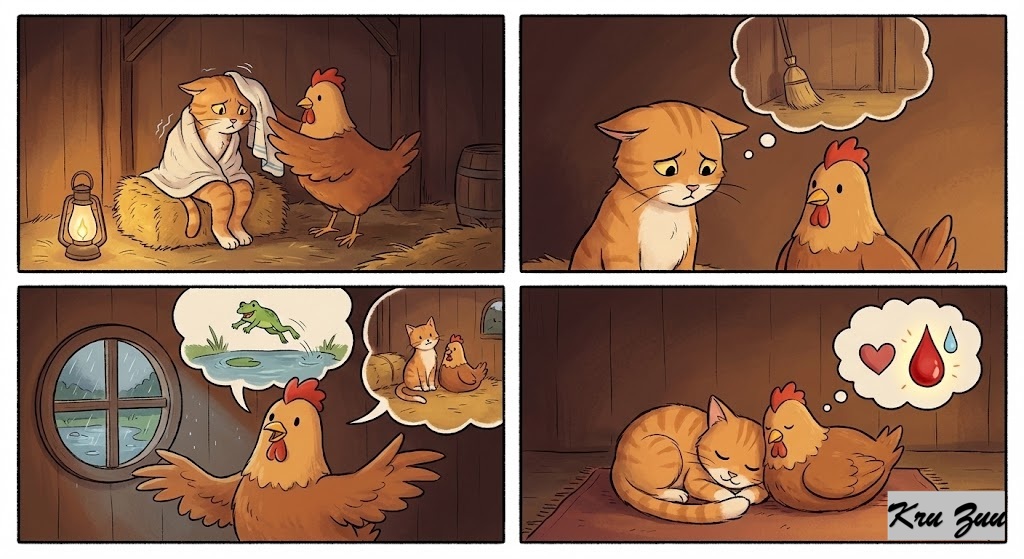
    🎭 Short Story: The Sour Seed 🍎🐱🐔🐸


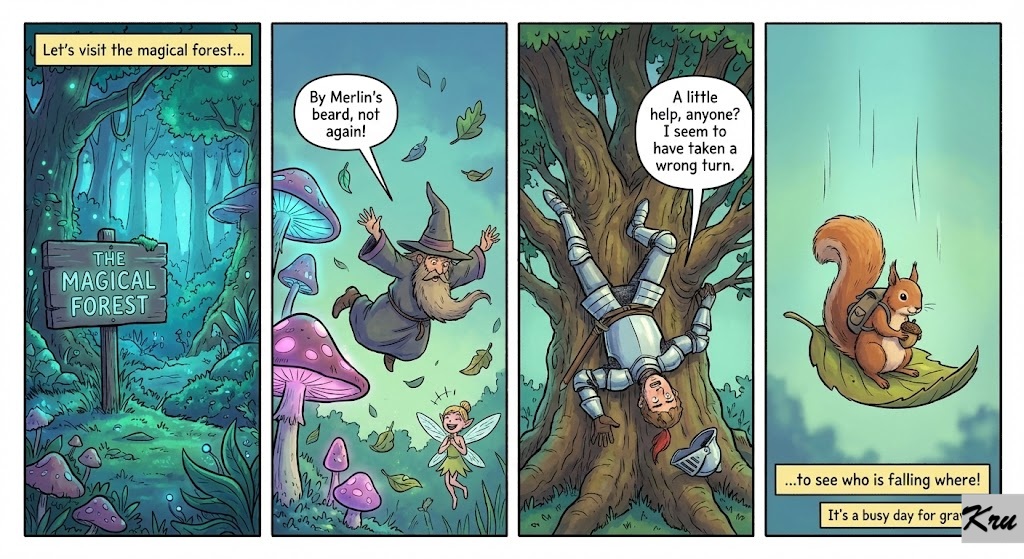
    Let’s visit the magical forest to see who is falling where.

    🌟 The Cast


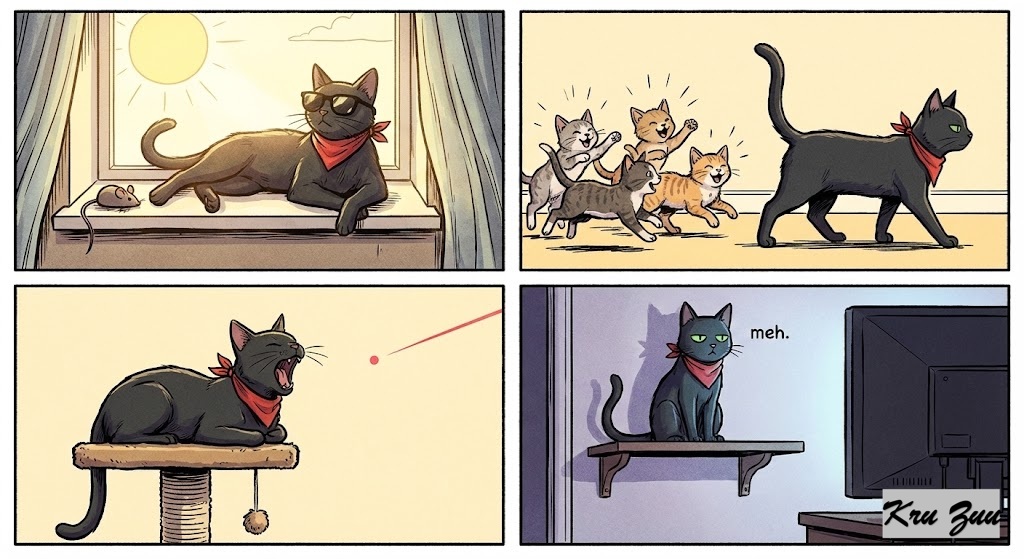
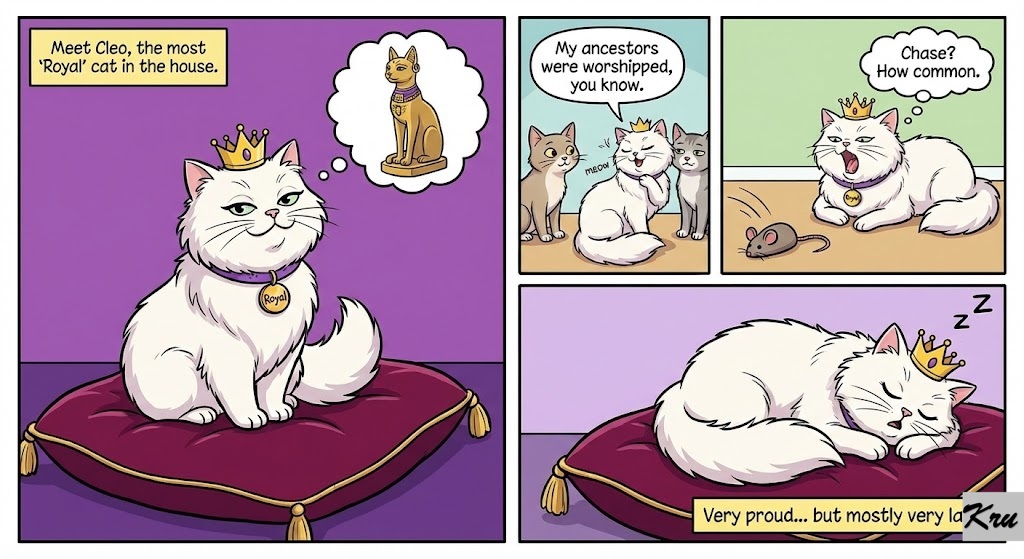
    Cleo the Cat: Very proud of her “Royal” lineage, but lazy. 😼

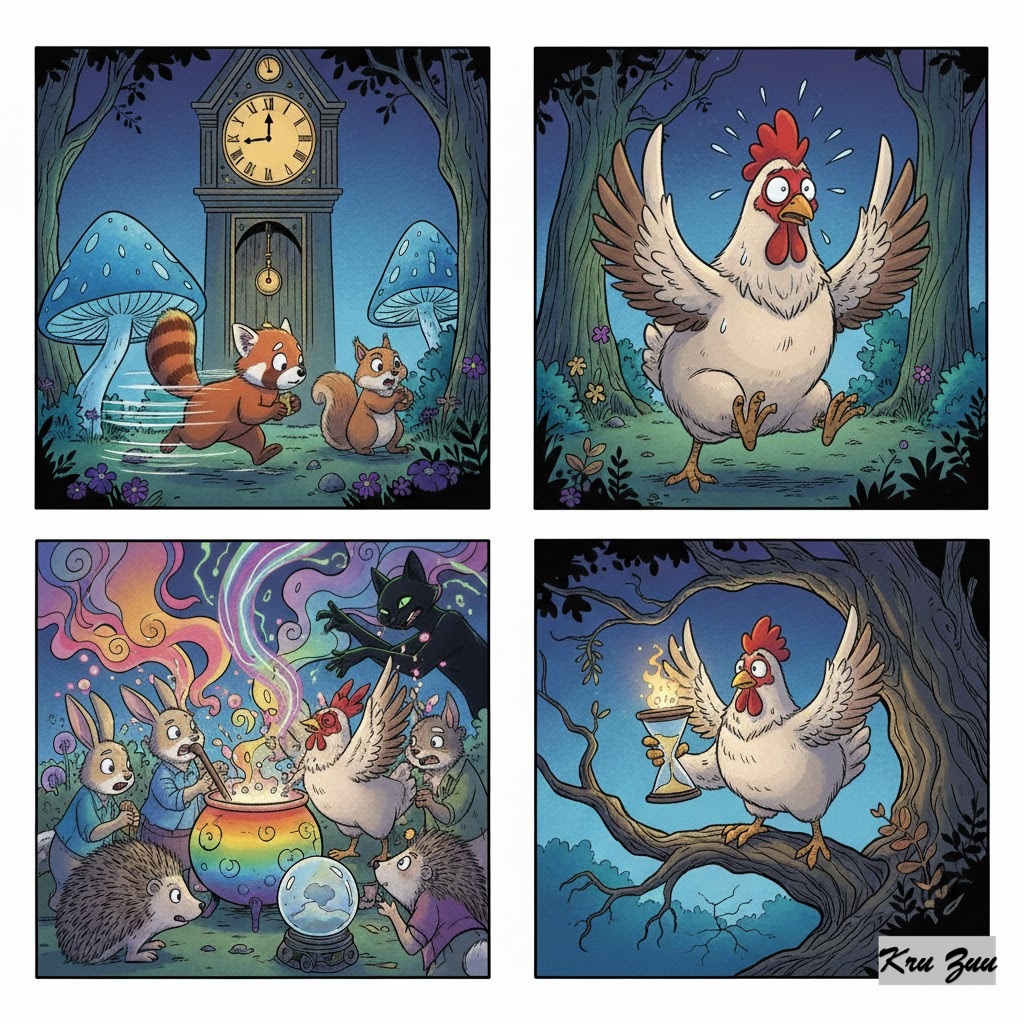
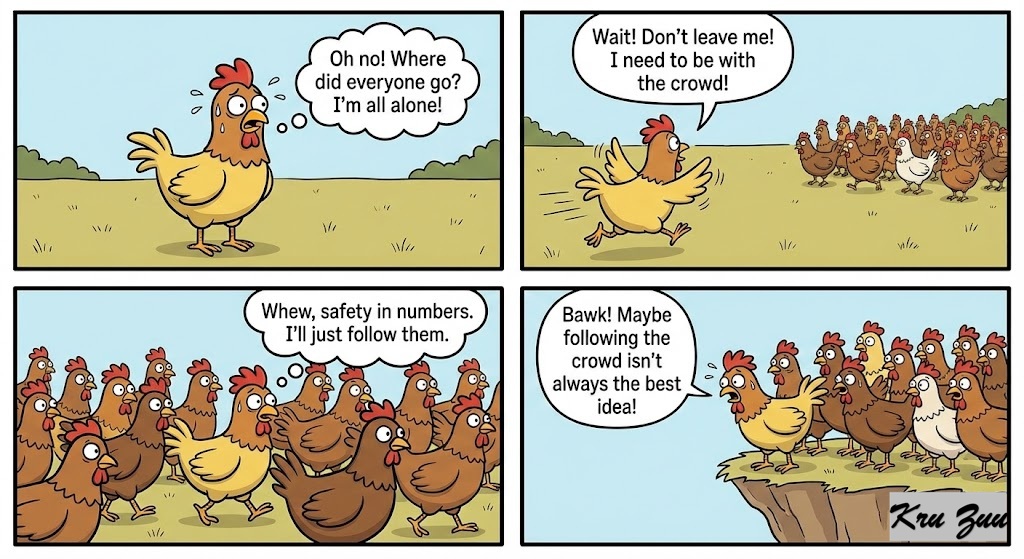
    Cluck the Chicken: Nervous, always follows the crowd. 🐔

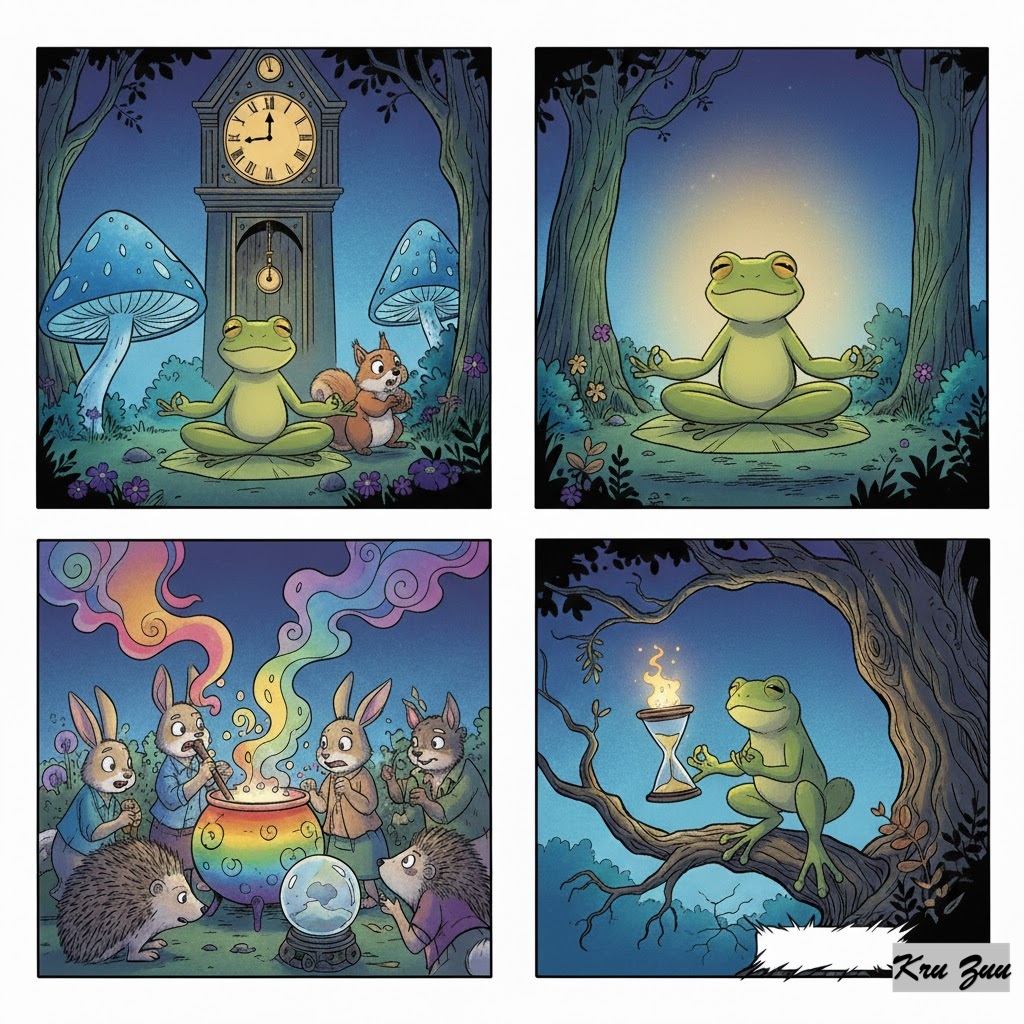
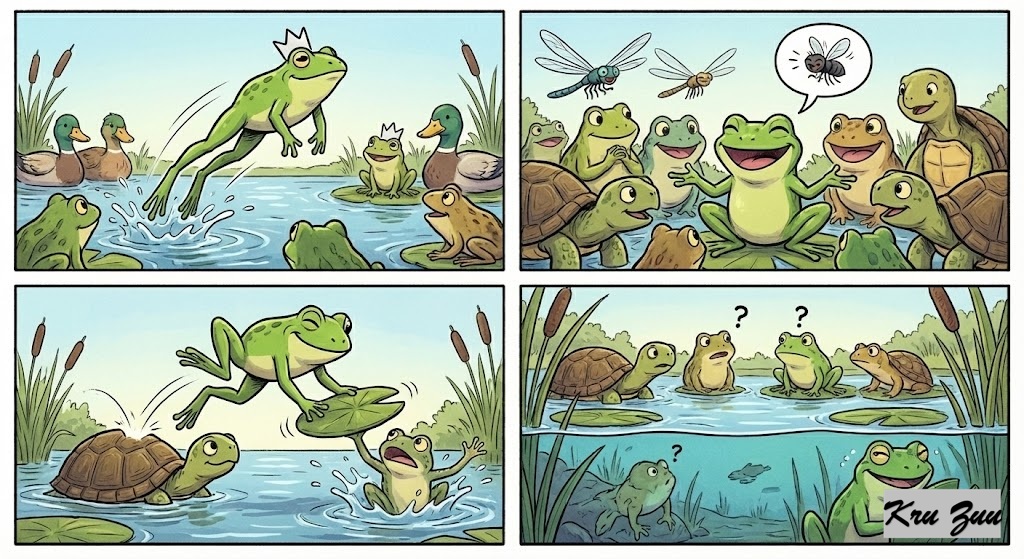
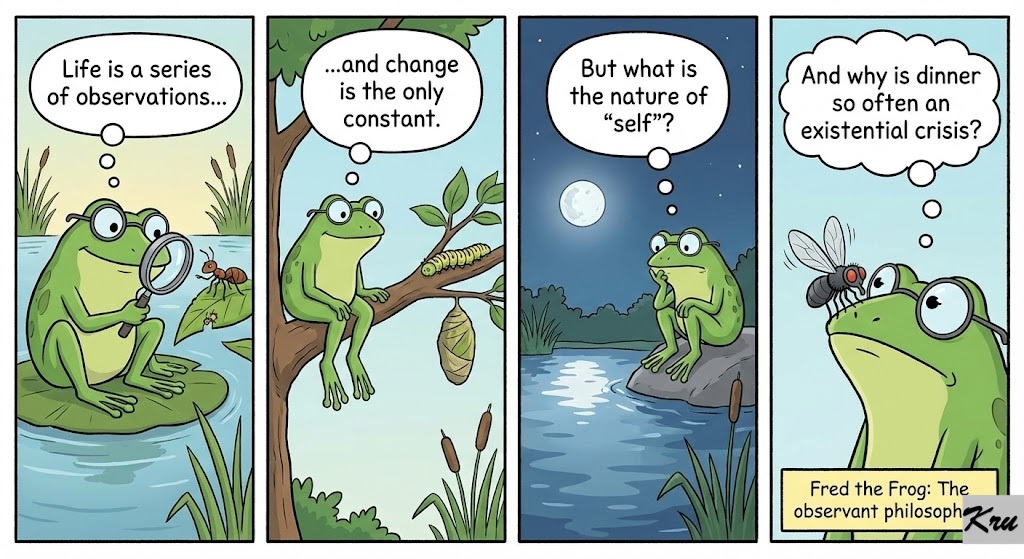
    Fred the Frog: The observant philosopher. 🐸

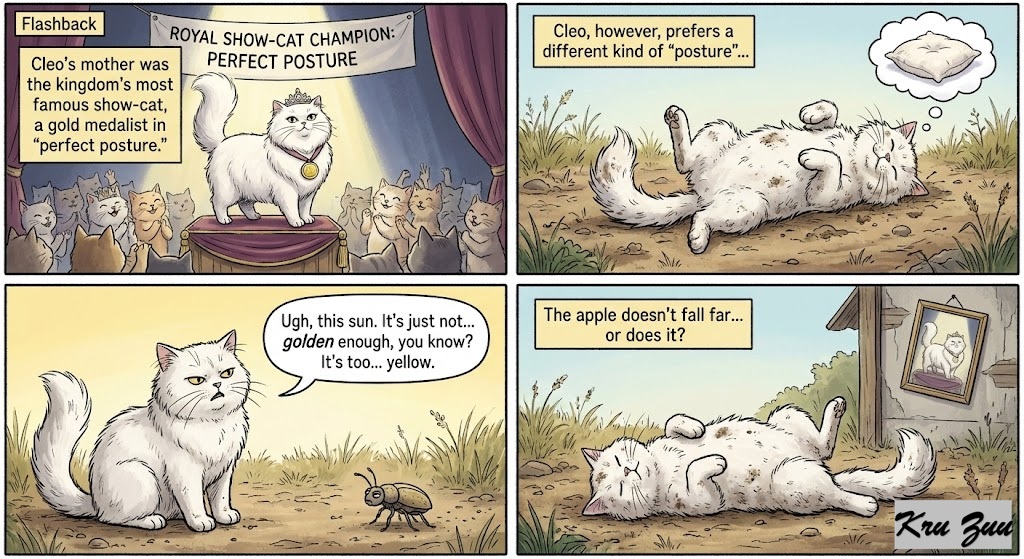
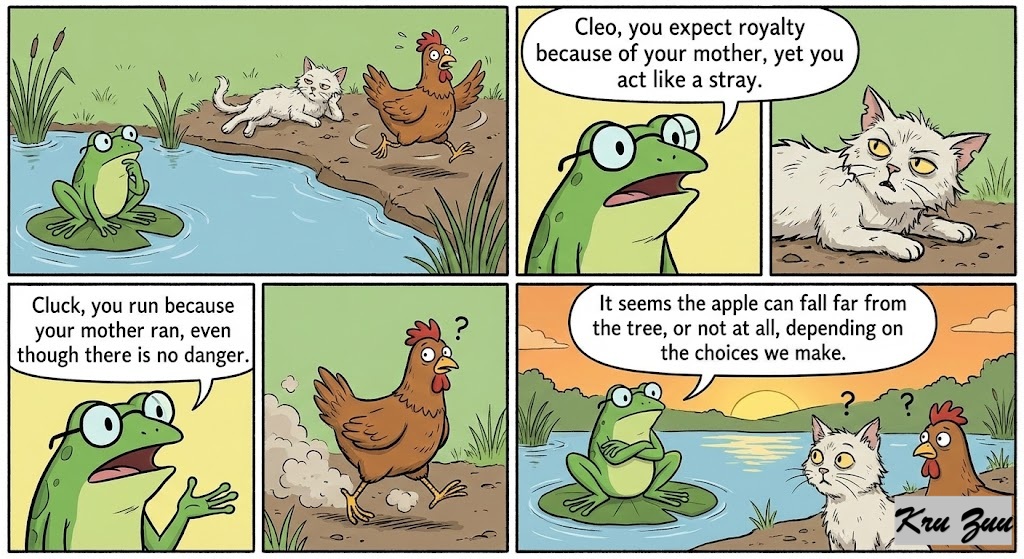
    The Situation: Cleo’s mother was the most famous show-cat in the kingdom. She won gold medals for her “perfect posture.” Cleo, however, spends all day napping in the dirt and complaining that the sun isn’t “golden enough.”

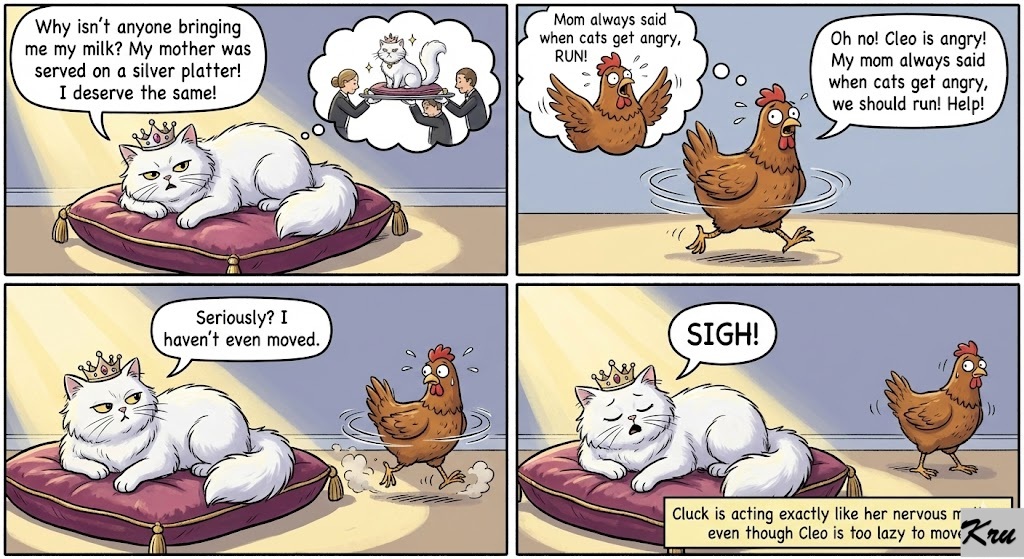
    The Conflict: “Why isn’t anyone bringing me my milk?” Cleo demands. “My mother was served on a silver platter! I deserve the same!” Cluck, who comes from a family of frantic, panicky chickens, starts running in circles. “Oh no! Cleo is angry! My mom always said when cats get angry, we should run! Help!” Cluck is acting exactly like her nervous mother, even though Cleo is too lazy to move.

    The Reaction: Fred the Frog watches from his pond. “Cleo, you expect royalty because of your mother, yet you act like a stray. Cluck, you run because your mother ran, even though there is no danger.”

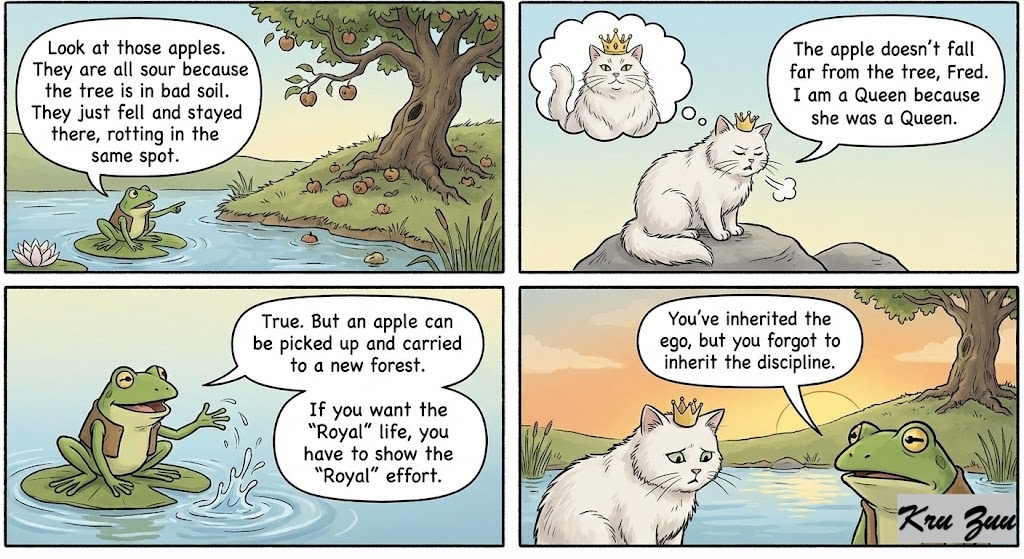
    The Lesson: Fred points to a wild apple tree. “Look at those apples. They are all sour because the tree is in bad soil. They just fell and stayed there, rotting in the same spot.” Cleo huffs, “The apple doesn’t fall far from the tree, Fred. I am a Queen because she was a Queen.” Fred splashes some water. “True. But an apple can be picked up and carried to a new forest. If you want the ‘Royal’ life, you have to show the ‘Royal’ effort. You’ve inherited the ego, but you forgot to inherit the discipline.”

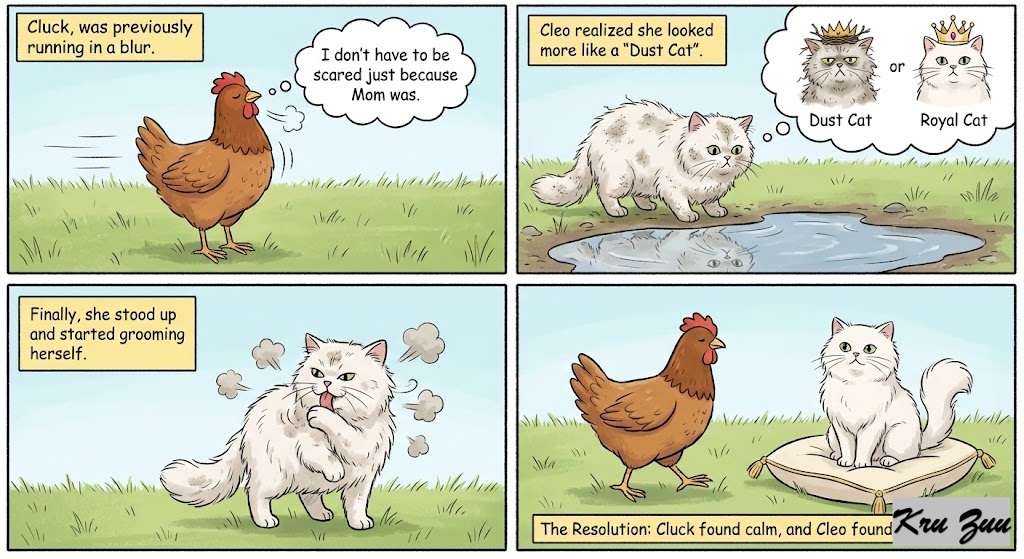
    The Resolution: Cluck stopped running and took a deep breath. She realized she didn’t have to be scared just because her mom was. Cleo, realizing she looked more like a “Dust Cat” than a “Royal Cat,” finally stood up and started grooming herself.

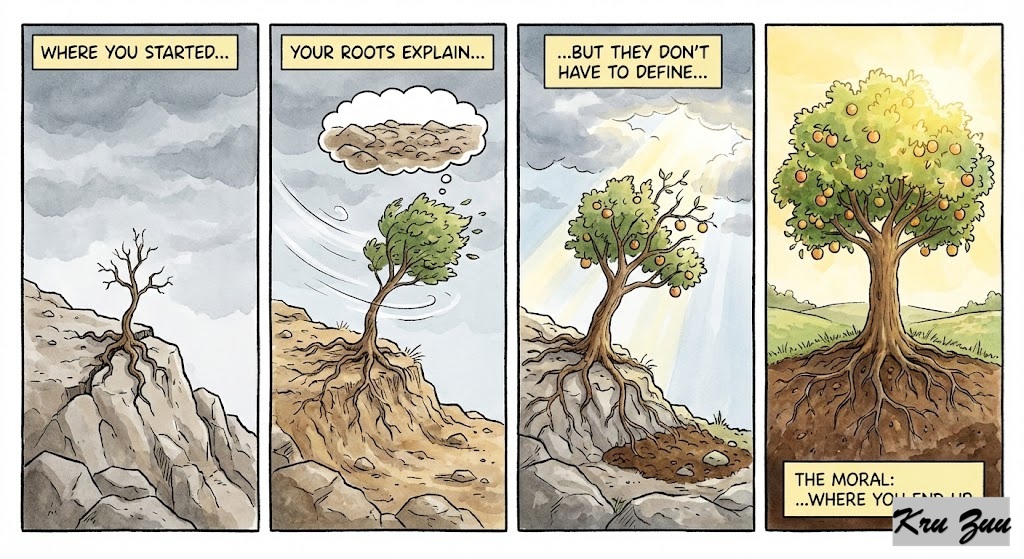
    The Moral: Your roots explain where you started, but they don’t have to define where you end up. 🌳
    🎓 Lesson for English Learners


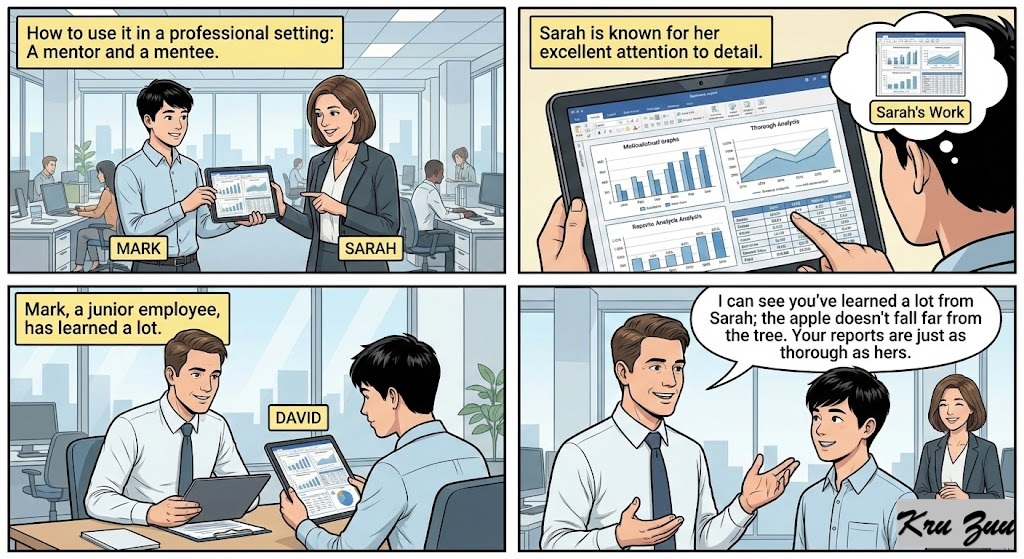
    How to use it in a professional setting: If you see a junior employee who has the same excellent attention to detail as their mentor, you can say: “I can see you’ve learned a lot from Sarah; the apple doesn’t fall far from the tree. Your reports are just as thorough as hers.”

    💬 Your Turn: The “Mirror” Challenge 🚀


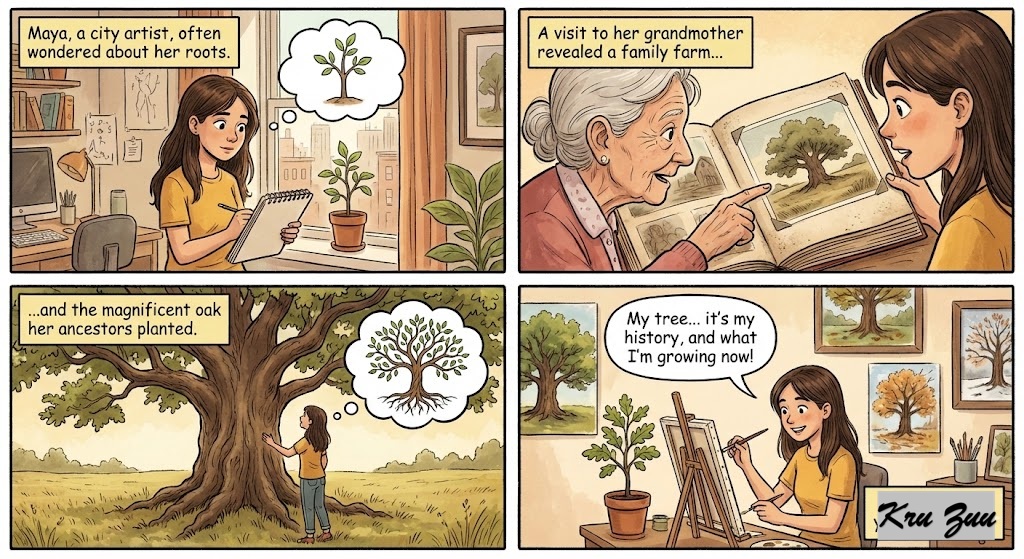
    Ready to see your own “tree”?

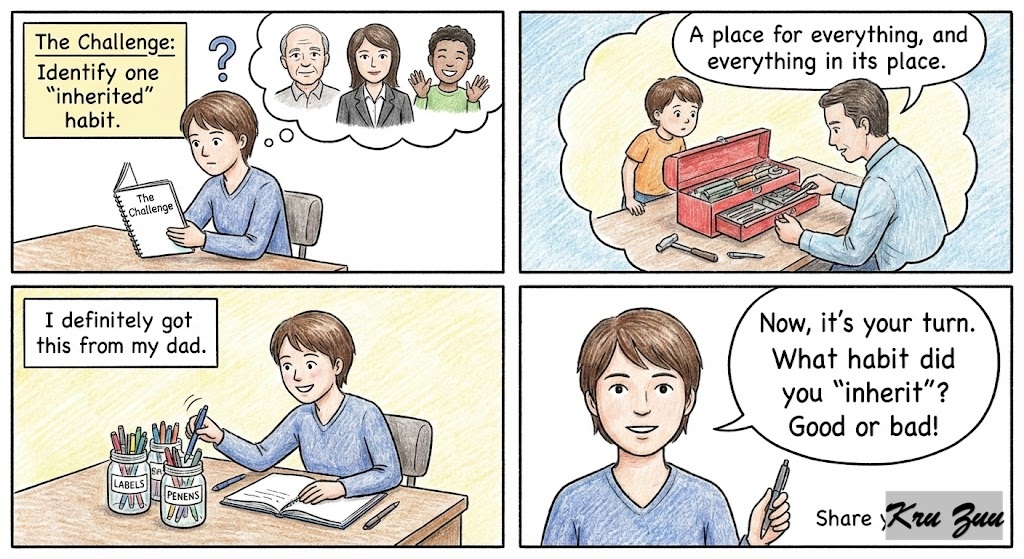
    The Challenge:
    Identify one habit you have (good or bad) that you definitely “inherited” from a parent, a former boss, or a close friend.
    The Action: 1. If it’s a Good Habit: Write it down and thank that person today. 2. If it’s a Bad
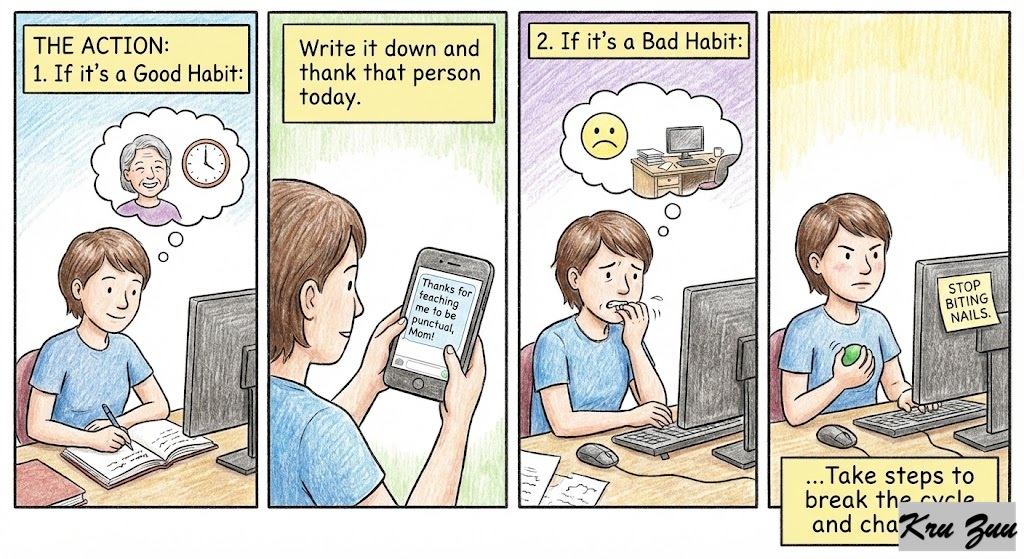
    Habit: Consciously do the opposite for 24 hours. Prove that this apple can roll a little further away.
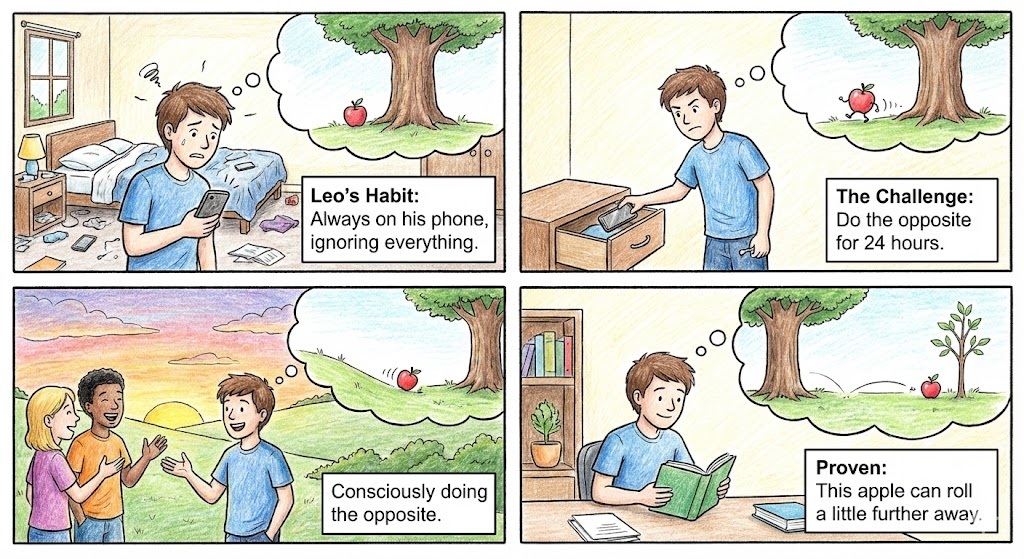

    👇 Question for the comments: Which trait did you get from your “tree”? Are you happy about it, or are you trying to roll away? Tell us below!

    By Zubeyir YURTKURAN

    https://www.facebook.com/BrainBattleground/

    https://www.facebook.com/zubeyr.yurtkuran/

    https://www.instagram.com/zubeyryurtkuran/
    https://www.youtube.com/@BrainBattleground-b3p

    https://www.instagram.com/brainbattleground/

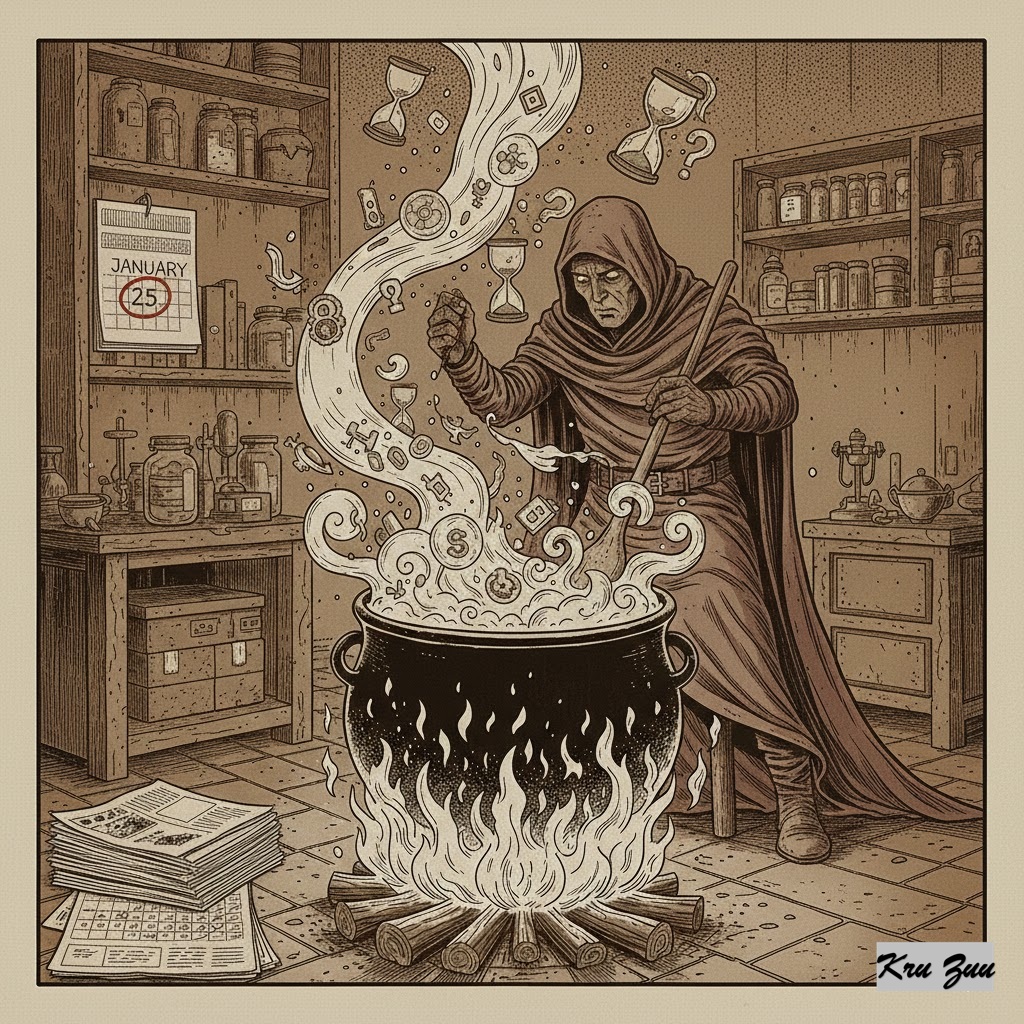
  • 🕰️ The Daily Shield: The Law of Patience

    🕰️ The Daily Shield: The Law of Patience

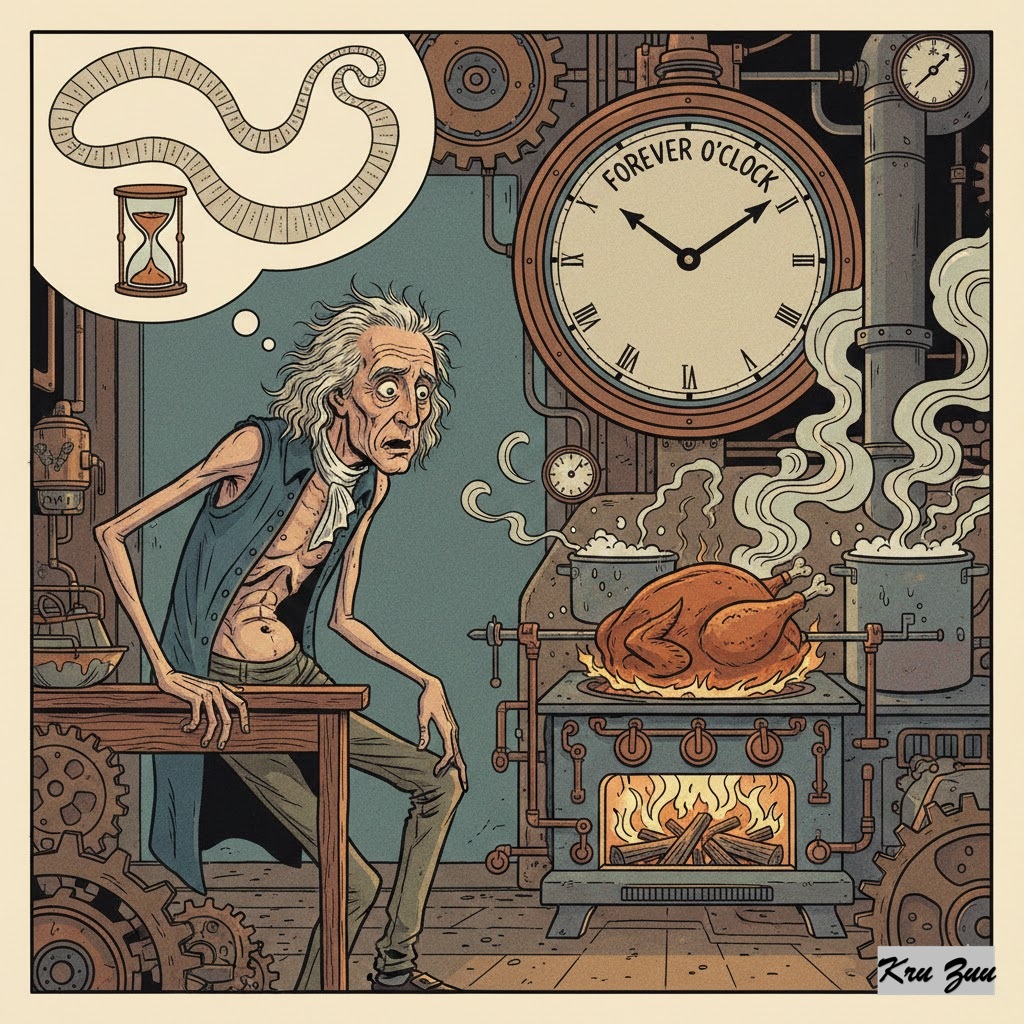
    “A watched pot never boils.”


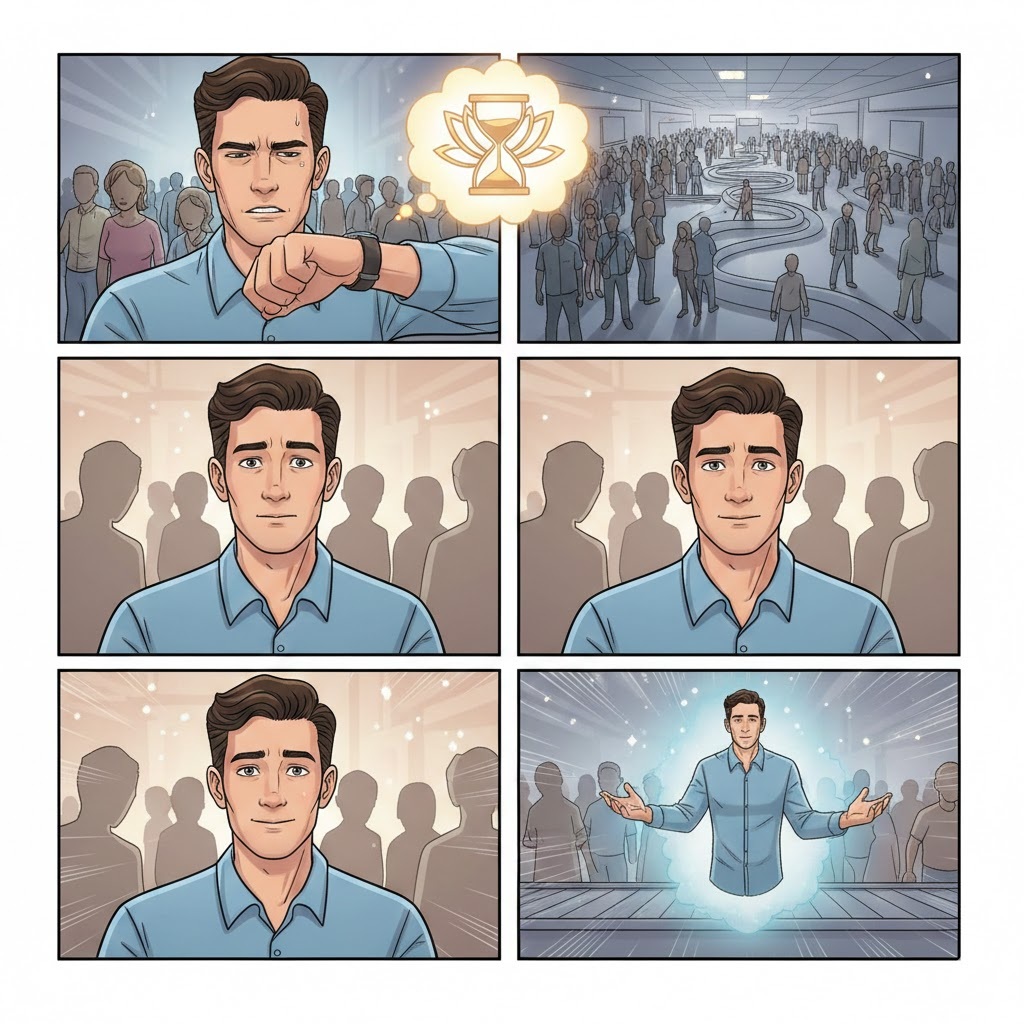
    😈 The Villain (The Checker)

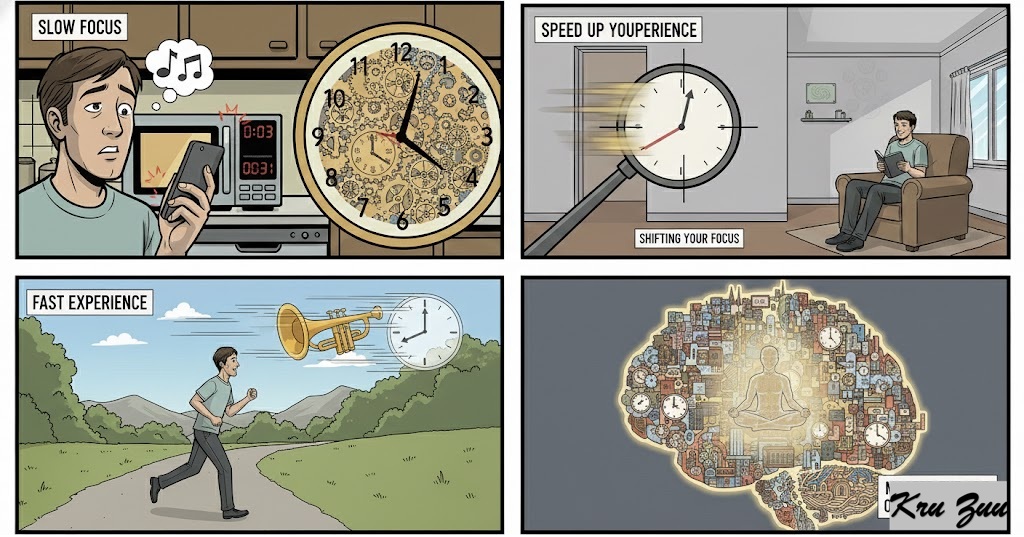
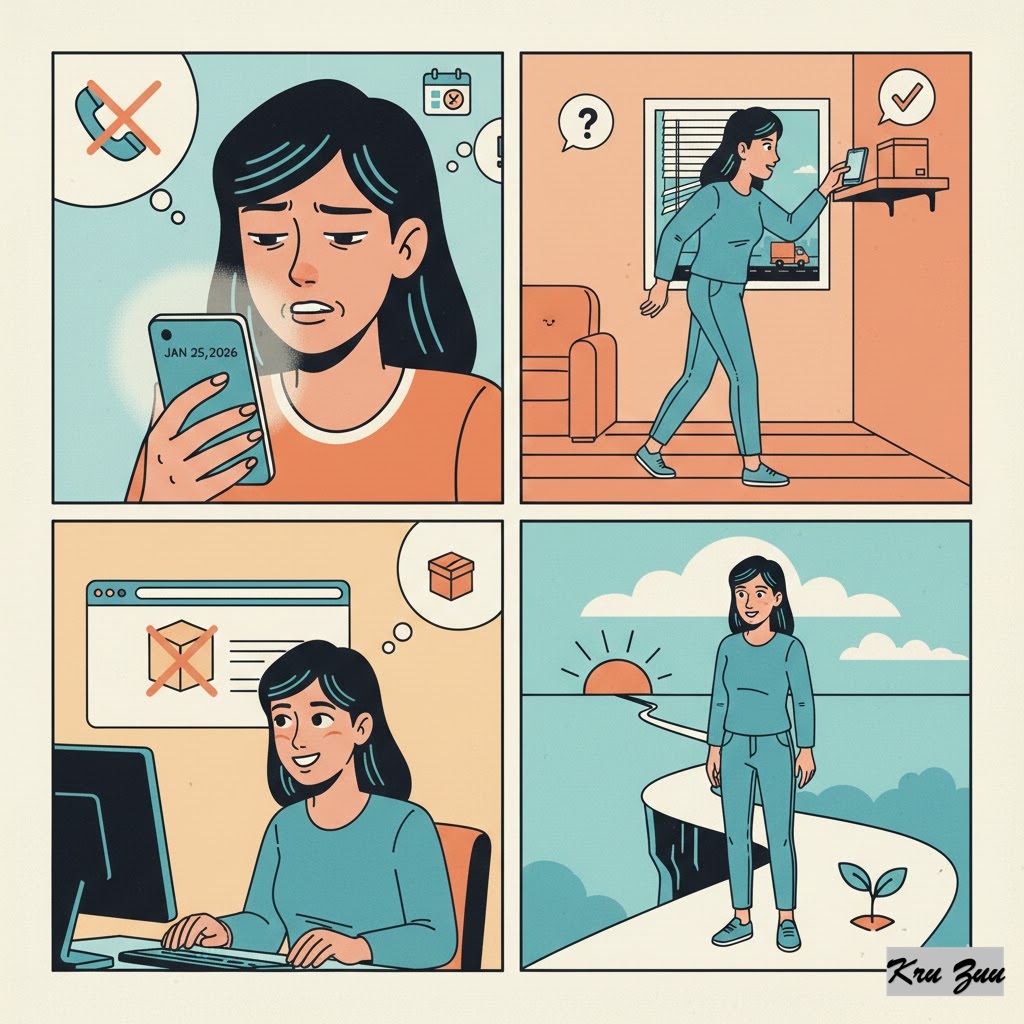
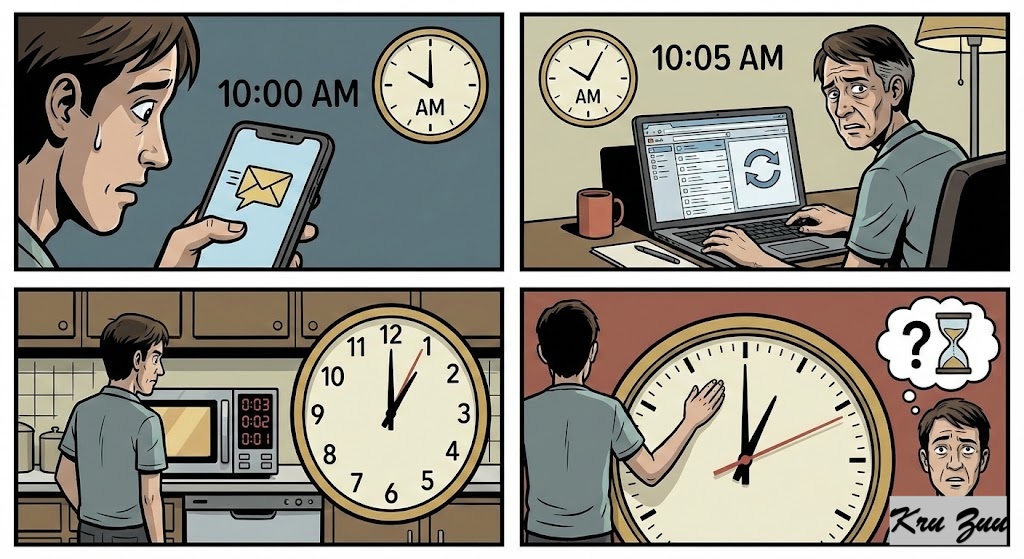
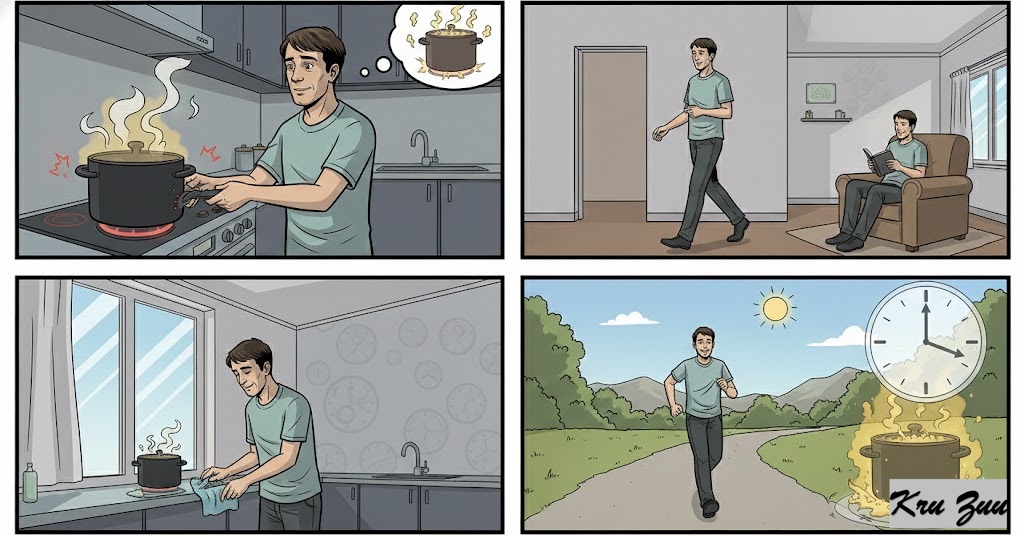
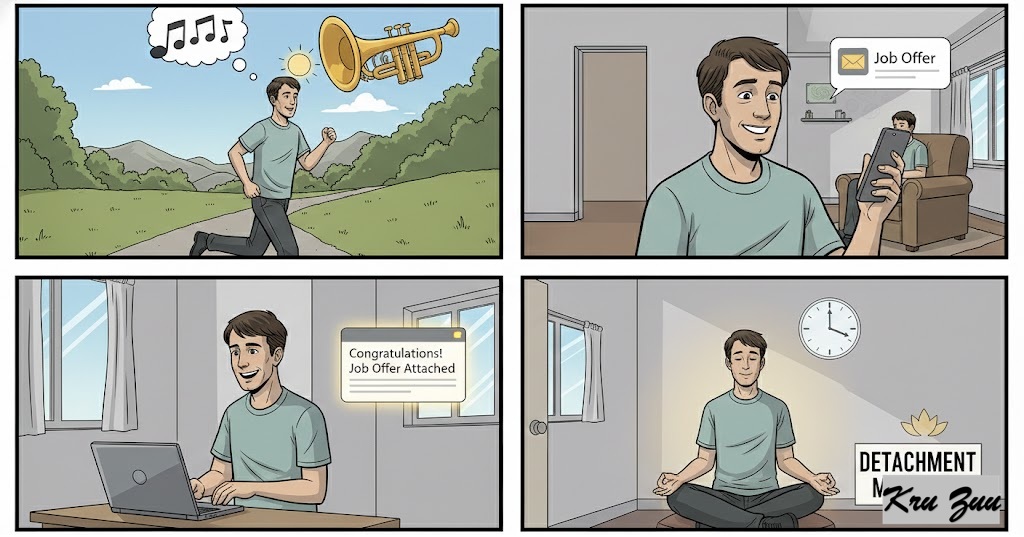
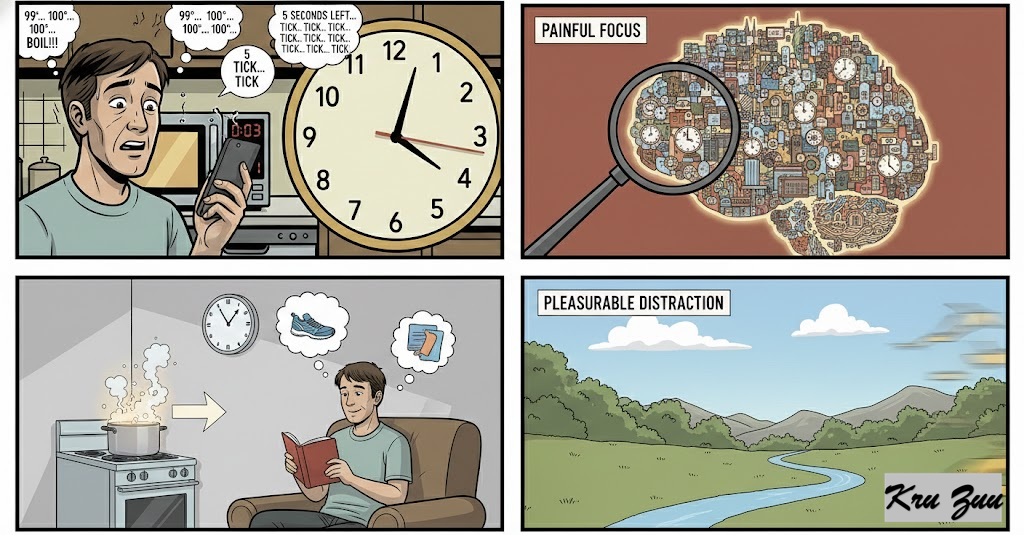
    You send an important text message. 💬 You check your phone. Nothing. You check again 10 seconds later. Still nothing. You refresh your email 50 times in one hour waiting for a job offer. You stand in front of the microwave, staring at the numbers counting down: 5… 4… 3… Why does one minute feel like one hour?

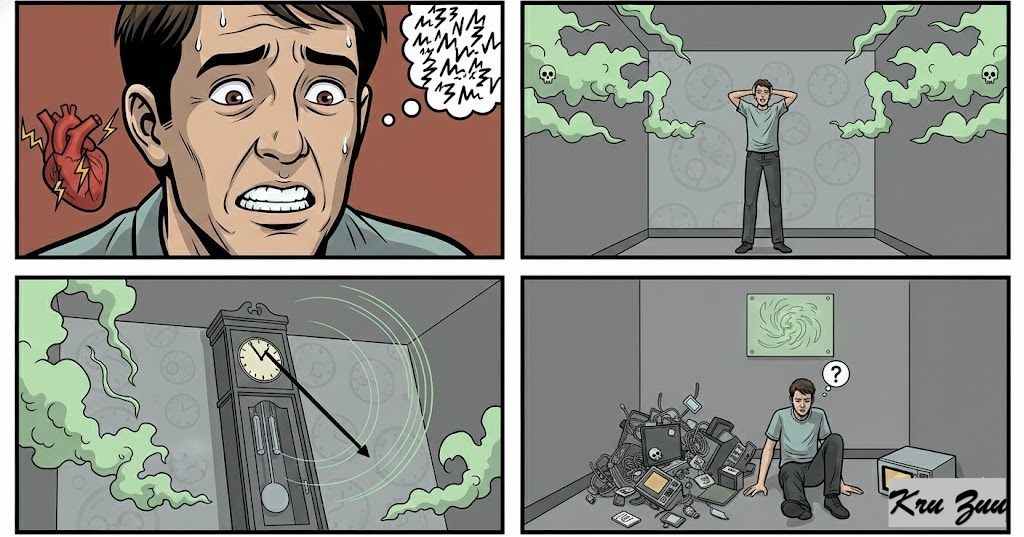
    The Result? Anxiety spikes. Stress hormones flood your body. The more you obsess over the outcome, the slower time seems to move. You are trapped in the “Waiting Room of Misery.” 😫


    😇 The Hero (The Flow Master)

    You have a goal (the pot). You turn on the heat (do the work). Then, instead of staring at it, you walk away. You read a book. You clean the house. You go for a run. You trust the process.

    The Result? Suddenly, you hear the whistle! 🎺 The water is boiling. The email arrives. The text pops up. Because you were busy living your life, the waiting period felt instant. You mastered the art of Detachment. 🧘‍♂️


    ⚖️ The Reality


    Physics tells us that water boils at 100°C regardless of whether you look at it or not. But Psychology tells a different story. When you focus entirely on the passage of time, your brain notices every single second. It is painful. When you distract yourself, your brain skips the boring parts.


    💎 The Secret

    You cannot speed up time, but you can speed up your experience of time by shifting your focus.

    🧐 The Anatomy of the Proverb


    This is your reminder that obsession kills patience.


    Watched (Adjective): Observed closely; stared at with anxiety.


    Pot (Noun): The vessel holding your goal (cooking, results, news).


    Never Boils (Phrase): It seems like the desired result will never happen.


    Simpler Version: If you wait anxiously for something, it seems to take a very long time.


    📚 Vocabulary Vault


    Patience (Noun): The capacity to accept delay without getting angry. (A superpower!) 🦸


    Anticipation (Noun): The action of waiting for something exciting (or scary).


    Distraction (Noun): Something that prevents you from giving full attention to something else. (In this case, a good thing).


    Outcome (Noun): The final result.


    Process (Noun): A series of actions taken to achieve an end.

    📜 History: Origin and Science


    The Origin:
    This phrase is often attributed to Benjamin Franklin (the American inventor and writer) around 1785. He used it in a report, noting that he was so hungry that looking at the food cooking made it seem like it was taking forever!


    Global Cousins


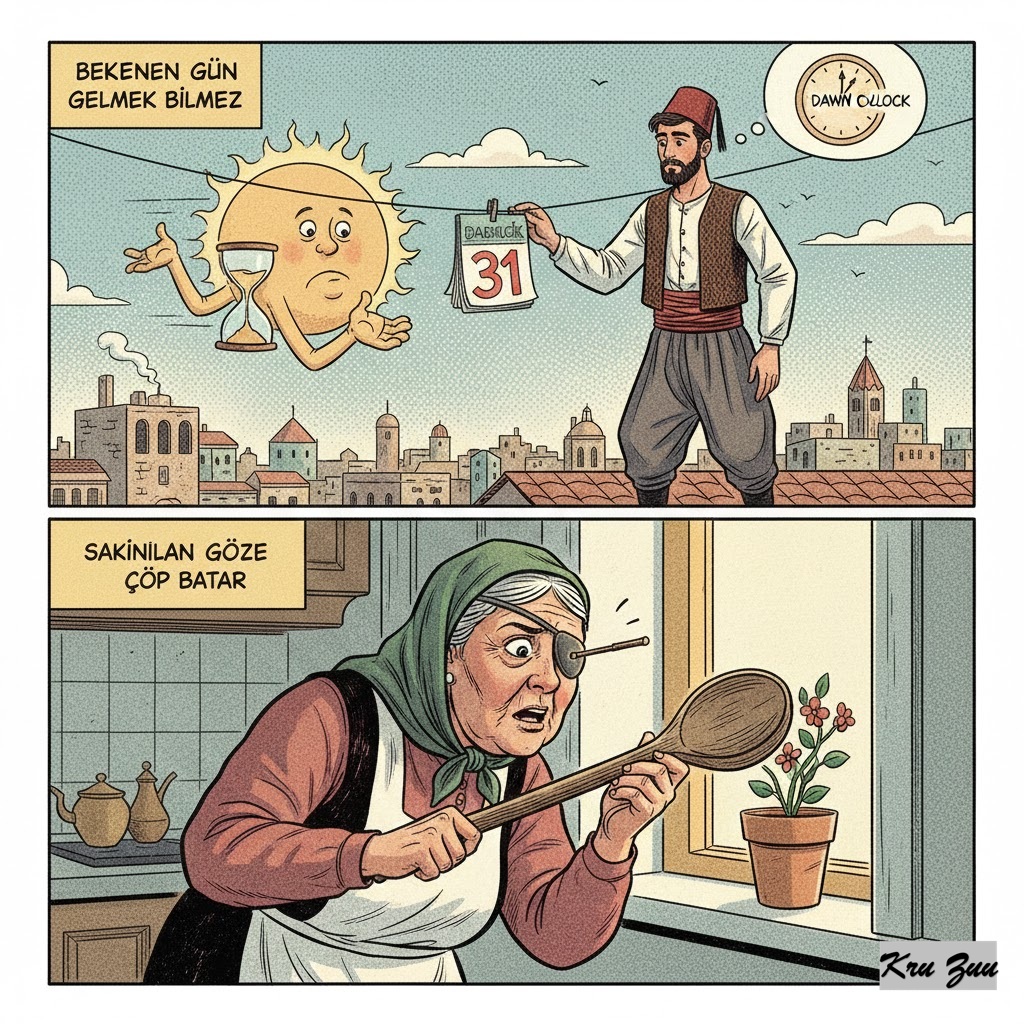
    🇹🇷 Turkish:“Beklenen gün gelmek bilmez” (The awaited day does not know how to come) or “Sakınılan göze çöp batar” (A stick pokes the protected eye – focusing too much causes issues).


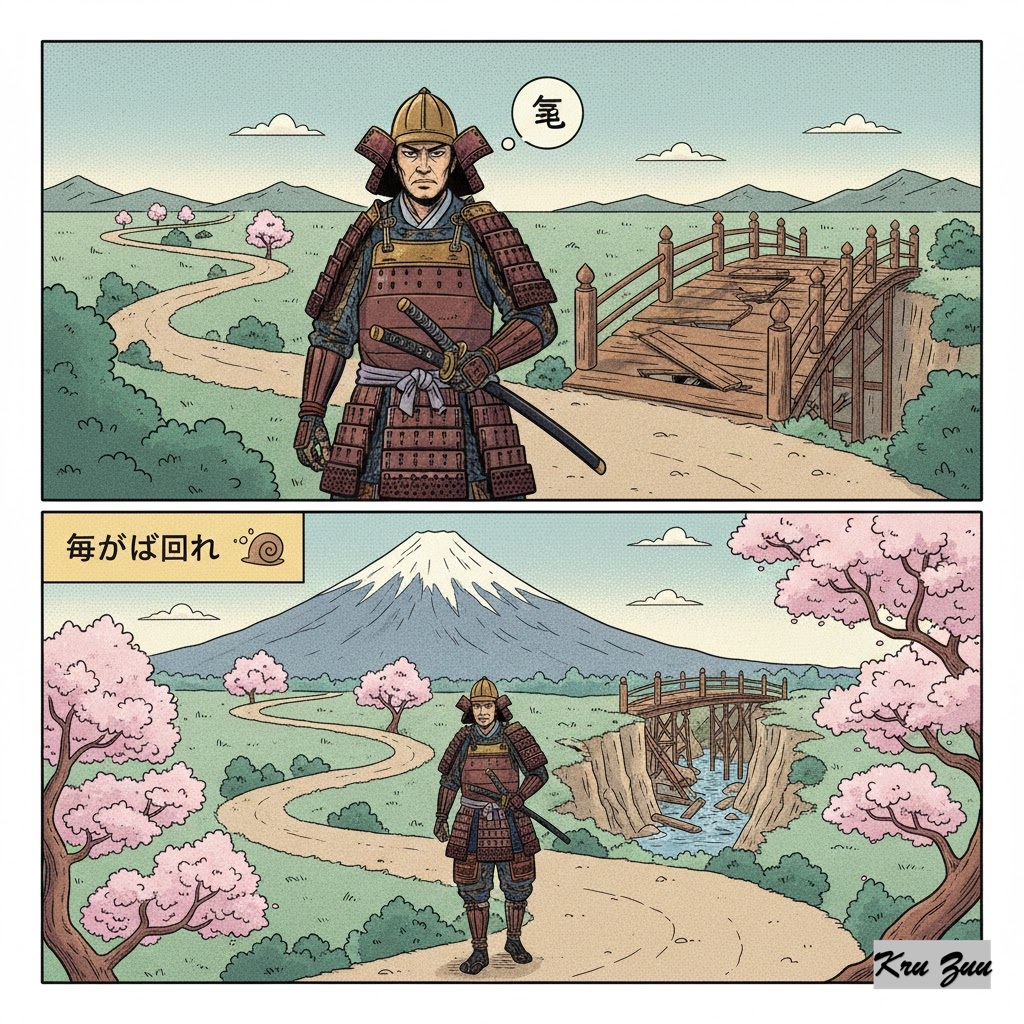
    🇯🇵 Japanese:“Isoba maware” (If you are in a hurry, go the long way around).

    🎭 Short Story: The Perfect Cup of Tea 🍵


    Let’s return to the magical forest to see how our friends handle the pressure of waiting.


    🌟 The Cast


    Cleo the Cat:
    😼 Elegant, impatient, demands instant results.


    Cluck the Chicken: 🐔 Nervous, fidgety, cannot sit still.


    Fred the Frog: 🐸 The Zen master of the swamp.


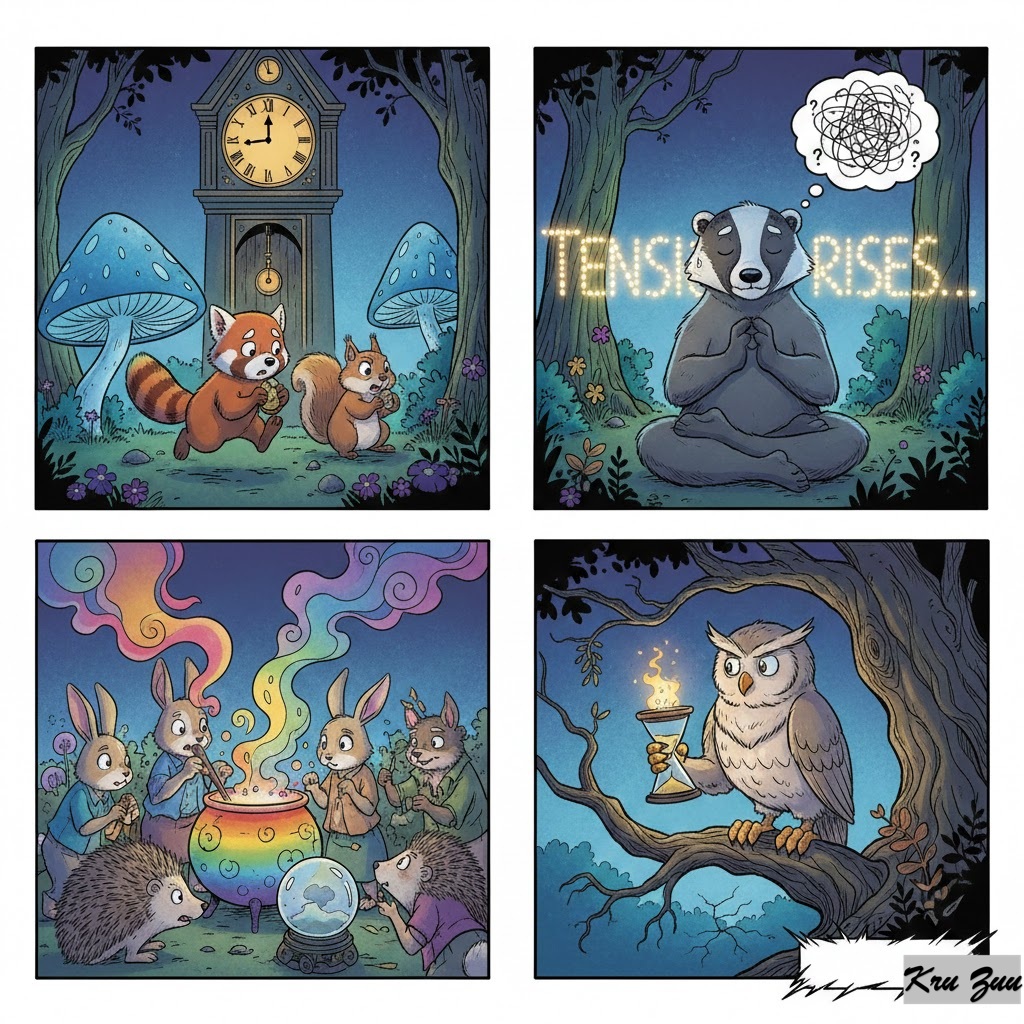
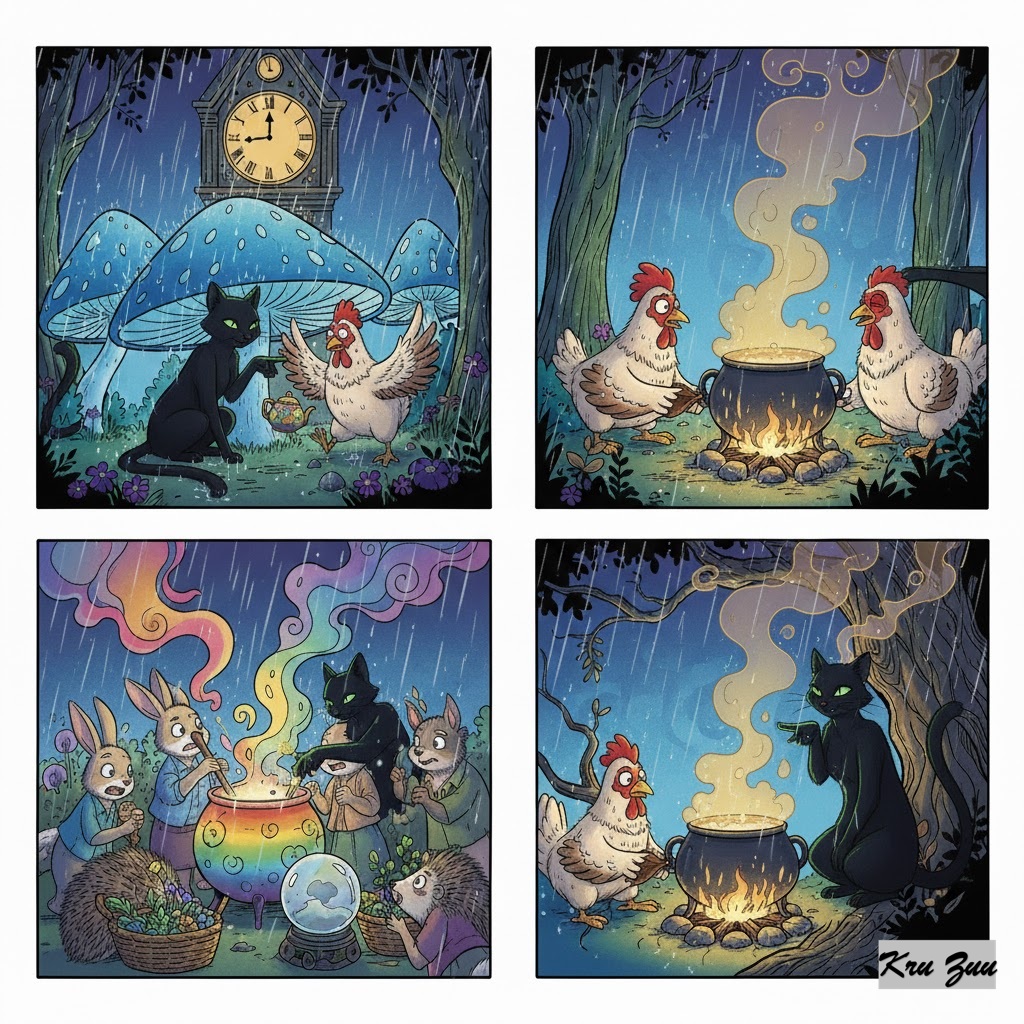
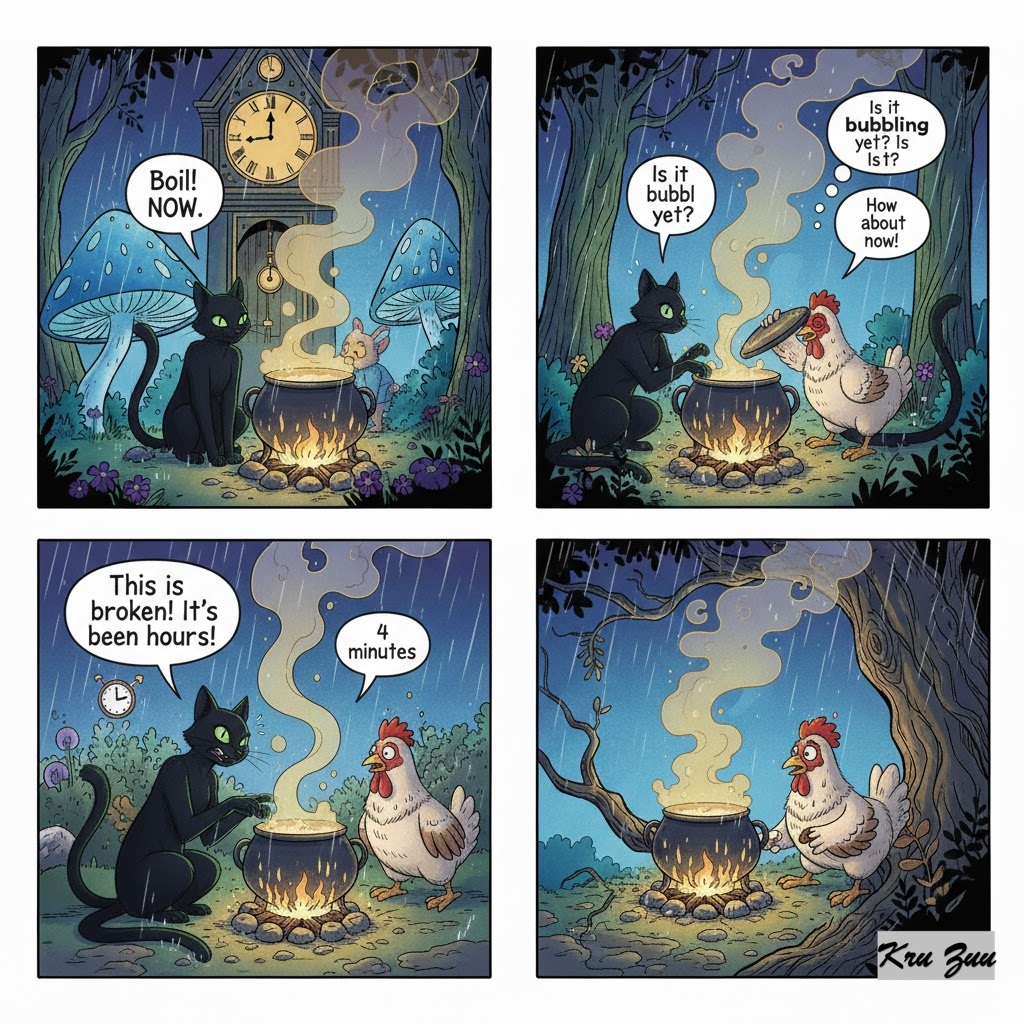
    The Situation: It is a cold, rainy afternoon. Cleo and Cluck decide to make the legendary “Golden Swamp Tea.” It is delicious, but the water must boil perfectly over a slow fire.


    The Conflict: They put the heavy iron pot on the fire. Cleo sits directly in front of the pot. Her tail twitches. She stares at the water with intense green eyes. “Boil,” she commands. “Boil NOW.” Cluck is even worse. Every 30 seconds, he lifts the lid to peek inside. “Is it bubbling yet? Is it? How about now?” 🐔 By lifting the lid, Cluck lets the heat escape! By staring at it, Cleo makes the 10 minutes feel like 10 years. “This is broken!” Cleo yells. “It’s been hours!” (It had been 4 minutes).


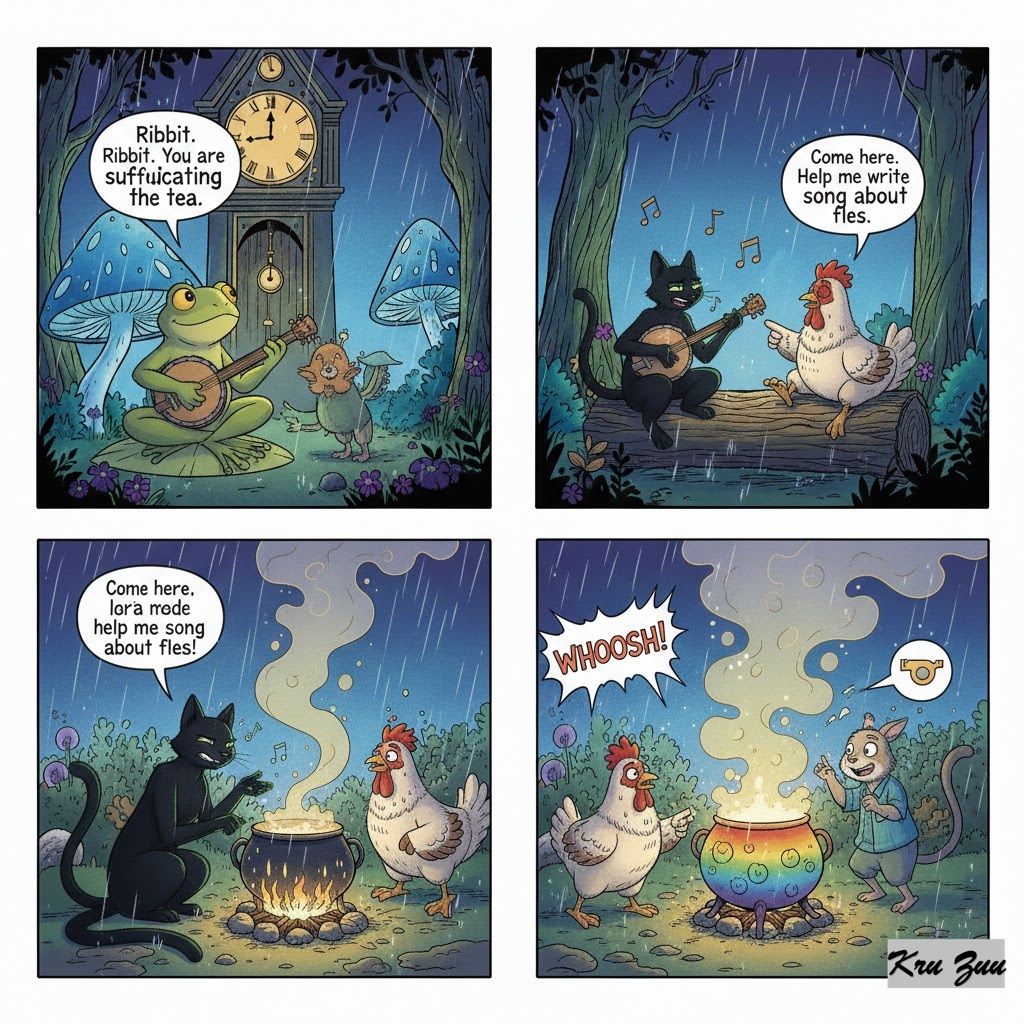
    The Resolution: Fred the Frog hops into the kitchen, carrying a banjo. He sees them stressed and staring at the silent water. “Ribbit,” Fred croaks. “You are suffocating the tea.” Fred starts to play a happy song on his banjo. 🎶 “Come here,” he says. “Help me write a song about flies.” Reluctantly, Cleo turns away from the stove to correct Fred’s lyrics. Cluck starts dancing to the music. They laugh. They argue about rhymes. They forget the kitchen exists. WHOOSH! 💨 Suddenly, steam whistles from the pot! The water is boiling vigorously.


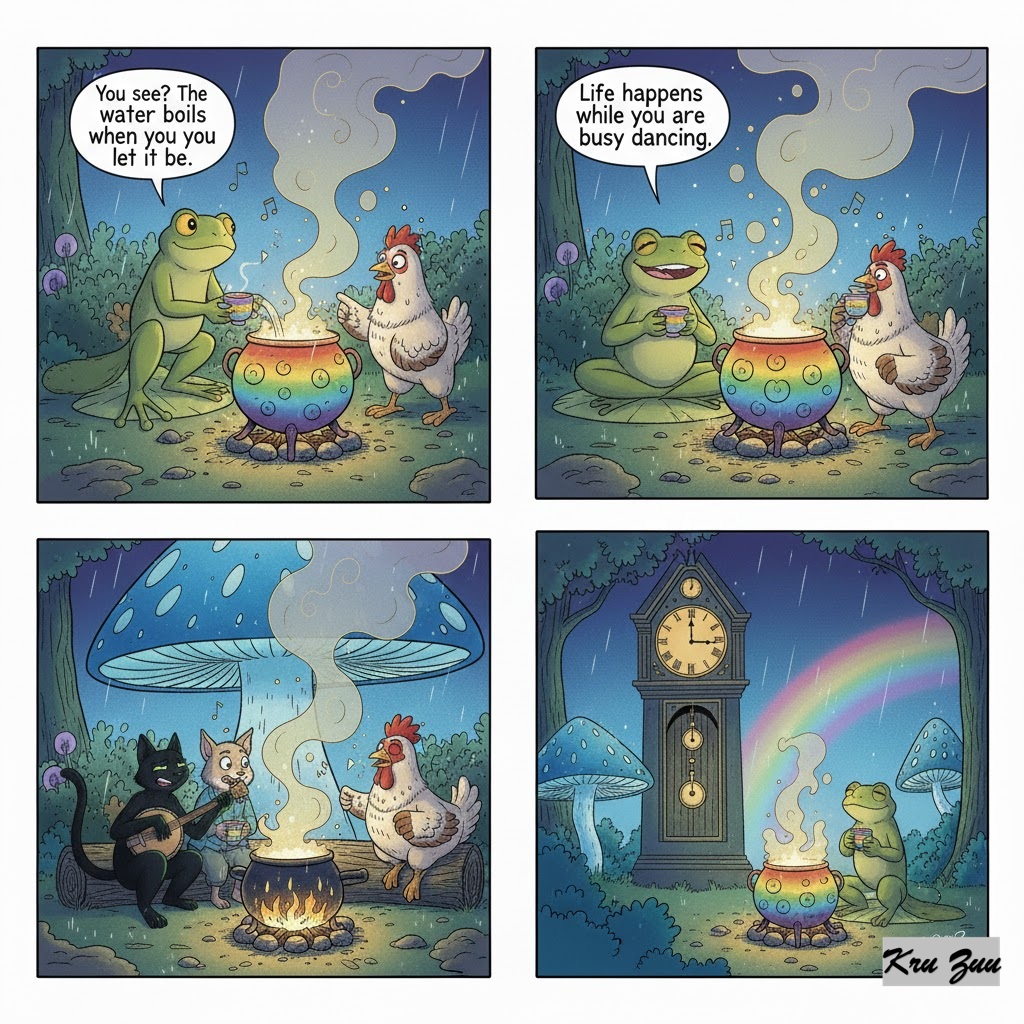
    The Moral: Fred pours the tea. “You see?” he smiles. “The water boils when you let it be. Life happens while you are busy dancing.”

    🎓 Lesson for English Learners


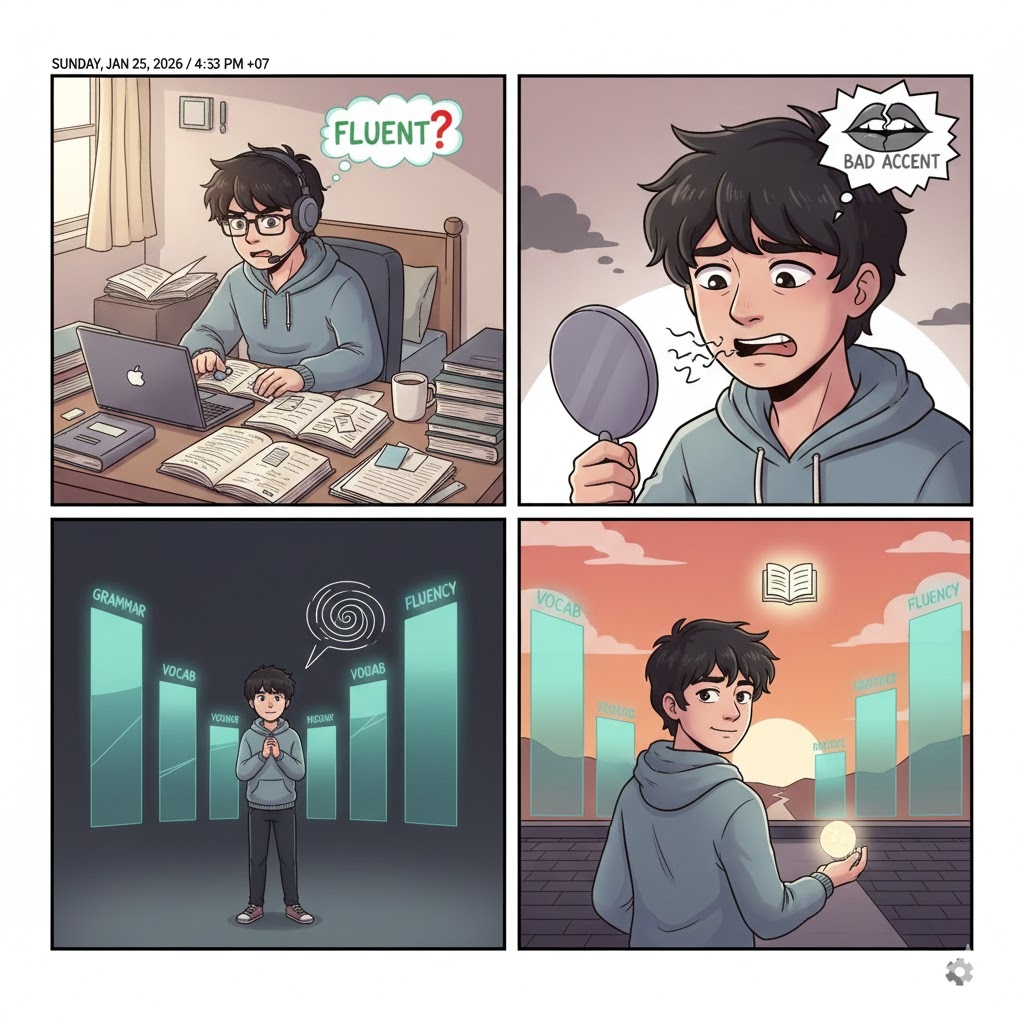
    Don’t obsess over your level.


    Situation: You study English every day. You constantly ask yourself: “Am I fluent yet? Why is my accent still bad?”


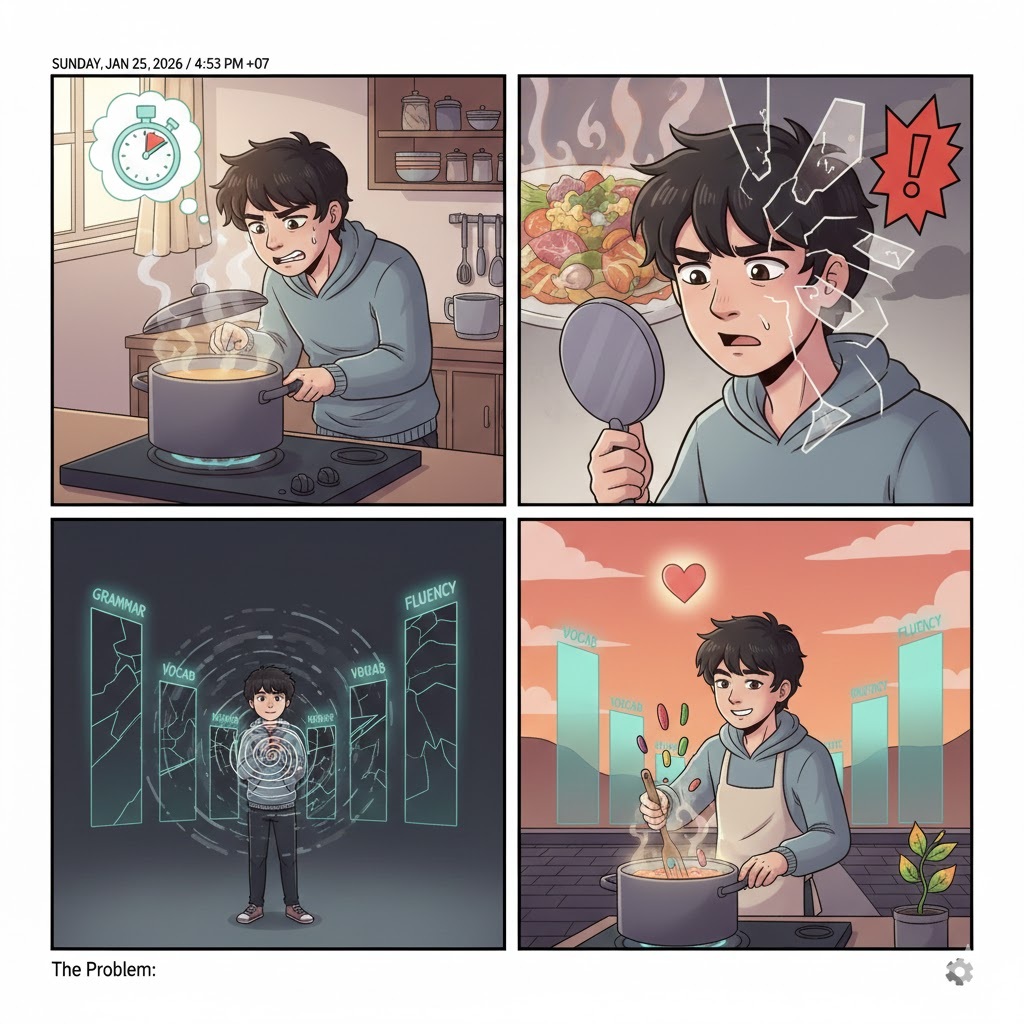
    The Problem: You are watching the pot. You are stressing over the result instead of enjoying the process.


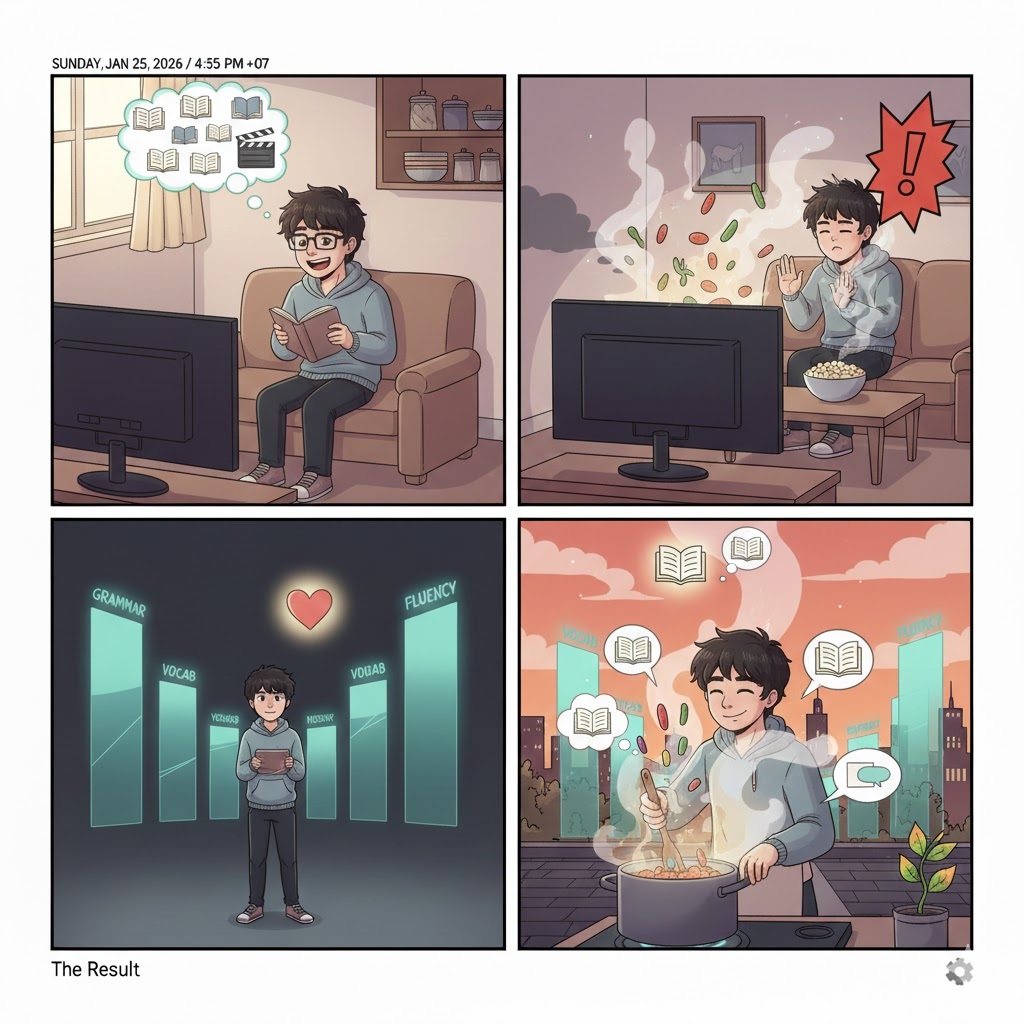
    The Shift: Stop testing yourself every day. Read a book you enjoy. Watch a movie. Talk to friends. Forget about “studying” and just “use” the language.


    The Result: One day, you will realize you understood a whole movie without subtitles. The pot boiled while you weren’t looking! 🎬


    💬 Your Turn: The Distraction Challenge 🚀


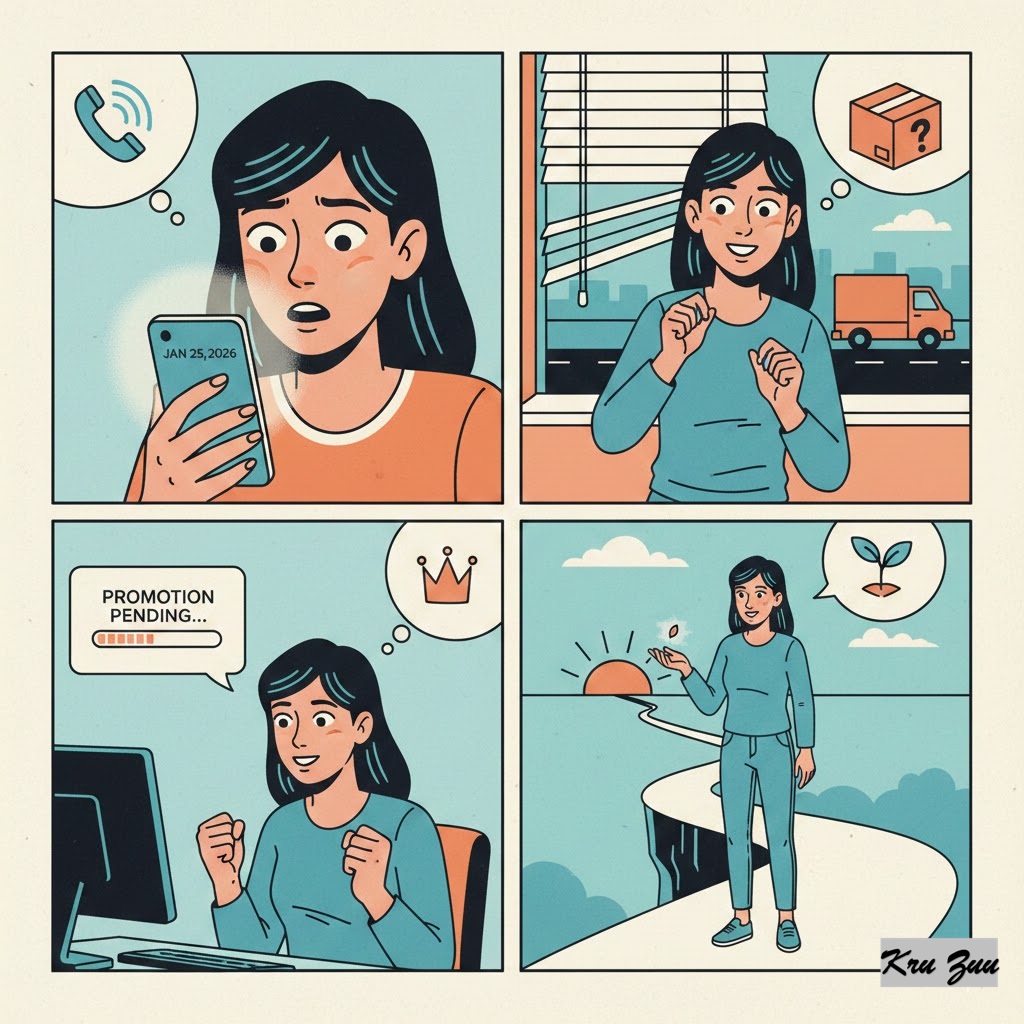
    Is there something you are waiting for right now? (A message, a package, a promotion, a life change?)


    The Challenge: Stop checking. Put your phone in another room. Close the tracking tab.

    The Action: Pick a task that takes 30 minutes (Read a chapter, cook a meal, go for a walk).

    Do NOT check the status until the task is done.

    Comment Below: 👇 What is the “Pot” you are watching too closely today? Tell us your strategy to stop staring at it!

    By Zubeyir YURTKURAN

    https://www.facebook.com/BrainBattleground/

    https://www.facebook.com/zubeyr.yurtkuran/

    https://www.instagram.com/zubeyryurtkuran/
    https://www.youtube.com/@BrainBattleground-b3p

    https://www.instagram.com/brainbattleground/

  • 🥛 The Daily Shield: The Law of Acceptance

    🥛 The Daily Shield: The Law of Acceptance

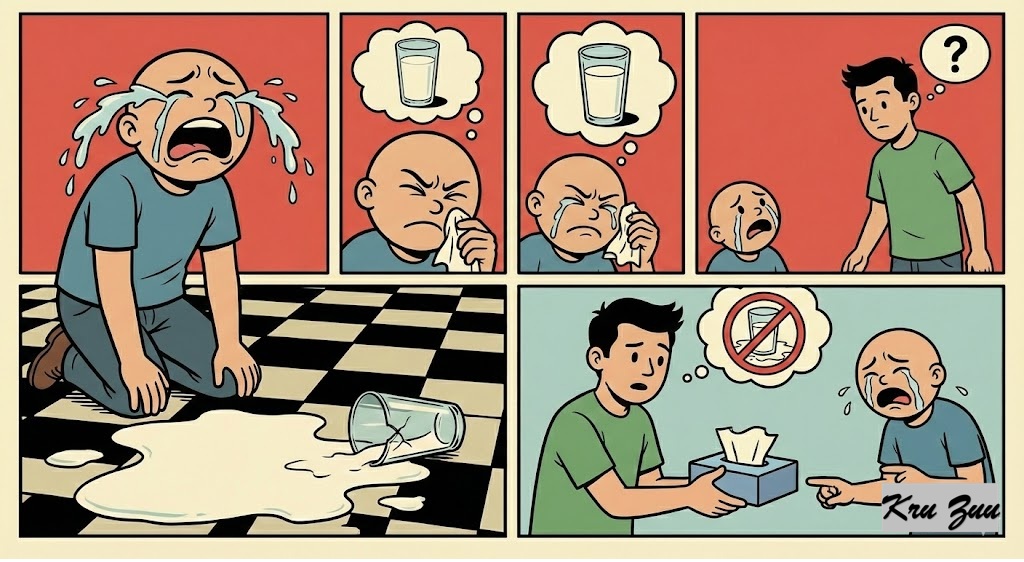
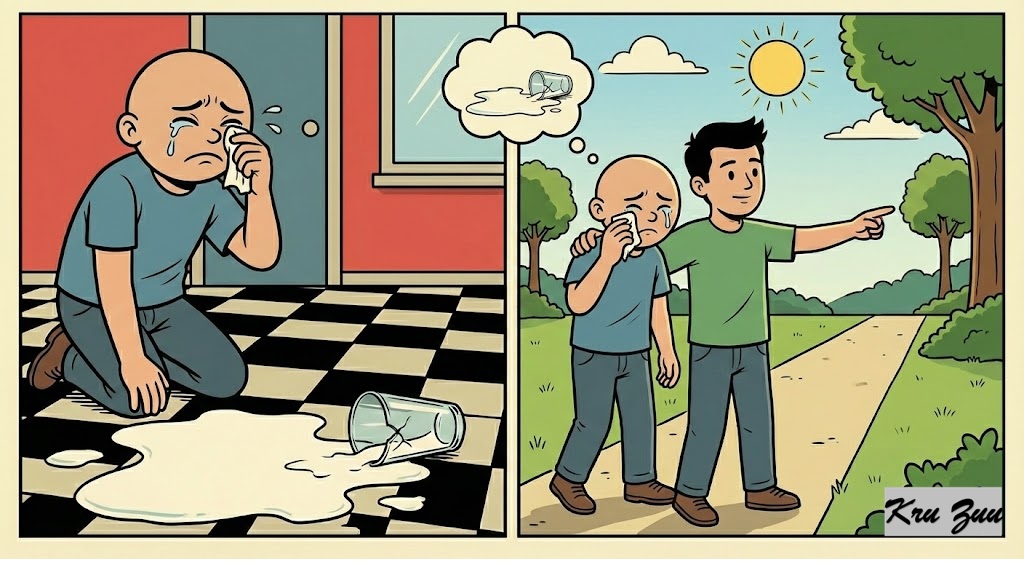
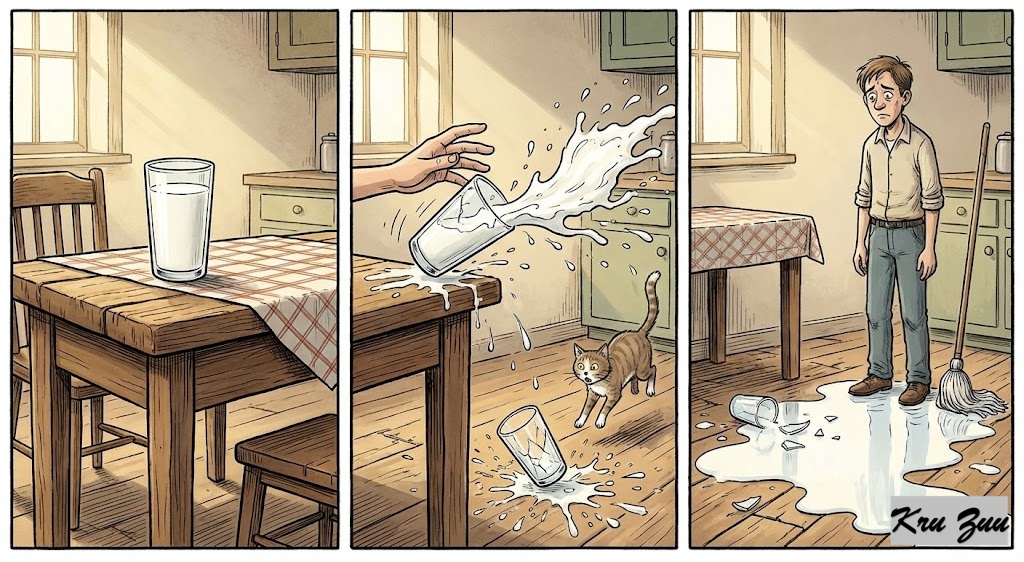
    “Don’t cry over spilt milk.”


    😈 The Villain (The Dweller)

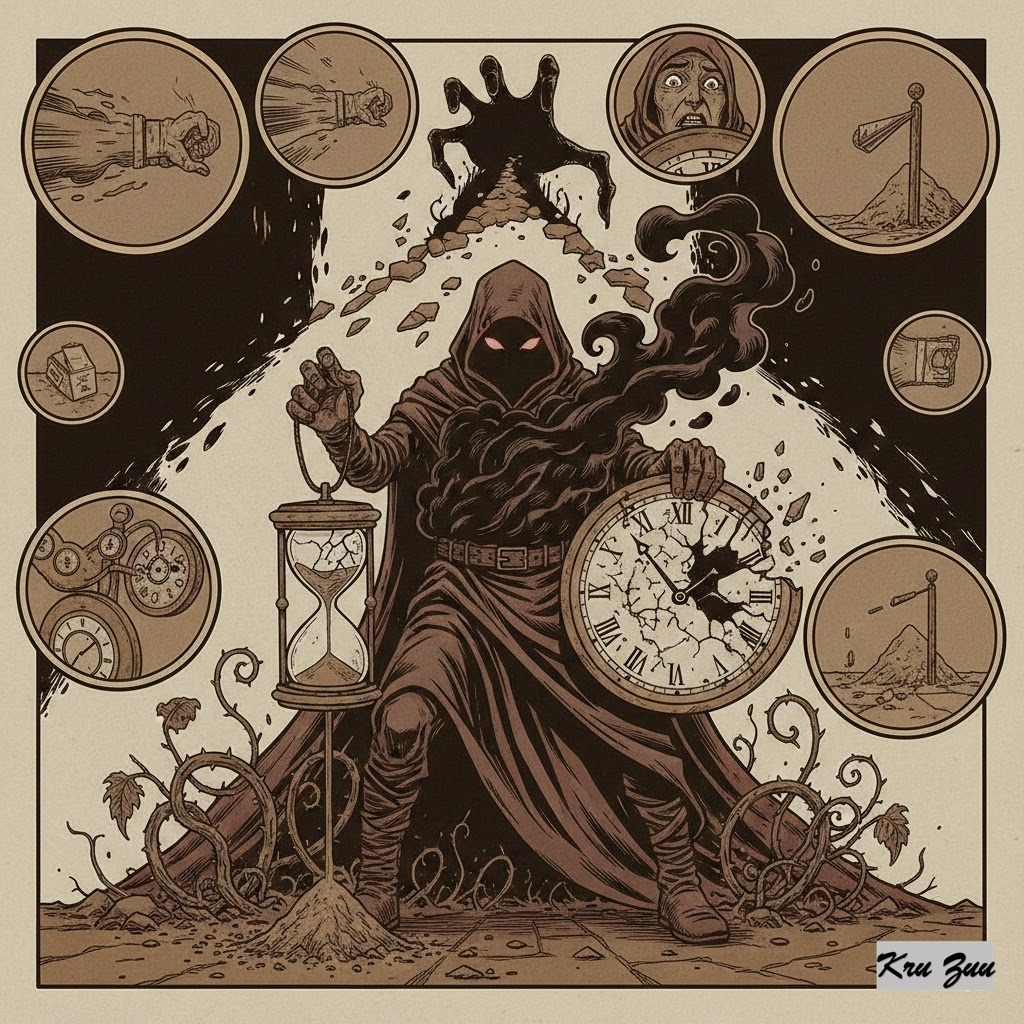
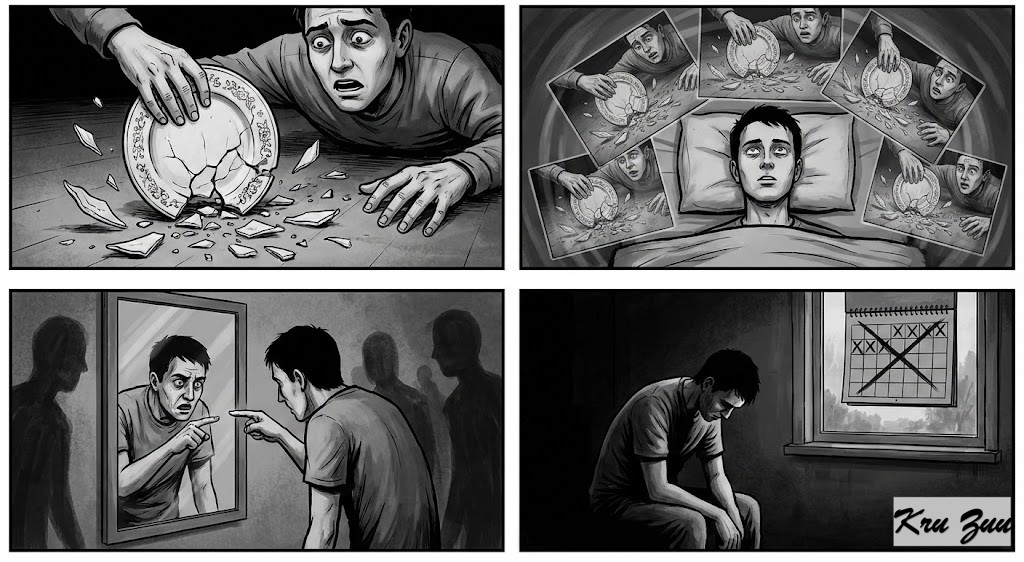
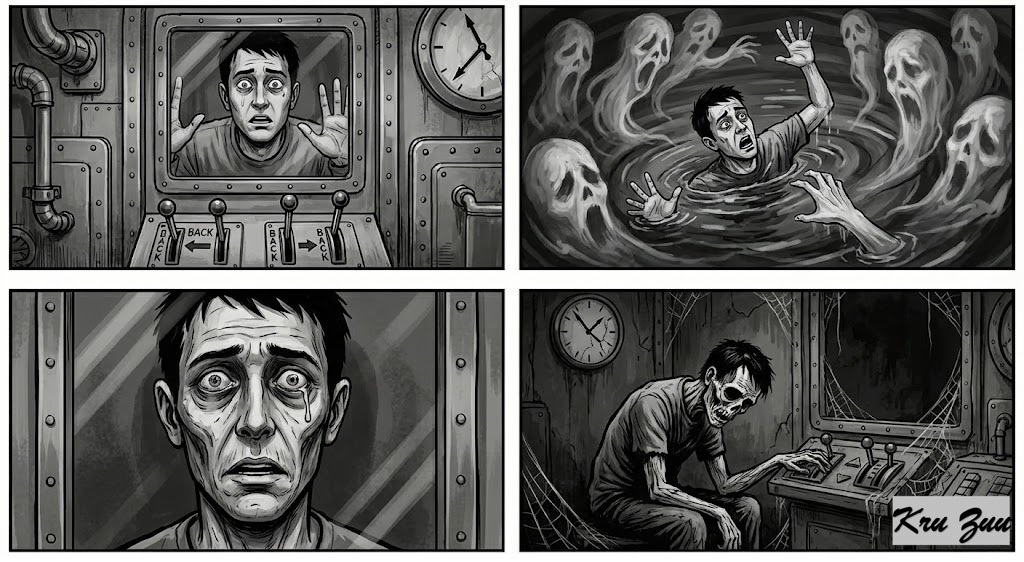
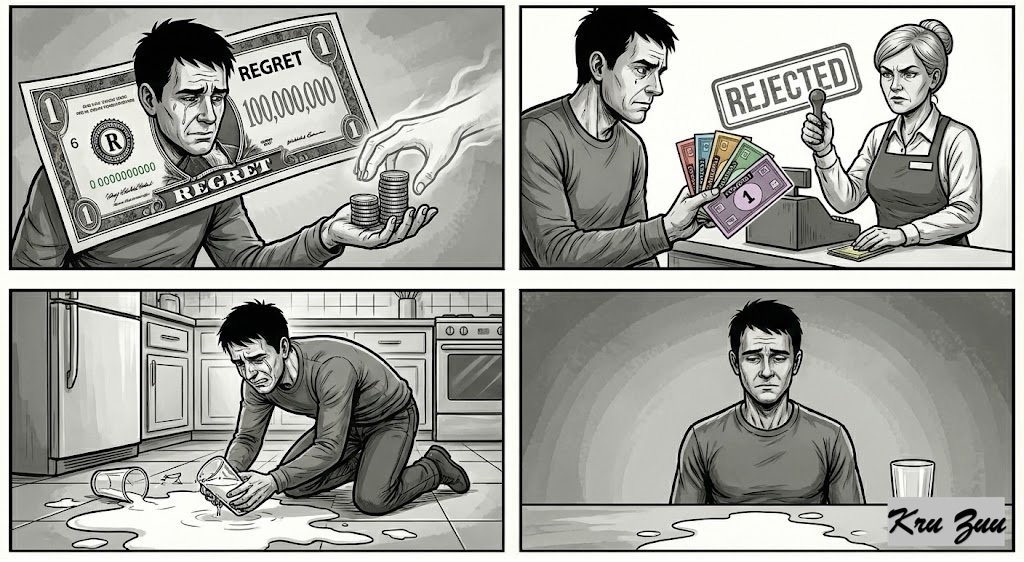
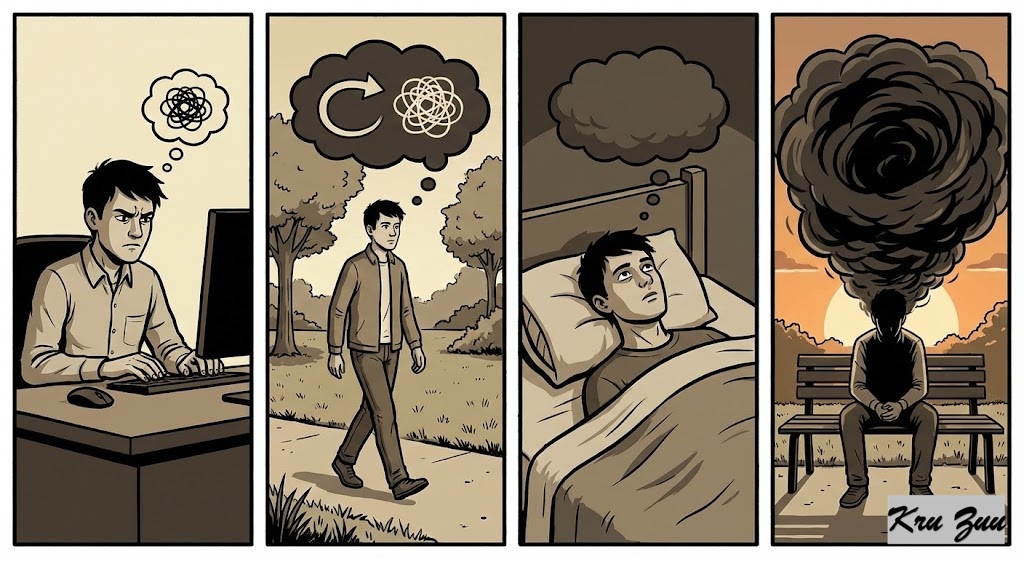
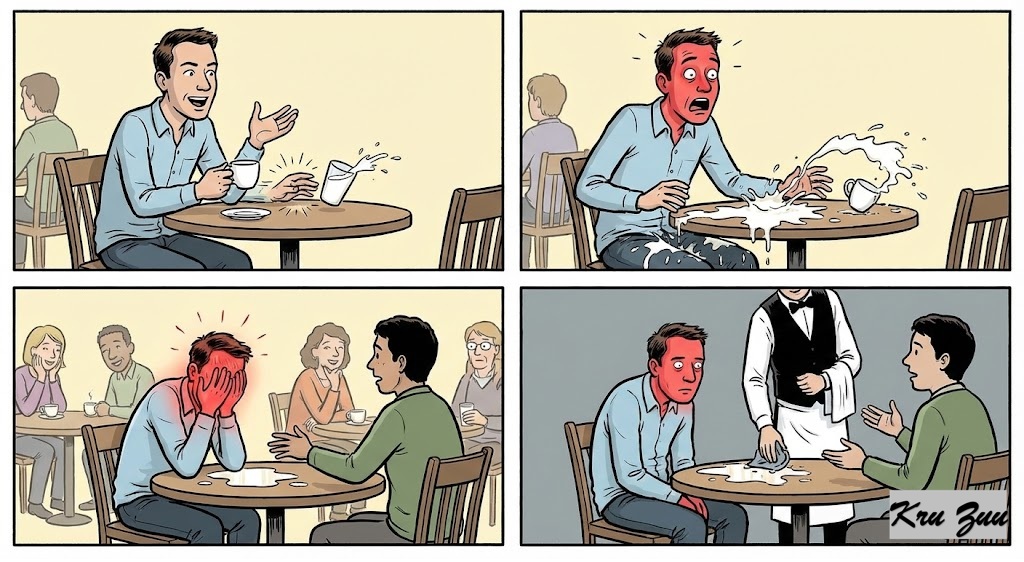
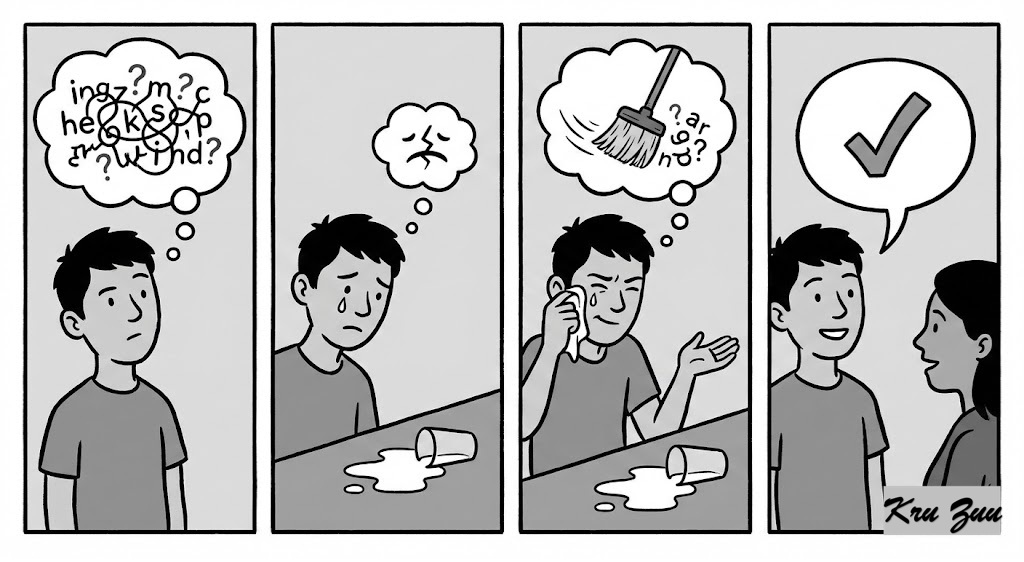
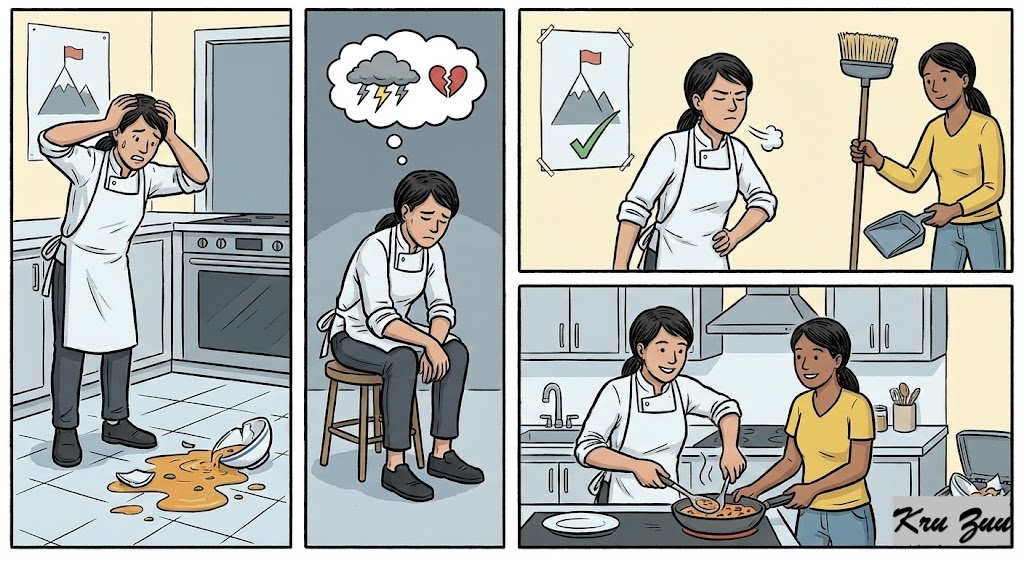
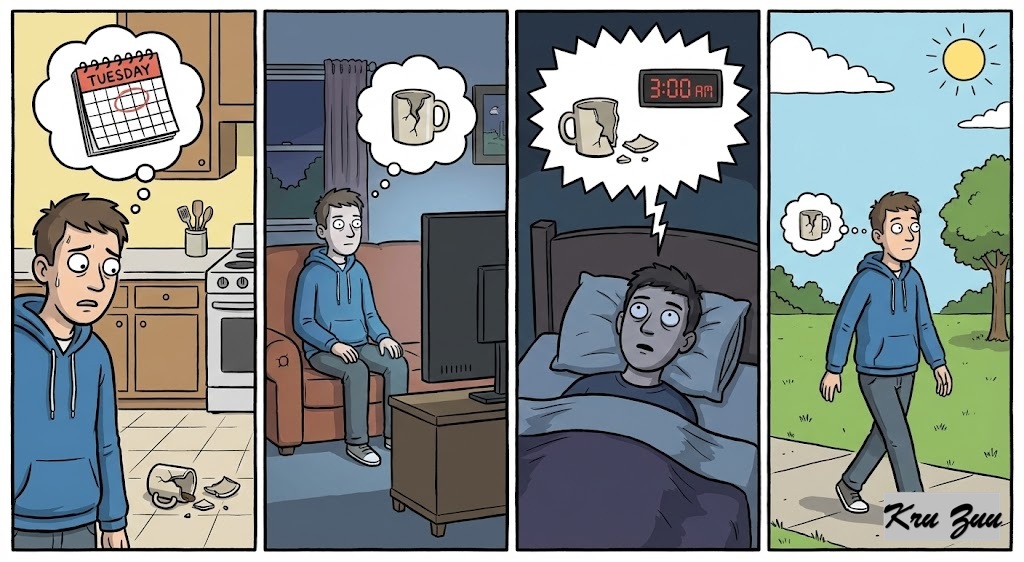
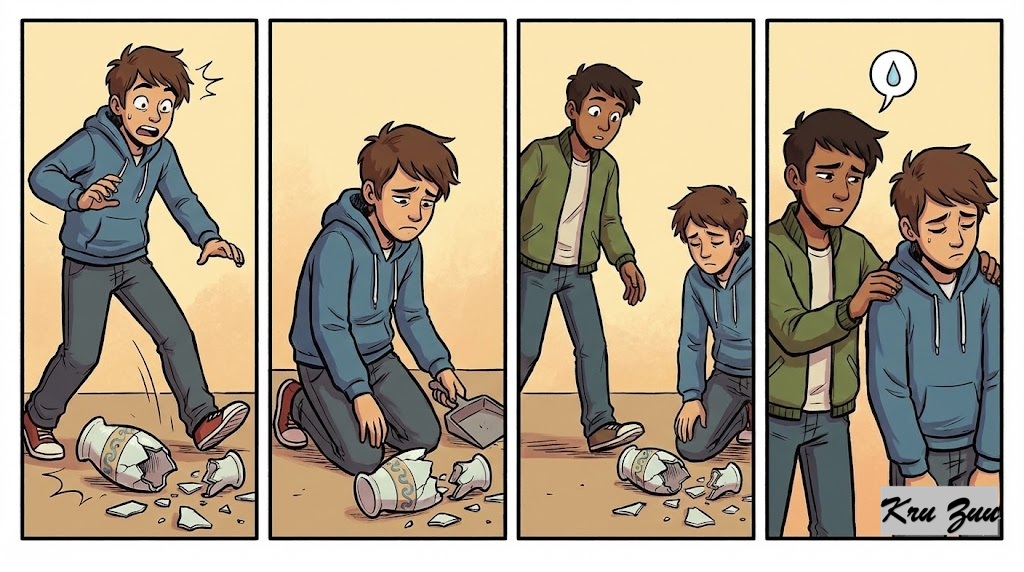
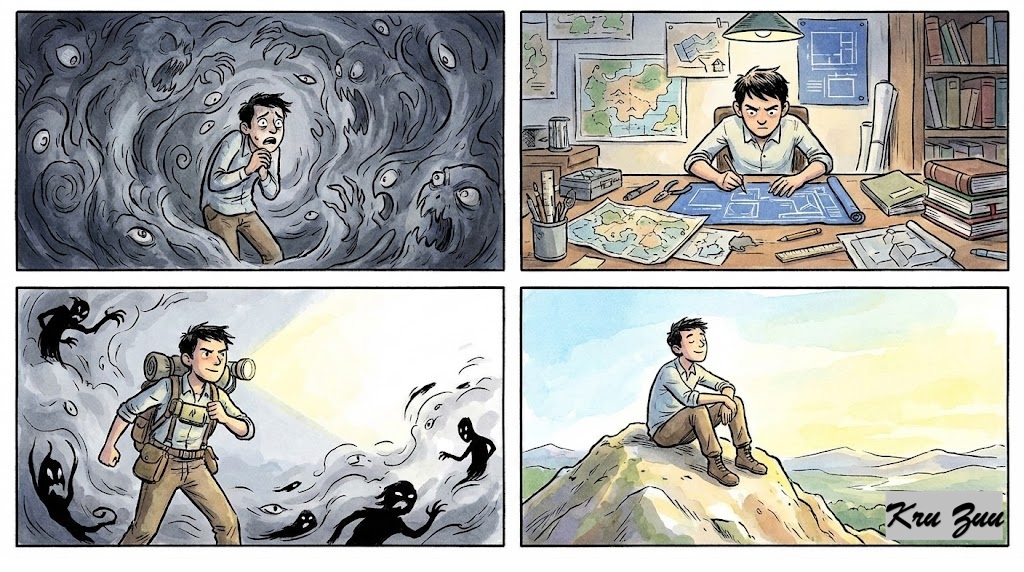
    You make a mistake. Maybe you failed an exam, sent an embarrassing text, or broke a valuable plate. What do you do? You replay the scene in your head 1,000 times. You say, “If only I had been faster… If only I had been smarter.” You let one bad moment ruin your entire week. You dwell on the past until you are paralyzed by it.

    The Result? You are stuck in a time machine that only goes backward. You are drowning in a puddle of regret. 🧟‍♂️


    😇 The Hero (The Stoic)

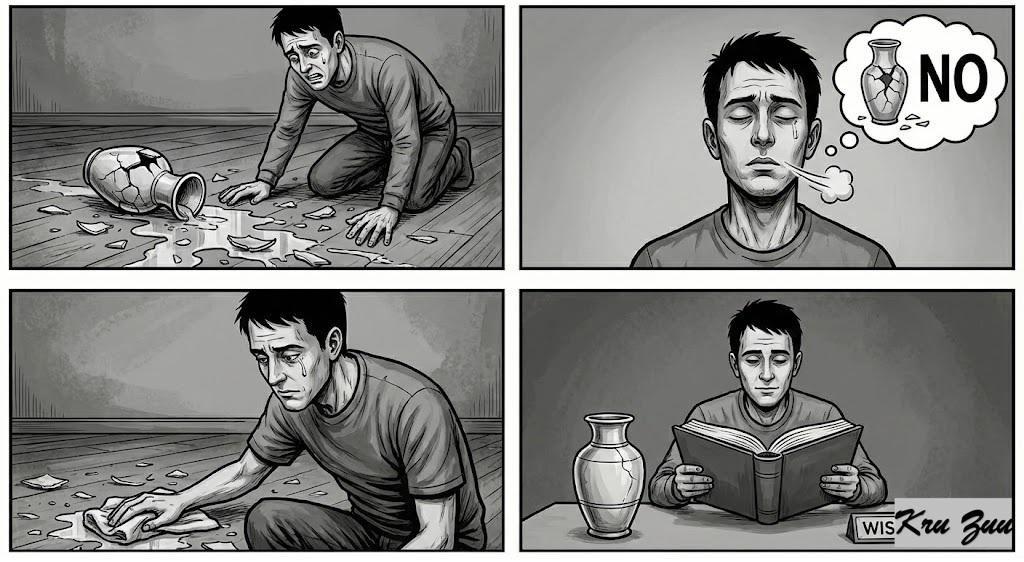
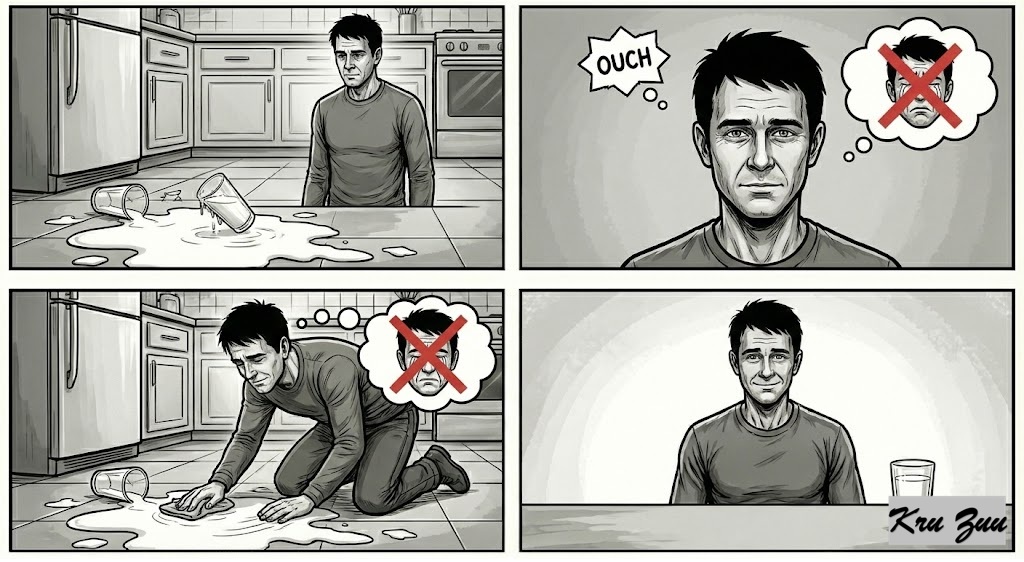
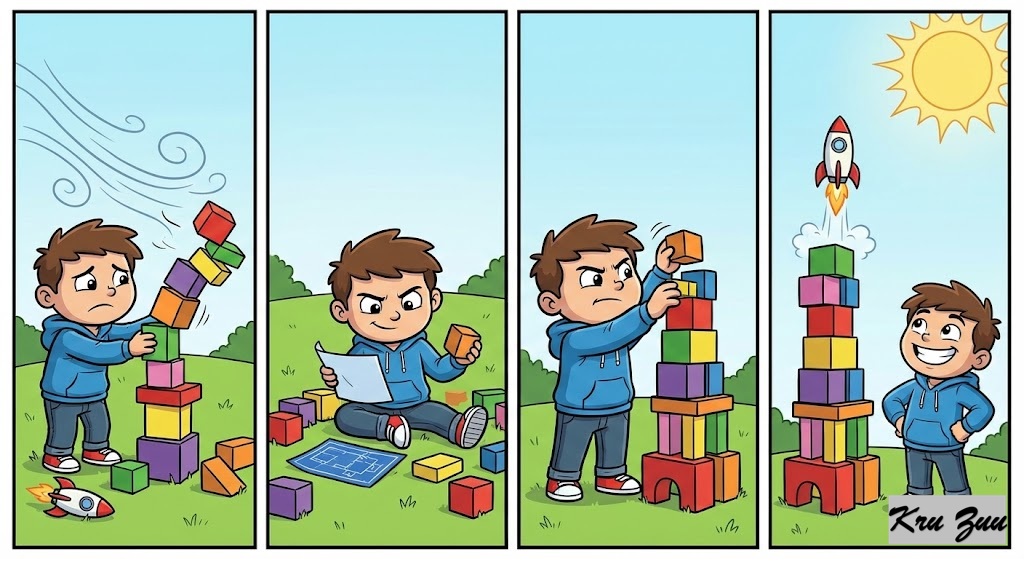
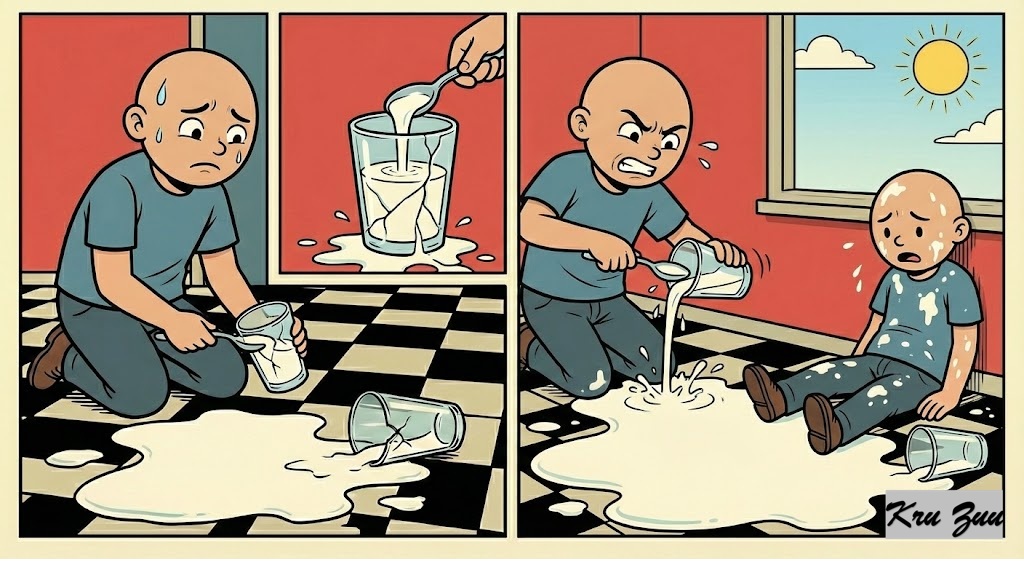
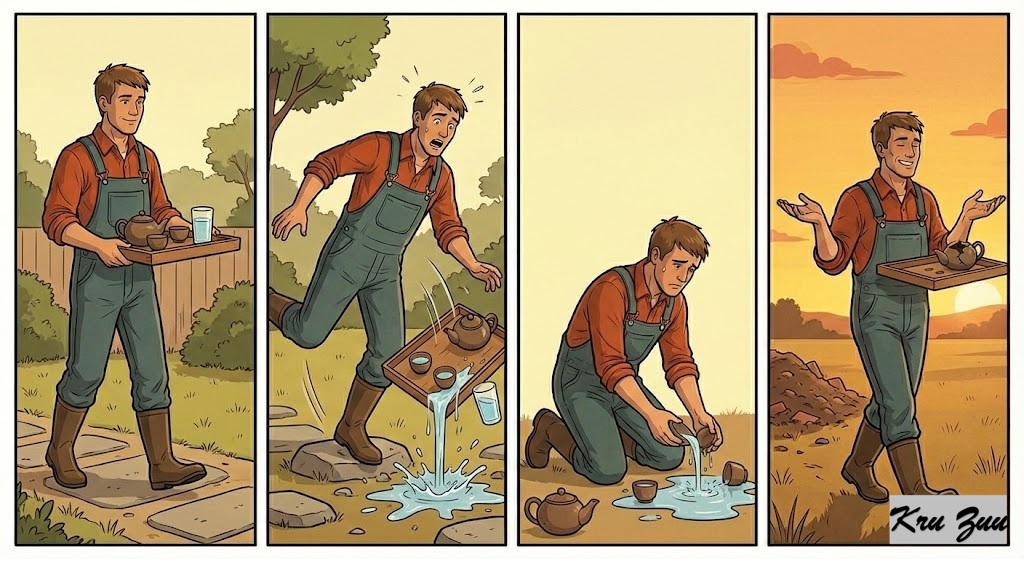
    You make a mistake. It stings. It hurts. You take a deep breath and look at the mess. You ask one question: “Can I change this?” The answer is No. So, you grab a towel, clean it up, and learn the lesson. You treat the mistake as a tuition fee for wisdom.

    The Result? You move forward instantly. Your energy is spent on fixing the future, not mourning the past. You are bulletproof against regret. 🛡️


    ⚖️ The Reality


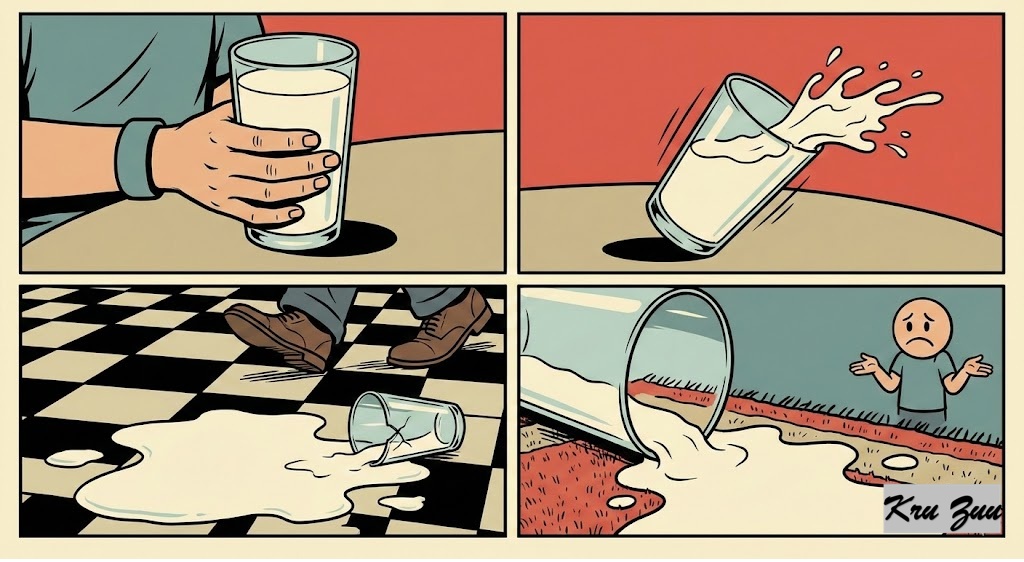
    Regret is expensive. Worrying about what already happened is like trying to pay a bill with Monopoly money. It doesn’t work. The milk is on the floor. No amount of crying, screaming, or analyzing will put the milk back into the glass.


    💎 The Secret

    The event (the spill) is not what hurts you. It is your reaction (the crying) that hurts you. Pain is inevitable; suffering is optional.

    🧐 The Anatomy of the Proverb


    This is the ultimate weapon against anxiety.


    Spilt (Adjective): The past participle of “spill.” It is done. Finished. Irreversible.


    Cry Over (Phrasal Verb): To be upset or sad about a specific thing.


    Simpler Version: Move on.


    📚 Vocabulary Vault


    Irreversible (Adjective):
    Cannot be changed or undone. (The milk is irreversible).


    Dwell (Verb): To think/speak about something for too long (usually something bad).


    Resilience (Noun): The ability to recover quickly from difficulties. 🚀


    Ruminate (Verb): To think deeply about something; often negative thoughts on a loop.


    Futile (Adjective): Pointless; producing no useful result.


    🧠 Grammar Focus: Prepositions of Cause


    Notice the preposition “Over.” We don’t cry for the milk or at the milk. We cry over it.


    English Logic: The emotion is covering the subject.


    Examples: “He is arguing over money.” / “Don’t worry over small details.”

    📜 History: Origin and Spread


    The Origin:
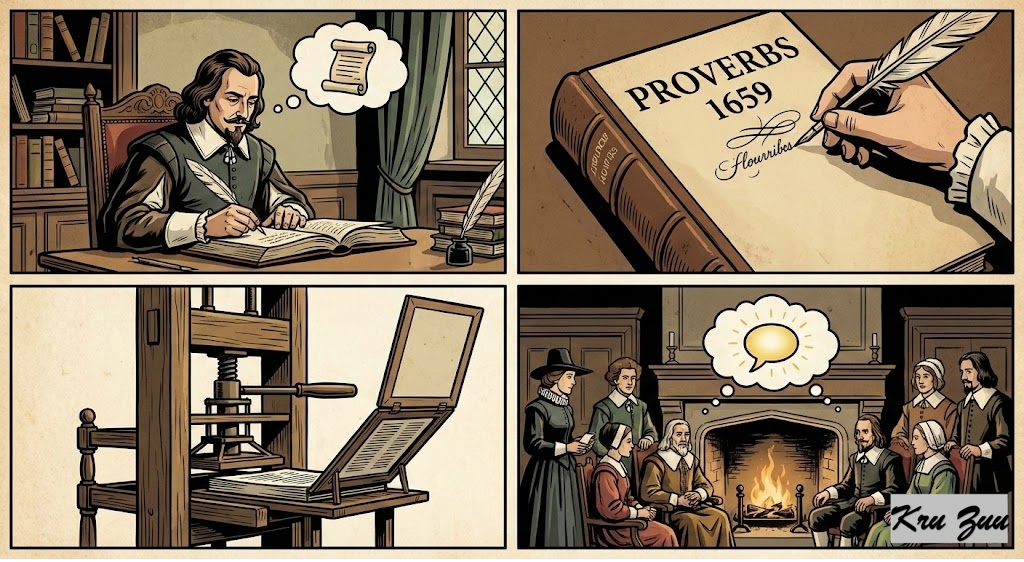
    This proverb was first recorded in 1659 by historian James Howell.

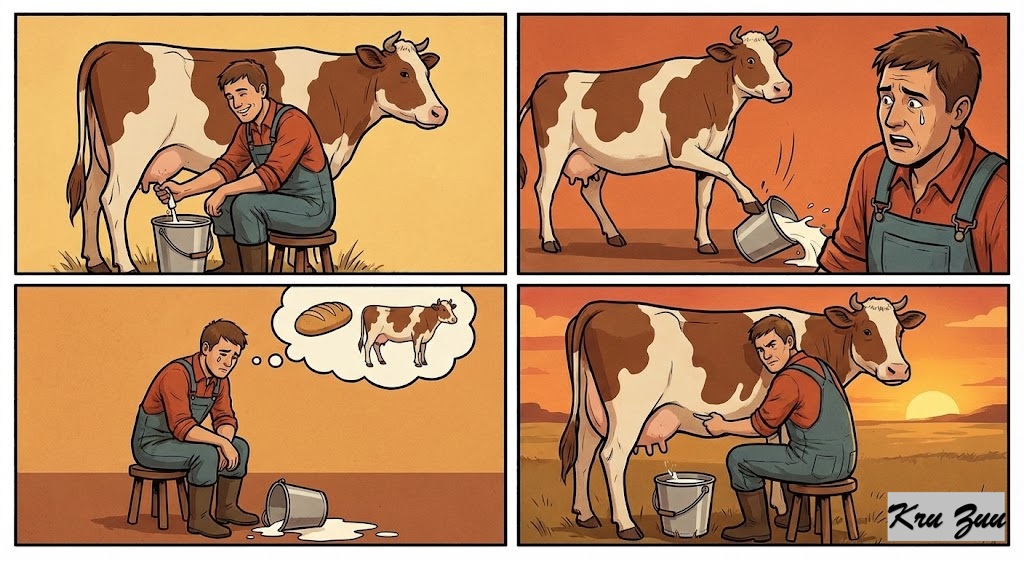
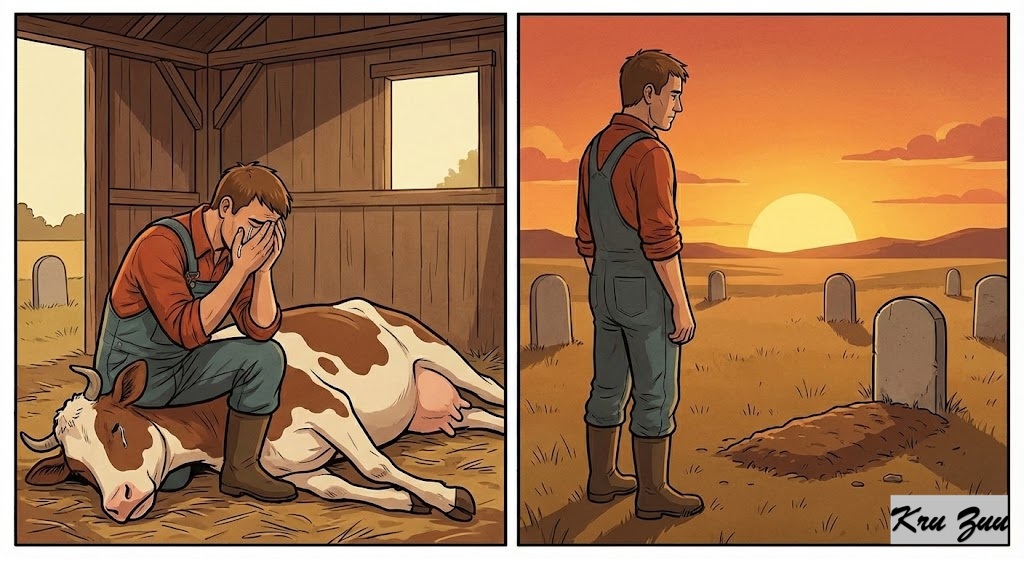
    The Logic: In old farming days, milk was money. If a cow kicked the bucket over, the farmer lost that day’s profit. But standing there crying wouldn’t feed the family, milking the next cow would.


    Global Cousins


    🇹🇷 Turkish:
    “Olanla ölene çare yoktur.” (There is no cure for what has happened or who has died.) — A darker, but very true equivalent!


    🇫🇷 French:“Ce qui est fait est fait.” (What is done is done.)


    🇯🇵 Japanese:“Fukusui bon ni kaerazu.” (Spilt water will not return to the tray.)

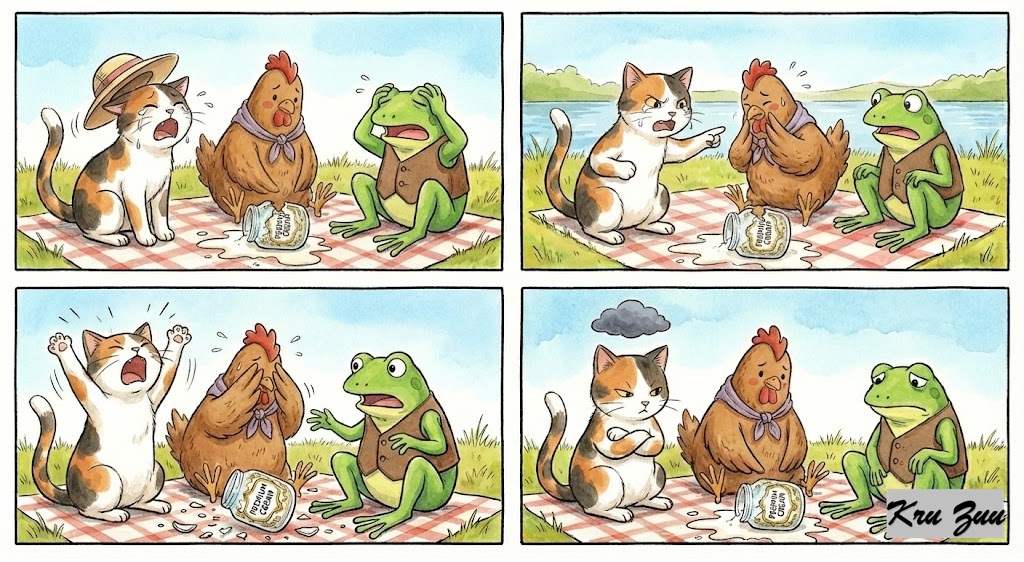
    🎭 Short Story: The Picnic at the Pond


    Let’s see how different personalities handle a disaster.


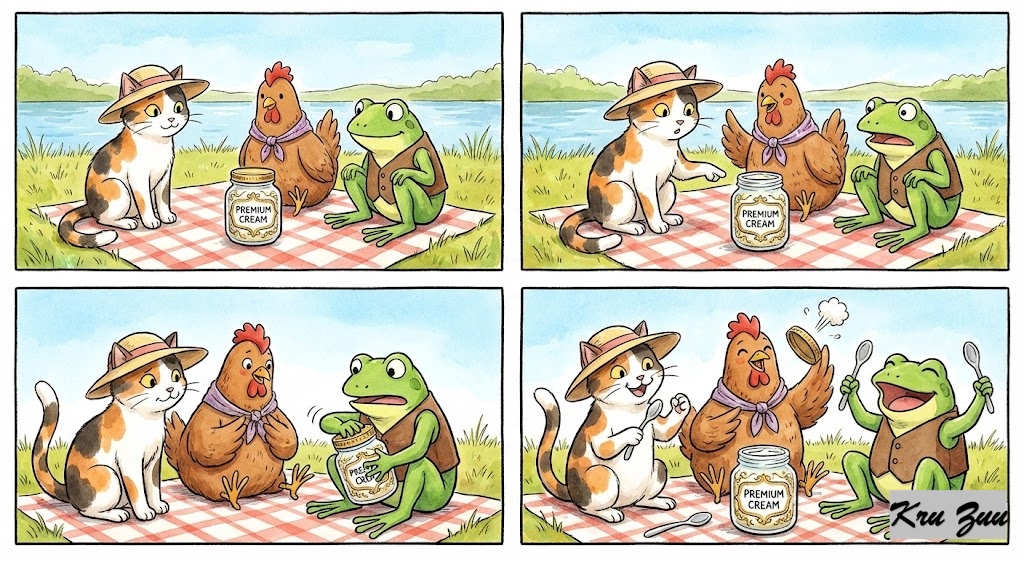
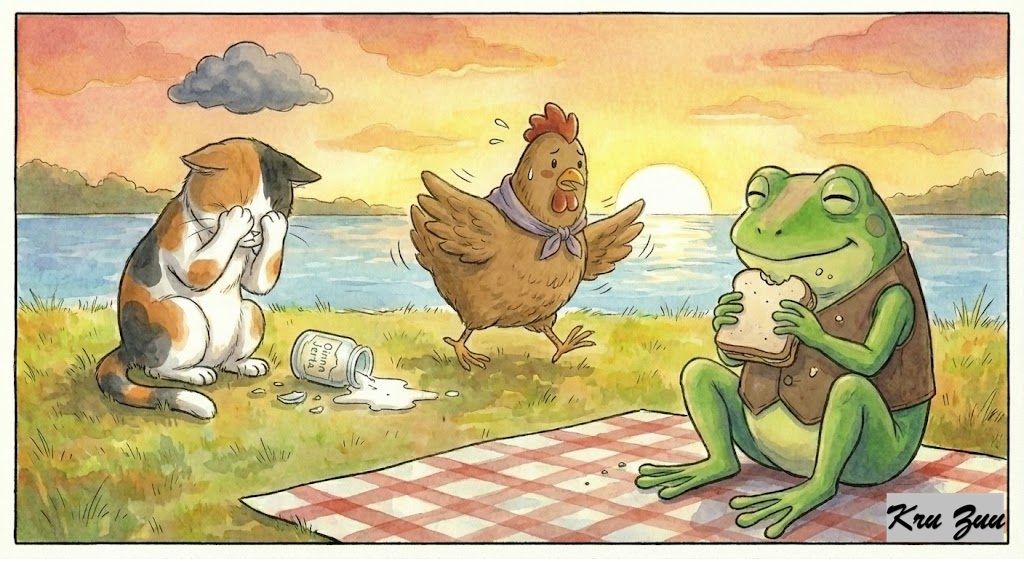
    🌟 The Setup: It is a beautiful Sunday. Three friends are having a picnic by the lake: Cleo the Cat, Henrietta the Chicken, and Franklin the Frog. They have one jar of delicious, expensive cream.


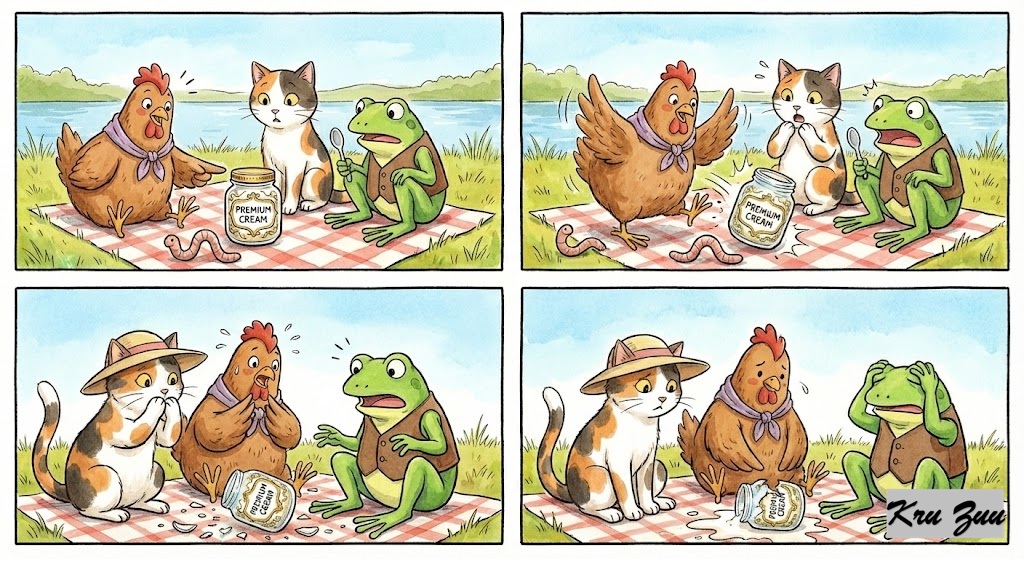
    The Accident: Henrietta the Chicken gets excited about a worm. She flaps her wings, hits the table, and—SMASH. The jar breaks. The expensive cream soaks into the dirt. It is gone.


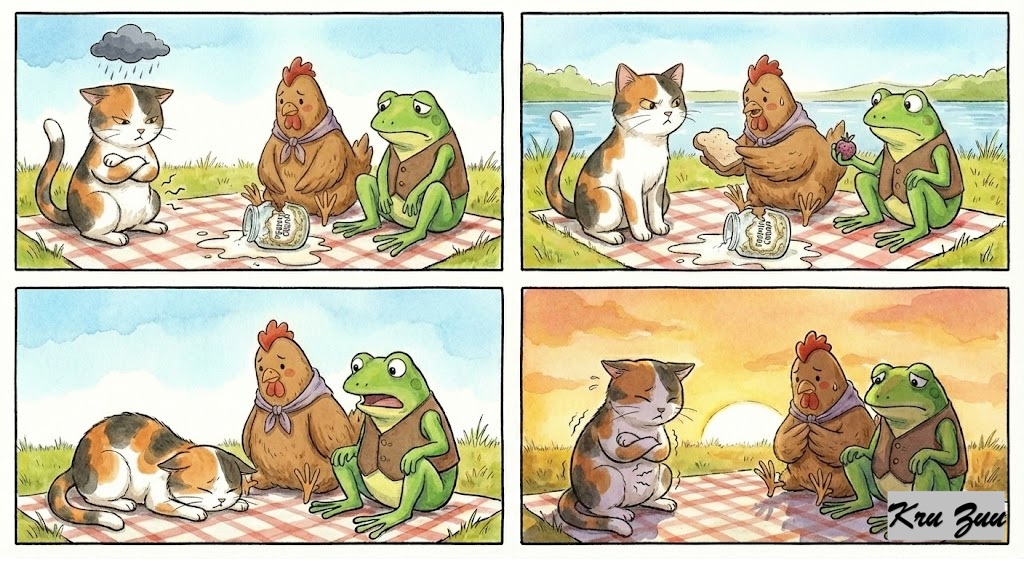
    😿 Cleo the Cat (The Dweller): Cleo stares at the cream. She starts to wail. “My cream! It was perfect! Why are you so clumsy, Henrietta? If we had sat on the grass, this wouldn’t have happened! I can’t believe this. My day is ruined. I’m not eating anything else!”

    Result: Cleo is hungry and miserable.


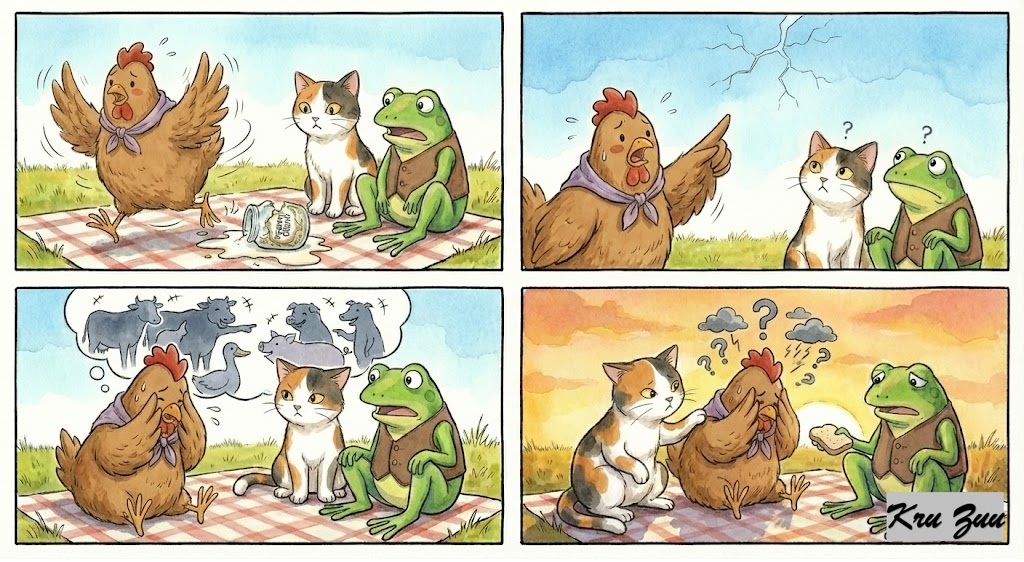
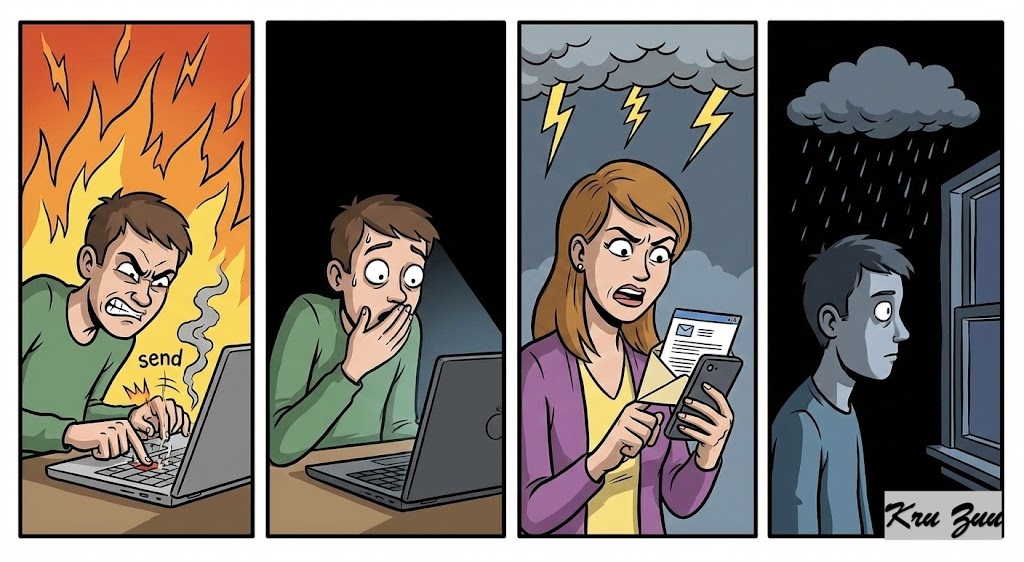
    🐔 Henrietta the Chicken (The Anxious): Henrietta runs in circles, flapping wildly. “Oh no! Oh no! The sky is falling! What will we do? We have no cream! It’s a disaster! Everyone will laugh at us!”

    Result: Henrietta is having a panic attack.


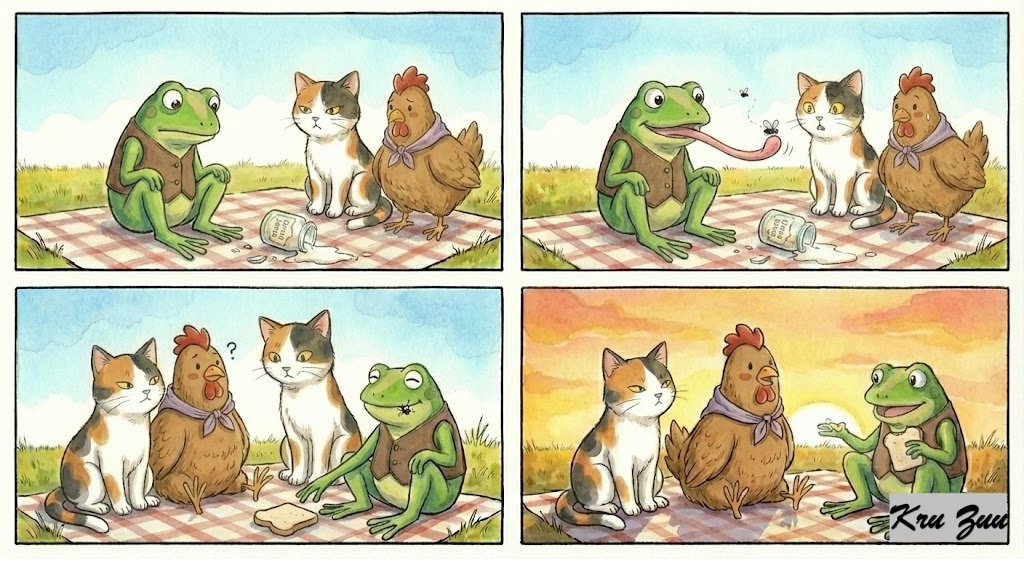
    🐸 Franklin the Frog (The Stoic): Franklin looks at the broken glass. He looks at the cream in the dirt. He blinks his big eyes. “Ribbit,” says Franklin. He sticks out his long tongue and catches a fly buzzing near the mess. “The cream is gone,” Franklin says calmly. “But the sandwiches are still dry. And the sun is still warm. Pass the bread, please.”


    The Moral: Cleo cried. Henrietta panicked. Franklin ate lunch. Be like Franklin. Eat the sandwich. 🥪

    🎓 Lesson for English Learners


    Don’t Let Mistakes Silence You.


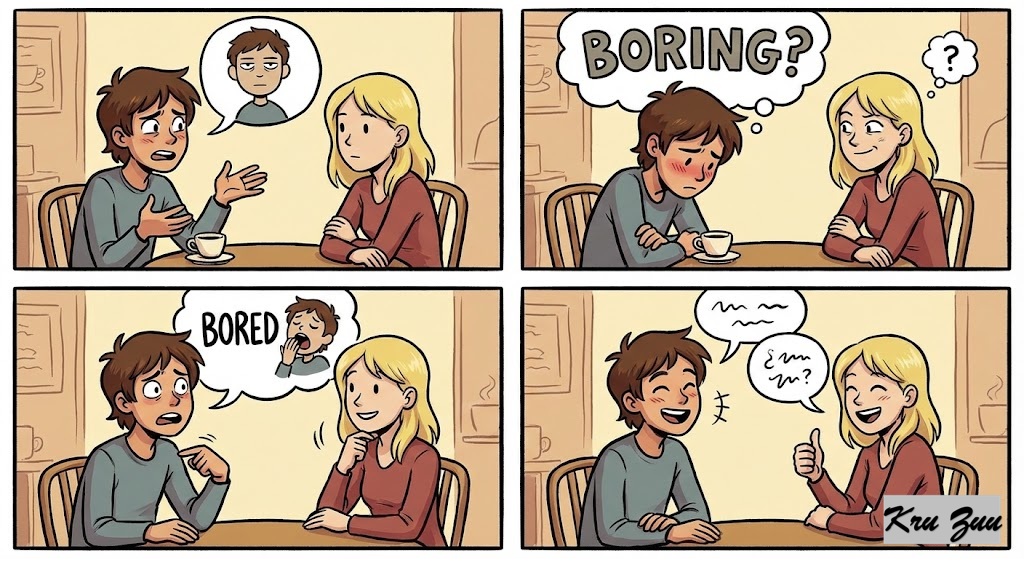
    Situation: You are speaking English to a native speaker. You try to say “I was bored,” but you accidentally say “I was boring.”


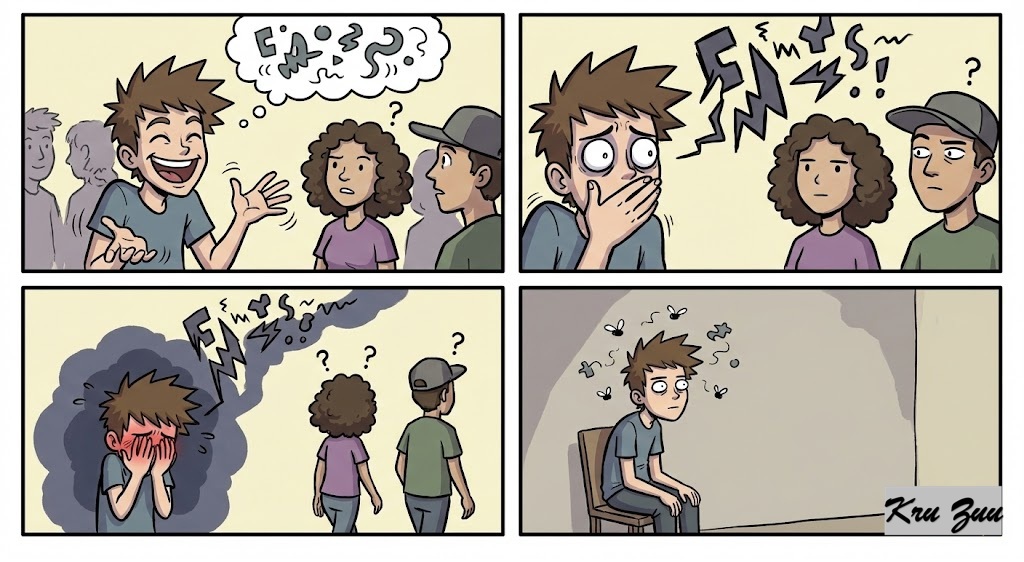
    The “Spilt Milk” Reaction: You freeze. Your face turns red. You stop talking because you are afraid of making another mistake.


    The Hero Reaction: You laugh. You say, “Oops! I mean I was bored!” and you keep talking.


    Remember: A grammar mistake is spilt milk. Once the words leave your mouth, they are gone. You cannot catch them. Don’t cry over a bad verb tense. Just speak the next sentence better.


    💬 Your Turn: The 5-Second Funeral 🚀


    We all have “spilt milk” in our lives. Here is your challenge.


    The Exercise: Think of one small mistake you made this week that is still bothering you.


    A rude email you sent?


    A workout you skipped?


    A dumb comment you made?


    The Action:
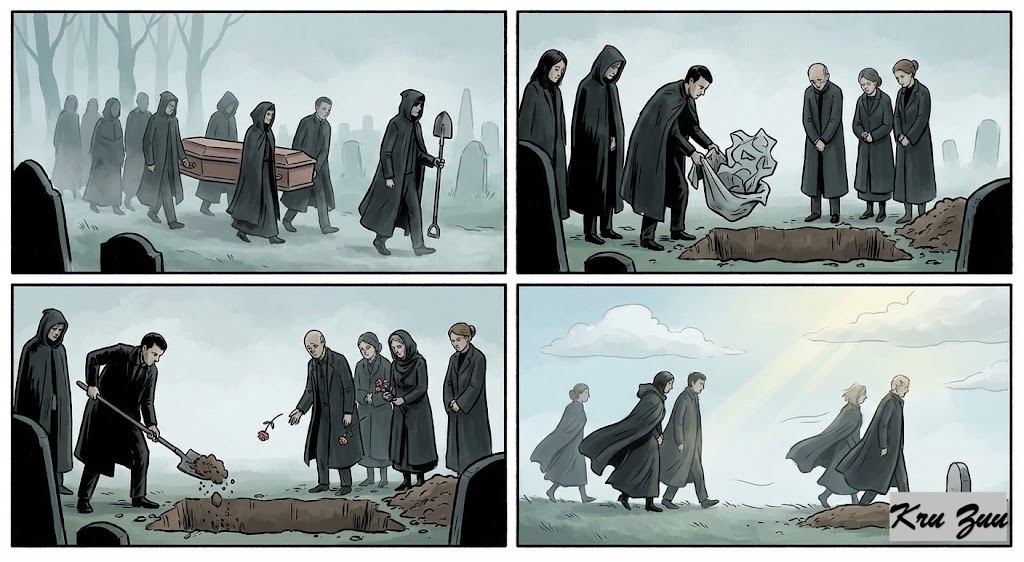
    We are going to hold a funeral for that mistake.


    Close your eyes.


    Admit the mistake happened.


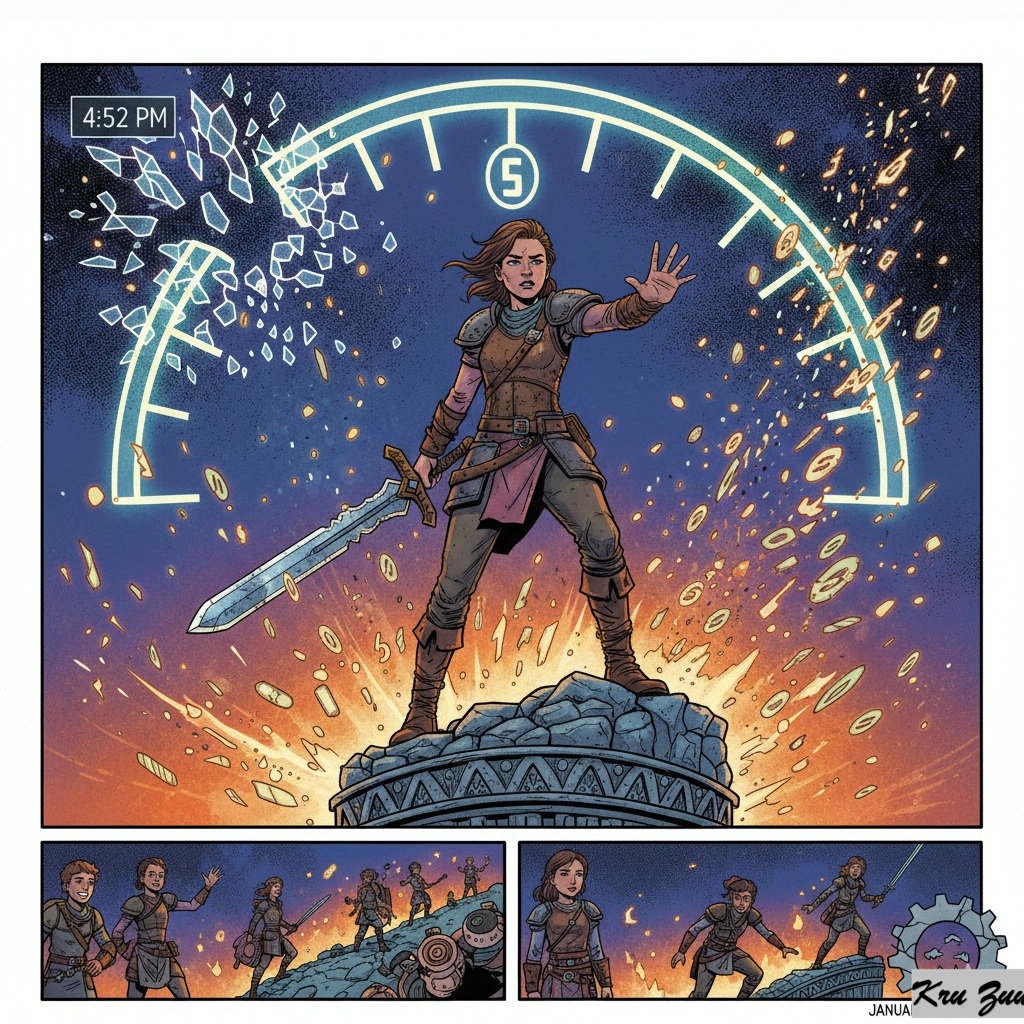
    Count backward:
    5, 4, 3, 2, 1.


    Say out loud: “It is spilt.”


    Move on.


    Question:
    What is one “spilt milk” moment you are letting go of today? Tell us in the comments! 👇

    By Zubeyir YURTKURAN

    https://www.facebook.com/BrainBattleground/

    https://www.facebook.com/zubeyr.yurtkuran/

    https://www.instagram.com/zubeyryurtkuran/
    https://www.youtube.com/@BrainBattleground-b3p

    https://www.instagram.com/brainbattleground/

  • 🛡️ The Daily Shield: The Law of Loyalty

    🛡️ The Daily Shield: The Law of Loyalty

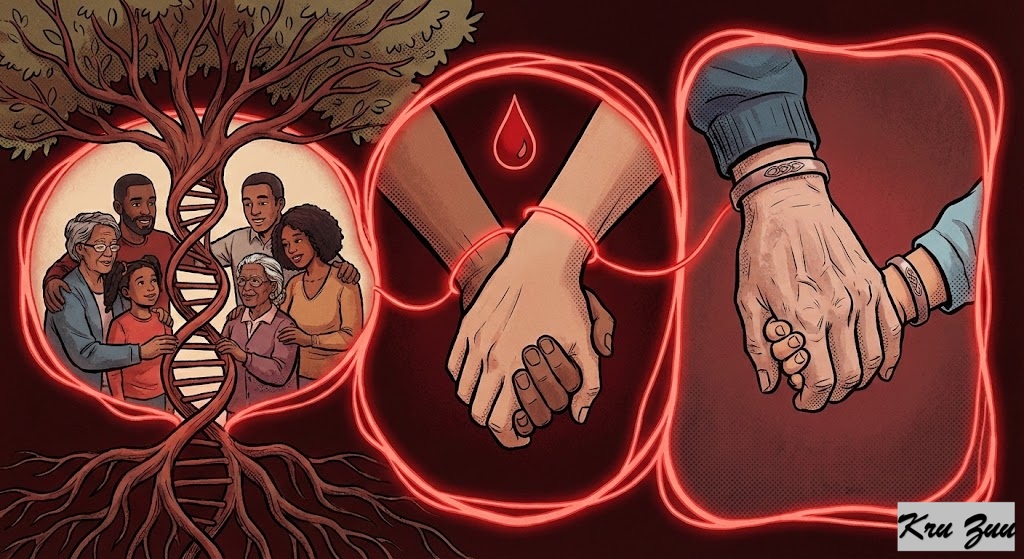
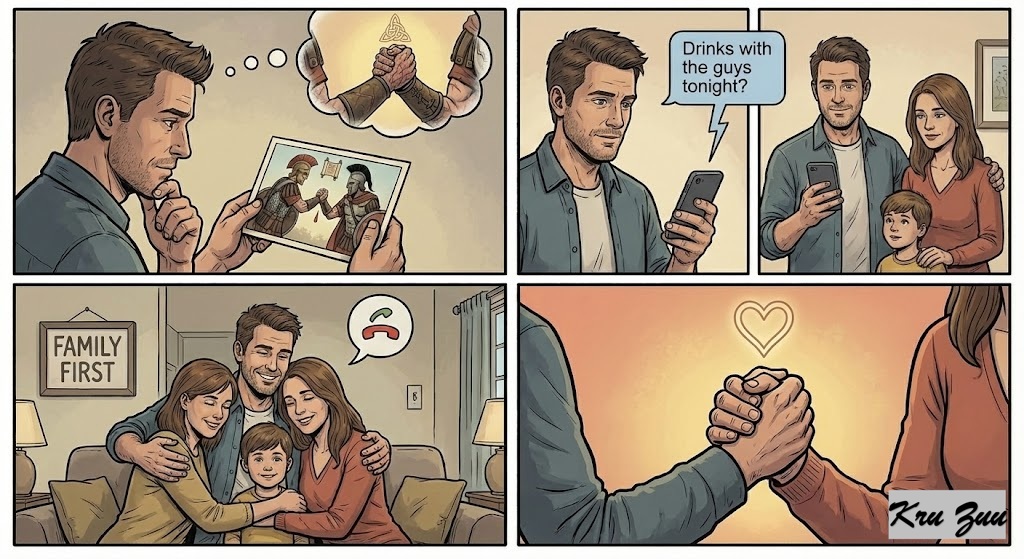
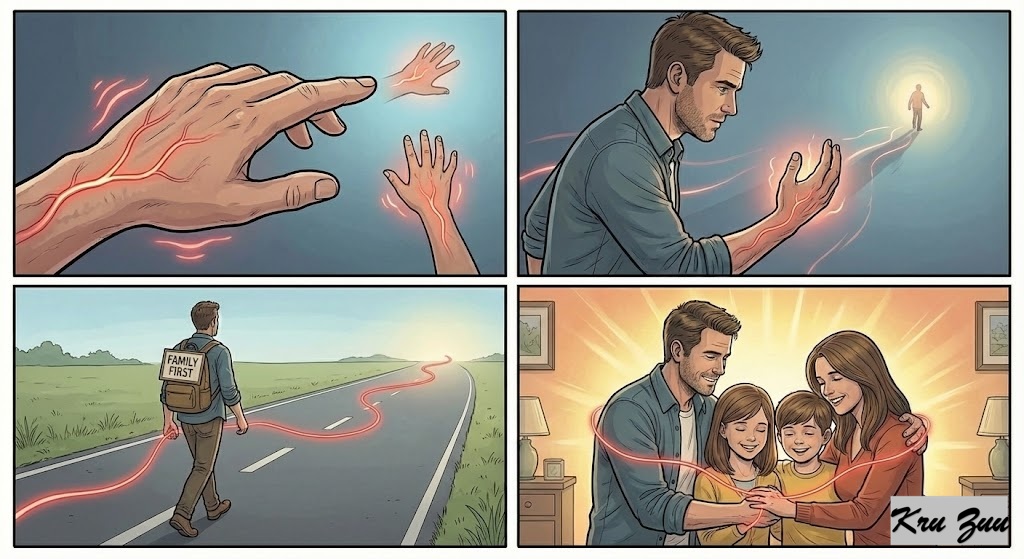
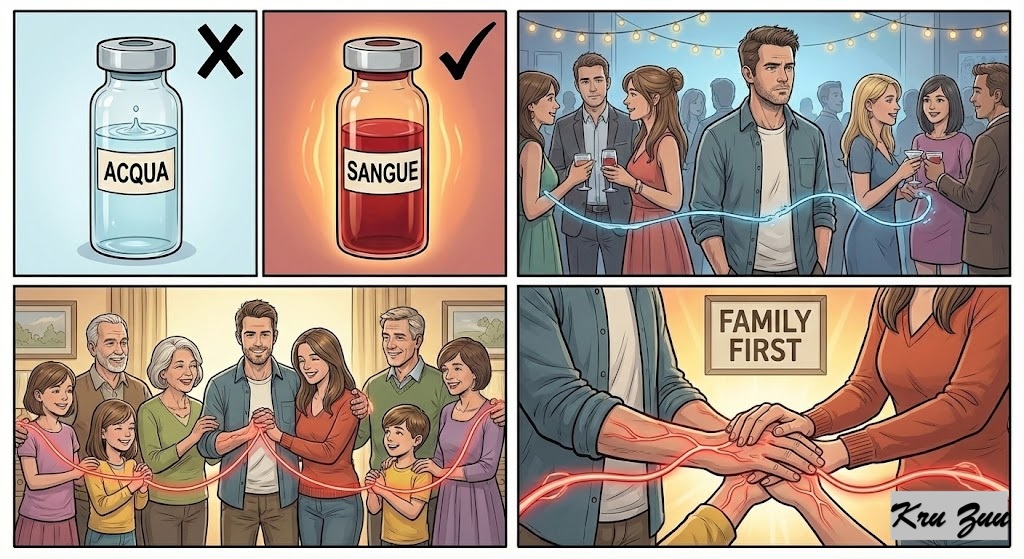
    “Blood is thicker than water.”


    😈 The Villain (The Fair-Weather Friend)


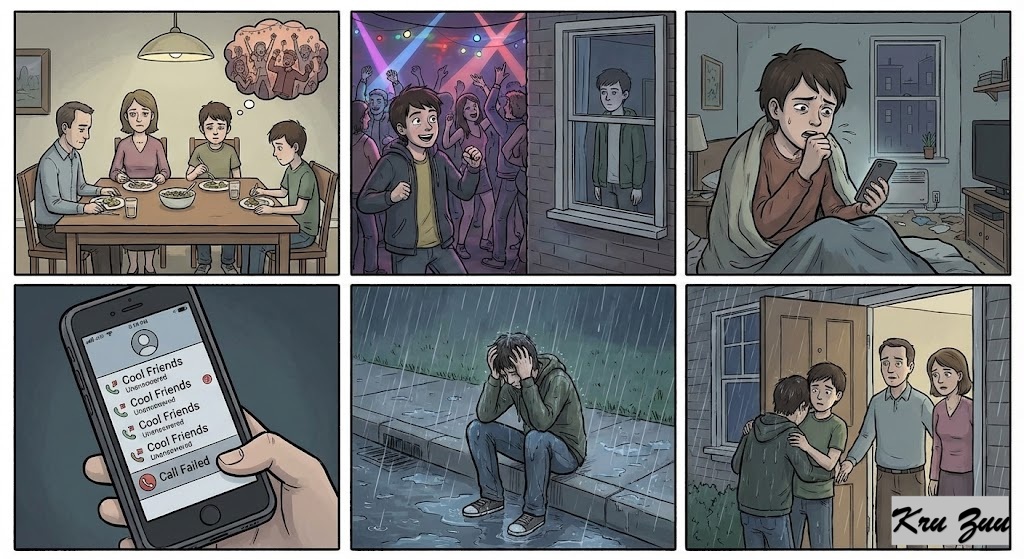
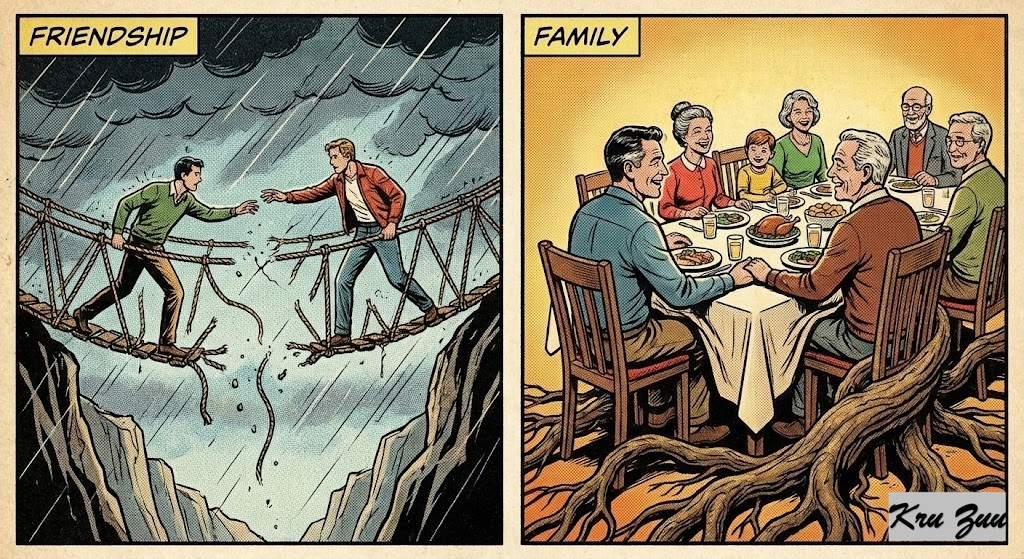
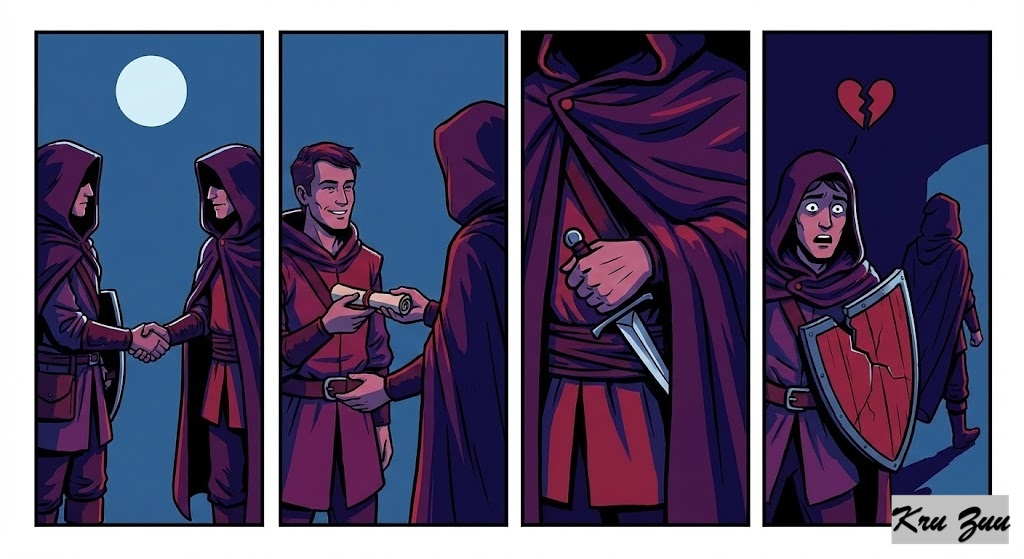
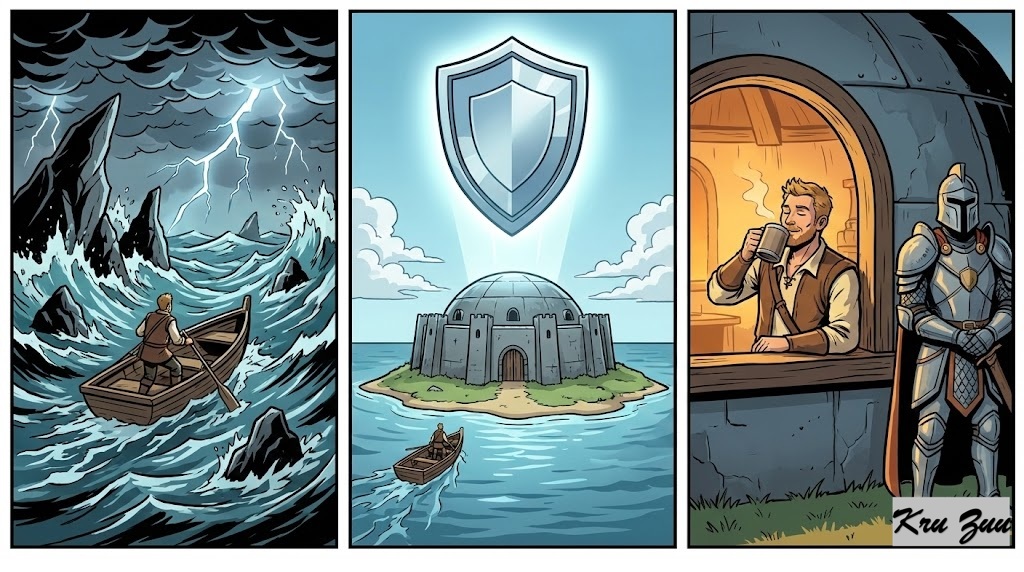
    You have a family dinner planned, but a new friend invites you to a cool party. You think, “My family is boring. I see them every day.” You ditch your brother to hang out with people who don’t even know your middle name. When you lose your job or get sick, you call those “cool friends.” No answer. They are busy. You are left alone in the rain. You chased the “water” and ignored the “blood.” 🌧️


    😇 The Hero (The Loyal Guardian)


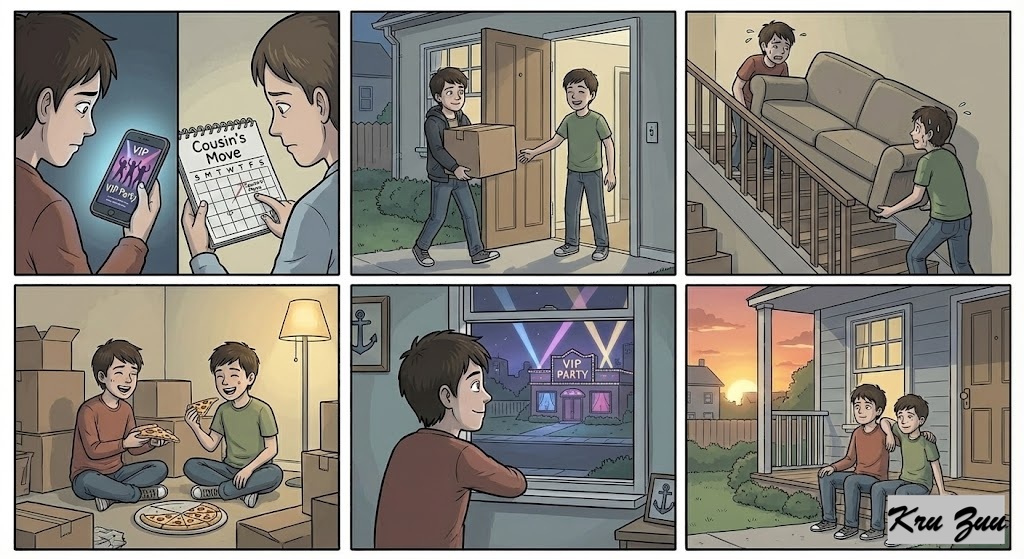
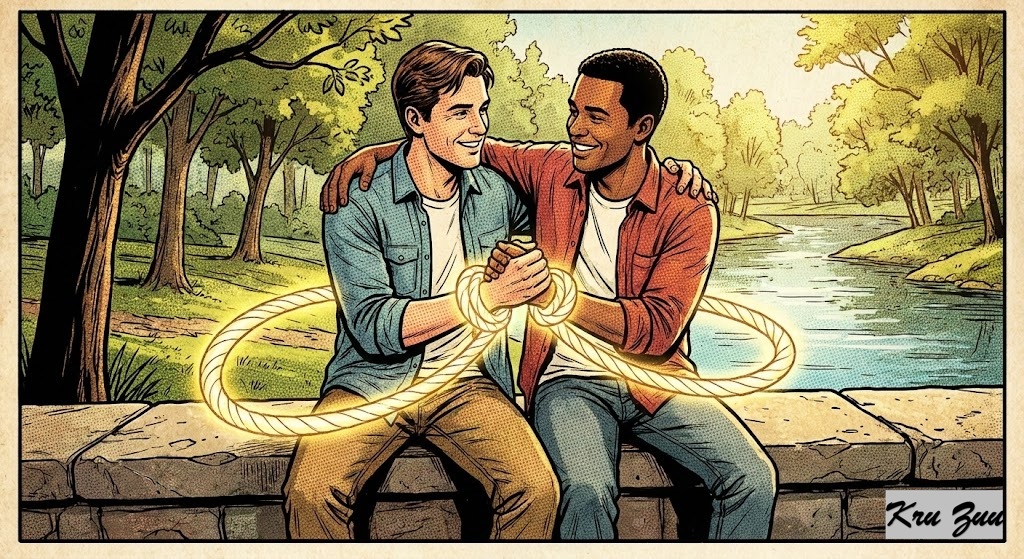
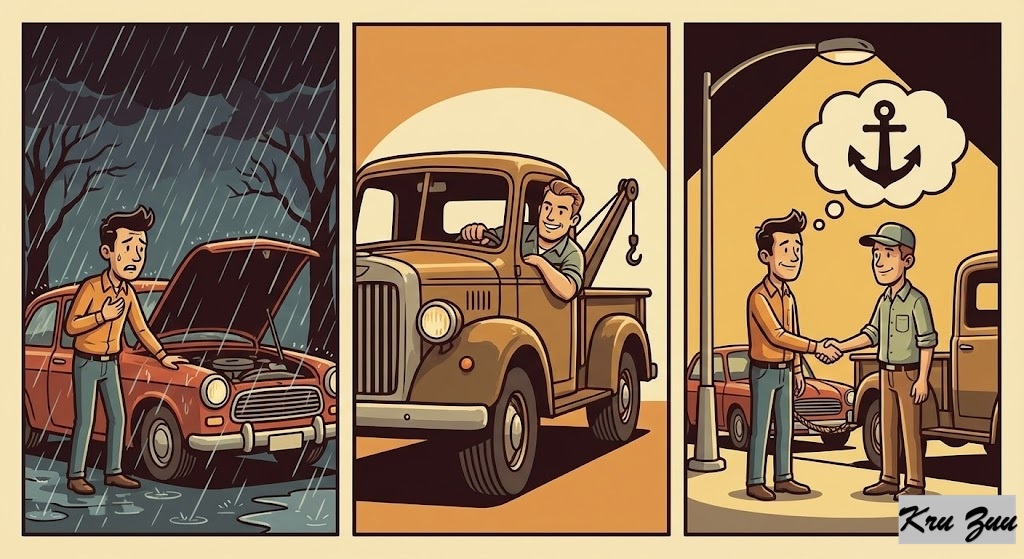
    You have a choice: A flashy event with strangers or helping your cousin move into a new house. It’s hard work. It’s not “fun.” But you choose family. You realize that friends may come and go like tides, but family (or the people who are like family) is the anchor.

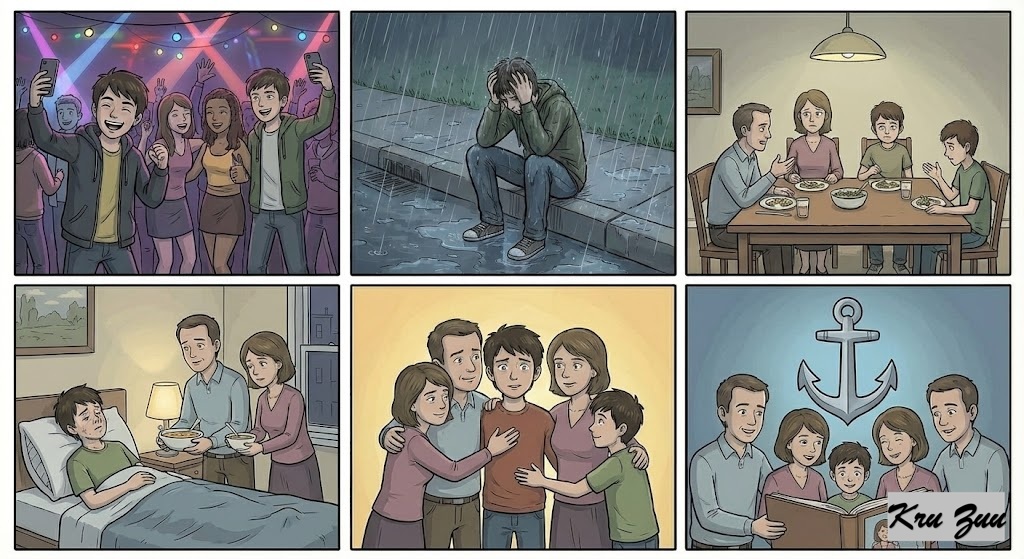
    The Result? When your world falls apart, you have an army behind you. You are never truly alone. ⚔️


    ⚖️ The Reality


    Popularity is temporary. Loyalty is permanent. We often treat strangers better than our own family because we try to impress them. We treat our family poorly because we think, “They will forgive me anyway.” This is a dangerous trap.

    💎 The Secret

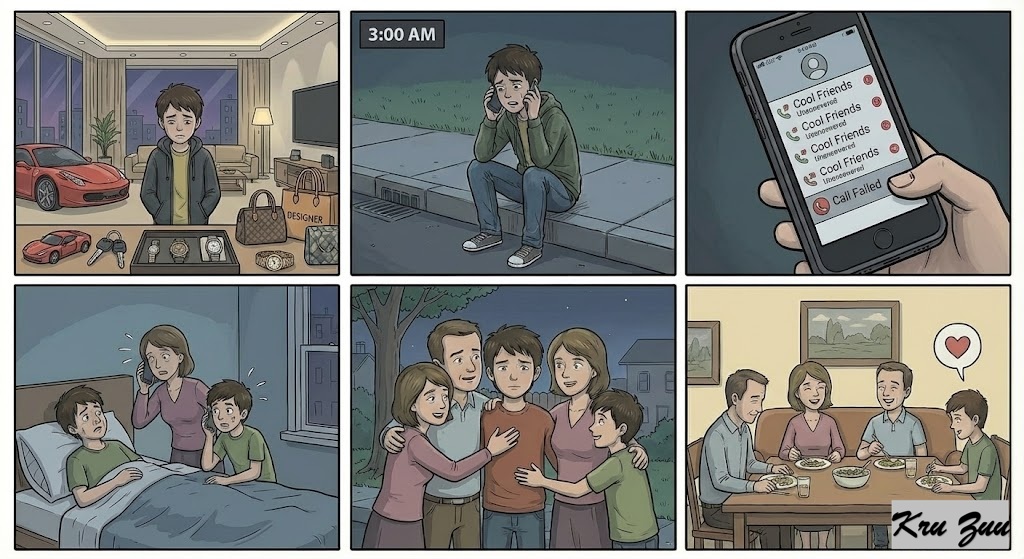
    Real wealth is not money; it is knowing exactly who will pick up the phone at 3:00 AM when you are in trouble.

    🧐 The Anatomy of the Proverb


    This is the ultimate rule of relationships.


    Blood (Noun): Represents family ties, genetics, and deep, unbreakable bonds. 🩸


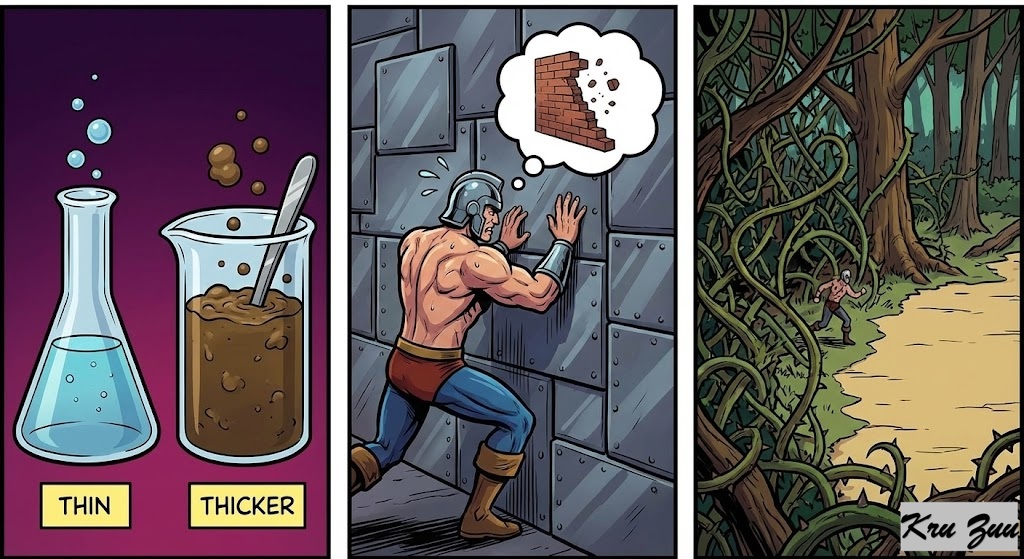
    Thicker (Comparative Adjective): More dense; stronger; harder to pass through.


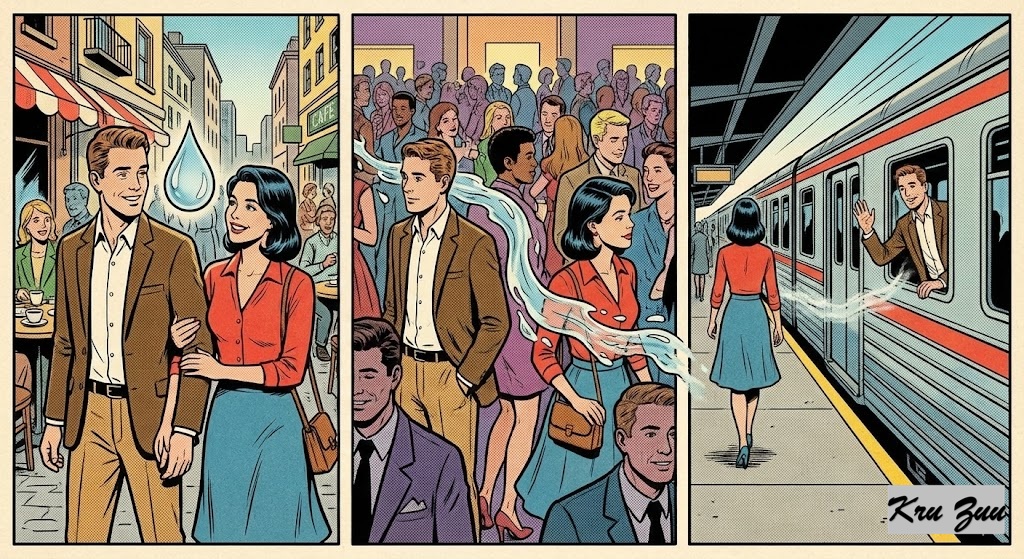
    Water (Noun): Represents weak, temporary, or fluid relationships (acquaintances, casual friends). 💧


    Simpler Version:
    Family relationships are stronger than friendships.


    📚 Vocabulary Vault


    Bond (Noun): A strong connection between two people. (Example: The bond between brothers.)


    Loyalty (Noun): A strong feeling of support or allegiance.


    Kinship (Noun): Blood relationship; sharing the same origin.


    Betrayal (Noun): The action of breaking trust. (The opposite of loyalty). 💔


    Dependable (Adjective): Trustworthy and reliable.


    🧠 Grammar Focus: Comparative Adjectives


    This proverb uses the Comparative Form to measure the strength of relationships.


    Rule: Short adjectives + -er + than.


    Thick ➡️ Thicker than
    Strong ➡️ Stronger than
    Deep ➡️ Deeper than


    Example in context:
    “His love for his family is stronger than his love for money.”

    📜 History: Origin and Spread


    Where did this come from?


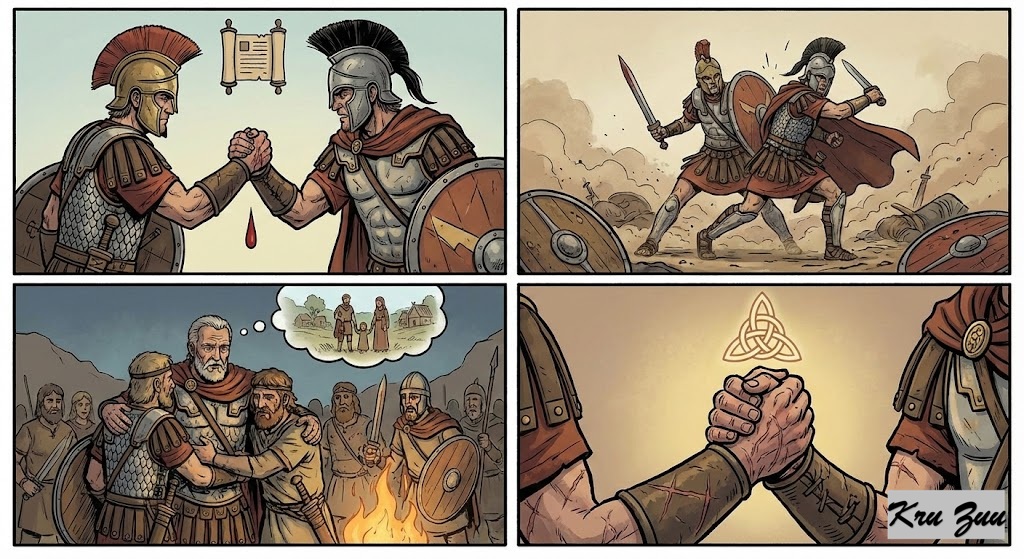
    The Twist: Originally, some historians believe the phrase was “The blood of the covenant is thicker than the water of the womb.” This meant that soldiers who bled together in battle (covenant) were closer than brothers by birth!


    Modern Meaning: Over centuries, the meaning flipped. Today, it strictly means Family comes first.


    Global Cousins


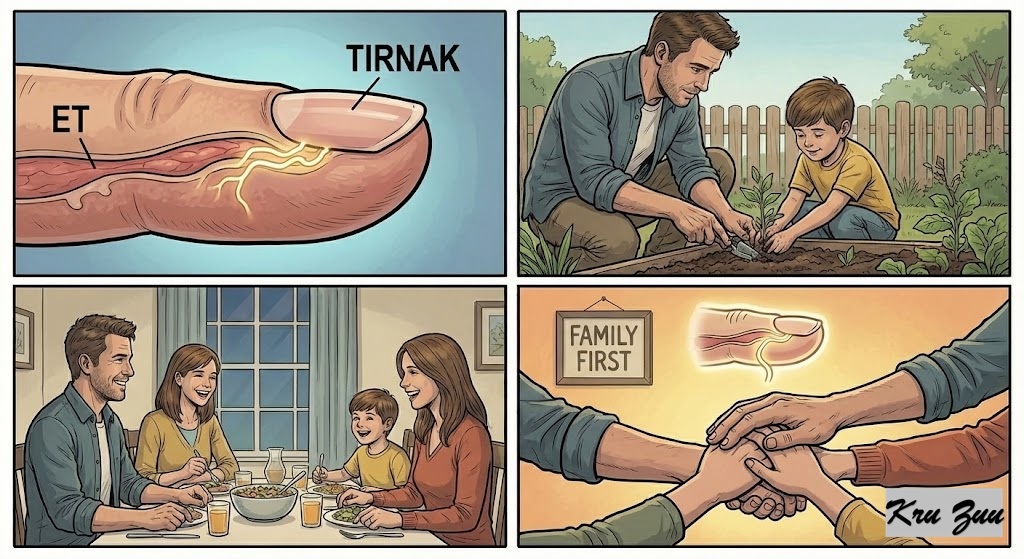
    🇹🇷 Turkish: “Et tırnaktan ayrılmaz.” (Flesh cannot be separated from the fingernail.) — A perfect biological metaphor!


    🇪🇸 Spanish: “La sangre tira.” (The blood pulls/calls.)


    🇮🇹 Italian: “Il sangue non è acqua.” (Blood is not water.)

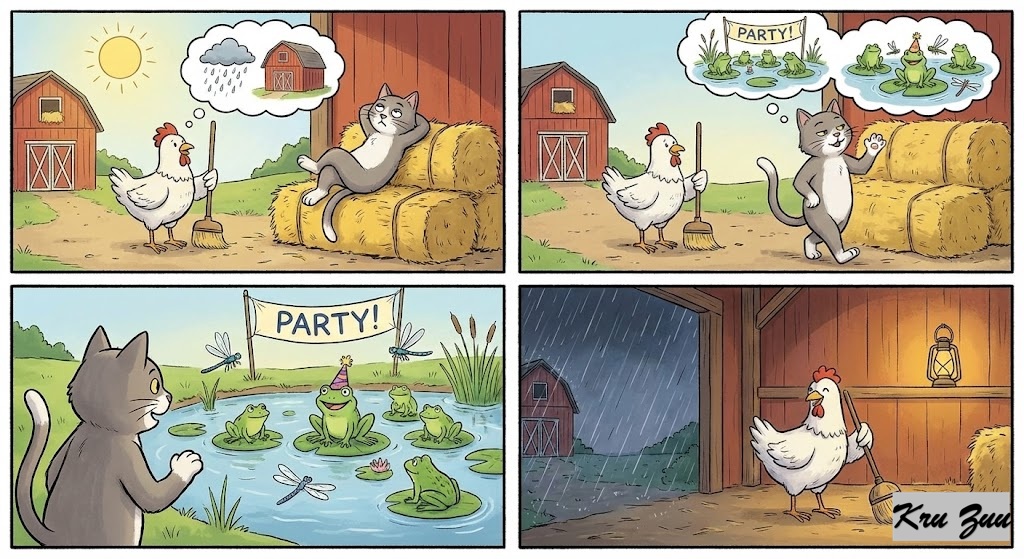
    🎭 Short Story: The Pond, The Barn, and The Storm


    Let’s meet our unlikely trio to see this law in action.


    🐱 The Character: Whiskers (The Cat) – Cool, independent, and easily bored.

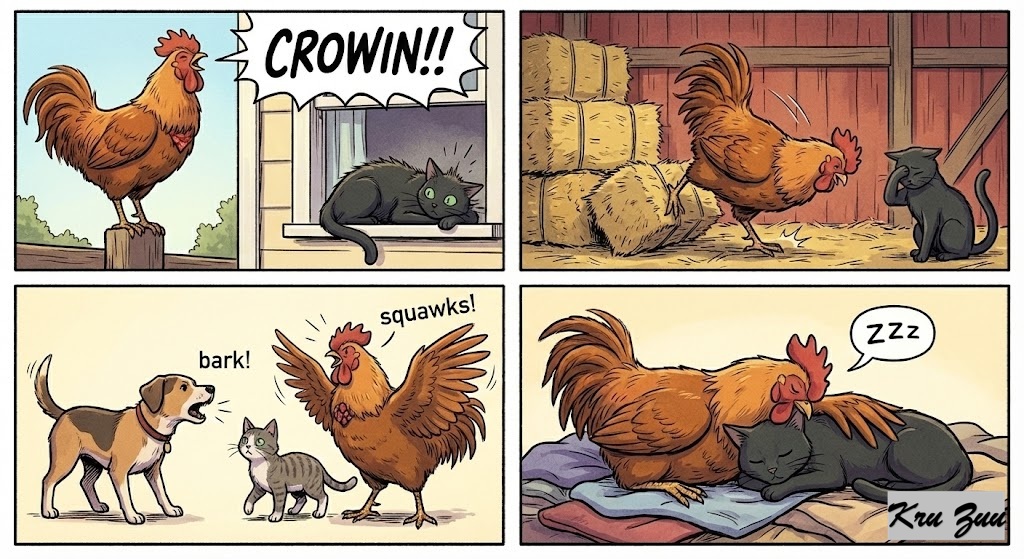
    🐔 The Character: Peck (The Chicken) – Whiskers’ adopted brother. Loud, clumsy, but loyal.

    🐸 The Character: Hop (The Frog) – The new, popular guy at the pond. Fun but slippery.


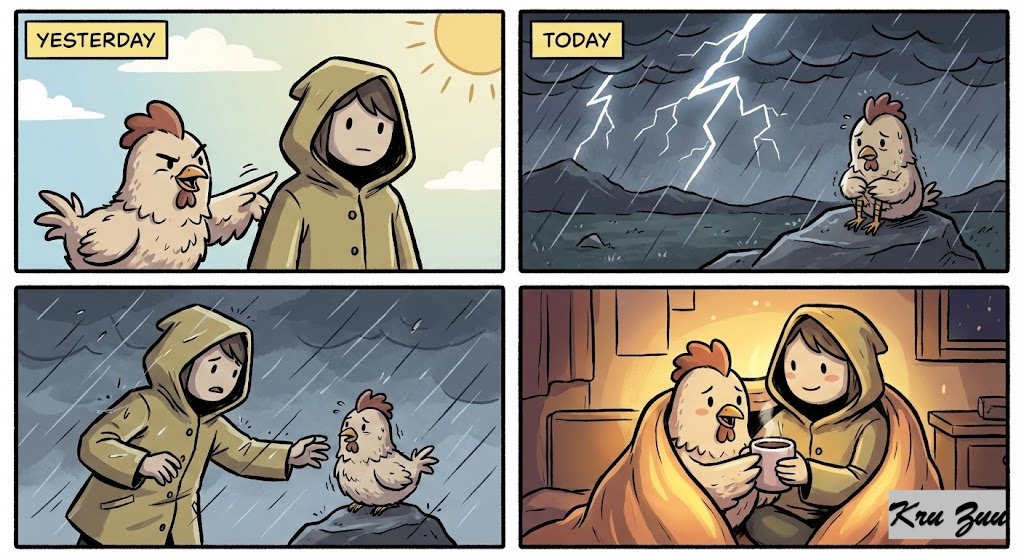
    🌟 The Setup: It is a sunny afternoon. Peck the Chicken says, “Hey Whiskers! Let’s clean the barn together. It’s going to rain later.” Whiskers rolls his eyes. “Cleaning? Boring! Hop the Frog invited me to the Lily Pad Party at the pond. Catch you later, feather-brain!”


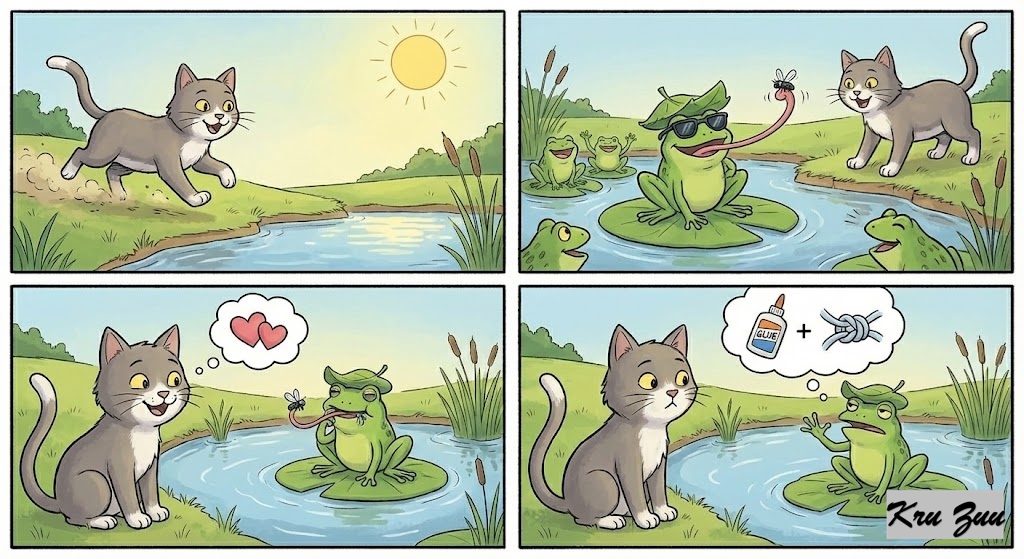
    The Conflict: Whiskers runs to the pond. Hop is there, telling jokes, catching flies, looking cool. “You are my best friend, Hop!” Whiskers says. “Sure, sure,” says Hop. “We are tight like glue!”


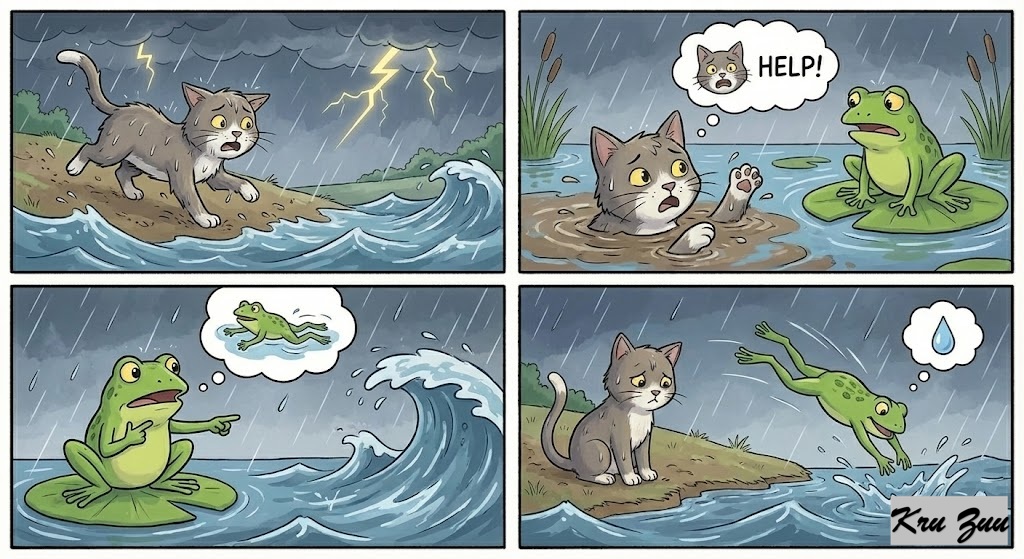
    The Climax: Suddenly, the sky turns black. Thunder shakes the ground. A massive storm hits. The water in the pond rises fast. Whiskers hates water. He slips into the mud. “Help! Hop, help me!” Hop looks at Whiskers, then looks at the dangerous water. “Sorry, cat! I’m an amphibian, I gotta save myself!” Hop splashes away, disappearing into the deep water. Water washes away easily.


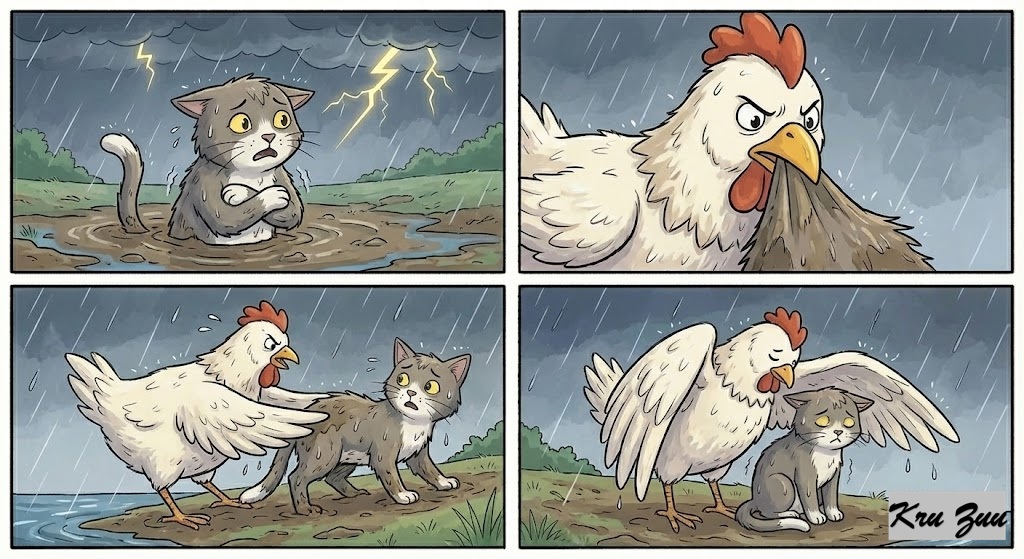
    Whiskers is stuck. He is wet, shivering, and scared. Suddenly, he feels a beak grabbing his collar. It’s Peck. Peck hates the rain too, but he ran all the way from the safe barn. He drags Whiskers out of the mud, covering him with his wings to block the rain.


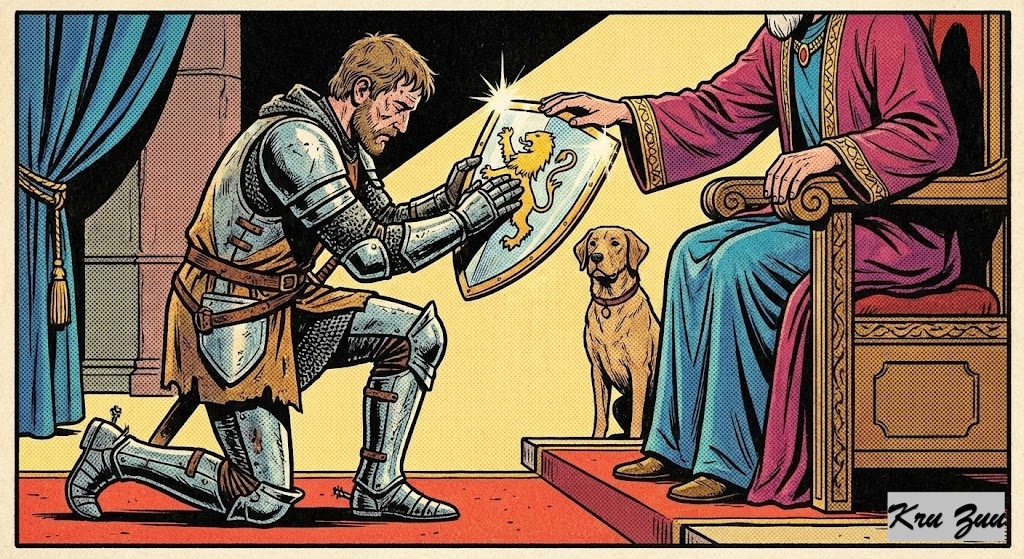
    The Resolution: Safe in the barn, Whiskers dries off. “Why did you come?” Whiskers asks. “I left you alone to clean.” Peck clucks softly. “Hop is a pond creature. He flows where the water goes. We live in the same barn. We are family. And blood is thicker than water.”

    🎓 Lesson for English Learners


    Context Matters.


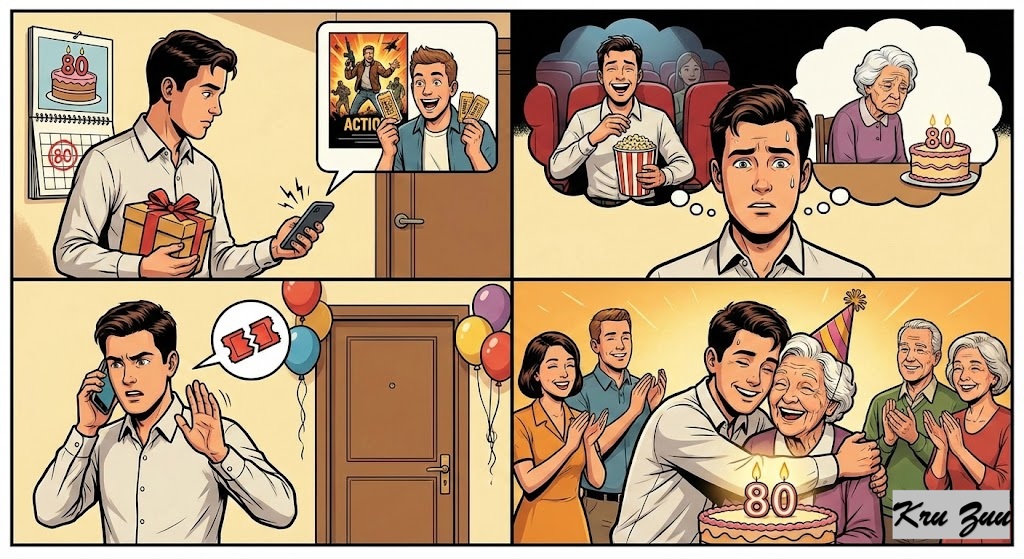
    Situation: Your friend asks you to skip your grandmother’s 80th birthday party to go to the cinema.


    You Say: “I can’t go. It’s my grandma’s big day, and you know what they say: Blood is thicker than water.


    Warning: Do not use this to excuse toxic behavior. It explains loyalty, but it shouldn’t justify bad actions!


    💬 Your Turn: The Loyalty Test 🚀


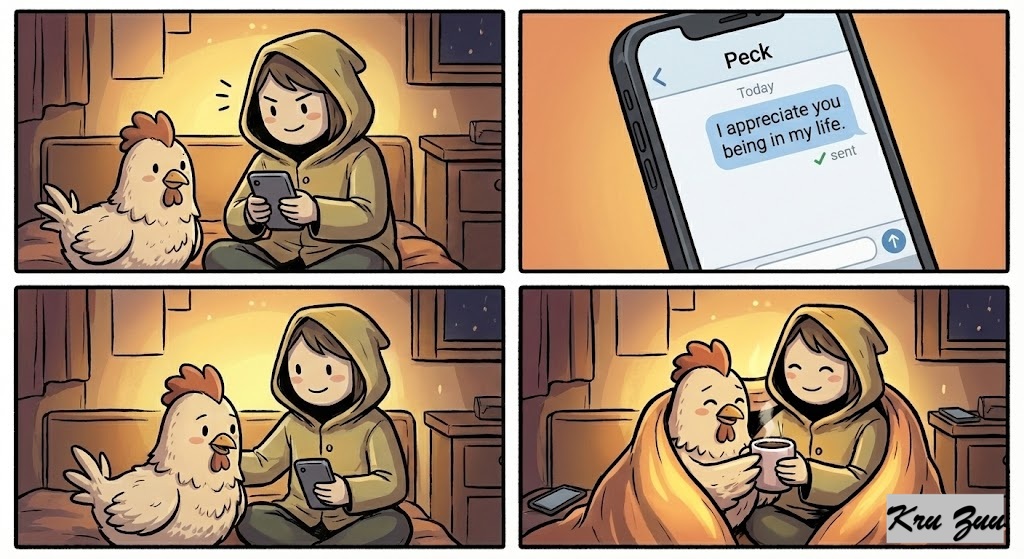
    Think about the “Peck” (The Chicken) in your life. Who is the person that would come to save you in a storm, even if you were annoying yesterday?


    The Challenge:
    Send that person a message right now. Just say: “I appreciate you being in my life.” (It takes 10 seconds. Do it!)


    Question: Have you ever had a “Frog” friend who disappeared when things got hard? Tell us in the comments! 👇


    By Zubeyir YURTKURAN

    https://www.facebook.com/BrainBattleground/

    https://www.facebook.com/zubeyr.yurtkuran/

    https://www.instagram.com/zubeyryurtkuran/
    https://www.youtube.com/@BrainBattleground-b3p

    https://www.instagram.com/brainbattleground/

  • 🛡️ The Daily Shield: The Law of Precaution

    🛡️ The Daily Shield: The Law of Precaution

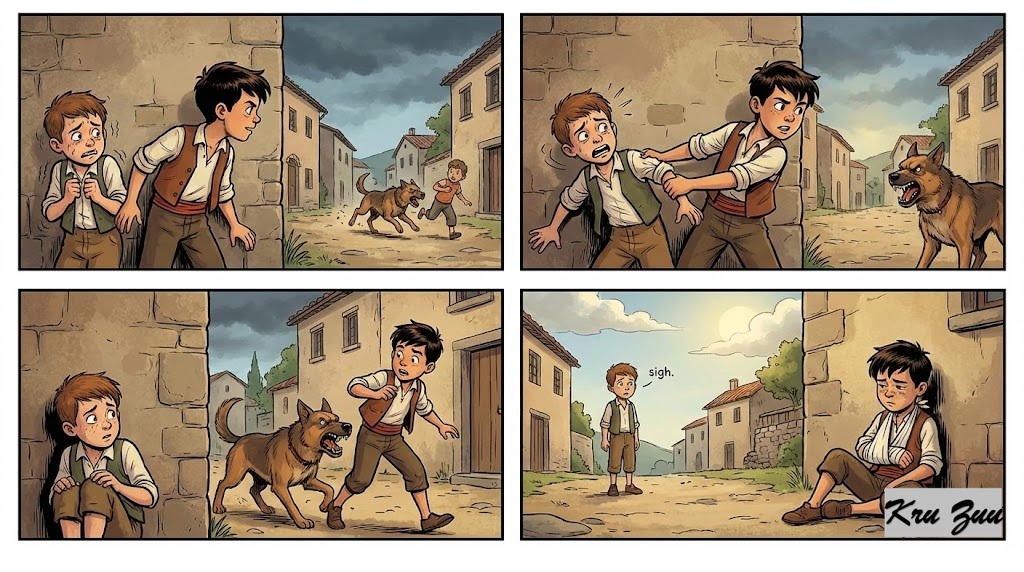
    “Better safe than sorry.”


    😈 The Villain (The Gambler)


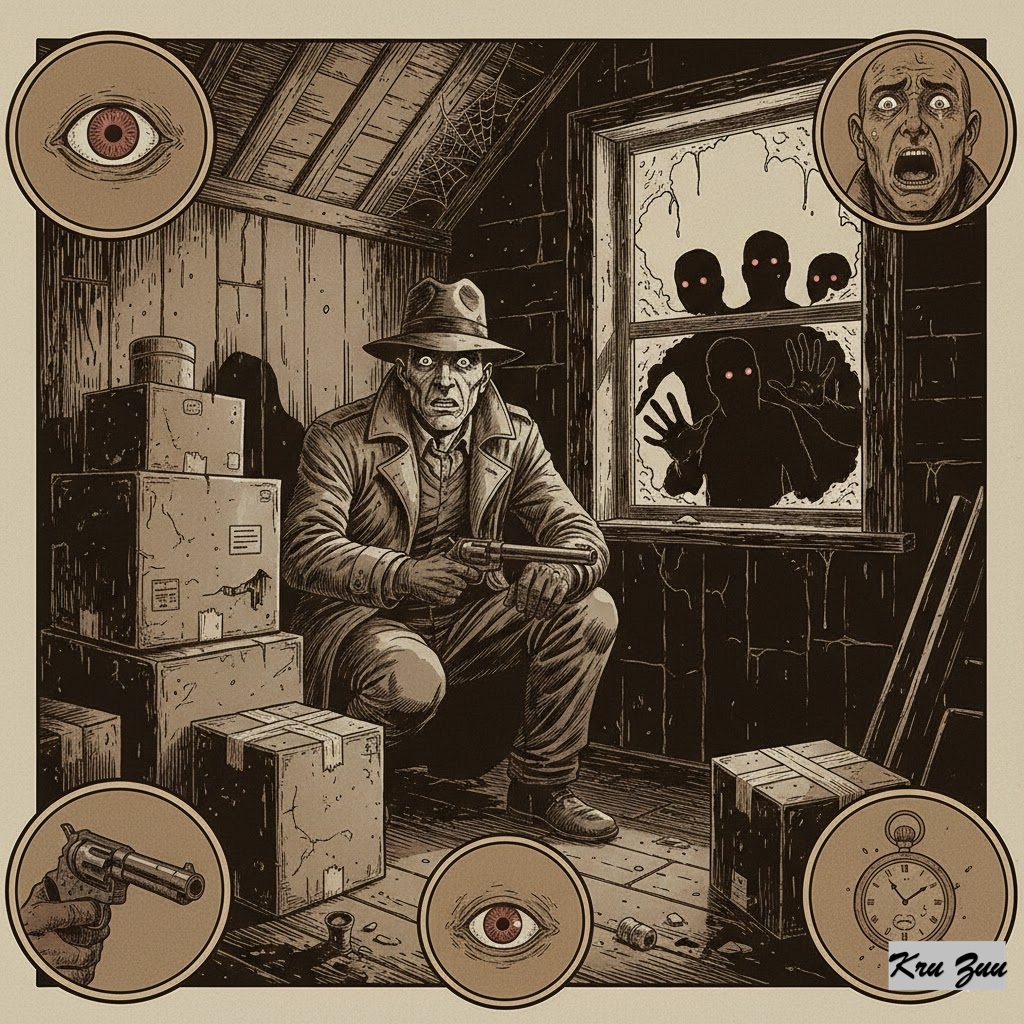
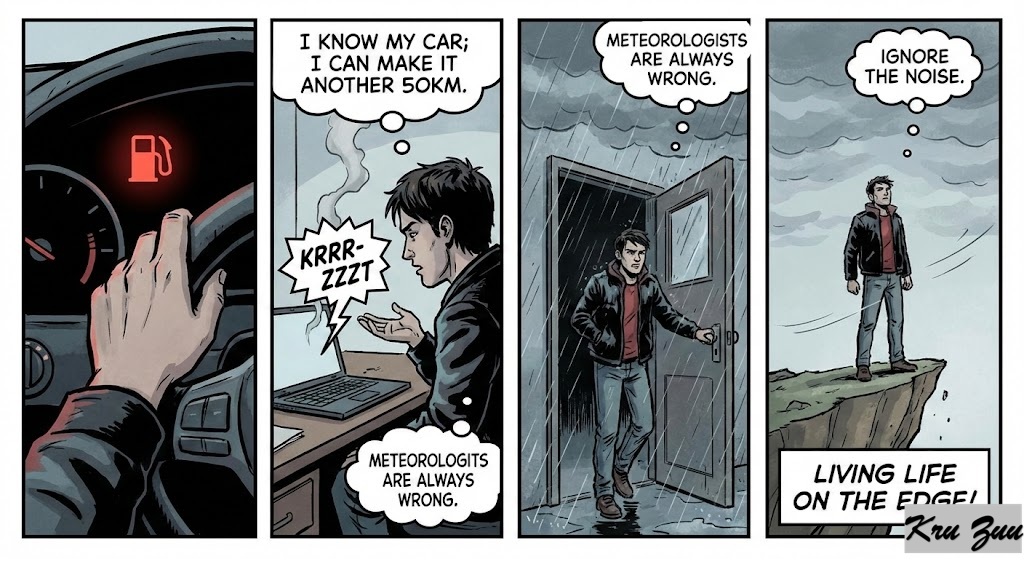
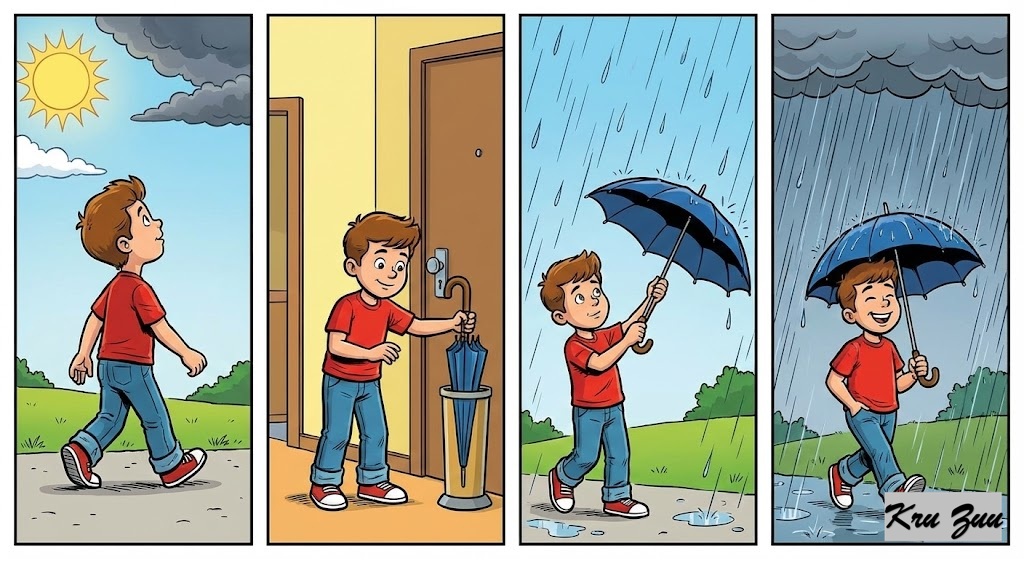
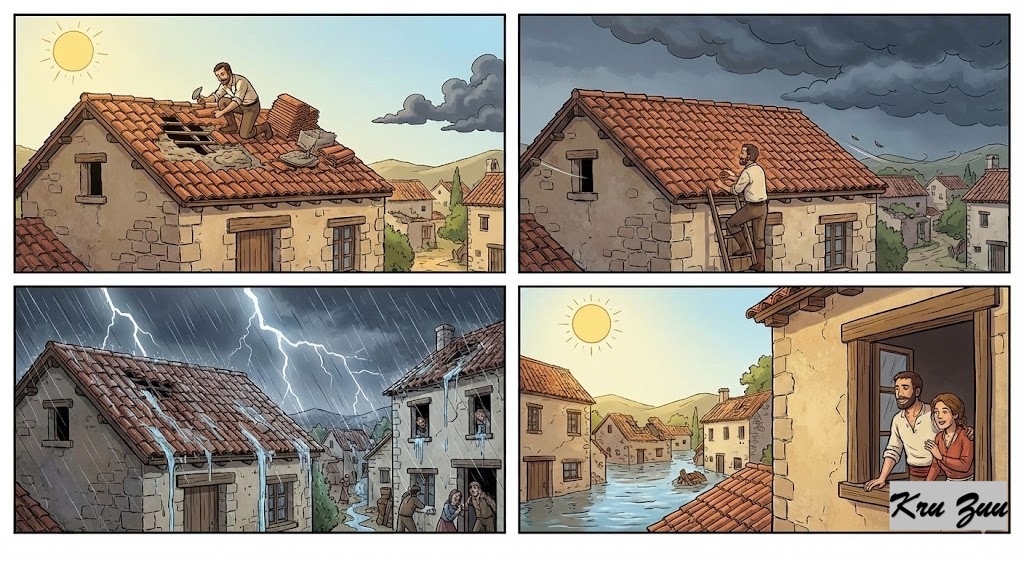
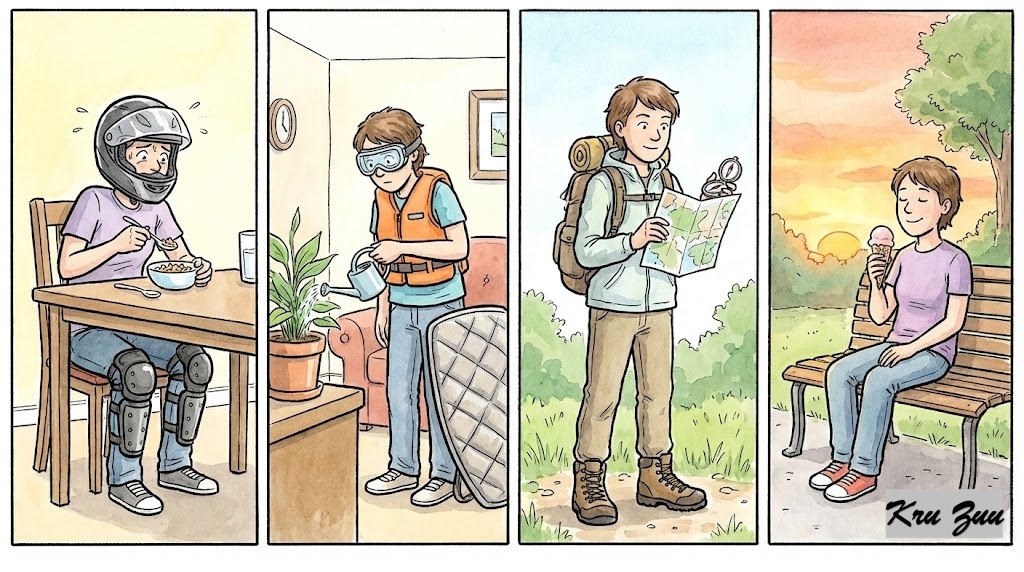
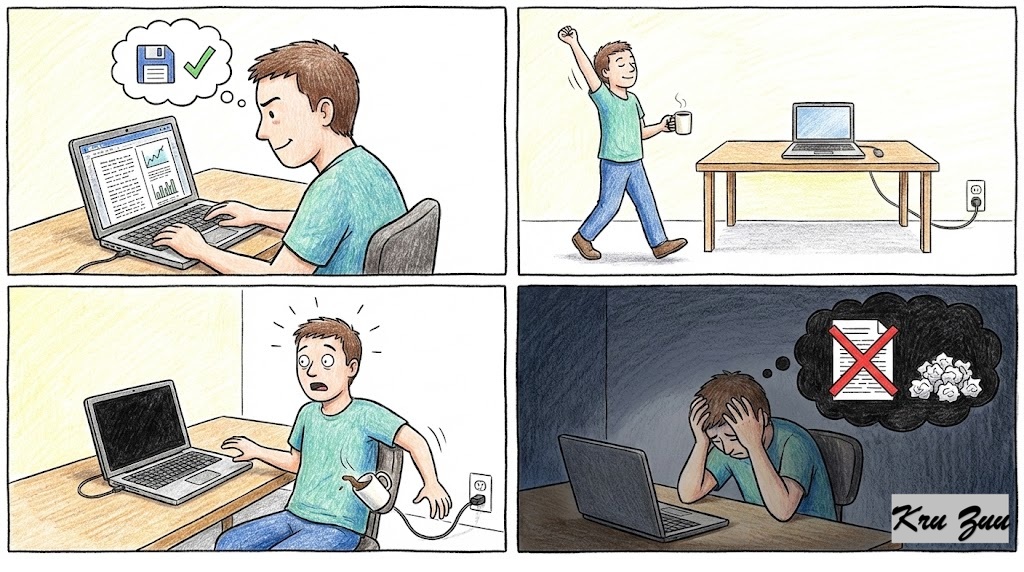
    You are driving, and the fuel light turns on. You say, “I know my car; I can make it another 50km.” You ignore the strange noise your laptop is making. You walk out into a grey sky without an umbrella because “Meteorologists are always wrong.” You live life on the edge.

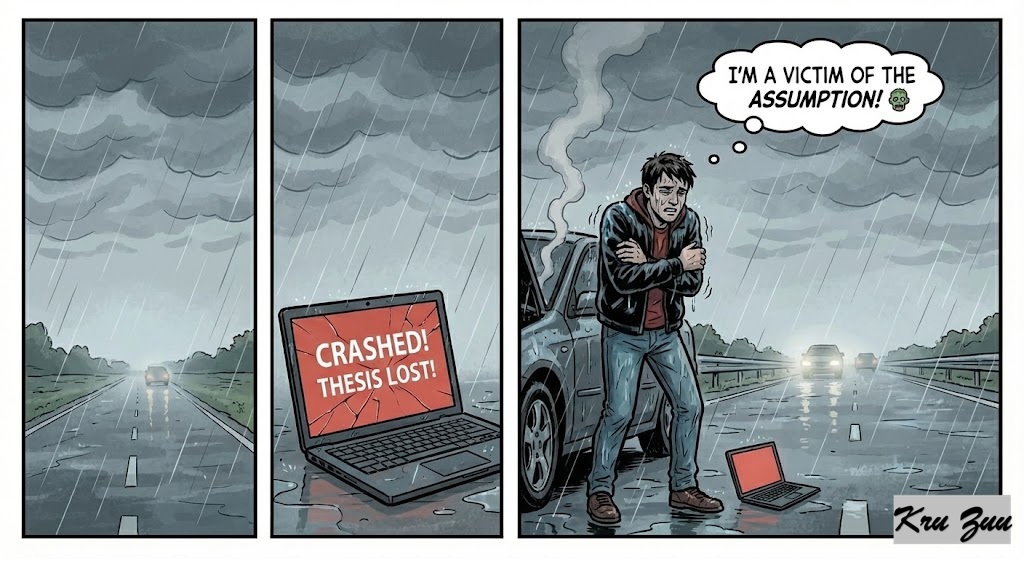
    The Result? You are stranded on the side of the highway in the rain. Your hard drive crashes, and you lose your thesis. You are soaked, cold, and miserable. You are a victim of The Assumption. 🧟‍♂️


    😇 The Hero (The Guardian)


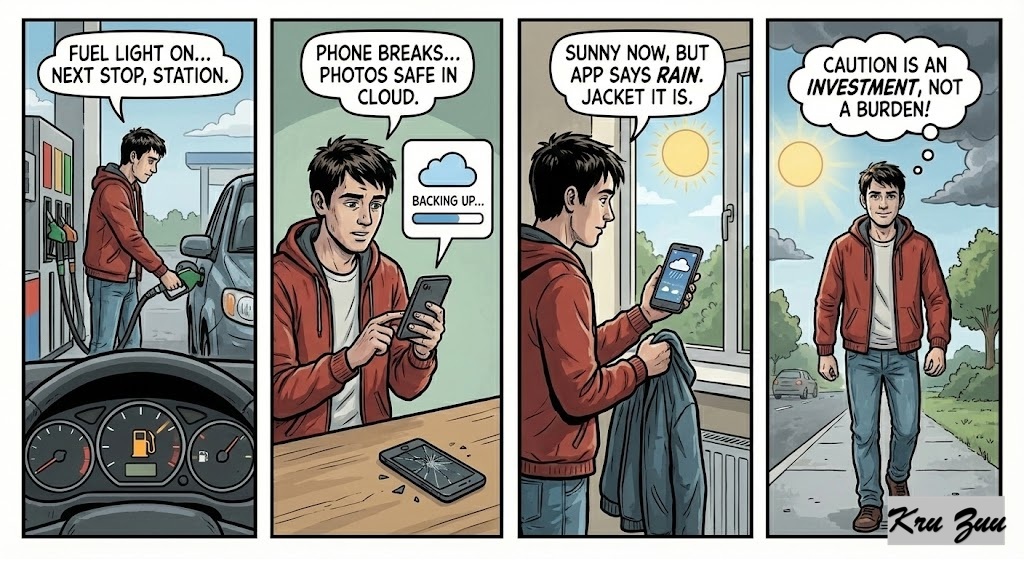
    You see the fuel light, and you stop at the next station. You backup your photos to the cloud before your phone breaks. You check the weather app and grab a jacket, even if it looks sunny now. You treat “Caution” as an investment, not a burden.

    The Result? When disaster strikes, you are untouched. You sleep soundly because you are prepared. You don’t rely on luck; you rely on Strategy. 🛡️


    ⚖️ The Reality


    “Optimism” is dangerous without a plan. We all think, “It won’t happen to me.” That is the brain’s favorite lie. Accidents, storms, and crashes don’t make appointments. They just show up.

    💎 The Secret

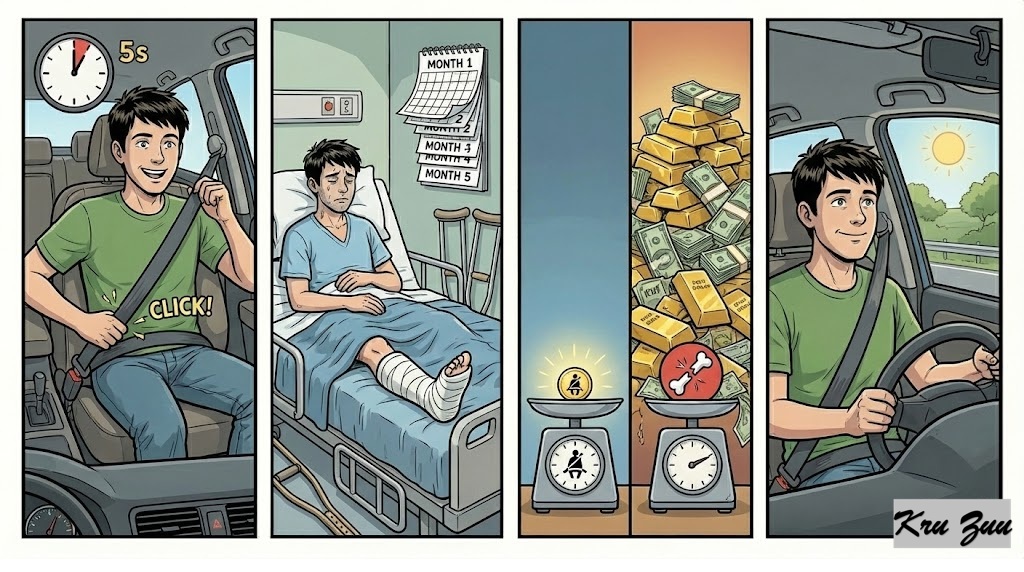
    It takes 5 seconds to fasten a seatbelt. It takes 5 months to recover from an injury. The “cost” of being safe is tiny. The “cost” of being sorry is enormous.

    🧐 The Anatomy of the Proverb


    This is the Golden Rule of Risk Management.


    Better (Adjective – Comparative): More desirable; superior.


    Safe (Adjective): Protected from or not exposed to danger or risk. 🛡️


    Sorry (Adjective):
    Feeling distress, typically through sympathy with someone else’s misfortune or regret. 😢


    Simpler Version: Be careful now so you don’t cry later.


    📚 Vocabulary Vault


    Precaution (Noun): A measure taken in advance to prevent something dangerous. (Example: Buying travel insurance is a smart precaution.)


    Inevitable (Adjective): Certain to happen; unavoidable.


    Hindsight (Noun): Understanding a situation only after it has happened.


    Prudent (Adjective): Acting with or showing care and thought for the future. 🧠


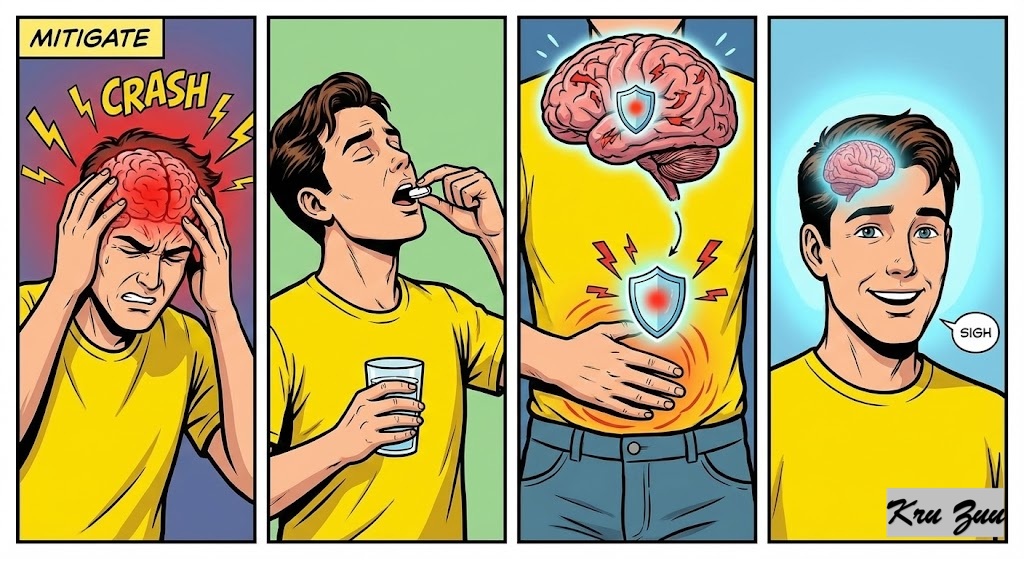
    Mitigate (Verb): Make less severe, serious, or painful.


    🧠 Grammar Focus: Comparative Adjectives & Ellipsis


    This proverb is a masterclass in shortening sentences (Ellipsis).


    The Full Sentence:“It is better to be safe than it is to be sorry.”


    The Grammar Rule: When comparing two states, we use [Adjective] + -er or More + [Adjective].


    Good → Better
    Bad → Worse


    Examples:
    “Better late than never.”
    “Sooner or later.”

    📜 History: Origin and Spread


    This isn’t just English; it’s universal human survival instinct.


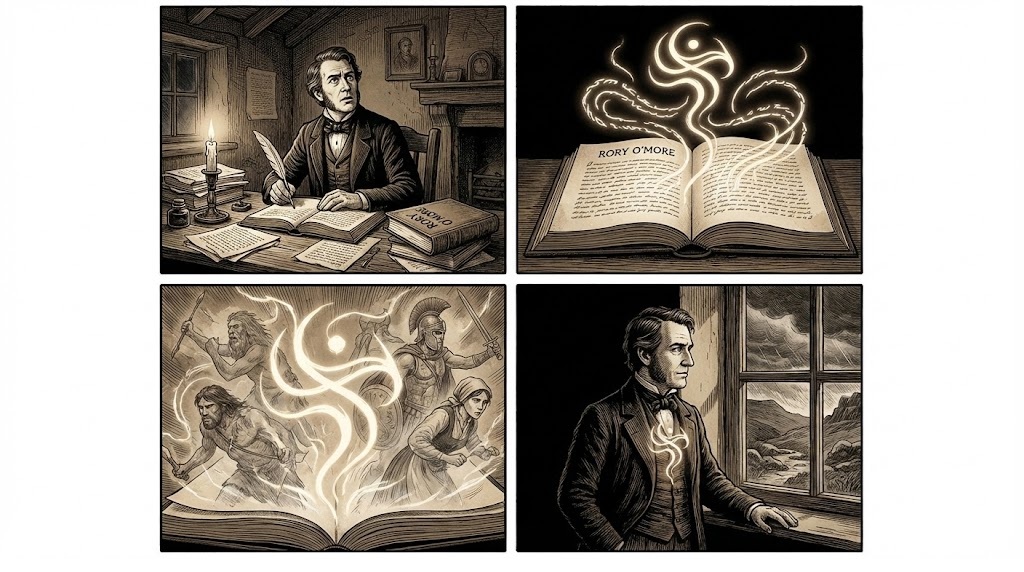
    The Origin: While the concept is ancient, this specific phrasing appeared in the Irish novel Rory O’More in 1837.


    Global Cousins


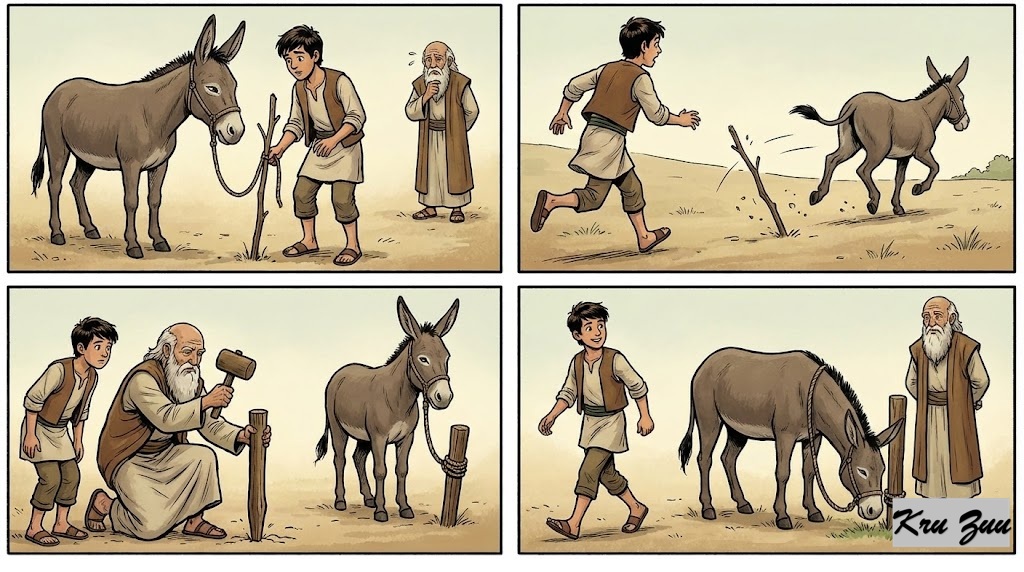
    🇹🇷 Turkish:“Eşeğini sağlam kazığa bağla.” (Tie your donkey to a sturdy stake.) — Don’t trust the donkey to stay; trust the rope!


    🇪🇸 Spanish:“Mas vale prevenir que curar.” (It is better to prevent than to cure.)


    🇮🇹 Italian:“Meglio aver paura che buscarne.” (Better to be afraid than to get hurt.)

    🎯 Impact on Life: The Pros & Cons


    ✅ The Pros (The Confidence)


    Peace of Mind:
    Anxiety comes from the unknown. Preparation kills anxiety.


    Control: When you are safe, you control the situation, instead of the situation controlling you.


    ❌ The Cons (The Paranoia)


    Overthinking:
    Don’t wear a helmet to eat dinner. There is a fine line between “Safety” and “Fear.” Be prepared, not scared.

    🎭 Short Story: The Storm and the Shelter


    Let’s visit our animal friends to see this law in action.


    🌟 The Setup: The weather forecast predicts a massive storm tonight.


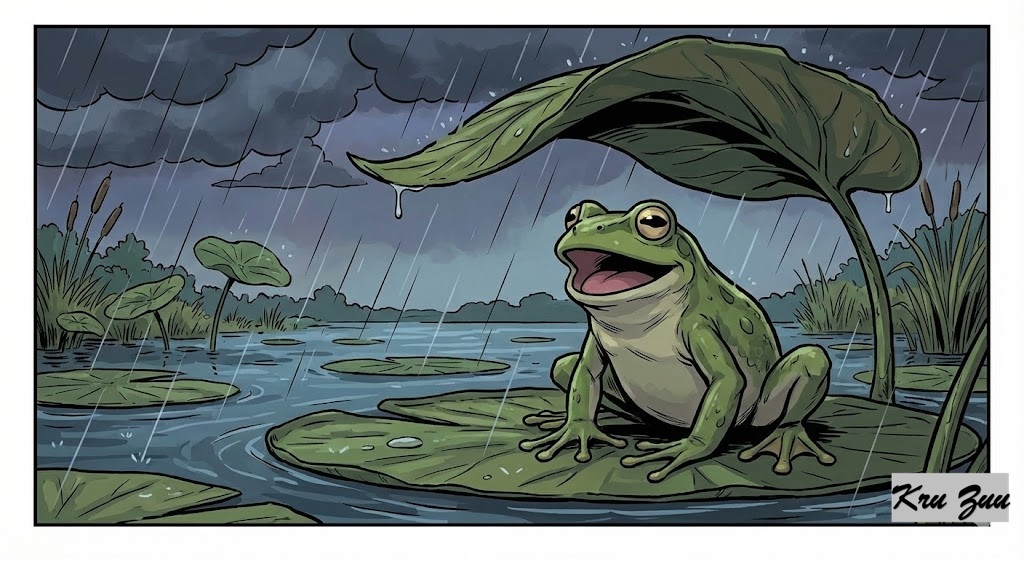
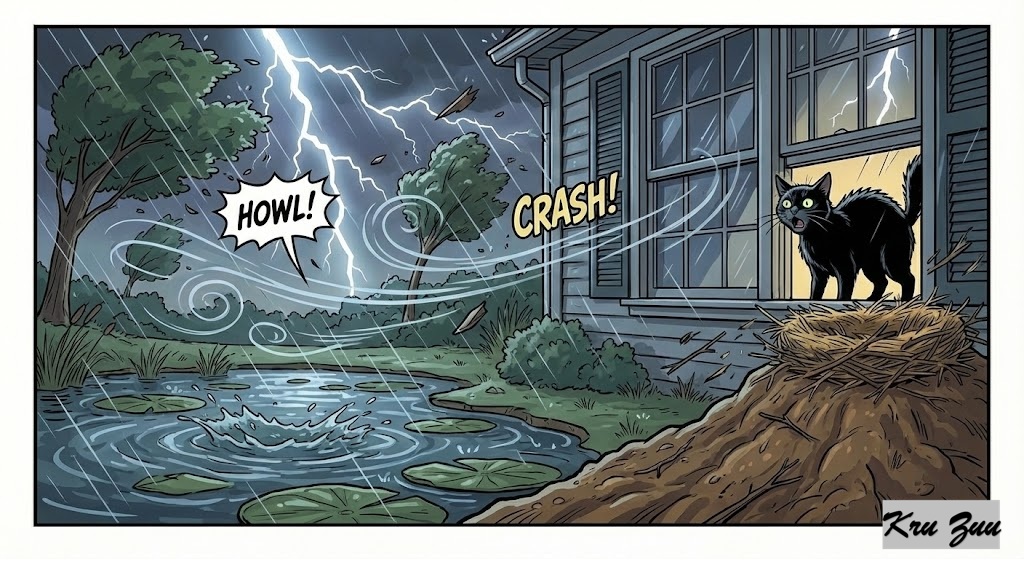
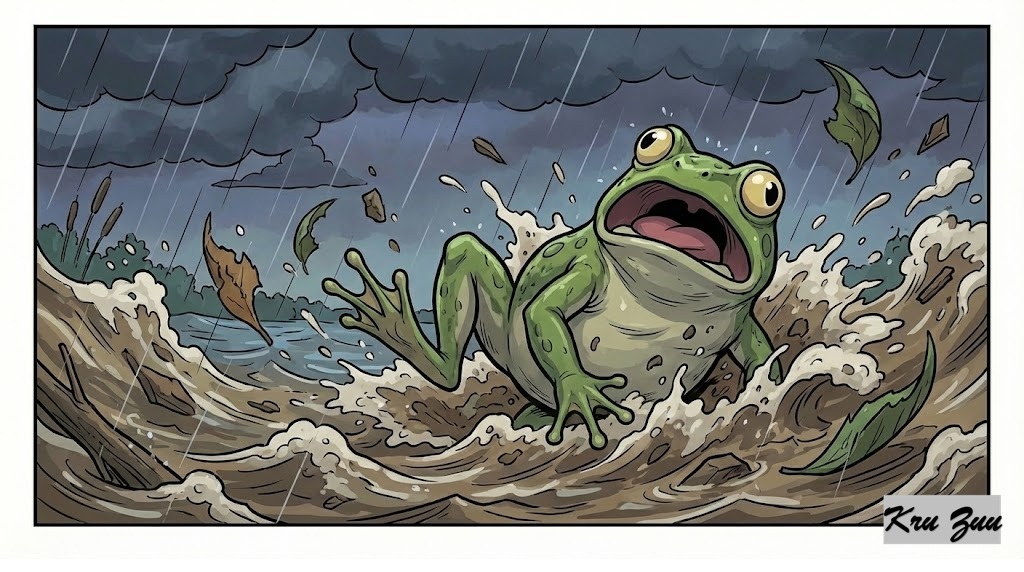
    🐸 The Frog (The Risk-Taker): The Frog is sharp and fast. He laughs. “A storm? I live in nature! I can jump away from danger. I don’t need to reinforce my lily pad. I’ll just hide under a leaf when the rain starts. I have plenty of time.” The Frog chooses “Later.”


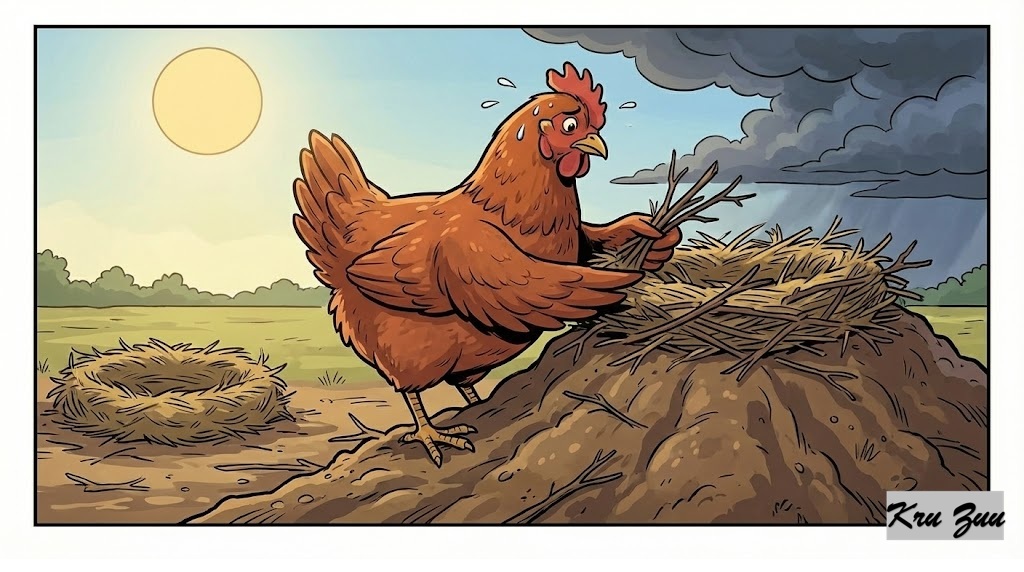
    🐔 The Chicken (The Cautious One): The Chicken is rusty but comfortable. She is worried. “My feathers cannot get wet,” she clucks. She spends the whole afternoon moving her nest to high ground. She reinforces the walls with extra twigs. She works hard while the sun is still shining. The Chicken chooses “Now.”


    🐱 The Cat (The Observer): The Cat watches them both from the window. “Meow,” implies the Cat. “The Frog is arrogant. The Chicken is prudent.”


    The Climax: Midnight comes. The storm is stronger than expected. The wind howls.


    The Frog: The wind blows his leaf away instantly. He is tossed around in the chaotic muddy water, cold and terrified. He wishes he had prepared a burrow. He is Sorry.


    The Chicken: She sits warm and dry in her reinforced nest on high ground, sipping corn tea. She sleeps peacefully. She is Safe.


    The Moral: You don’t prepare for the storm when the rain starts. You prepare when the sun is shining. Be the Chicken. 🐔

    🎓 Lesson for English Learners


    Don’t trust your memory.


    Situation: You learn a new word. You tell yourself, “I will remember this.”


    You Say: “No, that is the Frog talking. I will write it down. I will review it tomorrow. Better safe than sorry.”


    Situation: You have an exam in 3 days. You think you know the topics.


    You Say: “I will study for one hour today anyway. If the exam is hard, I will be ready. If it is easy, I lost nothing.”


    💬 Your Turn: The “Backup” Challenge 🚀


    We all have one area where we are being a “Frog.”


    The Challenge


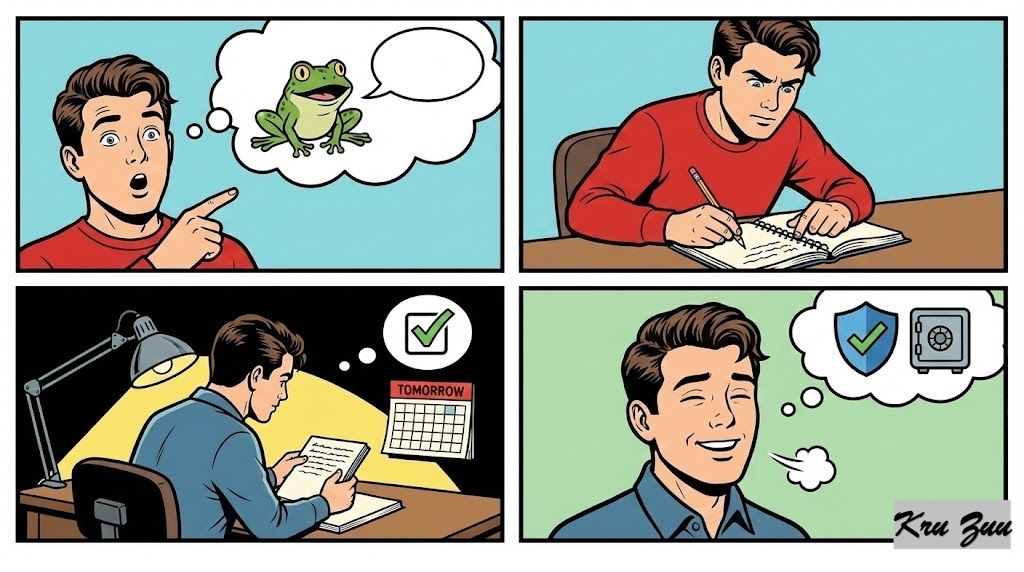
    Check your phone. When was the last time you backed up your photos?


    Check your bag. Do you have a portable charger?


    Check your work. Did you hit “Save” on that document?


    The Action: Do one act of “Safety” right now. Back up the files. Lock the door. Check the tires.


    Question: What is one thing you always double-check before leaving the house? Tell us in the comments! 👇


    By Zubeyir YURTKURAN

    https://www.facebook.com/BrainBattleground/

    https://www.facebook.com/zubeyr.yurtkuran/

    https://www.instagram.com/zubeyryurtkuran/
    https://www.youtube.com/@BrainBattleground-b3p

    https://www.instagram.com/brainbattleground/

  • 🧺 Don’t Put All Your Eggs in One Basket: The Secret to Risk Management

    🧺 Don’t Put All Your Eggs in One Basket: The Secret to Risk Management

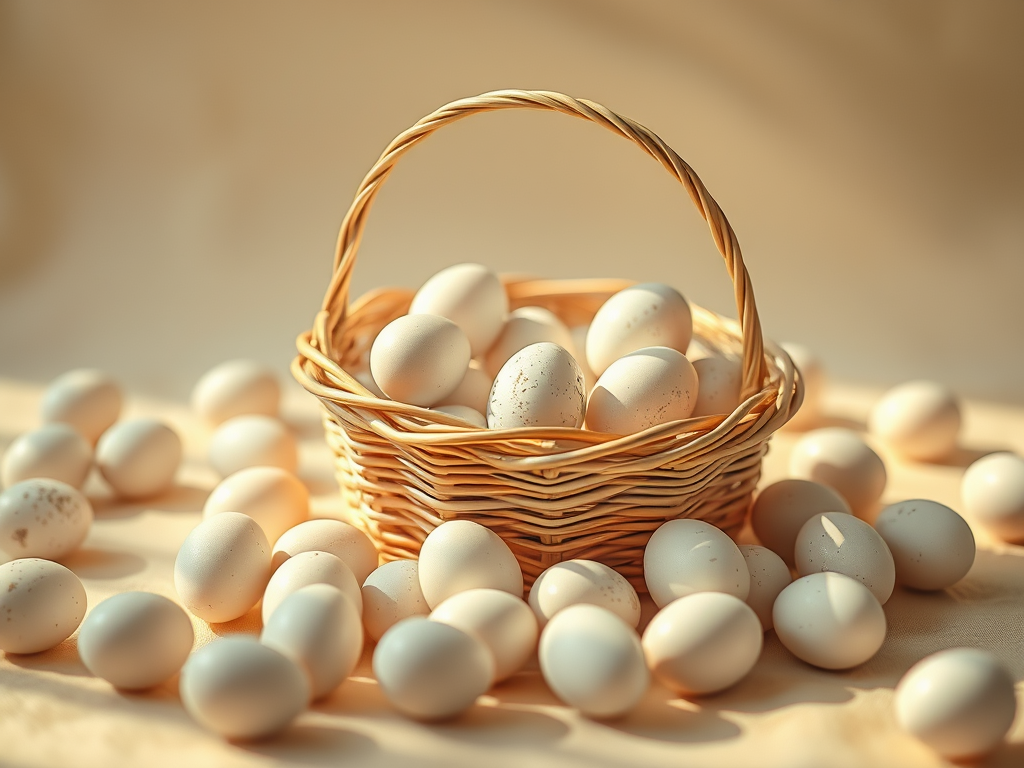
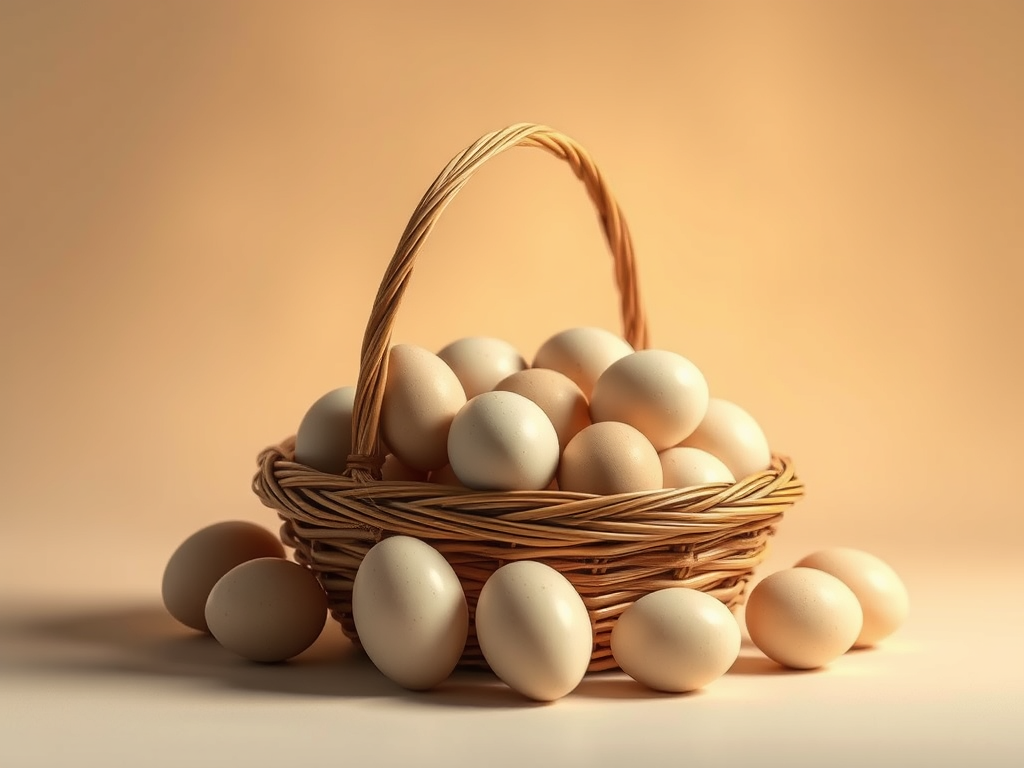
    Don’t put all your eggs in one basket.


    👿 The Risk Taker:
    You invested all your savings in a single stock.

    You applied to only one university. You are waiting solely for the job offer from one company.

    The Result? If that stock tanks, everything is gone. If that university rejects you, you have no backup.

    Stress levels skyrocket, and your entire life is tied to one fragile point. 🌋


    😇 The Planner (The Diversifier): You spread your money across different bank accounts and investment tools.

    You applied to three different colleges.

    You are learning a new skill while also taking on some freelance work.

    The Result? If one investment dips, the others protect you. There is always a ‘Plan B.’ Your life rests on solid ground. 🛡️


    📉 The Reality: This saying is not just about finance. It applies to career, relationships, hobbies, and education too.

    Life is not a lottery where one thing saves you; it’s a strategic game where you manage probabilities. 🎯


    💎 The Secret: Flexibility is your power in life. If one area fails, the others can support you. Successful people always have a contingency plan.

    🧐 The Anatomy of the Proverb


    This common English phrase is a direct warning against making your life dependent on a single thing.


    📚 Vocabulary Vault


    Basket (Noun):
    A container. (Here: An area of investment, an opportunity, or an effort.) 🍎


    Example: “She keeps all her laundry in a plastic basket.”


    To Put (Verb): To place. (Here: To invest, to focus, to trust.)


    All Your Eggs: All your eggs. (Here: All your resources, money, energy, or hopes.) 🥚


    Diversification (Bonus Word):
    The strategy of investing in a variety of assets to reduce risk.


    🧠 Grammar Focus


    The Negative Imperative Mood (The Bossy Verb, Negative):


    The sentence starts with “Don’t” (Do not). Like the positive imperative “Treat others…”, this is a direct instruction or strong piece of advice.


    Normal: You should not put…


    Imperative:Don’t put all your eggs… (You are strongly advised not to do this!)

    📜 History: Origin and Spread


    The saying is based on a centuries old agricultural metaphor.


    The Origin: The phrase can be traced back to the 1600s in Spanish literature and the works of English writer Miguel de Cervantes (author of Don Quixote). The basic idea is simple: if you drop the basket, all your eggs break. 🍳


    Global Cousins:


    🇹🇷 Turkish:
    “Bütün yumurtalarını tek bir sepete koyma.” (Direct translation and most common usage.)


    🇨🇳 Chinese: “A man who wants his own end hangs himself from a single tree.” (The idea of finding alternative solutions.)


    🇮🇳 Hindi: “Taking risks is fine, but don’t risk your entire existence.” (Emphasizing the same theme.)

    🎯 Impact on Life: The Pros & Cons


    What are the benefits of living by this philosophy?


    ✅ The Pros (The Safety Net):


    Resilience:
    One failure doesn’t derail your whole life. You can recover quickly.


    Mental Peace: It reduces the pressure that comes from being over-reliant on a single outcome.


    Broader Experience: Trying different areas diversifies your skills and capabilities.


    ❌ The Cons (The Pitfalls):


    Dilution of Focus:
    If you spend too little energy on too many things, you might not achieve true excellence in any of them. (Too many baskets, too few eggs!)


    Missed Opportunity: Sometimes, taking a big risk can yield a big reward. This rule can sometimes lead to excessive caution.

    🎭 Short Story: The Village Market


    Let’s check in with our farm friends again!


    🌟 Character Introduction


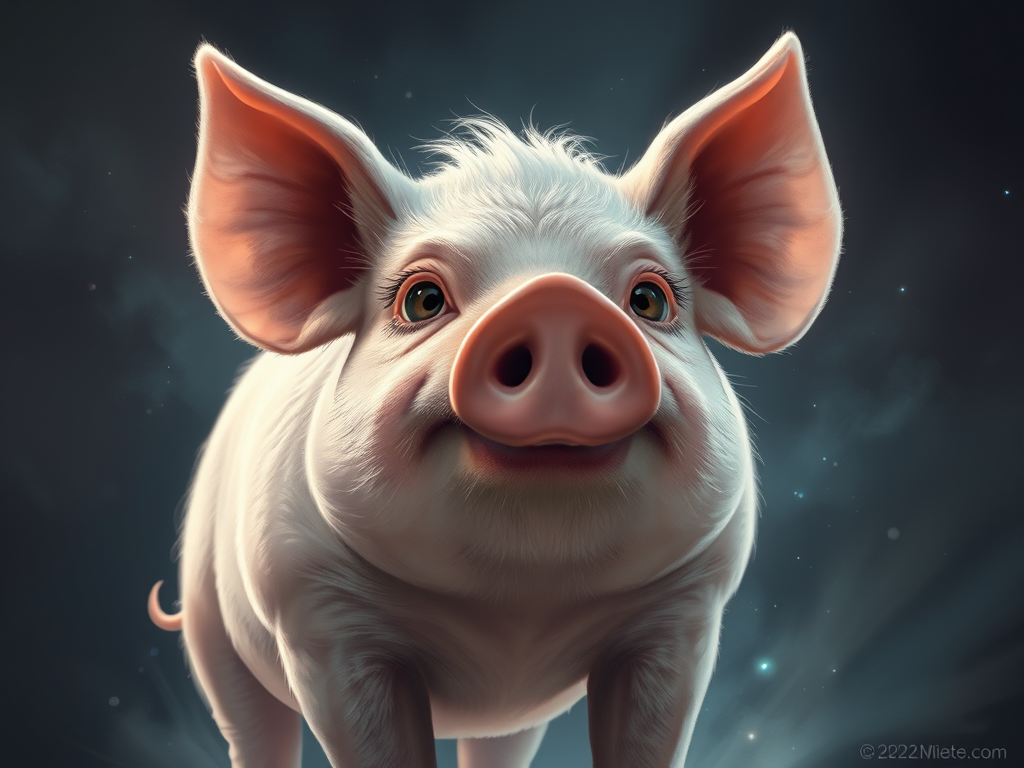
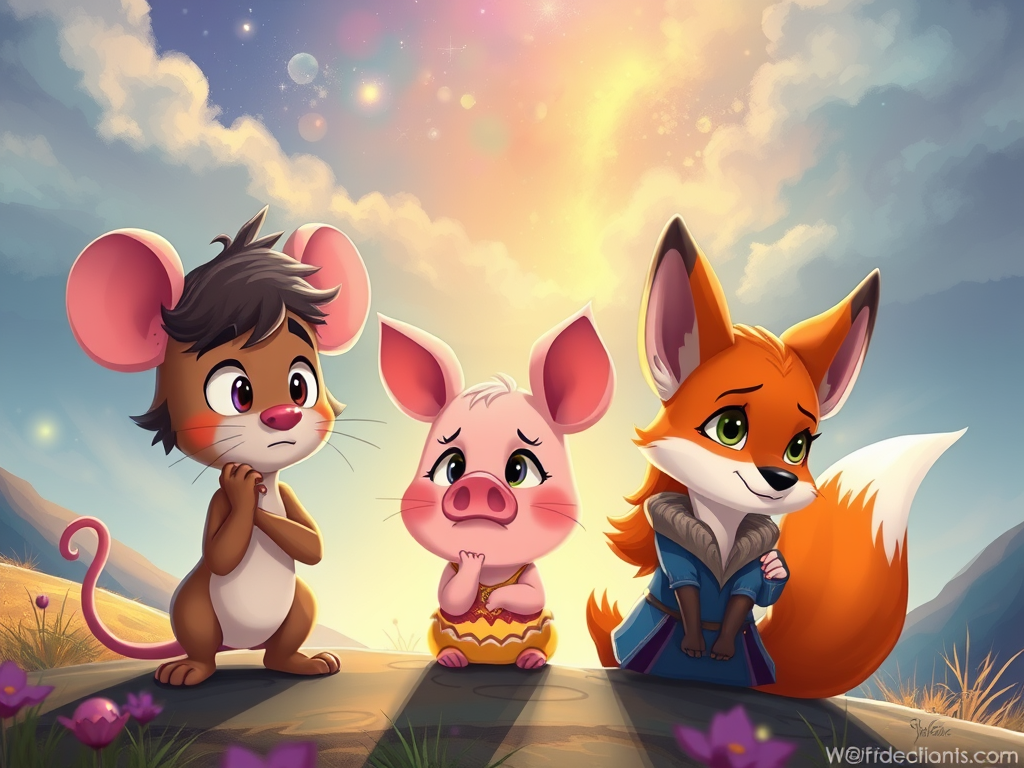
    Penny the Pig:
    Ambitious, highly focused. 🐷


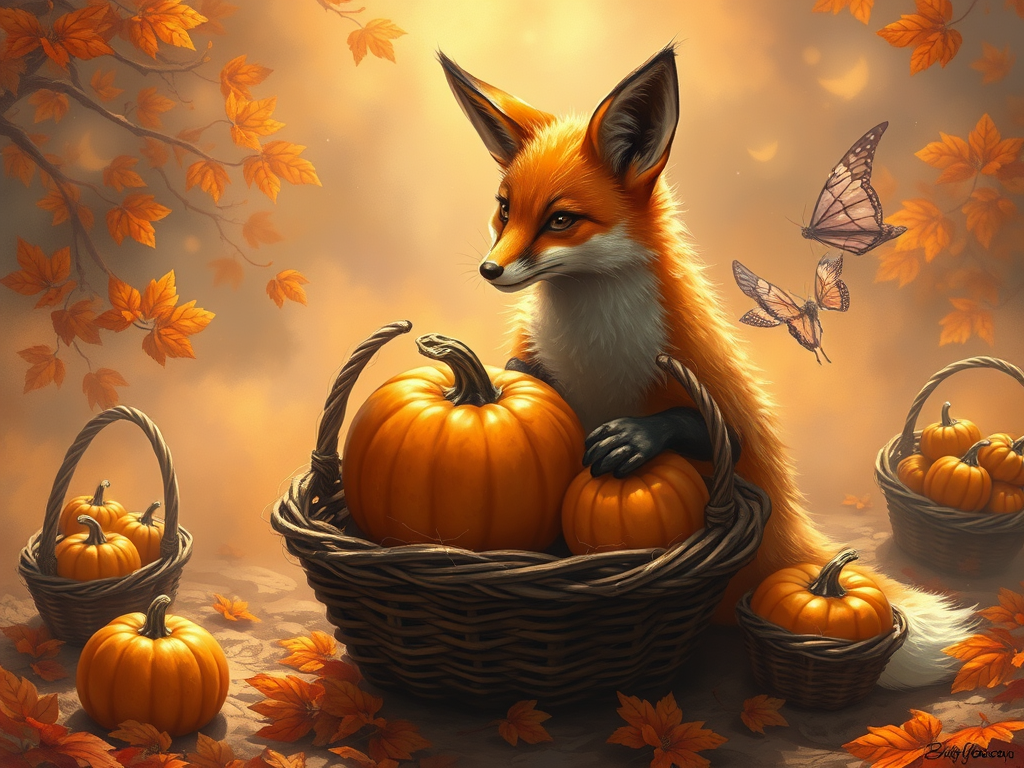
    Fiona the Fox: Cunning, risk-management expert. 🦊


    Max the Mouse:
    The market accountant. 🐭


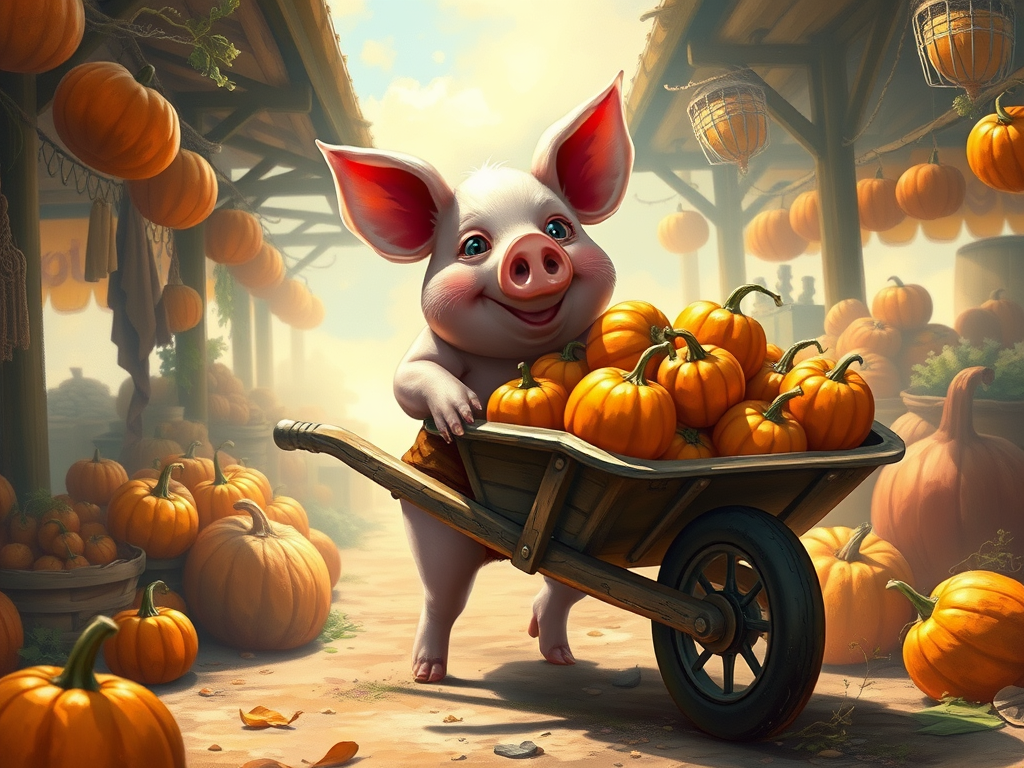
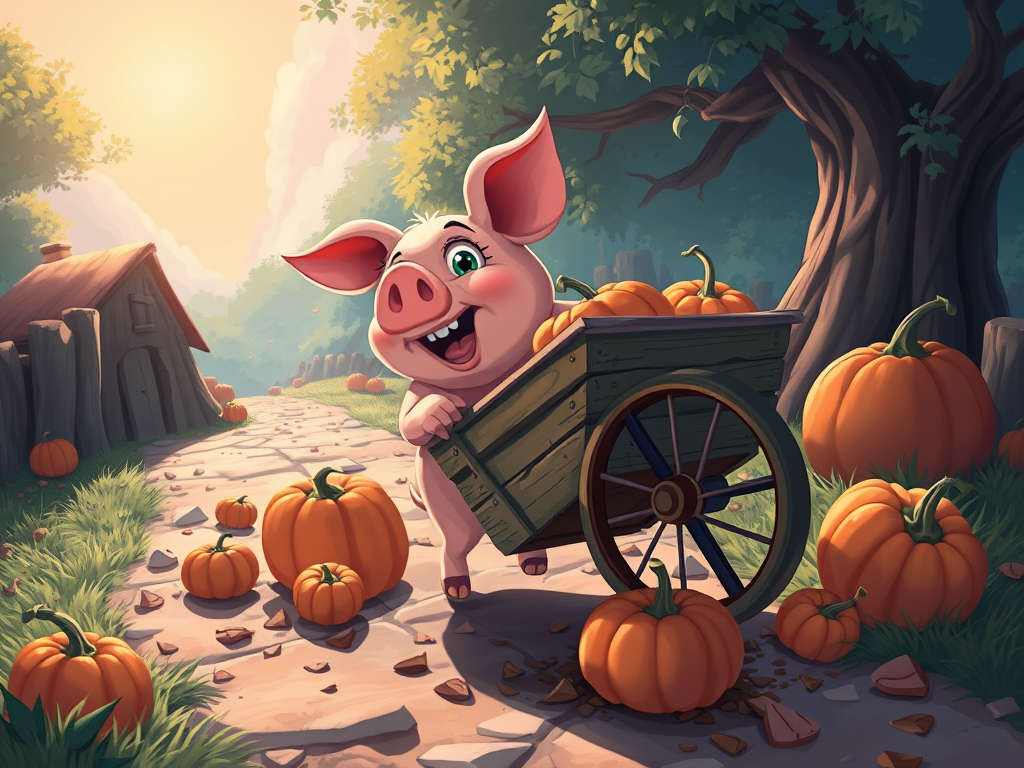
    The Setup: It was market day. Penny loaded all her delicious pumpkins onto one massive wheelbarrow. “This is the fastest way!” she thought.

    Fiona, however, divided her pumpkins into three separate smaller baskets, ready to sell at three different stalls.


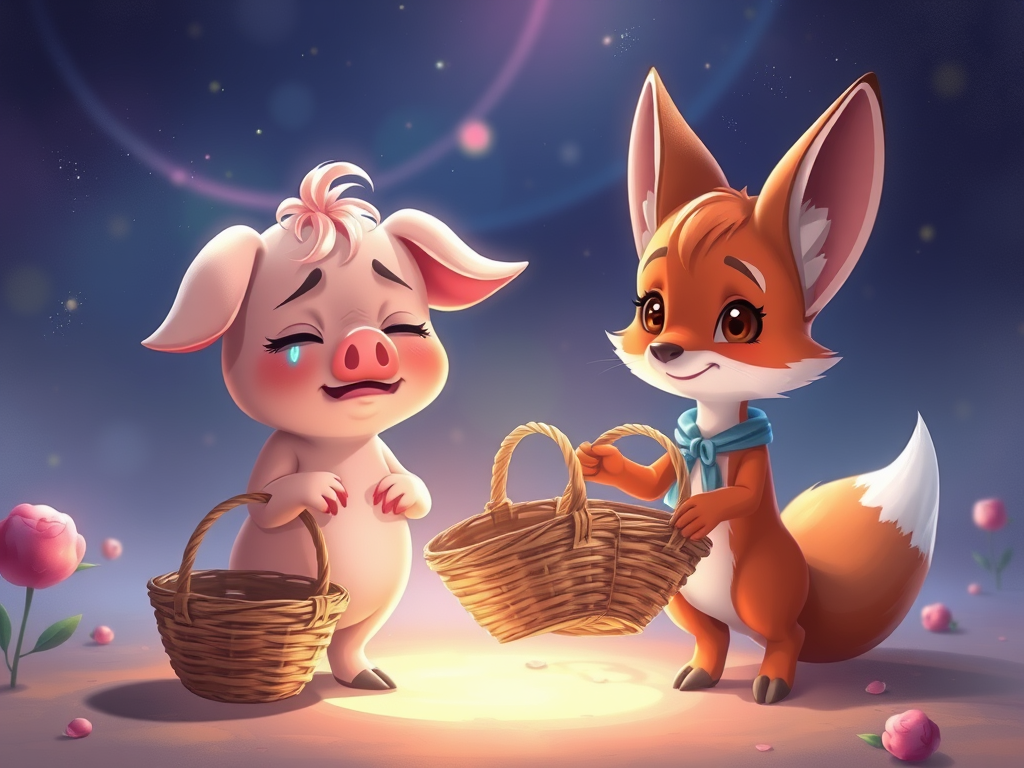
    The Conflict: The path was bumpy, and just as Penny was descending a hill, her large wheelbarrow’s wheel came loose, and the WHOLE THING CRASHED! All her pumpkins were smashed. 🎃


    The Solution: As Penny cried, Fiona realized that two of her three baskets were still perfectly fine. Even though the third basket had tipped, the bulk of her loss was contained.

    Max the Mouse summed it up: “Penny’s loss is 100%. Fiona’s loss is only 33%. Fiona earned less, but she didn’t crash.”


    The Moral: Success is measured not only by what you gain but by what you avoid losing. Separating the baskets minimizes the cost of risk.

    🎓 Lesson for English Learners


    How can you use “The Basket Proverb” in your English conversations?


    Advice Language 🗣️


    If your friend applies to only one company:
    “Hey, don’t put all your eggs in one basket. Maybe apply to two or three more places as a backup.”


    To someone stressing over an exam: “Remember to study a variety of topics. Don’t put all your eggs in one basket for the final exam!”


    Vocabulary Expansion 📚


    Contingency Plan (Noun):
    A plan for a possible future event. “We need a contingency plan in case the main project fails.”


    Mitigate (Verb): To make less severe or serious. “The strategy is designed to mitigate risk.”


    Prudent (Adjective): Acting with or showing care for the future. “It is prudent to have multiple sources of income.”


    💬 Your Turn


    The Life Portfolio Challenge 📝


    Right now, think about the 3 most important “baskets” in your life and the “eggs” (energy/resources) you put into them.


    Basket 1 (e.g., Career/Job)


    Basket 2 (e.g., Health/Fitness)


    Basket 3 (e.g., Relationships/Family)


    Question: If one basket completely crashed (like losing your job), would the other two baskets be strong enough to save you? Or have you put all your eggs into one place?


    Tell me in the comments below which basket you’ve decided to strengthen! 👇

    By Zubeyir YURTKURAN

    https://www.facebook.com/BrainBattleground/

    https://www.facebook.com/zubeyr.yurtkuran/

    https://www.instagram.com/zubeyryurtkuran/
    https://www.youtube.com/@BrainBattleground-b3p