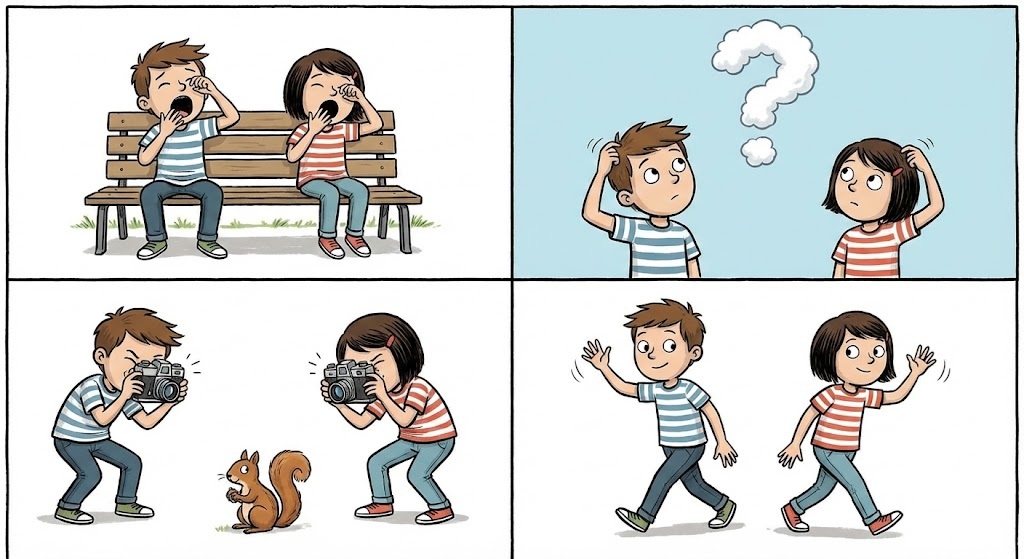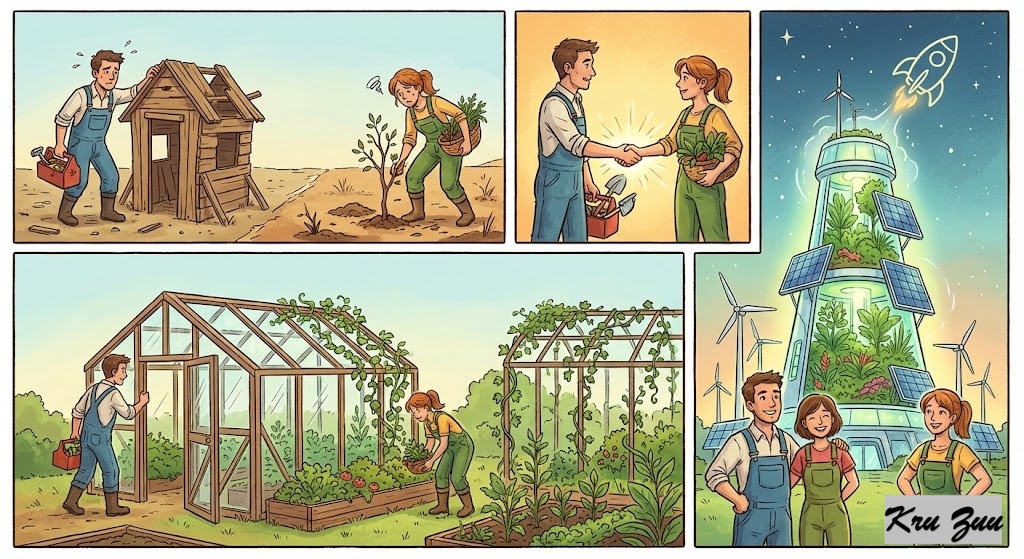
Tag: Communication Skills

  • 🤫 The Daily Shield: The Law of Quiet Power

    🤫 The Daily Shield: The Law of Quiet Power

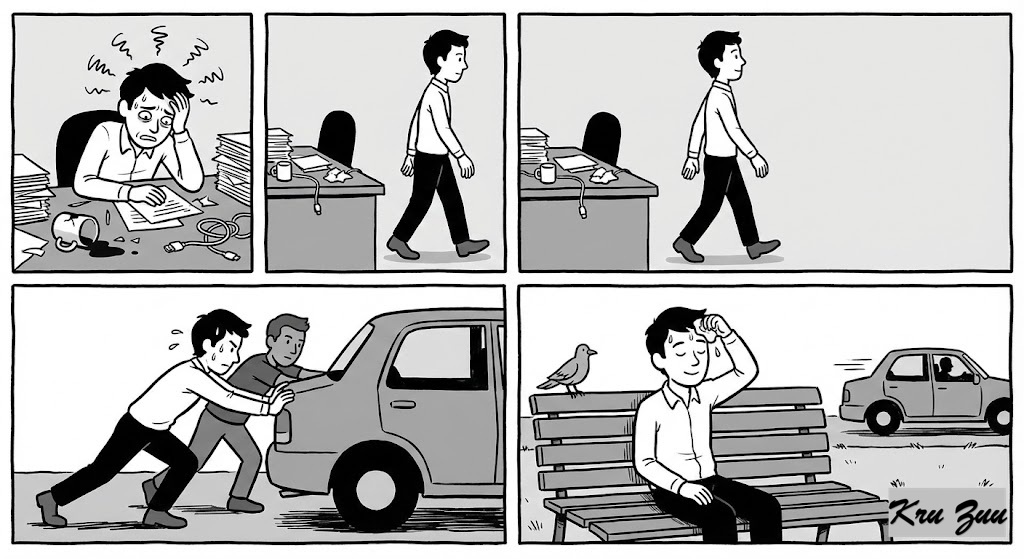
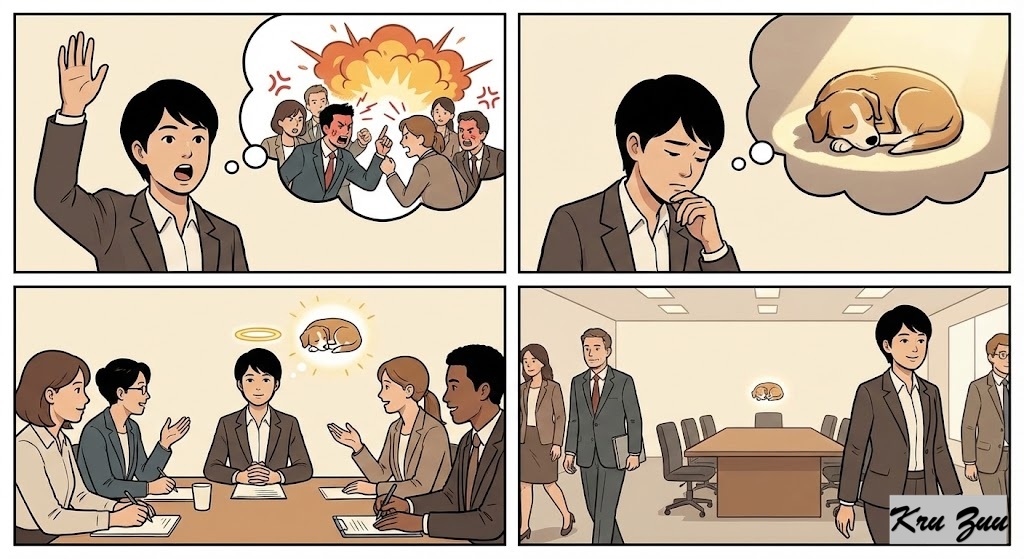
    “Silence is golden.”


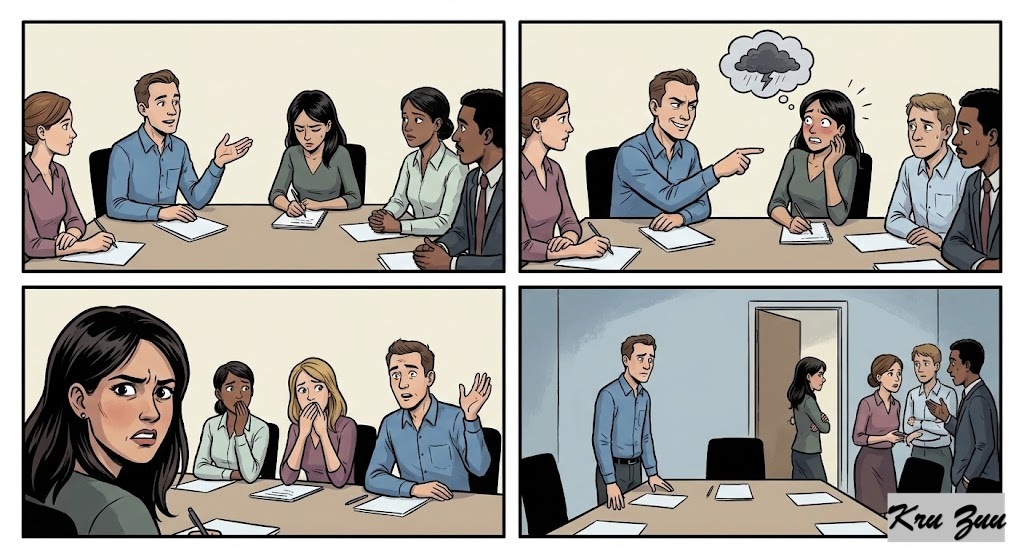
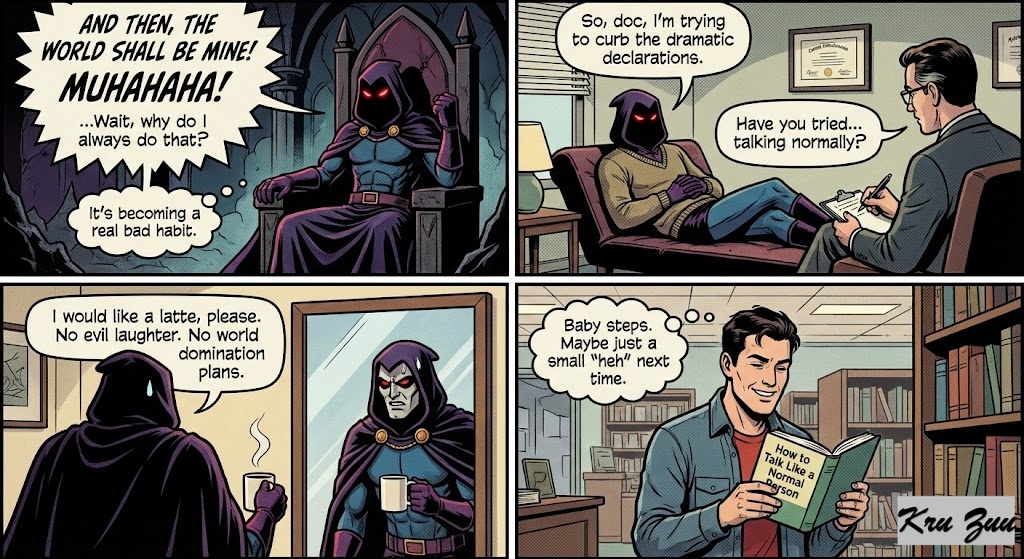
    😈 The Villain (The Noise Maker)

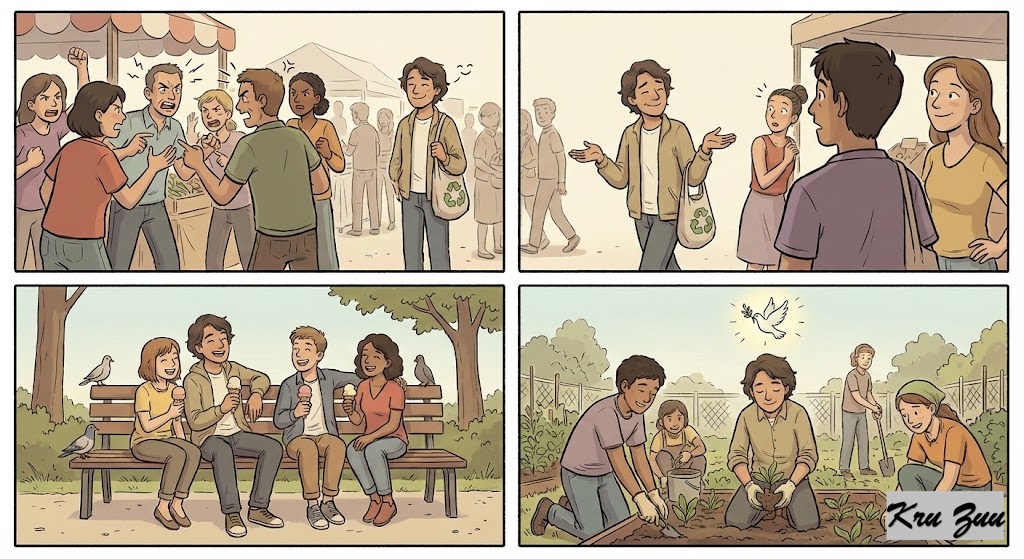
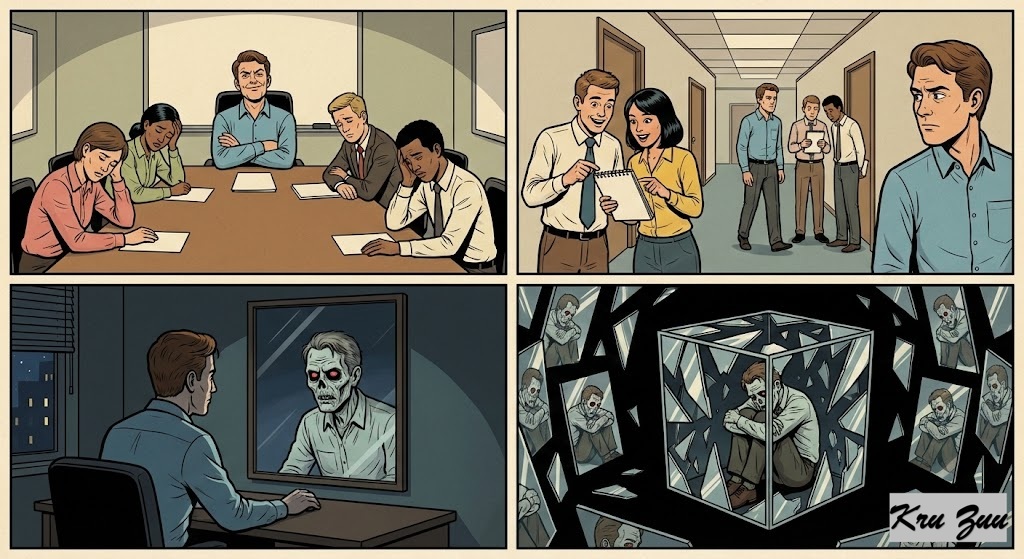
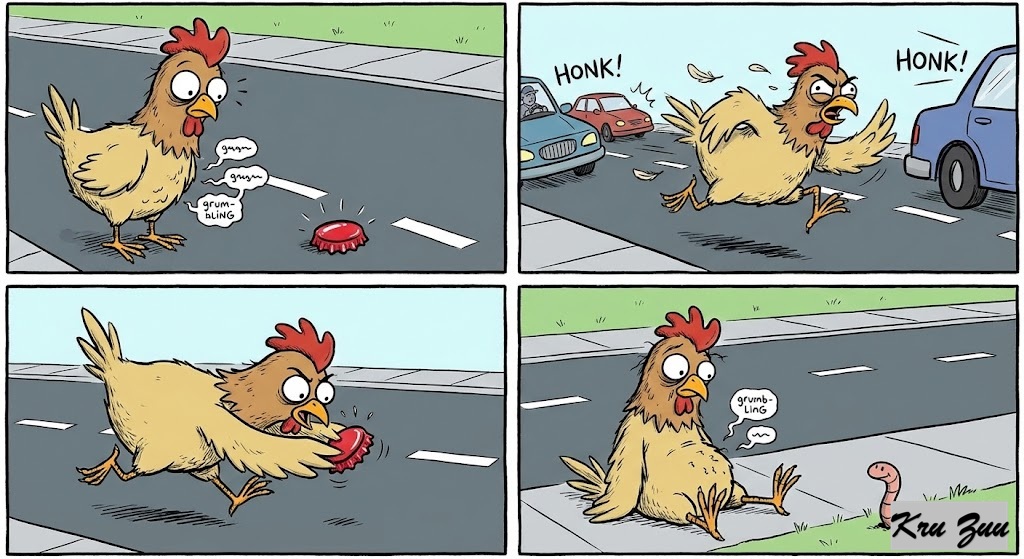
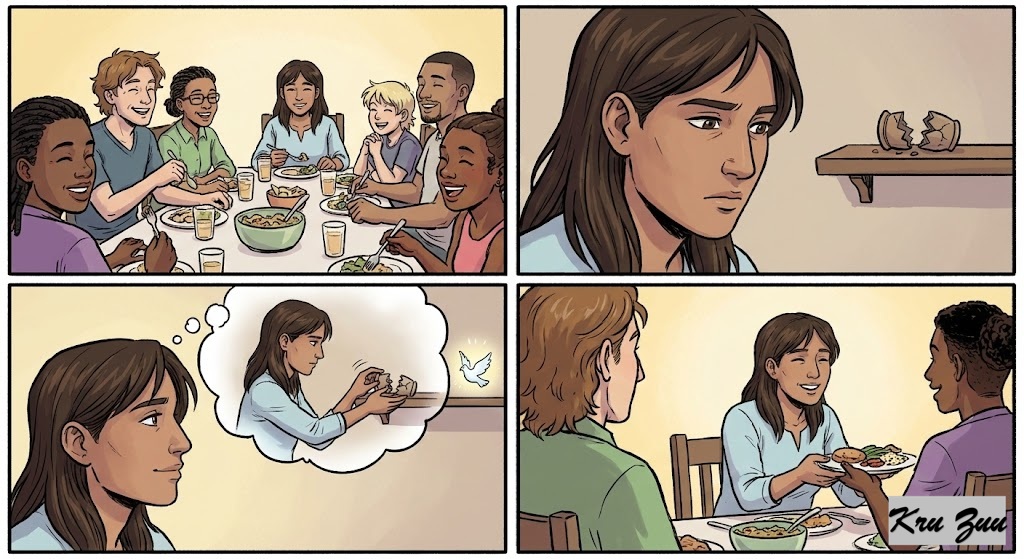
    You have a thought, and it instantly leaves your mouth. 🗣️ “I have to say my opinion!” “Did you hear the gossip about…?” “Let me interrupt you right there!” You act as if every silence is awkward and needs to be filled. You reveal your secrets to strangers. You speak when you are angry.
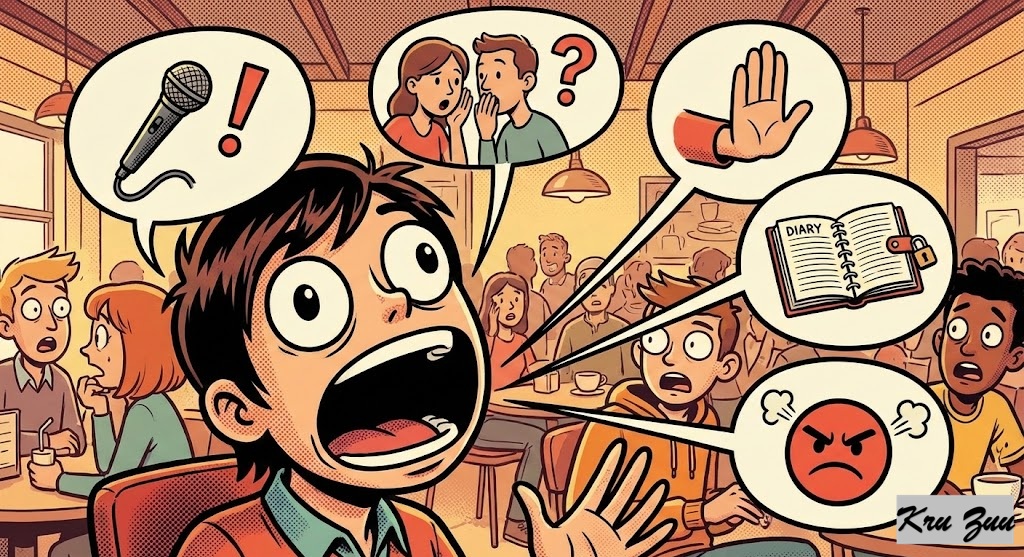
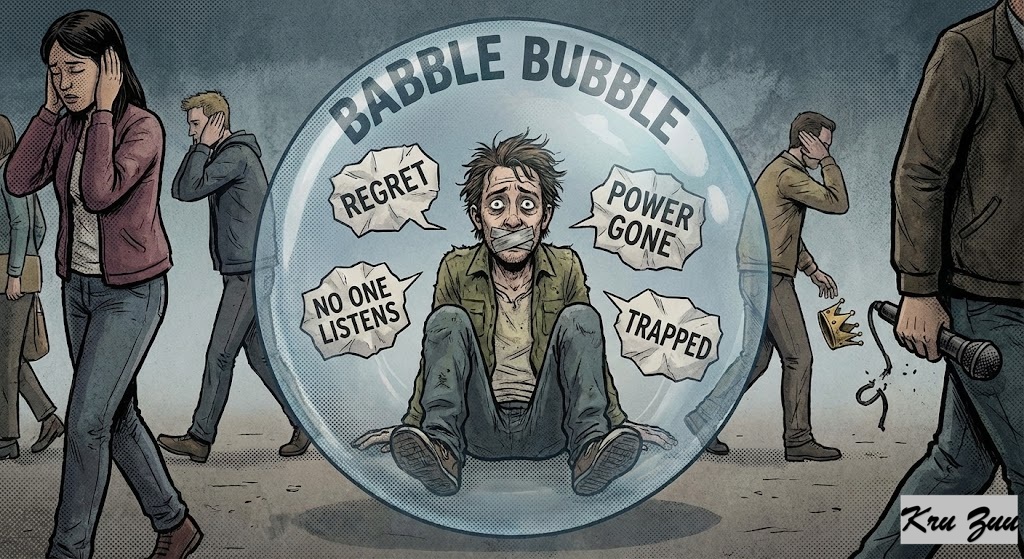
    The Result? You say things you regret. You give away your power. People stop listening because you never stop talking. You are trapped in the “Babble Bubble.” 🫧

    😇 The Hero (The Wise Observer)

    You have a thought. You pause. 🛑 You listen. You realize that you have two ears and one mouth for a reason, to listen twice as much as you speak. You think: “Does this need to be said now? Does it need to be said by me?” You are comfortable in the quiet.
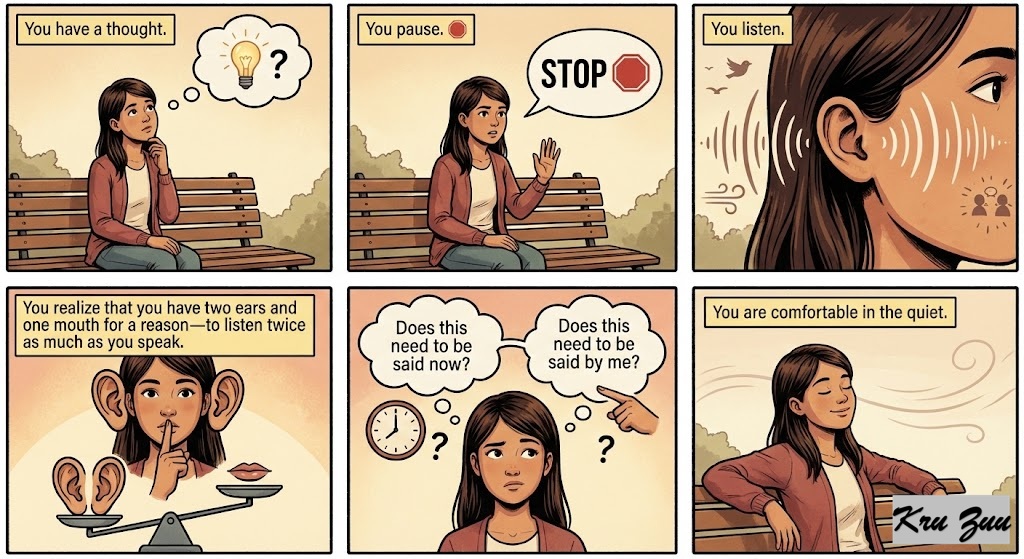
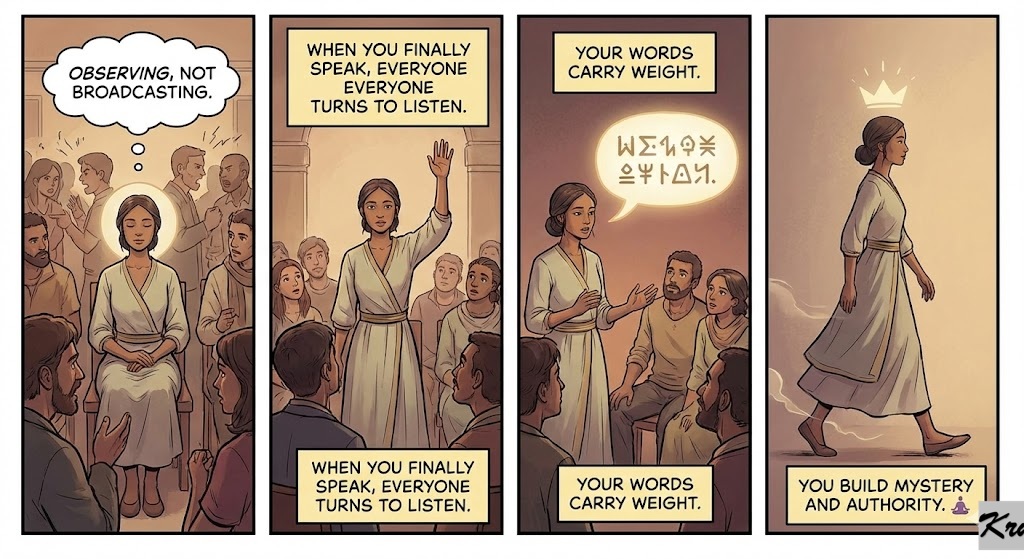
    The Result? When you finally speak, everyone turns to listen. Your words carry weight. You learn more because you are observing, not broadcasting. You build mystery and authority. 🧘

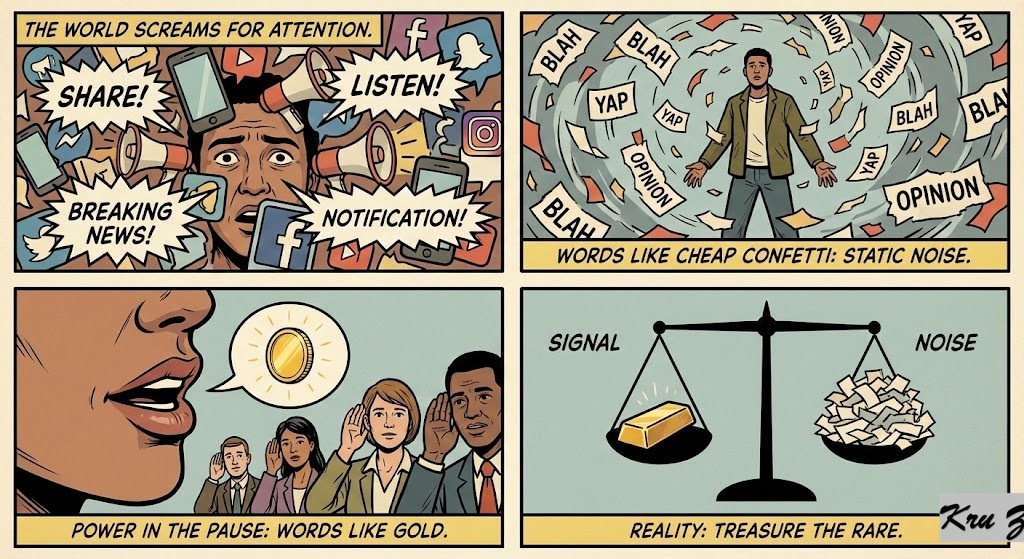
    ⚖️ The RealitySignal vs. Noise. We live in a world that screams for attention. Social media, notifications, and 24/7 news cycles tell us we must “share” everything. But physics and psychology agree: A constant signal is just static noise. True power is found in the pause. If you treat words like cheap confetti (throwing them everywhere), they lose value. If you treat words like gold (rare and heavy), people will treasure them.

    💎 The Secret

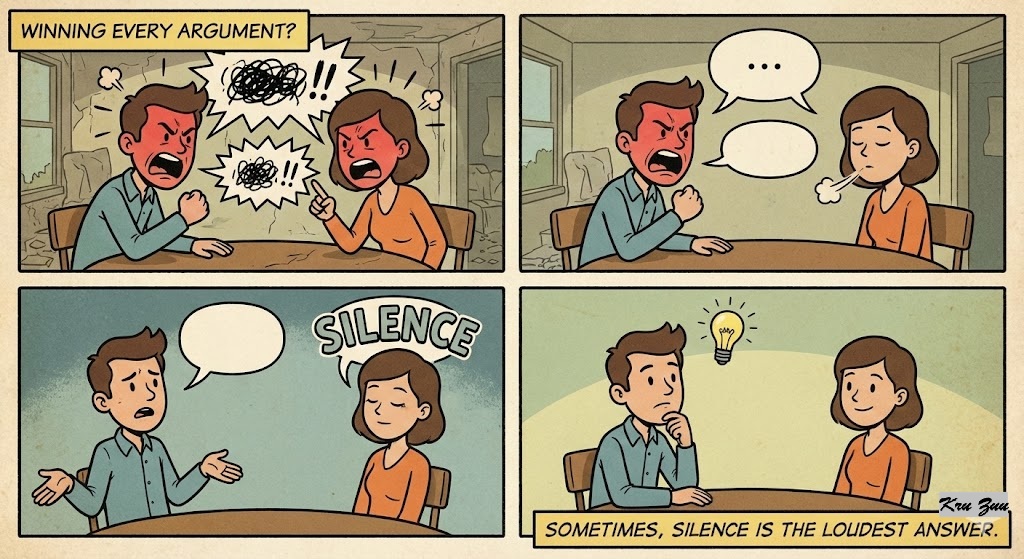
    You don’t have to win every argument. Sometimes, silence is the loudest answer.
    🧐 The Anatomy of the Proverb


    This is your reality check that restraint is often more valuable than action.
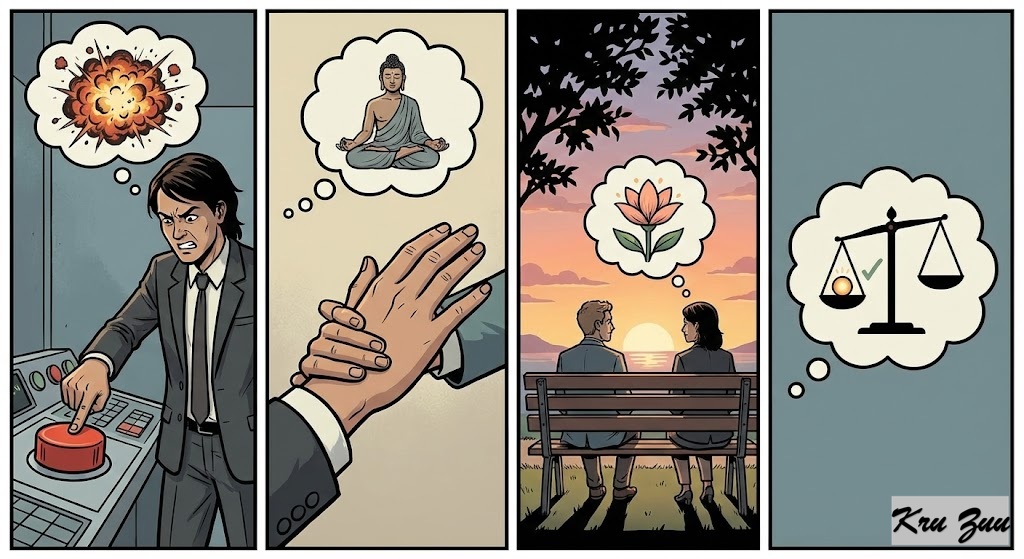

    Silence (Noun): Complete absence of sound; the state of not speaking.
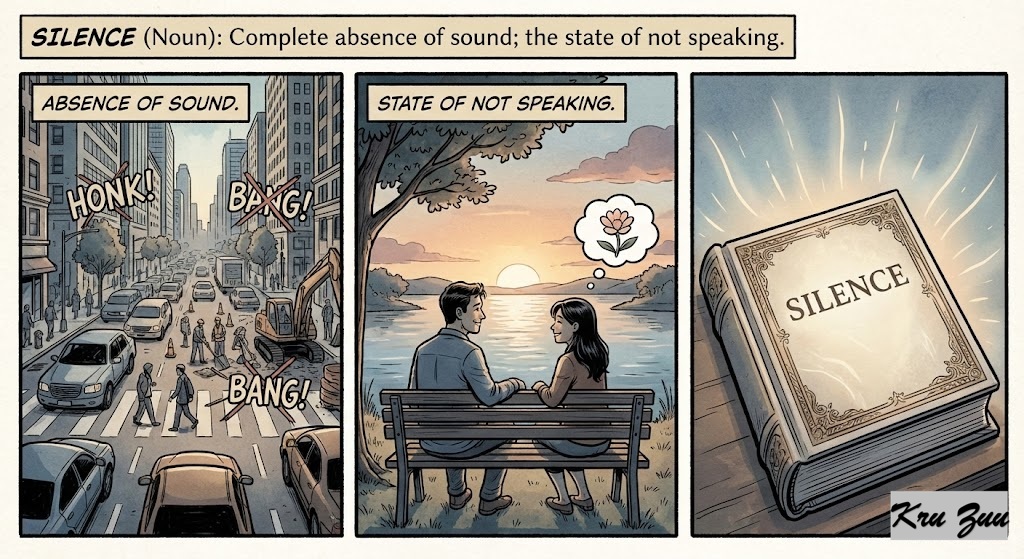

    Is (Verb): State of being.
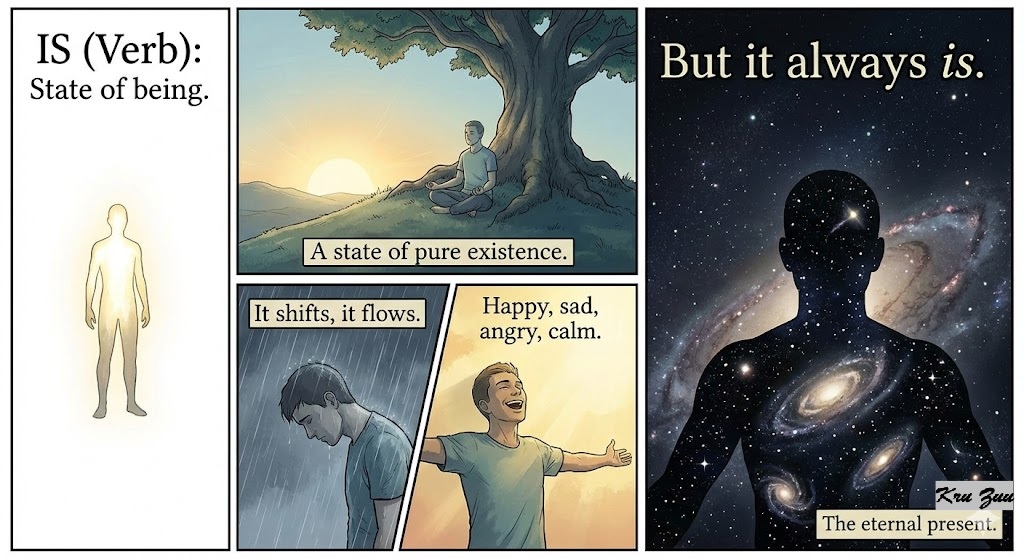

    Golden (Adjective): Made of gold; extremely valuable; precious.
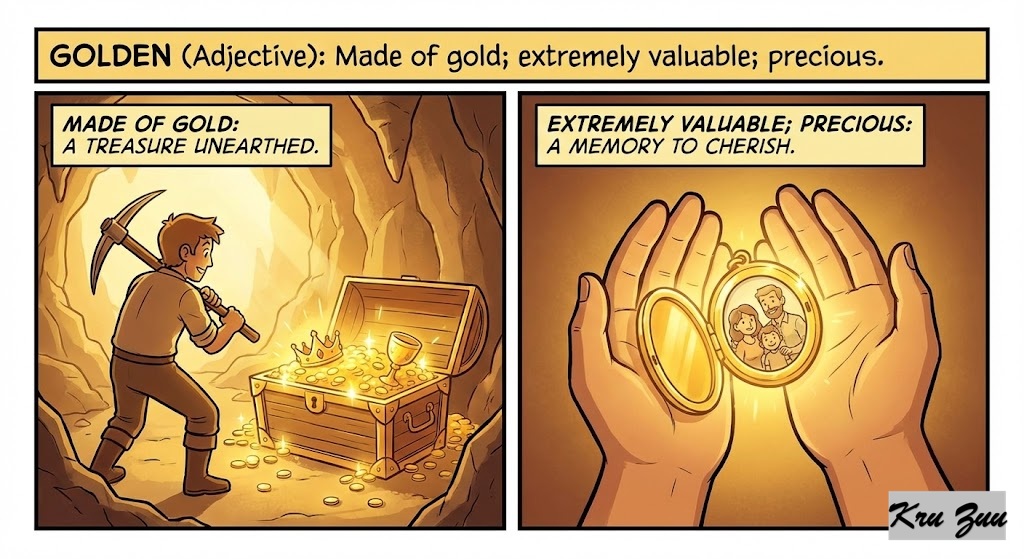

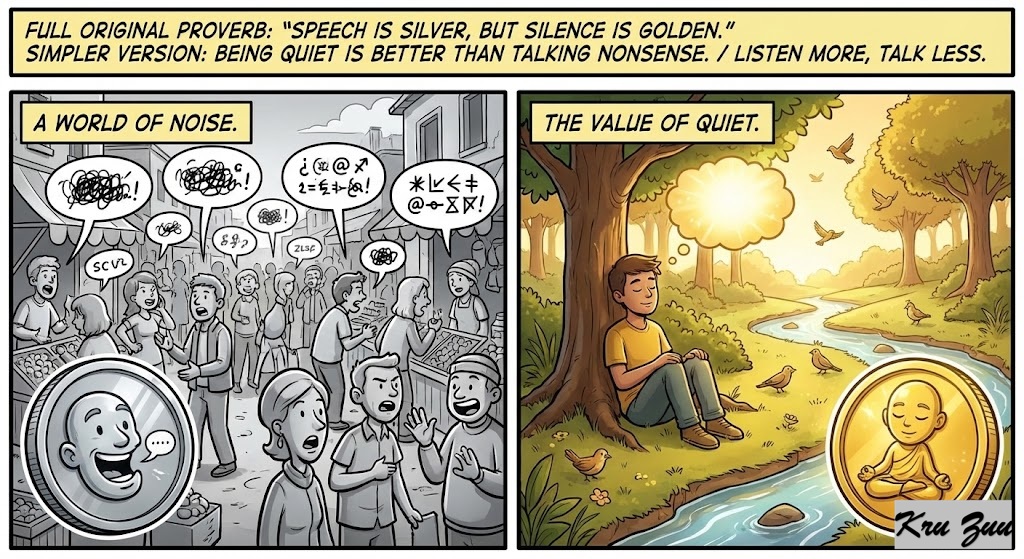
    Full Original Proverb:“Speech is silver, but silence is golden.”Simpler Version: Being quiet is better than talking nonsense. / Listen more, talk less.

    📚 Vocabulary Vault


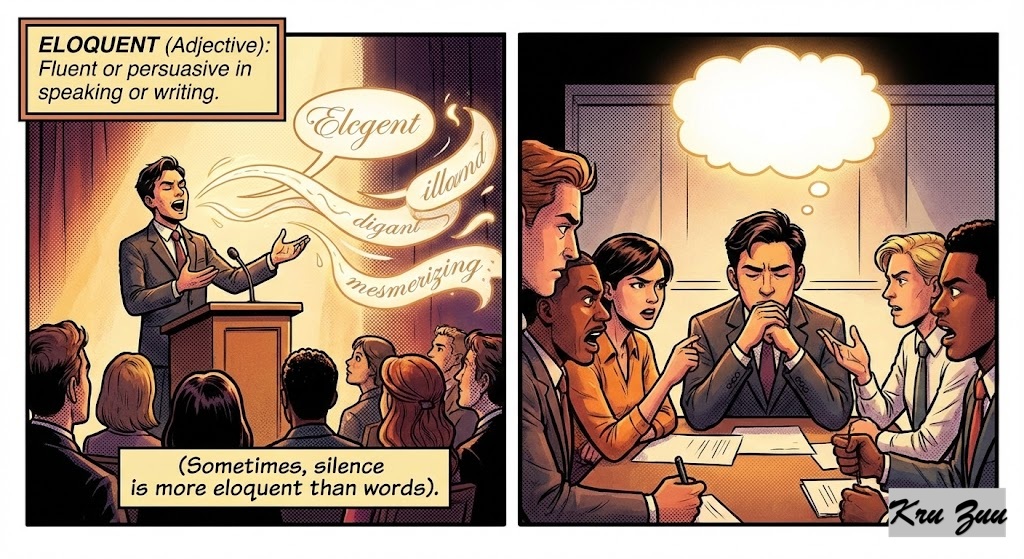
    Eloquent (Adjective): Fluent or persuasive in speaking or writing. (Sometimes, silence is more eloquent than words).

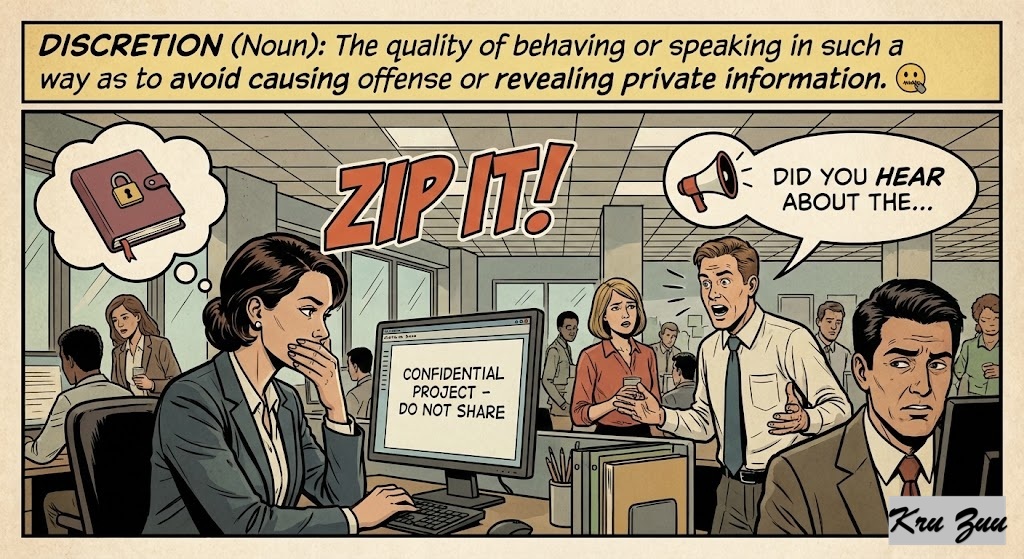
    Discretion (Noun): The quality of behaving or speaking in such a way as to avoid causing offense or revealing private information. 🤐

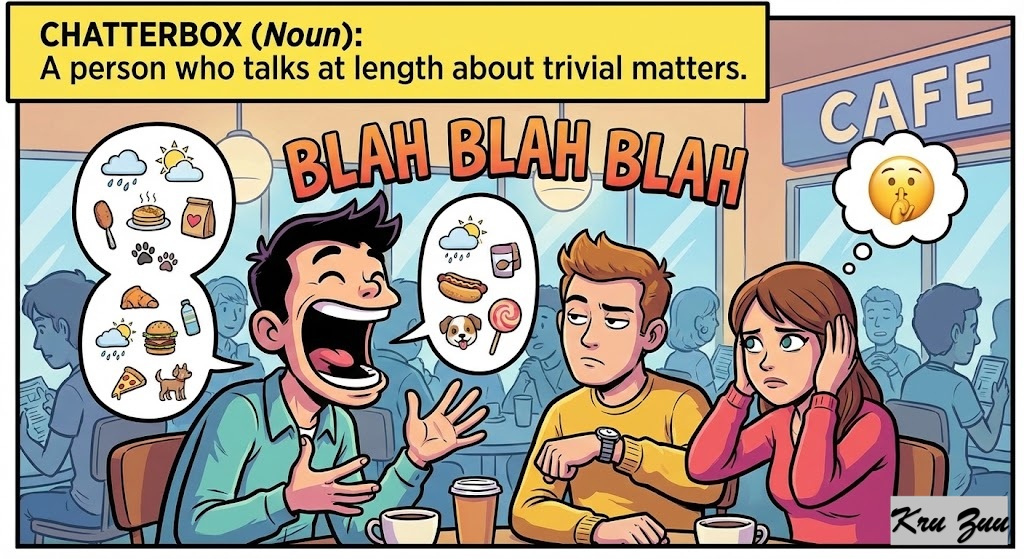
    Chatterbox (Noun): A person who talks at length about trivial matters.

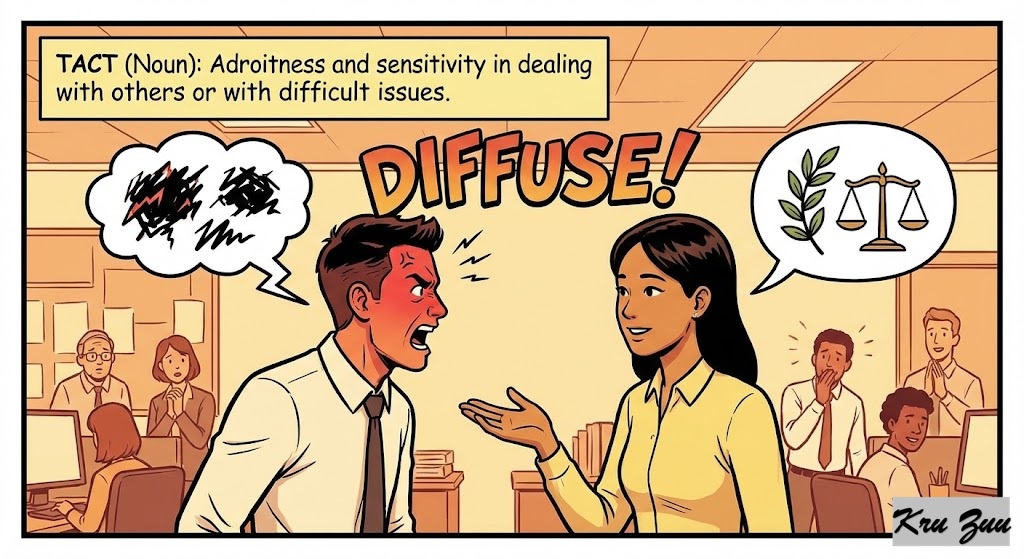
    Tact (Noun): Adroitness and sensitivity in dealing with others or with difficult issues.

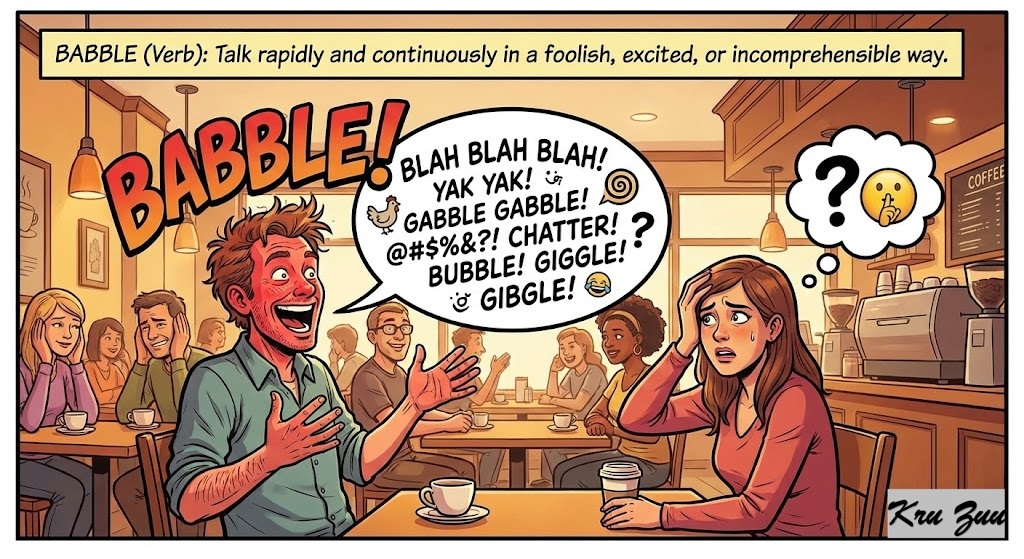
    Babble (Verb): Talk rapidly and continuously in a foolish, excited, or incomprehensible way.

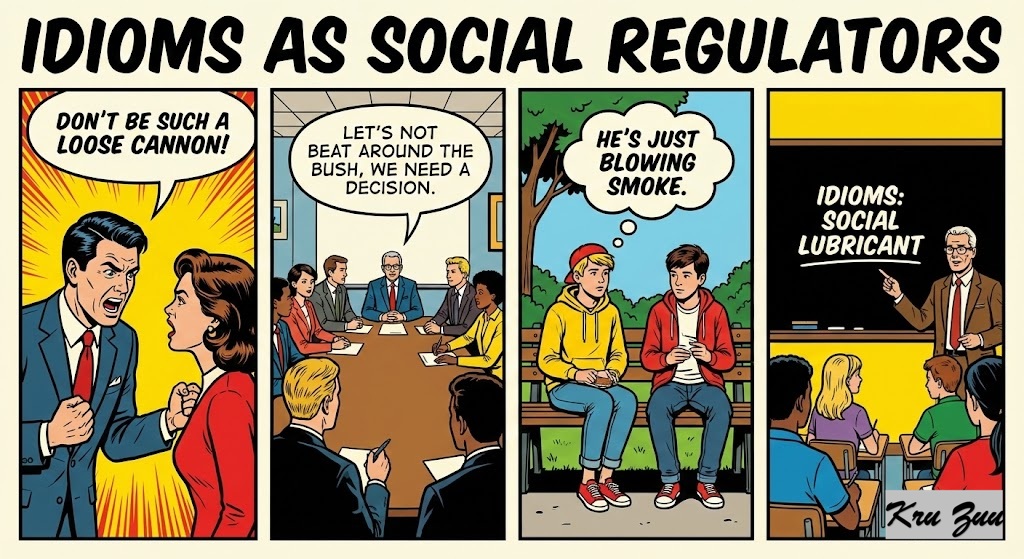
    🧠 Grammar Focus: Idioms as Social Regulators

    We often use this idiom to politely tell someone to stop talking or to express regret for speaking too much.
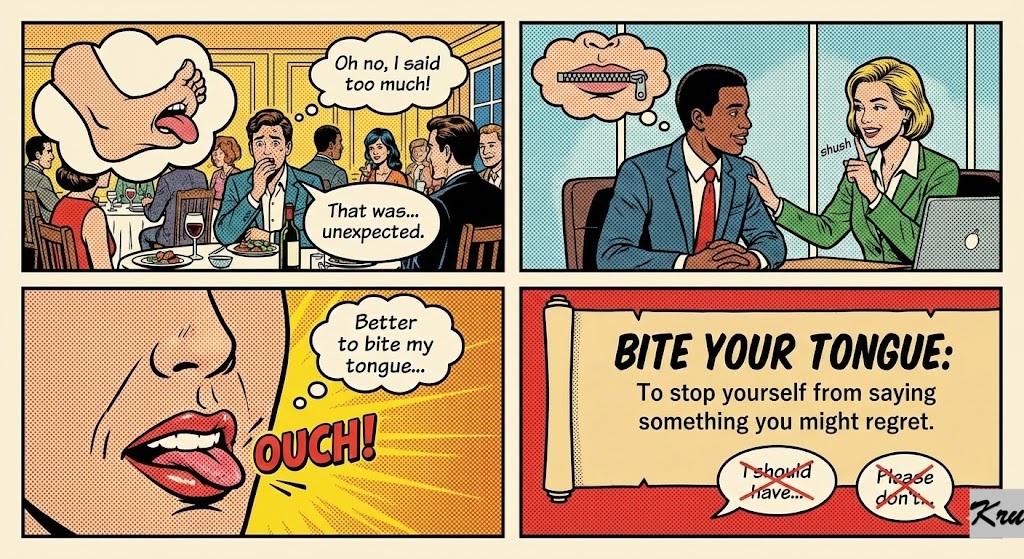

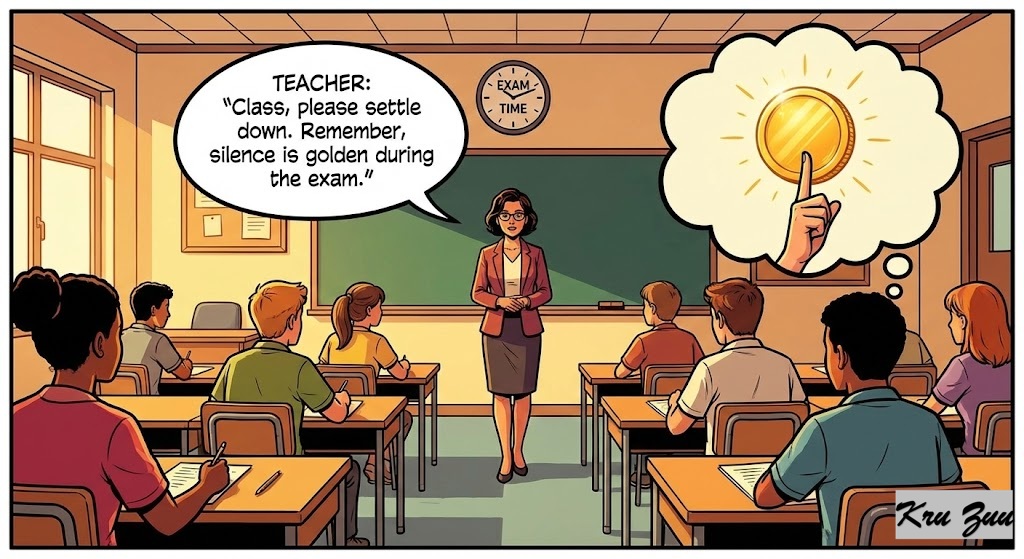
    Teacher: “Class, please settle down. Remember, silence is golden during the exam.”

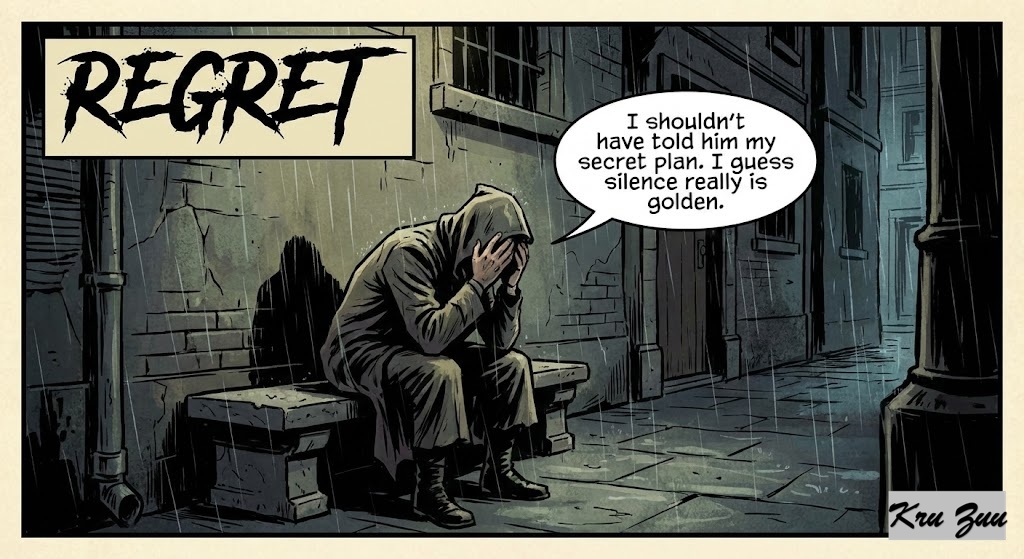
    Regret: “I shouldn’t have told him my secret plan. I guess silence really is golden.”
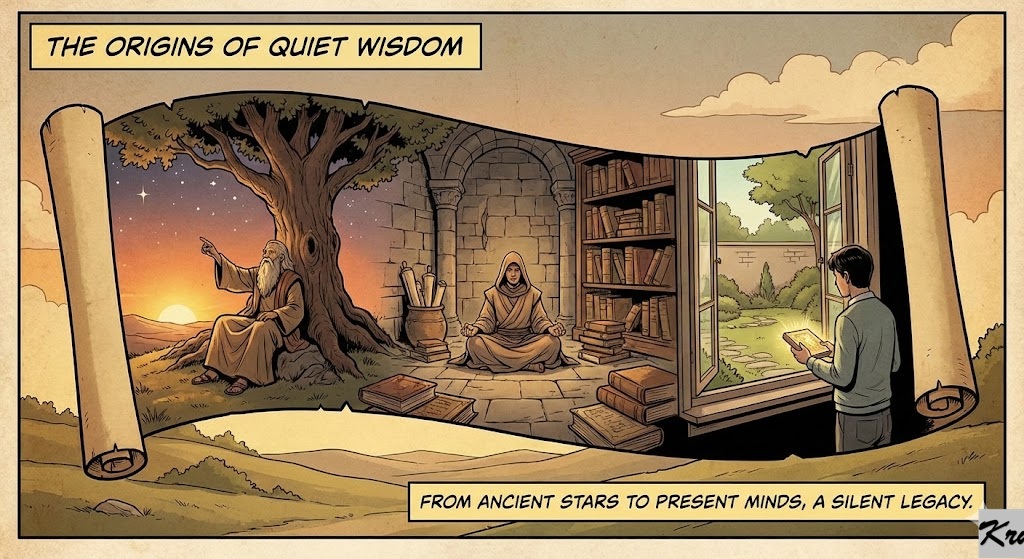
    📜 History: Origin and Spread


    Where did this quiet wisdom come from?

    The Origin: The phrase traces back to ancient culture. It was popularized in English by Thomas Carlyle in the 19th century (1831), who translated a Swiss/German inscription: “Sprechen ist Silber, Schweigen ist Gold.” (Speech is silver, Silence is gold).
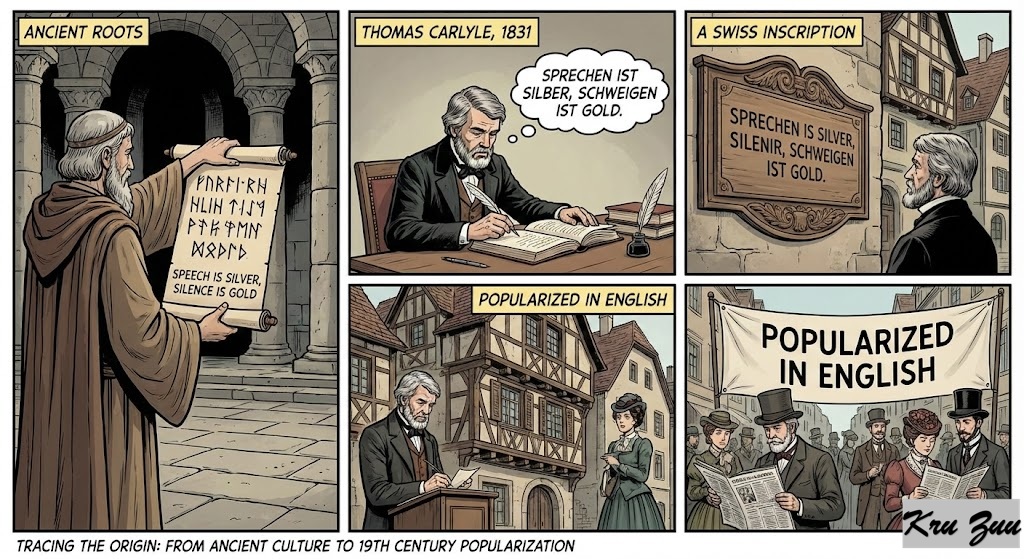

    The Logic: Silver is valuable. Being able to speak well is a great skill (Silver). But Gold is more valuable. Therefore, knowing when not to speak is a higher level of wisdom.
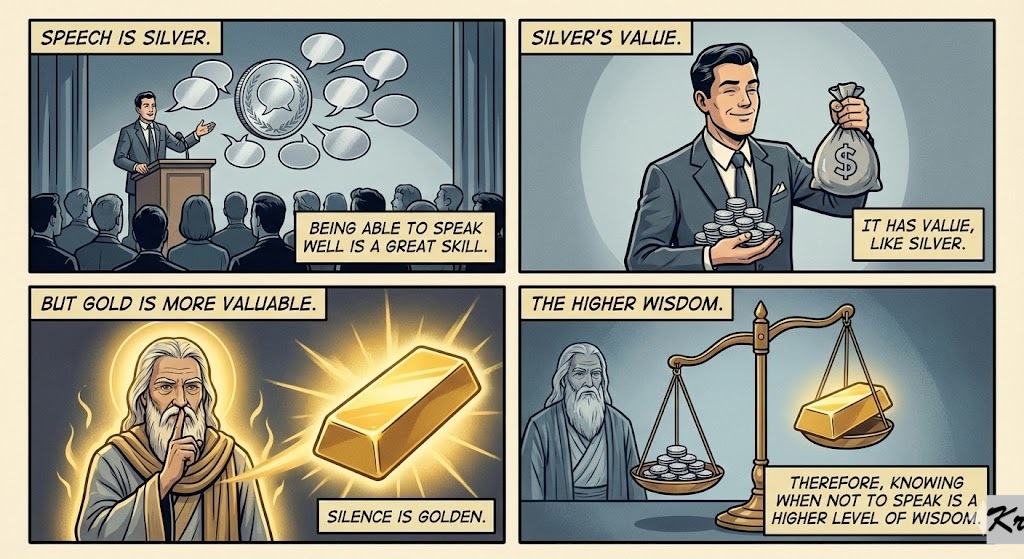

    Global Cousins


    🇯🇵 Japanese: “Iwanu ga hana” (Not speaking is the flower).
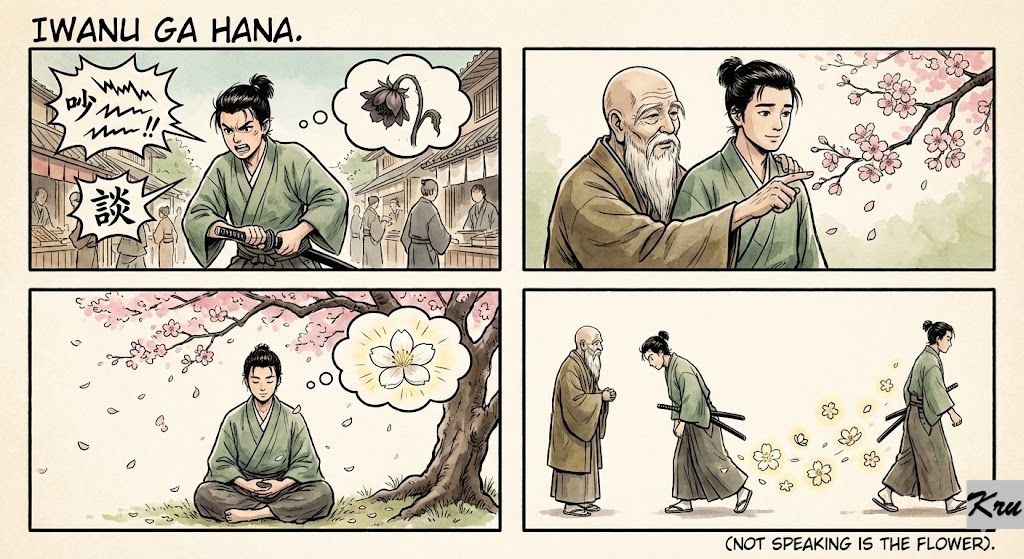

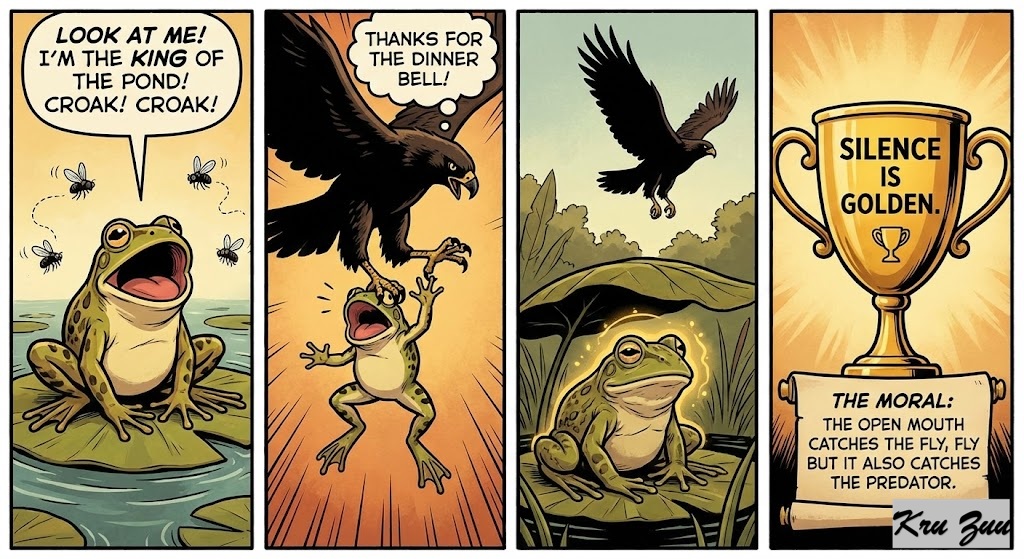
    🇪🇸 Spanish: “En boca cerrada no entran moscas” (Flies don’t enter a closed mouth).


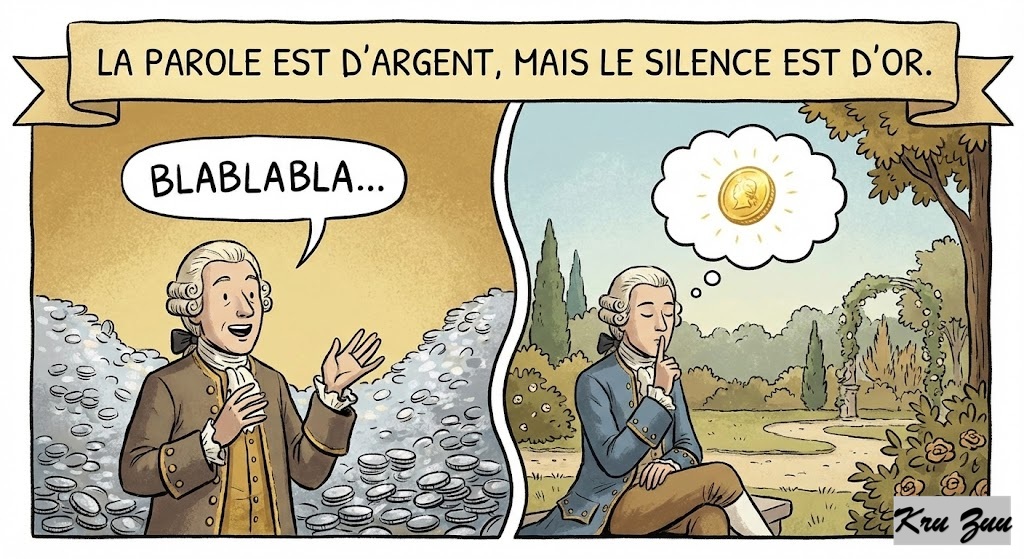
    🇫🇷 French: “La parole est d’argent, mais le silence est d’or.”
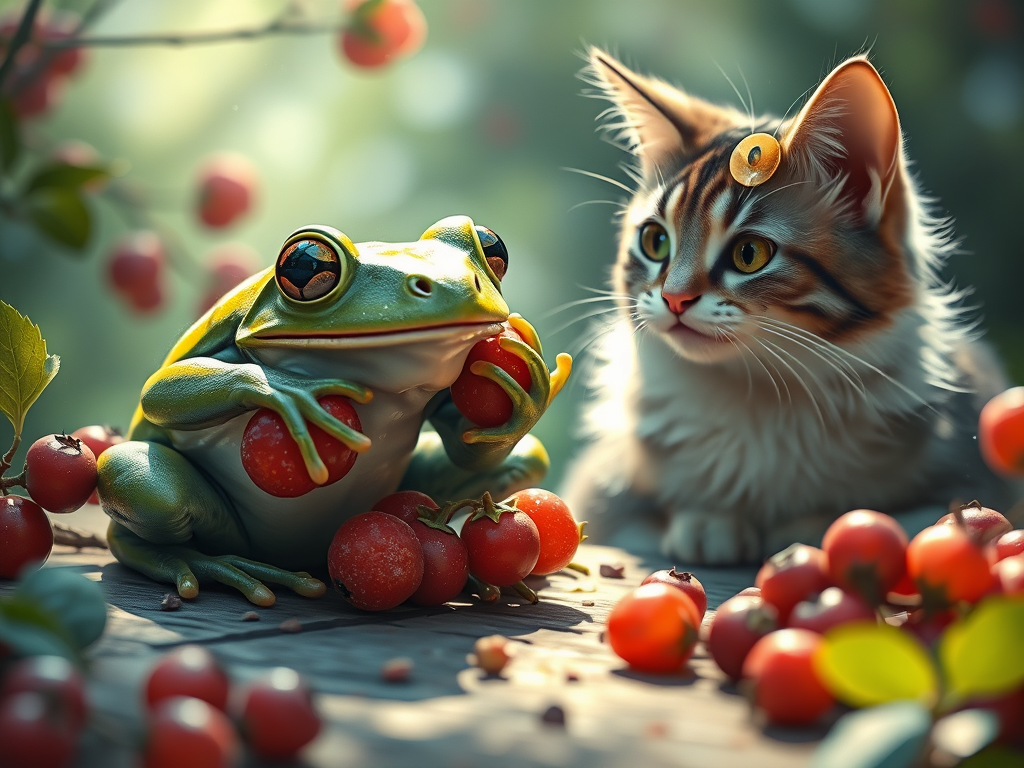
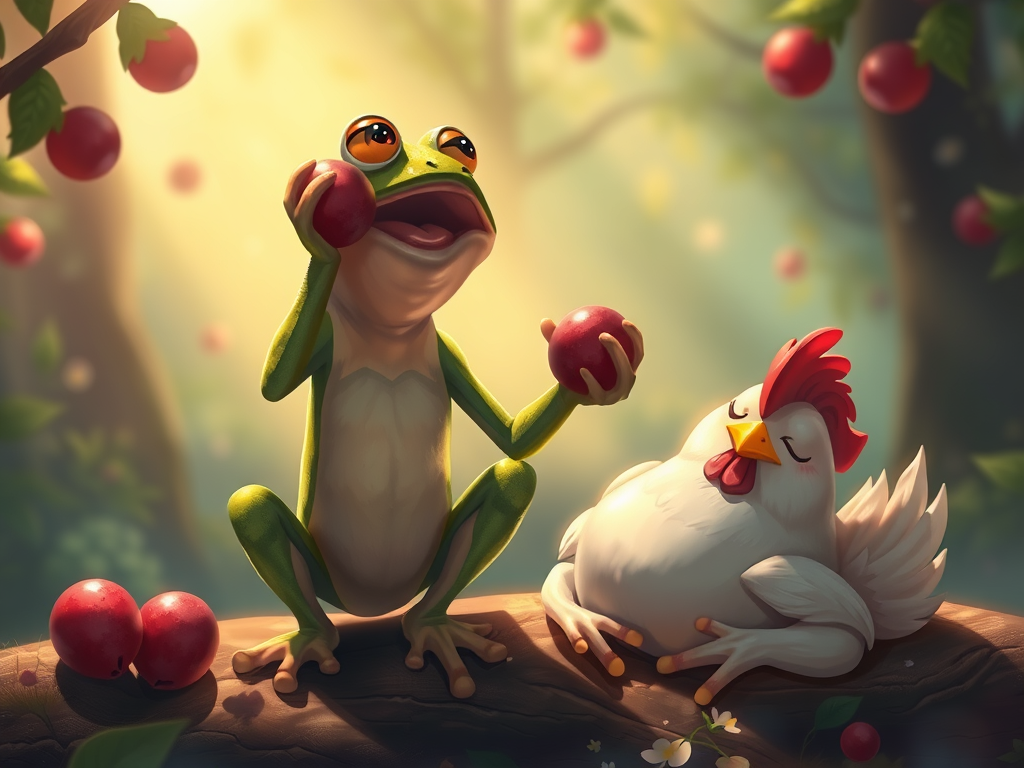
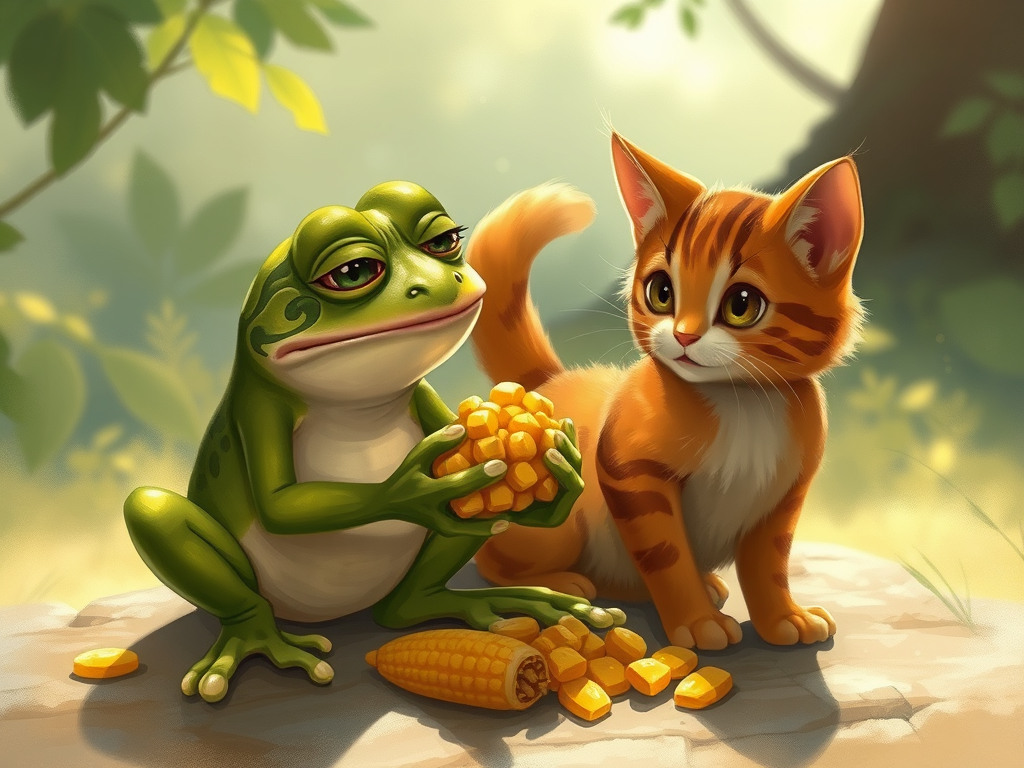
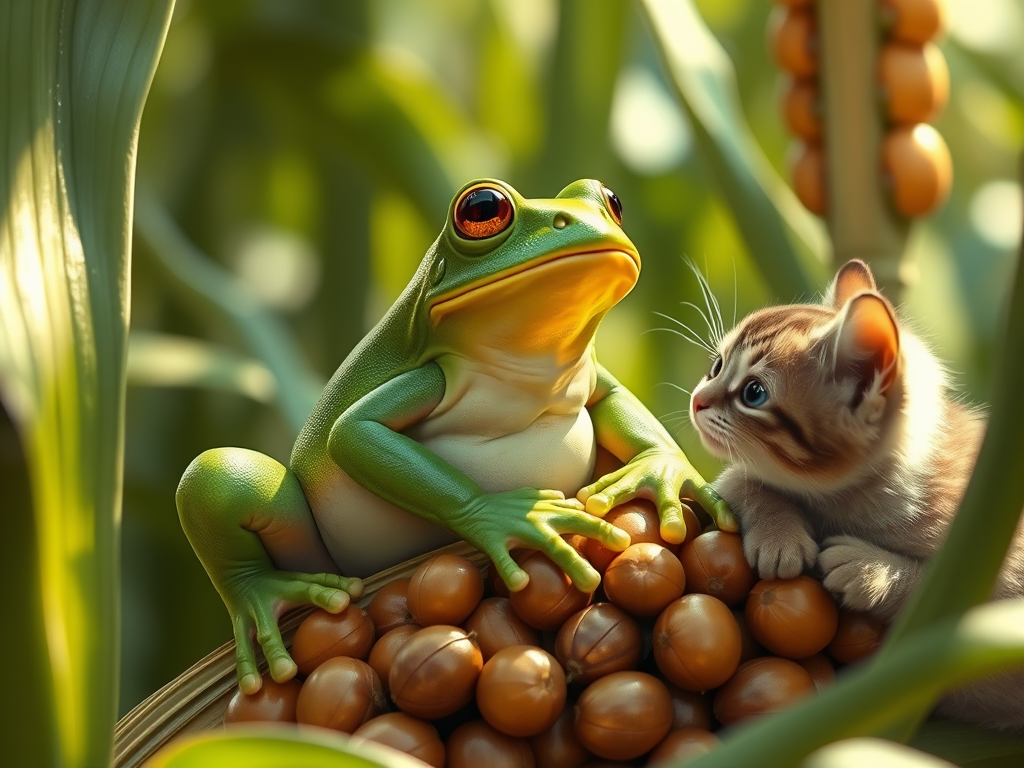
    🎭 Short Story: The Loudest Mistake 🤫🐱🐔🐸


    Let’s visit the magical forest to see who can keep a secret.
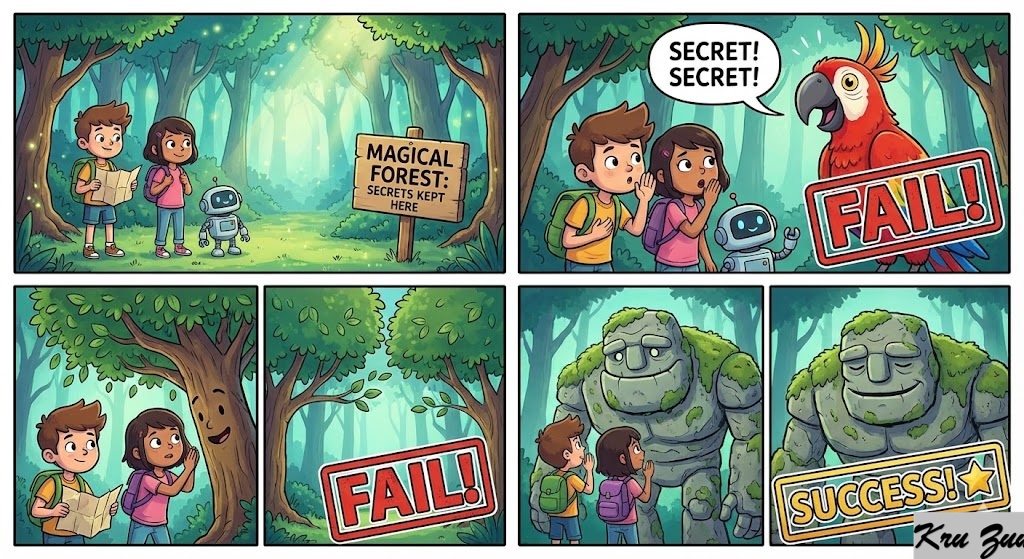

    🌟 The Cast


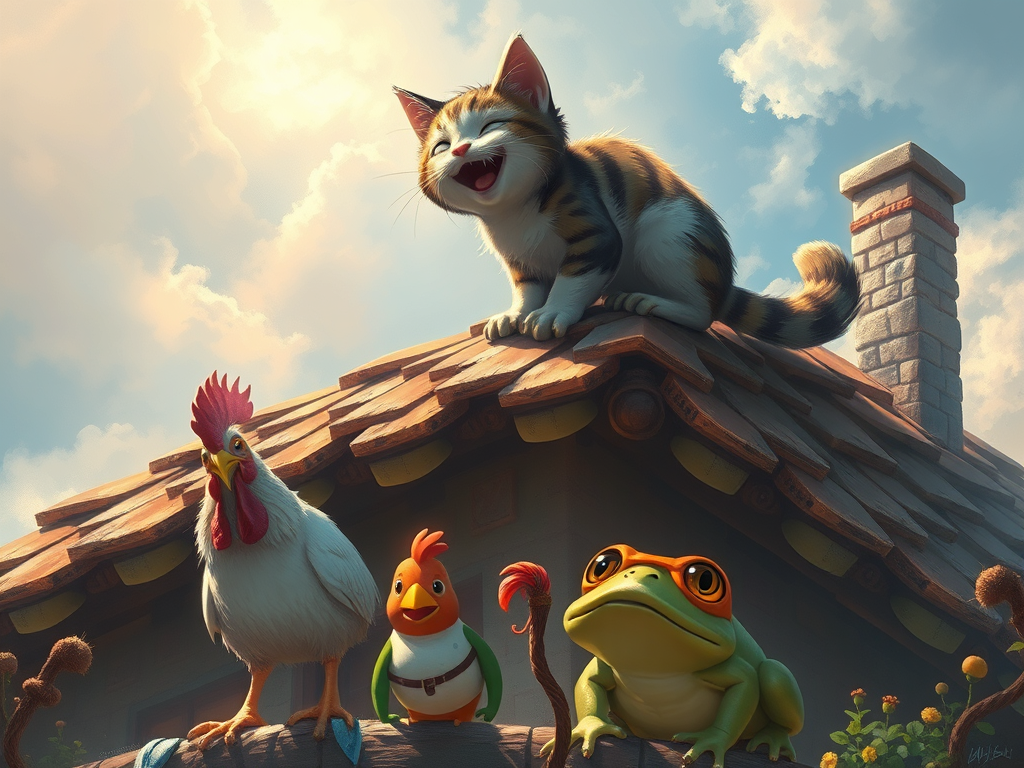
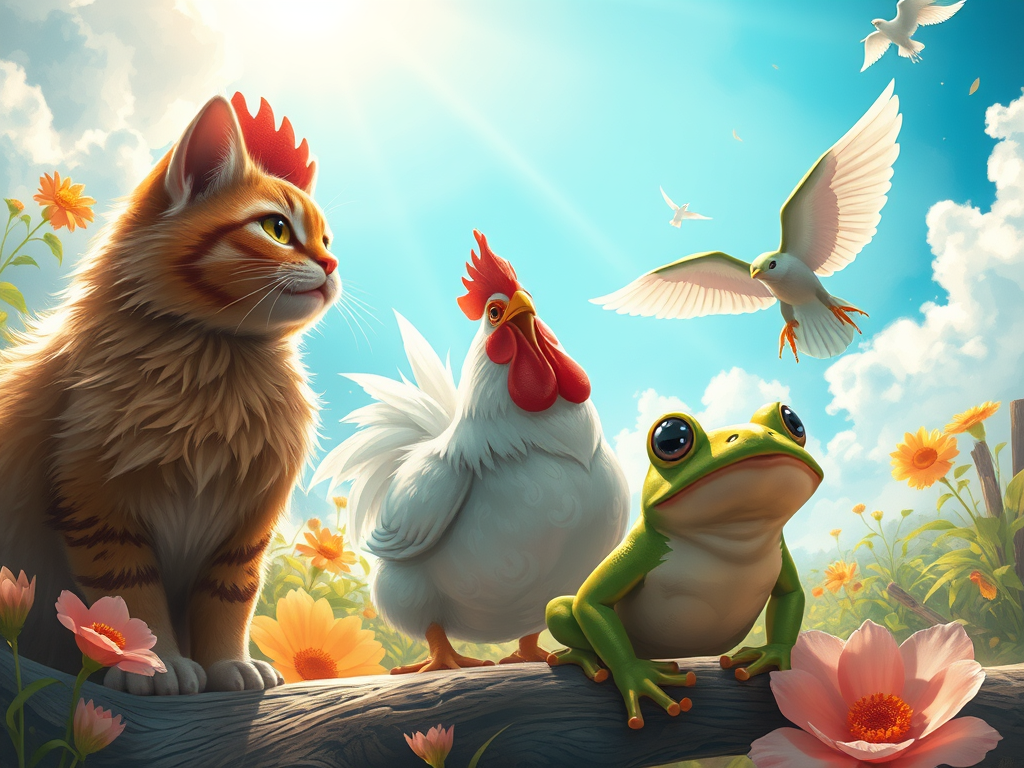
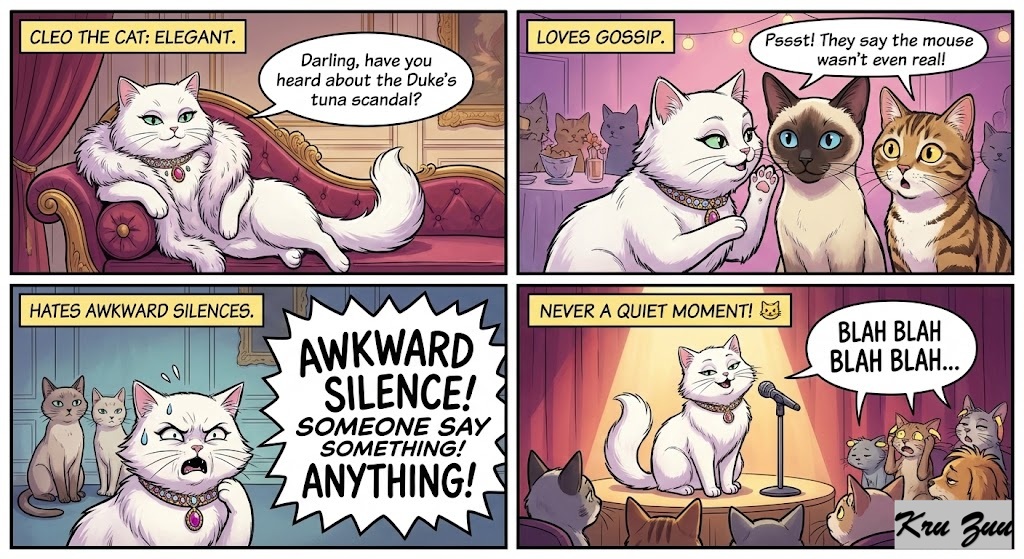
    Cleo the Cat: Elegant, loves gossip, hates awkward silences. 😼

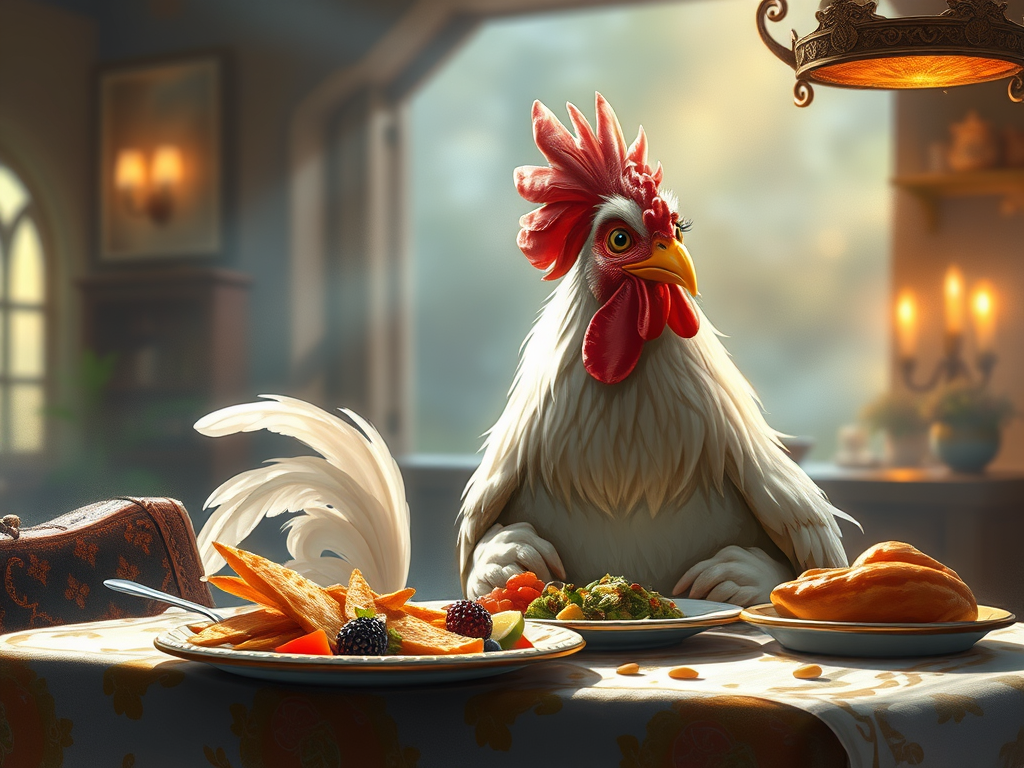
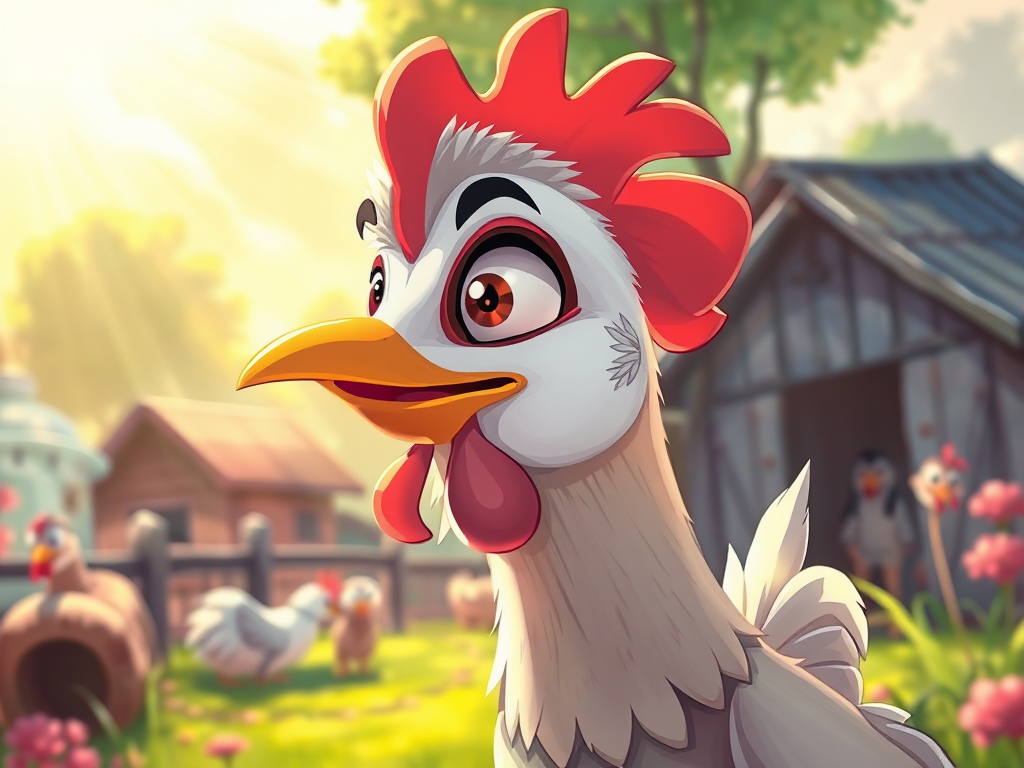
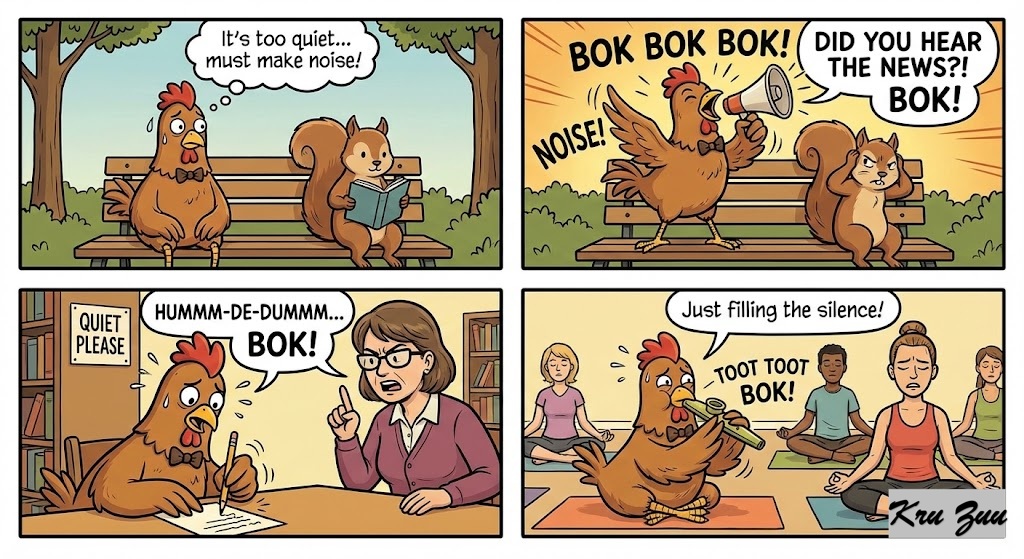
    Cluck the Chicken: Nervous, fills every quiet moment with noise. 🐔

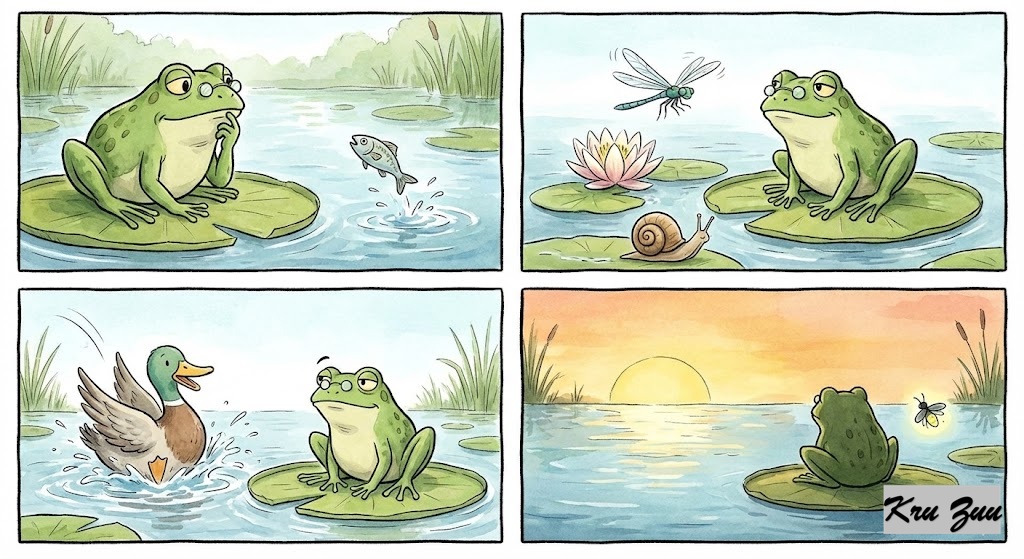
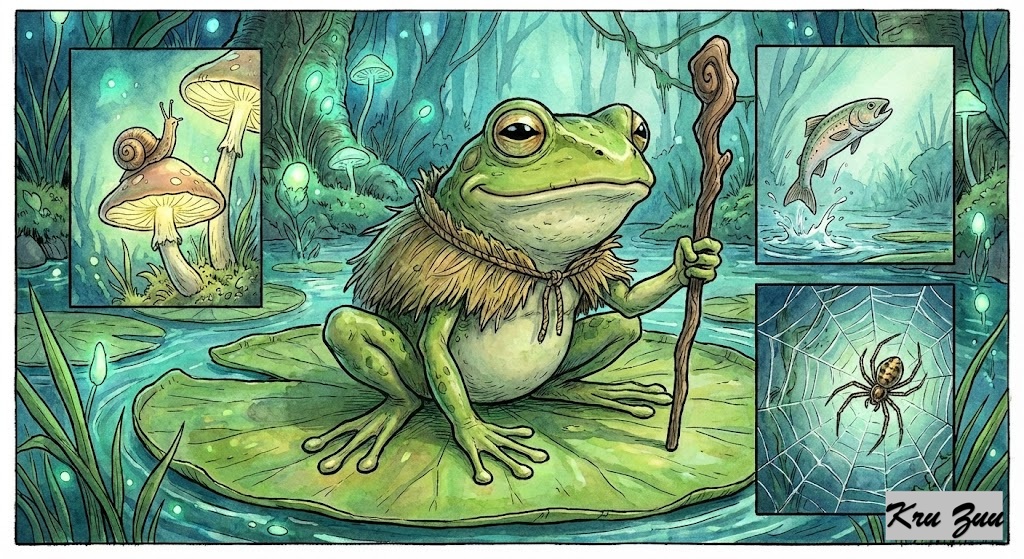
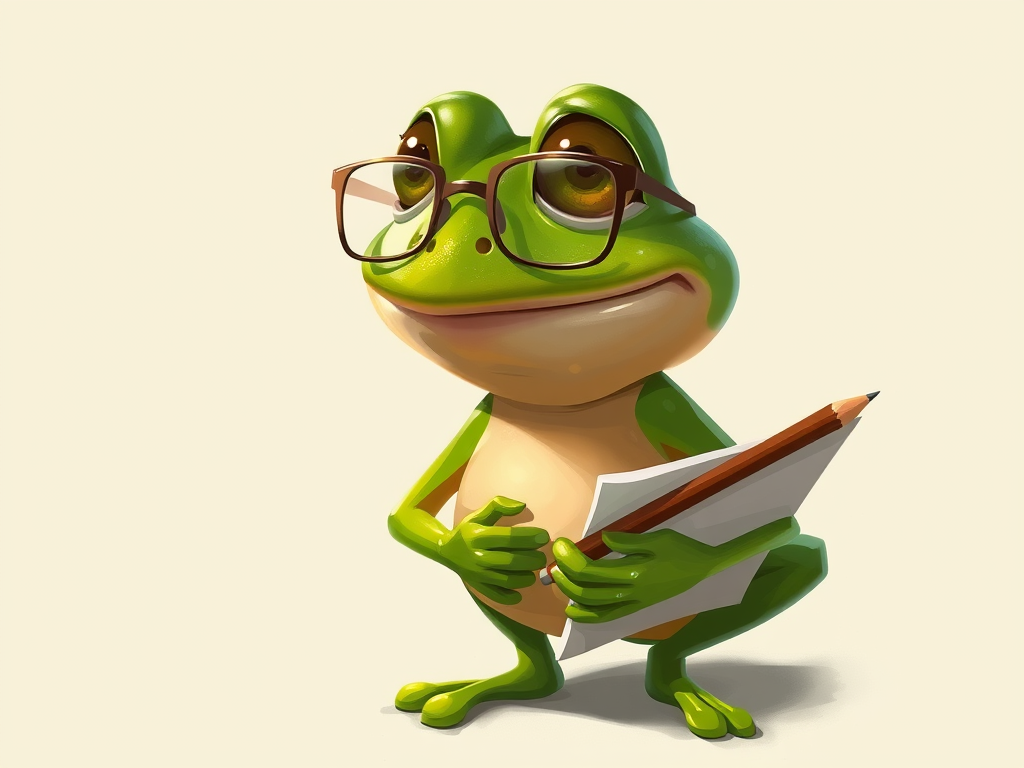
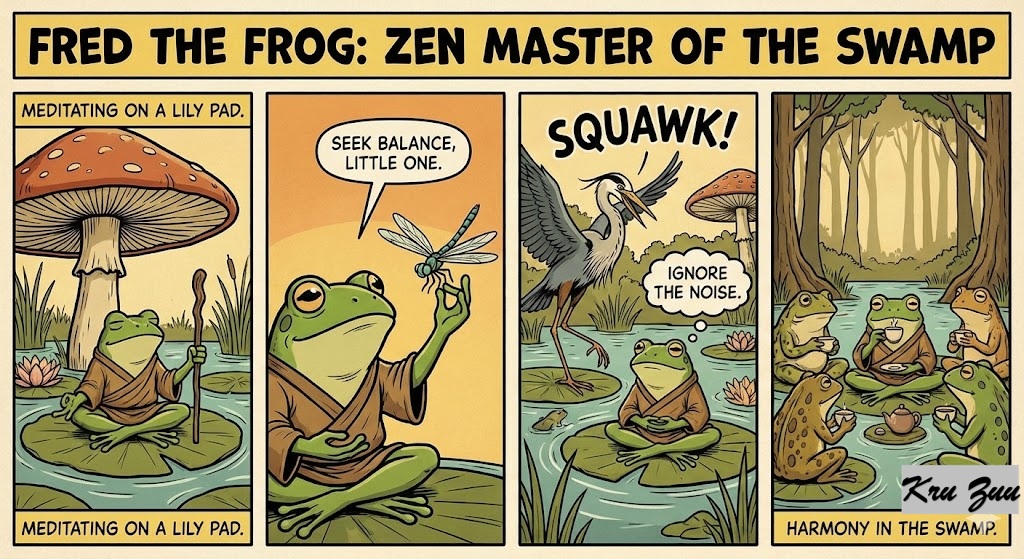
    Fred the Frog: The Zen master of the swamp. 🐸

    The Situation: It is the night of the “Great Forest Hide-and-Seek.” The winner gets a basket of the finest treats. The seeker is the Big Bad Wolf, who has very sharp ears.
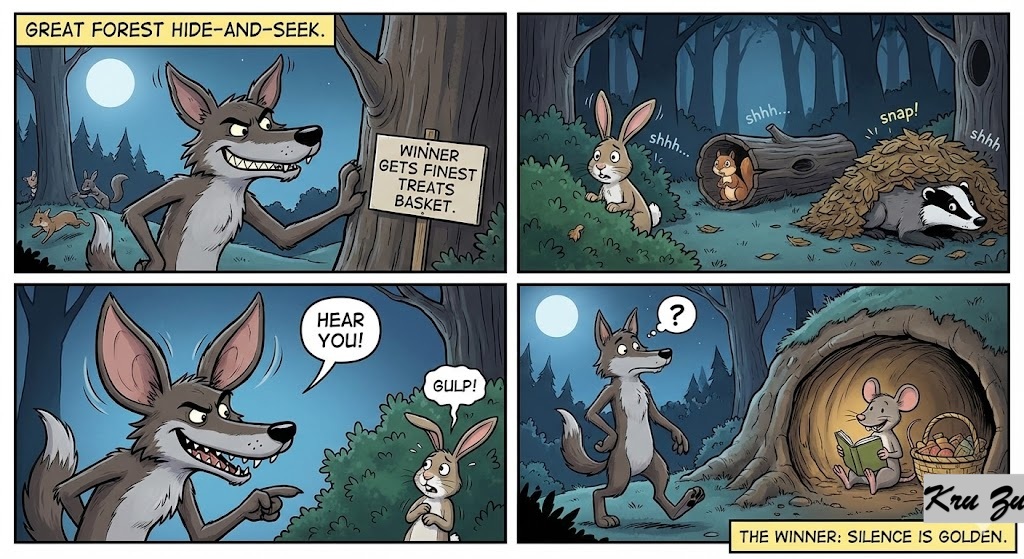

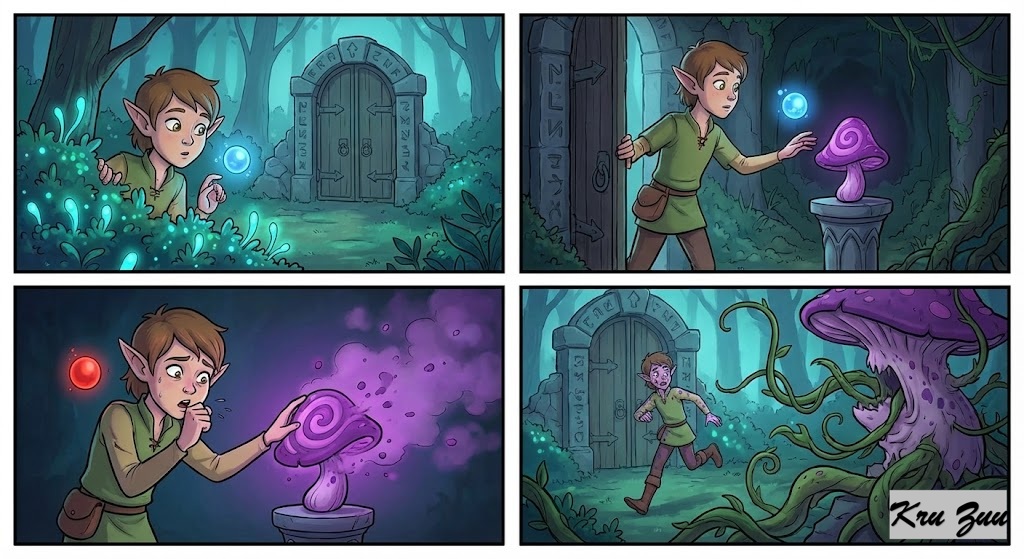
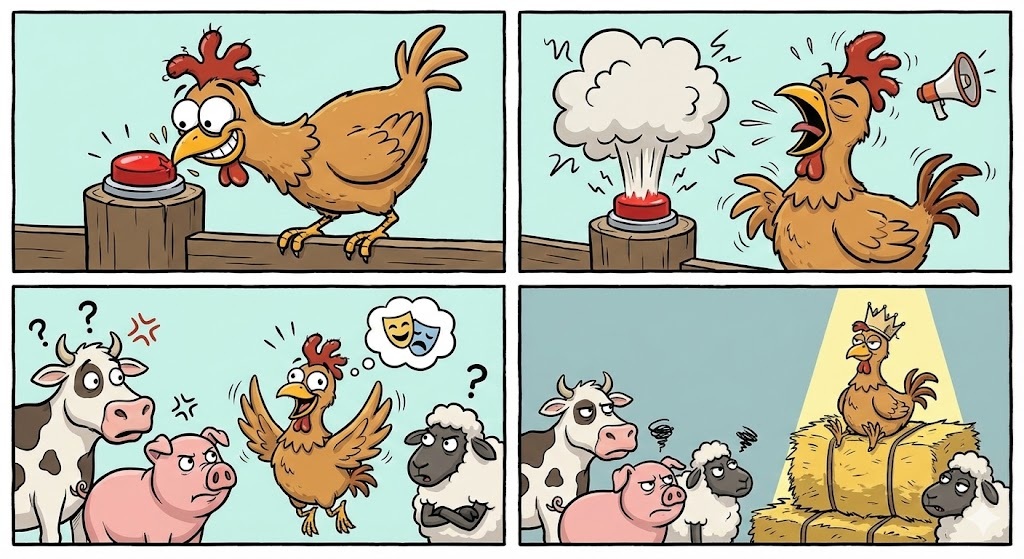
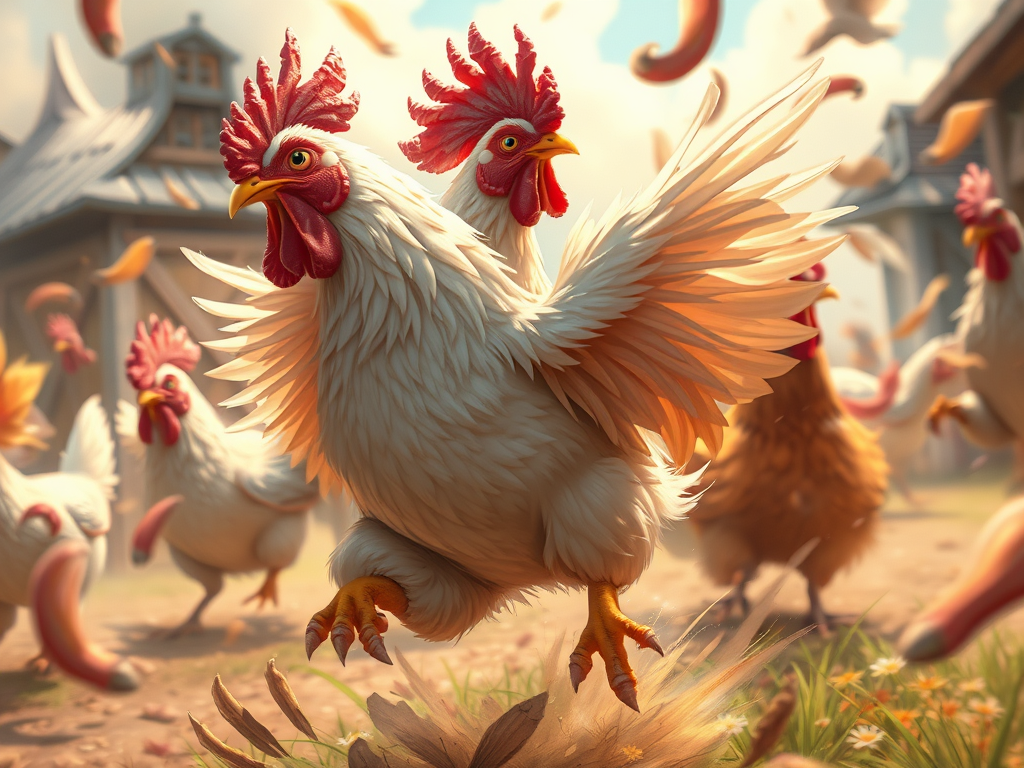
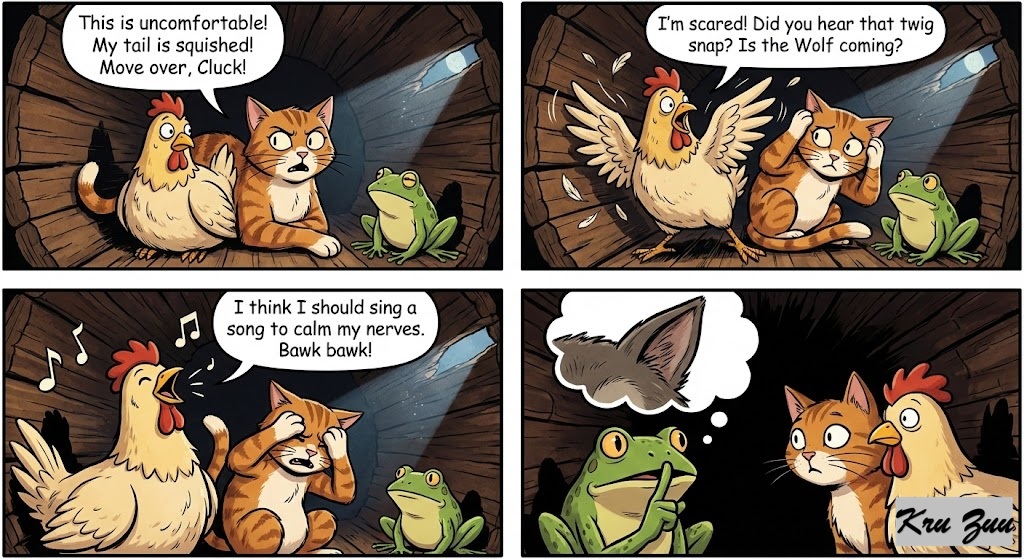
    The Conflict: Cleo, Cluck, and Fred find the perfect hiding spot inside a hollow log. It is dark and tight. “This is uncomfortable!” Cleo whispers loudly. “My tail is squished! Move over, Cluck!” “I’m scared!” Cluck squawks, flapping his wings. “Did you hear that twig snap? Is the Wolf coming? I think I should sing a song to calm my nerves. Bawk bawk!”

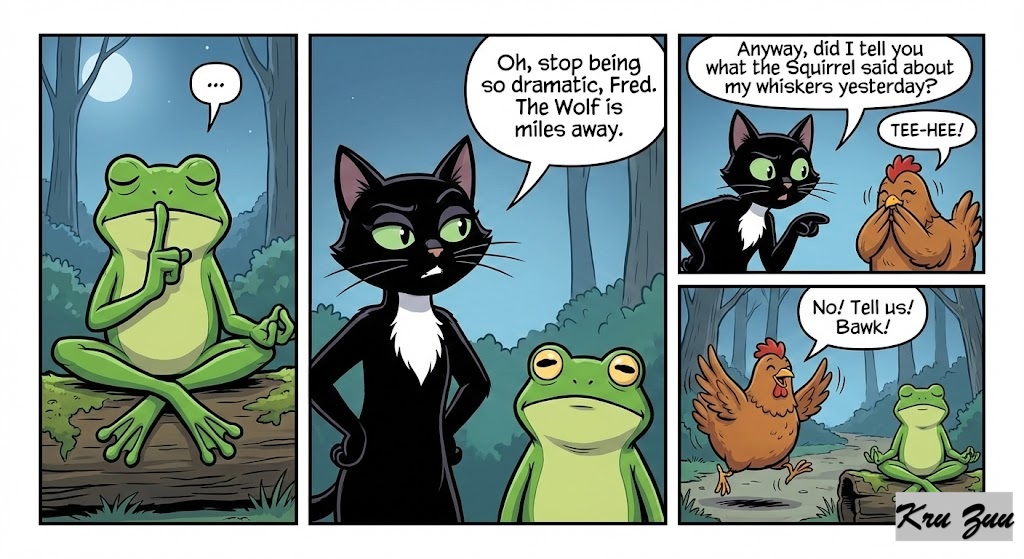
    The Reaction: Fred the Frog sits perfectly still. He closes his eyes. He breathes slowly. He puts a green finger to his lips. “…” Cleo rolls her eyes. “Oh, stop being so dramatic, Fred. The Wolf is miles away. Anyway, did I tell you what the Squirrel said about my whiskers yesterday?” Cluck giggles. “No! Tell us! Bawk!”

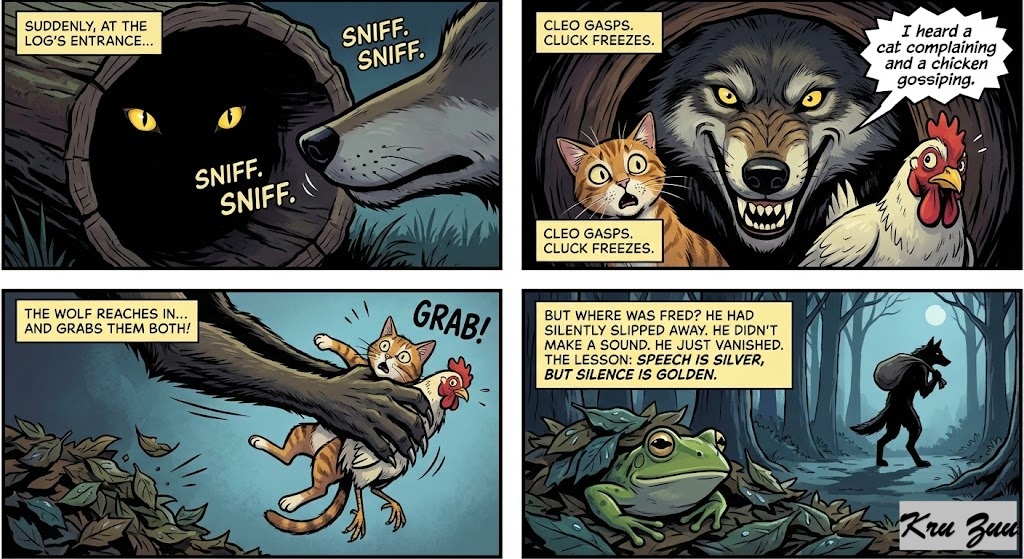
    The Lesson: Suddenly, two yellow eyes appear at the entrance of the log. Sniff. Sniff. The Wolf smiles. “I heard a cat complaining and a chicken gossiping.” Cleo gasps. Cluck freezes. The Wolf reaches in… and grabs them both! But where was Fred? In the moment the Wolf appeared, Fred had silently slipped under a pile of wet leaves. He didn’t make a sound. He didn’t brag. He didn’t scream. He just vanished.

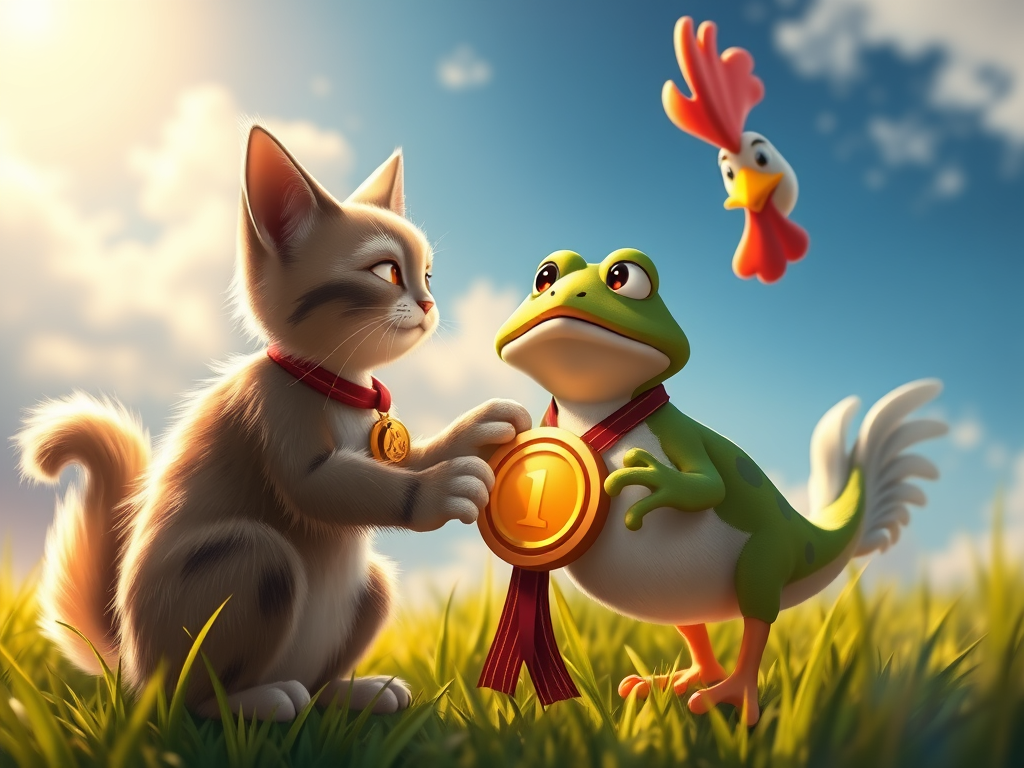
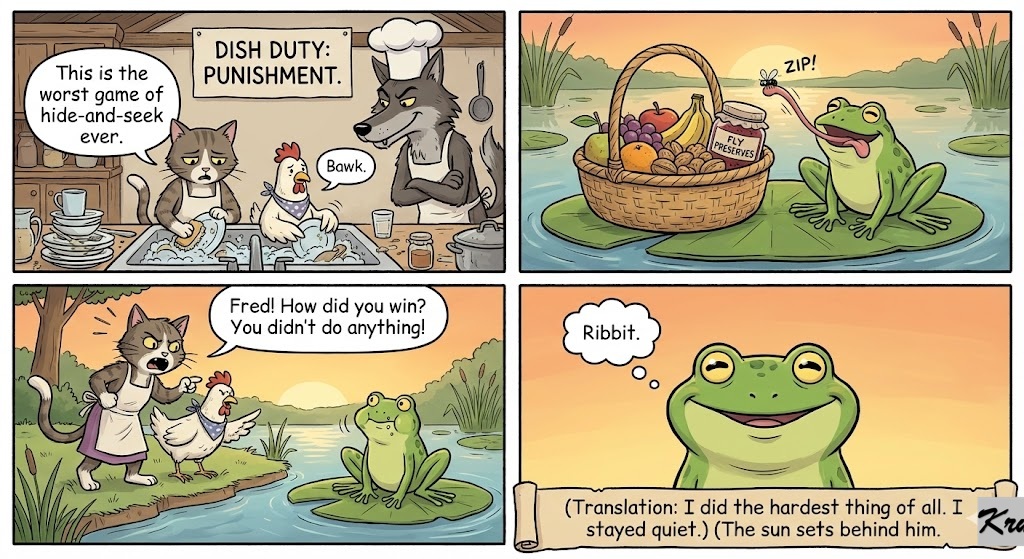
    The Resolution: Cleo and Cluck lost the game (and their treats). They spent the evening washing dishes for the Wolf as punishment. Fred won the basket of treats. He sat on his lily pad, eating a delicious fly. “Fred!” Cleo cried. “How did you win? You didn’t do anything!” Fred chewed slowly, swallowed, and smiled. “Ribbit.” (Translation: I did the hardest thing of all. I stayed quiet).

    The Moral: The open mouth catches the fly, but it also catches the predator. Silence is golden. 🏆
    🎓 Lesson for English Learners


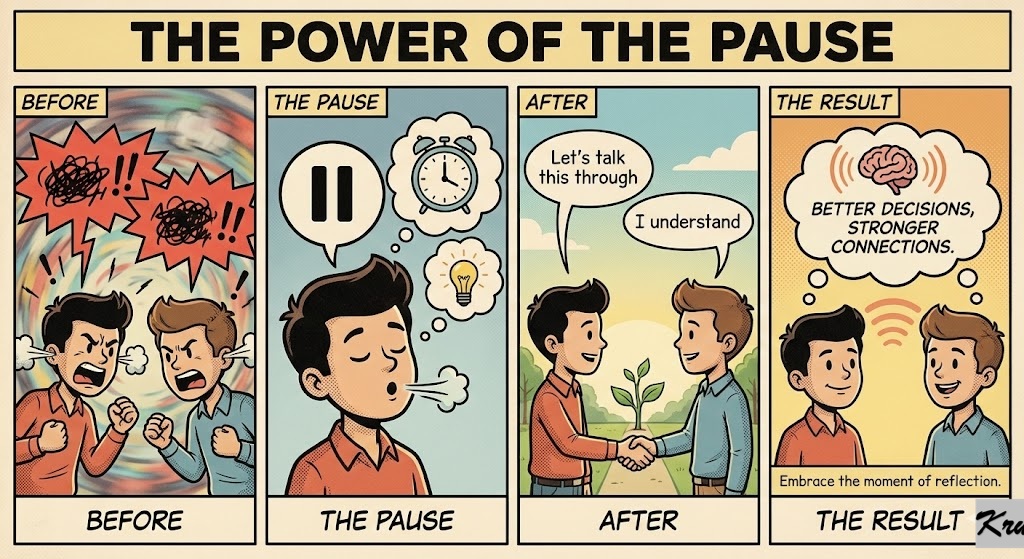
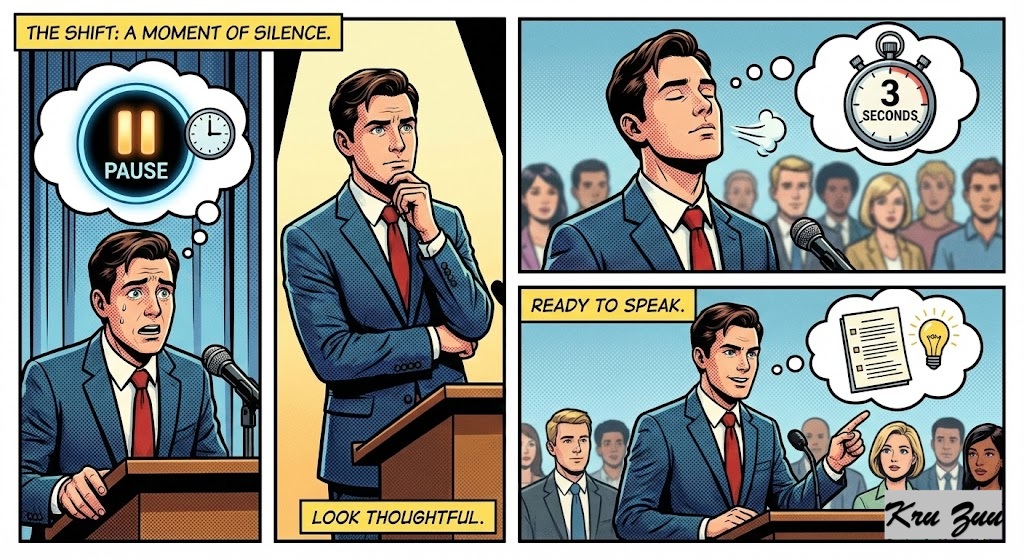
    The Power of the Pause.

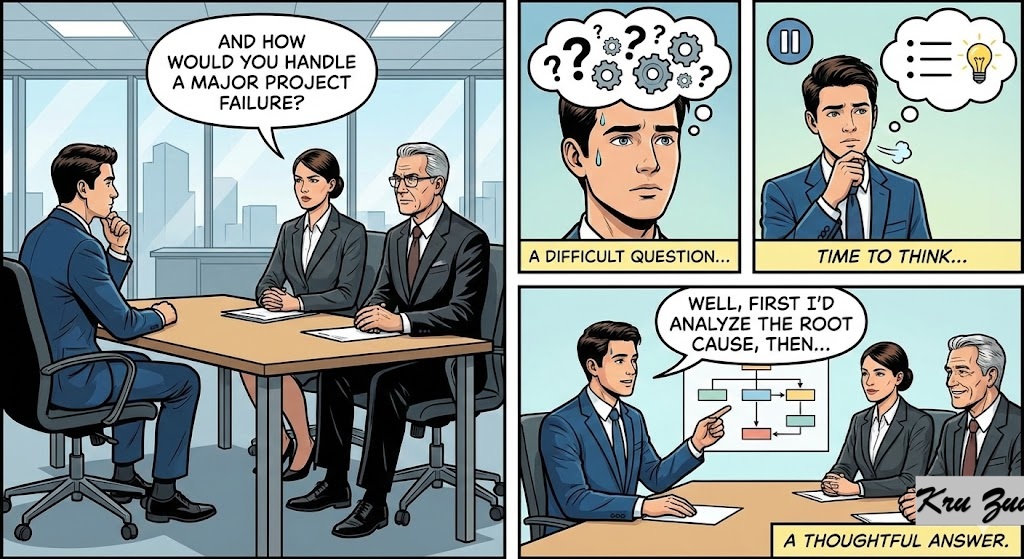
    Situation: You are in a job interview or a meeting. Someone asks you a difficult question.

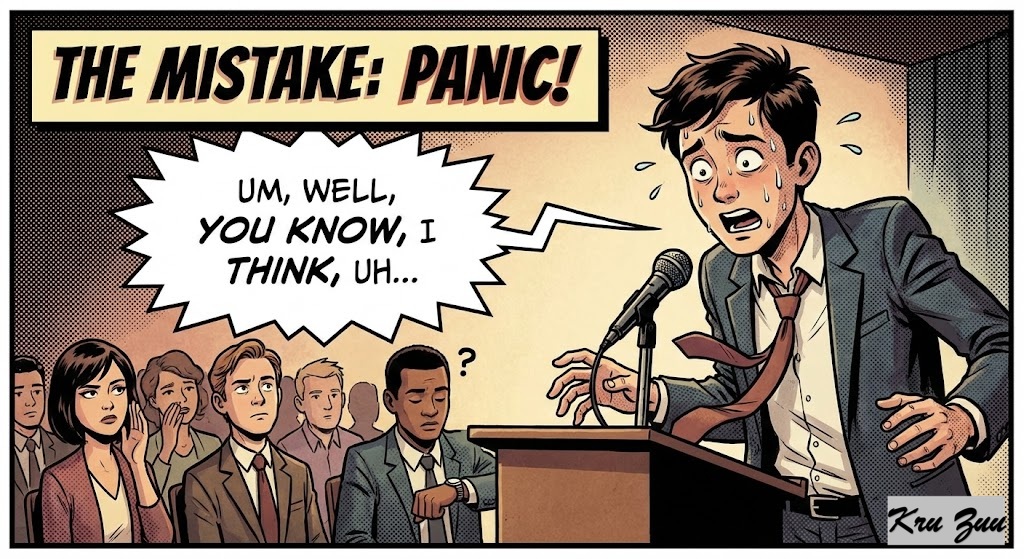
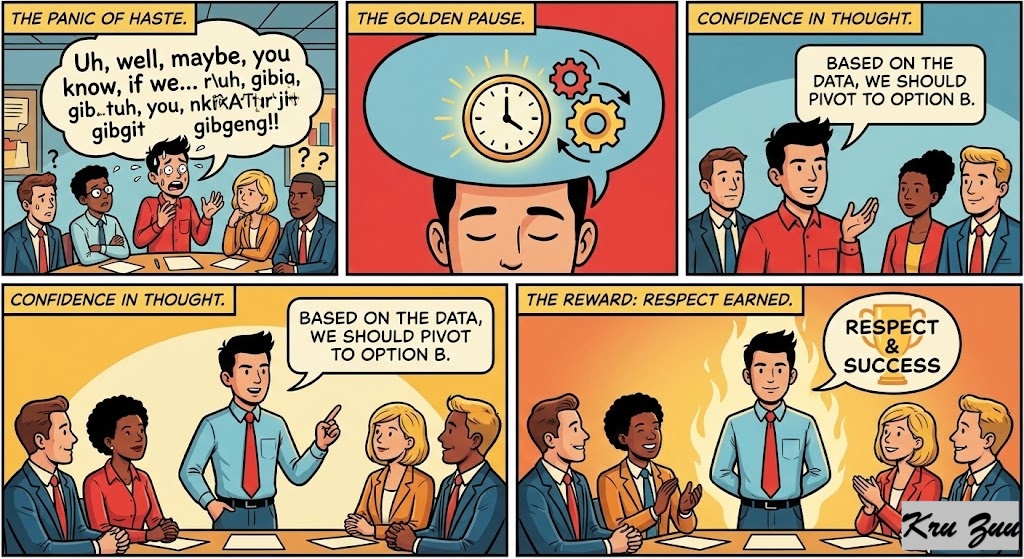
    The Mistake: You panic and start talking immediately (“Um, well, you know, I think, uh…”). You look nervous.

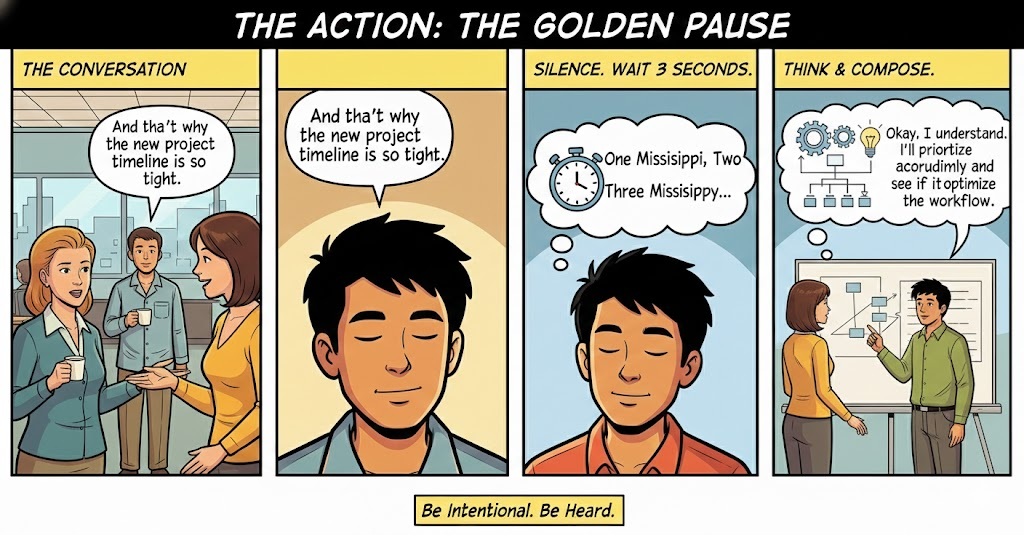
    The Shift: Use the “Golden Pause.” Take 3 seconds of silence. Look thoughtful.

    You Say: “That is an interesting question. Let me think about that for a moment…” (Then give a clear answer).
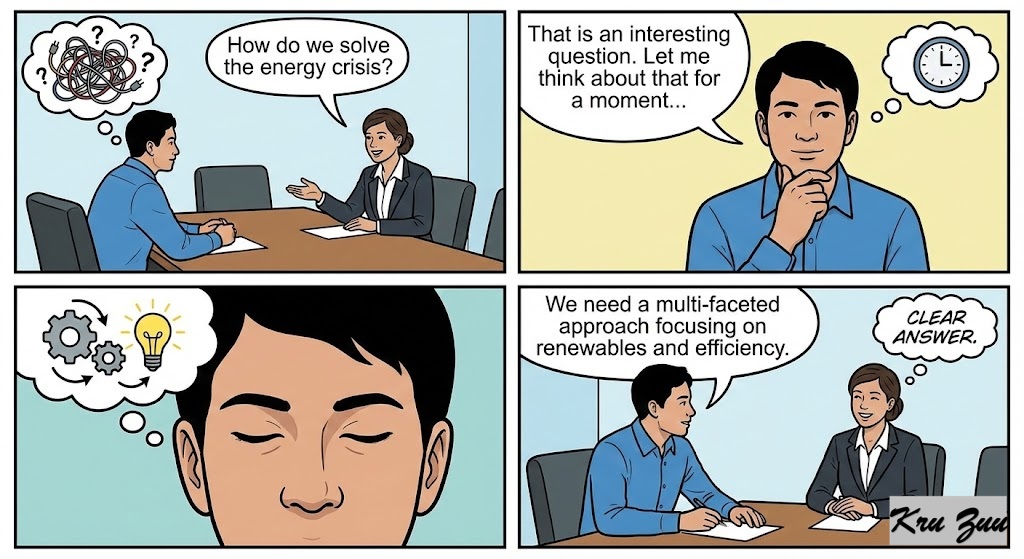

    Why: This shows confidence. It shows you think before you speak.

    💬 Your Turn: The “3-Second” Challenge 🚀


    Do you want to cure your “Villain” talking habits?

    The Challenge:
    For one whole day, follow the 3-Second Rule.
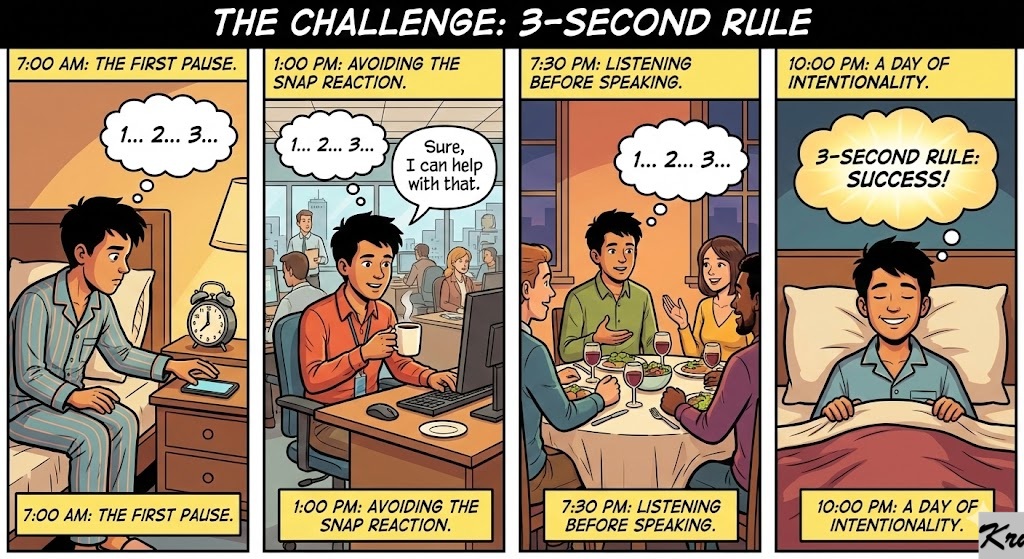

    The Action: Whenever someone finishes talking, count to 3 in your head (One Mississippi, Two Mississippi, Three Mississippi) before you respond.

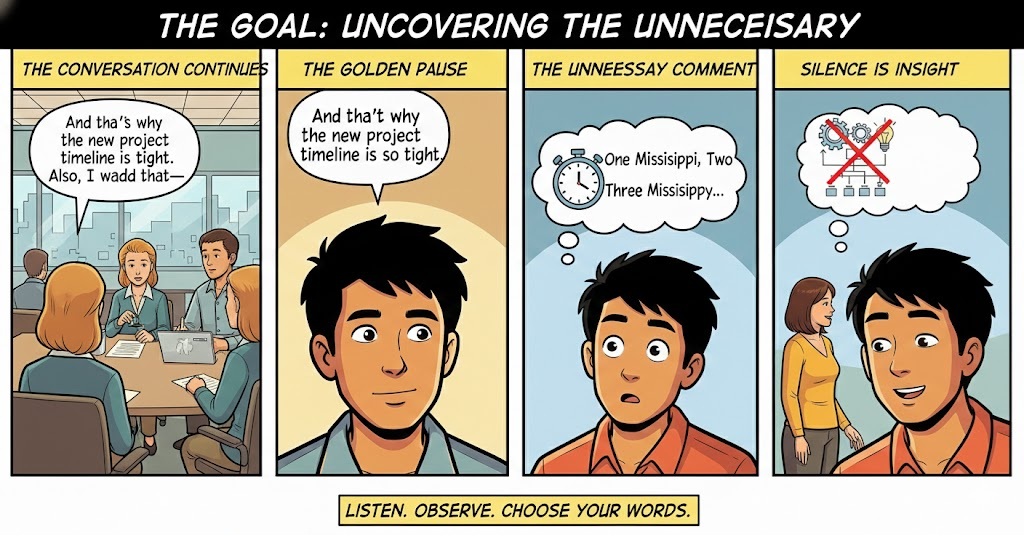
    The Goal: You will realize that often, the other person wasn’t finished talking! Or, you will realize your comment wasn’t necessary.

    👇 Question for the comments: Have you ever said something you immediately regretted? Or has staying silent ever saved you? Tell us your story below!

    By Zubeyir YURTKURAN

    https://www.facebook.com/BrainBattleground/

    https://www.facebook.com/zubeyr.yurtkuran/

    https://www.instagram.com/zubeyryurtkuran/

    https://www.youtube.com/@BrainBattleground-b3p

    https://www.instagram.com/brainbattleground/

  • 🤫 The Daily Shield: The Art of Peace

    🤫 The Daily Shield: The Art of Peace

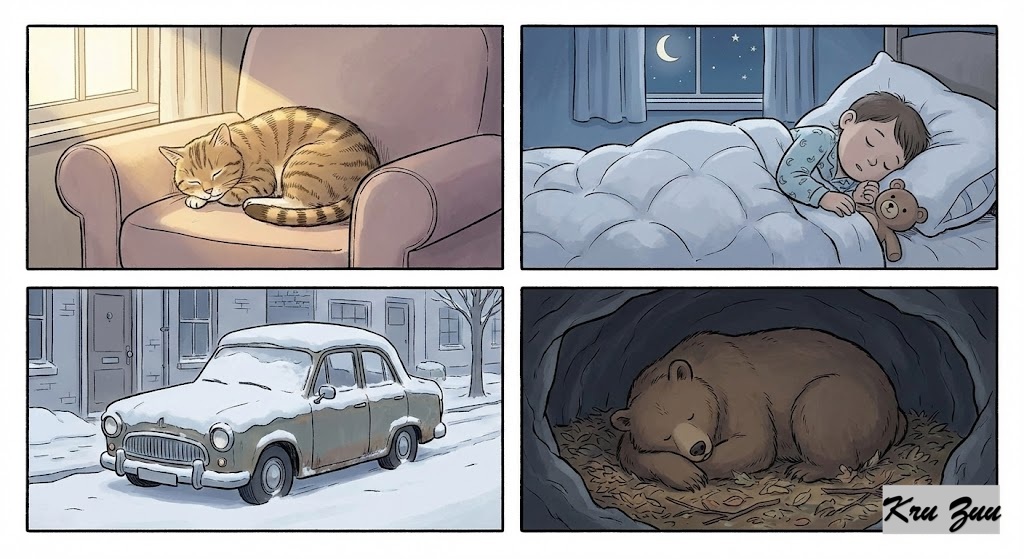
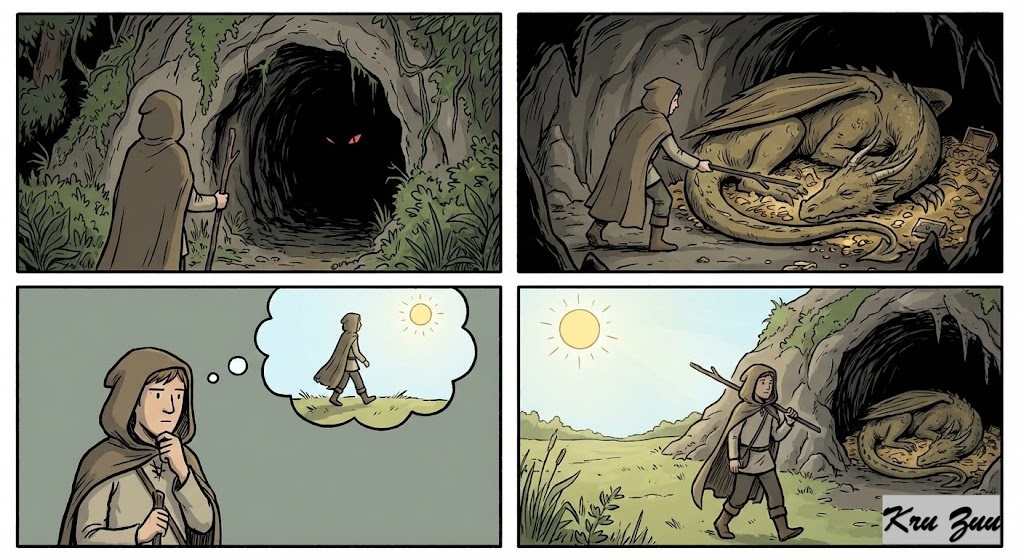
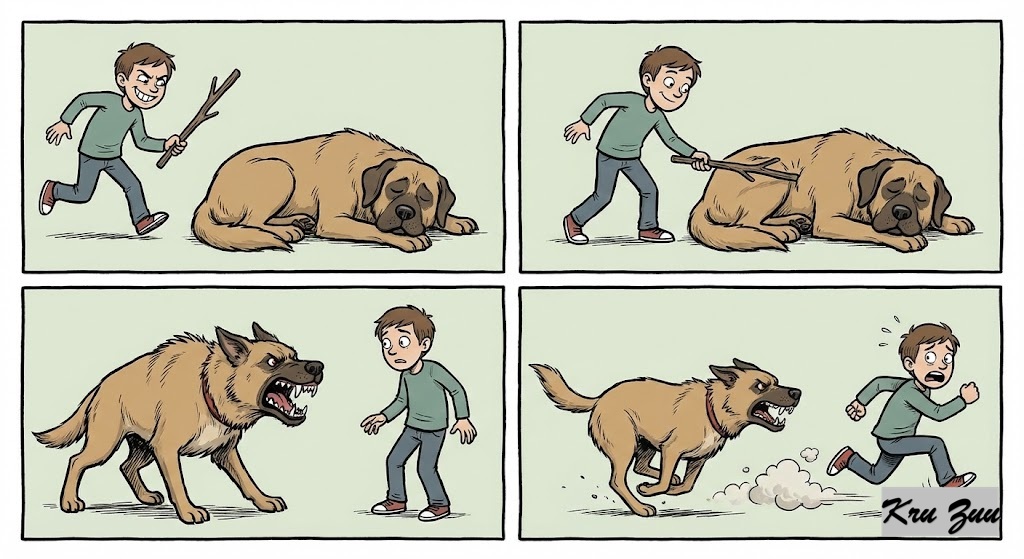
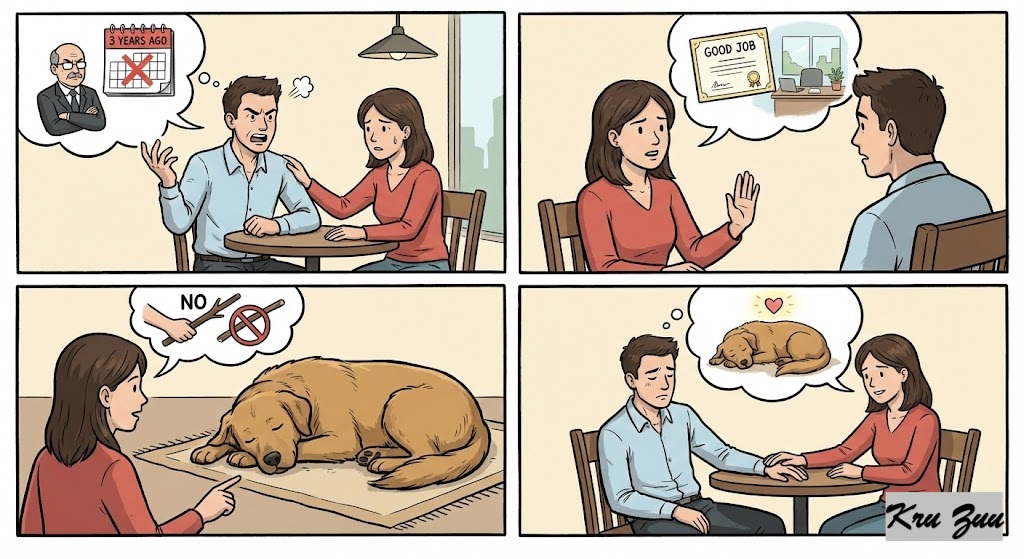
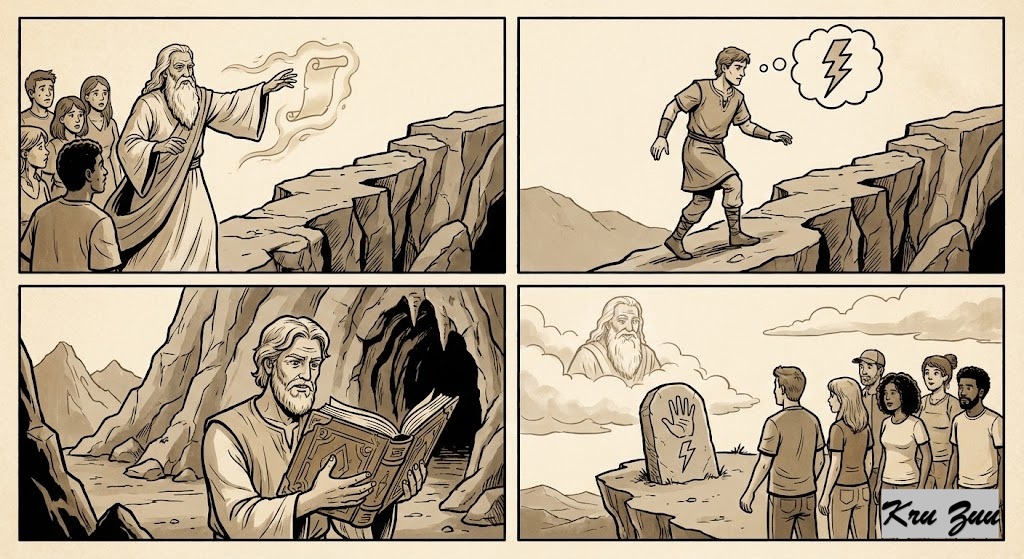
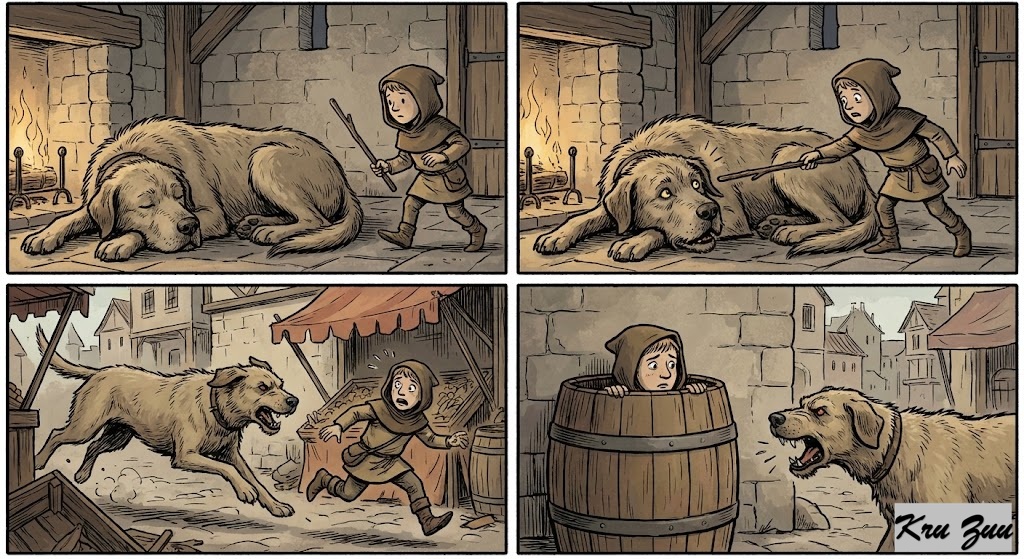
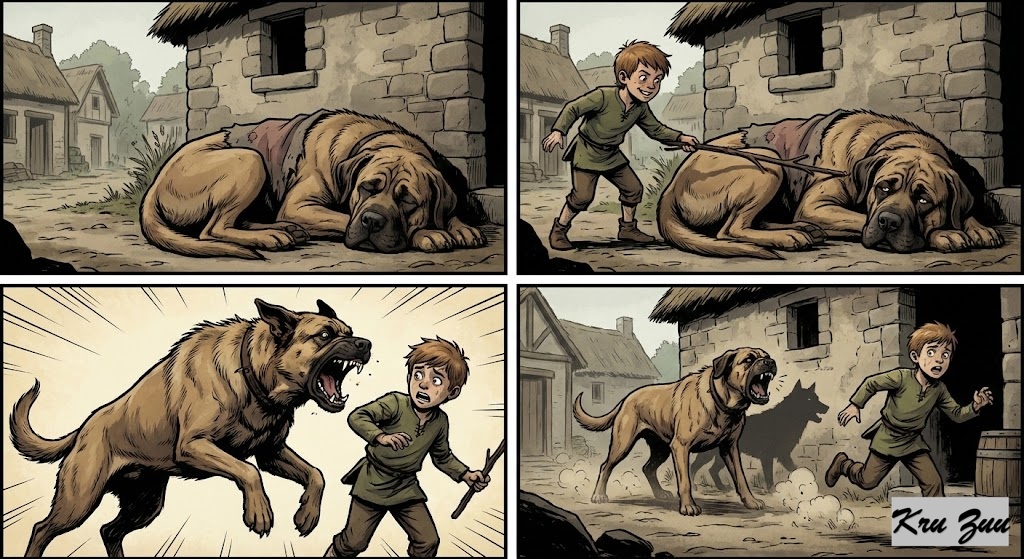
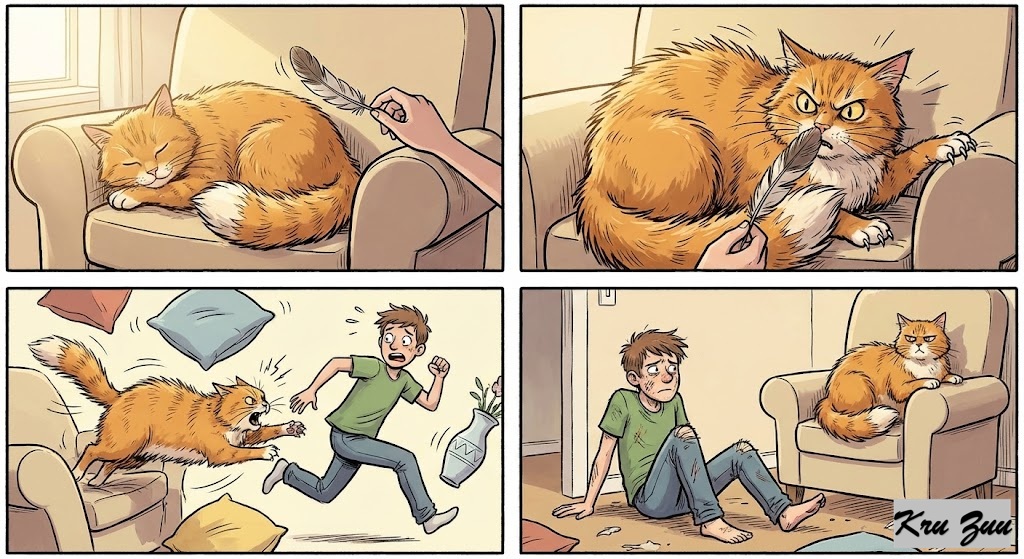
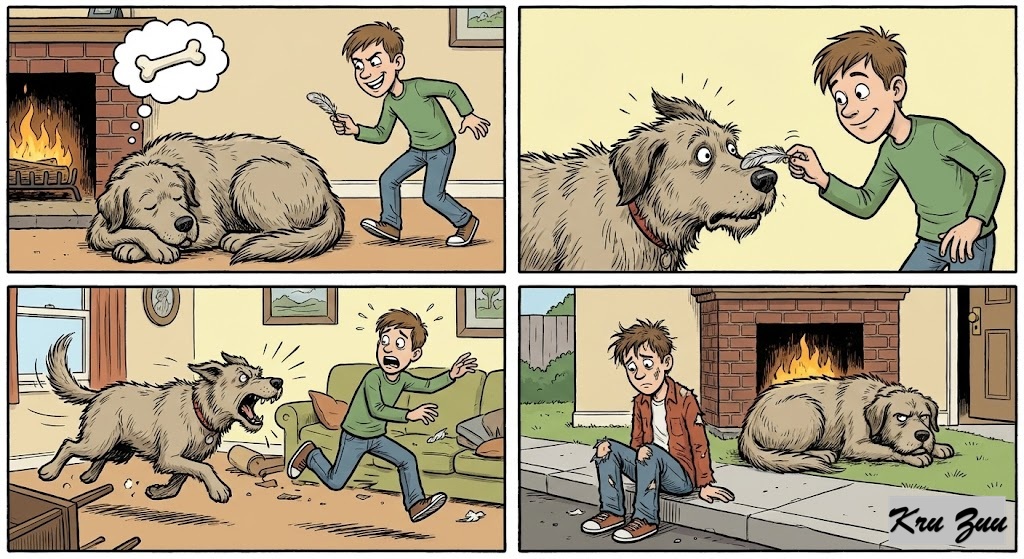
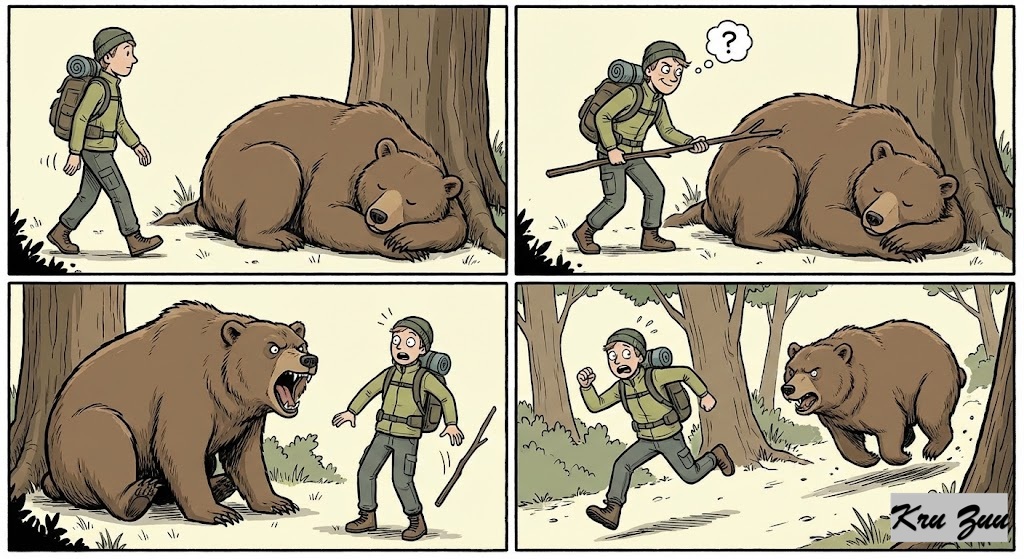
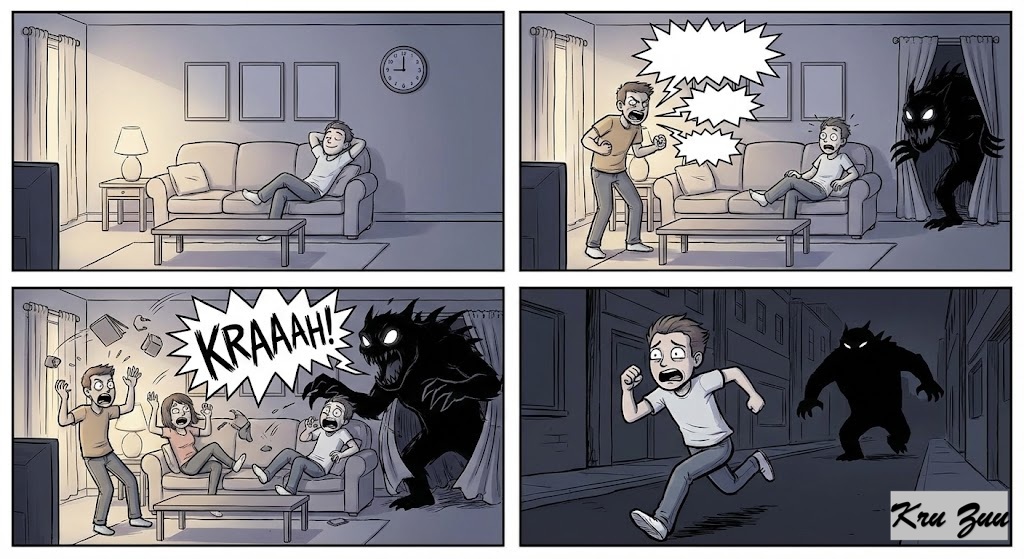
    “Let sleeping dogs lie.”


    😈 The Villain (The Poker)

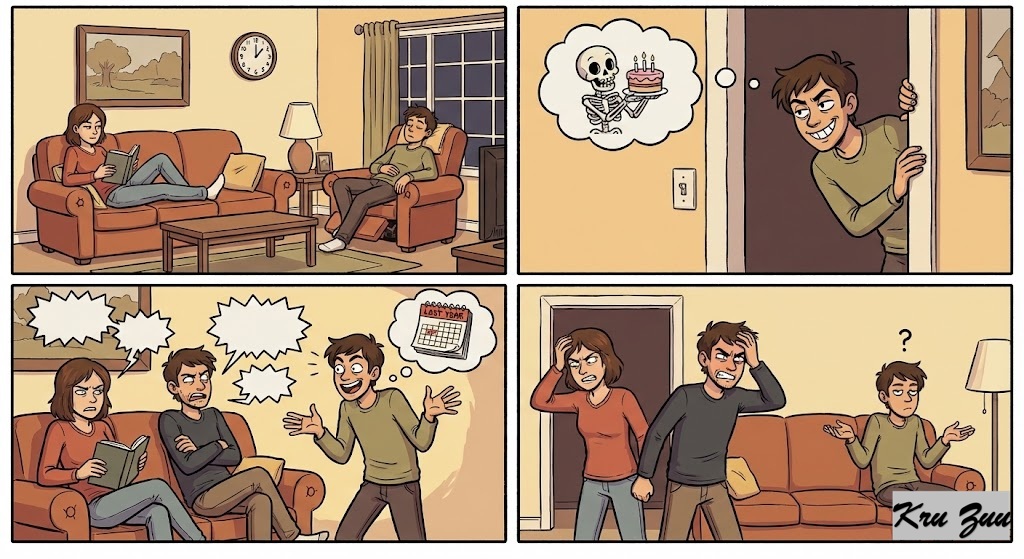
    Things are finally calm. The argument ended three days ago. Everyone is relaxing. But then… you walk in. You are bored with peace. You say: “Hey, remember last year when you forgot my birthday?” or “I’m still not sure why you looked at me like that yesterday.” 👉 You poke the wound. You dig up old skeletons. You insist on “talking it out” even when there is nothing left to say.

    The Result? Chaos returns. The calm evening turns into a screaming match. You just woke up the beast, and now you have to run. 🧟‍♂️


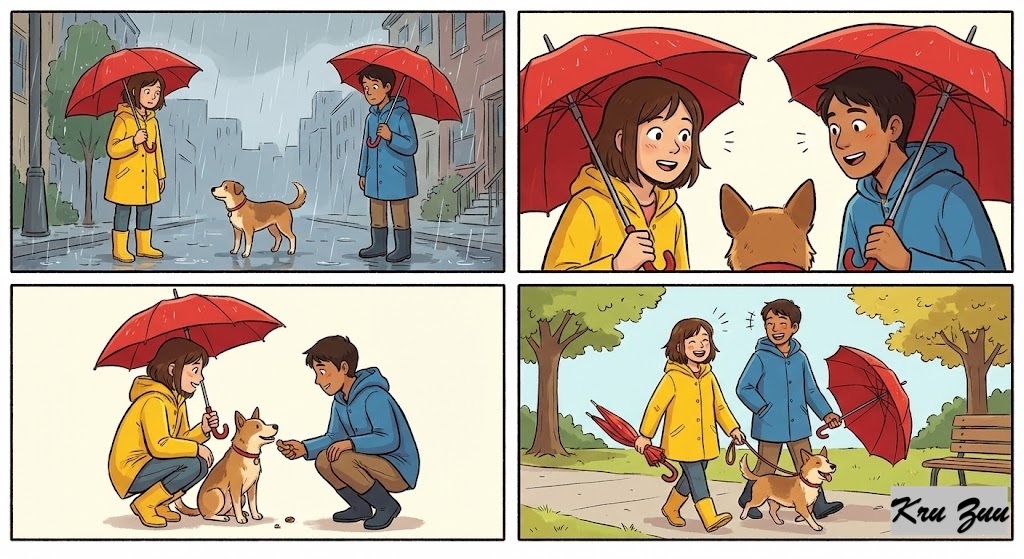
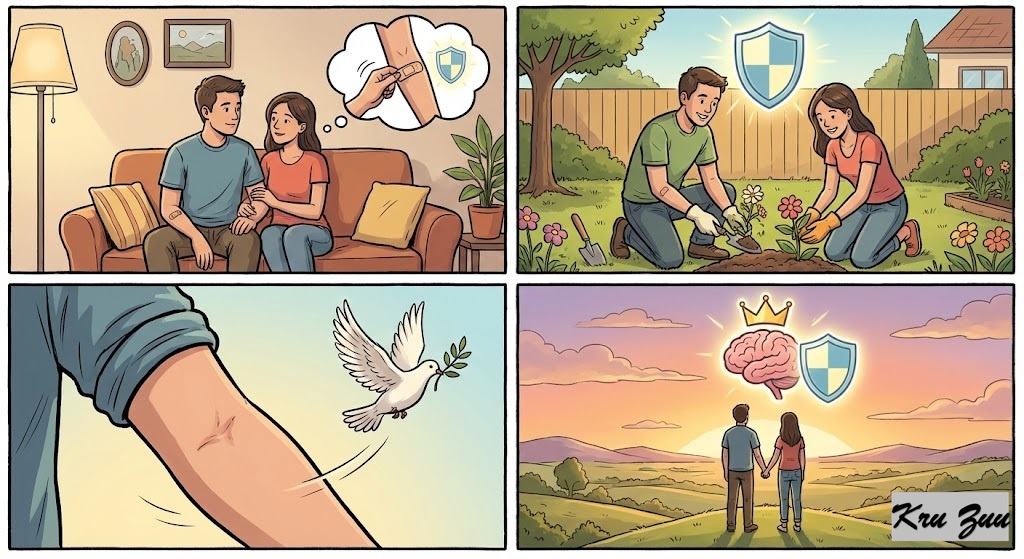
    😇 The Hero (The Peacemaker): You notice a sensitive topic, but you see that everyone is currently happy. You make a conscious choice. You realize that digging up the past won’t fix the future—it will only create new pain. You smile and say nothing. You focus on today.

    The Result? The moment remains peaceful. Relationships heal naturally over time because you didn’t pick at the scab. You chose wisdom over drama. 🛡️


    ⚖️ The Reality


    Some problems are like sleeping monsters. If they are quiet, they can’t bite you. Bringing up old grievances or reopening settled arguments rarely leads to a “better understanding.” Usually, it just leads to noise.


    💎 The Secret

    Peace is not just the absence of war; it is the discipline to keep your mouth shut when everything is calm.

    🧐 The Anatomy of the Proverb


    This is your permission to leave things alone.


    Let (Verb): Allow; permit.


    Sleeping (Adjective): Inactive; quiet; at rest.


    Dogs (Noun): A metaphor for trouble, old arguments, or hidden secrets.


    Lie (Verb): To rest in a horizontal position (stay down).


    Simpler Version: Don’t look for trouble. / Don’t restart an old conflict.


    📚 Vocabulary Vault


    Provoke (Verb): To stimulate or give rise to anger (poking the dog). 😡


    Dormant (Adjective): Having normal physical functions suspended or slowed down for a period of time; in or as if in a deep sleep.


    Grievance (Noun): A real or imagined wrong or other cause for complaint or protest.


    Tact (Noun): Sensitivity in dealing with others or with difficult issues.


    Instigate (Verb): To bring about or initiate (an action or event).


    🧠 Grammar Focus: Imperative Mood


    This idiom is almost always used as a command or advice (Imperative).


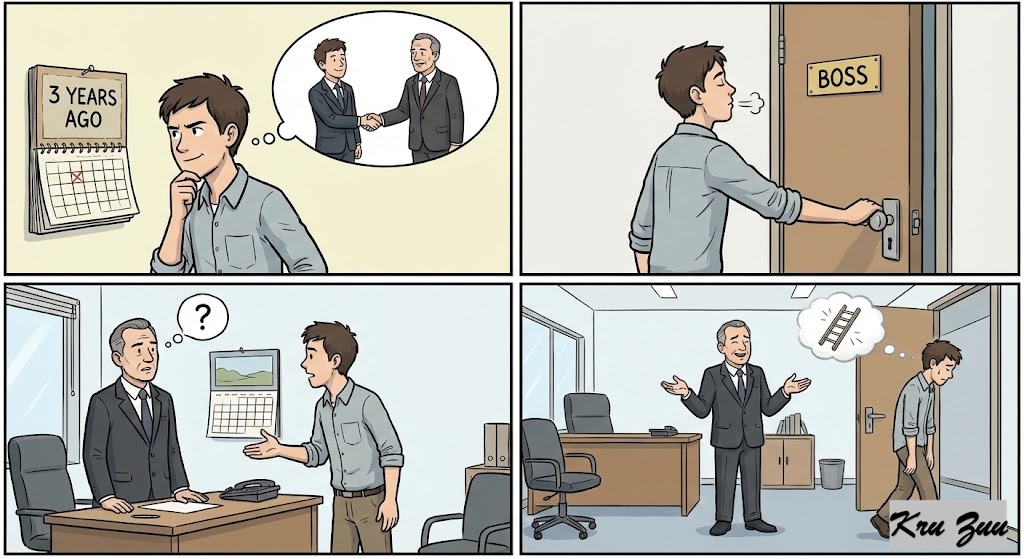
    Person A: “I want to ask my boss why he didn’t promote me three years ago.”


    Person B: “Don’t do it. You have a great job now. Let sleeping dogs lie.”

    📜 History: Origin and Spread


    Where did this wise warning come from?

    The Origin: The legendary writer Geoffrey Chaucer used a version of this in the 1300s! He wrote, “It is nought good a slepyng hound to wake.”

    The Logic: Before domesticated pets, dogs were working animals—guards and hunters. They were often fierce. If you woke a sleeping guard dog suddenly, it would likely bite your face before realizing who you were.

    Global Cousins

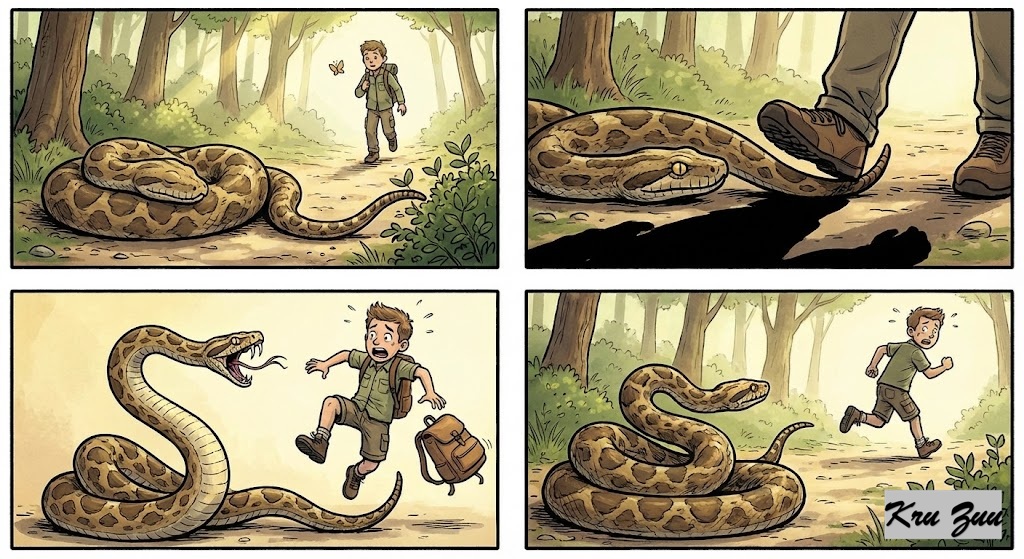
    🇹🇷 Turkish: “Uyuyan yılanın kuyruğuna basma.” (Don’t step on the tail of a sleeping snake.)

    🇫🇷 French: “N’éveillez pas le chat qui dort.” (Don’t wake the sleeping cat.)

    🇩🇪 German: “Schlafende Hunde soll man nicht wecken.” (One should not wake sleeping dogs.)

    🎯 Impact on Life: The Pros & Cons


    ✅ The Pros (The Shield)


    Stress Reduction:
    You save your energy for problems that actually matter today.


    Harmony: You become known as an easy-going person, not a drama-seeker.


    ❌ The Cons (The Trap)


    Avoidance:
    Be careful. Don’t use this idiom to ignore serious problems that are getting worse. If the “dog” has a disease (a toxic issue), letting it sleep won’t cure it.

    🎭 Short Story: The Cave of Grumpy Bears 🐸🐱🐔


    Let’s return to the magical forest to see why curiosity can be dangerous.


    🌟 The Cast


    Cleo the Cat:
    Cautious, elegant, dislikes dirty paws. 😼


    Cluck the Chicken: Impulsive, loud, loves drama. 🐔


    Fred the Frog: The wise observer on the lily pad. 🐸


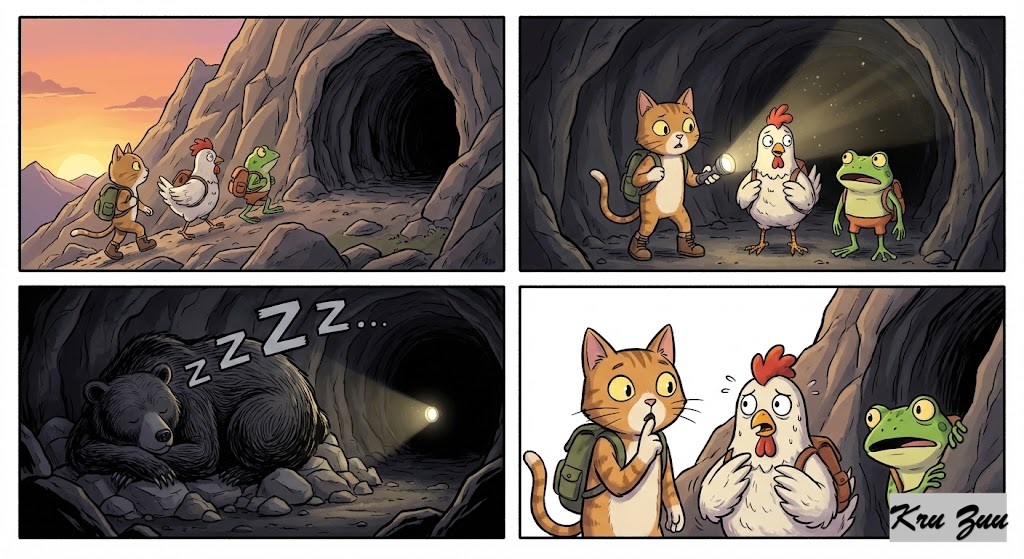
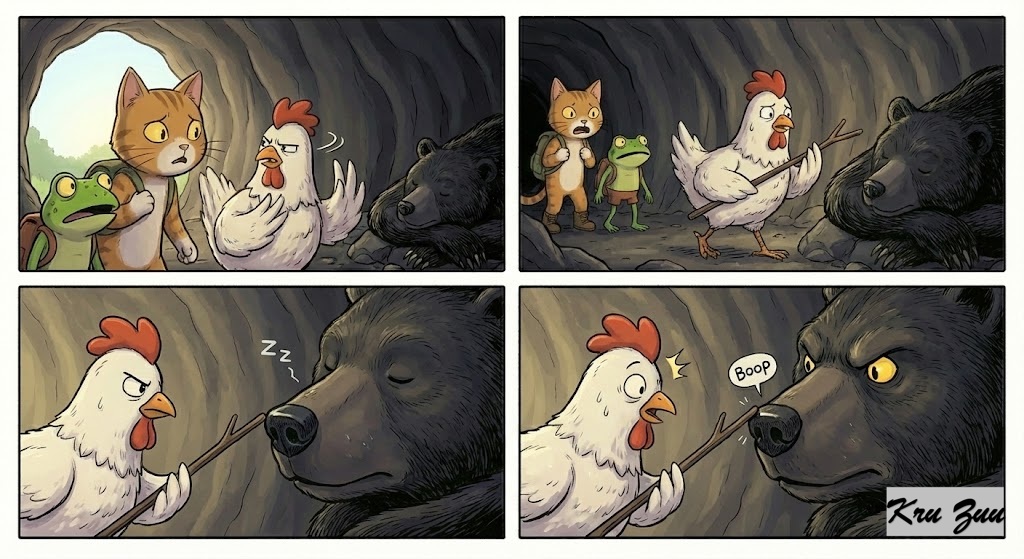
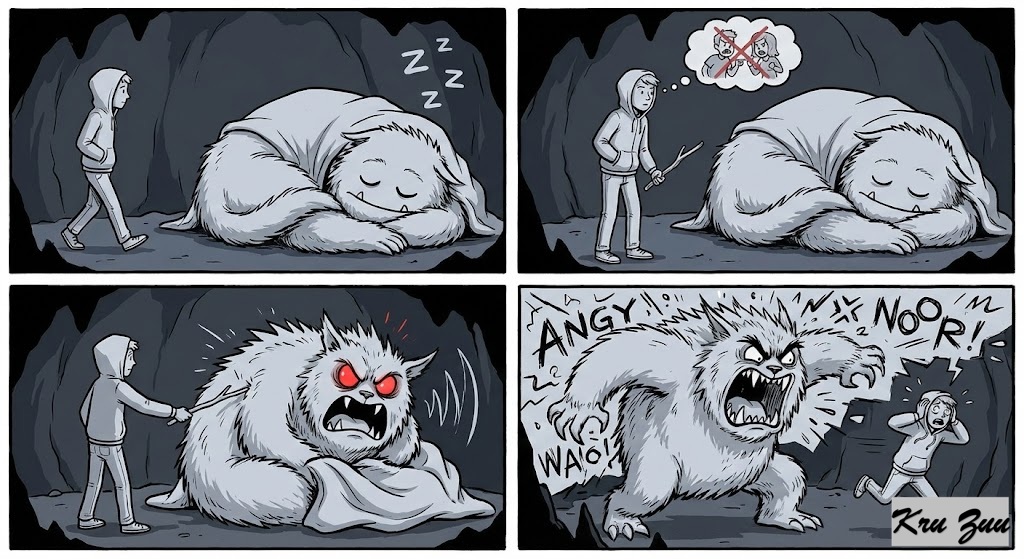
    The Situation: The trio is hiking up “Mount Mystery.” They come across a dark, echoing cave. Inside, a massive Shadow Bear is sleeping. It is snoring loudly: ZzzZZzz…


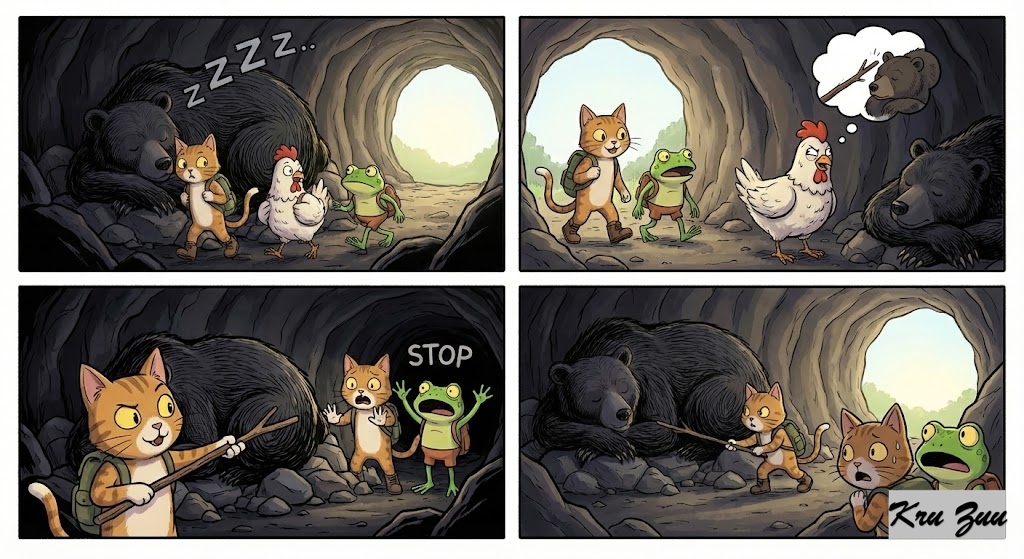
    The Conflict: They tiptoe past the bear safely. They are almost at the exit! But Cluck stops. He whispers loudly, “Hey! I wonder if that bear is actually asleep or just pretending? I bet I can poke him and run away before he catches me!”


    Cleo hisses quietly, “Cluck! Are you crazy? We are safe. Just keep walking!”


    Cluck shakes his head. “No, no. I need to know. Plus, remember that time a bear ate my corn? I want revenge!” Cluck picks up a long stick. He creeps toward the massive, snoring beast. He pokes the bear’s nose. Boop.


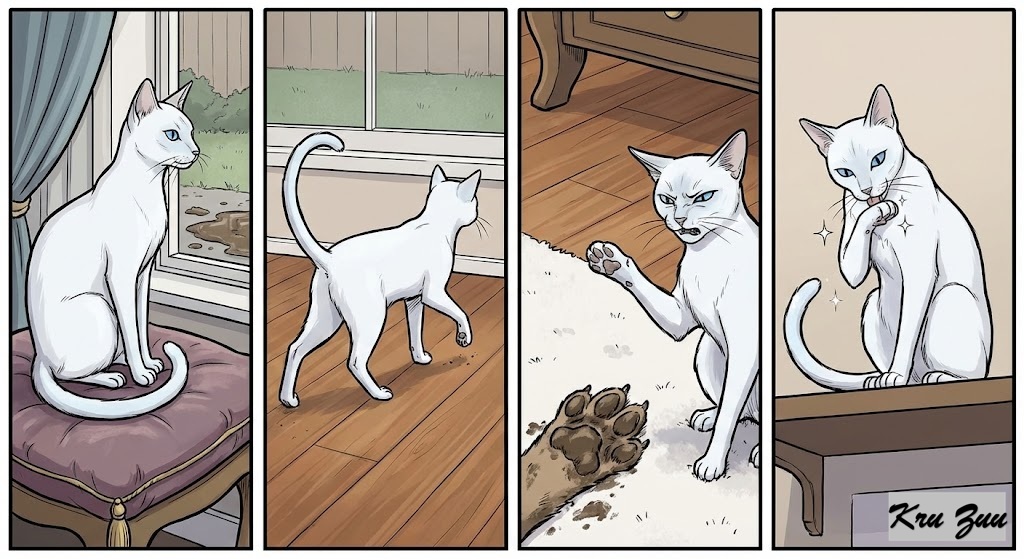
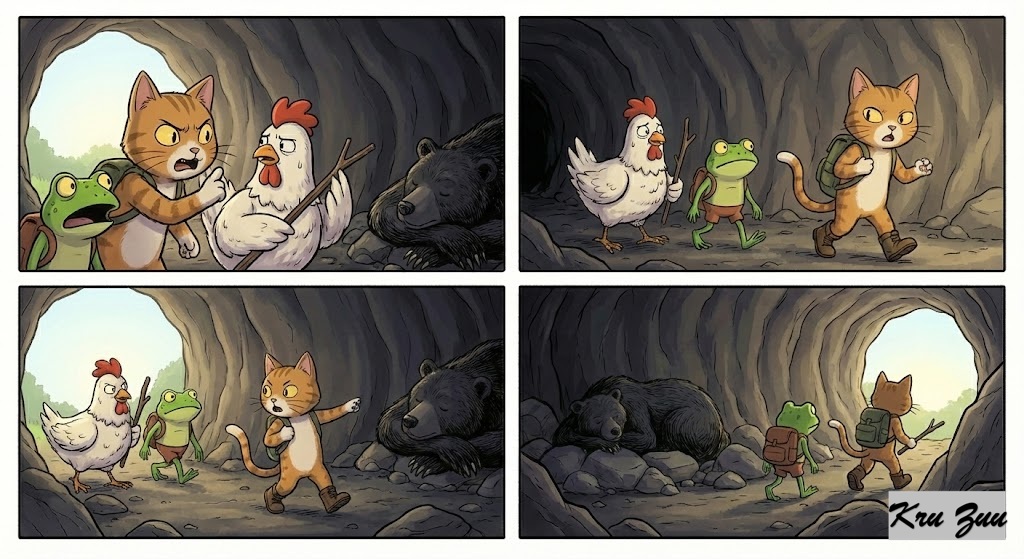
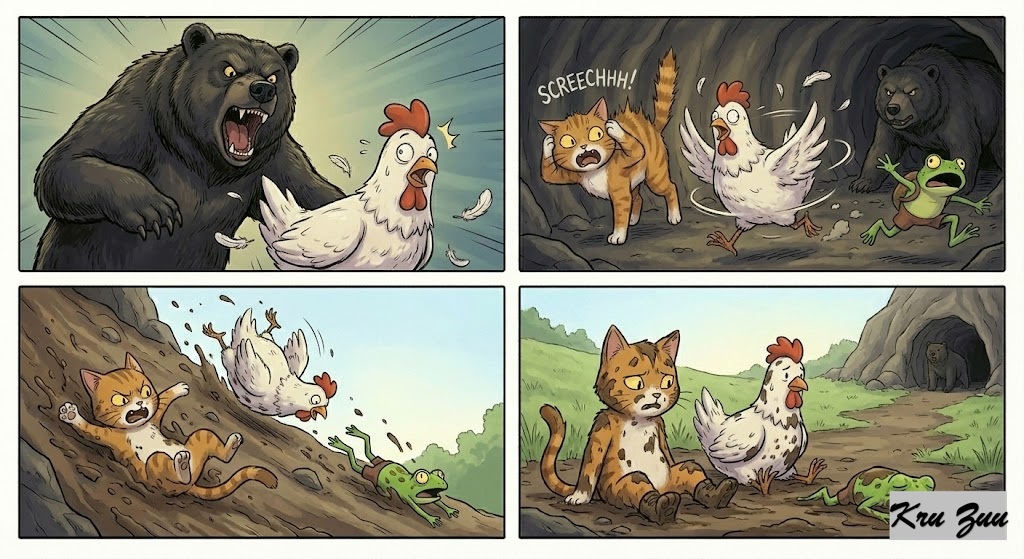
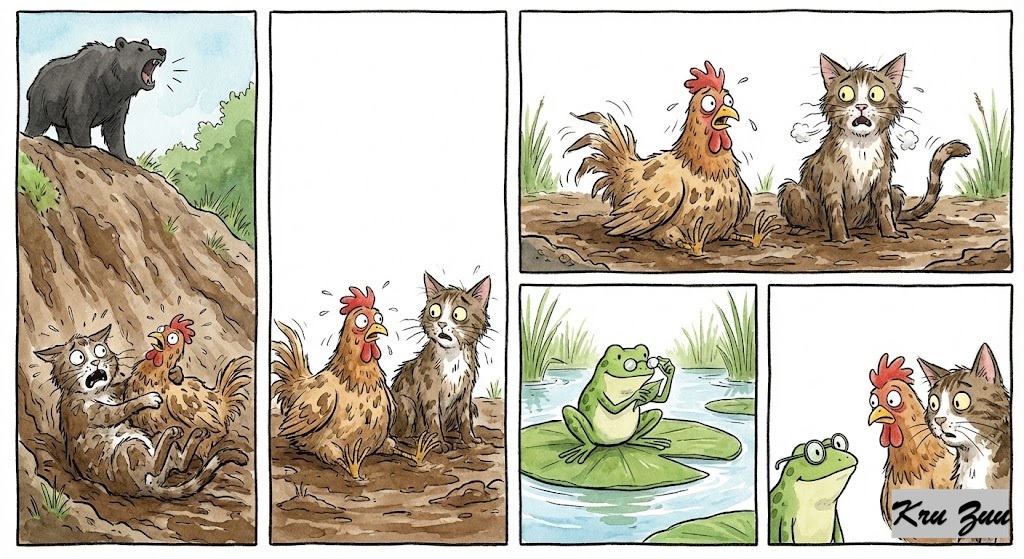
    The Result? ROAAAAAR! 🐻 The bear wakes up instantly. It is NOT happy. Cleo screeches! Feathers fly everywhere! Cluck runs in circles, clucking in terror! They barely escape the cave, sliding down the mud, ruining Cleo’s perfect fur.


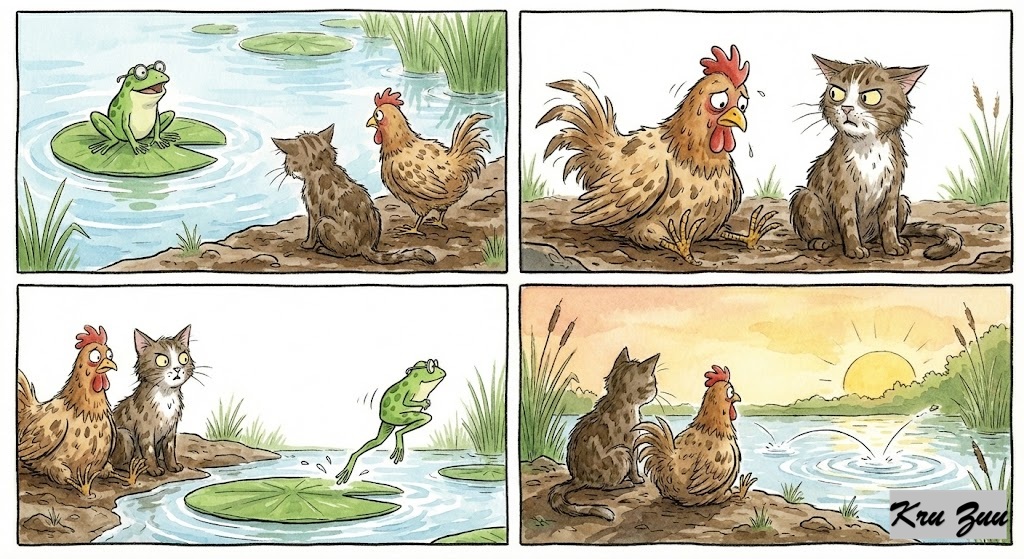
    The Resolution: They land at the bottom of the hill, covered in mud, shaking with fear. Fred the Frog is sitting there, polishing his glasses. He looks at the breathless Chicken.


    “Ribbit,” Fred says. “Cluck, the bear was happy. You were safe. You poked the problem, and now you are covered in mud.” Fred hops away. “Next time, my friend… let sleeping dogs (or bears) lie.”


    The Moral: If the problem is sleeping, don’t be the one to wake it up with a stick.

    🎓 Lesson for English Learners


    Context Matters Situation:
    You are in a meeting. Your colleague, Sarah, made a mistake last month. She fixed it. The boss has forgotten about it.

    Bad Move: Saying, “Well, at least this isn’t like the mistake Sarah made last month…”

    The Correction: Stop yourself. Think: If I say this, I create new drama.You Say: Nothing. You let sleeping dogs lie.


    💬 Your Turn: The Peace Challenge 🚀


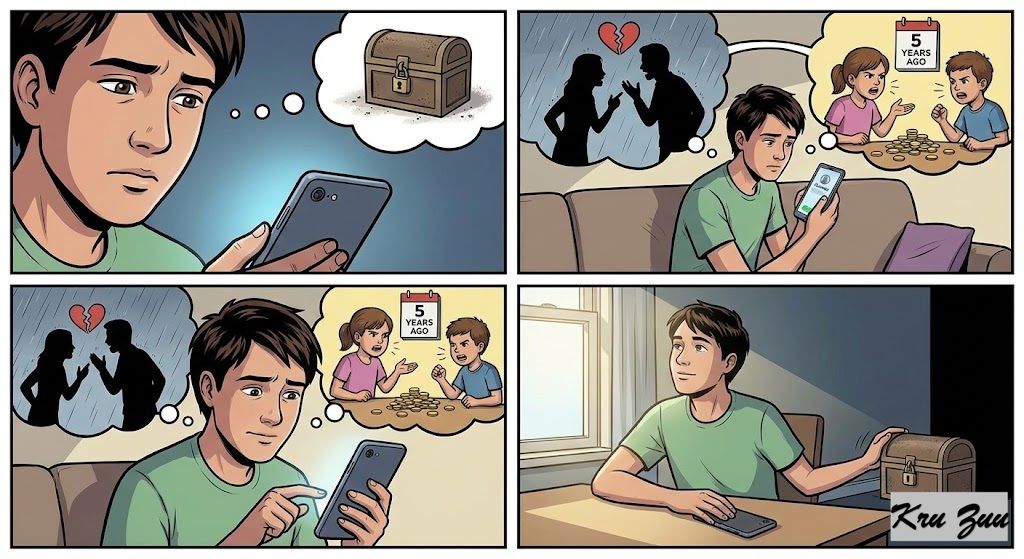
    Is there an old argument you are tempted to bring up? Maybe you want to text your ex? Maybe you want to remind your sibling about money they owed you 5 years ago?


    The Challenge:
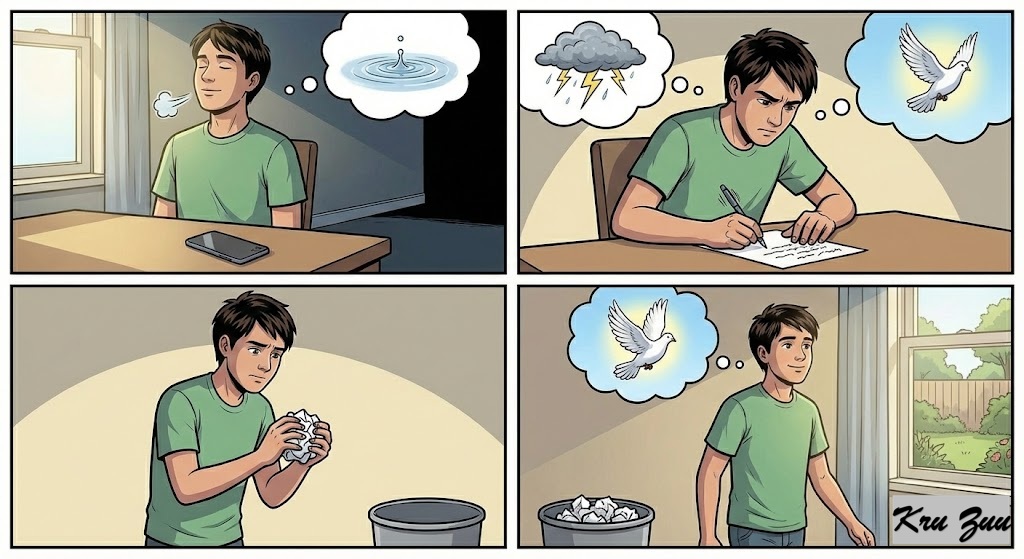
    Don’t. Take a deep breath. Write the complaint on a piece of paper. Then, crumple the paper and throw it in the trash. Tell yourself: “I am choosing peace today.”


    👇 Question for the comments: Have you ever “woked a sleeping dog” and regretted it immediately? Tell us your story below! (I promise we won’t judge!)

    By Zubeyir YURTKURAN

    https://www.facebook.com/BrainBattleground/

    https://www.facebook.com/zubeyr.yurtkuran/

    https://www.instagram.com/zubeyryurtkuran/
    https://www.youtube.com/@BrainBattleground-b3p

    https://www.instagram.com/brainbattleground/

  • 🧠 The Daily Shield: The Law of Connection

    🧠 The Daily Shield: The Law of Connection

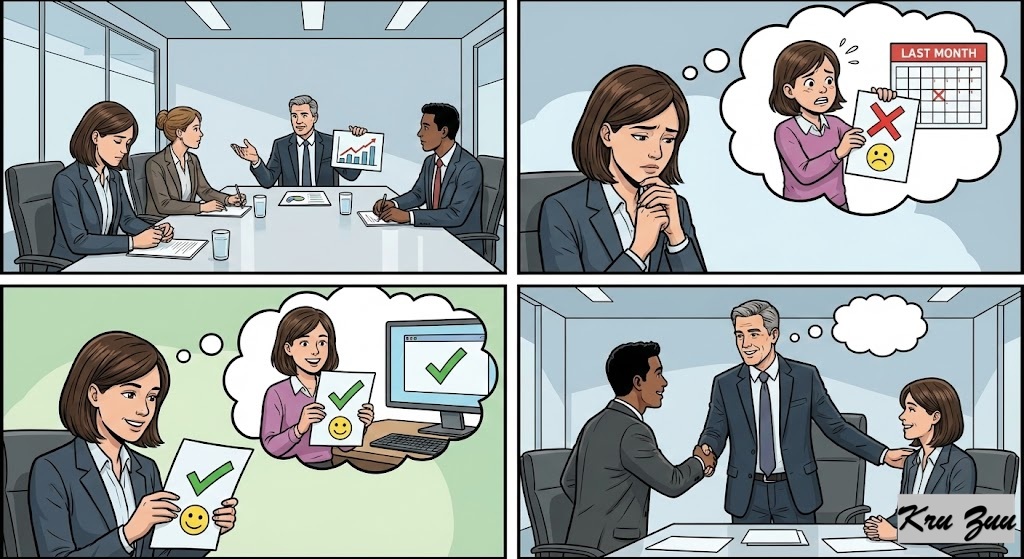
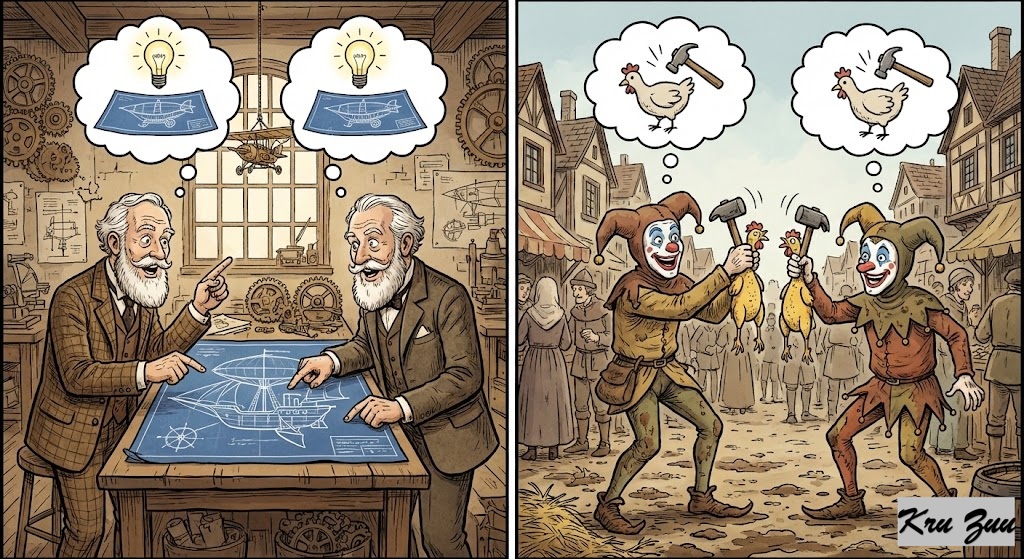
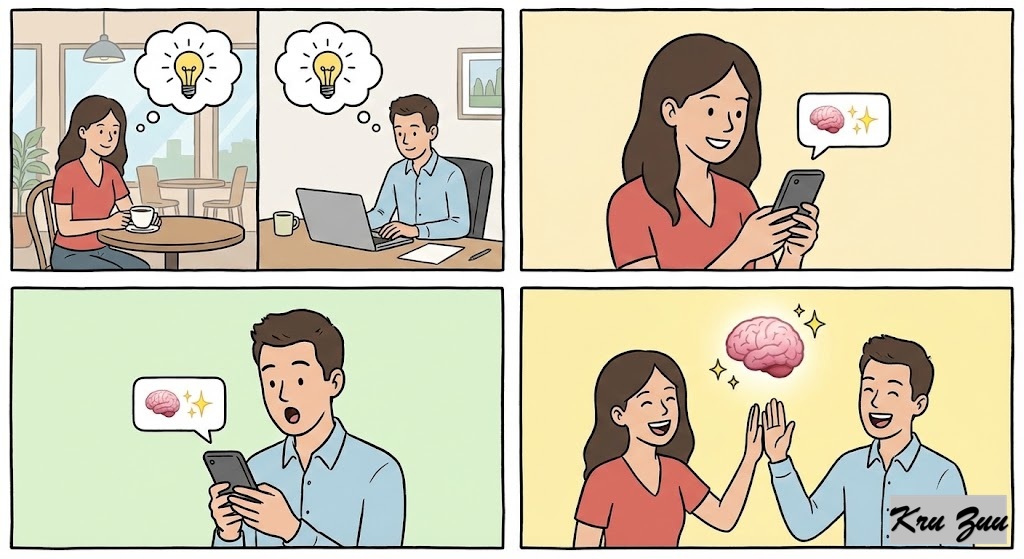
    “Great minds think alike.”


    😈 The Villain (The Intellectual Snob)

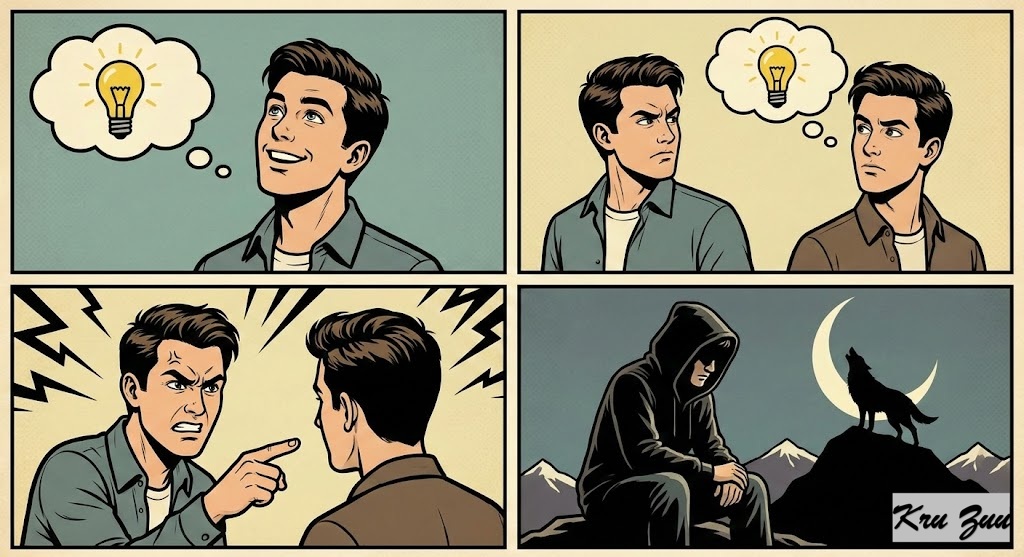
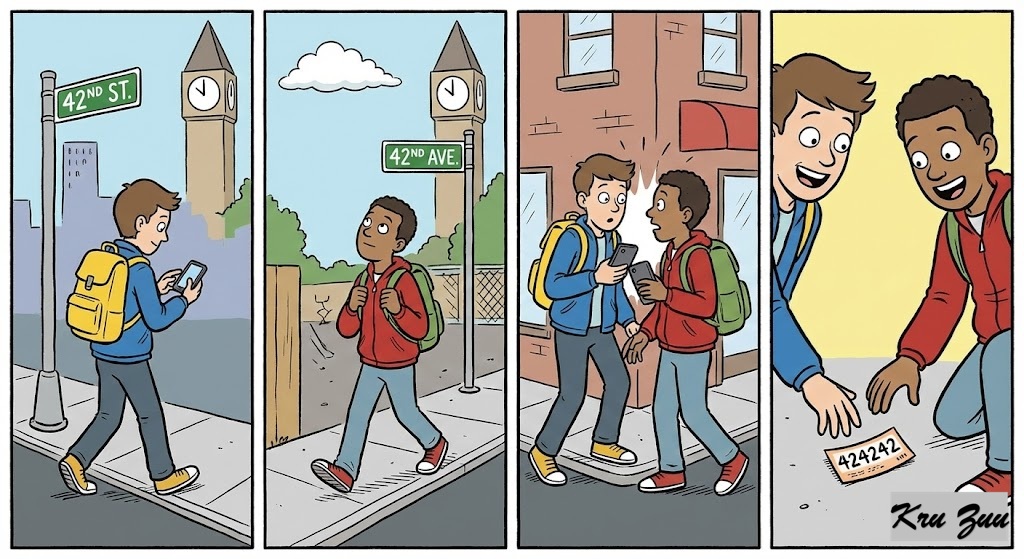
    You have an idea. Someone else suggests the same thing. What do you do? You get annoyed. 😒 “Hey, I thought of that first!””Stop copying me!” You believe your ideas are special property. You see shared thoughts as theft, not connection. You want to be the “Lone Wolf” genius.

    The Result? You isolate yourself. People feel awkward sharing ideas with you. You kill the momentum of the team because you are too busy claiming credit. You are trapped in the “Ego Trap.” 🧟‍♂️


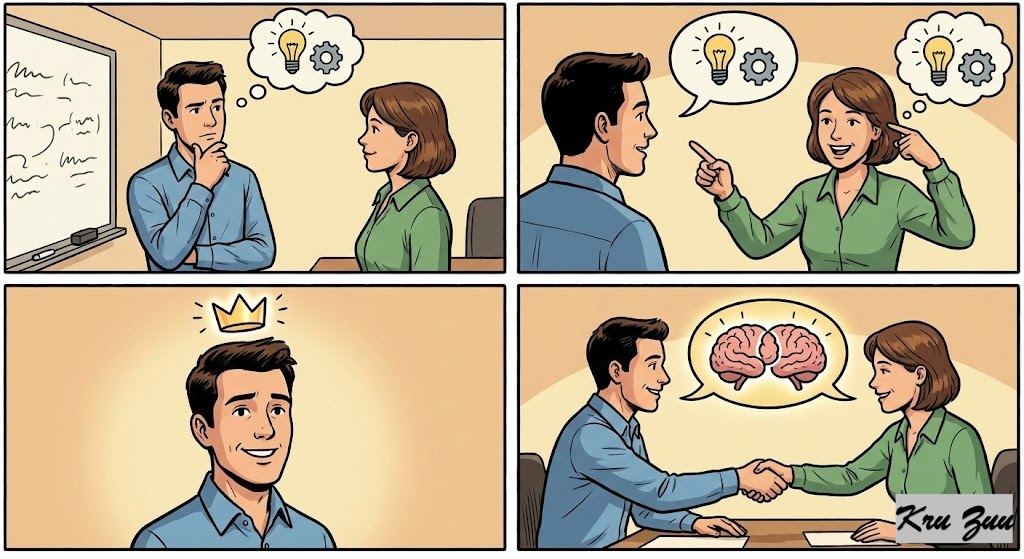
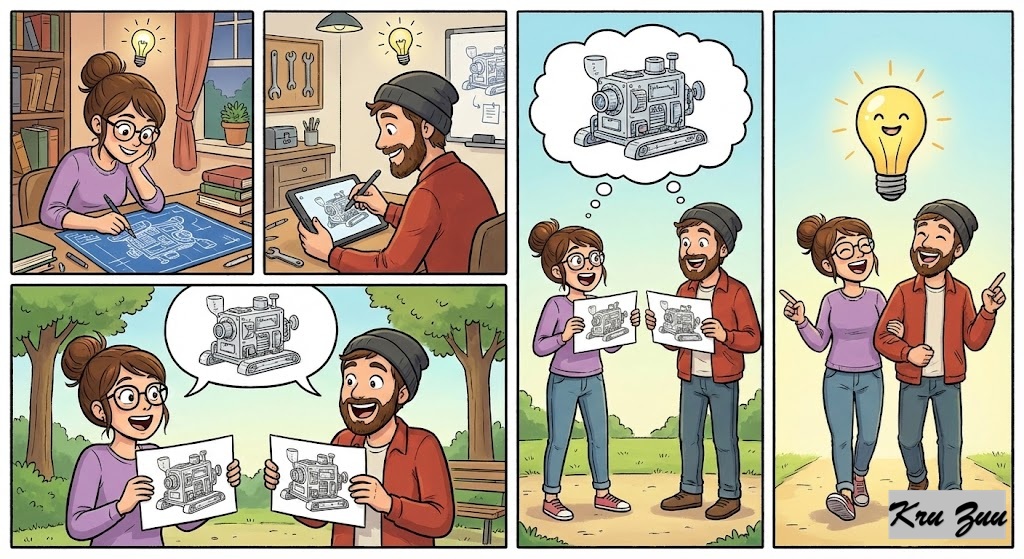
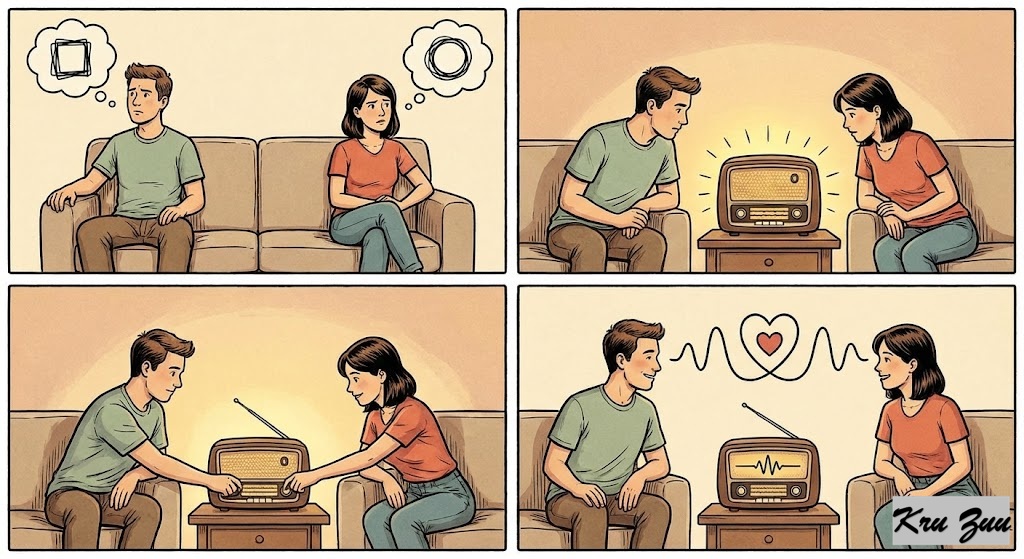
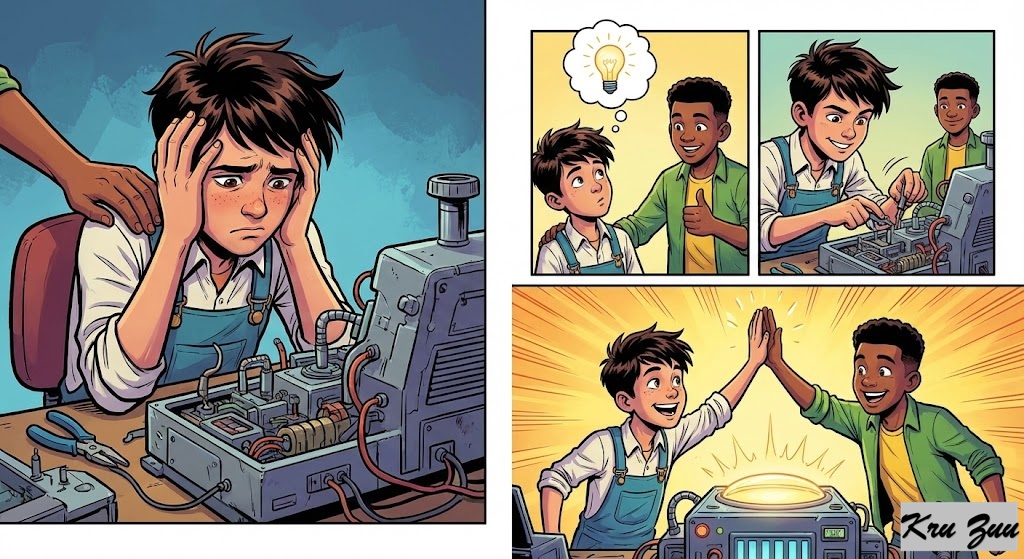
    😇 The Hero (The Synergist): You are brainstorming. A colleague blurts out the exact solution you were just thinking of. Instead of getting jealous, you smile. 😄 You point at them and say: “Great minds think alike!” You validate their intelligence, which validates yours. You realize that shared thinking isn’t copying, it’s alignment.

    The Result? Instant rapport. The other person feels smart and connected to you. You create a bond of trust (“We are on the same wavelength”). You build a tribe, not just a resume. ⚡


    ⚖️ The Reality


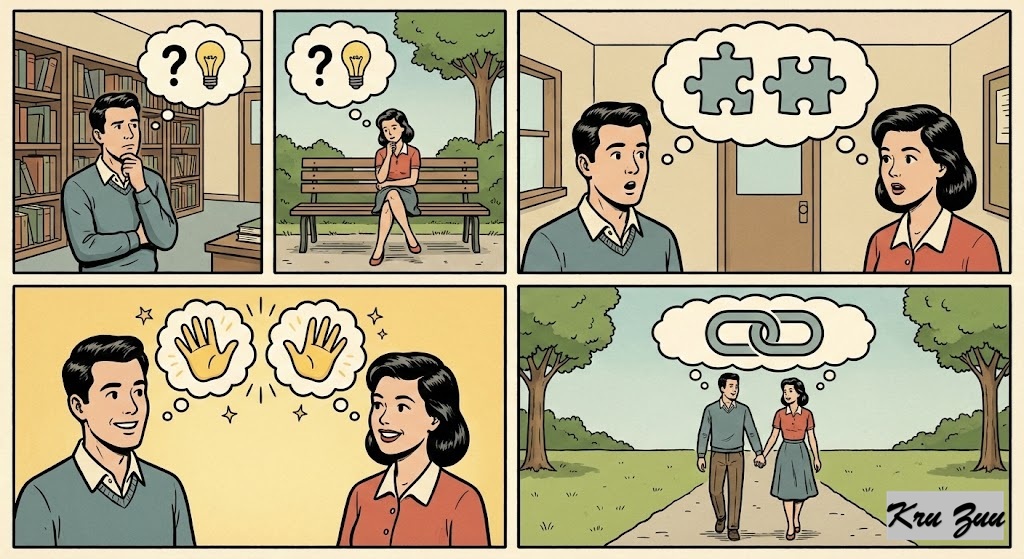
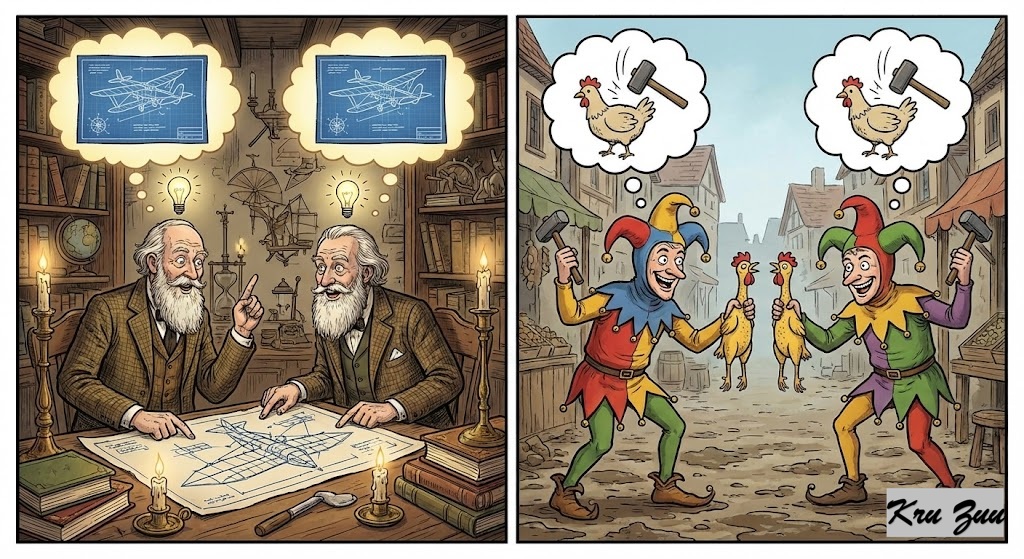
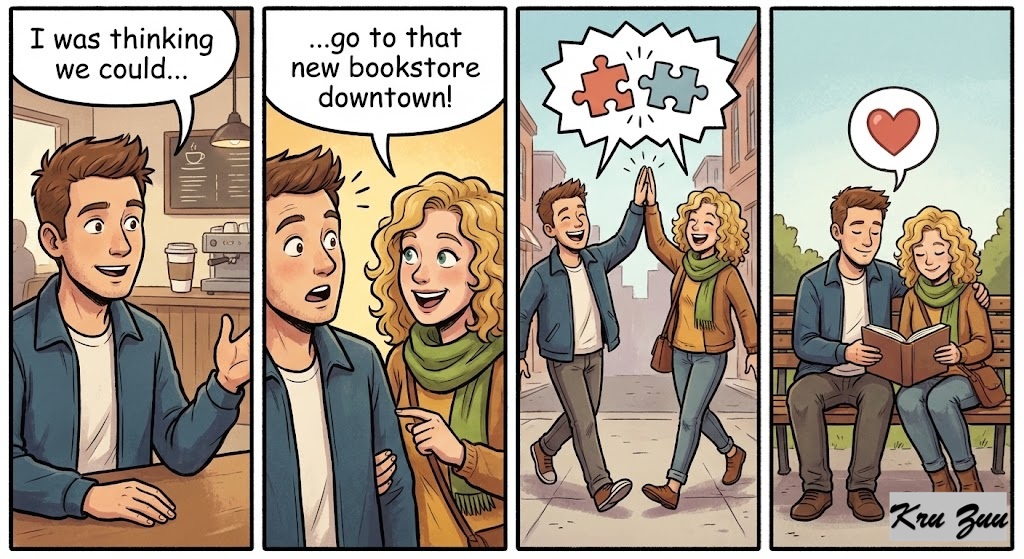
    We are social creatures. When two people arrive at the same conclusion independently, it is a powerful signal of compatibility. It means your values, logic, or instincts are aligned. It is a moment of “mental high-five.” 👋


    💎 The Secret

    Using this phrase isn’t just about being right; it is a tool to make the other person feel good. It says, “You are smart because you think like me.”

    🧐 The Anatomy of the Proverb


    This is your go-to phrase for those “Jinx!” moments.


    Great Minds (Noun Phrase): Intelligent people; thinkers; visionaries.


    Think (Verb): To process thoughts/ideas.


    Alike (Adverb):
    In a similar way; identically.


    Simpler Version: Smart people have the same ideas. / We are on the same page.


    📚 Vocabulary Vault


    Synergy (Noun):
    When the combined effect is greater than the sum of separate effects. (1+1=3). 🚀


    Telepathy (Noun): The supposed communication of thoughts by means other than the known senses. (e.g., “It’s like we have telepathy!”).


    Validation (Noun): Recognition or affirmation that a person’s feelings or opinions are valid or worthwhile.


    Coincidence (Noun): A remarkable concurrence of events or circumstances without apparent causal connection.


    Wavelength (Noun):Idiom: “To be on the same wavelength” (To think similarly). 📻

    📜 History: Origin and The Twist


    Where did this compliment come from?


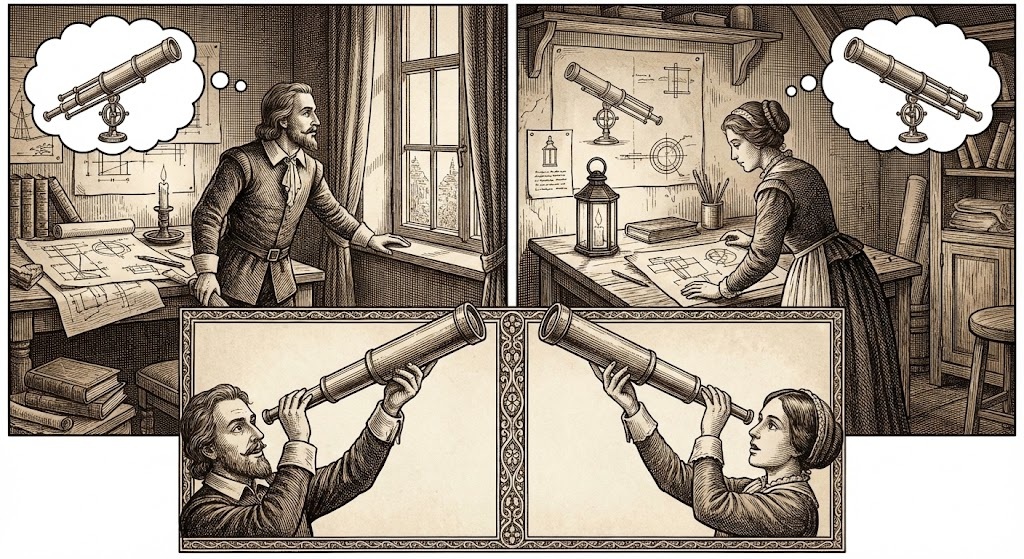
    The Origin: The idea has been around since the early 1600s. The original recorded phrase in English was “Great wits jump” (meaning “jump to the same conclusion”). It evolved into “Great minds think alike” over time.


    The Twist (The Humorous Truth): Did you know this idiom has a second half that is often left out? The full phrase is historically known as:”Great minds think alike, though fools seldom differ.”


    Translation: Smart people might have the same idea, but stupid people also follow the crowd! Note: We usually only use the first half (the polite half) in business and friendship! 😉

    🎯 Impact on Life: The Pros & Cons


    ✅ The Pros (The Bond)


    Speed:
    You don’t have to explain yourself. The other person already “gets it.”


    Confidence: Knowing someone supports your idea makes you more likely to succeed.


    ❌ The Cons (The Echo Chamber)


    Groupthink:
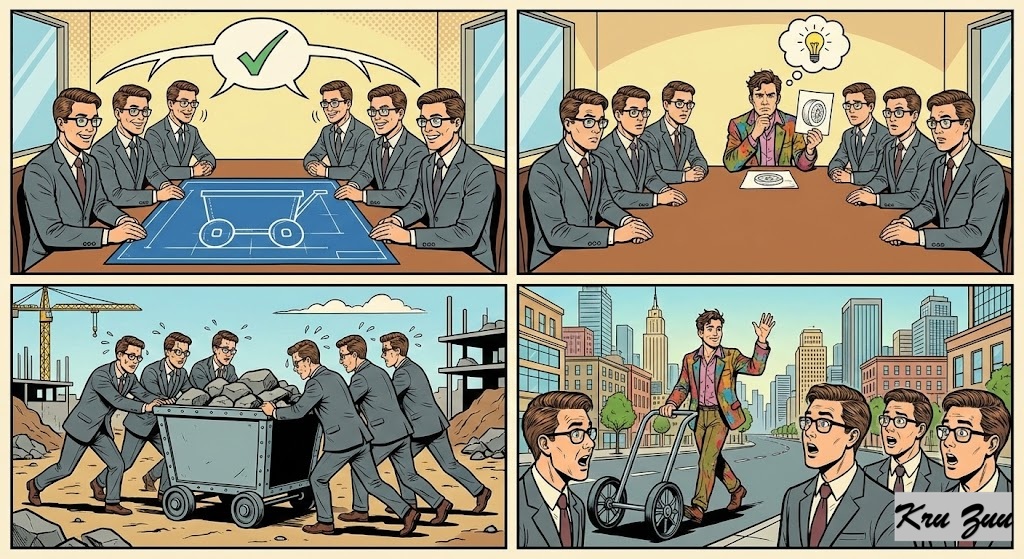
    If everyone thinks alike, no one is spotting the mistakes. Sometimes you need a “Great Mind” who thinks differently to challenge you.

    🎭 Short Story: The Mystery of the Locked Box 📦


    Let’s visit the magical forest to see how mental connection works.


    🌟 The Cast


    Cleo the Cat: Elegant, logical, loves puzzles. 😼


    Cluck the Chicken: Impulsive, hungry, relies on gut instinct. 🐔


    Fred the Frog: The wise, green observer. 🐸


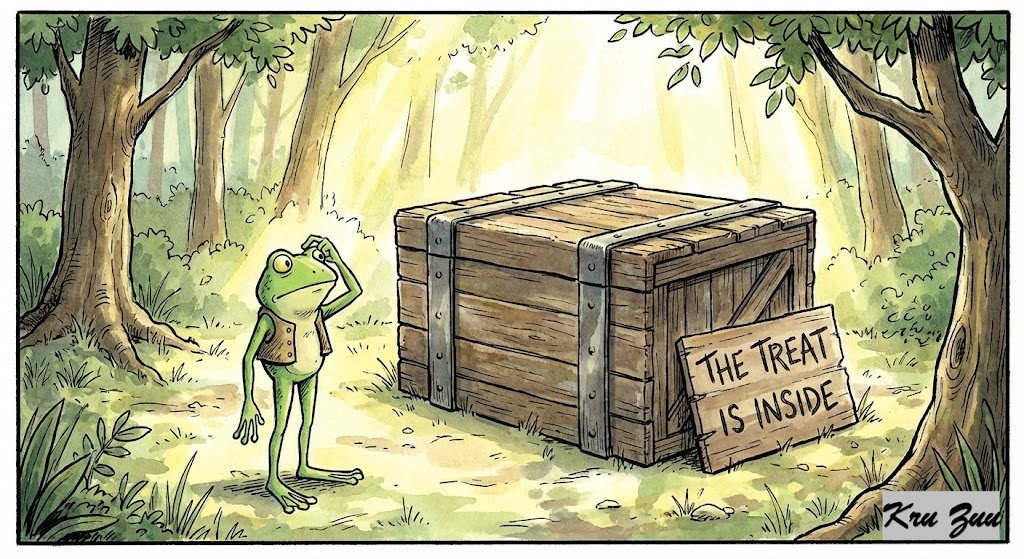
    The Situation: Fred the Frog has placed a mysterious, heavy wooden box in the middle of the clearing. It has no keyhole. It has no handle. Just a sign that says: “The treat is inside.”


    The Conflict:
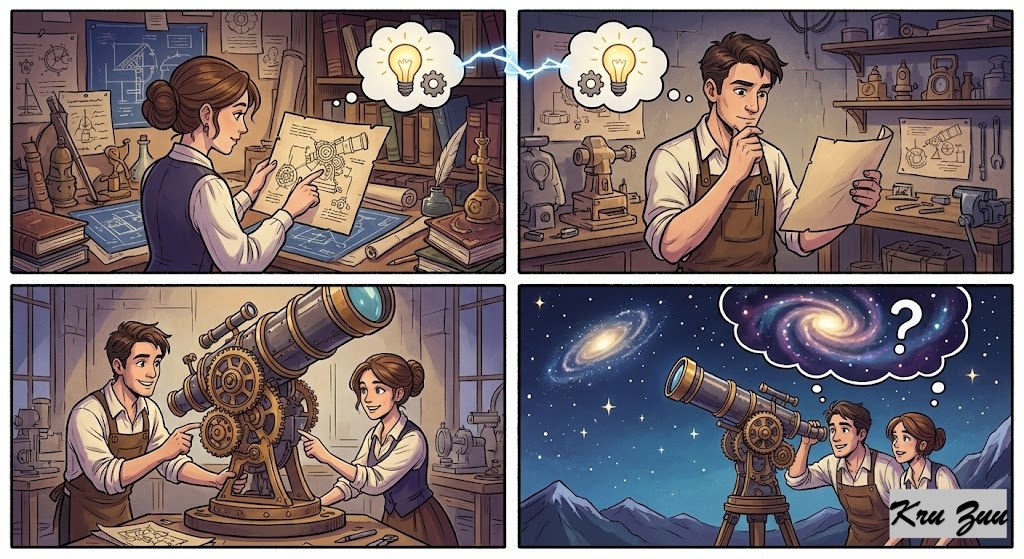
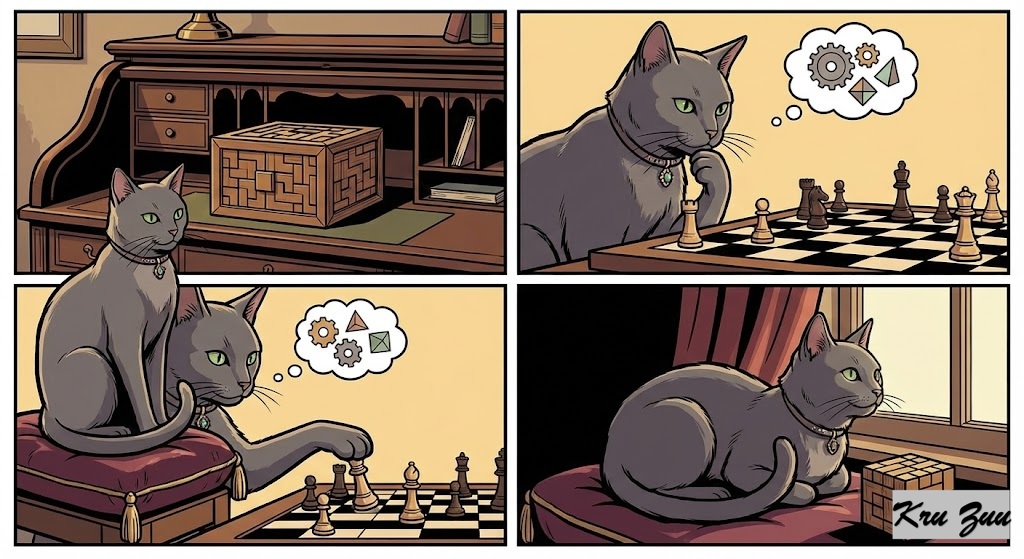
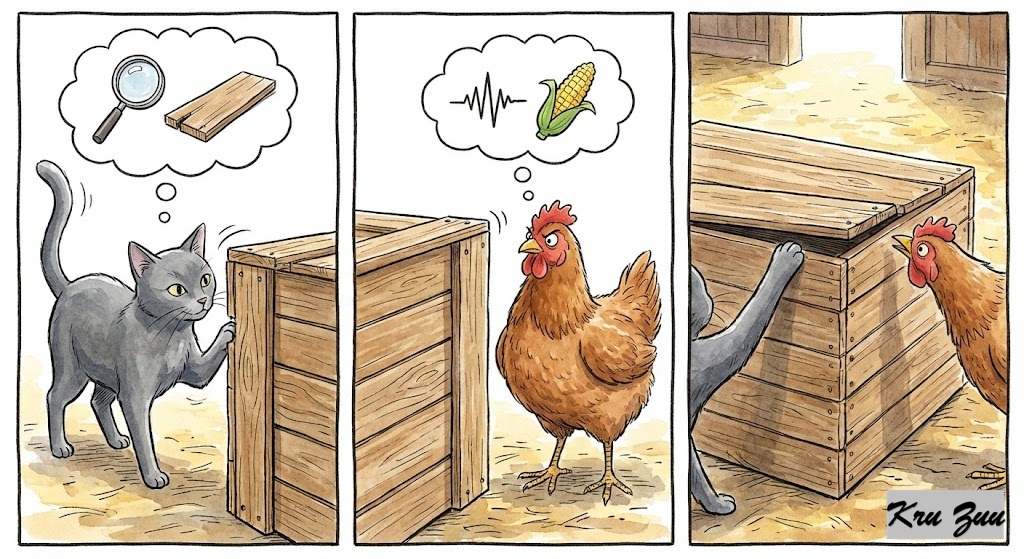
    Cleo circles the box, analyzing the wood grain. She thinks hard. “The wood is loose on the top right corner. I need something thin to pry it open.” Cluck stares at the box, thinking about the corn inside. He feels a vibration. “The top right corner looks weak. I need something flat to poke it.”


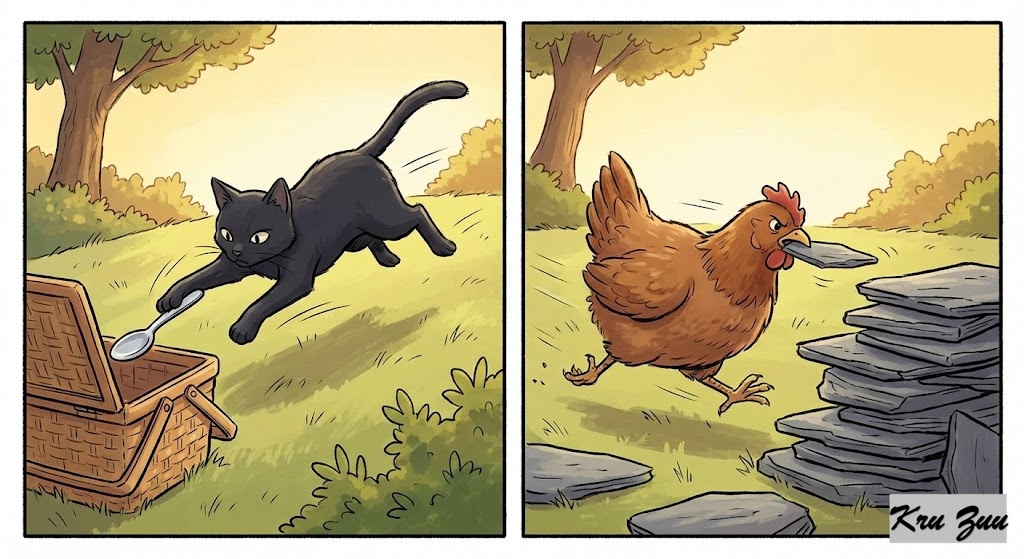
    The Climax: Without saying a word to each other… Cleo runs to the left and grabs a flat, silver spoon from a picnic basket. 🥄 Cluck runs to the right and grabs a flat, loose slate of rock. 🪨


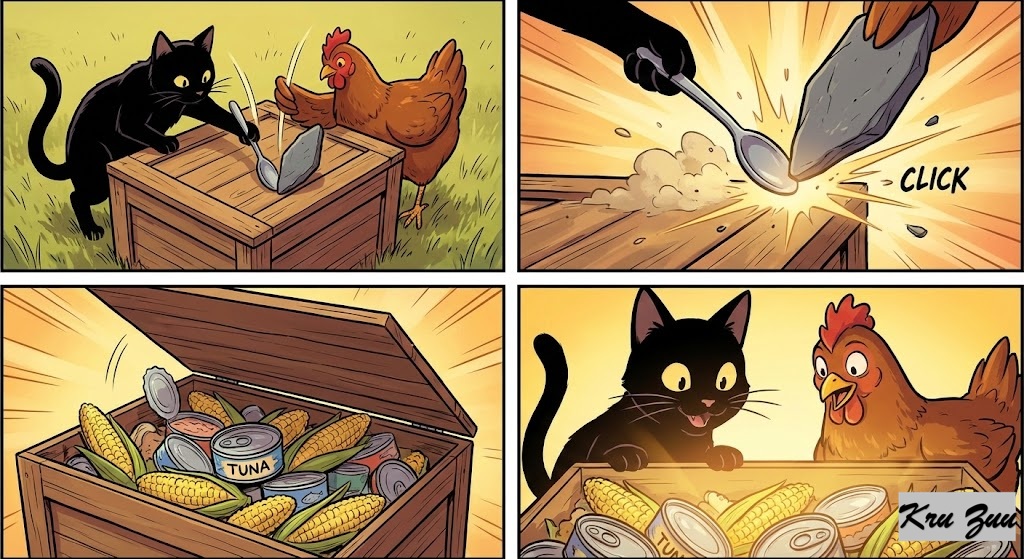
    They both run back to the box and jam their tools into the exact same spot (the top right corner) at the exact same time. Click! The box pops open. It is filled with tuna and corn!


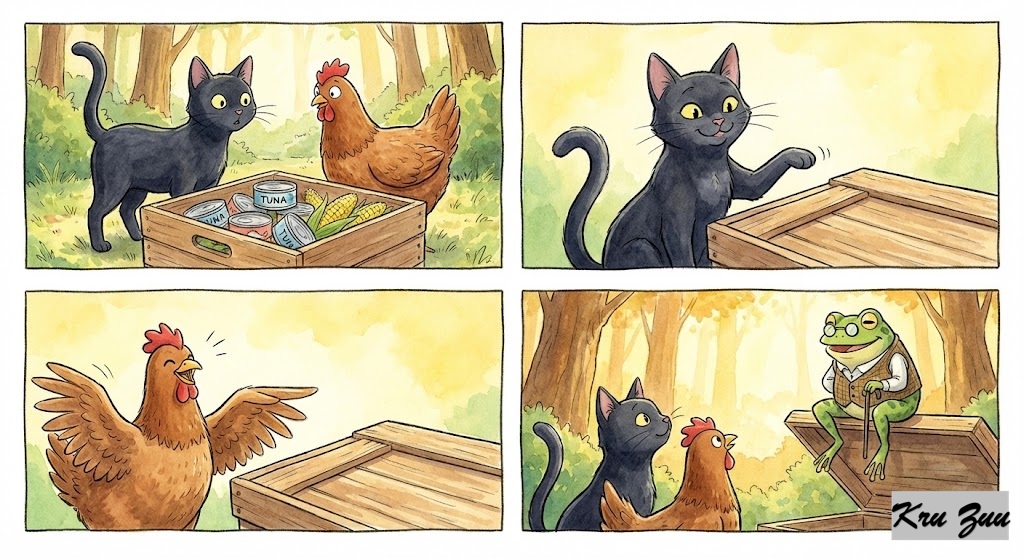
    The Resolution: They look at each other, shocked. Cleo smiles, her tail twitching. “I was going for the leverage point.” Cluck laughs. “I just knew that was the weak spot!” Fred the Frog hops onto the open lid. He adjusts his tiny glasses. “Ribbit,” Fred says. “Different species, different styles, but the same solution. Great minds think alike.”


    The Moral: You don’t have to be identical to be compatible. When you find someone who solves problems the way you do, hold onto them. That is your teammate.

    🎓 Lesson for English Learners


    Context is Key.


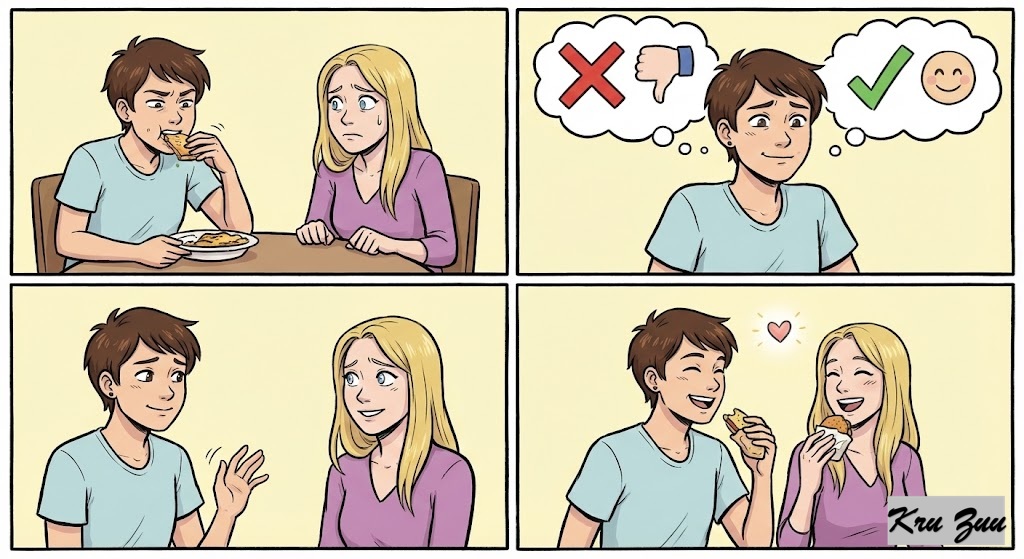
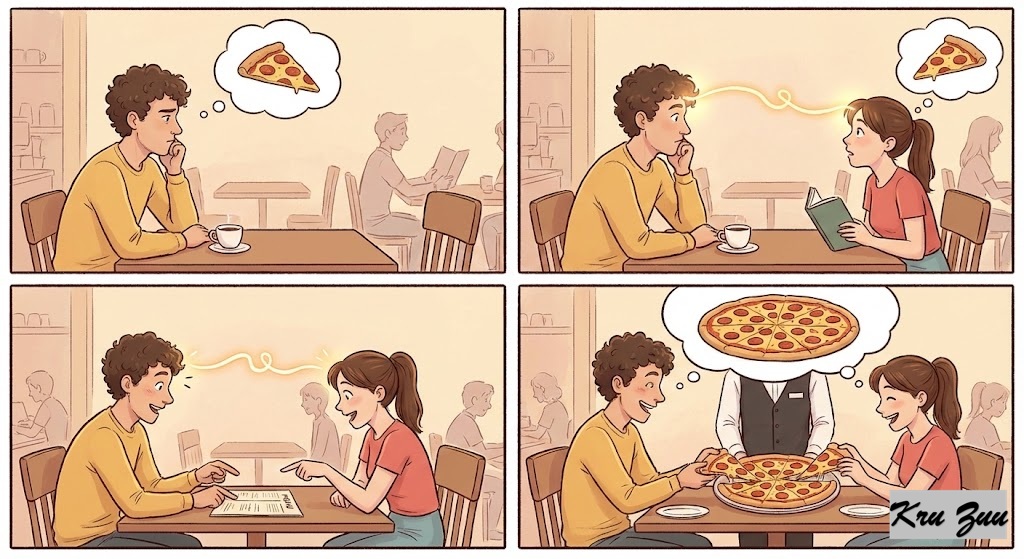
    Situation: You and your friend both reach for the last slice of pizza at the same time.


    You Say: “Great minds think alike!” (This is funny/playful).


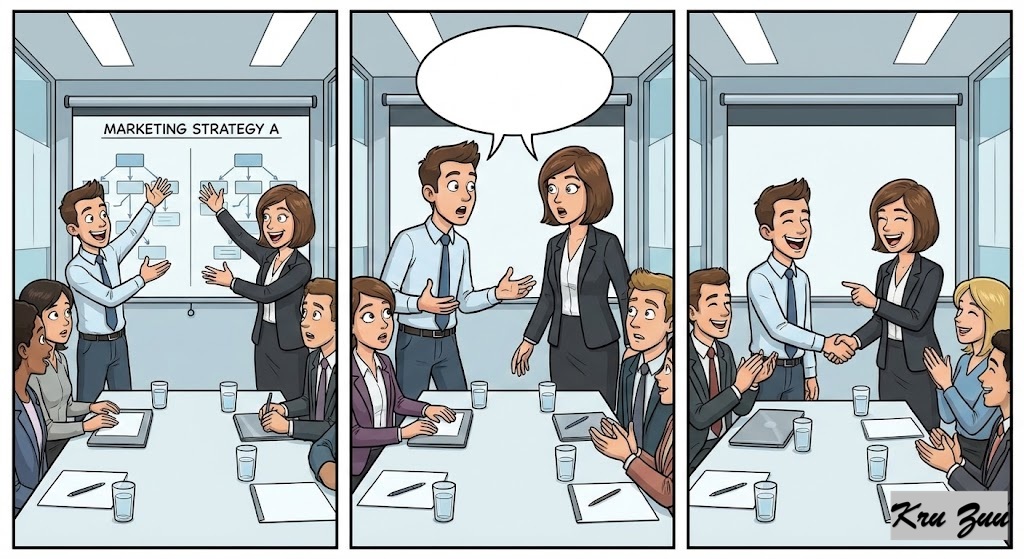
    Situation: You and your boss both suggest the same marketing strategy in a meeting.


    You Say: “Great minds think alike!” (This is complimentary and builds a professional bond).


    💬 Your Turn: The Connection Challenge 🚀


    Is there someone in your life (a partner, a best friend, a coworker) who often finishes your sentences?


    The Challenge:
    The next time this happens, the next time you both say the same thing or text each other at the same moment, do not ignore it.

    The Action: Immediately send them a message or say: “Great minds think alike! 🧠✨”


    Celebrate the connection. It turns a coincidence into a relationship builder.


    👇 Question for the comments: Who is your “Mind Twin”? Tag the person who always seems to know what you are thinking!

  • 🌍 The Chameleon Code: How to Fit In Anywhere

    🌍 The Chameleon Code: How to Fit In Anywhere

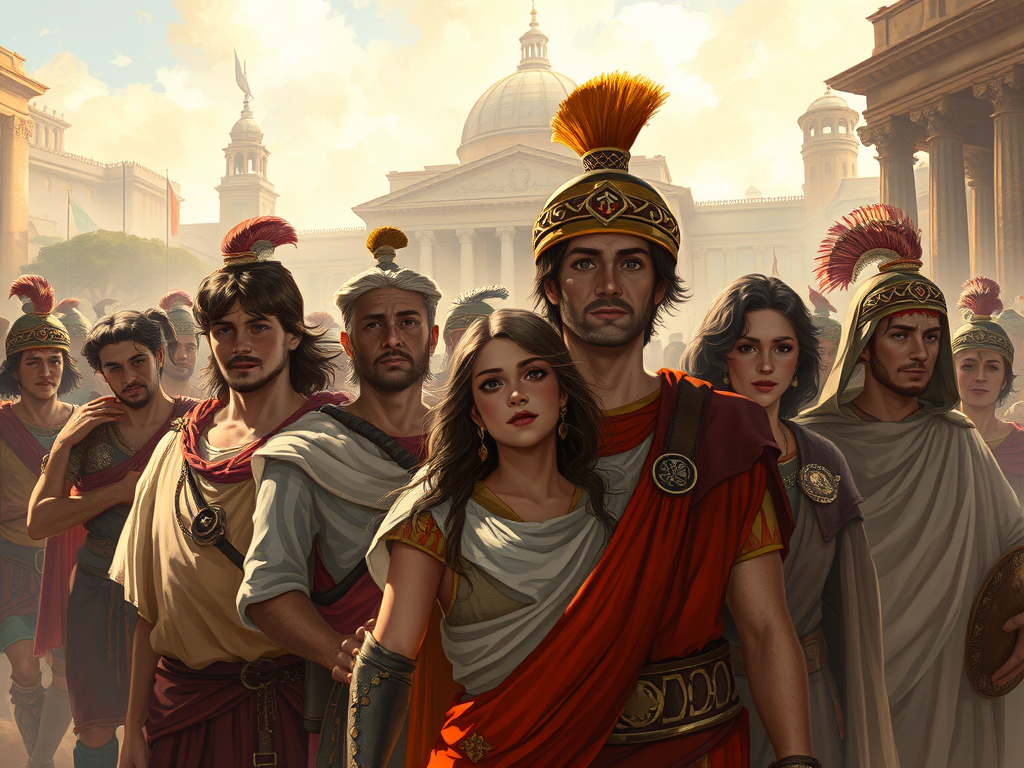
    When in Rome, do as the Romans do.


    📸 The Tourist:
    You travel to Japan. You wear your shoes inside the house. You talk loudly on the train. You try to tip the waiter (which is rude there!). Everyone stares at you. You feel awkward.

    😳 ninja The Traveler: You arrive in Japan. You take your shoes off at the door. You whisper on the train. You bow respectfully instead of tipping. You make local friends instantly. You belong. 🍣

    📉 The Reality: Rules change depending on where you are. 🚀

    The Secret: Success isn’t about being right; it’s about being adaptable. In this post, we are mastering the art of “Cultural Intelligence.” Let’s pack our bags! 🧳

    🧐 The Anatomy of the Proverb


    Let’s look under the hood of this famous idiom.


    📚 Vocabulary Vault


    Rome (Proper Noun):
    In this idiom, “Rome” is a metaphor. It represents any new place, situation, or environment you are in. (e.g., A new office, a friend’s house, a different country). 🏛️


    Do (Verb):
    To act, behave, or follow customs. 🎭


    Romans (Plural Noun): These represent the locals or the people who belong to that group. 👥


    🧠 Grammar Focus


    This is an Imperative Sentence (A command or advice).


    Structure: When [Condition/Place], [Command].


    Formula: [When you are in a specific context] + [Copy the behavior of the people there].


    Short Version: Native speakers often just say: “Well, when in Rome…” (and leave the rest silent!).

    📜 History: Saints & Emperors


    Did this actually happen in Rome? Yes!


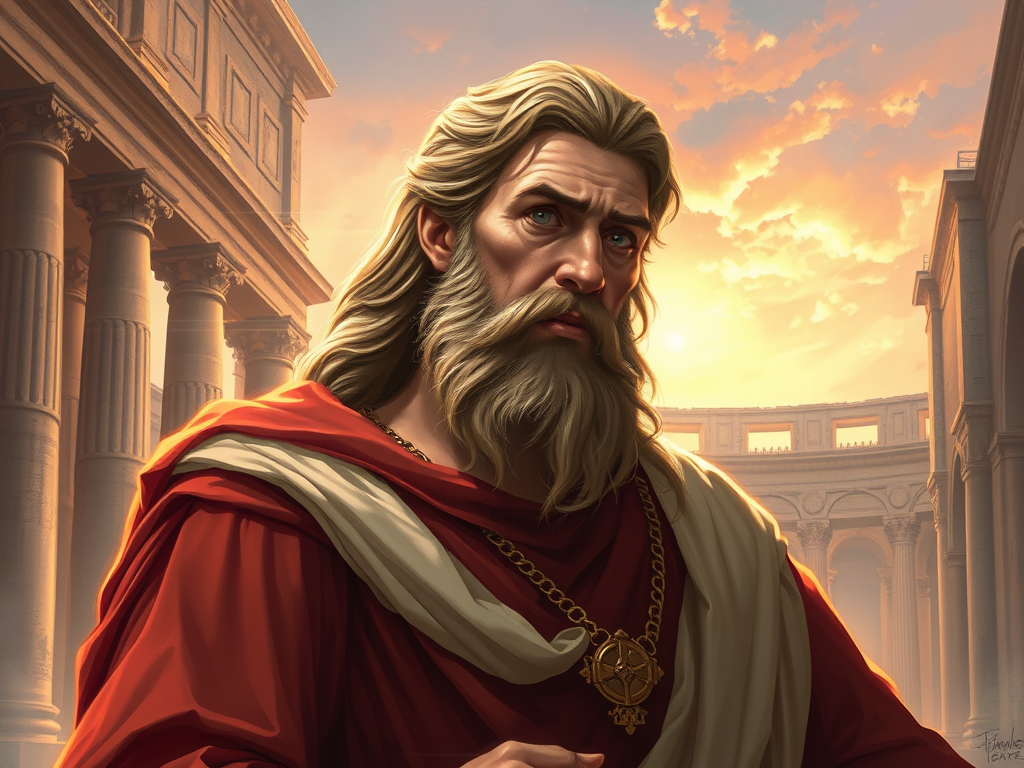
    The Legend: In the year 387 AD, St. Augustine arrived in Milan. He noticed the church customs there were different from his home in Rome. He asked St. Ambrose what to do.


    The Advice: St. Ambrose famously said: “If you are at Rome, live in the Roman style; if you are elsewhere, live as they live elsewhere.”


    Global Cousins:


    🇹🇷 Turkish:
    “Gittiğin yer kör ise, bir gözünü de sen kapat.” (If the place you go to is blind, close one of your eyes too!) 😉


    🇪🇸 Spanish: “Donde fueres, haz lo que vieres.” (Wherever you go, do what you see.)


    🇯🇵 Japanese: “Go ni itte wa, go ni shitagae.” (Enter the village, obey the village.)


    The Lesson: It is not about losing your identity. It is about showing respect and harmony.

    🎯 Impact on Life: The Pros & Cons


    Should you always copy others?


    ✅ The Pros ( The Diplomat)


    Respect:
    People appreciate when you try to understand their culture.


    Safety: Blending in stops you from looking like a clueless tourist (and a target for pickpockets!).


    Connection: You make friends faster when you break down barriers.


    ❌ The Cons (The Peer Pressure)


    Losing Yourself:
    Don’t do things that violate your core morals just to fit in.


    The “Copycat” Risk: If “the Romans” are jumping off a bridge, you shouldn’t do it! 🚫

    🎭 Short Story: The Dinner Party


    Let’s see how our farm friends handle a fancy dinner!


    🌟 Character Introduction


    Percy the Chicken:
    Stubborn and stuck in his ways. 🐔


    Fred the Frog: Observant and flexible. 🐸


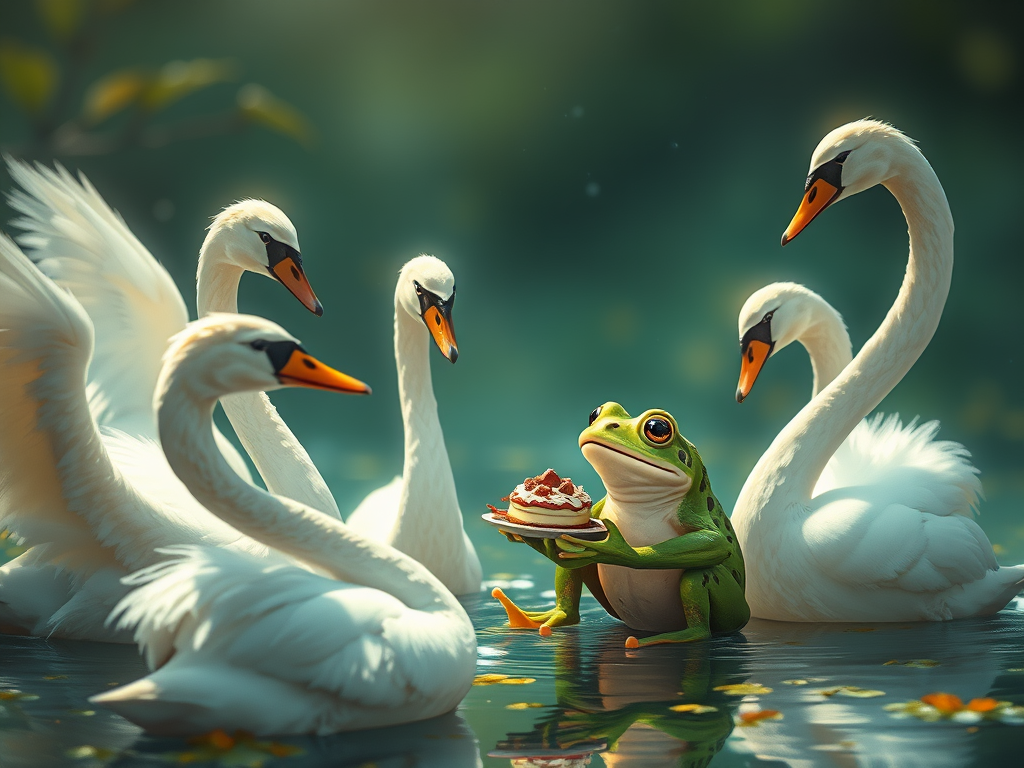
    The Swans: The fancy hosts of the dinner party. 🦢


    The animals were invited to a formal dinner at the Swan Lake.

    The Custom: Swans eat gracefully with their heads high, and they never make loud noises while chewing.


    Percy: Didn’t care. Percy sat at the table. He pecked at the food rapidly peck, peck, peck!

    He scratched the table with his feet (like a chicken does).

    He clucked loudly with his mouth full.

    The Swans looked at him in horror. “How rude,” they whispered. Percy was not invited back. 🚫


    Fred: Watched the Swans. Fred was a frog.

    He usually catches flies with his tongue. But he looked around.

    He saw the Swans eating soup slowly. Fred didn’t use his tongue. He used a spoon.

    He sat up straight. He mimicked their politeness. The Swans smiled. “What a charming gentleman,” they said. Fred was offered dessert. 🍰


    Luna the Cat watched from a tree: “Percy acted like a chicken in a swan’s house. Fred acted like a swan. Fred did as the Romans do.”

    🎓 Lesson for English Learners


    How can you use this strategy to master English?

    Don’t just translate your language into English. Mimic the culture.


    The Greeting Protocol 👋


    Your Home:
    Maybe you kiss on the cheek or bow.


    In Rome (USA/UK): A firm handshake or a simple “Hey.”


    Action: Watch movies. How do friends say hello? Copy that.


    The “Politeness” Filter ☕


    Direct Translation: “Give me coffee.” (Grammatically correct, but rude).


    The Roman Way: “Could I have a coffee, please?”


    Action: Learn the “softener” words (Could, Would, May).


    The Slang Squad 🗣️


    If you are in a business meeting, speak formally.


    If you are gaming on Discord, don’t say “How do you do?” Say “What’s up?”


    Action: Match your vocabulary to your environment.


    💬 Your Turn


    Have you ever experienced Culture Shock? 🤯


    Did you try food that was strange to you? 🦑


    Did you make a mistake in a new country? 🌍


    Do you act differently at school vs. at home with family?


    Tell us your story in the comments! 👇

    By Zubeyir YURTKURAN

    https://www.facebook.com/BrainBattleground/

    https://www.facebook.com/zubeyr.yurtkuran/

    https://www.instagram.com/zubeyryurtkuran/
  • ⚡ The Efficiency Hack: Do Less, Get More

    ⚡ The Efficiency Hack: Do Less, Get More

    Kill two birds with one stone.


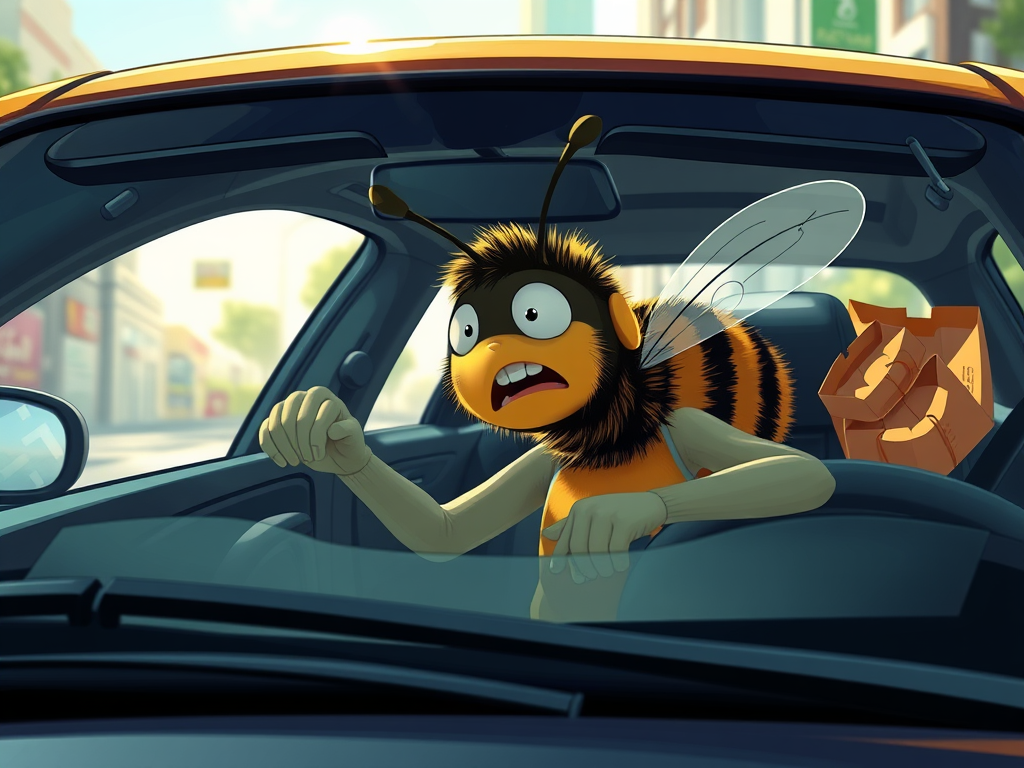
    🏃 The Busy Bee: You have a busy day. You drive to the gym to exercise. You drive home. Then, you realize you need milk. You drive to the supermarket. You drive home. You are exhausted. 🥵

    🧠 The Strategist: You realize the supermarket is next to the gym. You exercise, then you buy milk on your way out. You are home early, relaxing on the sofa.

    📉 The Reality: Hard work is good. Smart work is better.

    🚀 The Secret: Why do two separate tasks when one action can finish both? In this post, we are mastering the art of the “Double Win.” Let’s sharpen your strategy! ⚔️

    🧐 The Anatomy of the Proverb


    Let’s look under the hood of this famous idiom.


    📚 Vocabulary Vault


    Kill (Verb):
    In this context, it doesn’t mean violence. It means to “complete” or “achieve” a task. ✅


    Two Birds (Noun Phrase):
    These represent your Goals or Problems. (e.g., Learning English + Watching a Movie). 🐦🐦


    One Stone (Noun Phrase): This represents a single Action or Effort. 🪨


    🧠 Grammar Focus


    This is an idiom used to describe efficiency.


    Structure: [Verb Phrase] + [Prepositional Phrase]


    Formula: [Solve 2 Problems] + [Using 1 Action]


    Example:“I cycled to work today. I killed two birds with one stone: I saved money on gas, and I got my daily exercise!”

    📜 History: Myths & Archers


    Is this actually about hunting? Originally, yes.


    The Legend: The story goes back to the Greek myth of Daedalus, who was so strong he killed two birds with one stone.


    The Written Record: It appeared in English philosophy in the 1600s (Thomas Hobbes).


    Global Cousins:


    🇨🇳 Chinese:
    “One arrow, two hawks.” (Cooler, right?) 🏹


    🇹🇷 Turkish: “Bir taşla iki kuş vurmak.” (Exactly the same!)


    The Lesson: It is not about cruelty to animals. It is about maximum results with minimum effort.

    🎯 Impact on Life: The Pros & Cons


    Is multitasking always the answer?


    ✅ The Pros (The Superpower)


    Time Management:
    You gain extra free time.


    Energy Saving: You don’t burn out doing unnecessary trips.


    Satisfaction: It feels amazing to be productive.


    ❌ The Cons (The Trap)


    Lower Quality:
    If you try to study, cook, and talk on the phone at the same time, you might burn the food! 🔥


    Distraction: Sometimes, focusing on one bird is better than missing two.

    🎭 Short Story: The Rainy Day Errand


    Let’s see how our farm friends handle a busy day!


    🌟 Character Introduction


    Percy the Chicken (The Busy Body):
    Runs around a lot, but gets little done. 🐔


    Fred the Frog (The Mastermind): Loves efficiency. 🐸


    Luna the Cat (The Boss): Sleeping on the porch. 😼


    It was a rainy Tuesday. The animals had chores to do.

    Goal 1: They needed to mail a letter to the neighboring farm. ✉️

    Goal 2: They were out of corn and hungry. 🌽


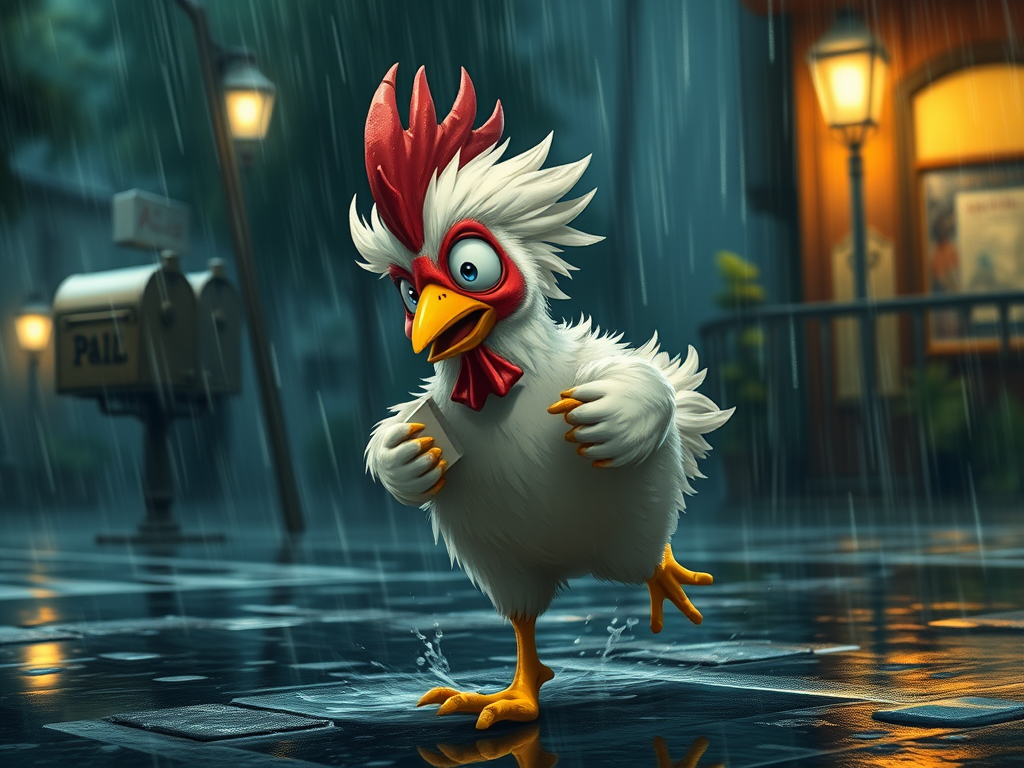
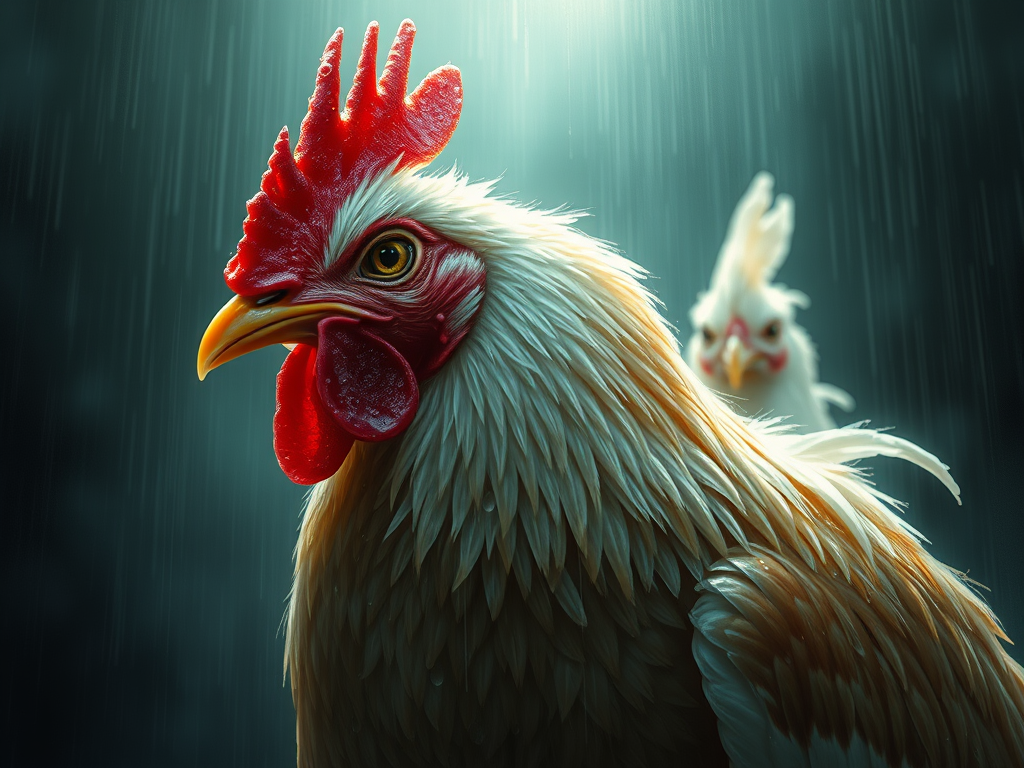
    Percy: Panicked. “I must go now!” Percy grabbed the letter and ran in the rain to the mailbox.

    He ran back, soaking wet. 🌧️ Then his stomach rumbled. “Oh no! We have no food!”

    Percy ran back out into the rain to the barn to get corn. He came back, shivering and tired.

    Percy walked 2 miles and got wet twice.


    Fred: Looked at the list.

    He sat on a lily pad and thought. “I am hungry, and I need to mail this letter.”

    Fred waited until he was hungry. He put the letter in his pocket.

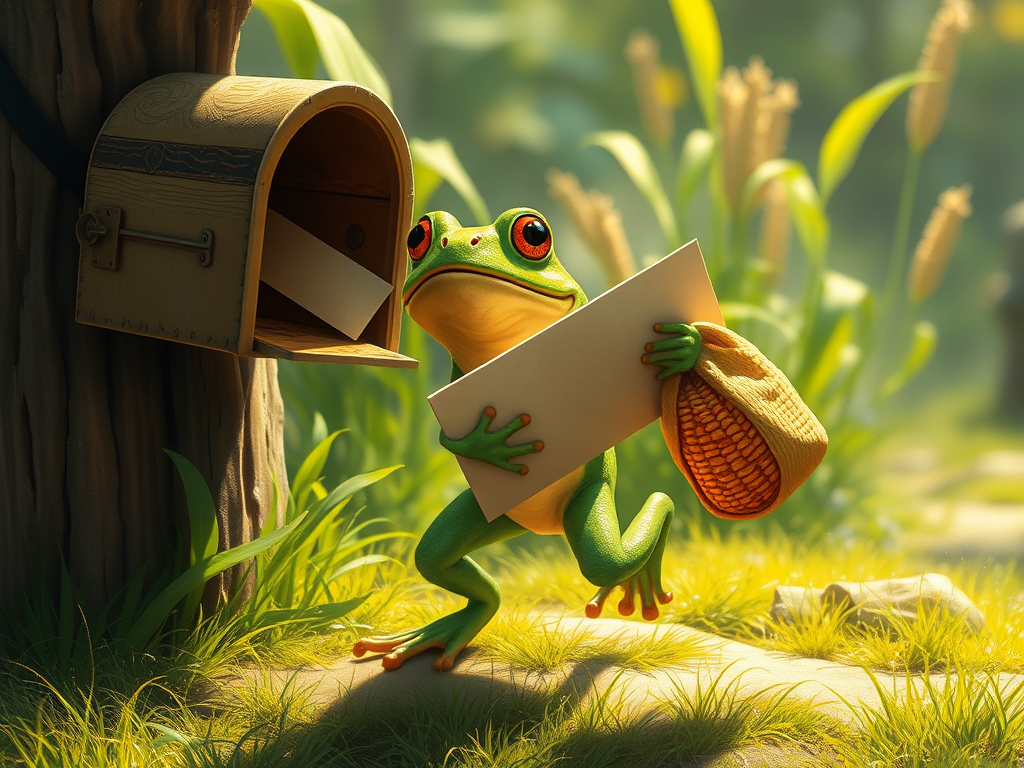
    He hopped to the mailbox, dropped the letter, and then since the food barn was right next to the mailbox, he grabbed the corn bag. He hopped home.


    The Result:

    Percy was sneezing and exhausted. 🤧

    Fred was dry, eating corn, and reading a book.


    Luna opened one eye: “Percy, you worked hard. Fred, you worked smart. Fred killed two birds with one stone.” (Disclaimer: No actual birds were harmed in this story!) 🚫🐦

    🎓 Lesson for English Learners


    How can you use this strategy to learn English faster?


    Don’t “Make Time” for English. Combine it.


    The Commuter Strategy: 🚌
    Bird 1:
    Going to work/school (Boring travel time).


    Bird 2: Improving listening skills.


    The Stone: Listen to an English Podcast on the bus.


    The Netflix Method: 🍿
    Bird 1:
    Relaxing and having fun.


    Bird 2: Learning slang and vocabulary.


    The Stone: Watch your favorite series with English subtitles.


    The Gamer Hack: 🎮
    Bird 1:
    Playing video games.


    Bird 2: Speaking practice.


    The Stone: Join an international server and chat with teammates in English.


    Remember: You don’t need more time. You just need a better stone.


    💬 Your Turn


    What is your best “efficiency hack”?


    Do you brush your teeth in the shower? 🚿


    Do you listen to audiobooks while cleaning the house? 🧹🎧


    Tell us how YOU kill two birds with one stone in the comments! 👇

    By Zubeyir YURTKURAN

    https://www.facebook.com/BrainBattleground/

    https://www.facebook.com/zubeyr.yurtkuran/

    https://www.instagram.com/zubeyryurtkuran/
  • 💡 The Spark of Genius: Why Problems Are Good for You

    💡 The Spark of Genius: Why Problems Are Good for You

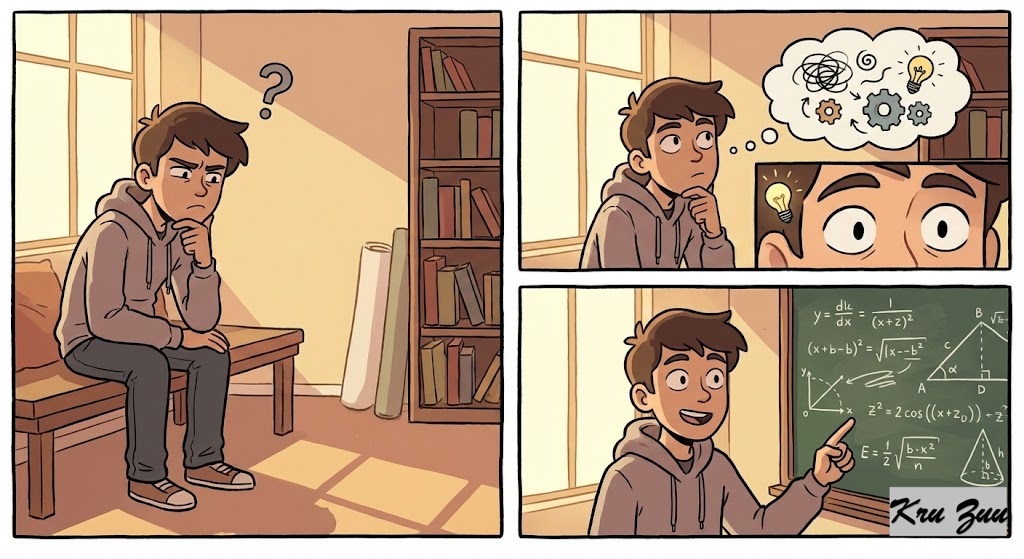
    Necessity is the mother of invention.


    🏖️ The Comfort Zone: You have a car, a GPS, and a full tank of gas. You don’t need to think about directions. You just drive.

    📉 The Reality: You rely on tools. If the battery dies, you are lost. Comfort kills creativity.


    🔥 The Danger Zone: You are lost in the jungle. Your phone is dead. It is getting dark.

    📈 The Reality: Suddenly, your brain wakes up! You build a shelter, you find north using the sun, you find water. You become a genius because you have no choice.


    Life has a secret rule: We rarely change when we are comfortable. We change when we need to.


    In this post, we explore why “problems” are actually “gifts.” Let’s unlock your inner inventor! 🔓

    🧐 The Anatomy of the Proverb


    Let’s dismantle this mechanical masterpiece.


    📚 Vocabulary Vault


    Necessity (Noun):
    A situation where something is absolutely required or essential. (A “must-have” situation). 🆘


    Mother (Noun – Metaphor): The source, origin, or creator of something. (Not a biological mom, but the “starting point”). 🌱


    Invention (Noun): The action of inventing something typically a process or device. (Creating something new). ⚙️


    🧠 Grammar Focus


    This sentence uses a powerful literary device called a Metaphor.


    Subject: Necessity (Abstract Noun)


    Verb: Is (State of being)


    Object: The mother of invention (Noun Phrase)


    Formula: [Problem] = [Creator of Solution].

    Note: We are comparing “Need” to a “Mother.” Just as a mother gives birth to a child, a “Need” gives birth to a “New Idea.”

    📜 History: From Plato to Smartphones


    Is this just a catchy slogan? No, it is ancient wisdom.


    The Origin: The concept appears in Plato’s Republic (Ancient Greece), where he wrote: “Our need will be the real creator.”


    The Evolution: It entered English in 1519, but the phrasing we use today became famous in the 1700s.


    Real Life Example: Why was the Internet created? Because the military needed a way to communicate if phone lines were destroyed.


    The Lesson: Don’t complain about problems. Problems are the fuel for progress.

    🎯 Impact on Life: The Pros & Cons


    Is being under pressure always good?


    ✅ The Pros (Why it works)


    Focus:
    When you have a deadline in 1 hour, you don’t check Instagram. You focus 100%.


    Innovation: People didn’t invent the umbrella because they liked carrying sticks. They invented it because they hated getting wet! ☔


    Survival: Your brain is lazy. It only works hard when it feels it is necessary.


    ❌ The Cons (What to watch out for)


    Stress:
    Constant necessity (always being in “survival mode”) causes burnout. 😫


    Ugly Solutions: Sometimes, a quick fix is ugly. (Like fixing a broken window with duct tape). It works, but it isn’t “perfect.”

    🎭 Short Story: The Heatwave & The Bucket


    Let’s visit our farm friends to see who survives the summer heat!


    🌟 Character Introduction


    Percy the Chicken (The Complainer):
    Waits for others to solve his problems. 🐔


    Fred the Frog (The Thinker): Uses what he has to get what he needs. 🐸


    Luna the Cat (The Observer): Watching from the shade. 😼


    It was the hottest day of the year. The farmer had left a tall, narrow bucket of cold water in the yard. But the water level was very low right at the bottom.


    The Problem: The animals were thirsty, but their heads couldn’t reach down to the water.


    Percy: Poked his beak into the bucket. Bonk. He couldn’t reach. “This is unfair!” Percy squawked. “The farmer forgot us! I will just sit here and be thirsty until he comes back.” Percy sat in the hot dust, miserable and waiting.


    Fred: Looked at the water. He was drying out. He needed that water to survive. He tried to jump in, but the bucket was too narrow. Luna watched lazily. “Give up, Fred. It’s physics.”


    Fred didn’t give up. He looked around. He saw a pile of small pebbles (stones) near the garden.

    Idea! 💡 Fred picked up a pebble and dropped it into the bucket. Plop. Nothing happened. He dropped another. Plop. He dropped ten. Twenty. Fifty!


    Percy laughed: “Now you are just playing with rocks, you silly frog.”


    The Result: With every stone Fred dropped, the water level rose higher due to displacement. After the 100th stone, the cool water rose to the very top of the bucket.


    Fred took a long, refreshing drink. 🥤 Percy looked shocked.


    Luna smiled: “Percy, you saw a problem. Fred saw a puzzle.”


    The Moral:


    Percy:
    Had a need, but waited for help = Thirsty.


    Fred: Had a need, and created a solution = Satisfied.

    🎓 Lesson for English Learners


    How does this apply to learning a language?


    Don’t wait until you are “Ready.” Wait until you are “Desperate.”


    The “Survival” Method: If you study English in a classroom, you might be lazy. But imagine if you are dropped in the middle of London, hungry, and need to find a bathroom. Necessity will force you to speak. You won’t care about grammar rules; you will care about communication.


    Create Your Own Necessity:


    Don’t just read books.


    Change your phone language to English. (Now you need to understand it to use your phone).


    Promise to teach a friend a topic in English. (Now you need to learn it so you don’t look foolish).


    Remember: We learn fastest when we have no other choice.


    💬 Your Turn


    Have you ever fixed something using a strange object (like opening a box with a key, or fixing glasses with a paperclip) because you didn’t have the right tool? 🛠️🖇️


    Tell us your best “MacGyver Moment” in the comments! 👇

    By Zubeyir YURTKURAN

    https://www.facebook.com/BrainBattleground/

    https://www.facebook.com/zubeyr.yurtkuran/

    https://www.instagram.com/zubeyryurtkuran/
  • 🚀 Practice Makes Perfect: The Secret Sauce of Mastery

    🚀 Practice Makes Perfect: The Secret Sauce of Mastery

    🚫 Can You Learn to Swim by Reading a Book?


    📖 The Short Cut: You watch 50 YouTube videos about “How to play guitar,” memorize every chord name, but never actually pick up the instrument.

    📉 The Reality: The moment you hold the guitar, your fingers don’t work. You have knowledge, but zero skill.

    🗣️ The Short Cut: You study English grammar rules for 5 years but you are too afraid to speak because you might make a mistake.

    📉 The Reality: You become a “Grammar Professor” who cannot order a coffee. Silence is not fluency.


    Life has a strict rule: You cannot think your way to mastery; you must do your way to mastery. In this post, we explore why repetition is the mother of skill. Don’t just read this do it! 👊

    🧐 The Anatomy of the Proverb


    Let’s break down the mechanics of this golden rule.


    📚 Vocabulary Vault


    Practice (Noun/Verb): Performing an activity or exercise repeatedly to improve your proficiency. (Doing it again and again). 🔄


    Make (Verb): To cause something to become specific. (To result in). 🔨


    Perfect (Adjective): Having all the required or desirable elements; free from faults or defects. ✨


    🧠 Grammar Focus


    This is a concise Subject + Verb + Object sentence in the Present Simple Tense.


    Subject: Practice (Uncountable Noun – treated as Singular “It”)


    Verb: Makes (Causative verb)


    Object: Perfect (Adjective acting as a noun idea, “perfection”)


    Formula: [Practice] + [Makes] + [Perfect]. Note: Since “Practice” is a singular concept, we must add -s to the verb (Make -> Makes).

    📜 History: From Romans to Bruce Lee


    Is this a modern idea?


    The Origin: The roots go back to the Latin phrase “Uses promptos facit” (Use makes ready). The modern English version became popular in the 1500s.


    The Legend: Martial arts legend Bruce Lee famously said: “I fear not the man who has practiced 10,000 kicks once, but I fear the man who has practiced one kick 10,000 times.”


    The Lesson: It is better to do one thing deeply than 100 things shallowly.

    🎯 Impact on Life: The Pros & Cons


    Is doing the same thing over and over always good?


    ✅ The Pros (Why it works)


    Muscle Memory: Whether it’s your tongue forming the “TH” sound or your fingers playing piano, repetition moves the skill from your brain to your body. You stop thinking and start doing. 🧠➡️💪


    Confidence: Familiarity kills fear. The 100th time you give a presentation, you won’t be nervous.


    Speed: Amateurs are slow because they are thinking. Professionals are fast because they have practiced.


    ❌ The Cons (What to watch out for)


    Bad Practice:
    If you practice a mistake repeatedly, you make the mistake “perfect.” (e.g., pronouncing “Three” as “Tree” for 10 years). Correction is necessary.


    Boredom: Repetition can be dull. You must find ways to keep it fun (Gamification).

    🎭 Short Story: The Juggling Contest


    Let’s see how our farm friends handle a new talent show!


    🌟 Character Introduction


    Percy the Chicken (The Impatient Talent):
    Wants to be a star immediately. 🐔


    Fred the Frog (The Consistent Worker): Willing to look silly to get better. 🐸


    Luna the Cat (The Critic): Watching from the fence. 😼


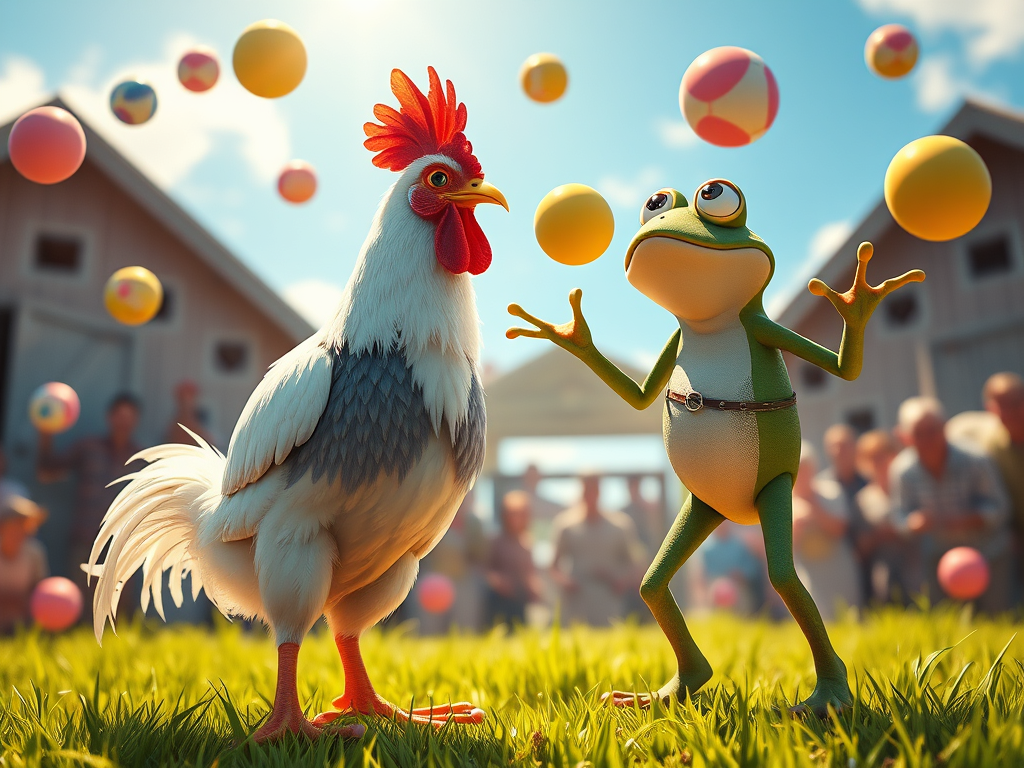
    The “Farm Talent Show” was one week away. Percy and Fred decided to learn juggling (throwing balls in the air).


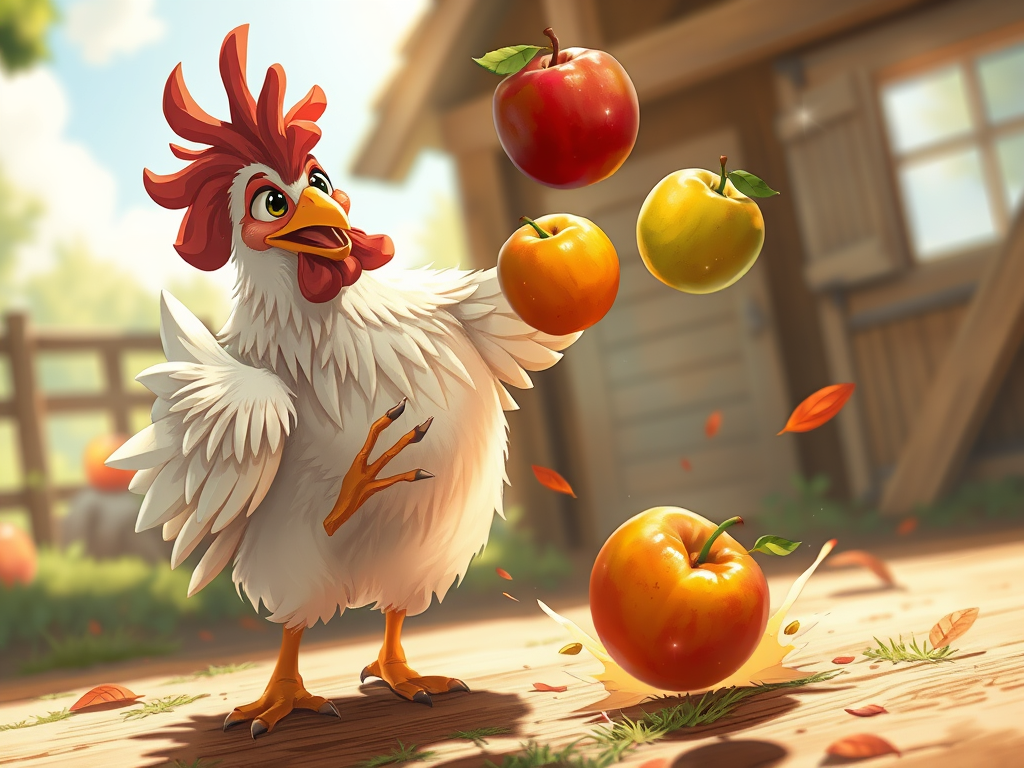
    Day 1: Percy picked up three apples. “Watch this!” he shouted. He threw them up… and SPLAT! All three hit the floor. “This is stupid!” Percy yelled. “I don’t have the ‘juggling gene.’ I quit.” He went back to eating corn.


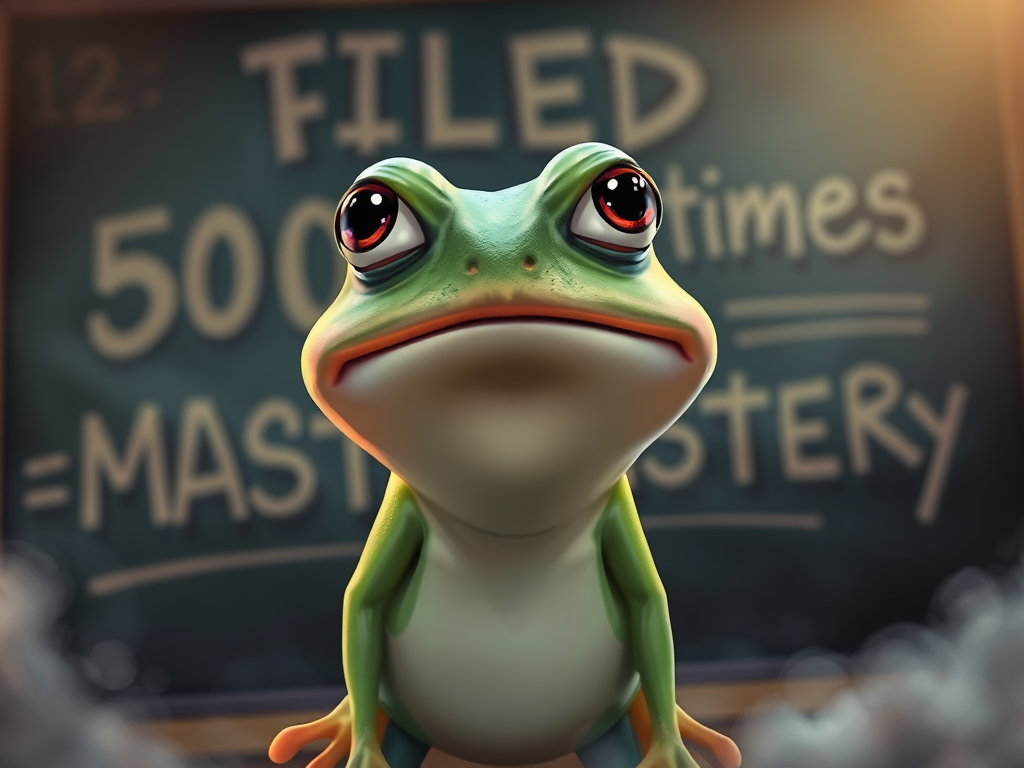
    Fred picked up three small berries. He threw one up, dropped it. Threw it up, dropped it. He did this 500 times. He looked clumsy. Luna laughed, “Fred, you look ridiculous.” Fred smiled, “Not yet, Luna. Give me time.”


    Day 4: Fred was still dropping berries, but now he could catch two in a row. His hands were starting to move automatically. Percy was sleeping.


    Day 7 (Showtime!): 🎪 Percy went on stage. “I will wing it!” he said. He threw the apples… BONK! One hit him on the head. The audience laughed. Percy was embarrassed. Then, Fred hopped on stage. He picked up three shining red berries. Whoosh, whoosh, whoosh. His hands moved like a blur. He didn’t even look at the berries; he looked at the audience and smiled. It was a flawless performance. 🌟


    Luna pinned the blue ribbon on Fred: “Percy, you wanted magic. Fred understood that magic is just practice in disguise.”


    The Moral:


    Percy:
    Gave up after 1 fail = No Skill.


    Fred: Failed 500 times = Mastery.

    🎓 Lesson for English Learners


    How do you use this for English?


    Don’t Aim for “Perfect” Immediately: A better version of this proverb is “Practice makes Progress.”


    The “Shadowing” Technique: Listen to a native speaker sentence. Pause. Repeat it exactly. Do this 20 times.


    Time 1: You feel weird.


    Time 10: Your tongue feels more comfortable.


    Time 20: You sound natural.


    Mistakes are Data: Every time you make a grammar mistake, don’t feel bad. That is just one “dropped berry.” Pick it up and try again.


    Remember: No one is born speaking a language. Every fluent speaker you see has “practiced” thousands of hours.


    💬 Your Turn


    Is there a skill (cooking, driving, a video game) that you used to be terrible at, but now you are a master of? 🎮🍳🚗


    Tell us your story of “Zero to Hero” in the comments! 👇

    By Zubeyir YURTKURAN

    https://www.facebook.com/BrainBattleground/

    https://www.facebook.com/zubeyr.yurtkuran/

    https://www.instagram.com/zubeyryurtkuran/
  • 🌅 The Early Bird Catches the Worm: Why the Snooze Button is the Enemy of Success

    🌅 The Early Bird Catches the Worm: Why the Snooze Button is the Enemy of Success

    🚫 Can You Build an Empire While You Sleep?


    🛌 The Short Cut: Hitting the “Snooze” button 5 times because “5 more minutes” feels like heaven.

    📉 The Reality: You rush, spill coffee on your shirt, miss the bus, and start the day stressed and behind schedule.

    📱 The Short Cut: Waiting for the “perfect time” or “New Year’s Day” to start studying English.

    📉 The Reality: By the time you start, the job interview was yesterday. The position is filled by someone who started last month.


    Life has a simple timing algorithm: First come, first served. In this post, we explore why timing is everything. Wake up, grab your coffee; the opportunity bus is leaving! 🚌

    🧐 The Anatomy of the Proverb


    Let’s dissect this classic idiom to understand its mechanics.


    📚 Vocabulary Vault


    Early (Adjective):
    Happening before the usual or expected time. (Being ahead of the crowd). ⏰


    Catch (Verb): To capture, seize, or grab something. 🤲


    Worm (Noun): A small animal. Metaphorically: The prize, the opportunity, the job, or the reward. 🪱


    🧠 Grammar Focus


    This is a perfect example of the Present Simple Tense representing a “General Truth.”


    Subject:
    The early bird (The proactive person)


    Verb: Catches (The action/result)


    Object: The worm (The reward)


    Formula: [Subject] + [Verb + s] + [Object]. Note: Because “The bird” is singular (It), we add -es to the verb catch (Catches).

    📜 History: A 17th Century Wake-Up Call


    Who told us to wake up so early?


    The Origin:
    This phrase first appeared in a collection of proverbs by John Ray in 1670.


    The Logic: Before supermarkets, birds literally had to wake up at dawn to find worms coming out of the damp morning soil. If a bird slept until noon, the worms were gone (hiding underground from the sun).


    The Lesson: Opportunities are limited resources. They don’t wait for you to finish your breakfast.

    🎯 Impact on Life: The Pros & Cons


    Is waking up at 5:00 AM the only way to succeed?


    ✅ The Pros (Why it works)


    Zero Distractions:
    At 6:00 AM, nobody is texting you. Instagram is quiet. It is just you and your goals. Focus is at 100%. 🧘‍♂️


    Proactivity: You act before problems arise. You control the day; the day doesn’t control you.


    The “First Choice” Privilege:
    The first person at the buffet gets the freshest food. The first applicant often gets the interview.


    ❌ The Cons (What to watch out for)


    The Night Owl Dilemma:
    Some people are genetically wired to be creative at night. If you force yourself to wake up early but are exhausted, you lose quality.


    Social Lag: If you wake up at 4 AM, you might be sleepy by 8 PM when your friends want to hang out.

    🎭 Short Story: The Great Garden Breakfast


    Let’s return to our farm friends to see this proverb in action.


    🌟 Character Introduction


    Percy the Chicken (The Snoozer):
    Loves his warm bed and dreams of corn. 🐔


    Fred the Frog (The Early Riser): Alert, hungry, and disciplined. 🐸


    Luna the Cat (The Observer): Watches from the roof. 😼


    It was a rainy Tuesday morning. The soil was wet perfect conditions for finding juicy worms!


    5:30 AM: The sun began to rise. Fred the Frog opened his eyes immediately. “Rainy night means breakfast delight!” he croaked. He hopped out to the garden while the rest of the farm was snoring. He found the biggest, juiciest worm right in the middle of the path. “Delicious!” Fred said, enjoying his feast in the quiet morning mist. 😋


    9:00 AM: Percy the Chicken’s alarm went off… for the third time. Percy stretched, yawned, and slowly walked out to the garden. “Okay world, I am ready for my breakfast!” he announced. He looked at the ground. Nothing. He scratched the dirt. Nothing. The sun was high now, and the ground was dry. All the worms had gone back underground.


    Luna looked down from the roof and laughed: “Percy, you have great feathers, but an empty stomach. Fred got the worm because he didn’t negotiate with his alarm clock.”


    The Moral:


    Percy:
    Slept late = Leftovers (or hunger).


    Fred: Woke up early = The Grand Prize.

    🎓 Lesson for English Learners


    How does this apply to learning a language?


    The “Worm” is Fluency.


    The “Early Bird” is Preparation.


    Review Before Class: If you learn the vocabulary before the lesson starts (Early Bird), you can use the lesson to practice speaking (Catching the Worm). If you wait for the teacher to explain everything, you waste time.


    Morning Brain: Research shows that reviewing notes for 15 minutes in the morning is more effective than 1 hour when you are tired at night.


    Don’t Wait for “Someday”: “I will learn English when I have time” is the biggest lie. The time is now.


    Remember: You don’t have to be a genius to learn English; you just have to start before everyone else quits.


    💬 Your Turn


    Are you a Morning Person (Early Bird) ☀️ or a Night Owl 🦉? Do you believe getting up early is the key to success, or can you catch the worm at midnight?


    Tell us your routine in the comments! 👇

    By Zubeyir YURTKURAN

    https://www.facebook.com/BrainBattleground/

    https://www.facebook.com/zubeyr.yurtkuran/

    https://www.instagram.com/zubeyryurtkuran/
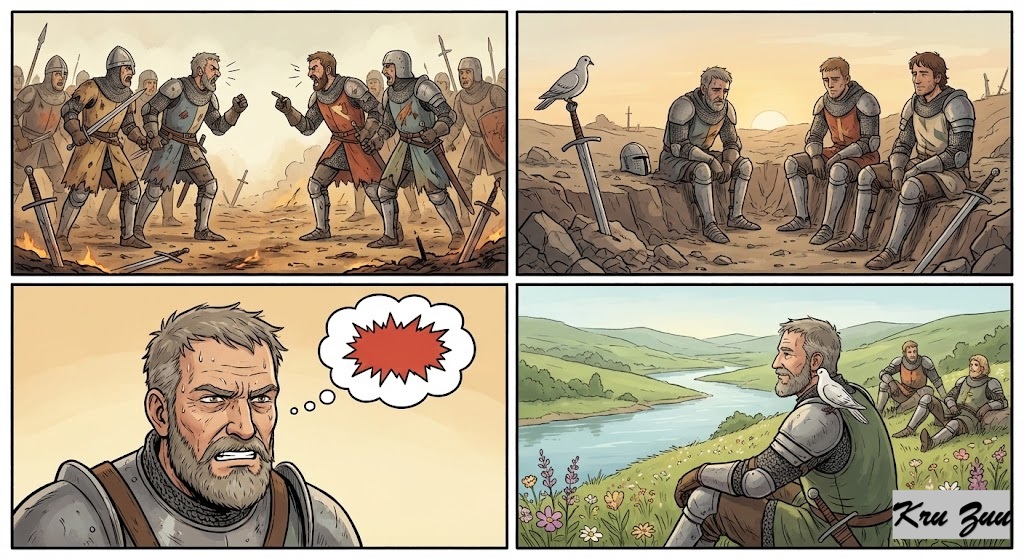
  • 💪 No Pain, No Gain: The Comfort Zone is Where Dreams Go to Die

    💪 No Pain, No Gain: The Comfort Zone is Where Dreams Go to Die

    🚫 Can You Win a Gold Medal from Your Couch?


    🛋️ The Short Cut: Drinking “Miracle Slimming Tea” instead of going to the gym.

    📉 The Reality: Your wallet gets lighter, but your belly stays the same. Disappointment is guaranteed.


    📚 The Short Cut: Watching TV shows with subtitles to “get used to the sound” because memorizing vocabulary is too hard.

    📉 The Reality: Years pass, and you are trapped in the “I understand but I can’t speak” trap.


    Life’s most brutal but fair rule is this: No sweat, no victory. In this post, we examine why success requires paying a price. Take off your masks, put on your running shoes; the training starts now! 🏋️‍♂️

    🧐 The Anatomy of the Proverb


    Let’s look at the mechanics of this motivational phrase.


    📚 Vocabulary Vault


    Pain (Noun):
    Physical suffering, effort, trouble, or difficulty. (Here, it means “necessary struggle.”) 😓


    Gain (Noun): Profit, advancement, increase, or achievement. 🏆


    No (Determiner): Indicates absence or lack of something.


    🧠 Grammar Focus


    This structure is the shortest and most powerful form of a “Conditional” sentence in English.


    Formula: No + [Noun 1] + , + No + [Noun 2].


    The Meaning: If the first noun (pain/effort) is absent, the second noun (gain/success) is impossible.


    Example: No risk, no fun.


    📜 History: From Poets to Bodybuilders


    Who made this famous?


    The Origin:
    While roots go back to 17th century poet Robert Herrick, the phrase was popularized in the modern world by 1980s fitness icon Jane Fonda. She used it in her aerobic videos to encourage people to push through “the burn” in their muscles.


    The Lesson: Success is not an accident; it is the receipt for the price you paid in effort.

    🎯 Impact on Life: The Pros & Cons


    Is pushing yourself constantly always good?


    ✅ The Pros (Why it works)


    Resilience: Difficulties forge a character as strong as steel.


    True Skill: What is easily gained is easily lost. Hard-earned skills are permanent.


    Pride: The view is different for the person who climbed the mountain compared to the person who took a helicopter to the peak. 🏔️


    ❌ The Cons (What to watch out for)


    Burnout:
    Chasing “pain” without rest leads to injury or mental exhaustion. You must work hard, but also work smart.

    🎭 Short Story: The Great Farm Marathon


    To understand this proverb, let’s look at our farm friends and the upcoming “Great Summer Race.”


    🌟 Character Introduction


    Percy the Chicken (The Dreamer):
    Wants to win the race but hates waking up early to run. 🐔


    Fred the Frog (The Grinder): Jumps every morning until his legs ache. He knows the process is hard. 🐸


    Luna the Cat (The Coach): The observer and referee. She focuses on results. 😼


    One week before the race, Percy bought himself a pair of expensive, brand new running shoes. “Hey Fred!” shouted Percy, lying in his hammock. “Why do you tire yourself out so much? Look, my shoes are super fast! I’m saving my energy for race day.” 🥤 Fred stopped, panting, and wiped the sweat from his forehead. “My legs are burning, Percy. But every day I get one step faster. I love this pain because it leads me to the goal.”


    Race day arrived. 🏁 With the starting whistle, Percy bolted! He was great for the first 10 meters. But at 50 meters, his lungs started to burn. At 100 meters, his legs shook, and he collapsed. “This is unfair! My shoes were so expensive!” he cried. 😵


    Fred started slow but steady. As he hopped up the hill, he felt that familiar “burning” sensation in his legs. But thanks to his training, he was used to this pain. It didn’t stop him; it fueled him. He crossed the finish line as the champion. 🏆


    As Luna placed the medal on Fred, she turned to Percy: “Percy, expensive shoes (The Short Cut) don’t make you a champion. The leg pain Fred endured (The Pain) brought him this medal (The Gain).”


    The Moral:


    Percy:
    Comfort Zone = No Trophy.


    Fred: Sweat & Ache = Victory.

    🎓 Lesson for English Learners


    Does your hand hurt while writing new vocabulary words 10 times in a notebook? (Pain) ✍️


    This is a sign that your brain is etching that word into long-term memory. (Gain) 🧠


    Did you make a mistake in a speaking club, turn red, and feel embarrassed? (Pain) 😳


    That emotional memory ensures you will never make that mistake again. (Gain) ✨


    Remember: The feeling of “struggle” when learning a language is not failure; it is the sound of improvement footsteps.


    💬 Your Turn


    Has there been a moment in your life where you said, “I wish I had pushed a little harder”? Or a success you are proud of because you suffered for it? Share your story in the comments! 👇

    By Zubeyir YURTKURAN

    https://www.facebook.com/BrainBattleground/

    https://www.facebook.com/zubeyr.yurtkuran/

    https://www.instagram.com/zubeyryurtkuran/
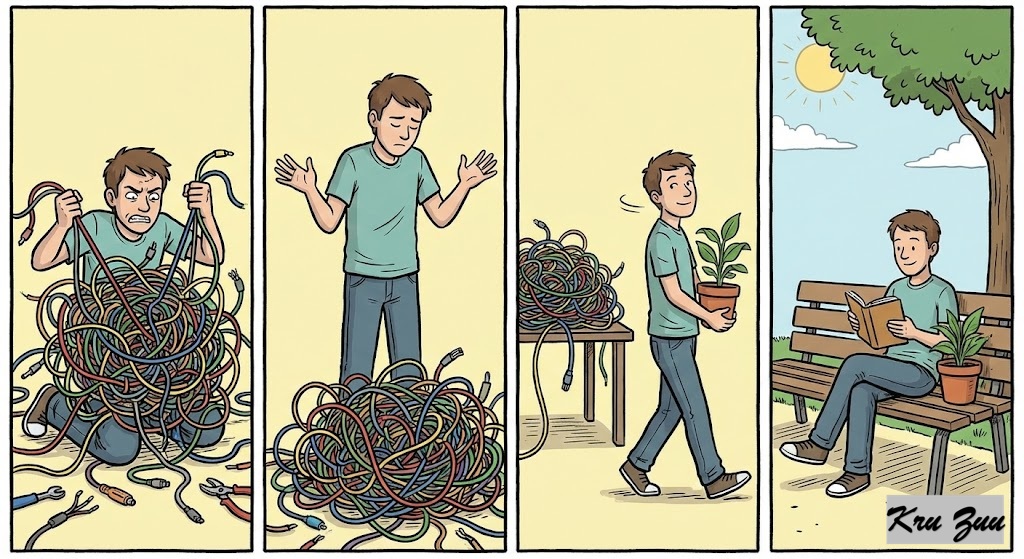
  • Honesty Is The Best Policy: How Short-Term Comfort Kills Long-Term Trust

    Honesty Is The Best Policy: How Short-Term Comfort Kills Long-Term Trust

    🧐 When Does the Liar’s Lamp Go Out?


    📝 The Short Cut: Fabricating an excuse to cover up that you haven’t finished a report.

    🔥 The Long-Term Cost: Having to invent three more lies to support the first one; permanently losing your manager’s/friend’s trust.


    💰 The Short Cut: Intentionally concealing a small piece of information in a deal to gain immediate profit.

    📉 The Long-Term Cost: Your reputation spreading, being labeled “untrustworthy” in the industry, and losing all future major deals.


    Life constantly proves a rule well-known to successful people: “Honesty Is The Best Policy.”


    In this post, we examine why a simple ethical rule is the most profitable strategy in life. Take off your masks, take a deep breath, and let’s dive into the value of trust. 💡

    🧐 The Anatomy of the Proverb


    Let’s look at the mechanics of this ethical compass.


    📚 Vocabulary Vault


    Honesty (Noun):
    The quality of being truthful, sincere, and possessing integrity. 🛡️


    Policy (Noun): A course of action or set of principles adopted by an individual or organization to achieve a goal. ⚖️


    Best (Adjective): Most profitable, most advantageous, or most long-lasting.


    🧠 Grammar Focus


    This sentence is a defining statement that establishes honesty as the wisest strategy.


    Formula: Honesty + [is] (Linking Verb) + [the best policy].


    The Meaning: Even if it causes immediate difficulty, honesty is the smartest policy because it secures reputation, trust, and therefore, long-term success.


    📜 History: The Price of Trust


    When did this idea become popular? People have known the societal cost of trust since they started living in groups.


    The Origin:
    The proverb is commonly associated with the American Founding Father, Benjamin Franklin. Franklin believed that honesty would lead to financial success in business. However, the saying itself predates him.


    The Lesson: The price of dishonesty (lost trust) is always higher than the immediate cost of telling the truth (the consequence of confession).

    🎯 Impact on Life: The Pros & Cons


    Is being 100% honest always a viable lifestyle? Let’s weigh the options.


    ✅ The Pros (Why it helps)


    Reputation: It builds and sustains trust, the most valuable asset one can acquire in the marketplace.


    Mental Peace: You don’t have to remember your lies. Your mind is free from the stress of managing a web of deceit. 🧘


    Simplifies Life: Instead of building complex lies, it simplifies your life and allows you to focus.


    ❌ The Cons (Why it can be tricky)


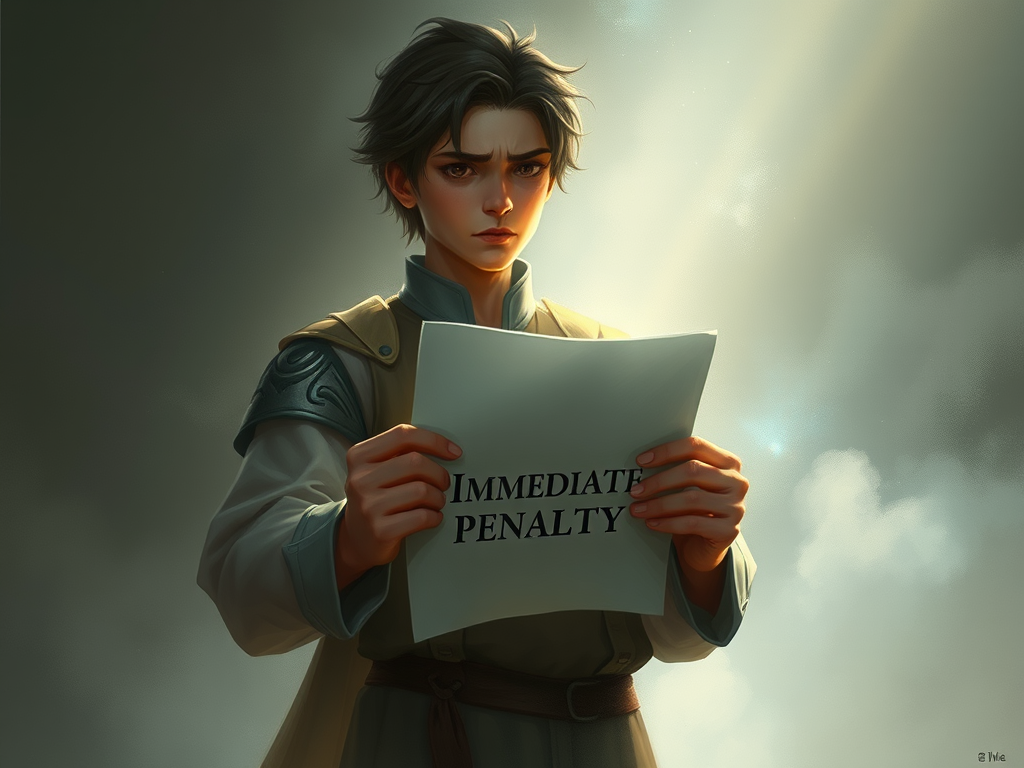
    Immediate Penalty:
    Sometimes, honesty means admitting a mistake or deficiency, which can result in an instant penalty.


    Emotional Harm: In sensitive social situations where white lies are often preferred, excessive blunt honesty can cause emotional damage.

    🎭 Short Story: The Missing Nut Fund


    To understand this proverb better, let’s revisit our friends on the farm. The communal winter provisions fund (nuts and corn) is running low.


    🌟 Character Introduction


    Percy the Chicken (The Short-Cutter): Resorts to big lies for instant relief. He prioritizes short-term gain over long-term reputation. 😵


    Luna the Cat (The Trust Manager): Manages the farm’s funds. She highly values trust, and once broken, it cannot be easily restored. ✨


    Fred the Frog (The Integrity Expert): If he makes a mistake, he confesses immediately and knows that rectifying his error is the most profitable path. 🐸


    Luna noticed a small amount of nuts was missing from the winter provisions fund.


    Percy immediately rushed over. “Ah, Luna! I’m sure that pesky squirrel, Sneaky Tail, came and stole it! I saw him this morning, he’s very crafty!” Percy had actually secretly eaten the nuts but blamed someone else. 🤥


    Meanwhile, Fred approached Luna to confess that he had accidentally knocked over and spilled a tiny portion of corn due to fatigue.


    Percy whispered to him: “Shhh, Fred! No one will notice two kernels of corn. Why put yourself in trouble by confessing?”


    Fred shrugged. He turned to Luna: “Luna, I am very sorry. I spilled two kernels of corn because I was tired. I will immediately replace them. I promise to bring back double tomorrow.” 🐸


    Luna smiled at Fred. “Thank you, Fred. There is no penalty for your honesty. Your integrity is worth far more than two kernels of corn.”


    A week later, inconsistencies in Percy’s story surfaced. Luna realized that the specific type of squirrel he mentioned didn’t even live in that area. Luna approached Percy: “The nuts are gone. But worse, my trust is gone.”


    Percy bowed his head in ashamed regret.


    Fred, that week, not only replaced the corn but also found extra nuts, solidifying his position as Luna’s most trusted partner.


    In this story, the characters represent the cost of integrity:


    Percy’s Lie:
    Short-term comfort (No immediate penalty) 😵


    Fred’s Truth: Immediate cost (Confession and promise to fix) 🤓


    Luna’s Trust: Long-term profit (The most valuable asset in the marketplace) 🛡️

    🎓 Lesson for English Learners:


    You made a mistake in a speaking club and mispronounced a word. You ignored your error out of shame. (Percy’s Method)


    If your teacher asks, “Did I make a mistake?” and you confess and correct it immediately, the moment of shame is fleeting, but the correct learning is guaranteed. (Fred’s Method)


    True learning lies not in concealing errors, but in openly confessing and correcting them.


    💬 Your turn: Was there a time when honesty opened a big door for you, or a lie cost you dearly in life? Share your story in the comments! 👇

    By Zubeyir YURTKURAN

    https://www.facebook.com/BrainBattleground/

    https://www.facebook.com/zubeyr.yurtkuran/
    https://www.instagram.com/zubeyryurtkuran/