🔥 The Word: I’m going to study all night and ace the big exam! 🎮 The Action: You spend 3 hours playing video games, and suddenly realize you haven’t studied for the test tomorrow.

🔥 The Word: I’ll just scroll through TikTok “for 5 minutes.” 📱 The Action: You look up to see that two hours have vanished without gaining anything.

🔥 The Word: I’ll finish this project perfectly, I promise. 🛠️ The Action: You haven’t started a single step because you were waiting for the “perfect time” or the “perfect plan.”

Life has a strict rule that successful people know well: “Actions Speak Louder Than Words.”
In this post, we are looking at the most famous proverb about getting things done. Put down your phone, focus your mind, and let’s dive into the power of execution. 🚀
The Anatomy of the Proverb
Let’s look at the mechanics of this famous phrase.
📚 Vocabulary Vault
Action (Noun): A thing done, often in pursuit of a purpose. (Reading a book, sending an email, writing code). 🛠️

Word (Noun): A spoken or written statement; the expression of an intention. (I will do, I will start, I will try). 📝
🧠 Grammar Focus
This sentence is a comparative idiom that delivers a strong message.
Formula: Action + [speak louder than] + Word.
The Meaning: Deeds and accomplishments carry more value and impact than mere promises or intentions. A Word is a promise, but an Action is the fulfillment of that promise.

History: Intention is Not Enough
Who turned this idea into a famous saying? People have always criticized those who talk big but fail to deliver.

The Origin: While there is no single inventor of the exact phrase, the philosophy is ancient. It echoes the sentiment of the Roman poet Ovid, who lived in the 1st Century BC: “Deeds are words, and words are merely air.”

The Lesson: Success depends not on how well you speak, but on how much you do.

Impact on Life: The Pros & Cons
Is living by action alone a good way to live? Let’s weigh the options.
✅ The Pros (Why it helps)
Trustworthiness: When you say you will do something and then you actually do it, people trust you. Trust is the most valuable asset in life and career.

Momentum: It stops procrastination. Instead of waiting for the “perfect moment,” it encourages you to take a small step now. Every small action builds momentum. 🧗

Focus: It teaches you to spend your energy on producing results rather than crafting excuses or making intricate, non-executed plans.

❌ The Cons (Why it can be tricky)
The Perfectionist Trap: The pressure to constantly act might cause you to rush without proper planning. Actions that are poorly thought out can lead to failure.

Neglecting Communication: Sometimes, saying something (asking for feedback, stating an intention) is important. Focusing solely on action might cause you to neglect crucial planning and communication with others. 🧘

Short Story: The Empty Basket
To understand this better, let’s visit our friends on the farm again.
It was a bright autumn morning. Percy the Chicken, Luna the Cat, and Fred the Frog were sitting under the Great Walnut Tree. 🌳

“Today,” announced Percy, puffing out his chest, “I am going to work hard and gather all these walnuts! I will bake a magnificent cake, and the whole farm will be impressed!” 📣

Luna the Cat rolled her eyes. “That sounds lovely, Percy. But you are just talking.”

Fred the Frog, with his small basket, had already begun hopping under the tree. He worked slowly but surely, picking up the fallen walnuts and placing them in his basket. 🐸

Percy ignored him. He continued to dream out loud, looking at the nuts. “First, I must create a detailed plan. What is the best recipe for my cake? Are these walnuts of suitable quality?” Percy spent a full hour talking about his perfect plan and how wonderful his cake would be. 😴
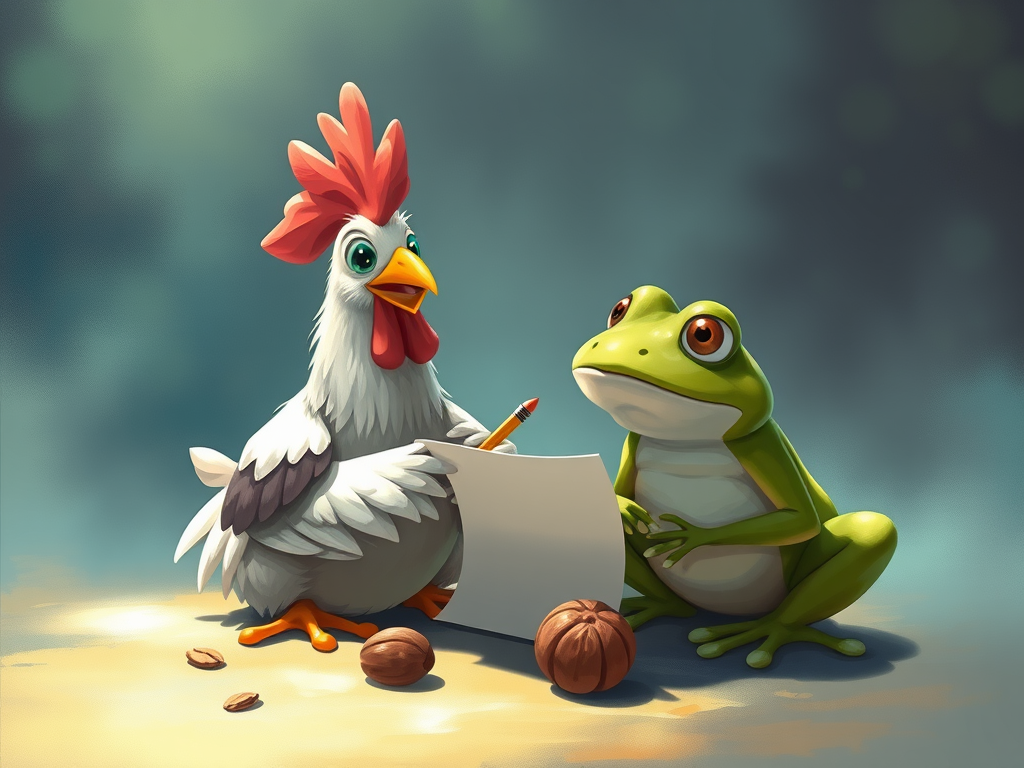
An hour passed. Suddenly, the farmer arrived with a large cart to collect all the scattered walnuts for himself.

Percy squawked in surprise. “No! My walnuts! I was just about to start!”

Fred sat on a dry rock, holding his full basket. “While you were talking about your cake, I was collecting these,” Fred said. “Your basket was full of imaginary biscuits. My basket is full of real walnuts.”

Percy stared sadly at his empty basket.

“I see now,” Percy whispered sadly. “I only spoke. Fred took action. My words were worthless.”

In this story, the characters represent how we manage our intentions:
Percy: Empty Words (The one who talks a lot and procrastinates) 😵
Fred: Action/Execution (The one who uses the moment wisely) 🤓
The Farmer: Missed Opportunity (The value lost while you were only talking) 🌪️
Learning English takes action. You cannot buy fluency.
If you study for 10 minutes every day (Fred’s method), you are executing your plan.
If you only say “I will start tomorrow” and wait until the night before the exam (Percy’s method), you will find that your goal remains only a hollow promise.
💬 What about you? When you have a new idea, do you start with a small, immediate action, or do you keep planning until everything is perfect? Tell me in the comments! 👇
https://www.facebook.com/BrainBattleground/