Tag: Vocabulary Building

  • πŸ’˜ The Daily Shield: The Law of Invisible Red Flags

    πŸ’˜ The Daily Shield: The Law of Invisible Red Flags

    “Love is blind.”


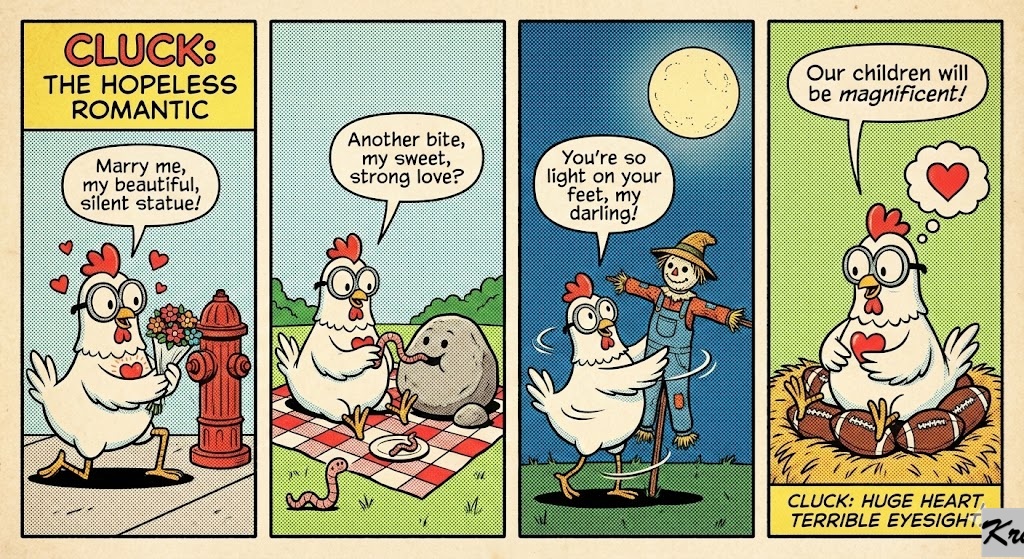
    😈 The Villain (The Hopeless Romantic)

    You meet someone new. Sparks fly. πŸŽ‡ Suddenly, logic leaves the building. They are rude to the waiter? “Oh, he’s just passionate.” She never pays for anything? “She’s just old-fashioned.” They ghost you for three days? “They are just so busy being successful!” You ignore the warning signs. You project your fantasy onto a flawed reality.
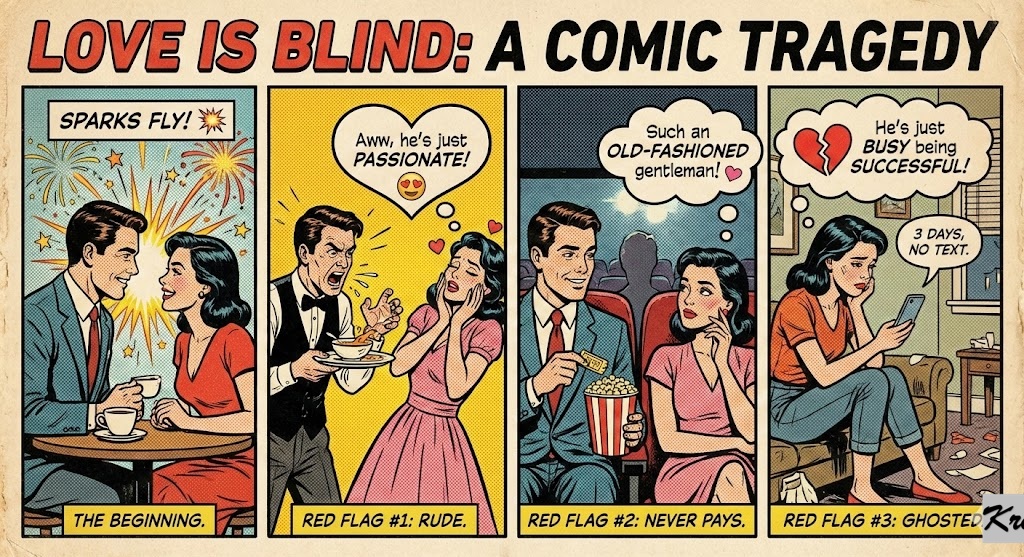
    The Result? You get heartbroken. You waste months on a relationship that was doomed from day one. You realize too late that you fell in love with a mask, not a person. 🎭
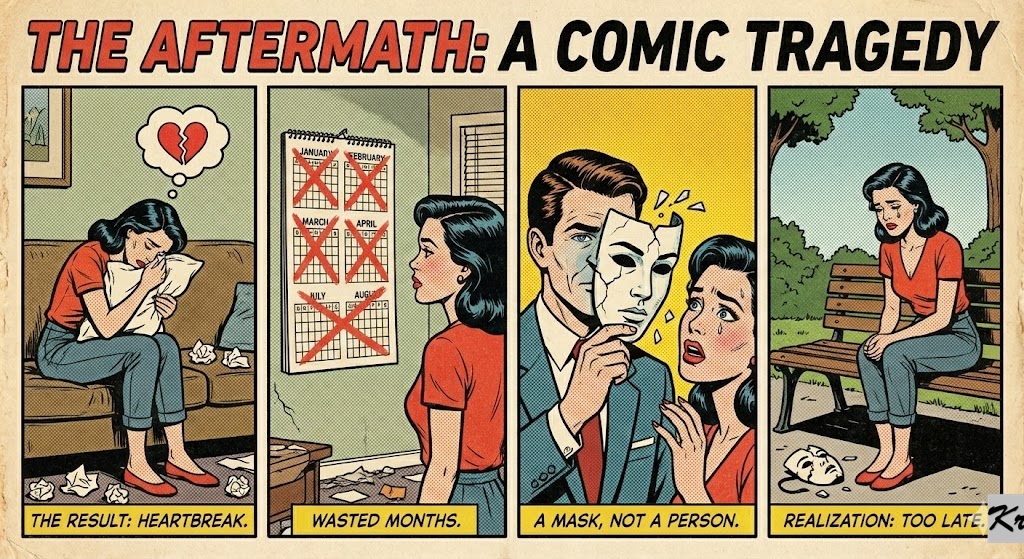

    πŸ˜‡ The Hero (The Conscious Partner)

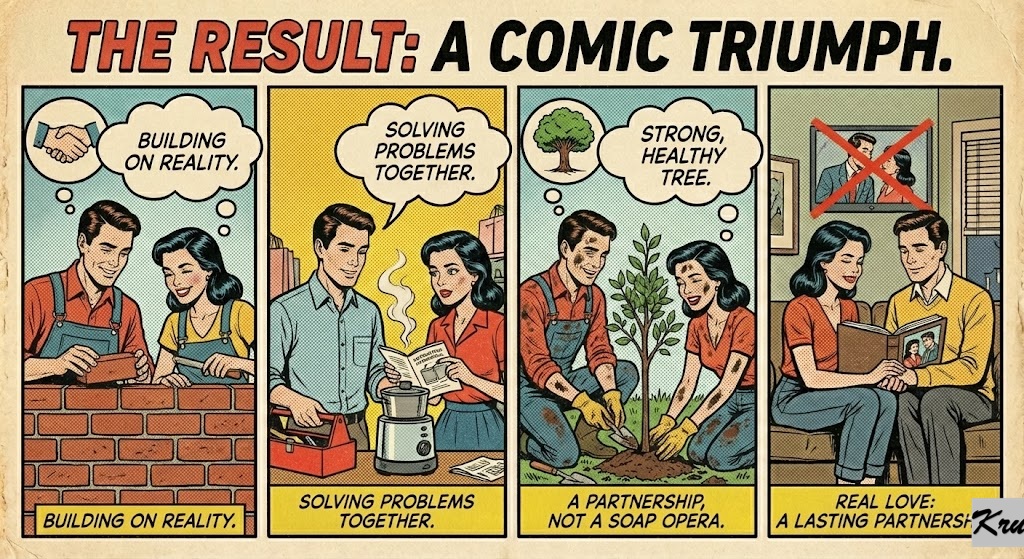
    You feel the chemistry, but you keep your eyes open. πŸ‘€ You love them, but you acknowledge their flaws. You think: “He is funny, but he is terrible with money. Can I live with that?” or “She is beautiful, but she has a bad temper. Is she working on it?” You don’t ignore the red flags; you address them.
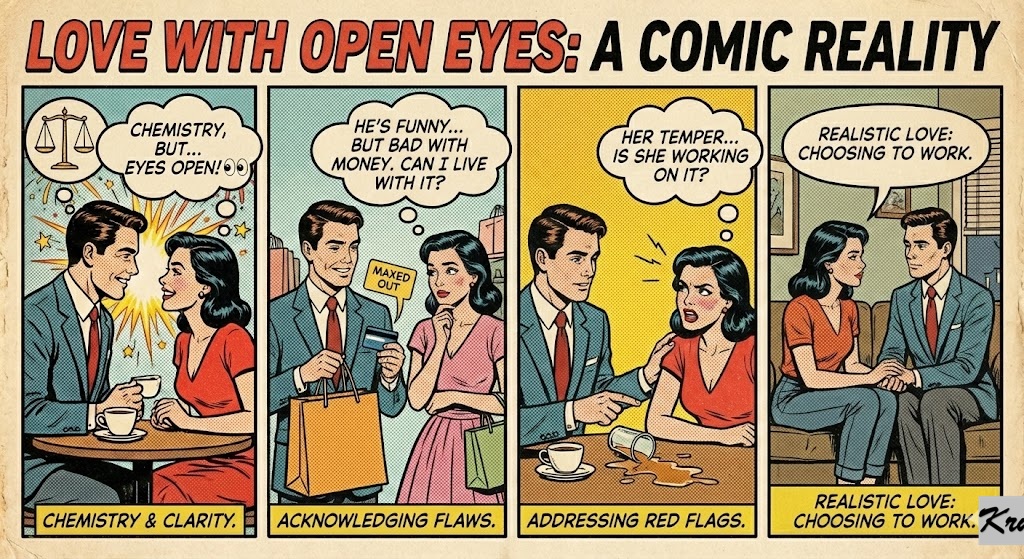
    The Result? You build a relationship based on trust and reality, not fantasy. When problems happen, you solve them because you saw them coming. You build a partnership, not a soap opera. 🀝


    βš–οΈ The Reality


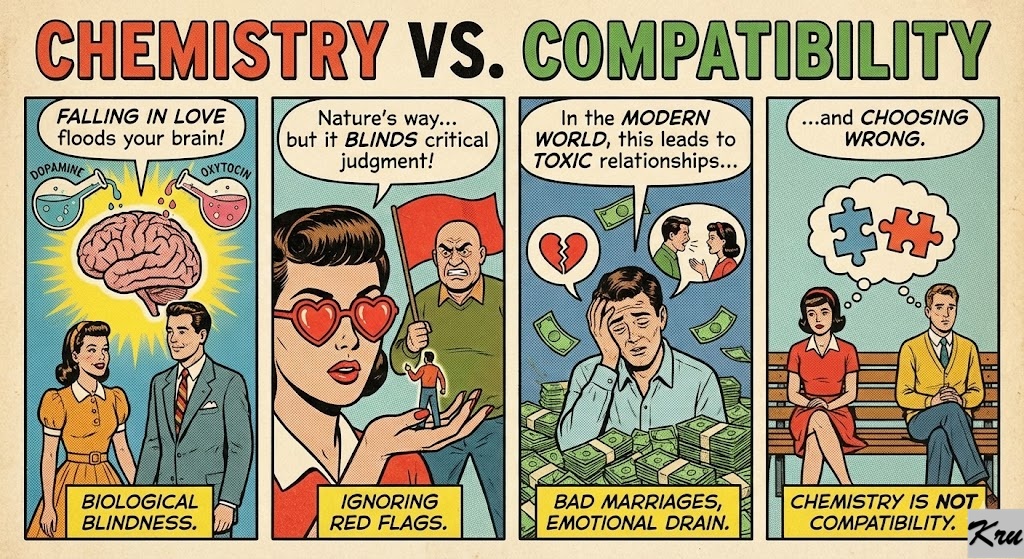
    Chemistry vs. Compatibility. Biologically, falling in love floods your brain with dopamine and oxytocin. These chemicals literally “blind” the critical judgment part of your brain. It is nature’s way of making sure humans pair up. But in the modern world, this biological blindness can lead to toxic relationships, bad marriages, and emotional drain.

    πŸ’Ž The Secret

    Love might be blind, but marriage (or long-term commitment) is an eye-opener. Don’t fall in love; walk into love with your eyes wide open.
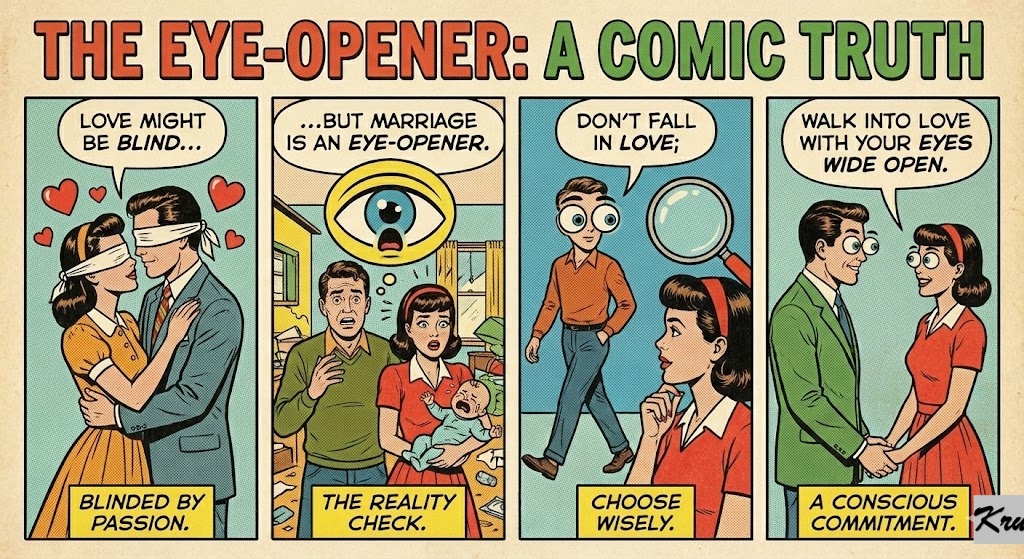
    🧐 The Anatomy of the Proverb


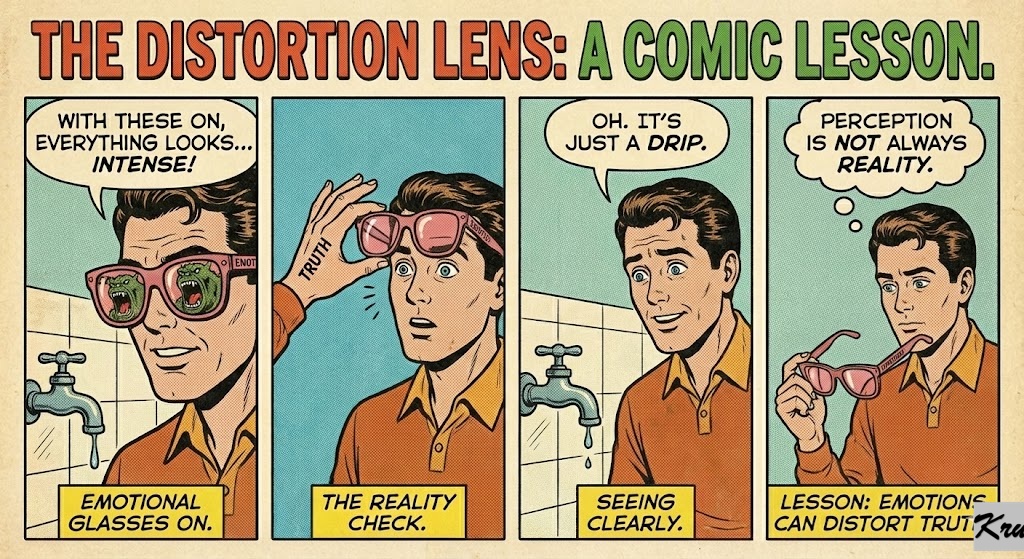
    This is your reality check that emotions can distort your perception of the truth.

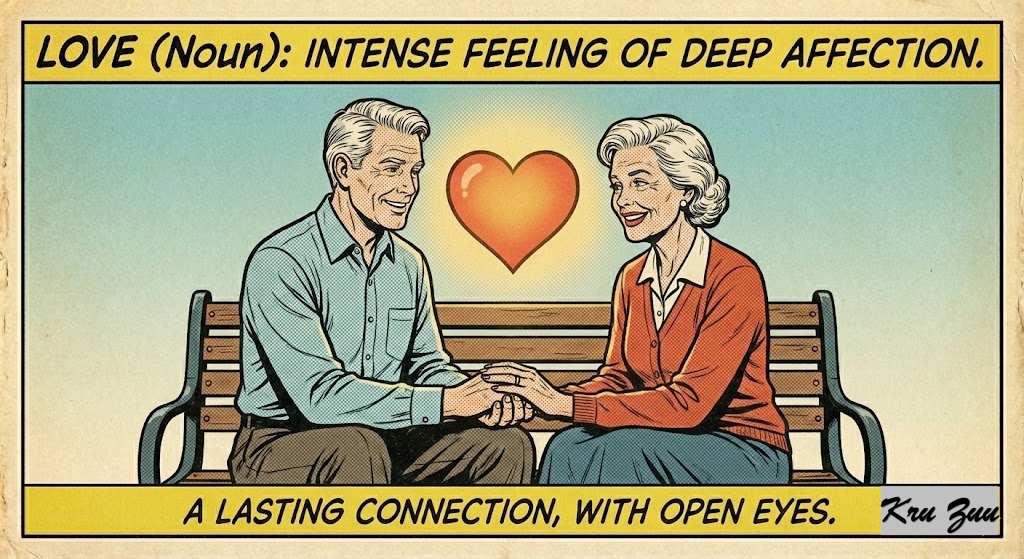
    Love (Noun): Intense feeling of deep affection.

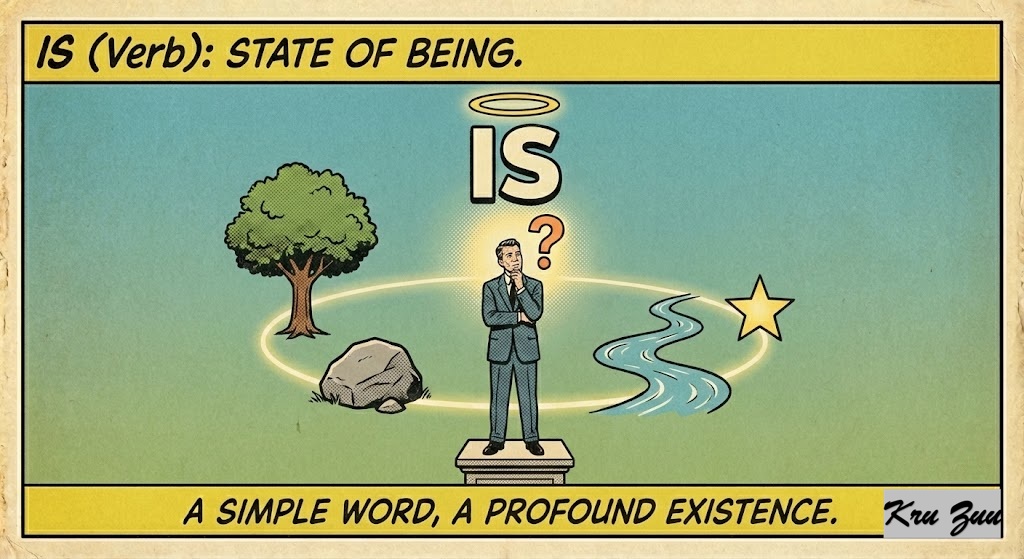
    Is (Verb): State of being.

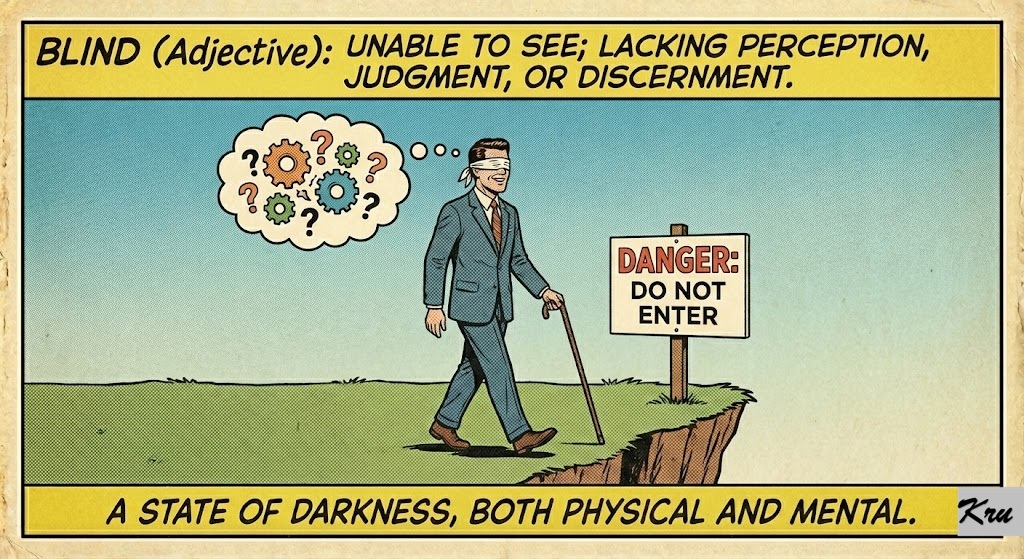
    Blind (Adjective): Unable to see; lacking perception, judgment, or discernment.

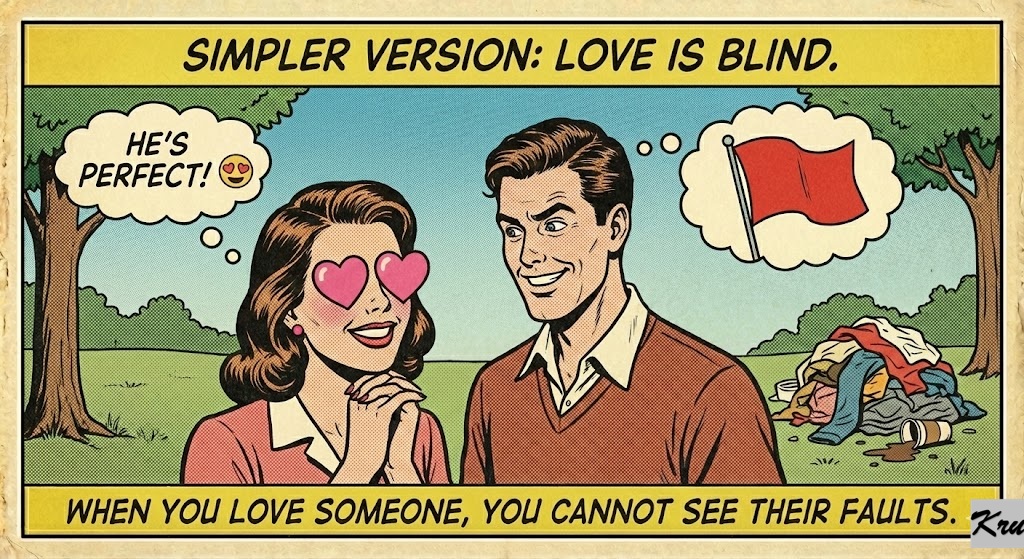
    Simpler Version: When you love someone, you cannot see their faults.

    πŸ“š Vocabulary Vault


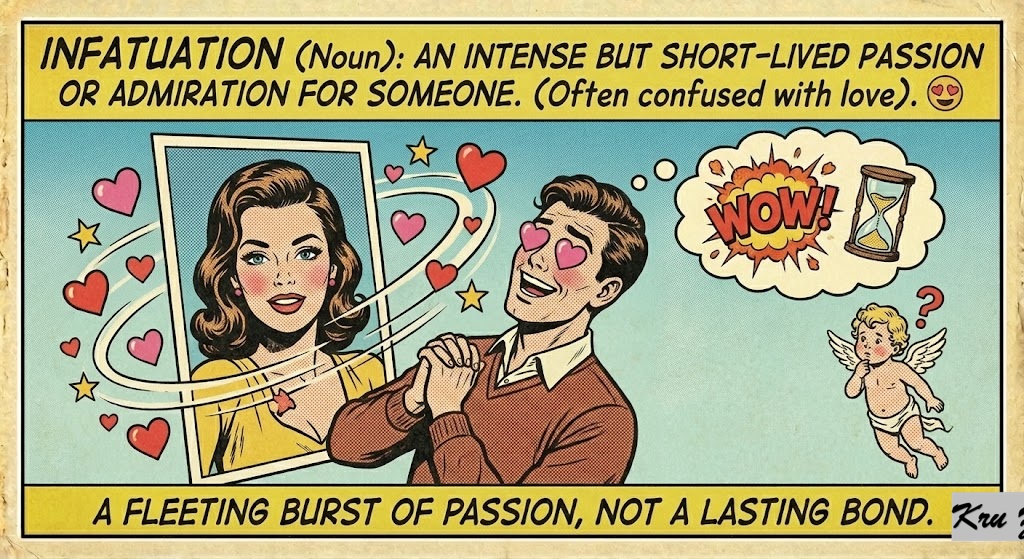
    Infatuation (Noun): An intense but short-lived passion or admiration for someone. (Often confused with love). 😍

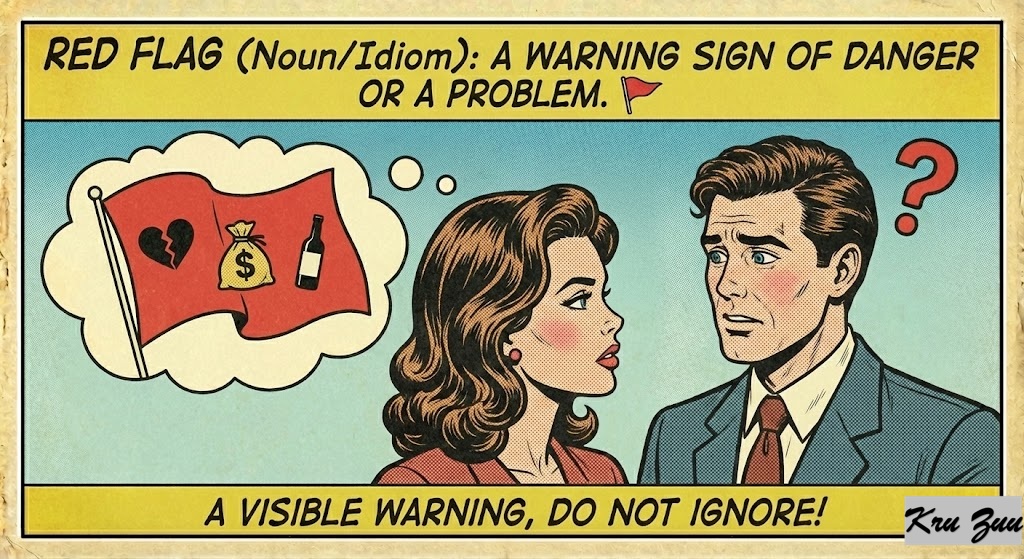
    Red Flag (Noun/Idiom): A warning sign of danger or a problem. 🚩

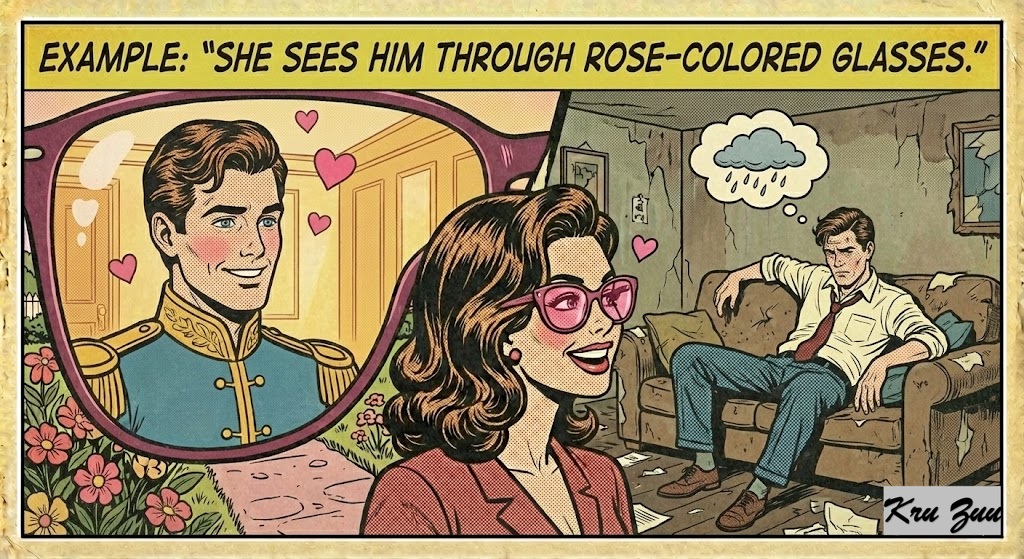
    Rose-colored glasses (Idiom): Looking at a situation in an overly optimistic way, ignoring the negatives.
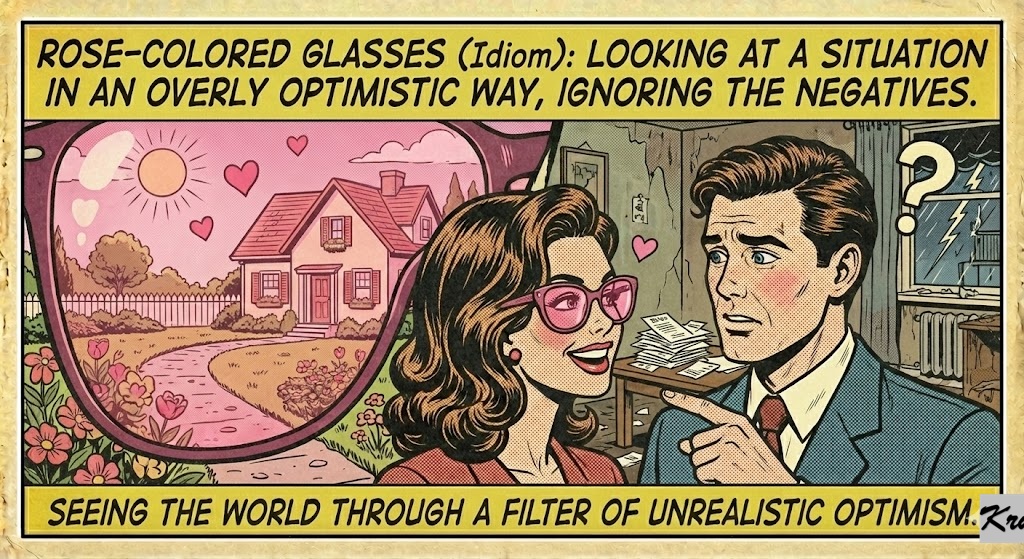
    Example: “She sees him through rose-colored glasses.” πŸ•ΆοΈ


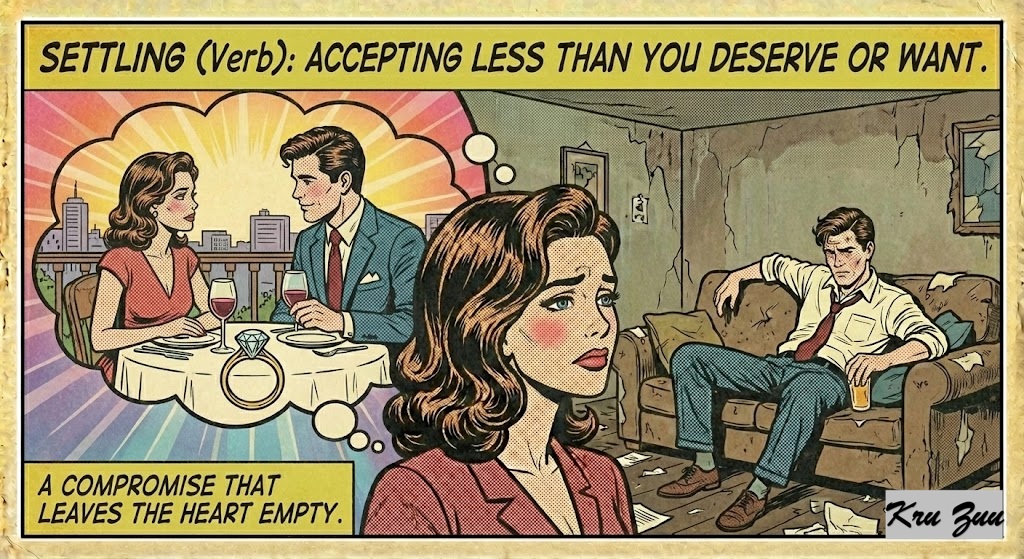
    Settling (Verb): Accepting less than you deserve or want.

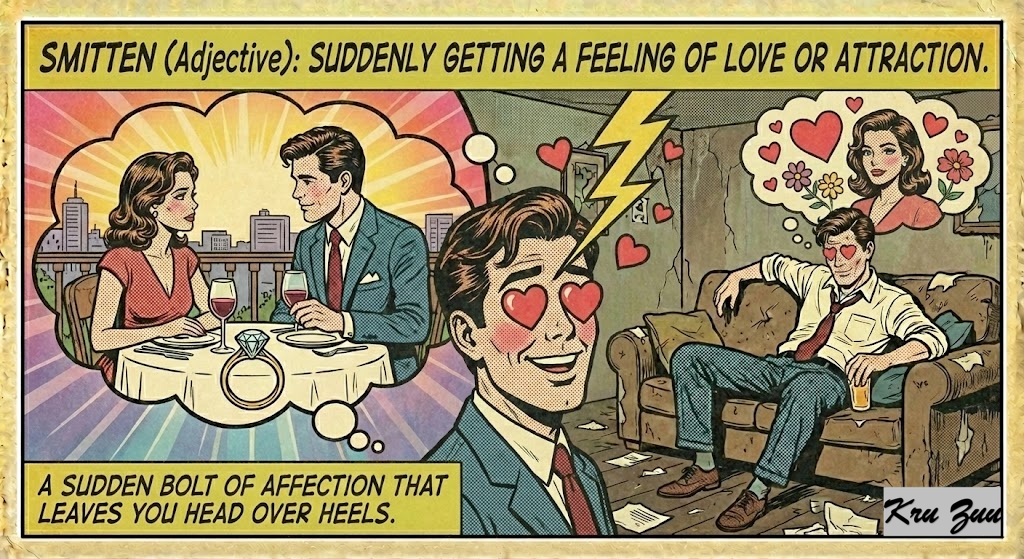
    Smitten (Adjective): Suddenly getting a feeling of love or attraction.

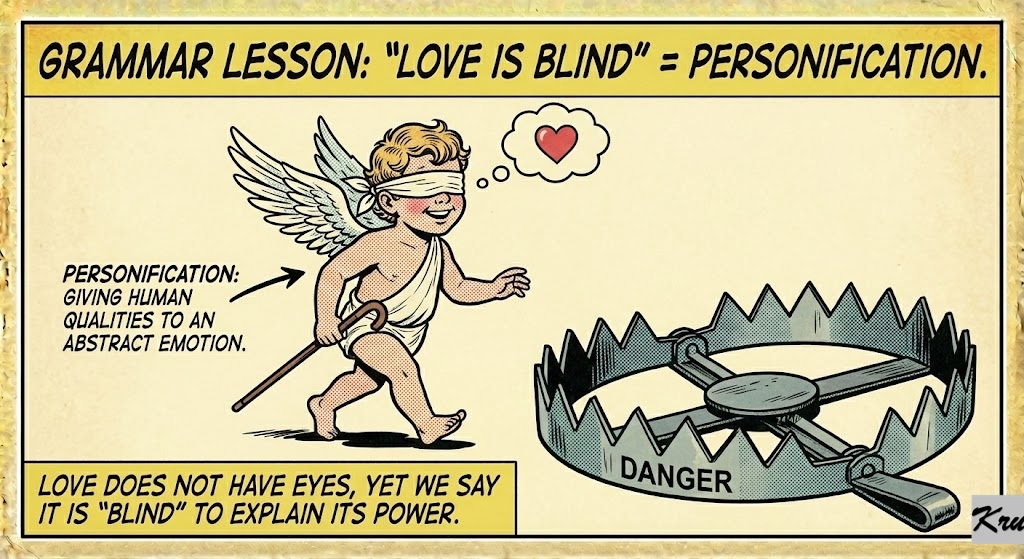
    🧠 Grammar Focus: Personification


    “Love is blind.” Grammatically, this is Personification. Love is an abstract emotion. It does not have eyes. It cannot literally be blind. However, we give it human qualities to explain how powerful it is. It acts like a person who has lost their sight.

    Other examples


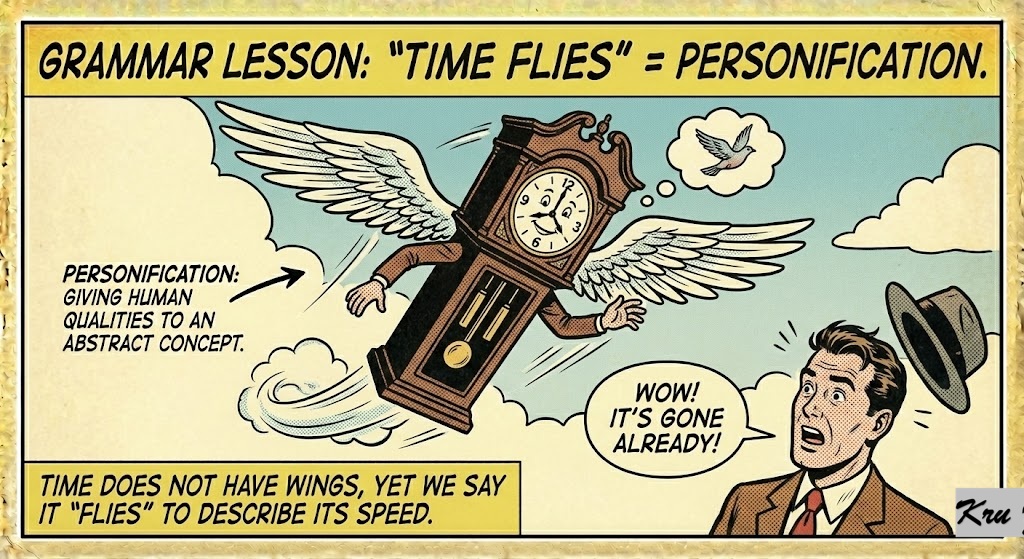
    “Time flies.” (Time doesn’t have wings).

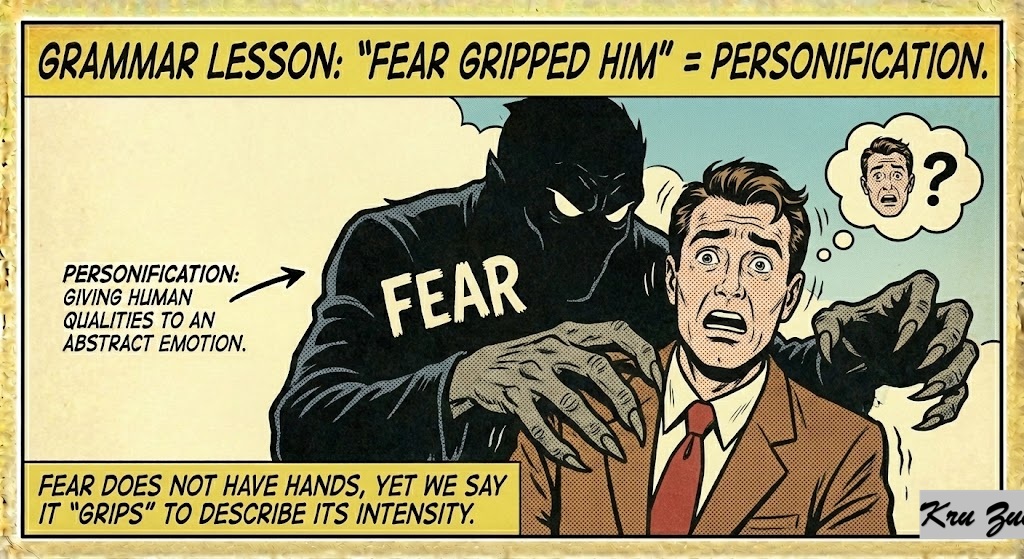
    “Fear gripped him.” (Fear doesn’t have hands).
    πŸ“œ History: Origin and Spread


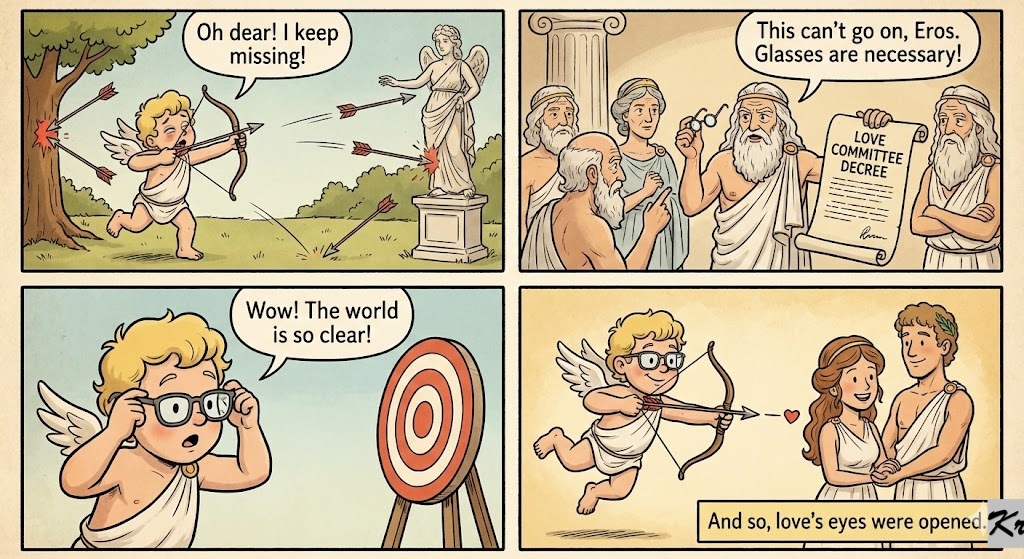
    Who first decided that Cupid needs glasses?

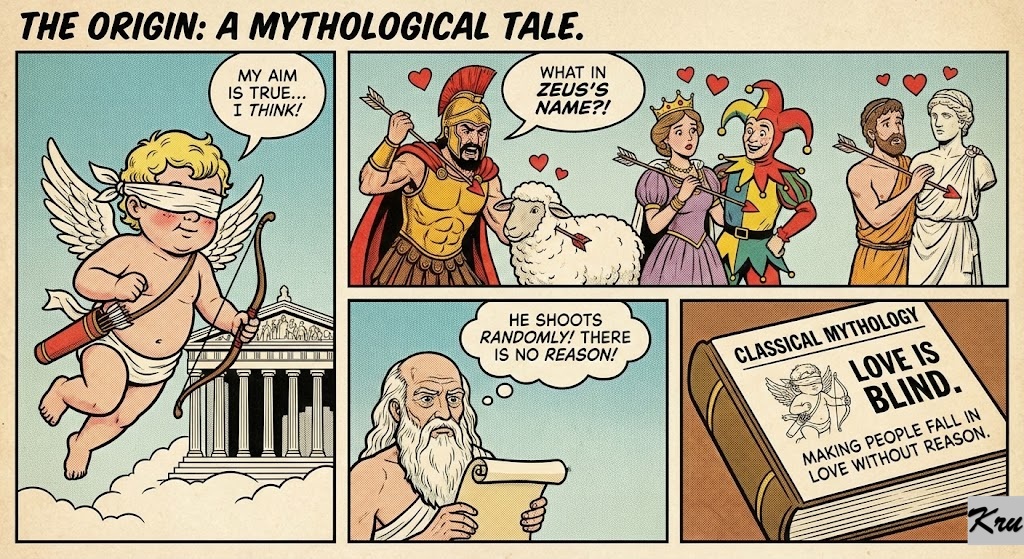
    The Origin: This idea is ancient. In Classical Mythology, Cupid (the god of affection) is often depicted wearing a blindfold. He shoots his arrows randomly, making people fall in love without reason.

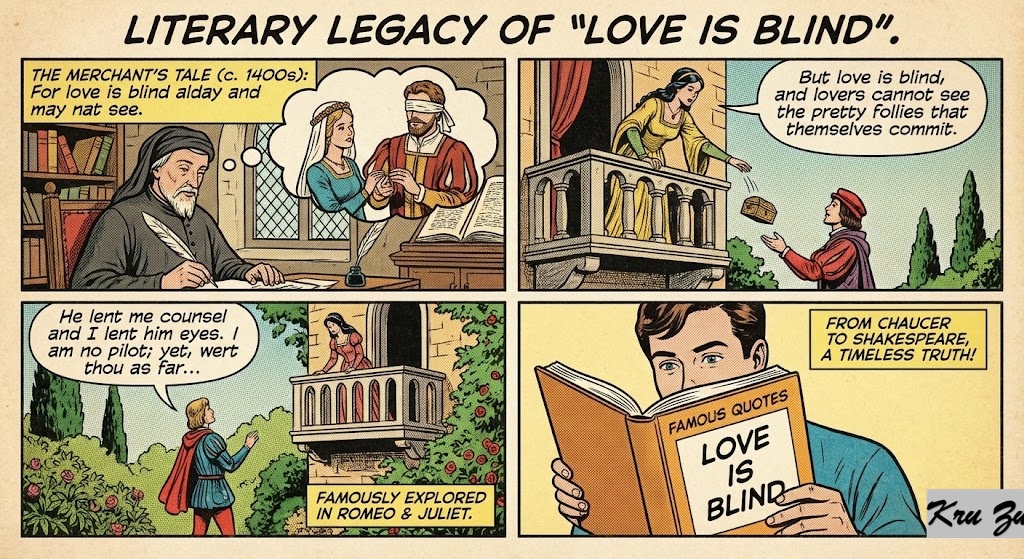
    The Writer: Geoffrey Chaucer used the phrase in the 1400s, but William Shakespeare made it famous in The Merchant of Venice and Romeo and Juliet.

    Global Cousins


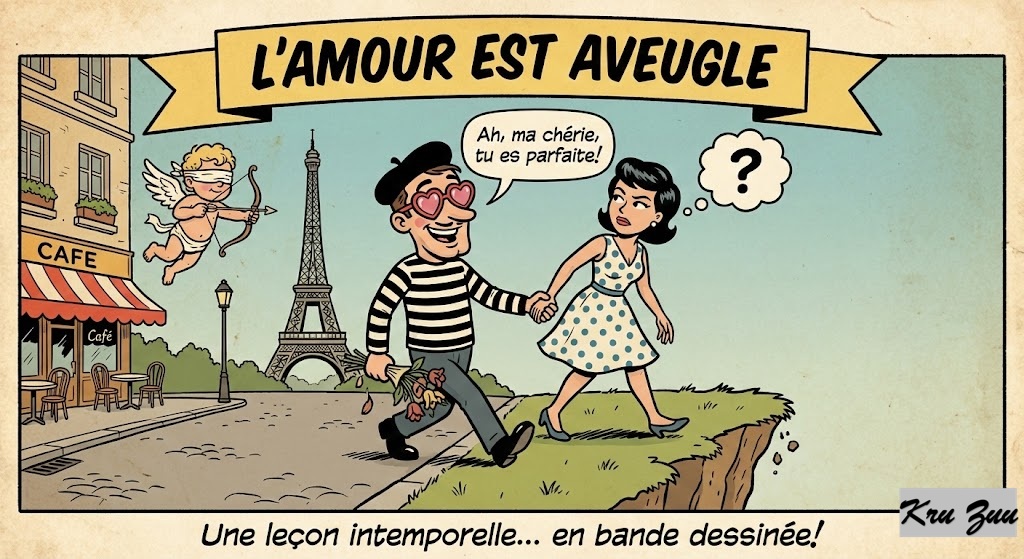
    πŸ‡«πŸ‡· French: “L’amour est aveugle.” (Love is blind – direct translation).

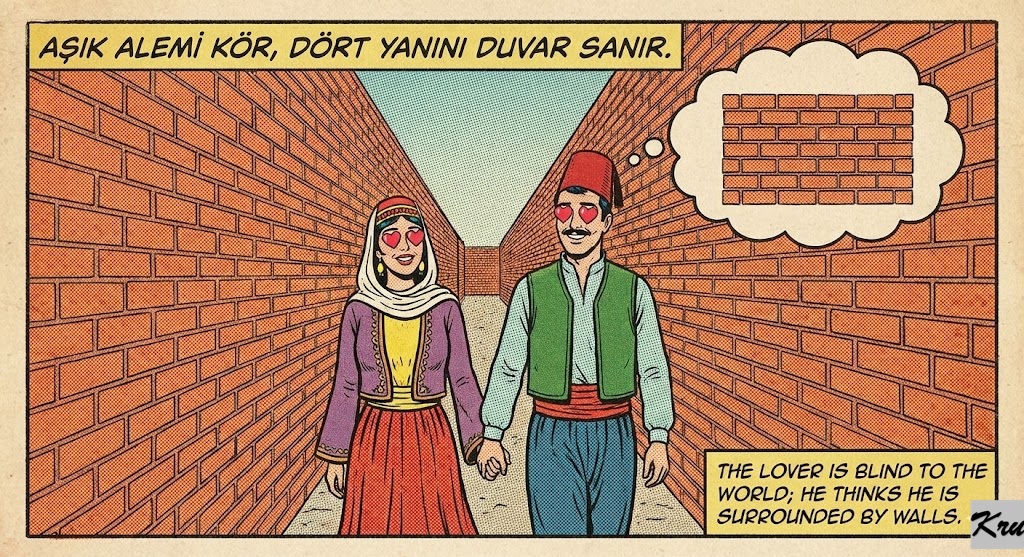
    πŸ‡ΉπŸ‡· Turkish: “Aşık alemi kΓΆr, dΓΆrt yanΔ±nΔ± duvar sanΔ±r.” (The lover is blind to the world; he thinks he is surrounded by walls).

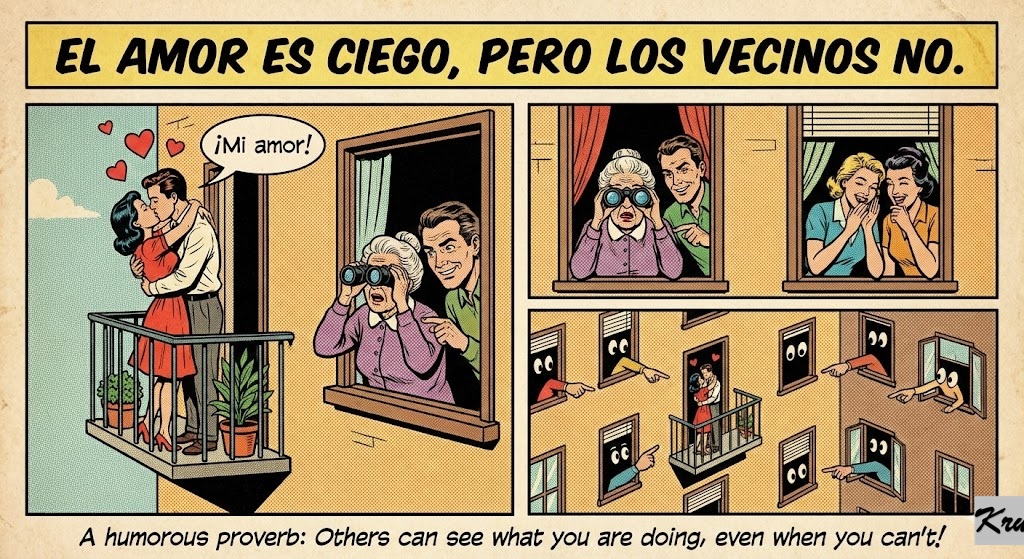
    πŸ‡ͺπŸ‡Έ Spanish: “El amor es ciego, pero los vecinos no.” (Love is blind, but the neighbors are not! meaning others can see what you are doing).
    🎭 Short Story: The Statue of Perfection πŸ—ΏπŸ±πŸ”πŸΈ


    Let’s visit the forest to see who has their “love goggles” on.
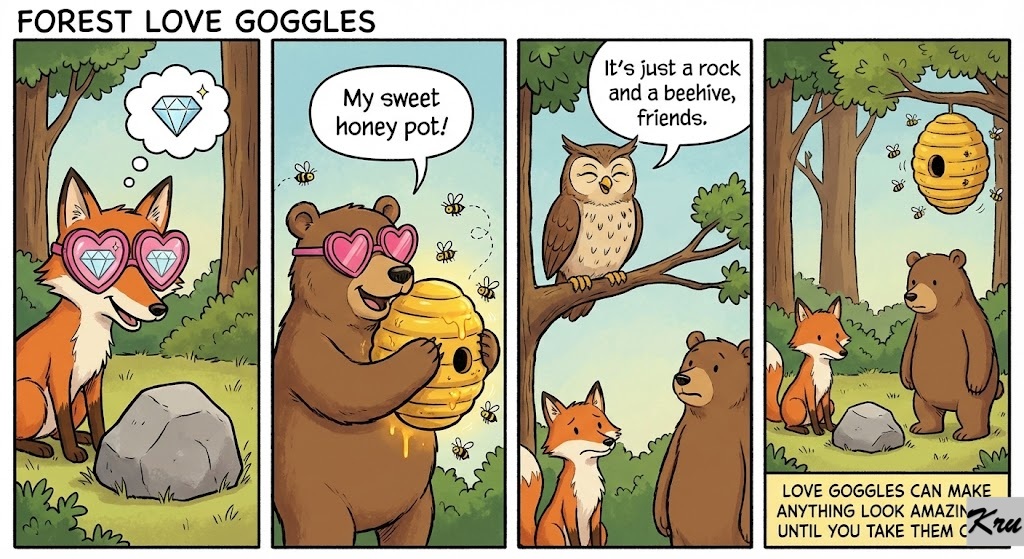

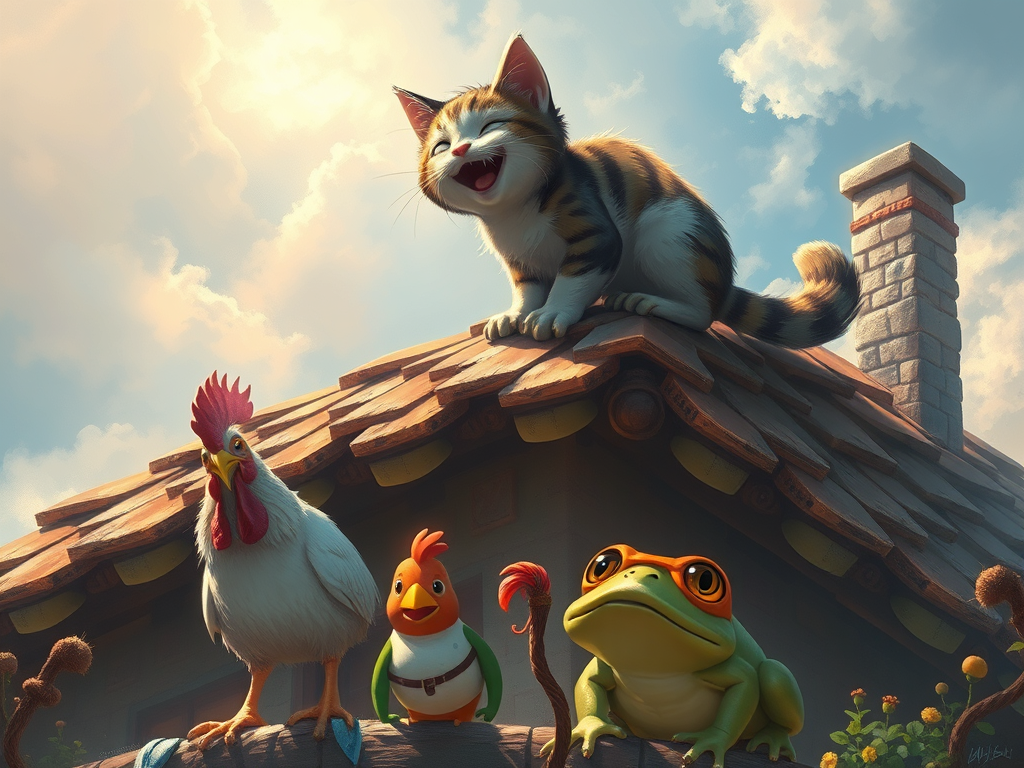
    🌟 The Cast


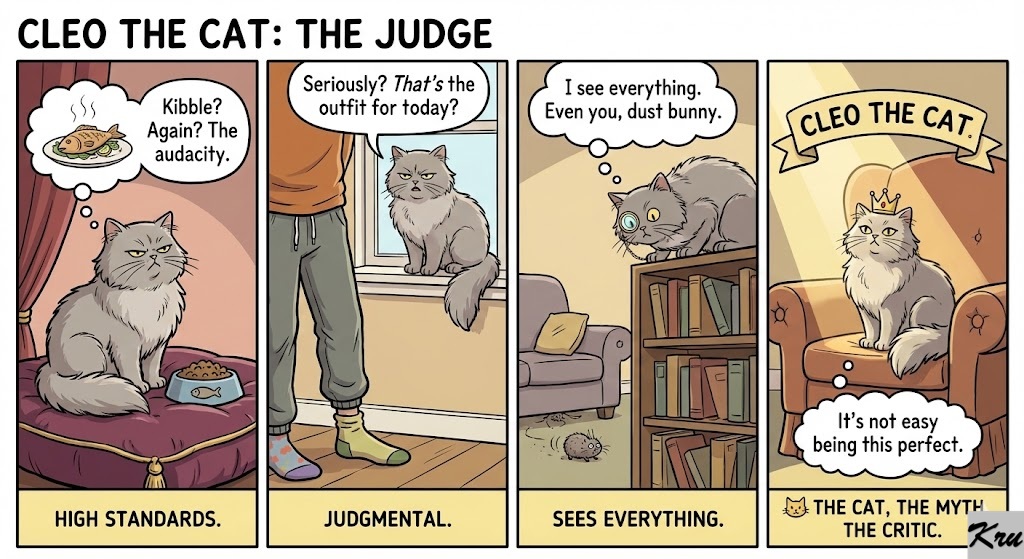
    Cleo the Cat: High standards, judgmental, sees everything. 😼

    Cluck the Chicken: Falls in love instantly, huge romantic heart, terrible eyesight. πŸ”


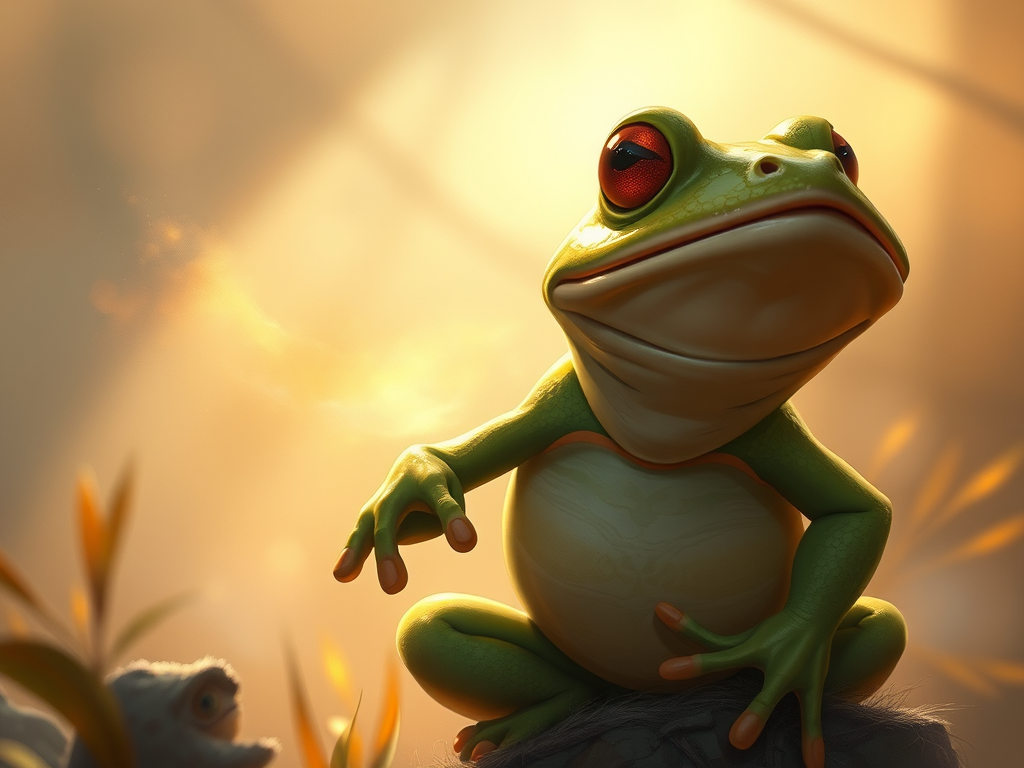
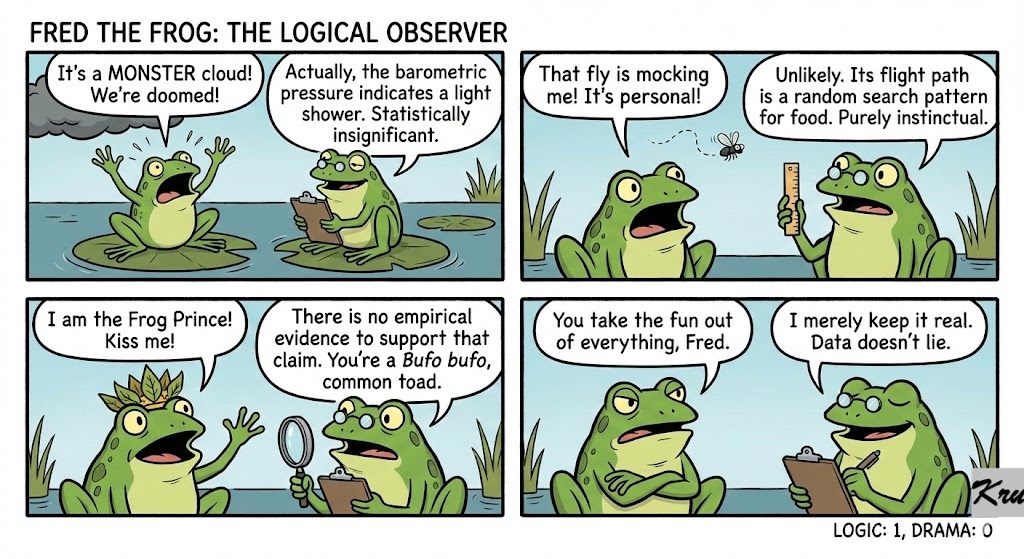
    Fred the Frog: The logical observer, keeps it real. 🐸

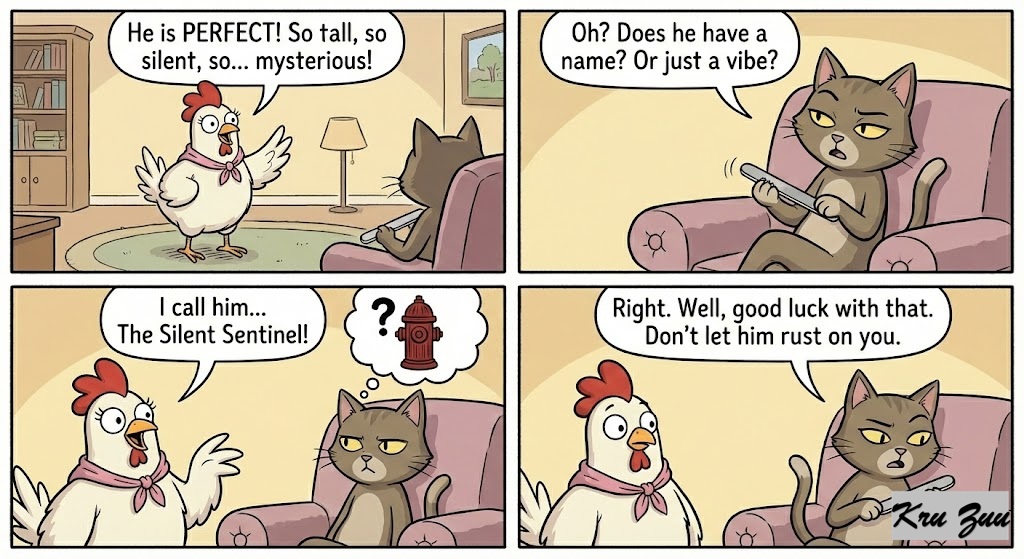
    The Situation: Cluck the Chicken comes running into the town square, flapping her wings excitedly. “Guys! Guys! I met Him! I met the perfect guy! He is tall, strong, dark, and mysterious!”
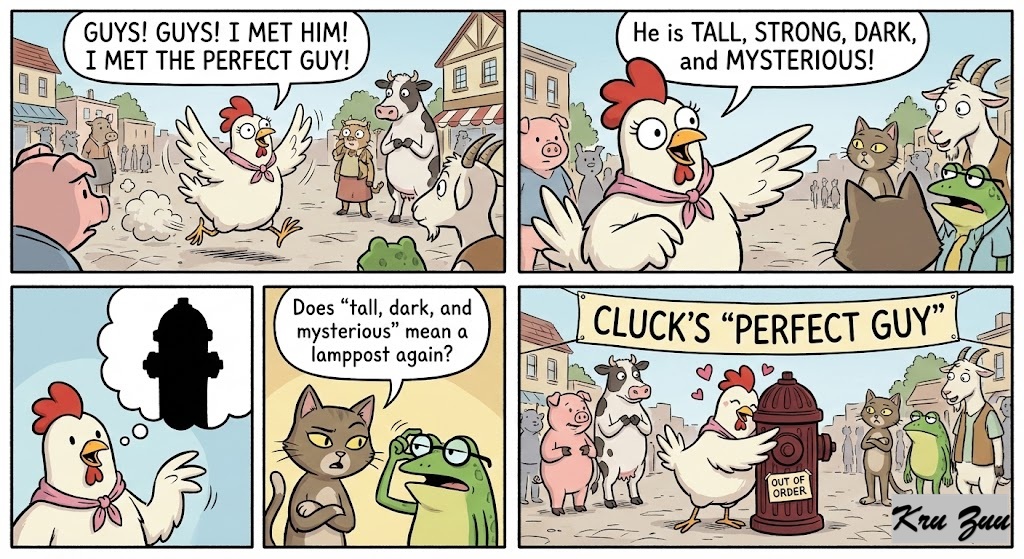

    Cleo looks up from filing her nails. “Oh? Does he have a name? Or just a vibe?”

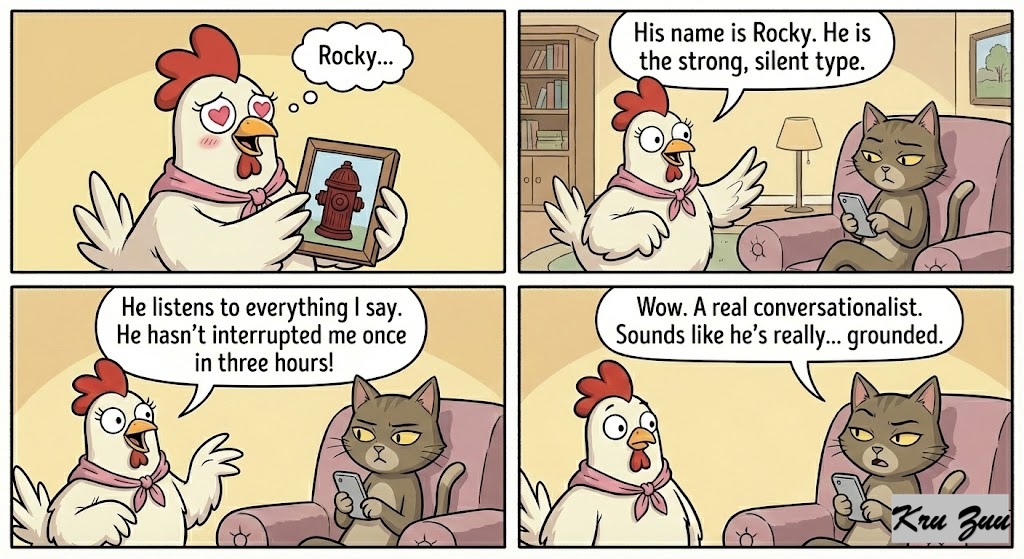
    “His name is Rocky,” Cluck sighs. “He is the strong, silent type. He listens to everything I say. He hasn’t interrupted me once in three hours!”

    The Conflict: Fred the Frog frowns. “Rocky? Where is he?” “He’s by the garden,” Cluck says. “Come meet him!”
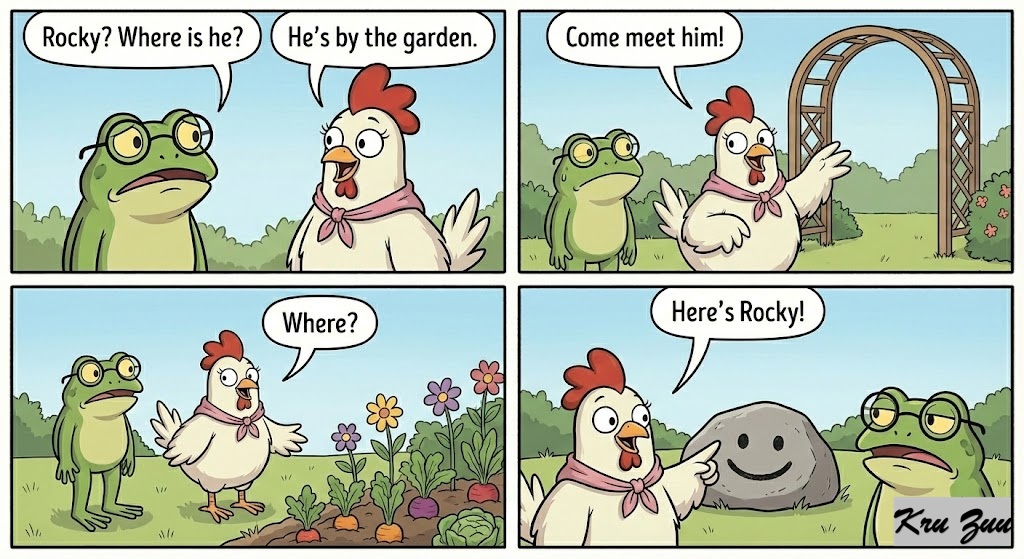

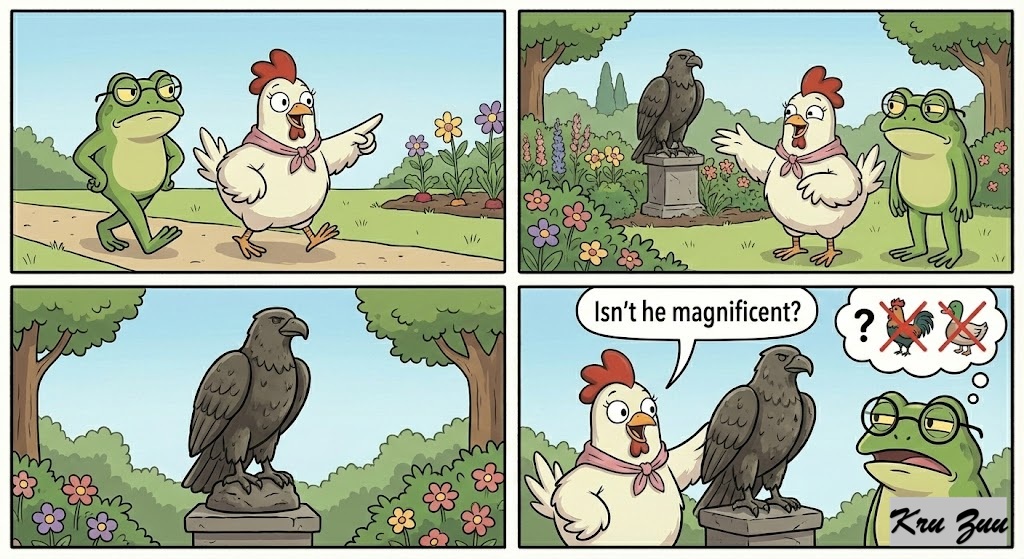
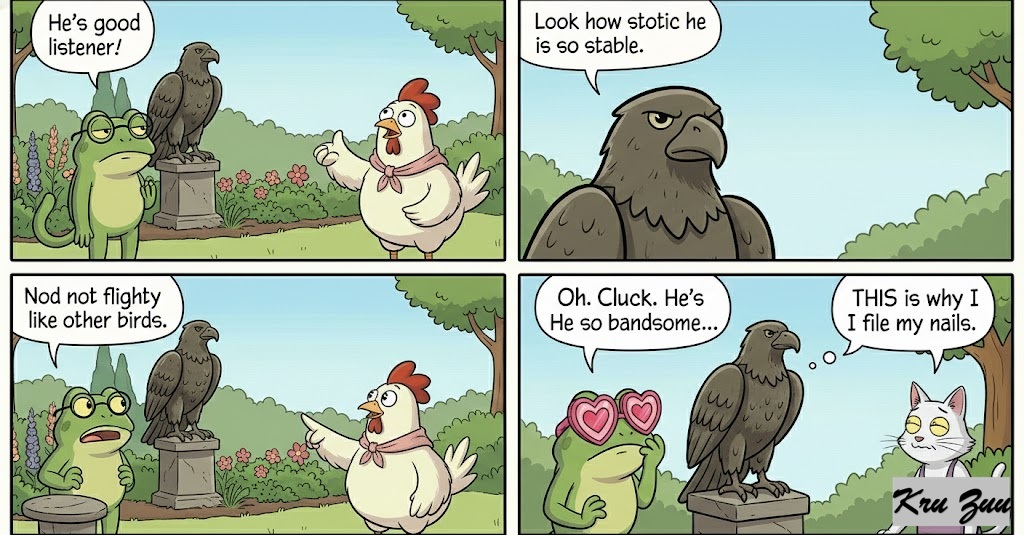
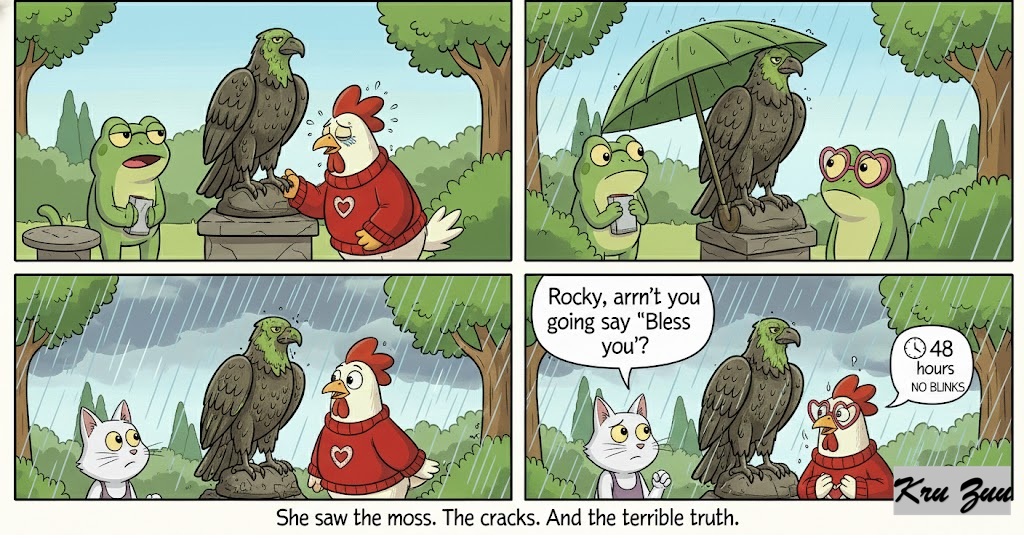
    They walk to the garden. Standing there is not a rooster. It is not a duck. It is a dark, stone garden statue of an Eagle. πŸ—Ώ


    “Cluck,” Fred says slowly. “That is a rock.”
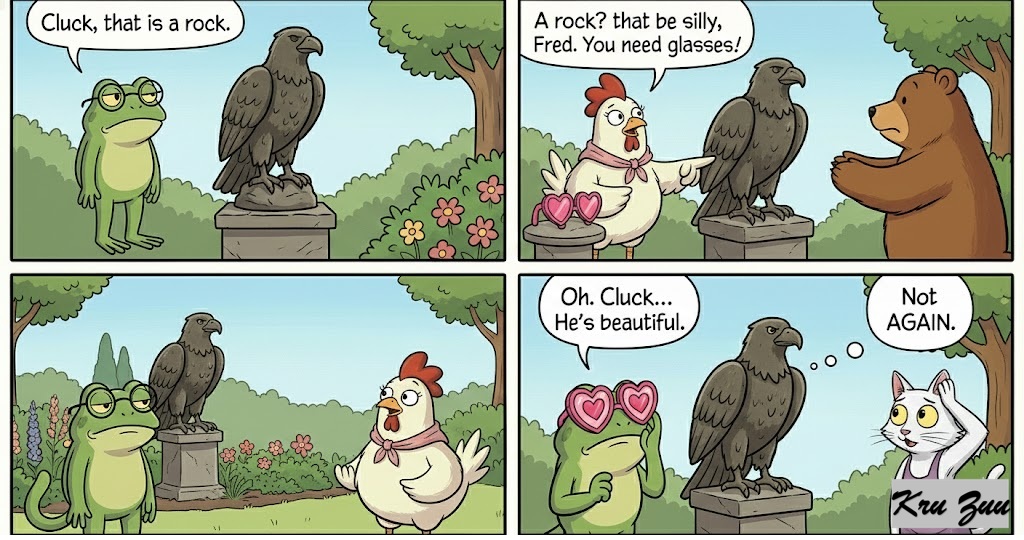

    “He’s a good listener!” Cluck defends him. “Look how stoic he is. He’s so stable. He’s not flighty like other birds.”

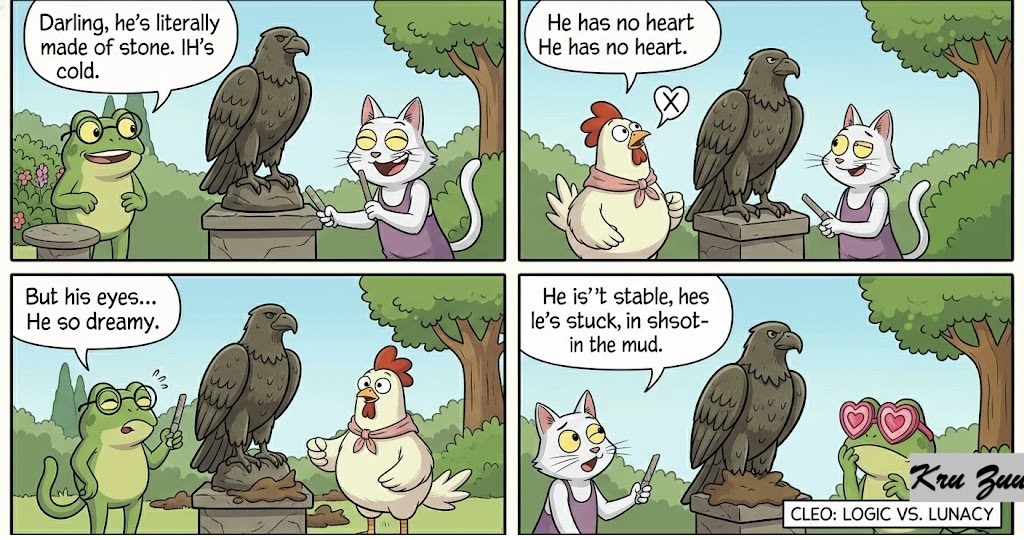
    Cleo laughs. “Darling, he’s literally made of stone. He’s cold. He has no heart. He isn’t stable; he’s stuck in the mud.”

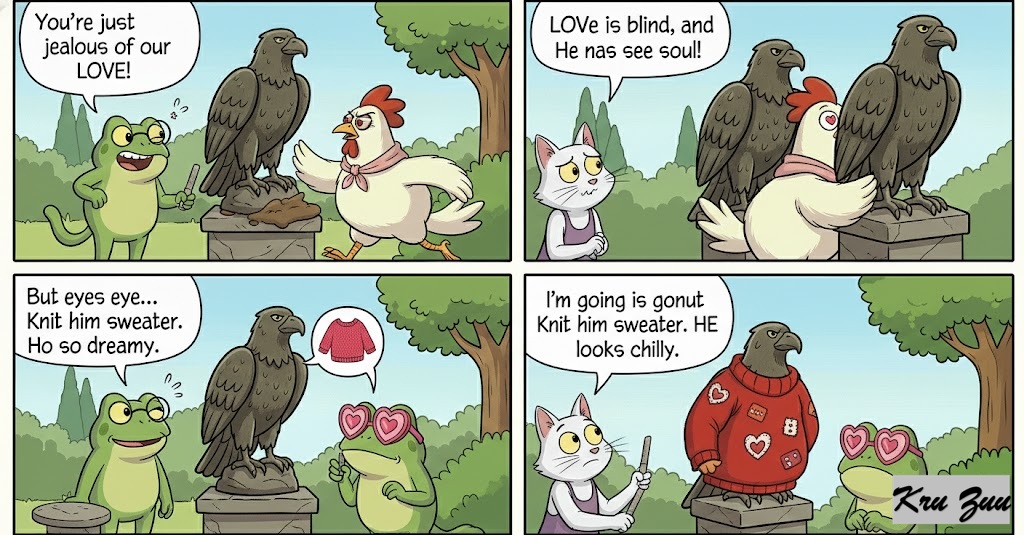
    The Reaction: “You are just jealous of our love!” Cluck yells. “Love is blind, and I see his soul!” She runs over and hugs the cold stone statue. “I’m going to knit him a sweater. He looks chilly.”

    Fred looks at Cleo. “Should we tell her?” Cleo shakes her head. “No. Wait for the rain.”
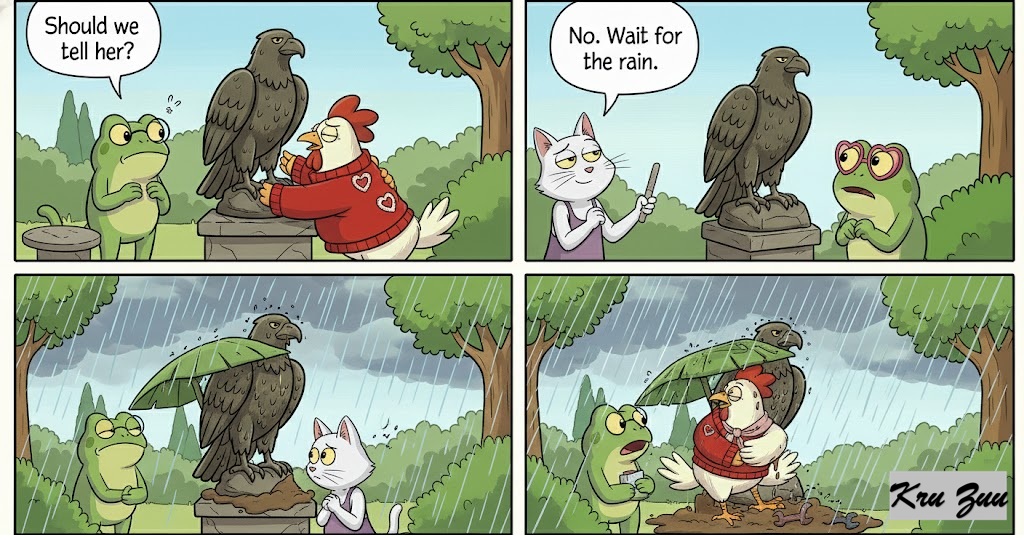

    The Resolution: Two days later, it rained heavily. Cluck stood by “Rocky” with an umbrella, but Rocky didn’t say thank you. He didn’t move. Moss started growing on his beak. Finally, Cluck sneezed. “Rocky, aren’t you going to say ‘Bless you’?” Silence. Cluck finally stepped back. She looked, really looked, and saw the moss. She saw the cracks in the stone. She realized he hadn’t blinked in 48 hours.

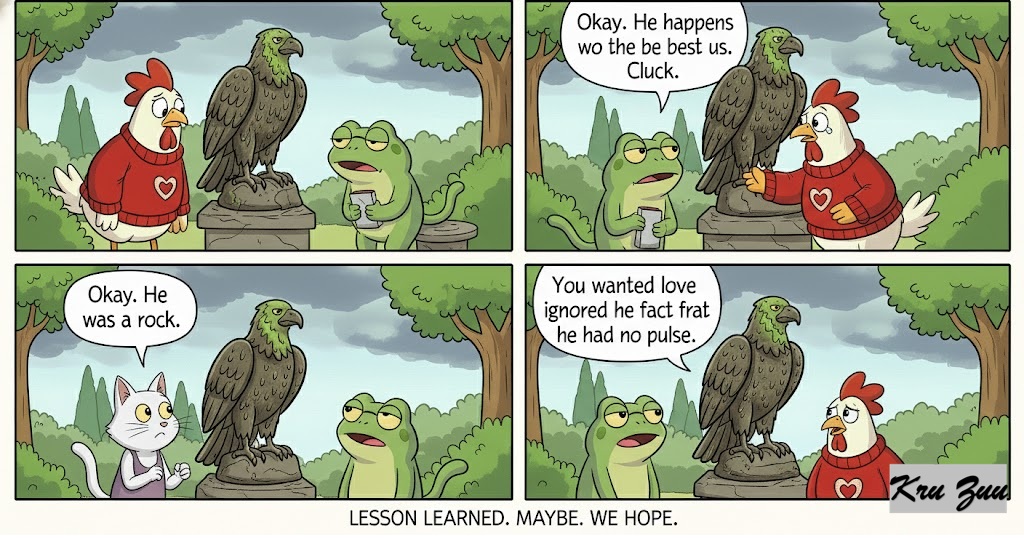
    The Lesson: Cluck walked back to her friends, head down. “Okay. He was a rock.” Fred patted her wing. “It happens to the best of us, Cluck. You wanted love so badly, you ignored the fact that he had no pulse.”

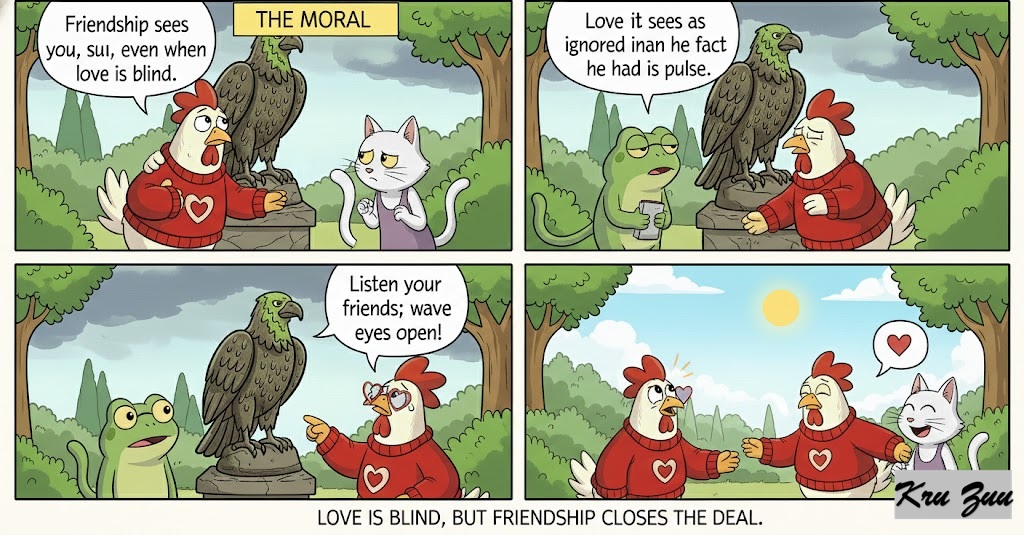
    The Moral: Love is blind, but friendship closes the deal. Listen to your friends; they have their eyes open.
    πŸŽ“ Lesson for English Learners


    How to give advice without being mean.
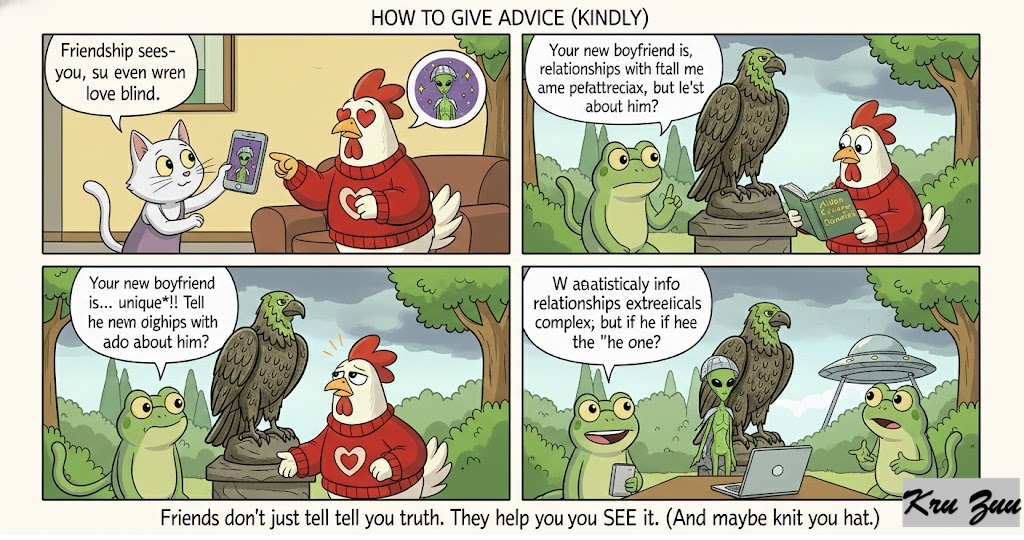

    Situation: Your friend is dating someone who treats them badly. You want to warn them, but you don’t want to fight.
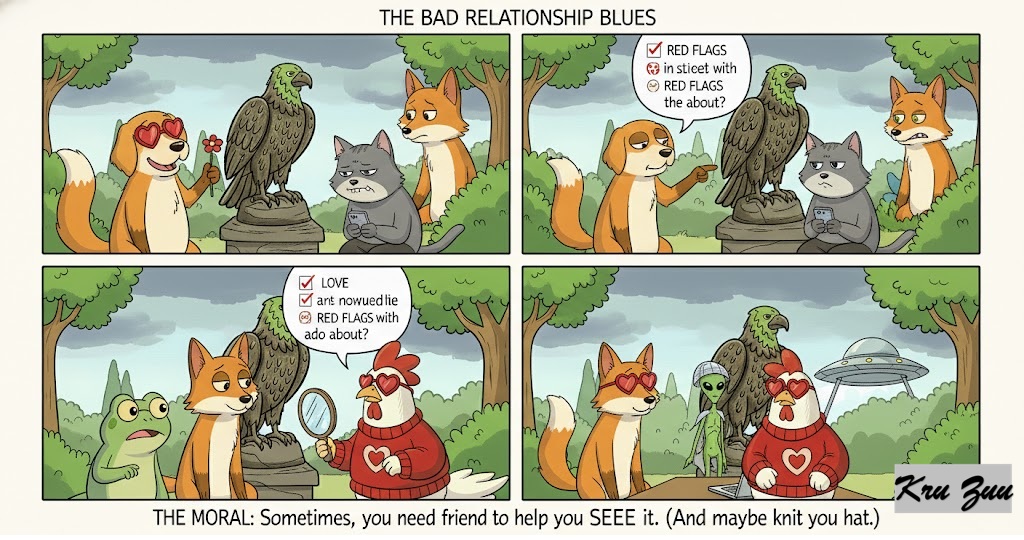
    The Shift: Don’t attack the partner (“He is a loser”). Attack the perception.
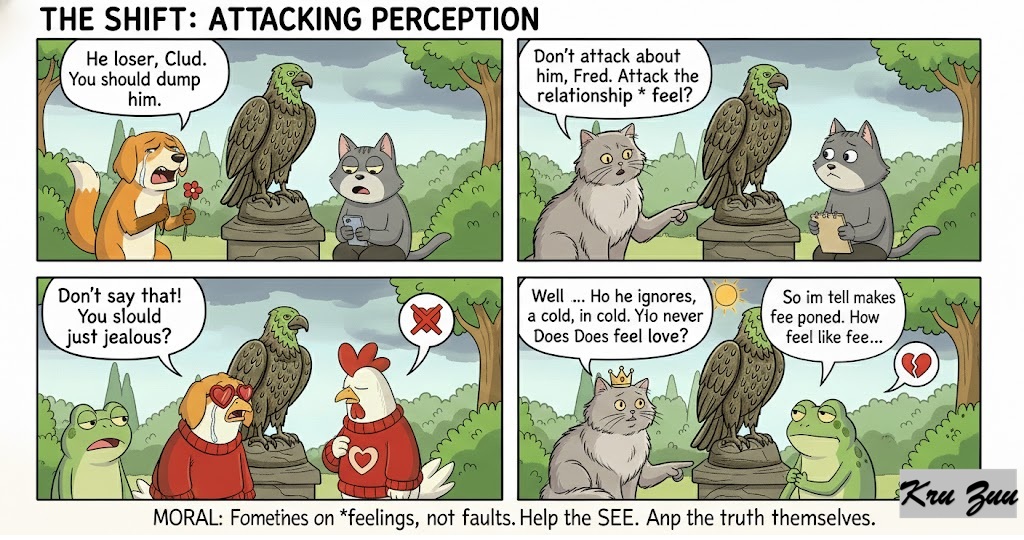
    You Say: “I know you really like him, and love is blind, but I’m worried that he borrows money from you and never pays it back. Just be careful.”
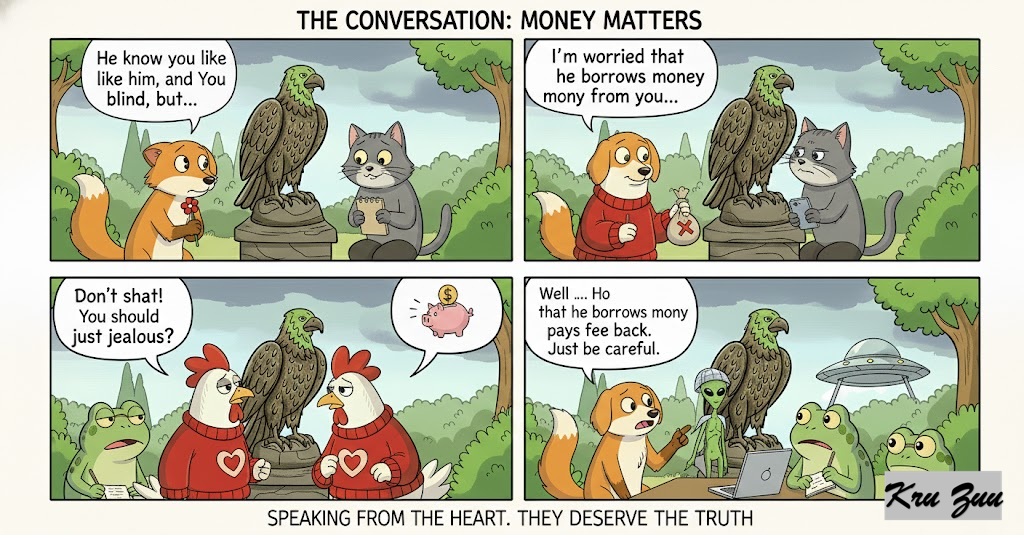

    πŸ’¬ Your Turn: The “Red Flag” Challenge πŸš€


    Do you want to cure your “Villain” romantic habits?
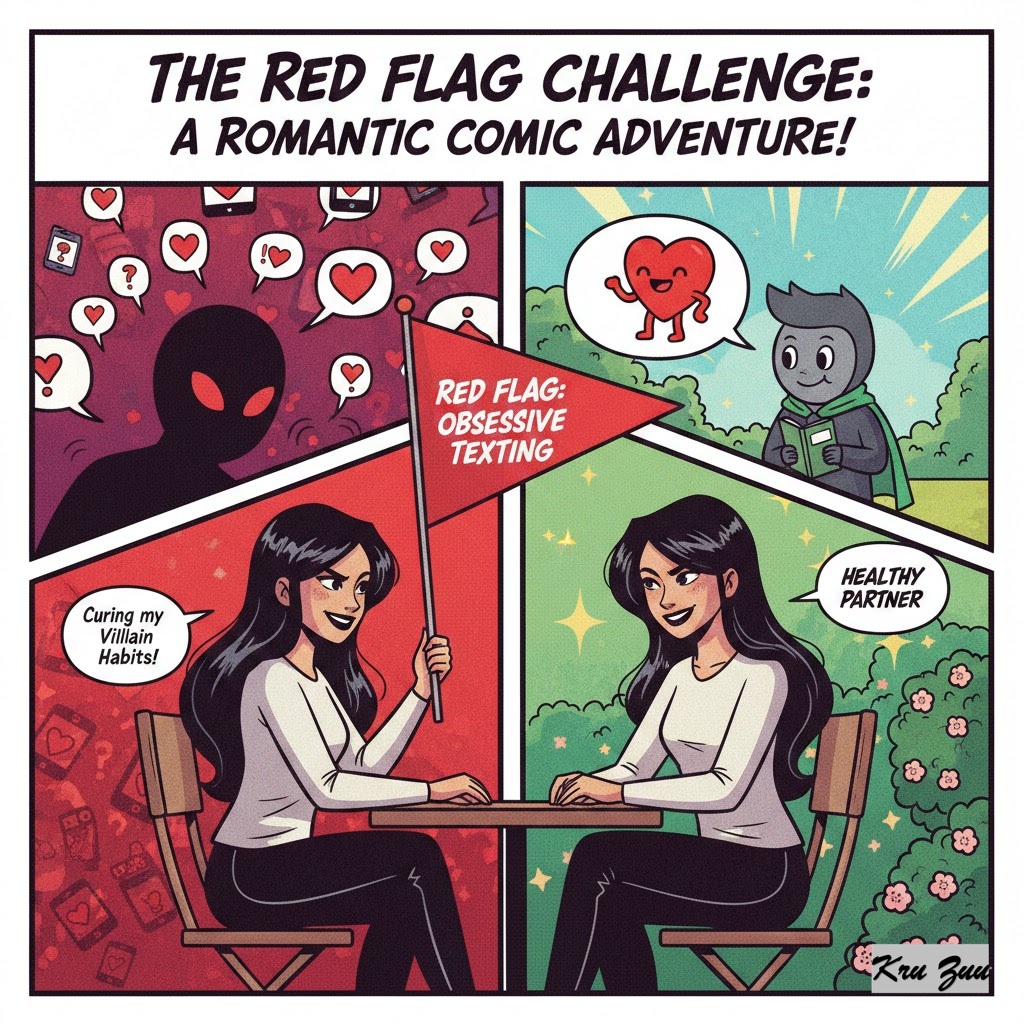

    The Challenge:
    Think of a past relationship or crush that didn’t work out.
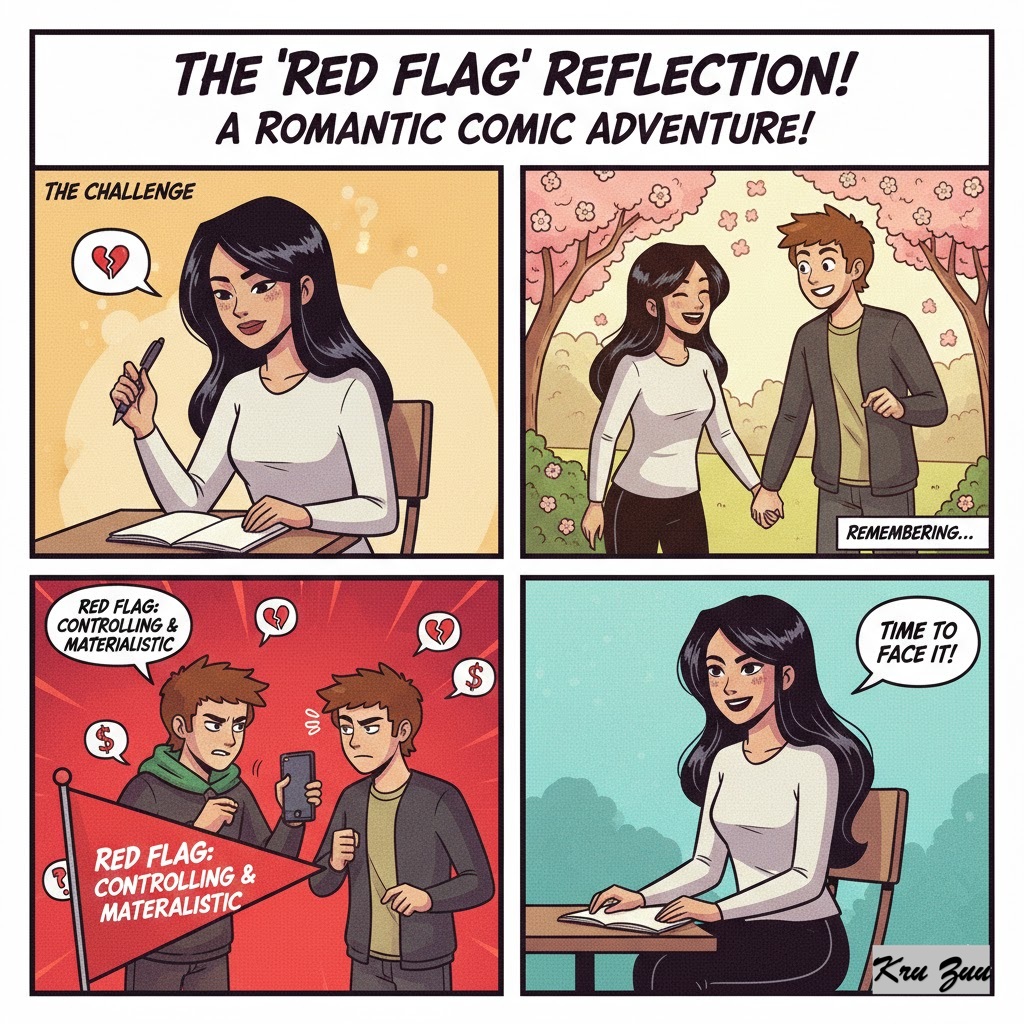
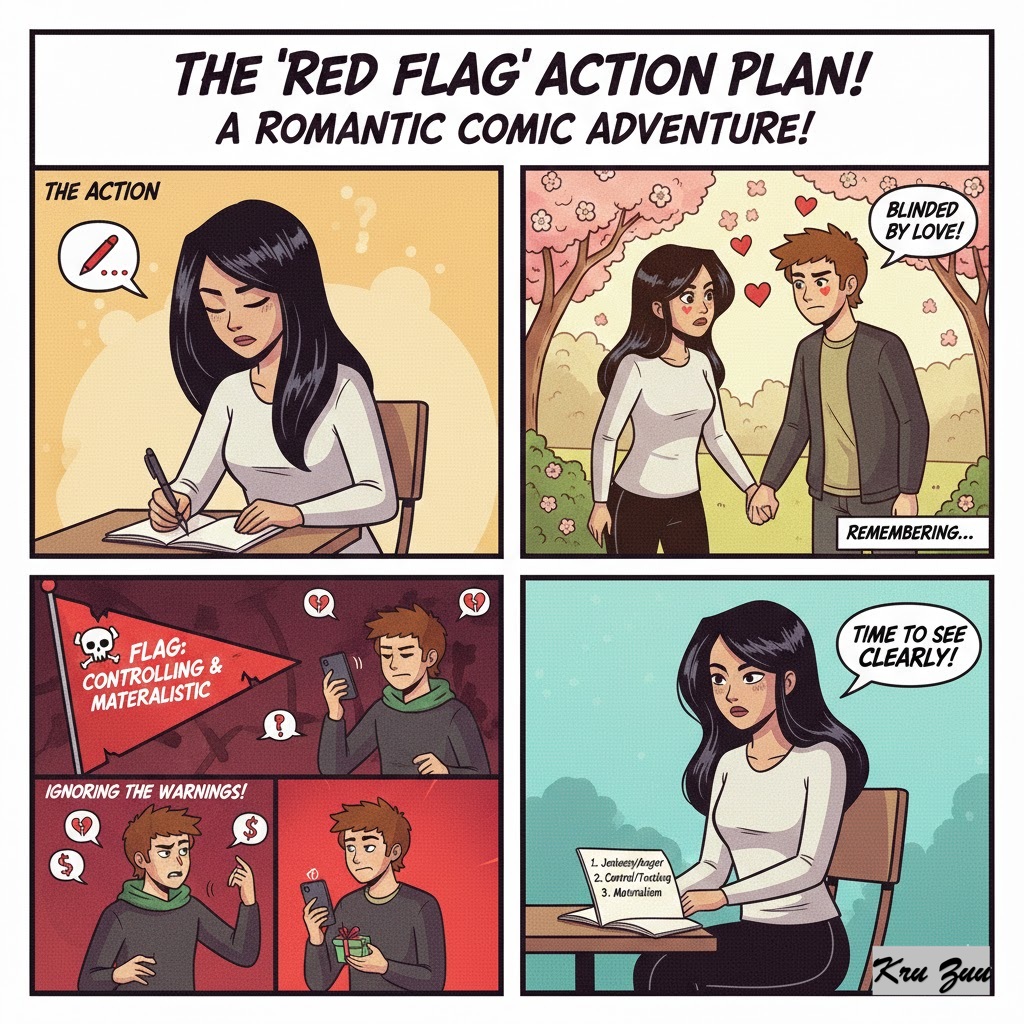
    The Action: Write down three “Red Flags” (warning signs) that you ignored at the beginning because you were “blind.”

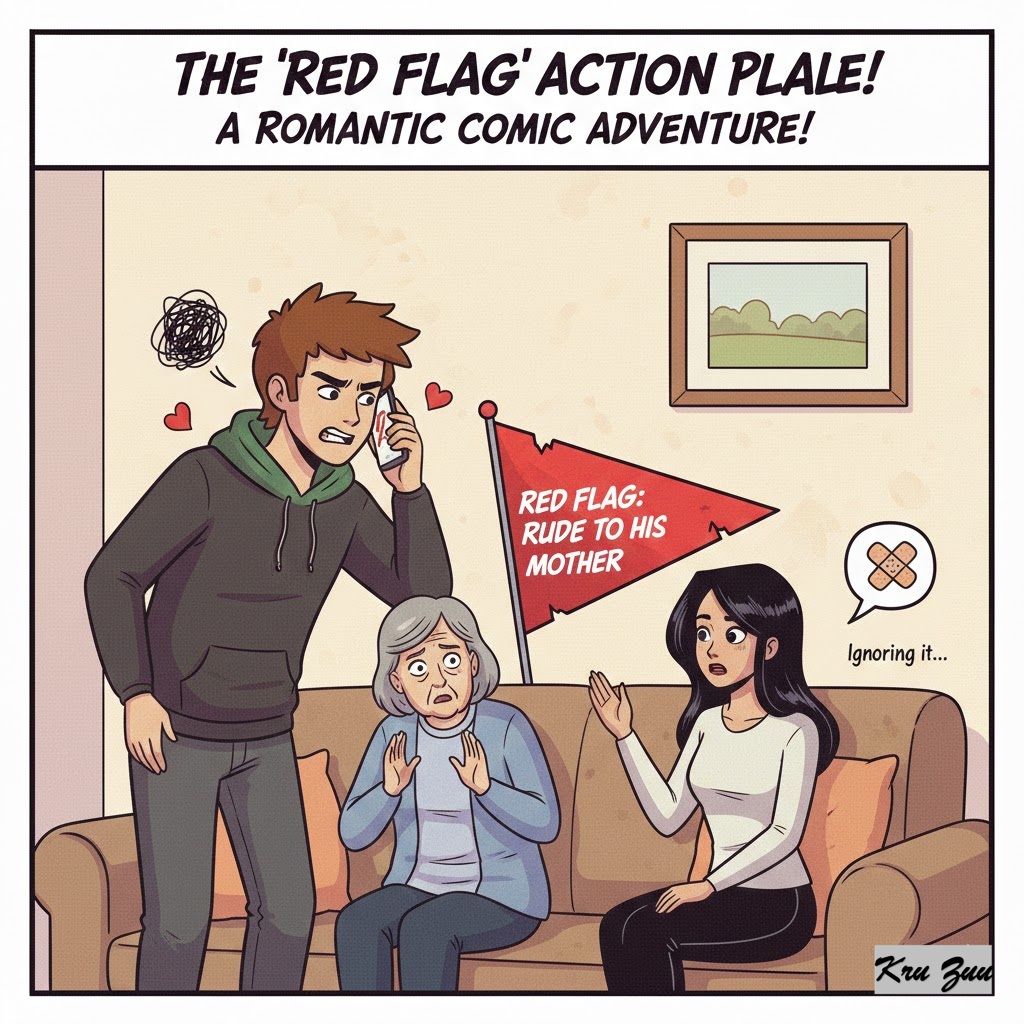
    Example: I ignored that he was rude to his mother.

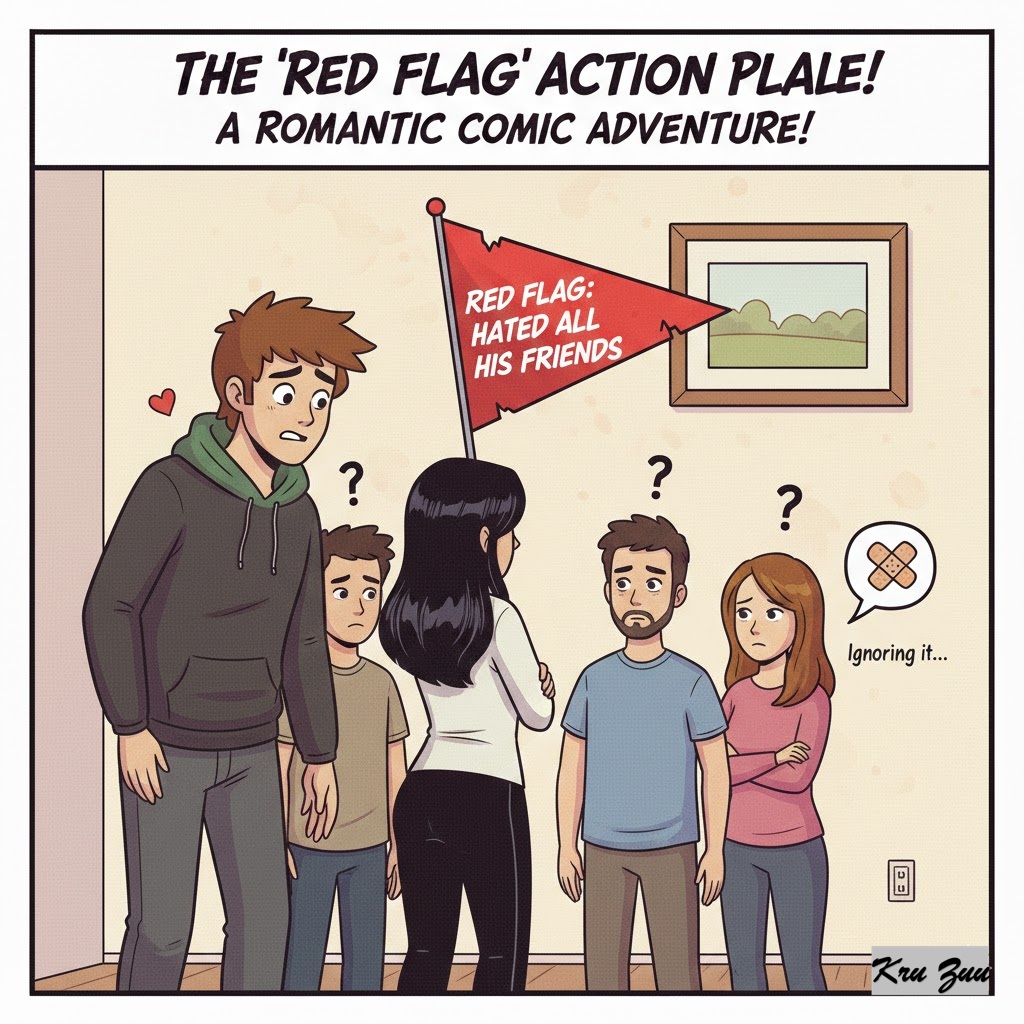
    Example: I ignored that she hated all my friends.

    πŸ‘‡ Question for the comments: Have you ever worn “Rose-colored glasses”? What is one funny thing you overlooked in a partner because you were in love? Tell us below!

    By Zubeyir YURTKURAN

    https://www.facebook.com/BrainBattleground/

    https://www.facebook.com/zubeyr.yurtkuran/

    https://www.instagram.com/zubeyryurtkuran/

    https://www.youtube.com/@BrainBattleground-b3p

    https://www.instagram.com/brainbattleground/

  • ⏳ The Daily Shield: The Law of Immediacy

    ⏳ The Daily Shield: The Law of Immediacy

    “Don’t put off until tomorrow what you can do today.”


    😈 The Villain (The Procrastinator): You have a project due next week.

    You say, “I have plenty of time.” You open Instagram.

    You watch just one episode on Netflix (which turns into five).

    You clean your room instead of working.

    You convince yourself that you work better under pressure.

    The Result? Sunday night arrives. Panic sets in.

    You drink 5 coffees, stay up all night, and produce garbage work.

    You live in a cycle of stress and regret. You are a slave to the “Last Minute.” πŸ§Ÿβ€β™‚οΈ


    πŸ˜‡ The Hero (The Executor): You get the assignment.

    You don’t want to do it, but you count to three: 1, 2, 3, GO.

    You open the laptop. You do the hard work first so you can enjoy your guilt-free free time later.

    You treat “Tomorrow” as a bonus, not a trash can for your duties.

    The Result? You sleep peacefully.

    Your work is high quality because you had time to check it.

    You own your time; time doesn’t own you. πŸ›‘οΈ


    βš–οΈ The Reality


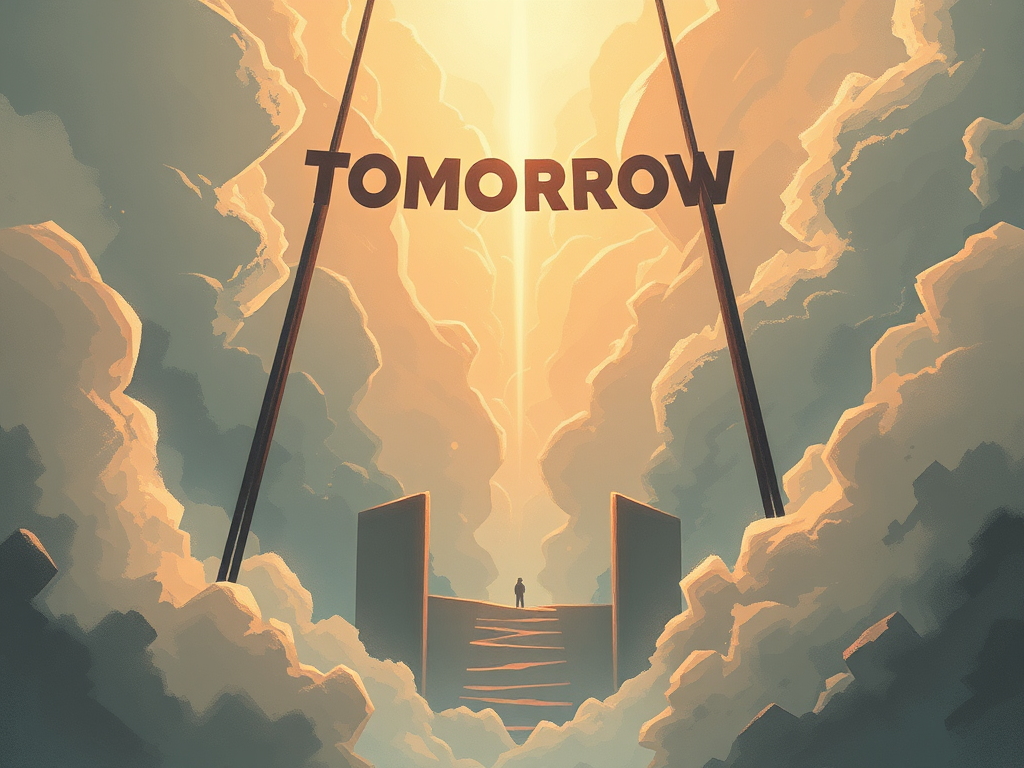
    “Tomorrow” is a liar. Tomorrow is a mystical land where 99% of all human productivity, motivation, and diets are stored. But guess what? When you wake up, it is Today again.


    πŸ’Ž The Secret: There is no perfect time. The “pain” of doing the work now weighs ounces. The “pain” of regret weighs tons.

    🧐 The Anatomy of the Proverb


    This is the ultimate weapon against laziness.


    Put off (Phrasal Verb): To delay; to move an activity to a later time. (This is the enemy!). 🐒


    Until (Conjunction): Up to the point in time.


    What (Pronoun): The thing that.


    Simpler Version: Do it now.


    πŸ“š Vocabulary Vault


    Procrastination (Noun):
    The action of delaying or postponing something. (The #1 enemy of success).


    Prioritize (Verb): To treat something as more important than other things.


    Deadline (Noun): The latest time or date by which something should be completed. ⏰


    Immediacy (Noun): The quality of bringing one into direct and instant involvement.


    Productive (Adjective): Achieving or producing a significant amount or result. πŸš€


    🧠 Grammar Focus: The Imperative & Phrasal Verbs


    The Phrasal Verb:
    “Put Off” English speakers love phrasal verbs.


    Formal: “Please postpone the meeting.”


    Natural: “Can we put off the meeting?”


    Synonym: Delay, defer.


    The Negative Imperative


    Structure:
    Do not (Don’t) + [Verb].


    Examples: Don’t smoke. Don’t go. Don’t put off.

    πŸ“œ History: Origin and Spread


    This wisdom has echoed through history.


    The Origin:
    Benjamin Franklin, one of the Founding Fathers of the USA, popularized this specific phrasing in the 1700s. He was obsessed with productivity.


    The Logic: Farming societies couldn’t wait. If you didn’t harvest the wheat today because you were lazy, the rain might destroy it tomorrow. Delay meant death.


    Global Cousins:


    πŸ‡ΉπŸ‡· Turkish:
    “BugΓΌnΓΌn işini yarΔ±na bΔ±rakma.” (Don’t leave today’s work for tomorrow.) β€” Exactly the same logic!


    πŸ‡ͺπŸ‡Έ Spanish: “No dejes para maΓ±ana lo que puedes hacer hoy.”


    πŸ‡©πŸ‡ͺ German: “Was du heute kannst besorgen, das verschiebe nicht auf morgen.” (What you can get done today, do not shift to tomorrow.)

    🎯 Impact on Life: The Pros & Cons


    βœ… The Pros (The Peace):


    Freedom:
    When you finish tasks early, your free time feels actually free. No anxiety in the background.


    Opportunity: If you are ready early, you can say “Yes” to new opportunities that appear suddenly.


    ❌ The Cons (The Burnout Risk):


    Obsession:
    Don’t become a robot. Sometimes, it is okay to rest if you are sick or exhausted.


    Rushing: Doing it “now” is good, but doing it “too fast and making mistakes” is bad. Balance speed with quality.

    🎭 Short Story: The Heavy Backpack


    Let’s look at our students, Penny and Max again.


    🌟 The Setup:
    The teacher assigns a 10-page essay on Monday. It is due on Friday.


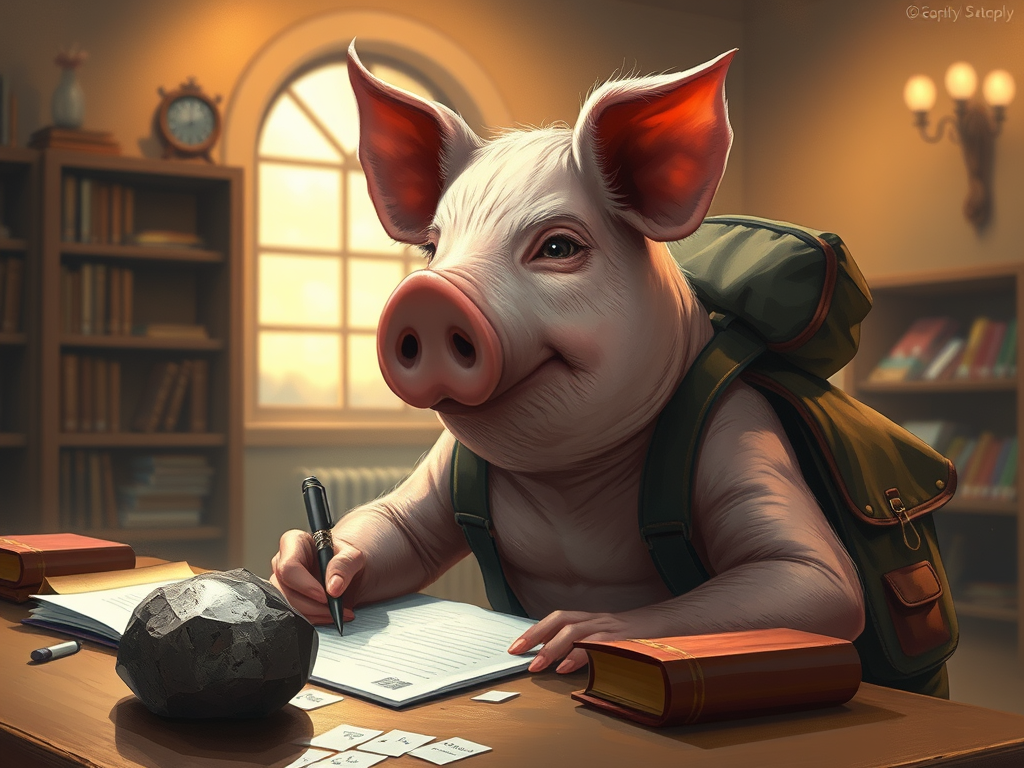
    The Weight: Imagine the essay is a 5kg rock in a backpack.


    The Conflict:Max (The Procrastinator) says, “Friday is far away!” He puts the rock in his backpack. He carries it all week.


    Tuesday: He plays games, but the rock is on his back (worry).


    Wednesday: He goes to a party, but the rock feels heavier.


    Thursday Night:
    The rock is now 50kg. He is sweating. He is stressed. He hates his life.


    Penny (The Doer) says, “I hate carrying rocks.”


    Monday Night: She sits down, writes the essay, and submits it. She takes the rock out of her backpack.


    Tuesday – Friday: Penny walks around light as a feather. She plays games with zero guilt.


    The Moral: Procrastination doesn’t make the work go away; it just makes the work heavier. Be like Penny. Drop the rock. πŸŽ’

    πŸŽ“ Lesson for English Learners


    Don’t wait for “Perfect.”


    Situation:
    You want to speak English, but you say, “I will start speaking when my grammar is perfect.” You Say: “That is procrastination disguised as perfectionism. Don’t put off until tomorrow what you can do today. Speak now. Make mistakes now. Learn now.”


    Situation: You have a vocabulary list to memorize. You Say: “If I learn 5 words today, that is 150 words a month. If I wait until I have ‘time’ to learn 50 at once, I will quit. Do it today.”


    πŸ’¬ Your Turn: The 2-Minute Rule πŸš€


    The “Tomorrow” trap is easy to fall into. Here is how to escape.


    The Challenge:
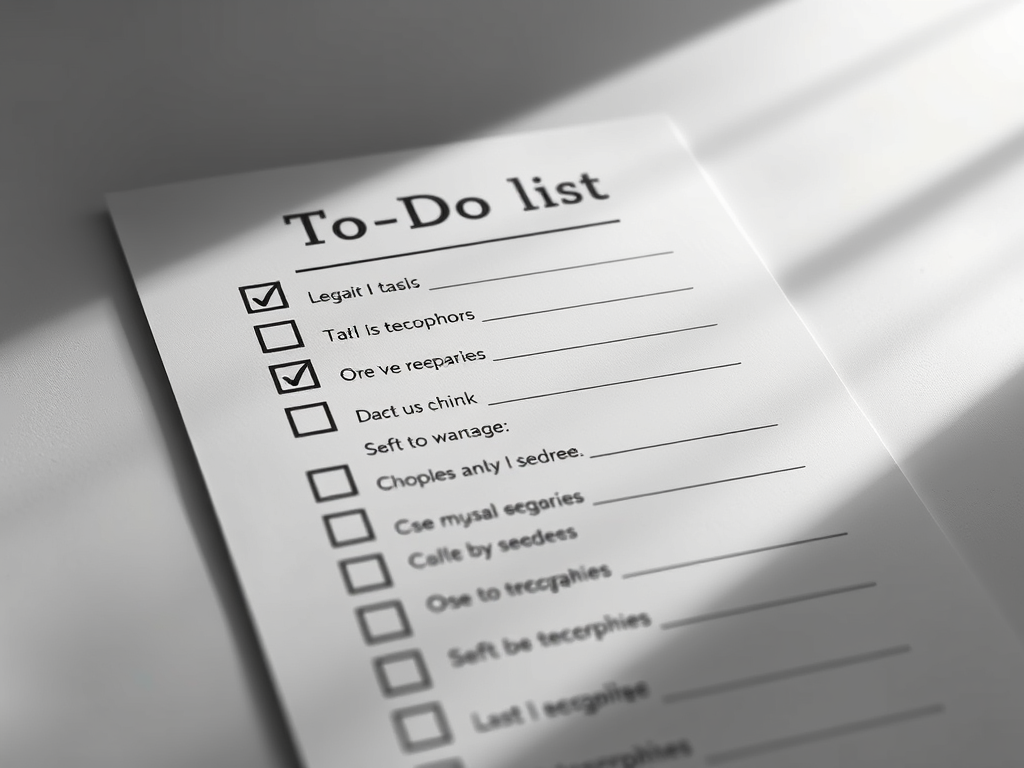
    Look at your To-Do list. Find one task that takes less than 2 minutes to do.


    Sending that email?


    Washing that one dish?


    Booking that appointment?


    The Action:
    DO IT RIGHT NOW. Before you finish reading this sentence. (Did you do it? Good. That is the power of Today.)


    Question: What is the one thing you have been “putting off” for weeks? Tell us in the comments! πŸ‘‡

    By Zubeyir YURTKURAN

    https://www.facebook.com/BrainBattleground/

    https://www.facebook.com/zubeyr.yurtkuran/

    https://www.instagram.com/zubeyryurtkuran/

    https://www.youtube.com/@BrainBattleground-b3p

  • πŸŒ… The Early Bird Catches the Worm: Why the Snooze Button is the Enemy of Success

    πŸŒ… The Early Bird Catches the Worm: Why the Snooze Button is the Enemy of Success

    🚫 Can You Build an Empire While You Sleep?


    πŸ›Œ The Short Cut: Hitting the “Snooze” button 5 times because “5 more minutes” feels like heaven.

    πŸ“‰ The Reality: You rush, spill coffee on your shirt, miss the bus, and start the day stressed and behind schedule.

    πŸ“± The Short Cut: Waiting for the “perfect time” or “New Year’s Day” to start studying English.

    πŸ“‰ The Reality: By the time you start, the job interview was yesterday. The position is filled by someone who started last month.


    Life has a simple timing algorithm: First come, first served. In this post, we explore why timing is everything. Wake up, grab your coffee; the opportunity bus is leaving! 🚌

    🧐 The Anatomy of the Proverb


    Let’s dissect this classic idiom to understand its mechanics.


    πŸ“š Vocabulary Vault


    Early (Adjective):
    Happening before the usual or expected time. (Being ahead of the crowd). ⏰


    Catch (Verb): To capture, seize, or grab something. 🀲


    Worm (Noun): A small animal. Metaphorically: The prize, the opportunity, the job, or the reward. πŸͺ±


    🧠 Grammar Focus


    This is a perfect example of the Present Simple Tense representing a “General Truth.”


    Subject:
    The early bird (The proactive person)


    Verb: Catches (The action/result)


    Object: The worm (The reward)


    Formula: [Subject] + [Verb + s] + [Object]. Note: Because “The bird” is singular (It), we add -es to the verb catch (Catches).

    πŸ“œ History: A 17th Century Wake-Up Call


    Who told us to wake up so early?


    The Origin:
    This phrase first appeared in a collection of proverbs by John Ray in 1670.


    The Logic: Before supermarkets, birds literally had to wake up at dawn to find worms coming out of the damp morning soil. If a bird slept until noon, the worms were gone (hiding underground from the sun).


    The Lesson: Opportunities are limited resources. They don’t wait for you to finish your breakfast.

    🎯 Impact on Life: The Pros & Cons


    Is waking up at 5:00 AM the only way to succeed?


    βœ… The Pros (Why it works)


    Zero Distractions:
    At 6:00 AM, nobody is texting you. Instagram is quiet. It is just you and your goals. Focus is at 100%. πŸ§˜β€β™‚οΈ


    Proactivity: You act before problems arise. You control the day; the day doesn’t control you.


    The “First Choice” Privilege:
    The first person at the buffet gets the freshest food. The first applicant often gets the interview.


    ❌ The Cons (What to watch out for)


    The Night Owl Dilemma:
    Some people are genetically wired to be creative at night. If you force yourself to wake up early but are exhausted, you lose quality.


    Social Lag: If you wake up at 4 AM, you might be sleepy by 8 PM when your friends want to hang out.

    🎭 Short Story: The Great Garden Breakfast


    Let’s return to our farm friends to see this proverb in action.


    🌟 Character Introduction


    Percy the Chicken (The Snoozer):
    Loves his warm bed and dreams of corn. πŸ”


    Fred the Frog (The Early Riser): Alert, hungry, and disciplined. 🐸


    Luna the Cat (The Observer): Watches from the roof. 😼


    It was a rainy Tuesday morning. The soil was wet perfect conditions for finding juicy worms!


    5:30 AM: The sun began to rise. Fred the Frog opened his eyes immediately. “Rainy night means breakfast delight!” he croaked. He hopped out to the garden while the rest of the farm was snoring. He found the biggest, juiciest worm right in the middle of the path. “Delicious!” Fred said, enjoying his feast in the quiet morning mist. πŸ˜‹


    9:00 AM: Percy the Chicken’s alarm went off… for the third time. Percy stretched, yawned, and slowly walked out to the garden. “Okay world, I am ready for my breakfast!” he announced. He looked at the ground. Nothing. He scratched the dirt. Nothing. The sun was high now, and the ground was dry. All the worms had gone back underground.


    Luna looked down from the roof and laughed: “Percy, you have great feathers, but an empty stomach. Fred got the worm because he didn’t negotiate with his alarm clock.”


    The Moral:


    Percy:
    Slept late = Leftovers (or hunger).


    Fred: Woke up early = The Grand Prize.

    πŸŽ“ Lesson for English Learners


    How does this apply to learning a language?


    The “Worm” is Fluency.


    The “Early Bird” is Preparation.


    Review Before Class: If you learn the vocabulary before the lesson starts (Early Bird), you can use the lesson to practice speaking (Catching the Worm). If you wait for the teacher to explain everything, you waste time.


    Morning Brain: Research shows that reviewing notes for 15 minutes in the morning is more effective than 1 hour when you are tired at night.


    Don’t Wait for “Someday”: “I will learn English when I have time” is the biggest lie. The time is now.


    Remember: You don’t have to be a genius to learn English; you just have to start before everyone else quits.


    πŸ’¬ Your Turn


    Are you a Morning Person (Early Bird) β˜€οΈ or a Night Owl πŸ¦‰? Do you believe getting up early is the key to success, or can you catch the worm at midnight?


    Tell us your routine in the comments! πŸ‘‡

    By Zubeyir YURTKURAN

    https://www.facebook.com/BrainBattleground/

    https://www.facebook.com/zubeyr.yurtkuran/

    https://www.instagram.com/zubeyryurtkuran/

  • Why You Shouldn’t Trust Your Eyes: A Lesson on Glitter and Gold

    Why You Shouldn’t Trust Your Eyes: A Lesson on Glitter and Gold

    Shakespeare, Chickens, and Fake Gold: The Truth About “All That Glitters”

    We have all been there.
    πŸ” A job offer that looks perfect on paper but turns out to be a nightmare.

    🎁 A beautifully packaged meal that tastes like cardboard.

    😎 A person who looks incredibly cool on Instagram but has zero personality in real life.


    Life has a way of teaching us this lesson over and over again: “All that glitters is not gold.”
    In this post, we are putting one of the most popular and historically rich English proverbs under the microscope. Grab your coffee, and let’s dive in! β˜•

    The Anatomy of the Proverb


    Let’s break this sentence down like a linguist.
    πŸ“š Vocabulary Vault
    Glitter (Verb):
    To shine with a bright, shimmering, reflected light (think of a disco ball or a diamond). ✨


    Gold (Noun): A precious yellow metal. In this context, it represents anything that is “genuine,” “valuable,” or “real.” πŸ†

    🧠 Grammar Focus
    Here is the secret formula of the sentence:
    All (Subject) + [that glitters] (Relative Clause) + is (Verb) + not gold (Object/Complement).
    The Relative Clause: The phrase “that glitters” defines the subject “All.” We aren’t talking about everything in the world, just the things that shine.
    Subject-Verb Agreement: Watch out! In this proverb, “All” acts as a singular concept (everything). That’s why we say “glitters” (with an -s) and “is” (not are).

    History: Aesop or Shakespeare?


    The roots of this saying go deeper than you might think. It’s a battle between Ancient Greece and Renaissance England!


    πŸ›οΈ Ancient Roots: As far back as the 6th Century B.C., the Greek storyteller Aesop explored the idea that “not everything that looks good is actually good” in his fables.


    🎭 The Shakespeare Touch: The proverb became a celebrity thanks to William Shakespeare. In his play The Merchant of Venice (1596), a character chooses a gold casket hoping to win a prize, only to find a scroll inside that reads: “All that glisters is not gold.”


    Fun Fact: Shakespeare used the old word “glisters.” Over centuries, language evolved, and by the 19th century, we switched to the modern word “glitters.”

    Impact on Life: The Pros & Cons


    Should you adopt this proverb as your life philosophy? Let’s weigh the options.


    βœ… The Pros (Why it helps)
    Critical Thinking:
    It encourages you not to trust first impressions blindly. It pushes you to look beneath the surface.


    Protection: Whether it’s a scam product or a “too good to be true” promise, this proverb acts as a shield against deception. πŸ›‘οΈ


    ❌ The Cons (Why it can be tricky)
    Cynicism:
    If you take it too far, you might become overly suspicious of everyone, unable to trust sincere people.


    Missing the Beauty:
    Sometimes, things are just beautiful because they glitter, and that is enough. Constantly looking for a “flaw” might make you miss the joy of the moment.

    Short Story: The Shiny Pebble


    To understand this better, let’s visit our friends on the farm.
    It was a bright, sunny morning. Percy the Chicken, Luna the Cat, and Fred the Frog were relaxing near the farm pond. β˜€οΈ


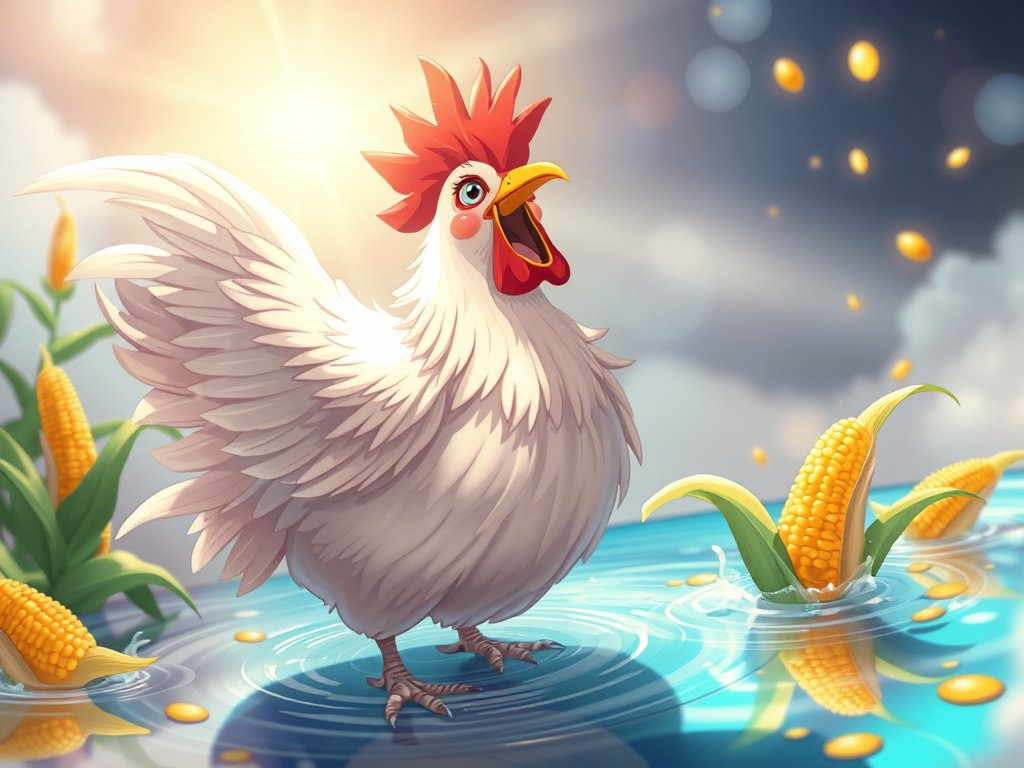
    Suddenly, Percy froze. He saw something shining at the bottom of the shallow water. It was bright, sparkly, and yellow.


    “Look!” clucked Percy, his feathers puffing up with excitement. “A piece of the sun has fallen into the water! It must be magic gold corn. I will eat it and become the King of Chickens!” πŸ‘‘


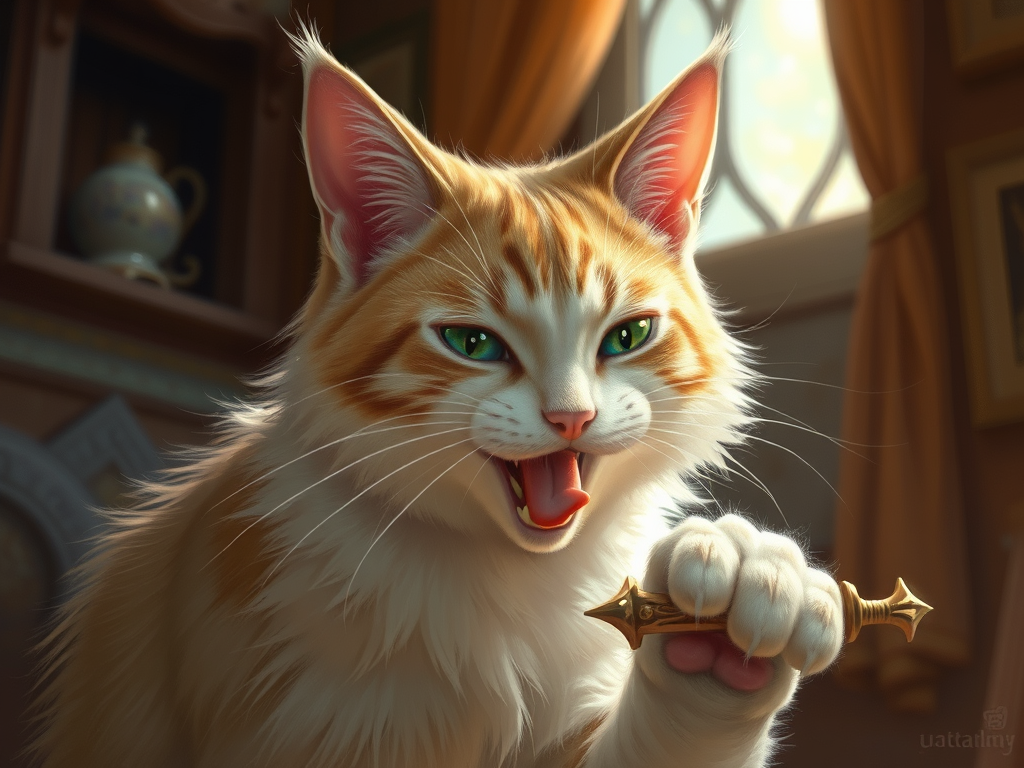
    Luna the Cat yawned lazily and licked her paw. She looked at the shiny object with narrowed, skeptical eyes. “I wouldn’t do that if I were you, Percy,” she purred. “It looks sharp. Not everything that shines is food.” 🐱


    “You are just jealous because you didn’t find it first!” shouted Percy. He prepared to jump into the water to peck the treasure.


    Just then, Fred the Frog hopped onto a lily pad right next to the object. He looked at it closely, blinked his big eyes, and laughed. “Croak! Percy, stop!” 🐸


    “Move away, Fred! That is my gold!” Percy insisted, flapping his wings.


    Fred stuck out his long, sticky tongue and flipped the object over. It wasn’t gold. It wasn’t magic corn. It was just a jagged, sharp piece of a broken yellow soda bottle.


    “The sun makes it shine,” said Fred wisely, “but underneath, it is just dangerous trash.”


    Percy stopped in his tracks. He realized he had almost cut his beak on a piece of glass. He looked at his friends, lowered his head, and sighed.
    “I guess all that glitters is not gold,” Percy admitted.

    In this story, the characters represent different mindsets:


    Percy:
    Naivety and Greed 😡
    Luna: Skepticism 🧐
    Fred: Experience and Truth πŸ€“


    Lesson for English Learners: When learning a language, fancy words (glitter) are nice, but knowing how to use simple words correctly (gold) is often much more valuable.


    πŸ’¬ What about you? Have you ever experienced a moment where “all that glitters was not gold”? Tell me in the comments!

    By Zubeyir YURTKURAN

    https://www.facebook.com/BrainBattleground/

    https://www.facebook.com/zubeyr.yurtkuran/

    https://www.instagram.com/zubeyryurtkuran/